

Microsoft published CVE-2026-42911 on June 9, 2026, as an Important-rated elevation-of-privilege flaw in the Windows Ancillary Function Driver for WinSock, affecting supported Windows client and server releases and carrying a CVSS 3.1 base score of 7.0. The dry label hides the real point: this is not a remote break-in bug, but it is exactly the kind of kernel-adjacent weakness attackers like to pair with something else. In a Patch Tuesday with more spectacular remote-code-execution headlines, AFD.sys still deserves attention because privilege escalation is how intrusions become durable. The confidence metric matters because Microsoft is not describing a rumor; it is acknowledging a concrete, patched vulnerability class in a core networking driver.
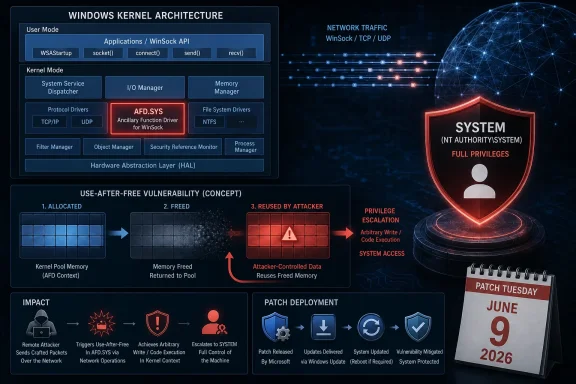
CVE-2026-42911 is described as a use-after-free vulnerability in the Windows Ancillary Function Driver for WinSock that allows an authorized attacker to elevate privileges locally. In plain English, the bug is in a kernel-mode component that helps Windows applications talk to the networking stack, and exploitation requires the attacker already to have some local execution capability.
That limitation should not lull administrators into treating the issue as academic. Modern Windows compromises are rarely a single cinematic exploit; they are chains. A phishing payload, a malicious document, a vulnerable service account, or a low-privilege foothold gets the attacker onto the machine, and a local elevation-of-privilege bug turns that foothold into administrator or SYSTEM-level leverage.
The CVSS vector tells the same story. The attack vector is local, privileges are required, user interaction is not, scope is unchanged, attack complexity is high, and the potential impact across confidentiality, integrity, and availability is high. The score lands at 7.0 not because the outcome is mild, but because the path to that outcome is constrained.
That distinction matters for patch prioritization. A local privilege escalation does not usually sit above a wormable TCP/IP remote-code-execution flaw in the emergency queue. But once the perimeter has failed, these bugs decide whether the attacker stays boxed in or owns the host.
For CVE-2026-42911, the important practical reading is that Microsoft has published the advisory and shipped fixes. That does not mean every exploit detail is public. It does mean defenders are not dealing with a speculative weakness inferred from a crash log or a half-verified research note.
This is where the difference between confirmed vulnerability and public exploit becomes operationally important. A confirmed bug can be quietly reverse-engineered from the patch even when Microsoft says there is no known exploitation and no public disclosure at release. Attackers do not need a blog post to begin diffing binaries.
The confidence metric also hints at asymmetric knowledge. Microsoft and the reporting parties may understand the root cause and the patch, while defenders see only a compact public summary. That is normal for kernel bugs, but it means the absence of details should not be interpreted as absence of risk.
Use-after-free bugs are particularly uncomfortable in that terrain. They happen when software continues to use memory after it has already been released, creating the possibility that an attacker can influence what occupies that memory next. In kernel space, that kind of memory-safety failure can become much more than a crash.
Microsoft’s classification of CVE-2026-42911 under the use-after-free weakness family is therefore significant even without exploit code. The phrase tells security teams enough to understand the rough shape of the flaw: lifetime management went wrong, and the object being mishandled lived in a privileged part of the OS.
That does not make exploitation automatic. The high attack complexity rating is a real caveat, and kernel heap shaping on modern Windows is not a trivial exercise. But high complexity often means “harder for commodity criminals today,” not “irrelevant to well-resourced attackers tomorrow.”
That is the wrong lesson. Patch Tuesday triage has to separate urgency from consequence, not simply sort by score. Remote unauthenticated bugs often deserve first deployment pressure, but local privilege escalation bugs are the glue that makes many real intrusions work.
CVE-2026-42911 was one of several June 2026 AFD.sys elevation-of-privilege entries. That clustering is itself notable. Whether it reflects a focused audit, multiple related reports, or a broader hardening pass, it tells administrators that Microsoft has been touching an area of the networking stack where memory-safety defects keep surfacing.
The patching question is therefore not whether this single CVE is the scariest item in the June bundle. It is whether your organization can afford to leave a known kernel privilege-escalation path open while attackers analyze the same update payload you are deferring.
But “not known exploited” is a narrow phrase. It does not mean “not exploitable,” and it does not mean “will not be exploited.” It means Microsoft was not publicly reporting observed exploitation when the advisory shipped.
For desktop fleets, the immediate risk is usually downstream of initial access. Malware running as a standard user, a compromised helpdesk tool, a browser escape that lands with limited rights, or a malicious insider with a low-privilege account all become more dangerous when a kernel elevation path exists.
For servers, the risk depends on what kinds of users and services can execute code locally. Multi-user hosts, Remote Desktop Session Host deployments, developer jump boxes, build systems, and servers running third-party agents are more exposed to local privilege escalation than a tightly locked single-purpose appliance.
The safest posture is not panic. It is to recognize that this is a second-stage bug with first-class consequences.
The practical consequence is that this is not a niche product patch. It is a baseline Windows maintenance item. Workstations, VDI images, development machines, domain-joined laptops, and server fleets all deserve attention.
Organizations using Windows Server Core should not assume reduced graphical surface area removes the risk. AFD.sys is tied to networking functionality, not to the desktop shell. Server Core may reduce some attack paths, but it does not make kernel networking components vanish.
This is also the kind of CVE that tests inventory quality. If your vulnerability management tooling can tell you which systems are missing the June cumulative update but cannot distinguish critical servers from disposable lab machines, the result will be either overreaction or drift. Neither is ideal.
For defenders, the question is who has the motivation to do the hard work. Commodity malware operators may ignore a fiddly local kernel bug if easier privilege-escalation paths exist. Targeted operators, exploit brokers, and ransomware crews that already invest in Windows internals may treat the same bug as worthwhile.
The public description does not provide proof-of-concept details, and that is by design. But the fix itself becomes a map. Patch diffing has long been part of vulnerability research, and widely distributed Windows updates give both defenders and attackers a before-and-after view of changed code.
This is why patch latency matters even when no exploit is public on day one. The risk curve can steepen after release, not before it. Every week of delay gives researchers more time to understand the patch and weaponize the underlying flaw.
The more interesting administrative work is prioritization. Start with exposed or high-value machines that commonly run arbitrary code: user workstations, RDS hosts, developer endpoints, security tooling boxes, and systems used by administrators. Then move through servers according to business criticality and maintenance windows.
Security teams should also watch for exploit development chatter, but they should not wait for it. If a public exploit appears later, the deployment conversation changes from routine maintenance to incident-prevention sprint. The advantage of acting now is that the patch can still be treated as planned hygiene.
There is also a lesson for least privilege. Local elevation-of-privilege bugs punish environments where too many users can log on to sensitive systems, where service accounts are overbroad, and where endpoint controls assume that standard-user compromise is a contained event. Standard user is a speed bump, not a wall.
That is why EoP vulnerabilities remain so valuable in Windows attack playbooks. They turn partial compromise into operational control. They also reduce the need for stolen administrator credentials at the earliest stage of an intrusion.
The bug’s location in AFD.sys adds another wrinkle. Networking components are widely loaded, heavily exercised, and difficult for administrators to remove from the equation. You cannot harden your way around the Windows networking stack in the same way you might uninstall an optional application.
This does not make every affected host equally risky. A kiosk with strict application control and no local user access is a different target from a developer workstation running unsigned tools all day. But the same patch closes the same class of privilege boundary failure on both.
Clusters can mean several things. They may indicate that a researcher or internal team examined a component deeply and found several independent flaws. They may also reflect related bug patterns discovered during patch development. Either way, they signal that AFD.sys is receiving scrutiny.
For administrators, clustered vulnerabilities change the psychological calculus. It is easier to defer one local privilege-escalation fix than to ignore a set of fixes in the same kernel driver. The latter begins to look less like a one-off and more like a component-level hardening event.
That matters because patch testing often focuses on obvious breakage: boot failures, application launch problems, VPN issues, printing, authentication, and line-of-business workflows. A networking driver update deserves testing with network-heavy applications, endpoint security agents, VPN clients, EDR sensors, and high-throughput server roles.
There are good reasons for restraint. More detail can accelerate exploit development, especially for memory-corruption bugs in kernel components. But sparse disclosure also pushes administrators to make risk decisions from metadata rather than narrative.
That is why the confidence metric matters so much here. When the vendor confirms the bug and ships a fix, the lack of technical elaboration is not a reason to downgrade the issue. It is a reason to treat the advisory metadata carefully.
The right editorial reading is simple: Microsoft is not telling you how to exploit AFD.sys, but it is telling you enough to patch it. In a month with hundreds of CVEs, that may be the most operationally useful sentence available.
That second lane is where many organizations struggle. Emergency patching gets executive attention. Routine monthly patching gets process. But bugs like this sit in the middle, where the severity is real and the business pressure is lower.
A mature Windows patch program should be able to say, without drama, that this CVE will be remediated across workstations quickly, across high-risk servers after validation, and across the rest of the estate within the standard cumulative-update window. If that sentence cannot be said confidently, the problem is larger than AFD.sys.
The other half of the response is detection. Endpoint telemetry should be watched for suspicious local privilege-escalation behavior, unexpected driver interaction, crashes involving AFD.sys, and post-compromise behaviors such as credential dumping or security tool tampering. Patching closes the known hole; monitoring catches the chains that found another one.
 A Local Bug in a Place Attackers Already Understand
CVE-2026-42911 is described as a use-after-free vulnerability in the Windows Ancillary Function Driver for WinSock that allows an authorized attacker to elevate privileges locally. In plain English, the bug is in a kernel-mode component that helps Windows applications talk to the networking stack, and exploitation requires the attacker already to have some local execution capability.That limitation should not lull administrators into treating the issue as academic. Modern Windows compromises are rarely a single cinematic exploit; they are chains. A phishing payload, a malicious document, a vulnerable service account, or a low-privilege foothold gets the attacker onto the machine, and a local elevation-of-privilege bug turns that foothold into administrator or SYSTEM-level leverage.
The CVSS vector tells the same story. The attack vector is local, privileges are required, user interaction is not, scope is unchanged, attack complexity is high, and the potential impact across confidentiality, integrity, and availability is high. The score lands at 7.0 not because the outcome is mild, but because the path to that outcome is constrained.
That distinction matters for patch prioritization. A local privilege escalation does not usually sit above a wormable TCP/IP remote-code-execution flaw in the emergency queue. But once the perimeter has failed, these bugs decide whether the attacker stays boxed in or owns the host.
Report Confidence Is the Quiet Signal in the Advisory
The user-facing phrase about “degree of confidence” is easy to mistake for boilerplate, but it is one of the more useful pieces of metadata in a vulnerability entry. In CVSS terms, report confidence is a temporal metric that tries to answer whether the vulnerability is merely alleged, reasonably corroborated, or confirmed.For CVE-2026-42911, the important practical reading is that Microsoft has published the advisory and shipped fixes. That does not mean every exploit detail is public. It does mean defenders are not dealing with a speculative weakness inferred from a crash log or a half-verified research note.
This is where the difference between confirmed vulnerability and public exploit becomes operationally important. A confirmed bug can be quietly reverse-engineered from the patch even when Microsoft says there is no known exploitation and no public disclosure at release. Attackers do not need a blog post to begin diffing binaries.
The confidence metric also hints at asymmetric knowledge. Microsoft and the reporting parties may understand the root cause and the patch, while defenders see only a compact public summary. That is normal for kernel bugs, but it means the absence of details should not be interpreted as absence of risk.
AFD.sys Remains a High-Value Neighborhood
AFD.sys is not a glamorous Windows component, but it is a familiar one to people who study privilege escalation. The Ancillary Function Driver for WinSock sits close to the boundary where user-mode networking requests meet kernel-mode implementation. That makes it both widely present and security-sensitive.Use-after-free bugs are particularly uncomfortable in that terrain. They happen when software continues to use memory after it has already been released, creating the possibility that an attacker can influence what occupies that memory next. In kernel space, that kind of memory-safety failure can become much more than a crash.
Microsoft’s classification of CVE-2026-42911 under the use-after-free weakness family is therefore significant even without exploit code. The phrase tells security teams enough to understand the rough shape of the flaw: lifetime management went wrong, and the object being mishandled lived in a privileged part of the OS.
That does not make exploitation automatic. The high attack complexity rating is a real caveat, and kernel heap shaping on modern Windows is not a trivial exercise. But high complexity often means “harder for commodity criminals today,” not “irrelevant to well-resourced attackers tomorrow.”
Patch Tuesday’s Noise Makes This Bug Easier to Miss
June 2026’s Microsoft security release was unusually crowded, with reporting from the Zero Day Initiative counting more than 200 Microsoft CVEs and calling it the largest Patch Tuesday release in its tracking period. In that kind of flood, a 7.0 Important local elevation-of-privilege bug can disappear beneath the remote-code-execution fireworks.That is the wrong lesson. Patch Tuesday triage has to separate urgency from consequence, not simply sort by score. Remote unauthenticated bugs often deserve first deployment pressure, but local privilege escalation bugs are the glue that makes many real intrusions work.
CVE-2026-42911 was one of several June 2026 AFD.sys elevation-of-privilege entries. That clustering is itself notable. Whether it reflects a focused audit, multiple related reports, or a broader hardening pass, it tells administrators that Microsoft has been touching an area of the networking stack where memory-safety defects keep surfacing.
The patching question is therefore not whether this single CVE is the scariest item in the June bundle. It is whether your organization can afford to leave a known kernel privilege-escalation path open while attackers analyze the same update payload you are deferring.
The Exploitation Status Is Comforting, Not Exculpatory
Public tracking placed CVE-2026-42911 in the “not publicly disclosed” and “not known exploited” bucket at release. That is good news. It means defenders are not starting from behind in the way they are when a vulnerability is already in active exploitation.But “not known exploited” is a narrow phrase. It does not mean “not exploitable,” and it does not mean “will not be exploited.” It means Microsoft was not publicly reporting observed exploitation when the advisory shipped.
For desktop fleets, the immediate risk is usually downstream of initial access. Malware running as a standard user, a compromised helpdesk tool, a browser escape that lands with limited rights, or a malicious insider with a low-privilege account all become more dangerous when a kernel elevation path exists.
For servers, the risk depends on what kinds of users and services can execute code locally. Multi-user hosts, Remote Desktop Session Host deployments, developer jump boxes, build systems, and servers running third-party agents are more exposed to local privilege escalation than a tightly locked single-purpose appliance.
The safest posture is not panic. It is to recognize that this is a second-stage bug with first-class consequences.
The Affected Footprint Reaches Across the Windows Estate
Available vulnerability trackers list affected Windows 10, Windows 11, and Windows Server releases, including older server branches and current Windows Server 2025 builds. That broad footprint is not surprising for a component as foundational as the WinSock ancillary driver.The practical consequence is that this is not a niche product patch. It is a baseline Windows maintenance item. Workstations, VDI images, development machines, domain-joined laptops, and server fleets all deserve attention.
Organizations using Windows Server Core should not assume reduced graphical surface area removes the risk. AFD.sys is tied to networking functionality, not to the desktop shell. Server Core may reduce some attack paths, but it does not make kernel networking components vanish.
This is also the kind of CVE that tests inventory quality. If your vulnerability management tooling can tell you which systems are missing the June cumulative update but cannot distinguish critical servers from disposable lab machines, the result will be either overreaction or drift. Neither is ideal.
High Complexity Is Not a Free Pass
Attack complexity is one of the most misunderstood parts of CVSS. A high-complexity exploit might require precise timing, memory layout manipulation, specific system state, or a sequence of operations that is hard to reproduce reliably. That lowers probability, but it does not eliminate impact.For defenders, the question is who has the motivation to do the hard work. Commodity malware operators may ignore a fiddly local kernel bug if easier privilege-escalation paths exist. Targeted operators, exploit brokers, and ransomware crews that already invest in Windows internals may treat the same bug as worthwhile.
The public description does not provide proof-of-concept details, and that is by design. But the fix itself becomes a map. Patch diffing has long been part of vulnerability research, and widely distributed Windows updates give both defenders and attackers a before-and-after view of changed code.
This is why patch latency matters even when no exploit is public on day one. The risk curve can steepen after release, not before it. Every week of delay gives researchers more time to understand the patch and weaponize the underlying flaw.
The Administrator’s Job Is Boring, Which Is the Point
For most WindowsForum readers, the recommended action is straightforward: deploy the June 2026 Windows security updates through your normal rings, with accelerated testing for systems where local code execution by untrusted users is plausible. There is no special registry mitigation or service disablement story here that should displace patching.The more interesting administrative work is prioritization. Start with exposed or high-value machines that commonly run arbitrary code: user workstations, RDS hosts, developer endpoints, security tooling boxes, and systems used by administrators. Then move through servers according to business criticality and maintenance windows.
Security teams should also watch for exploit development chatter, but they should not wait for it. If a public exploit appears later, the deployment conversation changes from routine maintenance to incident-prevention sprint. The advantage of acting now is that the patch can still be treated as planned hygiene.
There is also a lesson for least privilege. Local elevation-of-privilege bugs punish environments where too many users can log on to sensitive systems, where service accounts are overbroad, and where endpoint controls assume that standard-user compromise is a contained event. Standard user is a speed bump, not a wall.
The Real Risk Is the Chain
CVE-2026-42911 is best understood as a chain component. By itself, it requires local access and low privileges. Paired with an initial-access vector, it can help an attacker reach the level needed to disable defenses, dump credentials, install persistence, or pivot laterally.That is why EoP vulnerabilities remain so valuable in Windows attack playbooks. They turn partial compromise into operational control. They also reduce the need for stolen administrator credentials at the earliest stage of an intrusion.
The bug’s location in AFD.sys adds another wrinkle. Networking components are widely loaded, heavily exercised, and difficult for administrators to remove from the equation. You cannot harden your way around the Windows networking stack in the same way you might uninstall an optional application.
This does not make every affected host equally risky. A kiosk with strict application control and no local user access is a different target from a developer workstation running unsigned tools all day. But the same patch closes the same class of privilege boundary failure on both.
The June AFD.sys Cluster Should Shape the Patch Conversation
CVE-2026-42911 did not arrive alone. June’s release included multiple Windows Ancillary Function Driver for WinSock elevation-of-privilege vulnerabilities, most of them rated Important and clustered around similar scores. That pattern deserves more attention than any one entry’s short description.Clusters can mean several things. They may indicate that a researcher or internal team examined a component deeply and found several independent flaws. They may also reflect related bug patterns discovered during patch development. Either way, they signal that AFD.sys is receiving scrutiny.
For administrators, clustered vulnerabilities change the psychological calculus. It is easier to defer one local privilege-escalation fix than to ignore a set of fixes in the same kernel driver. The latter begins to look less like a one-off and more like a component-level hardening event.
That matters because patch testing often focuses on obvious breakage: boot failures, application launch problems, VPN issues, printing, authentication, and line-of-business workflows. A networking driver update deserves testing with network-heavy applications, endpoint security agents, VPN clients, EDR sensors, and high-throughput server roles.
Microsoft’s Sparse Disclosure Leaves Defenders Filling the Gaps
Microsoft’s public vulnerability write-ups have become increasingly terse, and CVE-2026-42911 fits that pattern. The advisory gives defenders the core facts: affected component, impact, weakness class, exploitability status, severity, and patched builds. It does not explain the vulnerable code path or the exact preconditions.There are good reasons for restraint. More detail can accelerate exploit development, especially for memory-corruption bugs in kernel components. But sparse disclosure also pushes administrators to make risk decisions from metadata rather than narrative.
That is why the confidence metric matters so much here. When the vendor confirms the bug and ships a fix, the lack of technical elaboration is not a reason to downgrade the issue. It is a reason to treat the advisory metadata carefully.
The right editorial reading is simple: Microsoft is not telling you how to exploit AFD.sys, but it is telling you enough to patch it. In a month with hundreds of CVEs, that may be the most operationally useful sentence available.
The Patch Queue Needs a Second Lane
Security teams often maintain an emergency lane for exploited zero-days and critical remote-code-execution vulnerabilities. CVE-2026-42911 probably does not belong in that lane for most organizations. It belongs in the second lane: broad, prompt deployment for vulnerabilities that materially improve an attacker’s position after initial access.That second lane is where many organizations struggle. Emergency patching gets executive attention. Routine monthly patching gets process. But bugs like this sit in the middle, where the severity is real and the business pressure is lower.
A mature Windows patch program should be able to say, without drama, that this CVE will be remediated across workstations quickly, across high-risk servers after validation, and across the rest of the estate within the standard cumulative-update window. If that sentence cannot be said confidently, the problem is larger than AFD.sys.
The other half of the response is detection. Endpoint telemetry should be watched for suspicious local privilege-escalation behavior, unexpected driver interaction, crashes involving AFD.sys, and post-compromise behaviors such as credential dumping or security tool tampering. Patching closes the known hole; monitoring catches the chains that found another one.
The AFD.sys Fix Belongs Near the Front of the Workstation Queue
The practical read on CVE-2026-42911 is neither “drop everything” nor “ignore until next quarter.” It is a confirmed Windows kernel-adjacent privilege-escalation bug in a broadly deployed networking driver, with no known exploitation at release but meaningful post-compromise value.- CVE-2026-42911 was published on June 9, 2026, as an Important Windows Ancillary Function Driver for WinSock elevation-of-privilege vulnerability.
- The flaw is described as a use-after-free issue that requires local access and low privileges, with no user interaction required.
- The CVSS 3.1 base score is 7.0, reflecting high potential impact but a constrained and higher-complexity exploitation path.
- Microsoft and third-party trackers listed the issue as not publicly disclosed and not known exploited at release.
- The most exposed systems are workstations, RDS hosts, developer machines, jump boxes, and any Windows servers where untrusted or semi-trusted users can execute code.
- The correct response is prompt cumulative-update deployment, not improvised mitigation or waiting for proof-of-concept code.
References
- Primary source: MSRC
Published: 2026-06-09T07:00:00-07:00
Security Update Guide - Microsoft Security Response Center
 msrc.microsoft.com
- Related coverage: thewindowsupdate.com
- Related coverage: bleepingcomputer.com
- Related coverage: nccgroup.com
- Related coverage: absolute.com
- Related coverage: mindray.com

- Related coverage: ws.buildingsbt.stage.honeywell.com
