

CVE-2026-43299 is a newly published Linux kernel Btrfs vulnerability, disclosed through kernel.org and surfaced in NVD and Microsoft’s Security Update Guide on May 8, 2026, involving a crash when Btrfs flips a filesystem read-only during pending read-repair work. The flaw is not a flashy remote-code-execution story, and that is exactly why it matters. It exposes a familiar weakness in modern storage stacks: the difference between a filesystem protecting data and a kernel surviving that protection path. For WindowsForum readers, the Microsoft angle is less about NTFS and more about the Linux systems now living inside Windows-adjacent infrastructure, from WSL-heavy developer workstations to Azure-hosted Linux fleets and appliance-like storage nodes.
The short version of CVE-2026-43299 sounds almost mundane. Btrfs encounters an ENOSPC condition in a critical path, aborts the current transaction, and marks the filesystem read-only. That behavior is intentional: when a copy-on-write filesystem can no longer safely complete metadata work, the conservative move is to stop writing rather than make damage worse.
The bug appears in what happens next. If read repair is already pending, Btrfs can enter
That distinction matters. A filesystem turning read-only is an outage, but it is a controlled outage. A kernel BUG is a much uglier failure mode, because the storage stack’s attempt to contain corruption or exhaustion can become a system-level crash.
This is the kind of vulnerability that will not dominate executive dashboards. There is no obvious network exploit chain, no “wormable” adjective, no authentication bypass. But in storage engineering, boring edge cases are often where the sharpest operational pain lives.
That lack of a score should not be mistaken for lack of importance. It means enrichment has not caught up with the kernel record. Administrators still have to decide whether the affected path matters in their environment before a neat severity number appears in vulnerability management tooling.
The reported trace is specific: Btrfs balance activity, metadata RAID1, ENOSPC errors, a transaction abort, a read-only filesystem state, and then an assertion failure in
For many organizations, that is enough. A storage node, build server, container host, or developer workstation that can be forced or nudged into a kernel crash by filesystem state is not merely “unstable.” It is a denial-of-service risk.
But richer filesystem behavior means richer failure states. Copy-on-write metadata, delayed allocation, balance operations, read repair, mirrored metadata, and space reservation all interact. ENOSPC in Btrfs has long been more subtle than “the disk is full,” because metadata allocation can fail even when a human reading
CVE-2026-43299 sits exactly in that uncomfortable zone. The root ENOSPC condition described in the kernel text is not fully resolved by this fix. The fix addresses the second failure: after Btrfs has already gone read-only, pending read repair must not assume the filesystem is still writable.
That is a narrow code change with a broad lesson. Storage code cannot treat “this should not happen” as a safe assertion when the path is already recovering from a serious error. In production, the state machine always finds the state the developer thought was impossible.
The assertion in
That sounds almost embarrassingly simple, but it is exactly the kind of fix mature infrastructure needs. Assertions are useful for catching impossible states during development. In kernel recovery paths, they can become an operational hazard if the “impossible” state is merely rare.
The better behavior is not heroic repair at all costs. The better behavior is to fail predictably, leave the filesystem read-only, and let administrators recover deliberately. Availability engineering is often about choosing the least destructive failure.
That does not mean your NTFS volume on Windows 11 is suddenly affected by Btrfs. It does mean Microsoft’s security ecosystem now has to account for Linux in ways that would have seemed strange in the Windows Vista era. Azure runs Linux at enormous scale. Developers run Linux under WSL. Enterprises manage mixed Windows and Linux estates through the same vulnerability scanners, patch SLAs, and compliance dashboards.
For WindowsForum readers, the practical question is not “does this attack Windows?” It is “where does Linux storage sit inside my Windows-centered operational reality?” The answer may include Hyper-V guests, Azure VMs, Kubernetes nodes, backup appliances, developer laptops, CI runners, or lab machines using Btrfs snapshots for fast rollback.
Microsoft surfacing the CVE is therefore not noise. It is another small sign that the boundary between “Windows security” and “Linux kernel security” has become administrative fiction.
But WSL has a way of blurring lines. Developers attach disks, mount filesystems, run privileged containers, experiment with custom kernels, and use Linux storage features because the boundary is convenient until it is not. Advanced users who bring Btrfs into that environment should treat this like any other kernel storage fix: know your kernel version, know your mount topology, and do not assume Windows Update alone covers every Linux component you have introduced.
The same logic applies to Docker Desktop and local Kubernetes labs. The vulnerability is not a Windows filesystem bug, but modern Windows development machines often host enough Linux machinery that “not Windows” no longer means “not my problem.”
A malicious local user may not need a classic privilege escalation if they can reliably trigger storage exhaustion patterns and crash the host. Whether CVE-2026-43299 is practically exploitable in that way depends on configuration, quotas, workload, and kernel version. But availability bugs in shared systems deserve more respect than they often receive.
Multi-tenant Linux machines, CI systems, shell servers, university lab boxes, and developer jump hosts are especially awkward. Users who cannot become root may still be able to create pathological filesystem pressure if quotas, project limits, or container storage isolation are weak. A kernel BUG in response to an edge-case storage state is therefore not just a filesystem curiosity.
The safest framing is conservative: this is not a remote apocalypse, but it is a kernel crash path in a complex filesystem. If Btrfs is part of a service boundary, patch planning should not wait for a marketing-friendly severity label.
Btrfs users have long learned that “no space left on device” can mean more than ordinary file data exhaustion. Metadata chunks, allocation profiles, balance state, snapshots, and reserved space can produce situations where the filesystem appears to have capacity but cannot make the specific allocation it needs. That is not unique to Btrfs in spirit, but Btrfs exposes the complexity more visibly.
CVE-2026-43299 does not fix that entire class of problems. It fixes the assertion after one of those problems has already pushed the filesystem read-only. In other words, it repairs the airbag deployment logic, not the road hazard.
That should temper both alarm and complacency. The bug is real, but the patch is not a magic wand for every Btrfs read-only incident. Administrators still need to watch metadata usage, avoid running volumes to the edge, and treat repeated ENOSPC or transid errors as serious health signals rather than routine annoyances.
This is not glamorous engineering. It is defensive programming in a hostile state space. Filesystems operate at the intersection of hardware errors, power failures, memory pressure, user mistakes, and workload spikes. The repair path must assume the floor is moving.
There is also a cultural point here. Kernel assertions are powerful tools, but in production code paths reachable through real workloads, they must be treated with suspicion. An assertion in a recovery path says, effectively, “if our model is wrong, take down the system.” For storage code, that is often too high a price.
The replacement return is more boring and more correct. Once the filesystem is read-only, the read repair should not proceed as if write repair remains available. It should step aside and let the larger failure state be handled without escalating into a kernel BUG.
Kernel security is often distributed through stable trees, vendor kernels, and distribution-specific backports. The relevant question for administrators is not simply whether a CVE page exists. It is whether their distribution kernel has taken the Btrfs fix corresponding to the upstream stable commits.
That means Ubuntu, Debian, Fedora, Arch, SUSE, Red Hat-family rebuilds, appliance vendors, NAS distributions, and cloud images may land the fix on different schedules. Some will backport the patch without changing the visible kernel version in a way casual users expect. Others may defer it until a broader kernel update.
For Windows-centered shops managing Linux through vulnerability scanners, this is where process often breaks. A scanner may flag a CVE against a kernel package, but the fix status depends on the vendor’s backport policy. Conversely, a scanner may lag while the package manager already contains the corrected code. The only reliable answer is the vendor advisory and package changelog for the kernel you actually run.
The worst habit in storage incidents is reaching immediately for destructive repair tools. Btrfs has powerful recovery options, but some are explicitly dangerous when used without diagnosis. A read-only mount can be a gift: it may provide a stable window to copy data off before more aggressive action is taken.
CVE-2026-43299 reinforces that mindset. The fixed behavior is to avoid crashing once the filesystem is already read-only. It does not say the filesystem is safe to write. It says the kernel should remain alive long enough for the administrator to make the next decision.
For home lab users, that next decision may be a snapshot rollback or restore. For enterprises, it may be failover, host evacuation, storage replacement, or opening a vendor case. Either way, the patched kernel buys stability during the failure, not immunity from the failure.
The danger is not that every Windows admin must become a Btrfs expert overnight. The danger is that organizations often have mature Windows patching processes and comparatively ad hoc Linux patching processes, even when Linux hosts are critical. Kernel storage bugs expose that imbalance sharply because they affect uptime, data safety, and recovery posture.
Microsoft’s presence in the disclosure chain adds a useful nudge. If a CVE appears in Microsoft’s guide but points to a Linux kernel component, the correct response is not confusion. It is inventory. Which Microsoft-adjacent products, Azure workloads, WSL environments, or third-party systems might be carrying that code?
That is the new normal. Security boundaries now follow dependencies, not brand names.
But proportion does not mean dismissal. Kernel crashes are serious when they affect shared systems or storage roles. Btrfs environments that rely on high availability, automated balancing, mirrored metadata, or snapshot-heavy workflows should treat this as a real reliability patch.
The absence of an NVD CVSS score at publication time should not freeze action. CVSS is useful, but it is not a substitute for knowing what your systems do. A low-profile denial-of-service flaw in the wrong storage layer can cost more than a high-scoring bug in a component you do not run.
The right reading is: patch when your vendor ships it, prioritize hosts using Btrfs for important workloads, and use the incident as a prompt to revisit space monitoring and recovery plans.
Source: NVD / Linux Kernel Security Update Guide - Microsoft Security Response Center
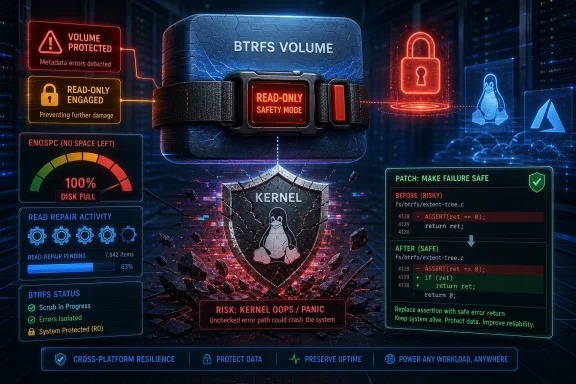 A Filesystem Tried to Save Itself, Then Tripped the Kernel
The short version of CVE-2026-43299 sounds almost mundane. Btrfs encounters an ENOSPC condition in a critical path, aborts the current transaction, and marks the filesystem read-only. That behavior is intentional: when a copy-on-write filesystem can no longer safely complete metadata work, the conservative move is to stop writing rather than make damage worse.The bug appears in what happens next. If read repair is already pending, Btrfs can enter
btrfs_repair_io_failure() after the superblock has been marked read-only. That function contained an assertion expecting the filesystem not to be mounted read-only, and when reality violated that assumption, the kernel hit a BUG rather than simply returning.That distinction matters. A filesystem turning read-only is an outage, but it is a controlled outage. A kernel BUG is a much uglier failure mode, because the storage stack’s attempt to contain corruption or exhaustion can become a system-level crash.
This is the kind of vulnerability that will not dominate executive dashboards. There is no obvious network exploit chain, no “wormable” adjective, no authentication bypass. But in storage engineering, boring edge cases are often where the sharpest operational pain lives.
The CVE Label Makes an Engineering Bug Operationally Visible
The Linux kernel CVE process has increasingly turned resolved kernel defects into CVE records, especially where a bug can crash the kernel or create denial-of-service conditions. CVE-2026-43299 follows that model. The NVD entry says the record has recently been published and, at the time of listing, NVD had not yet assigned CVSS scoring.That lack of a score should not be mistaken for lack of importance. It means enrichment has not caught up with the kernel record. Administrators still have to decide whether the affected path matters in their environment before a neat severity number appears in vulnerability management tooling.
The reported trace is specific: Btrfs balance activity, metadata RAID1, ENOSPC errors, a transaction abort, a read-only filesystem state, and then an assertion failure in
fs/btrfs/bio.c. That is not the profile of a mass internet bug. It is the profile of a reliability flaw that can become a security concern when availability is part of the system’s security model.For many organizations, that is enough. A storage node, build server, container host, or developer workstation that can be forced or nudged into a kernel crash by filesystem state is not merely “unstable.” It is a denial-of-service risk.
Btrfs’ Strength Is Also Why This Bug Is Uncomfortable
Btrfs is attractive because it tries to do more than older Linux filesystems. It brings checksumming, snapshots, send/receive, online balancing, transparent compression, and multi-device profiles into the filesystem itself. Those features are the reason it appears in desktop distributions, NAS-like setups, development machines, and backup workflows.But richer filesystem behavior means richer failure states. Copy-on-write metadata, delayed allocation, balance operations, read repair, mirrored metadata, and space reservation all interact. ENOSPC in Btrfs has long been more subtle than “the disk is full,” because metadata allocation can fail even when a human reading
df thinks space remains.CVE-2026-43299 sits exactly in that uncomfortable zone. The root ENOSPC condition described in the kernel text is not fully resolved by this fix. The fix addresses the second failure: after Btrfs has already gone read-only, pending read repair must not assume the filesystem is still writable.
That is a narrow code change with a broad lesson. Storage code cannot treat “this should not happen” as a safe assertion when the path is already recovering from a serious error. In production, the state machine always finds the state the developer thought was impossible.
Read-Only Is Supposed to Be the Seatbelt, Not the Crash
When Btrfs marks a filesystem read-only after a transaction abort, it is making a defensive decision. The filesystem is effectively saying: I cannot guarantee safe mutation from here, so I will preserve what I can and stop accepting writes. That can ruin a day, but it is better than silent corruption.The assertion in
btrfs_repair_io_failure() undermined that safety model. It converted a defensive transition into an opportunity for a kernel BUG if read repair happened to collide with the read-only flip. The patch replaces the assertion with a proper return when the filesystem is already read-only.That sounds almost embarrassingly simple, but it is exactly the kind of fix mature infrastructure needs. Assertions are useful for catching impossible states during development. In kernel recovery paths, they can become an operational hazard if the “impossible” state is merely rare.
The better behavior is not heroic repair at all costs. The better behavior is to fail predictably, leave the filesystem read-only, and let administrators recover deliberately. Availability engineering is often about choosing the least destructive failure.
The Microsoft Listing Is a Reminder That Linux Is Now Part of the Windows Estate
The user-visible source here is Microsoft’s Security Update Guide, which may seem odd for a Linux kernel Btrfs bug. But Microsoft has spent years expanding the Security Update Guide beyond traditional Windows-only bulletins, especially where open-source components intersect with Microsoft products, services, or customer environments.That does not mean your NTFS volume on Windows 11 is suddenly affected by Btrfs. It does mean Microsoft’s security ecosystem now has to account for Linux in ways that would have seemed strange in the Windows Vista era. Azure runs Linux at enormous scale. Developers run Linux under WSL. Enterprises manage mixed Windows and Linux estates through the same vulnerability scanners, patch SLAs, and compliance dashboards.
For WindowsForum readers, the practical question is not “does this attack Windows?” It is “where does Linux storage sit inside my Windows-centered operational reality?” The answer may include Hyper-V guests, Azure VMs, Kubernetes nodes, backup appliances, developer laptops, CI runners, or lab machines using Btrfs snapshots for fast rollback.
Microsoft surfacing the CVE is therefore not noise. It is another small sign that the boundary between “Windows security” and “Linux kernel security” has become administrative fiction.
WSL Users Should Not Panic, But They Should Understand the Boundary
Most WSL users will not be directly exposed to Btrfs inside WSL itself. WSL distributions typically live inside virtual disk files hosted by Windows filesystems, and the default user experience does not involve mounting Btrfs as the primary filesystem in the Linux guest. For the average developer using Ubuntu on WSL to run Git, Python, Node, Docker tooling, or shell scripts, CVE-2026-43299 is unlikely to be the urgent patch of the week.But WSL has a way of blurring lines. Developers attach disks, mount filesystems, run privileged containers, experiment with custom kernels, and use Linux storage features because the boundary is convenient until it is not. Advanced users who bring Btrfs into that environment should treat this like any other kernel storage fix: know your kernel version, know your mount topology, and do not assume Windows Update alone covers every Linux component you have introduced.
The same logic applies to Docker Desktop and local Kubernetes labs. The vulnerability is not a Windows filesystem bug, but modern Windows development machines often host enough Linux machinery that “not Windows” no longer means “not my problem.”
The Real Exposure Is in Servers That Treat Btrfs as Infrastructure
The more credible exposure lies in Linux systems where Btrfs is doing real storage work. That includes hosts using Btrfs for snapshots, balance operations, mirrored metadata, deduplicated or compressed workloads, and snapshot-based backup rotation. The bug report’s path includes balance and metadata RAID1, which should catch the eye of anyone running Btrfs for resilience rather than convenience.A malicious local user may not need a classic privilege escalation if they can reliably trigger storage exhaustion patterns and crash the host. Whether CVE-2026-43299 is practically exploitable in that way depends on configuration, quotas, workload, and kernel version. But availability bugs in shared systems deserve more respect than they often receive.
Multi-tenant Linux machines, CI systems, shell servers, university lab boxes, and developer jump hosts are especially awkward. Users who cannot become root may still be able to create pathological filesystem pressure if quotas, project limits, or container storage isolation are weak. A kernel BUG in response to an edge-case storage state is therefore not just a filesystem curiosity.
The safest framing is conservative: this is not a remote apocalypse, but it is a kernel crash path in a complex filesystem. If Btrfs is part of a service boundary, patch planning should not wait for a marketing-friendly severity label.
ENOSPC Is Still the Ghost in the Machine
The kernel record is careful to say the underlying ENOSPC trigger is still not fully understood. It notes that Btrfs still has cases where metadata can be over-committed but not fulfilled correctly, and that hitting such an error in a critical path forces a transaction abort. That is the deeper story behind the narrower CVE.Btrfs users have long learned that “no space left on device” can mean more than ordinary file data exhaustion. Metadata chunks, allocation profiles, balance state, snapshots, and reserved space can produce situations where the filesystem appears to have capacity but cannot make the specific allocation it needs. That is not unique to Btrfs in spirit, but Btrfs exposes the complexity more visibly.
CVE-2026-43299 does not fix that entire class of problems. It fixes the assertion after one of those problems has already pushed the filesystem read-only. In other words, it repairs the airbag deployment logic, not the road hazard.
That should temper both alarm and complacency. The bug is real, but the patch is not a magic wand for every Btrfs read-only incident. Administrators still need to watch metadata usage, avoid running volumes to the edge, and treat repeated ENOSPC or transid errors as serious health signals rather than routine annoyances.
The Patch Is Small Because the Policy Decision Is Clear
The fix described in the CVE is straightforward: replace the assertion with a proper return if the filesystem is already read-only. That is the kind of patch that looks trivial in a diff but carries a meaningful policy decision. The kernel should not crash because a repair path encountered a filesystem state created by another legitimate error-handling path.This is not glamorous engineering. It is defensive programming in a hostile state space. Filesystems operate at the intersection of hardware errors, power failures, memory pressure, user mistakes, and workload spikes. The repair path must assume the floor is moving.
There is also a cultural point here. Kernel assertions are powerful tools, but in production code paths reachable through real workloads, they must be treated with suspicion. An assertion in a recovery path says, effectively, “if our model is wrong, take down the system.” For storage code, that is often too high a price.
The replacement return is more boring and more correct. Once the filesystem is read-only, the read repair should not proceed as if write repair remains available. It should step aside and let the larger failure state be handled without escalating into a kernel BUG.
The Patch Queue Matters More Than the CVE Page
Because NVD had not assigned a CVSS score when the record appeared, many vulnerability tools may initially show CVE-2026-43299 as incomplete, unscored, or informational. That is a dangerous period for operational teams. The patch may already exist upstream while enterprise dashboards are still waiting for metadata.Kernel security is often distributed through stable trees, vendor kernels, and distribution-specific backports. The relevant question for administrators is not simply whether a CVE page exists. It is whether their distribution kernel has taken the Btrfs fix corresponding to the upstream stable commits.
That means Ubuntu, Debian, Fedora, Arch, SUSE, Red Hat-family rebuilds, appliance vendors, NAS distributions, and cloud images may land the fix on different schedules. Some will backport the patch without changing the visible kernel version in a way casual users expect. Others may defer it until a broader kernel update.
For Windows-centered shops managing Linux through vulnerability scanners, this is where process often breaks. A scanner may flag a CVE against a kernel package, but the fix status depends on the vendor’s backport policy. Conversely, a scanner may lag while the package manager already contains the corrected code. The only reliable answer is the vendor advisory and package changelog for the kernel you actually run.
Backups Still Beat Bravery
The operational response to a Btrfs read-only event should not be improvisation. If a filesystem has aborted a transaction and remounted read-only, the priority is preserving evidence and data, not forcing it back into service. That means collecting logs, checking device health, confirming backups, and understanding whether ENOSPC, hardware error, memory instability, or a kernel bug is implicated.The worst habit in storage incidents is reaching immediately for destructive repair tools. Btrfs has powerful recovery options, but some are explicitly dangerous when used without diagnosis. A read-only mount can be a gift: it may provide a stable window to copy data off before more aggressive action is taken.
CVE-2026-43299 reinforces that mindset. The fixed behavior is to avoid crashing once the filesystem is already read-only. It does not say the filesystem is safe to write. It says the kernel should remain alive long enough for the administrator to make the next decision.
For home lab users, that next decision may be a snapshot rollback or restore. For enterprises, it may be failover, host evacuation, storage replacement, or opening a vendor case. Either way, the patched kernel buys stability during the failure, not immunity from the failure.
The Windows Admin’s Linux Blind Spot Is Getting Expensive
A decade ago, many Windows administrators could treat Linux filesystem CVEs as somebody else’s weather. That is no longer realistic. Windows estates now contain Linux in the cloud, in containers, in developer workflows, in security appliances, in backup products, and in infrastructure managed by the same teams that patch domain controllers and Exchange servers.The danger is not that every Windows admin must become a Btrfs expert overnight. The danger is that organizations often have mature Windows patching processes and comparatively ad hoc Linux patching processes, even when Linux hosts are critical. Kernel storage bugs expose that imbalance sharply because they affect uptime, data safety, and recovery posture.
Microsoft’s presence in the disclosure chain adds a useful nudge. If a CVE appears in Microsoft’s guide but points to a Linux kernel component, the correct response is not confusion. It is inventory. Which Microsoft-adjacent products, Azure workloads, WSL environments, or third-party systems might be carrying that code?
That is the new normal. Security boundaries now follow dependencies, not brand names.
The Practical Read Is Narrow, But Not Dismissive
CVE-2026-43299 should be handled with proportion. It is not a remote compromise headline, and there is no evidence in the provided record of active exploitation. The known failure mode is tied to Btrfs, ENOSPC in a critical path, a read-only transition, and pending read repair.But proportion does not mean dismissal. Kernel crashes are serious when they affect shared systems or storage roles. Btrfs environments that rely on high availability, automated balancing, mirrored metadata, or snapshot-heavy workflows should treat this as a real reliability patch.
The absence of an NVD CVSS score at publication time should not freeze action. CVSS is useful, but it is not a substitute for knowing what your systems do. A low-profile denial-of-service flaw in the wrong storage layer can cost more than a high-scoring bug in a component you do not run.
The right reading is: patch when your vendor ships it, prioritize hosts using Btrfs for important workloads, and use the incident as a prompt to revisit space monitoring and recovery plans.
The Few Facts That Should Drive the Patch Meeting
This CVE is small enough to summarize, but the operational implications are concrete. The useful takeaway is not panic; it is sharper triage.- CVE-2026-43299 affects the Linux kernel’s Btrfs code path around
btrfs_repair_io_failure()when the filesystem has already flipped read-only. - The observed failure involves ENOSPC during a critical Btrfs path, a transaction abort, pending read repair, and an assertion that can escalate into a kernel BUG.
- The fix changes the behavior from asserting on an unexpected read-only state to returning cleanly when the filesystem is already read-only.
- NVD listed the CVE as newly received on May 8, 2026, and had not yet provided CVSS scoring at the time of publication.
- Windows itself is not the direct target, but Windows-centered environments may still care through Azure Linux systems, WSL-adjacent workflows, Hyper-V guests, containers, and third-party appliances.
- The patch should be tracked through distribution or vendor kernel updates rather than judged solely by the upstream kernel version number.
Source: NVD / Linux Kernel Security Update Guide - Microsoft Security Response Center
