

CVE-2026-43320 is a Linux kernel vulnerability published by NVD on May 8, 2026, and listed by Microsoft on May 9, affecting Azure Linux 3.0’s AMD display stack through a Display Stream Compression issue on embedded DisplayPort panels in certain systems. The bug is small in code terms but useful as a signal: modern “Windows” security coverage increasingly includes Linux kernels, GPU plumbing, and cloud host images. For administrators, the immediate task is not panic, but inventory. The larger lesson is that display-driver bugs now travel through enterprise security channels because the operating-system boundary has become porous.
At first glance, CVE-2026-43320 looks like the sort of entry that should live quietly in a kernel changelog. The description is terse even by Linux standards:
Yet Microsoft’s Security Update Guide lists it because the affected product in Microsoft’s orbit is Azure Linux 3.0, specifically an
The vulnerability also illustrates a recurring pattern in Linux kernel CVEs: a narrow patch in a driver subsystem becomes a formal vulnerability record after the fact. Kernel security handling has become more aggressive about assigning CVEs to fixes that might previously have been treated as stability or correctness bugs. That can make the feed noisier, but it also gives administrators a clearer audit trail when kernel packages change under production workloads.
For WindowsForum readers, the interesting part is the convergence. Microsoft is no longer just a Windows vendor shipping Windows patches. It is also a Linux distributor, a cloud platform operator, a container host provider, and a maintainer of security metadata that increasingly spans all of those surfaces.
The specific shorthand in the CVE points to DSC over eDP. DSC, or Display Stream Compression, is a bandwidth-saving technology used to push high-resolution or high-refresh display output through available links. eDP, or embedded DisplayPort, is the internal DisplayPort connection commonly used between a laptop motherboard and its built-in panel.
That combination makes the bug sound like a laptop-display corner case, and in many practical environments it probably is. But corner cases in display drivers are not trivial by default. GPU display stacks are privileged kernel code, they parse hardware state, they coordinate interrupts and memory objects, and they often sit in some of the most timing-sensitive code paths in the machine.
The published fix language says the driver needed to check whether a function hook existed before using it. In plain English, the code was calling into an optional operation without first verifying that the operation was actually present. Depending on the surrounding path, that class of mistake can produce anything from a harmless failed mode-set to a kernel crash.
The public record does not currently establish a remote attack path, privilege-escalation scenario, or reliable exploitation technique. That distinction matters. The responsible reading is not “AMD display bug lets attackers take over Linux,” but “a kernel driver dereference or missing guard was serious enough to be tracked as a CVE and patched in supported kernels.”
That is especially true in the AMD display stack, where the same broad driver family supports many generations of GPU hardware and display-controller logic. Code paths are layered through feature tables, hardware-sequencer operations, display-core abstractions, and board-specific behavior. A callback that is valid on one generation or configuration may be absent on another.
When the missing check is hit, the result can be a null-pointer dereference or another invalid call target. In kernel space, that tends to be unforgiving. The system may log an oops, reset the GPU, blank the display, or take down the whole machine depending on where and how the fault occurs.
This is why small display-driver fixes often get swept into security advisories even when the user-visible symptom is “the screen went black.” Kernel code does not get the luxury of being merely annoying. A mistake in a desktop compositor is a crash; a mistake in a kernel display path can become a denial of service.
The wording also suggests this was a defensive correctness fix rather than a large architectural change. That should reassure administrators who fear regressions from invasive patches. A guard check around an optional hook is the kind of change maintainers generally backport because it is low-risk and narrowly scoped.
In this case, Microsoft lists Azure Linux 3.0 with customer action required and a fixed build number. That is the operationally important bit. The upstream kernel fix may have several stable-branch commits, but the question for a Microsoft customer is whether the image, host, appliance, or workload base they actually run has consumed the patched package.
This is where vulnerability management gets more complicated than reading a CVE description. A laptop owner on Arch, Fedora, Ubuntu, or Debian will track the fix through their distribution’s kernel packages. An Azure Linux user tracks it through Microsoft’s package stream. A container-heavy shop may need to know whether the vulnerable kernel is in the host, the guest, the appliance image, or nowhere in the execution path at all.
That last distinction is crucial. Containers share the host kernel. Updating a container image does not fix a vulnerable host kernel unless the kernel itself is part of the image model, as in some specialized virtualized or appliance scenarios. Conversely, a CVE in a kernel package listed in a distribution advisory may not matter to a workload that never runs that kernel.
The Microsoft listing therefore acts less like a traditional Windows patch bulletin and more like a supply-chain waypoint. It tells administrators that Microsoft has mapped an upstream Linux kernel CVE into a Microsoft-maintained Linux product and has a fixed package available.
Still, the lack of a score forces a more practical analysis. The known details point toward a local kernel display-driver fault tied to AMD display hardware and eDP DSC behavior. That is a narrower risk profile than a remotely reachable network parser, an authentication bypass, or a wormable service bug.
For most enterprise environments, the likely impact is availability rather than confidentiality. A vulnerable code path in display handling could crash or destabilize affected systems, especially laptops, workstations, kiosks, or specialized endpoints using AMD graphics and internal high-resolution panels. In cloud server deployments without relevant display hardware exposed, the practical exposure may be limited.
But “limited” is not the same as “ignore.” Kernel packages are usually patched in bundles. If Azure Linux 3.0 is moving to a fixed kernel build, that build may also contain other security and reliability changes. Cherry-picking concern around a single unscored CVE can create more risk than simply following the supported update channel.
There is also a governance reason to track it. Vulnerability scanners and asset systems will eventually ingest CVE-2026-43320. If an organization cannot explain why an unscored kernel CVE is or is not applicable, it will waste time later when auditors, dashboards, or customers ask why the item remains open.
The old triage habit was to look for a high CVSS score and a scary impact label. That does not work well for kernel-driver issues where the record may initially contain only a commit subject, a one-line rationale, and links to stable backports. The meaningful work is in mapping the subsystem to deployed hardware and workloads.
For CVE-2026-43320, the subsystem gives the first filter: AMD display, DSC, eDP. That points toward systems with AMD graphics and embedded DisplayPort panels rather than headless virtual machines. The product mapping gives the second filter: Azure Linux 3.0 package versions. The fixed build gives the remediation target.
This is the sort of vulnerability that separates mature patch operations from checkbox scanning. A scanner may say “Linux kernel vulnerable.” A good administrator asks which kernel is booted, which package is installed, which hardware path is reachable, and whether the vendor-supported fixed build has been deployed.
The danger is that teams swing too far in either direction. Treat every kernel CVE as an emergency and the organization burns out. Treat every terse kernel CVE as noise and the organization eventually misses the one that matters. The better posture is boring, repeatable, and evidence-based.
Display Stream Compression has been a frequent source of complexity across the industry, not because DSC is inherently bad, but because it sits at the intersection of bandwidth, timing, panel capabilities, link training, firmware expectations, and operating-system policy. A high-refresh internal panel may depend on DSC to achieve its advertised mode. A driver bug in that path can look like a security item in one context and a “my screen flickers after update” forum post in another.
eDP adds another layer. Internal laptop panels are not generic desktop monitors on a cable. They are often tightly coupled to firmware tables, power sequencing, backlight control, panel self-refresh, and vendor-specific quirks. That makes it plausible for a fix to matter only on particular machines while still belonging in a broadly distributed kernel package.
This is why administrators should resist the temptation to dismiss display CVEs as consumer-desktop trivia. Enterprises deploy laptops by the thousands. They run Linux on developer workstations, engineering machines, kiosks, test rigs, and edge devices. Availability bugs in those fleets can be expensive even when they are not dramatic.
For Windows enthusiasts running Linux on AMD hardware, the advice is similarly practical: do not infer too much from the CVE alone. Watch your distribution’s kernel updates, test suspend/resume and display-mode changes after patching, and keep a known-good kernel available if you are on a fast-moving distro.
The administrative question is whether Azure Linux is part of your estate. Some organizations know this immediately because they standardize on it for appliances, container hosts, internal platforms, or Microsoft-aligned workloads. Others may discover it indirectly through vendor images, marketplace offerings, or internally maintained base images.
If Azure Linux 3.0 is present, the next question is whether the running kernel has changed, not merely whether the package manager downloaded an update. Kernel updates usually require a reboot or a controlled host recycle before the fixed kernel is actually running. That old rule remains one of the most common sources of false confidence in Linux patching.
If Azure Linux is not present, Microsoft’s advisory may still be useful as a signpost, but it is not your remediation channel. Ubuntu, Red Hat, Debian, SUSE, Arch, Fedora, and other distributions will carry their own kernel versions, backports, advisories, and timelines. The same upstream fix can appear under different package numbers and release cadences.
This is also a reminder that CVE status alone is not enough for change control. The patch must be evaluated in the vendor context that owns the system. A Git commit tells you what changed upstream; a distribution advisory tells you what you should install.
CVE-2026-43320 is not a WSL kernel advisory as presented, and it is not a Windows graphics-driver issue. But it belongs in the same organizational conversation because the tooling, ownership, and response process often overlap. The same endpoint team that tracks Windows cumulative updates may now be asked why a Microsoft security page shows a Linux kernel CVE with required customer action.
That creates a documentation burden. Teams should record whether the CVE applies, what products were checked, and what version remediates it. For small shops, that may be a note in a ticket. For larger environments, it belongs in vulnerability management systems with asset evidence attached.
The risk of ignoring these “not Windows, but Microsoft” advisories is that they expose a gap in ownership. If the Windows team assumes Linux owns it, and the Linux team assumes Microsoft advisories are Windows team territory, the patch falls between departments. Attackers and outages do not care which org chart box was supposed to read the bulletin.
The healthier model is product-based ownership. If your team owns Azure Linux hosts, you own the Azure Linux kernel update. If your team owns AMD Linux workstations, you own the distribution kernel update. If nobody owns those assets, CVE-2026-43320 is doing you a favor by revealing the problem.
Administrators should also be cautious about pinned kernels. It is common in production Linux environments to pin known-good kernels after a driver regression, especially on systems with sensitive hardware dependencies. That habit can preserve uptime, but it can also strand a system behind security fixes unless there is an explicit exception process.
Testing should focus on the hardware path implied by the bug. On systems with AMD graphics and internal eDP panels, validate boot, login display, suspend and resume, lid close and open behavior, docking transitions, resolution changes, and high-refresh modes if applicable. Those are the places where display-stack regressions usually reveal themselves.
For headless Azure Linux systems without relevant display hardware, the operational priority may be lower, but the patch still belongs in the normal kernel update cycle. Kernel updates are cumulative security maintenance, not boutique fixes for the one line in the CVE description. The organization should avoid building a special exemption unless it has a clear reason.
Home and enthusiast users should follow their distribution rather than manually applying kernel.org commits. Stable kernel backports are curated for a reason. Pulling a single display-driver patch into a custom kernel can create more uncertainty than waiting for the distro package that includes it.
The concrete takeaways are more useful than the drama:
Source: NVD / Linux Kernel Security Update Guide - Microsoft Security Response Center
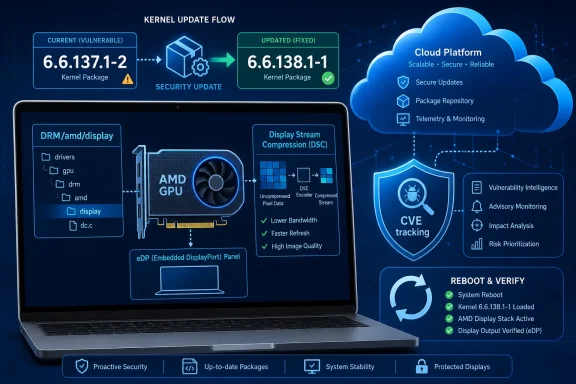 A Display Patch Becomes a Cloud Security Item
At first glance, CVE-2026-43320 looks like the sort of entry that should live quietly in a kernel changelog. The description is terse even by Linux standards: drm/amd/display: Fix dsc eDP issue, followed by the explanation that a function hook check needed to be added before use. There is no dramatic exploit narrative, no public proof of concept, and no NVD severity score at the time of publication.Yet Microsoft’s Security Update Guide lists it because the affected product in Microsoft’s orbit is Azure Linux 3.0, specifically an
azl3 kernel package moving from 6.6.137.1-2 to a fixed 6.6.138.1-1 build. That placement matters. This is not a Windows kernel bug, but it is a Microsoft-serviced operating-system component, and it lands in the same operational machinery that many IT departments already use for Patch Tuesday triage.The vulnerability also illustrates a recurring pattern in Linux kernel CVEs: a narrow patch in a driver subsystem becomes a formal vulnerability record after the fact. Kernel security handling has become more aggressive about assigning CVEs to fixes that might previously have been treated as stability or correctness bugs. That can make the feed noisier, but it also gives administrators a clearer audit trail when kernel packages change under production workloads.
For WindowsForum readers, the interesting part is the convergence. Microsoft is no longer just a Windows vendor shipping Windows patches. It is also a Linux distributor, a cloud platform operator, a container host provider, and a maintainer of security metadata that increasingly spans all of those surfaces.
The Bug Lives Where Most Users Never Look
The affected code sits indrm/amd/display, the AMD display driver area of the Linux kernel’s Direct Rendering Manager subsystem. This is the layer responsible for driving monitors, negotiating display modes, handling timing, and coordinating with GPU hardware. Most users experience it only when something goes wrong: a black screen, a frozen desktop, a failed resume from sleep, or a laptop panel that refuses to light up at the expected resolution.The specific shorthand in the CVE points to DSC over eDP. DSC, or Display Stream Compression, is a bandwidth-saving technology used to push high-resolution or high-refresh display output through available links. eDP, or embedded DisplayPort, is the internal DisplayPort connection commonly used between a laptop motherboard and its built-in panel.
That combination makes the bug sound like a laptop-display corner case, and in many practical environments it probably is. But corner cases in display drivers are not trivial by default. GPU display stacks are privileged kernel code, they parse hardware state, they coordinate interrupts and memory objects, and they often sit in some of the most timing-sensitive code paths in the machine.
The published fix language says the driver needed to check whether a function hook existed before using it. In plain English, the code was calling into an optional operation without first verifying that the operation was actually present. Depending on the surrounding path, that class of mistake can produce anything from a harmless failed mode-set to a kernel crash.
The public record does not currently establish a remote attack path, privilege-escalation scenario, or reliable exploitation technique. That distinction matters. The responsible reading is not “AMD display bug lets attackers take over Linux,” but “a kernel driver dereference or missing guard was serious enough to be tracked as a CVE and patched in supported kernels.”
A Missing Hook Check Is Boring Until It Isn’t
The phrase “function hook check before use” is security-speak for one of the oldest mistakes in systems programming: assuming a pointer-like callback exists because a nearby code path usually sets it. In a large driver, not every hardware generation, display engine, panel type, or feature combination supports the same callbacks. The code has to ask before it invokes.That is especially true in the AMD display stack, where the same broad driver family supports many generations of GPU hardware and display-controller logic. Code paths are layered through feature tables, hardware-sequencer operations, display-core abstractions, and board-specific behavior. A callback that is valid on one generation or configuration may be absent on another.
When the missing check is hit, the result can be a null-pointer dereference or another invalid call target. In kernel space, that tends to be unforgiving. The system may log an oops, reset the GPU, blank the display, or take down the whole machine depending on where and how the fault occurs.
This is why small display-driver fixes often get swept into security advisories even when the user-visible symptom is “the screen went black.” Kernel code does not get the luxury of being merely annoying. A mistake in a desktop compositor is a crash; a mistake in a kernel display path can become a denial of service.
The wording also suggests this was a defensive correctness fix rather than a large architectural change. That should reassure administrators who fear regressions from invasive patches. A guard check around an optional hook is the kind of change maintainers generally backport because it is low-risk and narrowly scoped.
Microsoft’s Role Is the Story Behind the Story
The presence of CVE-2026-43320 in Microsoft’s guide can look odd if one thinks of MSRC as a Windows-only venue. It is not. Microsoft’s modern security perimeter includes Azure Linux, formerly tied to the CBL-Mariner lineage, and the company now services Linux packages as part of its cloud and platform estate.In this case, Microsoft lists Azure Linux 3.0 with customer action required and a fixed build number. That is the operationally important bit. The upstream kernel fix may have several stable-branch commits, but the question for a Microsoft customer is whether the image, host, appliance, or workload base they actually run has consumed the patched package.
This is where vulnerability management gets more complicated than reading a CVE description. A laptop owner on Arch, Fedora, Ubuntu, or Debian will track the fix through their distribution’s kernel packages. An Azure Linux user tracks it through Microsoft’s package stream. A container-heavy shop may need to know whether the vulnerable kernel is in the host, the guest, the appliance image, or nowhere in the execution path at all.
That last distinction is crucial. Containers share the host kernel. Updating a container image does not fix a vulnerable host kernel unless the kernel itself is part of the image model, as in some specialized virtualized or appliance scenarios. Conversely, a CVE in a kernel package listed in a distribution advisory may not matter to a workload that never runs that kernel.
The Microsoft listing therefore acts less like a traditional Windows patch bulletin and more like a supply-chain waypoint. It tells administrators that Microsoft has mapped an upstream Linux kernel CVE into a Microsoft-maintained Linux product and has a fixed package available.
Severity Is Missing, but Risk Is Not Zero
At the time the record was published, NVD had not assigned CVSS 4.0, CVSS 3.x, or CVSS 2.0 scores. That absence should not be mistaken for proof of insignificance. It means the enrichment process had not yet produced a vector and base score, not that the bug is harmless.Still, the lack of a score forces a more practical analysis. The known details point toward a local kernel display-driver fault tied to AMD display hardware and eDP DSC behavior. That is a narrower risk profile than a remotely reachable network parser, an authentication bypass, or a wormable service bug.
For most enterprise environments, the likely impact is availability rather than confidentiality. A vulnerable code path in display handling could crash or destabilize affected systems, especially laptops, workstations, kiosks, or specialized endpoints using AMD graphics and internal high-resolution panels. In cloud server deployments without relevant display hardware exposed, the practical exposure may be limited.
But “limited” is not the same as “ignore.” Kernel packages are usually patched in bundles. If Azure Linux 3.0 is moving to a fixed kernel build, that build may also contain other security and reliability changes. Cherry-picking concern around a single unscored CVE can create more risk than simply following the supported update channel.
There is also a governance reason to track it. Vulnerability scanners and asset systems will eventually ingest CVE-2026-43320. If an organization cannot explain why an unscored kernel CVE is or is not applicable, it will waste time later when auditors, dashboards, or customers ask why the item remains open.
The Kernel CVE Firehose Is Changing Patch Triage
Linux kernel CVEs have become more numerous because the kernel project’s CVE assignment process has changed the economics of disclosure. Many fixes that once would have been absorbed silently into stable trees now receive identifiers. That is good for traceability, but it also means security teams must relearn how to read kernel CVEs.The old triage habit was to look for a high CVSS score and a scary impact label. That does not work well for kernel-driver issues where the record may initially contain only a commit subject, a one-line rationale, and links to stable backports. The meaningful work is in mapping the subsystem to deployed hardware and workloads.
For CVE-2026-43320, the subsystem gives the first filter: AMD display, DSC, eDP. That points toward systems with AMD graphics and embedded DisplayPort panels rather than headless virtual machines. The product mapping gives the second filter: Azure Linux 3.0 package versions. The fixed build gives the remediation target.
This is the sort of vulnerability that separates mature patch operations from checkbox scanning. A scanner may say “Linux kernel vulnerable.” A good administrator asks which kernel is booted, which package is installed, which hardware path is reachable, and whether the vendor-supported fixed build has been deployed.
The danger is that teams swing too far in either direction. Treat every kernel CVE as an emergency and the organization burns out. Treat every terse kernel CVE as noise and the organization eventually misses the one that matters. The better posture is boring, repeatable, and evidence-based.
AMD Display Bugs Keep Reminding Linux Users That Graphics Are Kernel Infrastructure
AMD’s open Linux graphics stack has been one of the platform’s great success stories. It powers gaming rigs, workstations, handhelds, laptops, and cloud-adjacent accelerated systems with a level of upstream integration that was once hard to imagine. But success also means exposure: when the driver is in the kernel, driver bugs become kernel bugs.Display Stream Compression has been a frequent source of complexity across the industry, not because DSC is inherently bad, but because it sits at the intersection of bandwidth, timing, panel capabilities, link training, firmware expectations, and operating-system policy. A high-refresh internal panel may depend on DSC to achieve its advertised mode. A driver bug in that path can look like a security item in one context and a “my screen flickers after update” forum post in another.
eDP adds another layer. Internal laptop panels are not generic desktop monitors on a cable. They are often tightly coupled to firmware tables, power sequencing, backlight control, panel self-refresh, and vendor-specific quirks. That makes it plausible for a fix to matter only on particular machines while still belonging in a broadly distributed kernel package.
This is why administrators should resist the temptation to dismiss display CVEs as consumer-desktop trivia. Enterprises deploy laptops by the thousands. They run Linux on developer workstations, engineering machines, kiosks, test rigs, and edge devices. Availability bugs in those fleets can be expensive even when they are not dramatic.
For Windows enthusiasts running Linux on AMD hardware, the advice is similarly practical: do not infer too much from the CVE alone. Watch your distribution’s kernel updates, test suspend/resume and display-mode changes after patching, and keep a known-good kernel available if you are on a fast-moving distro.
The Azure Linux Detail Narrows the Blast Radius
The most concrete Microsoft-side data point is the affected package and fixed build. Azure Linux 3.0’sazl3 kernel 6.6.137.1-2 is listed as affected, with 6.6.138.1-1 as the fixed build. That makes remediation straightforward for systems actually consuming that package stream.The administrative question is whether Azure Linux is part of your estate. Some organizations know this immediately because they standardize on it for appliances, container hosts, internal platforms, or Microsoft-aligned workloads. Others may discover it indirectly through vendor images, marketplace offerings, or internally maintained base images.
If Azure Linux 3.0 is present, the next question is whether the running kernel has changed, not merely whether the package manager downloaded an update. Kernel updates usually require a reboot or a controlled host recycle before the fixed kernel is actually running. That old rule remains one of the most common sources of false confidence in Linux patching.
If Azure Linux is not present, Microsoft’s advisory may still be useful as a signpost, but it is not your remediation channel. Ubuntu, Red Hat, Debian, SUSE, Arch, Fedora, and other distributions will carry their own kernel versions, backports, advisories, and timelines. The same upstream fix can appear under different package numbers and release cadences.
This is also a reminder that CVE status alone is not enough for change control. The patch must be evaluated in the vendor context that owns the system. A Git commit tells you what changed upstream; a distribution advisory tells you what you should install.
Windows Shops Should Care Because Their Linux Footprint Is Real
Many Windows-first organizations still talk about Linux as if it were a sidecar. That attitude no longer matches the architecture. Linux runs in WSL on developer machines, under Kubernetes nodes, inside security appliances, in Azure services, in CI/CD runners, and in embedded devices attached to otherwise Windows-managed networks.CVE-2026-43320 is not a WSL kernel advisory as presented, and it is not a Windows graphics-driver issue. But it belongs in the same organizational conversation because the tooling, ownership, and response process often overlap. The same endpoint team that tracks Windows cumulative updates may now be asked why a Microsoft security page shows a Linux kernel CVE with required customer action.
That creates a documentation burden. Teams should record whether the CVE applies, what products were checked, and what version remediates it. For small shops, that may be a note in a ticket. For larger environments, it belongs in vulnerability management systems with asset evidence attached.
The risk of ignoring these “not Windows, but Microsoft” advisories is that they expose a gap in ownership. If the Windows team assumes Linux owns it, and the Linux team assumes Microsoft advisories are Windows team territory, the patch falls between departments. Attackers and outages do not care which org chart box was supposed to read the bulletin.
The healthier model is product-based ownership. If your team owns Azure Linux hosts, you own the Azure Linux kernel update. If your team owns AMD Linux workstations, you own the distribution kernel update. If nobody owns those assets, CVE-2026-43320 is doing you a favor by revealing the problem.
The Fix Is Simple; The Verification Is the Work
For affected Azure Linux 3.0 systems, the remediation target is the fixed kernel build. In practice, that means updating through the supported package mechanism, rebooting into the new kernel, and verifying the running version after the reboot. Merely seeing the package in a repository is not remediation.Administrators should also be cautious about pinned kernels. It is common in production Linux environments to pin known-good kernels after a driver regression, especially on systems with sensitive hardware dependencies. That habit can preserve uptime, but it can also strand a system behind security fixes unless there is an explicit exception process.
Testing should focus on the hardware path implied by the bug. On systems with AMD graphics and internal eDP panels, validate boot, login display, suspend and resume, lid close and open behavior, docking transitions, resolution changes, and high-refresh modes if applicable. Those are the places where display-stack regressions usually reveal themselves.
For headless Azure Linux systems without relevant display hardware, the operational priority may be lower, but the patch still belongs in the normal kernel update cycle. Kernel updates are cumulative security maintenance, not boutique fixes for the one line in the CVE description. The organization should avoid building a special exemption unless it has a clear reason.
Home and enthusiast users should follow their distribution rather than manually applying kernel.org commits. Stable kernel backports are curated for a reason. Pulling a single display-driver patch into a custom kernel can create more uncertainty than waiting for the distro package that includes it.
The Small CVE That Teaches the Bigger Habit
CVE-2026-43320 will probably not be remembered as a landmark vulnerability. Its public description is short, its scope appears narrow, and there is no published severity score in the initial NVD entry. But it is an excellent example of the modern patch-management grind: small upstream fixes, cross-vendor metadata, cloud distribution packages, and ambiguous practical exposure.The concrete takeaways are more useful than the drama:
- CVE-2026-43320 is a Linux kernel AMD display-driver issue involving DSC over eDP, not a Windows graphics vulnerability.
- Microsoft lists the vulnerability because Azure Linux 3.0 includes an affected kernel package in Microsoft’s supported product ecosystem.
- The fixed Azure Linux package build is 6.6.138.1-1, replacing the affected 6.6.137.1-2 build listed in Microsoft’s guide.
- The absence of an NVD CVSS score at publication does not prove the bug is harmless; it means severity enrichment had not yet been completed.
- The most likely operational concern is stability or denial of service on affected AMD display configurations, especially systems using embedded DisplayPort panels.
- Administrators should verify the running kernel after update and reboot, not just the installed package version.
Source: NVD / Linux Kernel Security Update Guide - Microsoft Security Response Center
