

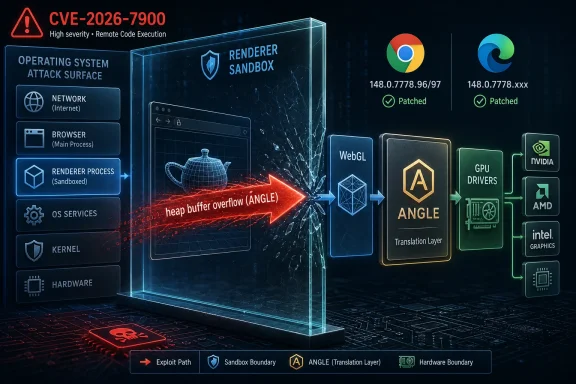
Google and Microsoft disclosed CVE-2026-7900 in early May 2026 as a high-severity Chromium flaw in ANGLE, fixed in Google Chrome before version 148.0.7778.96 and covered in Microsoft Edge because Edge consumes Chromium code. The bug is not another routine browser crash; it is a reminder that the modern browser’s graphics stack has become part of the operating system’s attack surface. A compromised renderer is supposed to be contained. CVE-2026-7900 matters because its stated path points past that containment boundary.
The short description is almost bland: heap buffer overflow in ANGLE. But the important words arrive later, where the advisory says a remote attacker who had already compromised the renderer process could potentially perform a sandbox escape through a crafted HTML page.
That is the security story in one sentence. Chrome and Edge do not rely on the renderer being perfect; they rely on the renderer being jailed. The web is too hostile, too programmable, and too weird for any browser vendor to promise that untrusted content will never trigger a memory-safety flaw. The bargain is that if the renderer falls, the sandbox should keep the attacker away from the rest of the machine.
CVE-2026-7900 sits exactly at the place where that bargain becomes uncomfortable. It is not described as a one-click remote code execution bug from a clean starting point. It is described as a possible second stage: first win code execution in the renderer, then use this ANGLE heap overflow to try to escape the sandbox.
That distinction should not make admins relax. Modern exploit chains are built from exactly these kinds of parts. A renderer compromise without an escape is noisy but constrained; a renderer compromise with a sandbox escape starts looking like endpoint compromise.
Security engineers have long known that graphics code is a rich target because it must be fast, complex, and forgiving of a staggering range of hardware and driver behavior. Browsers expose some of that complexity through carefully mediated APIs, but mediation does not make the complexity disappear. It moves the trust boundary into parsers, validators, translators, command buffers, drivers, and sandboxes.
A heap buffer overflow in that terrain is the kind of primitive attackers like. Heap corruption can sometimes be shaped into controlled memory writes, object confusion, or data leakage, depending on allocator behavior and surrounding mitigations. The public description does not provide exploit details, and it should not; vendors routinely restrict bug trackers until most users have been patched. But the class of bug is serious enough on its face.
The uncomfortable reality is that browser graphics is now a cross-platform substrate. A flaw in ANGLE is not just “a Chrome bug” in the narrow sense; it is a Chromium ecosystem bug. Once Chromium is the engine underneath Chrome, Edge, Brave, Opera, Vivaldi, Electron apps, embedded web views, and managed enterprise browsing, a graphics flaw in the shared layer becomes a fleet-management problem.
That is not Microsoft being evasive. It is the reality of Chromium-based Edge. Microsoft does not own the original bug report, and the upstream issue tracker entry is permission-restricted. Edge inherits the vulnerability because it inherits the code, and Edge ships the fix because it ingests Chromium updates.
For WindowsForum readers, that is the central operational point: do not wait for a traditional Windows cumulative update mental model to save you. Edge’s Chromium security servicing moves on the browser train, not the Windows Patch Tuesday train. Chrome does the same. The patch cadence is faster, the advisories are thinner, and the blast radius cuts across OS boundaries.
This is one reason browser inventory is still a surprisingly weak spot in enterprise security programs. Most organizations know their Windows build numbers. Fewer can say, with the same confidence, which Chromium branch is active across every user profile, VDI image, kiosk, server jump box, lab machine, and developer workstation.
The “high complexity” element is doing important work. This is not being presented as a simple drive-by bug where a malicious page reliably owns a fully patched system by itself. The advisory requires a prior renderer compromise. The attacker must already have one foothold inside Chromium’s content process before this ANGLE issue becomes the alleged escape route.
But that is how serious browser exploitation often works. Attackers combine a renderer memory corruption bug, a type confusion bug, a JIT issue, or a use-after-free with a separate sandbox escape. Each piece may look conditional in isolation. Together, they become the chain that makes the browser worth targeting.
The absence of public exploit-in-the-wild language also matters. There is no public claim here, based on the advisories available, that CVE-2026-7900 is being actively exploited. But defenders should not confuse “not known to be exploited” with “not exploitable.” Browser vendors routinely patch ahead of public proof, and the point of rapid browser updating is to close the window before commodity exploit kits catch up.
That context matters because CVE-2026-7900 is not an isolated flashing red light in an otherwise quiet month. It is one thread in a dense patch bundle. From an admin’s perspective, the right response is not to surgically obsess over one CVE while ignoring the rest of the browser train. The right response is to verify that the browser is on the fixed release family or later.
This is also why browser patching has become less like occasional software maintenance and more like antivirus signature updates used to be. The browser is a permanent, internet-facing execution environment. It parses attacker-controlled text, images, video, fonts, scripts, WebAssembly, certificates, compression formats, and GPU workloads all day.
Chrome and Edge auto-update for many users, but auto-update is not an assurance mechanism. It is a delivery mechanism. Enterprises still need reporting, compliance baselines, restart enforcement, update-policy sanity checks, and a plan for devices that sleep through the rollout.
A sandbox is a set of assumptions. It assumes the broker process will enforce the right policy. It assumes the renderer cannot reach privileged interfaces except through controlled channels. It assumes the GPU process, IPC layers, file handles, shared memory, and platform services are all constrained enough to prevent escape.
ANGLE-adjacent flaws are interesting because graphics paths have historically required delicate performance and compatibility compromises. Browsers cannot simply lock everything away if they want rich web applications, hardware acceleration, video conferencing, games, maps, CAD tools, and WebGL content to work smoothly. Every capability exposed to the renderer becomes another place where validation has to be right.
That is the pattern administrators should see in CVE-2026-7900. The exploit story does not begin with “user visits page, attacker wins everything.” It begins with defense in depth doing its job until a second bug tries to defeat the next layer. That makes the bug less theatrical, but not less relevant.
The fixed build notation in Microsoft’s guide — 148.0.7778.xxx — reflects that Microsoft’s Edge release may not map character-for-character to Google’s Chrome version string, even when the underlying Chromium security content is aligned. That can frustrate vulnerability scanners and patch dashboards that expect exact matches. It also makes it easy for sloppy reporting to say “Chrome fixed” while leaving Edge verification as an afterthought.
In managed Windows environments, Edge deserves the same urgency as Chrome because it may be the default browser, the WebView2 runtime provider, or the quietly available fallback even when Chrome is the officially blessed browser. Users do not need to prefer Edge for Edge to matter. Applications can invoke it, identity flows can depend on it, and administrators can forget that it is present.
This is one of the consequences of Microsoft’s Chromium turn. Edge gained compatibility and joined a faster-moving security ecosystem. The price is that Windows administrators now have to track Chromium disclosures as part of routine Microsoft endpoint hygiene.
CPE mapping is hard because software packaging is messy. Chrome on Windows is not Chrome on Linux. Chromium in Ubuntu may be a snap-backed package rather than a traditional source package. Edge is Chromium-based but is not Google Chrome. Electron applications can embed Chromium in ways that do not appear in a browser inventory at all.
For defenders, the lesson is not that NVD is broken or that vendors are careless. The lesson is that vulnerability matching by product string is a crude instrument in a world of shared engines and embedded runtimes. If your scanner only finds “Google Chrome” and misses Edge, Brave, or bundled Chromium components, it is measuring a subset of the risk.
The practical answer is layered inventory. Know which browsers are installed. Know which are actually launched. Know which Chromium-based runtimes ride along with business applications. And know which update channels — stable, extended stable, beta, dev, ESR-like enterprise tracks, vendor-specific forks — are allowed in production.
That is not an indictment of Chromium alone. It is an indictment of the amount of critical infrastructure still written in languages and layers where memory mistakes remain security-relevant. Browsers are improving, compilers are adding mitigations, allocators are harder to exploit, and sandboxing raises the cost. But the attack surface remains enormous.
The industry’s migration toward memory-safe languages is real, but it is not magic either. Browser engines contain decades of C and C++, performance-sensitive rendering paths, platform abstractions, third-party libraries, and driver interfaces. Rewriting that world is a generational project, not a sprint.
In the meantime, defense depends on reducing exploit reliability. That means sandboxing, site isolation, control-flow protections, hardened heaps, fuzzing, privilege separation, and fast updates. CVE-2026-7900 is a case study in why all of those layers matter: the advisory assumes one layer has already failed and worries about the next one.
A sandbox escape in that environment can change the response timeline. Without an escape, defenders may be dealing with token theft, session abuse, or a contained browser process. With an escape, the concern moves toward persistence, lateral movement, credential access, and tampering with endpoint controls.
The advisory’s requirement for user interaction is also not much comfort. Browser exploitation almost always involves user interaction in the broad CVSS sense because the user must visit or load something. That does not mean the user made a reckless decision. In 2026, normal work is a chain of web applications, redirects, embedded frames, cloud documents, single sign-on prompts, and collaboration links.
That is why security teams should treat browser patch latency as exposure time, not as administrative delay. The attacker does not care whether a restart prompt was inconvenient. The attacker cares whether the vulnerable build is still running.
Chrome and Edge both have internal update pages that will force a check and display the active version. Managed environments can also use administrative templates, update policies, endpoint management tools, and vulnerability scanners to verify fleet state. The challenge is less about knowing the right button and more about closing every exception.
Kiosks are a common blind spot. So are non-persistent virtual desktops, developer machines with disabled update services, lab images, disconnected networks, shared workstations, and old gold images that get cloned back into service after the emergency has supposedly passed. Browser updates are easy until they meet real infrastructure.
The same applies to third-party Chromium browsers. If an organization permits them, it has to manage them. “User-installed but tolerated” is not a security posture. It is a future incident report with softer wording.
That is how mature browser exploitation works. A bug that leaks addresses may defeat ASLR. A renderer bug may get code running in a constrained process. A sandbox escape may cross into a more privileged process. A kernel bug may then finish the job. Each link has a different CVE, a different severity score, and sometimes a different vendor.
Defenders should therefore think in chains too. Browser patching breaks one chain. Exploit mitigations break another. Attack surface reduction, web isolation, EDR behavior detection, least privilege, credential guardrails, and rapid session revocation all make the attacker assemble more pieces under more pressure.
CVE-2026-7900 is a useful reminder that “the browser was patched” is not the whole defensive story. The browser must be patched quickly because it is one of the first links attackers touch. But endpoint hardening still matters because browser compromise is often a means, not the end.
Source: NVD / Chromium Security Update Guide - Microsoft Security Response Center
 The Browser Bug Is Really a Boundary Bug
The short description is almost bland: heap buffer overflow in ANGLE. But the important words arrive later, where the advisory says a remote attacker who had already compromised the renderer process could potentially perform a sandbox escape through a crafted HTML page.That is the security story in one sentence. Chrome and Edge do not rely on the renderer being perfect; they rely on the renderer being jailed. The web is too hostile, too programmable, and too weird for any browser vendor to promise that untrusted content will never trigger a memory-safety flaw. The bargain is that if the renderer falls, the sandbox should keep the attacker away from the rest of the machine.
CVE-2026-7900 sits exactly at the place where that bargain becomes uncomfortable. It is not described as a one-click remote code execution bug from a clean starting point. It is described as a possible second stage: first win code execution in the renderer, then use this ANGLE heap overflow to try to escape the sandbox.
That distinction should not make admins relax. Modern exploit chains are built from exactly these kinds of parts. A renderer compromise without an escape is noisy but constrained; a renderer compromise with a sandbox escape starts looking like endpoint compromise.
ANGLE Is the Translation Layer Attackers Cannot Ignore
ANGLE is not a consumer-facing brand, but it is everywhere Chromium needs graphics portability. It translates graphics API calls so web content can rely on WebGL and related rendering paths across different platforms and GPU stacks. That means it sits between hostile web input and privileged, performance-sensitive graphics machinery.Security engineers have long known that graphics code is a rich target because it must be fast, complex, and forgiving of a staggering range of hardware and driver behavior. Browsers expose some of that complexity through carefully mediated APIs, but mediation does not make the complexity disappear. It moves the trust boundary into parsers, validators, translators, command buffers, drivers, and sandboxes.
A heap buffer overflow in that terrain is the kind of primitive attackers like. Heap corruption can sometimes be shaped into controlled memory writes, object confusion, or data leakage, depending on allocator behavior and surrounding mitigations. The public description does not provide exploit details, and it should not; vendors routinely restrict bug trackers until most users have been patched. But the class of bug is serious enough on its face.
The uncomfortable reality is that browser graphics is now a cross-platform substrate. A flaw in ANGLE is not just “a Chrome bug” in the narrow sense; it is a Chromium ecosystem bug. Once Chromium is the engine underneath Chrome, Edge, Brave, Opera, Vivaldi, Electron apps, embedded web views, and managed enterprise browsing, a graphics flaw in the shared layer becomes a fleet-management problem.
Microsoft’s Advisory Is Short Because Chromium Carries the Weight
Microsoft’s Security Update Guide entry for CVE-2026-7900 is spare by design. It says the CVE was assigned by Chrome, that Microsoft Edge incorporates Chromium, and that the latest Edge version is no longer vulnerable. The affected product row lists Microsoft Edge (Chromium-based), with customer action required and a fixed build family of 148.0.7778.xxx.That is not Microsoft being evasive. It is the reality of Chromium-based Edge. Microsoft does not own the original bug report, and the upstream issue tracker entry is permission-restricted. Edge inherits the vulnerability because it inherits the code, and Edge ships the fix because it ingests Chromium updates.
For WindowsForum readers, that is the central operational point: do not wait for a traditional Windows cumulative update mental model to save you. Edge’s Chromium security servicing moves on the browser train, not the Windows Patch Tuesday train. Chrome does the same. The patch cadence is faster, the advisories are thinner, and the blast radius cuts across OS boundaries.
This is one reason browser inventory is still a surprisingly weak spot in enterprise security programs. Most organizations know their Windows build numbers. Fewer can say, with the same confidence, which Chromium branch is active across every user profile, VDI image, kiosk, server jump box, lab machine, and developer workstation.
The CVSS Score Says “High,” but the Chain Says “Pay Attention”
CISA’s ADP vector gives CVE-2026-7900 a CVSS 3.1 score of 8.3, with network attack vector, high attack complexity, no privileges required, user interaction required, changed scope, and high impact to confidentiality, integrity, and availability. NVD had not yet supplied its own full scoring at the time the entry was published.The “high complexity” element is doing important work. This is not being presented as a simple drive-by bug where a malicious page reliably owns a fully patched system by itself. The advisory requires a prior renderer compromise. The attacker must already have one foothold inside Chromium’s content process before this ANGLE issue becomes the alleged escape route.
But that is how serious browser exploitation often works. Attackers combine a renderer memory corruption bug, a type confusion bug, a JIT issue, or a use-after-free with a separate sandbox escape. Each piece may look conditional in isolation. Together, they become the chain that makes the browser worth targeting.
The absence of public exploit-in-the-wild language also matters. There is no public claim here, based on the advisories available, that CVE-2026-7900 is being actively exploited. But defenders should not confuse “not known to be exploited” with “not exploitable.” Browser vendors routinely patch ahead of public proof, and the point of rapid browser updating is to close the window before commodity exploit kits catch up.
Chrome 148 Was Not a Tiny Security Release
CVE-2026-7900 arrived as part of the Chrome 148 stable desktop update, a release that fixed a large number of security issues. Google’s stable channel update moved Linux to 148.0.7778.96 and Windows and macOS to 148.0.7778.96 or 148.0.7778.97. Reporting around the release counted 127 security fixes, including several critical vulnerabilities elsewhere in the Chromium stack.That context matters because CVE-2026-7900 is not an isolated flashing red light in an otherwise quiet month. It is one thread in a dense patch bundle. From an admin’s perspective, the right response is not to surgically obsess over one CVE while ignoring the rest of the browser train. The right response is to verify that the browser is on the fixed release family or later.
This is also why browser patching has become less like occasional software maintenance and more like antivirus signature updates used to be. The browser is a permanent, internet-facing execution environment. It parses attacker-controlled text, images, video, fonts, scripts, WebAssembly, certificates, compression formats, and GPU workloads all day.
Chrome and Edge auto-update for many users, but auto-update is not an assurance mechanism. It is a delivery mechanism. Enterprises still need reporting, compliance baselines, restart enforcement, update-policy sanity checks, and a plan for devices that sleep through the rollout.
The Sandbox Is Strongest When Admins Stop Treating It as Magic
The Chromium sandbox is one of the great engineering achievements of consumer security. It compartmentalizes dangerous work, reduces privileges, uses process isolation, and makes exploitation harder than it was in the browser monoculture of the 2000s. But it is not a force field.A sandbox is a set of assumptions. It assumes the broker process will enforce the right policy. It assumes the renderer cannot reach privileged interfaces except through controlled channels. It assumes the GPU process, IPC layers, file handles, shared memory, and platform services are all constrained enough to prevent escape.
ANGLE-adjacent flaws are interesting because graphics paths have historically required delicate performance and compatibility compromises. Browsers cannot simply lock everything away if they want rich web applications, hardware acceleration, video conferencing, games, maps, CAD tools, and WebGL content to work smoothly. Every capability exposed to the renderer becomes another place where validation has to be right.
That is the pattern administrators should see in CVE-2026-7900. The exploit story does not begin with “user visits page, attacker wins everything.” It begins with defense in depth doing its job until a second bug tries to defeat the next layer. That makes the bug less theatrical, but not less relevant.
Edge Inherits the Risk and the Fix
Microsoft Edge’s presence in the advisory is not a branding footnote. Edge is now a Chromium browser with Microsoft services, policies, identity integrations, management hooks, and enterprise defaults layered on top. When Chromium carries a security flaw, Edge customers are in the room.The fixed build notation in Microsoft’s guide — 148.0.7778.xxx — reflects that Microsoft’s Edge release may not map character-for-character to Google’s Chrome version string, even when the underlying Chromium security content is aligned. That can frustrate vulnerability scanners and patch dashboards that expect exact matches. It also makes it easy for sloppy reporting to say “Chrome fixed” while leaving Edge verification as an afterthought.
In managed Windows environments, Edge deserves the same urgency as Chrome because it may be the default browser, the WebView2 runtime provider, or the quietly available fallback even when Chrome is the officially blessed browser. Users do not need to prefer Edge for Edge to matter. Applications can invoke it, identity flows can depend on it, and administrators can forget that it is present.
This is one of the consequences of Microsoft’s Chromium turn. Edge gained compatibility and joined a faster-moving security ecosystem. The price is that Windows administrators now have to track Chromium disclosures as part of routine Microsoft endpoint hygiene.
The CPE Confusion Is a Symptom of a Bigger Inventory Problem
The NVD entry’s affected software configuration includes Google Chrome versions before 148.0.7778.96 across Windows, Linux, and macOS. It also displays the familiar prompt asking whether a CPE is missing. That sort of metadata wrinkle may look bureaucratic, but in enterprise vulnerability management it can decide whether a dashboard screams or stays quiet.CPE mapping is hard because software packaging is messy. Chrome on Windows is not Chrome on Linux. Chromium in Ubuntu may be a snap-backed package rather than a traditional source package. Edge is Chromium-based but is not Google Chrome. Electron applications can embed Chromium in ways that do not appear in a browser inventory at all.
For defenders, the lesson is not that NVD is broken or that vendors are careless. The lesson is that vulnerability matching by product string is a crude instrument in a world of shared engines and embedded runtimes. If your scanner only finds “Google Chrome” and misses Edge, Brave, or bundled Chromium components, it is measuring a subset of the risk.
The practical answer is layered inventory. Know which browsers are installed. Know which are actually launched. Know which Chromium-based runtimes ride along with business applications. And know which update channels — stable, extended stable, beta, dev, ESR-like enterprise tracks, vendor-specific forks — are allowed in production.
Memory Safety Keeps Sending the Same Bill
CVE-2026-7900 is another entry in the long ledger of memory-safety bugs. Heap buffer overflow is one of the oldest phrases in vulnerability management, yet here it is again inside one of the most heavily sandboxed, fuzzed, audited, and patched software projects in the world.That is not an indictment of Chromium alone. It is an indictment of the amount of critical infrastructure still written in languages and layers where memory mistakes remain security-relevant. Browsers are improving, compilers are adding mitigations, allocators are harder to exploit, and sandboxing raises the cost. But the attack surface remains enormous.
The industry’s migration toward memory-safe languages is real, but it is not magic either. Browser engines contain decades of C and C++, performance-sensitive rendering paths, platform abstractions, third-party libraries, and driver interfaces. Rewriting that world is a generational project, not a sprint.
In the meantime, defense depends on reducing exploit reliability. That means sandboxing, site isolation, control-flow protections, hardened heaps, fuzzing, privilege separation, and fast updates. CVE-2026-7900 is a case study in why all of those layers matter: the advisory assumes one layer has already failed and worries about the next one.
The Enterprise Risk Is Not the User Who Clicks Once
Consumer coverage of browser vulnerabilities tends to imagine a single user visiting a malicious page. That happens, but it is too small a frame for enterprise risk. The more interesting scenario is a user whose browser is already exposed to a hostile workflow: phishing pages, compromised ad networks, malicious document previews, SaaS integrations, OAuth consent traps, or internal portals that load third-party content.A sandbox escape in that environment can change the response timeline. Without an escape, defenders may be dealing with token theft, session abuse, or a contained browser process. With an escape, the concern moves toward persistence, lateral movement, credential access, and tampering with endpoint controls.
The advisory’s requirement for user interaction is also not much comfort. Browser exploitation almost always involves user interaction in the broad CVSS sense because the user must visit or load something. That does not mean the user made a reckless decision. In 2026, normal work is a chain of web applications, redirects, embedded frames, cloud documents, single sign-on prompts, and collaboration links.
That is why security teams should treat browser patch latency as exposure time, not as administrative delay. The attacker does not care whether a restart prompt was inconvenient. The attacker cares whether the vulnerable build is still running.
Patch Verification Beats Patch Assumption
For home users, the advice is simple: restart the browser and check the version. For enterprises, the advice is less glamorous: prove that the fixed build is installed and active. Installed but not restarted is not the same as patched. Updated in the system context but not in a stale user session is not the same as patched.Chrome and Edge both have internal update pages that will force a check and display the active version. Managed environments can also use administrative templates, update policies, endpoint management tools, and vulnerability scanners to verify fleet state. The challenge is less about knowing the right button and more about closing every exception.
Kiosks are a common blind spot. So are non-persistent virtual desktops, developer machines with disabled update services, lab images, disconnected networks, shared workstations, and old gold images that get cloned back into service after the emergency has supposedly passed. Browser updates are easy until they meet real infrastructure.
The same applies to third-party Chromium browsers. If an organization permits them, it has to manage them. “User-installed but tolerated” is not a security posture. It is a future incident report with softer wording.
The Exploit Chain Is the Unit of Defense
One of the mistakes defenders make with CVE scoring is treating each CVE as an island. CVE-2026-7900’s public description explicitly resists that habit. It says the attacker has already compromised the renderer process. In other words, the vulnerability’s practical significance depends on what else the attacker has.That is how mature browser exploitation works. A bug that leaks addresses may defeat ASLR. A renderer bug may get code running in a constrained process. A sandbox escape may cross into a more privileged process. A kernel bug may then finish the job. Each link has a different CVE, a different severity score, and sometimes a different vendor.
Defenders should therefore think in chains too. Browser patching breaks one chain. Exploit mitigations break another. Attack surface reduction, web isolation, EDR behavior detection, least privilege, credential guardrails, and rapid session revocation all make the attacker assemble more pieces under more pressure.
CVE-2026-7900 is a useful reminder that “the browser was patched” is not the whole defensive story. The browser must be patched quickly because it is one of the first links attackers touch. But endpoint hardening still matters because browser compromise is often a means, not the end.
The Quiet ANGLE Fix That Should Change This Week’s Checklist
This is not the kind of vulnerability that should send every administrator into theatrical panic. It is the kind that should make a well-run IT shop tighten its patch loop, audit its Chromium exposure, and verify that security tooling understands Edge as a first-class Chromium target.- Chrome should be updated to 148.0.7778.96 or later on Linux and to the fixed 148.0.7778.96/97 family or later on Windows and macOS.
- Microsoft Edge should be verified on the 148.0.7778.xxx security update line or later, rather than assumed safe because Windows Update ran.
- Vulnerability teams should confirm that scanners identify both Google Chrome and Microsoft Edge exposure for CVE-2026-7900.
- Administrators should treat still-running browser sessions as potentially unpatched until users restart into the updated build.
- Security teams should review whether unmanaged Chromium-based browsers or embedded runtimes are present outside the standard browser inventory.
- The absence of a public active-exploitation claim should reduce panic, not urgency.
Source: NVD / Chromium Security Update Guide - Microsoft Security Response Center
