

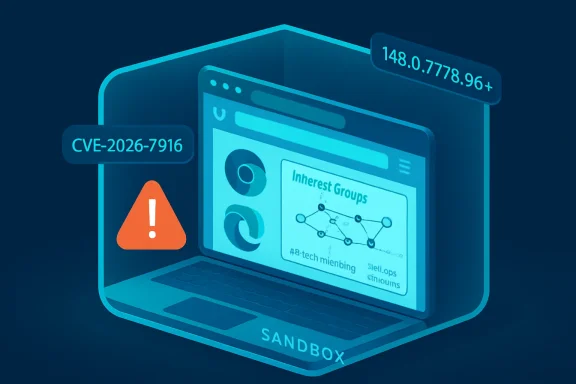
Google and Microsoft disclosed CVE-2026-7916 in early May 2026, a high-severity Chromium vulnerability in the InterestGroups component that affected Google Chrome before 148.0.7778.96 and Microsoft Edge builds before the corresponding Chromium 148 update. The bug is not the loudest flaw in the Chrome 148 security rollup, but it is the one that best explains where browser security now lives: in the hard-to-see seams between privacy features, ad-tech plumbing, and the sandbox. For Windows users and IT teams, the practical answer is simple — update Chrome and Edge — but the strategic lesson is less comfortable. Chromium’s attack surface is no longer just the renderer, JavaScript engine, and media stack; it is the sprawling platform layer that browsers have become.
CVE-2026-7916 is not described as a one-click remote code execution flaw in the traditional sense. The public description says an attacker would first need to compromise the renderer process and then use a crafted HTML page to potentially escape the browser sandbox. That condition matters because it tells us this vulnerability is part of an exploit chain, not necessarily the opening move.
That should not make anyone complacent. Modern browser exploitation often works exactly this way: one flaw gets code running inside a heavily constrained renderer, and another flaw breaks out into a more privileged context. The sandbox is supposed to turn browser compromise into a contained incident; a sandbox escape is the moment the containment story starts to fail.
The “InterestGroups” reference points to Chromium’s machinery for privacy-preserving advertising auctions, part of the broader attempt to replace older tracking mechanisms with browser-mediated ad infrastructure. That does not mean ordinary users were somehow attacked by ads alone, nor does it prove the bug was exploited in the wild. It does mean that even privacy-era web features can become security-critical code paths once they gain enough complexity and privilege boundaries.
For WindowsForum readers, the uncomfortable takeaway is that this is not only a Chrome story. Microsoft Edge consumes Chromium, and Microsoft’s Security Update Guide lists the CVE because Edge inherits the relevant upstream code. The patch cadence may differ by vendor, but the dependency graph is shared.
It has also created a monoculture problem. A serious Chromium vulnerability can ripple across consumer browsers, enterprise-managed endpoints, kiosk systems, Electron apps, WebView runtimes, and line-of-business tools that nobody in procurement thinks of as “browsers.” When a CVE lands in Chromium, the patching question is rarely limited to the blue, red, green, or multicolored icon on the taskbar.
Microsoft’s handling of CVE-2026-7916 is a good illustration. The company did not assign the vulnerability; Chrome did. Microsoft’s role is to tell Edge customers that Edge’s Chromium base has consumed the upstream fix and that the latest Edge build is no longer vulnerable. In one sense, that is efficient. In another, it forces enterprise administrators to track a vulnerability whose canonical details, exploitability hints, and component names live upstream.
The result is a kind of distributed responsibility that works well only when every layer is fast. Google must fix Chromium, Microsoft must ingest it into Edge, admins must deploy it, users must relaunch, and security scanners must recognize the fixed build. Any lag in that chain leaves a browser that appears “managed” but is still exposed.
That “xxx” is not an elegant artifact for vulnerability management teams. It reflects how Edge’s build packaging can differ from Chrome’s while still incorporating the relevant Chromium security fixes. For a human reading the advisory, it says “you need the current Edge 148 security update.” For a scanner, an auditor, or a compliance dashboard, it can be less satisfying.
This is why version verification remains boring but essential. In Chrome, users can check the version through the About Chrome page. In Edge, Microsoft directs users to the menu, then Help and Feedback, then About Microsoft Edge. That page is not merely informational; it normally triggers update checks and tells users whether a relaunch is required.
The relaunch is the part everyone forgets. Chromium browsers can download updates in the background, but the old vulnerable code may remain in memory until the browser restarts. A fleet that has “received” the update but has not relaunched is a fleet in the gray zone.
This is the bargain the modern browser has made. The browser promises users better privacy, developers richer APIs, advertisers workable measurement, and regulators a more defensible architecture. To do that, it absorbs more of the web’s economic machinery into itself. Every time the browser becomes the place where a market, auction, identity check, or local decision happens, it gains more code paths that must be validated against malicious input.
“Insufficient data validation” is one of those phrases that sounds almost bureaucratic until it is attached to a sandbox escape. Validation bugs are not glamorous. They do not have the cinematic appeal of a memory corruption primitive in a famous rendering engine. But they are often where assumptions leak across trust boundaries.
Interest Groups, Protected Audience, and related browser-side advertising mechanisms are designed to process data from sites, scripts, auctions, and browser services under strict rules. If the data crossing those boundaries is not checked correctly, a feature built to reduce one class of web risk can become a lever for another. That is the paradox of defensive platform design: moving complexity into the browser can reduce ecosystem abuse while increasing the browser’s own security burden.
This does not mean privacy-preserving ad APIs are doomed. It means they must be treated as security-sensitive infrastructure, not merely as policy-sensitive infrastructure. The web platform is past the point where “advertising component” can be mentally filed away from “exploit surface.”
The high attack complexity is important, but not exculpatory. Browser exploitation is a specialist discipline, and many powerful browser bugs start life as difficult chains before they become operationalized by well-resourced actors. If an attacker already has a renderer compromise, a sandbox escape becomes the upgrade path from browser-confined code execution to a more dangerous beachhead.
The absence of public “exploited in the wild” language should also be read carefully. Google’s Chrome advisories typically call out known exploitation when they are ready to say so. For CVE-2026-7916, the public materials do not state that exploitation has been observed. That makes this a patch-now vulnerability, not a panic-now vulnerability.
Still, exploit-chain bugs should be judged by where they fit, not just by whether they are known to be used today. A renderer compromise without escape may be contained. A sandbox escape without a renderer bug may be incomplete. Together, they are the kind of sequence defenders try to break at any available link.
That crowd matters. When a browser release contains dozens or more than a hundred security fixes, administrators cannot sensibly perform bespoke risk triage on every CVE before deployment. The operational model has to be closer to “browser updates are emergency plumbing” than “browser updates are optional feature maintenance.”
Chrome’s update machinery is built for that assumption. Consumer devices generally update automatically, and enterprise Chrome can be controlled through policy while still receiving rapid security releases. Edge follows a similar philosophy in the Microsoft ecosystem, where the browser update channel is separate from classic Patch Tuesday Windows servicing.
That separation is both a strength and a governance headache. The strength is obvious: browsers can ship security fixes outside the monthly OS patch cycle. The headache is that organizations with mature Windows patch rings may still have surprisingly immature browser update visibility. A patched Windows 11 machine running an unpatched browser is not meaningfully patched for web risk.
For sysadmins, that means Chrome CVEs can appear in Microsoft’s security universe even when the vulnerable code originated upstream. It also means Edge may require urgent treatment even in organizations that standardize on Chrome or tell users not to use Edge. If Edge is installed, callable, embedded, or used by WebView2-dependent applications, it belongs in the asset inventory.
The same logic applies in reverse. An organization that patches Edge but ignores Chrome has not solved the problem if Chrome is present. A vulnerability scanner that reports only the default browser is missing the point. The risk belongs to every vulnerable Chromium runtime that can be invoked by a user, an application, or an attacker.
This is where Windows environments get messy. Edge is deeply integrated into modern Windows, Chrome is often user-installed or department-installed, WebView2 underpins numerous desktop apps, and Electron packages Chromium with application-specific update behavior. CVE-2026-7916 is formally about Chrome and Edge, but the broader administrative lesson is that Chromium inventory is harder than browser inventory.
CPEs are only as useful as the products they can accurately describe. They are good at saying “Google Chrome before this version on these operating systems.” They are less good at capturing every downstream embed, repackaged runtime, managed fork, or application that bundles Chromium components without looking like a browser. This is why administrators often see a delay between a high-profile Chromium fix and complete coverage across endpoint tools.
The user-facing advisory language also creates a subtle problem. “Are we missing a CPE here?” is boilerplate on NVD pages, but with Chromium it is almost philosophical. The ecosystem is so broad that a single CPE entry cannot express all practical exposure. The clean database answer may still leave operational blind spots.
For CVE-2026-7916 specifically, the known public affected software centers on Chrome and Chromium-based Edge. But the defensive habit should be broader: when Chromium fixes a sandbox escape path, check managed browsers first, then ask where else Chromium lives in your estate. That second question is where many organizations discover stale runtimes.
But a sandbox is not a force field. It is a contract between processes, brokers, permissions, validation logic, IPC messages, file system rules, GPU services, network services, and operating system primitives. A bug in any of those negotiations can create a path out.
CVE-2026-7916’s description is terse, but the shape is familiar: compromised renderer, crafted HTML, insufficient validation, possible sandbox escape. That chain suggests a failure at a boundary where renderer-controlled or renderer-influenced data reached something that trusted it too much. That is exactly the kind of bug modern sandboxing is designed to make rare and exactly the kind attackers prize when they find it.
Windows adds its own layers to this story. Chromium’s sandbox on Windows relies on OS mechanisms, process isolation, tokens, job objects, integrity levels, and brokered access. The browser team can harden its architecture, but the final defense is an interaction between Chromium’s design and Windows’ security model. That is why browser updates are system security updates in everything but branding.
That sounds simple until it meets real fleets. Some users leave browsers open for weeks. Some VDI pools revert to stale images. Some kiosks run restricted shells that never expose the About page. Some enterprises disable or redirect browser update services to preserve change-control rituals designed for a slower era.
Browser attackers do not respect those rituals. The web is a delivery mechanism with global reach and near-zero friction. If a vulnerability is useful as part of a chain, the attacker’s deployment model is often faster than the enterprise’s approval model. This is why modern browser patching should be measured in hours and days, not in the next convenient maintenance window.
There is a reasonable exception for staged rollouts, especially in regulated environments with critical web applications. But staged does not mean leisurely. A sensible ring model can expose compatibility issues quickly while still moving the majority of endpoints to fixed builds before exploit code, proof-of-concept writeups, or adversary playbooks reshape the risk.
That mediation gives browsers more authority. They decide what data is stored, what scripts can ask, which auctions can run, and how results are fenced from the rest of the page. Security researchers will naturally look at those rules and ask where state crosses boundaries, where validation happens, and which process is allowed to believe which input.
The old mental model treated ads as dangerous because ad networks could deliver malicious JavaScript or redirect users to exploit kits. The new model does not remove that risk entirely, but it adds another one: the browser’s own ad-privacy infrastructure can contain bugs with security consequences. That is a more subtle problem, and subtle problems are harder to explain to boards and help desks.
For defenders, the answer is not to disable every experimental or privacy-preserving web feature on sight. The answer is to recognize that web platform expansion is attack-surface expansion. If a browser feature is complicated enough to require its own policy pages, developer docs, origin trials, auctions, and process boundaries, it is complicated enough to deserve security scrutiny.
Those details give administrators a measured playbook. This is not a reason to unplug networks or block all browsing. It is a reason to verify that automatic browser patching is actually working, that relaunch prompts are not ignored indefinitely, and that Edge is updated even on machines whose users swear they never open it.
Security teams should also watch for scanner lag. NVD enrichment, vendor advisories, CISA ADP scoring, and third-party vulnerability plugins do not always appear simultaneously. A fleet can be vulnerable before the dashboard turns red, and it can remain flagged after the fix if detection logic is crude. Version truth should win over dashboard color.
Most importantly, browser patching should not be buried under OS patching. Windows Update, Edge Update, Chrome Update, software deployment tools, and endpoint management platforms each have their own state. CVE-2026-7916 is a reminder that “fully patched” is not a single checkbox.
Source: NVD / Chromium Security Update Guide - Microsoft Security Response Center
 A Browser Bug That Starts After the First Compromise
CVE-2026-7916 is not described as a one-click remote code execution flaw in the traditional sense. The public description says an attacker would first need to compromise the renderer process and then use a crafted HTML page to potentially escape the browser sandbox. That condition matters because it tells us this vulnerability is part of an exploit chain, not necessarily the opening move.That should not make anyone complacent. Modern browser exploitation often works exactly this way: one flaw gets code running inside a heavily constrained renderer, and another flaw breaks out into a more privileged context. The sandbox is supposed to turn browser compromise into a contained incident; a sandbox escape is the moment the containment story starts to fail.
The “InterestGroups” reference points to Chromium’s machinery for privacy-preserving advertising auctions, part of the broader attempt to replace older tracking mechanisms with browser-mediated ad infrastructure. That does not mean ordinary users were somehow attacked by ads alone, nor does it prove the bug was exploited in the wild. It does mean that even privacy-era web features can become security-critical code paths once they gain enough complexity and privilege boundaries.
For WindowsForum readers, the uncomfortable takeaway is that this is not only a Chrome story. Microsoft Edge consumes Chromium, and Microsoft’s Security Update Guide lists the CVE because Edge inherits the relevant upstream code. The patch cadence may differ by vendor, but the dependency graph is shared.
Chromium’s Shared Foundation Cuts Both Ways
Chromium won the browser engine wars so thoroughly that many users stopped noticing the consequences. Chrome, Edge, Brave, Opera, Vivaldi, Arc, and countless embedded browser surfaces depend on the same core project to different degrees. That consolidation has brought enormous engineering discipline, rapid patching, and security investment at a scale no single smaller browser vendor could easily match.It has also created a monoculture problem. A serious Chromium vulnerability can ripple across consumer browsers, enterprise-managed endpoints, kiosk systems, Electron apps, WebView runtimes, and line-of-business tools that nobody in procurement thinks of as “browsers.” When a CVE lands in Chromium, the patching question is rarely limited to the blue, red, green, or multicolored icon on the taskbar.
Microsoft’s handling of CVE-2026-7916 is a good illustration. The company did not assign the vulnerability; Chrome did. Microsoft’s role is to tell Edge customers that Edge’s Chromium base has consumed the upstream fix and that the latest Edge build is no longer vulnerable. In one sense, that is efficient. In another, it forces enterprise administrators to track a vulnerability whose canonical details, exploitability hints, and component names live upstream.
The result is a kind of distributed responsibility that works well only when every layer is fast. Google must fix Chromium, Microsoft must ingest it into Edge, admins must deploy it, users must relaunch, and security scanners must recognize the fixed build. Any lag in that chain leaves a browser that appears “managed” but is still exposed.
The Version Number Is the Security Boundary
For Chrome, the line is clear: versions before 148.0.7778.96 are affected, while 148.0.7778.96 and later contain the fix. On Windows and macOS, Google’s stable update uses 148.0.7778.96 or 148.0.7778.97, while Linux is listed at 148.0.7778.96. Microsoft’s Edge guidance points to the Chromium-based Edge update train, with the fixed build family shown as 148.0.7778.xxx.That “xxx” is not an elegant artifact for vulnerability management teams. It reflects how Edge’s build packaging can differ from Chrome’s while still incorporating the relevant Chromium security fixes. For a human reading the advisory, it says “you need the current Edge 148 security update.” For a scanner, an auditor, or a compliance dashboard, it can be less satisfying.
This is why version verification remains boring but essential. In Chrome, users can check the version through the About Chrome page. In Edge, Microsoft directs users to the menu, then Help and Feedback, then About Microsoft Edge. That page is not merely informational; it normally triggers update checks and tells users whether a relaunch is required.
The relaunch is the part everyone forgets. Chromium browsers can download updates in the background, but the old vulnerable code may remain in memory until the browser restarts. A fleet that has “received” the update but has not relaunched is a fleet in the gray zone.
InterestGroups Shows the Security Cost of Browser Ambition
The most interesting word in the CVE is not “sandbox.” It is “InterestGroups.” That term belongs to a generation of web features intended to move ad targeting and auctions into browser-controlled processes rather than leaving everything to third-party cookies and server-side tracking.This is the bargain the modern browser has made. The browser promises users better privacy, developers richer APIs, advertisers workable measurement, and regulators a more defensible architecture. To do that, it absorbs more of the web’s economic machinery into itself. Every time the browser becomes the place where a market, auction, identity check, or local decision happens, it gains more code paths that must be validated against malicious input.
“Insufficient data validation” is one of those phrases that sounds almost bureaucratic until it is attached to a sandbox escape. Validation bugs are not glamorous. They do not have the cinematic appeal of a memory corruption primitive in a famous rendering engine. But they are often where assumptions leak across trust boundaries.
Interest Groups, Protected Audience, and related browser-side advertising mechanisms are designed to process data from sites, scripts, auctions, and browser services under strict rules. If the data crossing those boundaries is not checked correctly, a feature built to reduce one class of web risk can become a lever for another. That is the paradox of defensive platform design: moving complexity into the browser can reduce ecosystem abuse while increasing the browser’s own security burden.
This does not mean privacy-preserving ad APIs are doomed. It means they must be treated as security-sensitive infrastructure, not merely as policy-sensitive infrastructure. The web platform is past the point where “advertising component” can be mentally filed away from “exploit surface.”
The CVSS Score Says High, but the Chain Says More
CISA’s ADP scoring gives CVE-2026-7916 a CVSS 3.1 base score of 8.3, with network attack vector, high attack complexity, no privileges required, user interaction required, changed scope, and high impacts for confidentiality, integrity, and availability. That combination maps neatly onto the public description. The attacker needs the victim to interact with content, the exploit is not trivial, but the payoff can cross a sandbox boundary.The high attack complexity is important, but not exculpatory. Browser exploitation is a specialist discipline, and many powerful browser bugs start life as difficult chains before they become operationalized by well-resourced actors. If an attacker already has a renderer compromise, a sandbox escape becomes the upgrade path from browser-confined code execution to a more dangerous beachhead.
The absence of public “exploited in the wild” language should also be read carefully. Google’s Chrome advisories typically call out known exploitation when they are ready to say so. For CVE-2026-7916, the public materials do not state that exploitation has been observed. That makes this a patch-now vulnerability, not a panic-now vulnerability.
Still, exploit-chain bugs should be judged by where they fit, not just by whether they are known to be used today. A renderer compromise without escape may be contained. A sandbox escape without a renderer bug may be incomplete. Together, they are the kind of sequence defenders try to break at any available link.
The Patch Arrived Inside a Much Larger Chrome 148 Cleanup
CVE-2026-7916 landed as part of the Chrome 148 stable channel update for desktop, and that release was unusually busy. Google’s May 2026 Chrome 148 update fixed more than 100 security issues, including several critical vulnerabilities reported publicly in the release notes. The sheer volume makes it easy for a single high-severity sandbox-adjacent bug to disappear into the crowd.That crowd matters. When a browser release contains dozens or more than a hundred security fixes, administrators cannot sensibly perform bespoke risk triage on every CVE before deployment. The operational model has to be closer to “browser updates are emergency plumbing” than “browser updates are optional feature maintenance.”
Chrome’s update machinery is built for that assumption. Consumer devices generally update automatically, and enterprise Chrome can be controlled through policy while still receiving rapid security releases. Edge follows a similar philosophy in the Microsoft ecosystem, where the browser update channel is separate from classic Patch Tuesday Windows servicing.
That separation is both a strength and a governance headache. The strength is obvious: browsers can ship security fixes outside the monthly OS patch cycle. The headache is that organizations with mature Windows patch rings may still have surprisingly immature browser update visibility. A patched Windows 11 machine running an unpatched browser is not meaningfully patched for web risk.
Edge Turns a Chrome CVE Into a Windows Fleet Problem
Microsoft’s Security Update Guide entry for CVE-2026-7916 exists because Edge is now Chromium-based. That one sentence has years of strategic consequences packed into it. Edge is not a separate island with a separate engine; it is a Microsoft-distributed Chromium product with Microsoft account integration, enterprise policy hooks, Defender tie-ins, and Windows deployment realities.For sysadmins, that means Chrome CVEs can appear in Microsoft’s security universe even when the vulnerable code originated upstream. It also means Edge may require urgent treatment even in organizations that standardize on Chrome or tell users not to use Edge. If Edge is installed, callable, embedded, or used by WebView2-dependent applications, it belongs in the asset inventory.
The same logic applies in reverse. An organization that patches Edge but ignores Chrome has not solved the problem if Chrome is present. A vulnerability scanner that reports only the default browser is missing the point. The risk belongs to every vulnerable Chromium runtime that can be invoked by a user, an application, or an attacker.
This is where Windows environments get messy. Edge is deeply integrated into modern Windows, Chrome is often user-installed or department-installed, WebView2 underpins numerous desktop apps, and Electron packages Chromium with application-specific update behavior. CVE-2026-7916 is formally about Chrome and Edge, but the broader administrative lesson is that Chromium inventory is harder than browser inventory.
NVD’s CPE Detail Is Useful, but Not the Whole Inventory
The NVD entry lists Google Chrome versions up to but excluding 148.0.7778.96 and maps the affected configuration across Windows, Linux, and macOS. That is a conventional CPE view of the world: product, version range, platform. It is necessary for scanners, but it is not sufficient for security operations.CPEs are only as useful as the products they can accurately describe. They are good at saying “Google Chrome before this version on these operating systems.” They are less good at capturing every downstream embed, repackaged runtime, managed fork, or application that bundles Chromium components without looking like a browser. This is why administrators often see a delay between a high-profile Chromium fix and complete coverage across endpoint tools.
The user-facing advisory language also creates a subtle problem. “Are we missing a CPE here?” is boilerplate on NVD pages, but with Chromium it is almost philosophical. The ecosystem is so broad that a single CPE entry cannot express all practical exposure. The clean database answer may still leave operational blind spots.
For CVE-2026-7916 specifically, the known public affected software centers on Chrome and Chromium-based Edge. But the defensive habit should be broader: when Chromium fixes a sandbox escape path, check managed browsers first, then ask where else Chromium lives in your estate. That second question is where many organizations discover stale runtimes.
The Sandbox Is a Contract, Not a Force Field
Browser vendors talk about sandboxes because sandboxes work. They separate risky parsing and script execution from the rest of the system, and they force attackers to assemble more complex chains. The history of Chrome security is, in large part, the history of making renderer compromise less immediately catastrophic.But a sandbox is not a force field. It is a contract between processes, brokers, permissions, validation logic, IPC messages, file system rules, GPU services, network services, and operating system primitives. A bug in any of those negotiations can create a path out.
CVE-2026-7916’s description is terse, but the shape is familiar: compromised renderer, crafted HTML, insufficient validation, possible sandbox escape. That chain suggests a failure at a boundary where renderer-controlled or renderer-influenced data reached something that trusted it too much. That is exactly the kind of bug modern sandboxing is designed to make rare and exactly the kind attackers prize when they find it.
Windows adds its own layers to this story. Chromium’s sandbox on Windows relies on OS mechanisms, process isolation, tokens, job objects, integrity levels, and brokered access. The browser team can harden its architecture, but the final defense is an interaction between Chromium’s design and Windows’ security model. That is why browser updates are system security updates in everything but branding.
Patch Management Has to Beat the Exploit Chain
The operational response to CVE-2026-7916 should be direct. Chrome should be updated to 148.0.7778.96 or later, and Edge should be updated to the current Chromium 148-based security release that Microsoft marks as no longer vulnerable. Users should relaunch the browser after update installation, and administrators should verify versions through management tooling rather than assuming automatic updates have completed.That sounds simple until it meets real fleets. Some users leave browsers open for weeks. Some VDI pools revert to stale images. Some kiosks run restricted shells that never expose the About page. Some enterprises disable or redirect browser update services to preserve change-control rituals designed for a slower era.
Browser attackers do not respect those rituals. The web is a delivery mechanism with global reach and near-zero friction. If a vulnerability is useful as part of a chain, the attacker’s deployment model is often faster than the enterprise’s approval model. This is why modern browser patching should be measured in hours and days, not in the next convenient maintenance window.
There is a reasonable exception for staged rollouts, especially in regulated environments with critical web applications. But staged does not mean leisurely. A sensible ring model can expose compatibility issues quickly while still moving the majority of endpoints to fixed builds before exploit code, proof-of-concept writeups, or adversary playbooks reshape the risk.
The Ad-Tech Surface Is Now Part of the Security Perimeter
One of the quiet themes in CVE-2026-7916 is the convergence of privacy engineering and security engineering. Features like InterestGroups exist because the old web advertising model became politically, commercially, and technically unsustainable. Browsers stepped in to mediate more of the process, promising stronger user privacy and less uncontrolled cross-site tracking.That mediation gives browsers more authority. They decide what data is stored, what scripts can ask, which auctions can run, and how results are fenced from the rest of the page. Security researchers will naturally look at those rules and ask where state crosses boundaries, where validation happens, and which process is allowed to believe which input.
The old mental model treated ads as dangerous because ad networks could deliver malicious JavaScript or redirect users to exploit kits. The new model does not remove that risk entirely, but it adds another one: the browser’s own ad-privacy infrastructure can contain bugs with security consequences. That is a more subtle problem, and subtle problems are harder to explain to boards and help desks.
For defenders, the answer is not to disable every experimental or privacy-preserving web feature on sight. The answer is to recognize that web platform expansion is attack-surface expansion. If a browser feature is complicated enough to require its own policy pages, developer docs, origin trials, auctions, and process boundaries, it is complicated enough to deserve security scrutiny.
The Signal for Windows Admins Is Hiding in the Boring Fields
The most useful facts in this advisory are not dramatic. The fixed Chrome version is 148.0.7778.96 or later. Microsoft lists Edge as affected through its Chromium dependency and marks customer action as required. The CVSS score is high. The attack requires user interaction and a prior renderer compromise. There is no public statement in the advisory text that the vulnerability is known to be exploited in the wild.Those details give administrators a measured playbook. This is not a reason to unplug networks or block all browsing. It is a reason to verify that automatic browser patching is actually working, that relaunch prompts are not ignored indefinitely, and that Edge is updated even on machines whose users swear they never open it.
Security teams should also watch for scanner lag. NVD enrichment, vendor advisories, CISA ADP scoring, and third-party vulnerability plugins do not always appear simultaneously. A fleet can be vulnerable before the dashboard turns red, and it can remain flagged after the fix if detection logic is crude. Version truth should win over dashboard color.
Most importantly, browser patching should not be buried under OS patching. Windows Update, Edge Update, Chrome Update, software deployment tools, and endpoint management platforms each have their own state. CVE-2026-7916 is a reminder that “fully patched” is not a single checkbox.
The Practical Readout From a One-Line Chromium CVE
This vulnerability does not need mythology. It needs disciplined interpretation, fast patching, and a broader inventory mindset than many organizations still apply to browsers.- CVE-2026-7916 affects Google Chrome before 148.0.7778.96 and is addressed in the Chrome 148 stable desktop update.
- Microsoft documents the CVE because Chromium-based Edge consumes the affected upstream code, and Edge customers need the corresponding fixed 148.0.7778.xxx build family.
- The bug is best understood as a potential sandbox-escape component in an exploit chain, not as a standalone drive-by compromise based on the public description.
- The InterestGroups component shows that browser ad-privacy infrastructure has become part of the real security attack surface.
- Administrators should verify installed browser versions and force or encourage relaunches, because downloaded updates do not protect sessions still running old code.
- Chromium inventory should include Chrome, Edge, managed browser channels, and any other application stack where embedded Chromium runtimes may create delayed exposure.
Source: NVD / Chromium Security Update Guide - Microsoft Security Response Center
