

CVE-2026-43964 is a newly cataloged Postfix denial-of-service vulnerability, published in May 2026 and affecting Postfix before 3.8.16, 3.9 before 3.9.10, and 3.10 before 3.10.9, where malformed enhanced status-code handling can trigger a buffer over-read and crash a process. The bug is not a Windows vulnerability in the narrow sense, but it belongs on WindowsForum because mail infrastructure rarely respects neat operating-system boundaries. In hybrid estates, a Linux Postfix relay may be the unglamorous component that decides whether Microsoft 365, Exchange, ticketing systems, scanners, and line-of-business applications can keep speaking SMTP. The lesson is familiar: the weakest operational link is often not the loudest product in the rack.
Postfix has earned its reputation by being conservative, well-understood, and boring in the best possible way. It is the kind of mail transfer agent that disappears into the architecture until a queue backs up, a certificate expires, or a mail flow rule begins behaving like an overcaffeinated compliance officer. That is precisely why a vulnerability like CVE-2026-43964 deserves more attention than its short description might seem to invite.
The failure mode is narrow. Postfix can sometimes over-read a buffer when it encounters an enhanced status code that ends after the third number, rather than being followed by explanatory text. In practical terms, the malformed status-like input can crash the affected process, producing an availability problem rather than a data-theft or remote-code-execution scenario.
That distinction matters, but it should not be allowed to shrink the issue into trivia. Mail infrastructure is one of those places where a crash is not merely a crash. It can delay password resets, stop monitoring alerts, block help desk workflows, and create the kind of ambiguous outage that causes three teams to blame each other for an hour before anyone checks the MTA logs.
The affected upstream branches are also telling. The fixed versions are 3.8.16, 3.9.10, and 3.10.9, with newer stable releases also carrying the fix. That spread is a reminder that many organizations do not run the latest Postfix line; they run the version blessed by their Linux distribution, appliance vendor, managed image, or internal gold build.
That does not make CVE-2026-43964 a Windows patch. It does mean that a Windows-centric operations team can still own the risk. The mail relay sitting between a multifunction printer fleet and Exchange Online may be a small Debian VM. The SMTP hop feeding a legacy ERP system may be a RHEL clone. The developer test environment may use Postfix inside WSL or containers. None of those placements changes the CVE’s technical scope, but all of them change who gets paged when mail stops moving.
This is the quiet shift in enterprise security: the operating-system boundary is less useful than the service boundary. If Postfix handles business mail flow, it belongs in the same risk conversation as Exchange receive connectors, Microsoft 365 transport rules, DNS records, TLS settings, and spam-filtering gateways. The service is email; the implementation is merely where the bug happens to live.
For Windows admins, the practical message is not “panic about Linux.” It is more mundane and therefore more important: inventory the mail path before the outage teaches it to you. Organizations that cannot quickly answer which Postfix instances are internet-facing, which are internal relays, and which are embedded in appliances have a visibility problem larger than this CVE.
The lower-severity view emphasizes that successful exploitation depends on conditions beyond the attacker’s direct control. The user-supplied text describes exactly that: an attacker may need environmental knowledge, better positioning, or a man-in-the-middle role to improve reliability. That is not the usual shape of a point-and-shoot internet worm, and defenders should resist treating every CVE entry as if it were one.
The higher-severity view looks at the network-accessible nature of mail infrastructure and the potential availability impact. From that perspective, a process crash in a mail transfer path can be operationally meaningful even if it does not yield code execution. Security scoring systems have always struggled with this distinction: they are good at describing components and vectors, less good at capturing business dependence.
Both readings can be true. A bug can be technically constrained and operationally annoying. It can be hard to exploit at will and still worth patching quickly in environments where email is part of authentication, monitoring, alerting, or revenue workflow.
That is why mature vulnerability management teams do not merely sort by CVSS. They ask whether the affected service is exposed, whether the triggering input can realistically reach it, whether the process restarts cleanly, whether queueing absorbs the failure, and whether monitoring would detect repeated crashes. CVE-2026-43964 is a good test of whether an organization’s vulnerability process can reason beyond a red-yellow-green dashboard.
That subtlety is the entire story. This is not a generic “send a bad SMTP response and crash every Postfix server” bug. It is a parser edge case that becomes relevant when Postfix consumes enhanced status code material from places administrators may not think of as hostile input.
DNSBL integration is a particularly good example. Many mail systems consult real-time block lists and incorporate returned text into rejection messages. If a configuration combines status codes and remote text in a vulnerable way, input from an external DNSBL response path may become part of the attack surface. That does not automatically make exploitation easy, but it does turn a supporting service into a dependency worth checking.
Policy servers and milters create similar ambiguity. They are often deployed to add intelligence to mail flow: rate limiting, spam filtering, DKIM signing, compliance checks, greylisting, or custom business logic. But every extension point is also a trust boundary, and trust boundaries have a habit of eroding over years of “just one more integration.”
The phrase enhanced status code sounds harmless because it belongs to mail’s administrative grammar. These codes are meant to make delivery failures more machine-readable, giving systems structured reasons for rejection, deferral, or failure. But parsers are parsers, and a parser that assumes optional text exists after a numeric pattern can be tripped by the kind of malformed edge case that production systems eventually encounter.
That should keep the response proportionate. This is not another Exchange emergency where administrators should assume active exploitation until proven otherwise. It is not a mass compromise event. It is not a reason to rebuild mail servers from scratch or rotate every credential in the environment.
But availability bugs still matter, especially in email. A crashing Postfix process may be restarted by master process supervision, systemd, container orchestration, or a service wrapper. That resilience can turn a crash into a log entry rather than an outage. Yet repeated triggers can still degrade service, create delivery delays, or mask other problems.
The right operational question is therefore not “Can this destroy us?” It is “Can this make mail unreliable at the worst possible time?” For hospitals, manufacturers, law firms, MSPs, schools, and public-sector agencies, delayed or failed email can be more than an inconvenience. It can interrupt identity workflows, support escalation, procurement, and incident response.
That is the irony of low-drama infrastructure vulnerabilities. They rarely make cinematic headlines, but they attack the connective tissue. The blast radius is defined less by the CVE text than by what the organization has quietly built on top of SMTP.
That packaging layer can create confusion. A distribution may backport a fix without changing the visible upstream version to 3.8.16, 3.9.10, or 3.10.9. Another may mark the issue as minor and delay a dedicated security advisory. A container image may remain vulnerable because the base image was not rebuilt. A virtual appliance may require vendor firmware rather than a normal package update.
This is where Windows administrators often get tripped up when managing Linux-adjacent infrastructure. The habit learned from Windows Update is to look for a KB or cumulative update. In Linux mail systems, the answer may be a patched package with a distro-specific revision, a vendor advisory, or a container rebuild tied to an image digest. Version-number matching alone can be misleading.
The safest approach is to validate through the package vendor’s advisory and changelog, not merely through
For appliances and managed services, the task shifts from patching to accountability. Ask the vendor whether the product includes Postfix, which branch it tracks, whether CVE-2026-43964 is applicable, and which release contains the fix. That may sound tedious, but it is better than discovering during an audit that the “mail appliance” is simply an aging Linux box with a glossy web UI.
The obvious places to check are internet-facing MX hosts and any relay allowed to send to or through Microsoft 365. But the less obvious places can be just as important. Multifunction printers often send scan-to-email through an internal relay. Backup systems send job reports. SIEMs send alerts. Legacy applications send invoices or password reset links through a local SMTP host that nobody has logged into since the migration to cloud email.
Hybrid Exchange environments deserve particular scrutiny. A Postfix relay might sit between internal applications and Exchange Online to handle TLS requirements, rewrite sender addresses, throttle flows, or preserve compatibility with older systems. If that relay becomes unreliable, the outage may look like a Microsoft 365 mail-flow problem even though Microsoft’s service is healthy.
Developers and test environments also count. Postfix images are commonly used in local or CI environments to test mail output. A vulnerable development container is not the same risk as a production relay, but stale images can become templates, and templates have a way of graduating into production under deadline pressure. Security teams should treat image hygiene as part of the same inventory problem.
This is why the CVE’s Microsoft appearance is useful even if the affected code is not Microsoft’s. It pushes Windows-oriented teams to widen their perimeter from “Microsoft products we patch” to “services our Microsoft estate depends on.” That is a healthier model for 2026.
Administrators should therefore resist two bad instincts. The first is to dismiss the issue because it is not trivially exploitable. The second is to treat every Postfix instance as equally exposed. The truth is in the configuration.
A basic internal relay with minimal policy integration may have a very different risk profile from a busy internet-facing gateway that uses DNSBLs, custom checks, and third-party filtering hooks. A system that sanitizes or controls its status-code generation may be less exposed than one that incorporates text from external sources. A relay behind strict network controls may be less attractive than one directly reachable from the internet.
The process-crash behavior also depends on service supervision and traffic. Postfix is built as a collection of cooperating processes, and a crash in one process does not necessarily mean the whole service dies. That architecture limits the damage, but it does not erase it. Repeated process failures can still impair throughput, generate alert storms, or create subtle delivery delays.
The best response is a small, disciplined review. Identify affected hosts, confirm package status, examine whether enhanced status-code text can be influenced by external inputs, and look for repeated crashes or abnormal rejections in logs. That is not glamorous work, but it is exactly the work that turns a CVE from a headline into a closed ticket.
This is one reason mail software is difficult to secure. SMTP is old, flexible, and surrounded by decades of extensions, conventions, anti-spam mechanisms, and compatibility hacks. The main protocol may look simple, but real mail flow involves DNS, TLS, authentication, content filtering, reputation systems, policy callbacks, and downstream delivery semantics.
In that ecosystem, a missing bit of text after a three-number code is not absurd. It is the kind of malformed or minimally formed input that a robust parser should handle, but it is also the kind of edge case that can sit unnoticed for a long time because ordinary systems tend to produce ordinary strings. Security research often advances by asking what happens when ordinary assumptions are removed.
The uncomfortable part for administrators is that old bugs do not respect old risk decisions. A relay that was safely designed ten years ago may now sit in a different environment, with different integrations and different exposure. The code may be old, the configuration may be old, and the business dependence may be much larger than anyone remembers.
That is why “we have run this forever” is not a security argument. It is an uptime anecdote. CVE-2026-43964 is not a condemnation of Postfix; it is a reminder that mature infrastructure still needs active maintenance precisely because it is so trusted.
The difference matters for prioritization. An internet-facing Postfix gateway handling inbound mail for executives deserves attention before a powered-off lab VM. A relay used by identity systems for password resets may deserve attention before a general notification server. A system that integrates with DNSBL text in the relevant way may deserve closer review than a minimalist local-only relay.
This is where asset management either pays off or collapses. If a configuration database knows which applications depend on which SMTP relays, remediation can be ordered intelligently. If the organization only has a subnet scan and a spreadsheet from last year’s audit, the team will patch whatever is easiest to reach and hope the important systems are included.
For WindowsForum readers, this should sound familiar. The same pattern appeared in Exchange emergency patching, PrintNightmare triage, OpenSSL inventory work, Log4j response, and countless VPN appliance advisories. The technical bug changes; the operational bottleneck is always knowing what you run and why it matters.
Security teams should also watch for false comfort in vendor branding. A “Microsoft-first” environment can still rely on Postfix. An “Exchange Online-only” organization can still have a Postfix smart host for printers and applications. A “cloud-native” service can still ship a container image with an old MTA used for notifications. The dependency graph is the product now.
Testing should include the boring basics. Confirm that the Postfix service is running after update, that queues are draining, that inbound and outbound paths work, that TLS and authentication settings remain intact, and that monitoring sees the host correctly. In hybrid environments, confirm that Microsoft 365 connectors, SPF/DKIM/DMARC expectations, and any IP-based allow lists still match reality.
Administrators should also review logs after patching. A sudden absence of mail after a “successful” package update is not success. Neither is a relay that accepts mail locally but cannot forward it because a chroot path, certificate reference, or policy daemon changed behavior during a distro update. Security fixes are only complete when service behavior has been validated.
For containerized deployments, rebuilding from a patched base image is not enough if the old image is still running somewhere. Teams need to redeploy, verify the running digest, and clean up stale replicas. For immutable infrastructure, the fixed image should replace the vulnerable one in the deployment pipeline, not merely exist in a registry.
And for vendor appliances, proof may come in the form of a vendor release note or support statement. If the vendor cannot say whether Postfix is present or affected, that is useful information too. It may not solve today’s CVE, but it tells the organization something about the transparency of a product it trusts with mail.
But email is a dependency multiplier. A mail relay can sit under identity, finance, monitoring, customer communication, legal notices, and IT operations. When it becomes unreliable, the failure may surface in systems far above it, often with misleading symptoms.
That is why the right response is neither alarm nor apathy. Patch the affected versions, but also use the advisory as a reason to examine mail-flow architecture. Know which relays are exposed, which consume untrusted status text, which depend on external DNSBL or policy responses, and which business systems would fail quietly if SMTP stopped working.
The strategic point is larger than Postfix. Infrastructure risk increasingly lives in the seams between platforms. Microsoft publishes the advisory, Linux ships the package, a mail appliance embeds the daemon, Windows admins own the business service, and users experience only the outage. CVE-2026-43964 is a small vulnerability in code, but a clean example of how modern IT risk is distributed.
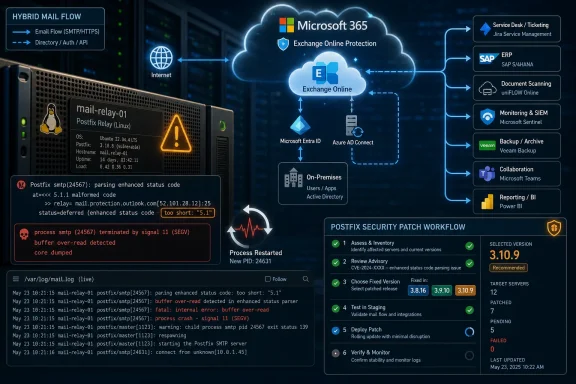 A Small Parser Bug Lands in a Very Large Mail Pipeline
Postfix has earned its reputation by being conservative, well-understood, and boring in the best possible way. It is the kind of mail transfer agent that disappears into the architecture until a queue backs up, a certificate expires, or a mail flow rule begins behaving like an overcaffeinated compliance officer. That is precisely why a vulnerability like CVE-2026-43964 deserves more attention than its short description might seem to invite.The failure mode is narrow. Postfix can sometimes over-read a buffer when it encounters an enhanced status code that ends after the third number, rather than being followed by explanatory text. In practical terms, the malformed status-like input can crash the affected process, producing an availability problem rather than a data-theft or remote-code-execution scenario.
That distinction matters, but it should not be allowed to shrink the issue into trivia. Mail infrastructure is one of those places where a crash is not merely a crash. It can delay password resets, stop monitoring alerts, block help desk workflows, and create the kind of ambiguous outage that causes three teams to blame each other for an hour before anyone checks the MTA logs.
The affected upstream branches are also telling. The fixed versions are 3.8.16, 3.9.10, and 3.10.9, with newer stable releases also carrying the fix. That spread is a reminder that many organizations do not run the latest Postfix line; they run the version blessed by their Linux distribution, appliance vendor, managed image, or internal gold build.
Microsoft’s Name on the Advisory Is a Sign of the Hybrid Reality
The presence of this CVE in Microsoft’s Security Update Guide may surprise readers who associate MSRC almost exclusively with Windows, Edge, Office, Exchange, and Azure platform vulnerabilities. But the modern Microsoft estate is no longer a monoculture, and Microsoft’s security communications increasingly reflect that. Azure runs Linux at enormous scale, Microsoft Defender for Endpoint and Defender Vulnerability Management track non-Windows software, and Windows administrators are routinely responsible for services that live one SSH session away.That does not make CVE-2026-43964 a Windows patch. It does mean that a Windows-centric operations team can still own the risk. The mail relay sitting between a multifunction printer fleet and Exchange Online may be a small Debian VM. The SMTP hop feeding a legacy ERP system may be a RHEL clone. The developer test environment may use Postfix inside WSL or containers. None of those placements changes the CVE’s technical scope, but all of them change who gets paged when mail stops moving.
This is the quiet shift in enterprise security: the operating-system boundary is less useful than the service boundary. If Postfix handles business mail flow, it belongs in the same risk conversation as Exchange receive connectors, Microsoft 365 transport rules, DNS records, TLS settings, and spam-filtering gateways. The service is email; the implementation is merely where the bug happens to live.
For Windows admins, the practical message is not “panic about Linux.” It is more mundane and therefore more important: inventory the mail path before the outage teaches it to you. Organizations that cannot quickly answer which Postfix instances are internet-facing, which are internal relays, and which are embedded in appliances have a visibility problem larger than this CVE.
The Severity Debate Says More Than the Score
One of the more interesting details around CVE-2026-43964 is the scoring split. The CNA assessment characterizes the issue as low severity with high attack complexity and low availability impact, while NVD’s enrichment has presented a higher availability-focused score. That disagreement is not just bureaucratic noise. It exposes the tension between theoretical exploit vectors and real-world service dependency.The lower-severity view emphasizes that successful exploitation depends on conditions beyond the attacker’s direct control. The user-supplied text describes exactly that: an attacker may need environmental knowledge, better positioning, or a man-in-the-middle role to improve reliability. That is not the usual shape of a point-and-shoot internet worm, and defenders should resist treating every CVE entry as if it were one.
The higher-severity view looks at the network-accessible nature of mail infrastructure and the potential availability impact. From that perspective, a process crash in a mail transfer path can be operationally meaningful even if it does not yield code execution. Security scoring systems have always struggled with this distinction: they are good at describing components and vectors, less good at capturing business dependence.
Both readings can be true. A bug can be technically constrained and operationally annoying. It can be hard to exploit at will and still worth patching quickly in environments where email is part of authentication, monitoring, alerting, or revenue workflow.
That is why mature vulnerability management teams do not merely sort by CVSS. They ask whether the affected service is exposed, whether the triggering input can realistically reach it, whether the process restarts cleanly, whether queueing absorbs the failure, and whether monitoring would detect repeated crashes. CVE-2026-43964 is a good test of whether an organization’s vulnerability process can reason beyond a red-yellow-green dashboard.
The Exploit Path Is Narrow, but Mail Is Full of Weird Paths
The Postfix announcement text matters because it narrows where the bug can be triggered. The maintainer guidance indicates that it cannot be triggered by a normal SMTP or LMTP server response, while it has been confirmed in some non-SMTP paths such as access-table handling and DNSBL TXT response handling under particular configurations. Other possible trigger points include policy-server responses, pipe-to-command output, header or body checks, error transports, or milter responses.That subtlety is the entire story. This is not a generic “send a bad SMTP response and crash every Postfix server” bug. It is a parser edge case that becomes relevant when Postfix consumes enhanced status code material from places administrators may not think of as hostile input.
DNSBL integration is a particularly good example. Many mail systems consult real-time block lists and incorporate returned text into rejection messages. If a configuration combines status codes and remote text in a vulnerable way, input from an external DNSBL response path may become part of the attack surface. That does not automatically make exploitation easy, but it does turn a supporting service into a dependency worth checking.
Policy servers and milters create similar ambiguity. They are often deployed to add intelligence to mail flow: rate limiting, spam filtering, DKIM signing, compliance checks, greylisting, or custom business logic. But every extension point is also a trust boundary, and trust boundaries have a habit of eroding over years of “just one more integration.”
The phrase enhanced status code sounds harmless because it belongs to mail’s administrative grammar. These codes are meant to make delivery failures more machine-readable, giving systems structured reasons for rejection, deferral, or failure. But parsers are parsers, and a parser that assumes optional text exists after a numeric pattern can be tripped by the kind of malformed edge case that production systems eventually encounter.
This Is a Denial-of-Service Bug, Not a Breach Story
There is no evidence in the public description that CVE-2026-43964 enables remote code execution, privilege escalation, mailbox compromise, or message disclosure. The impact described is a buffer over-read and process crash. That places the vulnerability in the availability bucket, not the confidentiality or integrity bucket.That should keep the response proportionate. This is not another Exchange emergency where administrators should assume active exploitation until proven otherwise. It is not a mass compromise event. It is not a reason to rebuild mail servers from scratch or rotate every credential in the environment.
But availability bugs still matter, especially in email. A crashing Postfix process may be restarted by master process supervision, systemd, container orchestration, or a service wrapper. That resilience can turn a crash into a log entry rather than an outage. Yet repeated triggers can still degrade service, create delivery delays, or mask other problems.
The right operational question is therefore not “Can this destroy us?” It is “Can this make mail unreliable at the worst possible time?” For hospitals, manufacturers, law firms, MSPs, schools, and public-sector agencies, delayed or failed email can be more than an inconvenience. It can interrupt identity workflows, support escalation, procurement, and incident response.
That is the irony of low-drama infrastructure vulnerabilities. They rarely make cinematic headlines, but they attack the connective tissue. The blast radius is defined less by the CVE text than by what the organization has quietly built on top of SMTP.
Patch Management Gets Complicated When the Package Is Not Yours
The upstream fix is straightforward: move to a fixed Postfix release in the relevant branch. The operational path may be less straightforward, because many organizations do not install Postfix directly from upstream source. They consume it from Debian, Ubuntu, Red Hat, SUSE, appliance vendors, container images, Plesk-like hosting stacks, mail security gateways, or managed service templates.That packaging layer can create confusion. A distribution may backport a fix without changing the visible upstream version to 3.8.16, 3.9.10, or 3.10.9. Another may mark the issue as minor and delay a dedicated security advisory. A container image may remain vulnerable because the base image was not rebuilt. A virtual appliance may require vendor firmware rather than a normal package update.
This is where Windows administrators often get tripped up when managing Linux-adjacent infrastructure. The habit learned from Windows Update is to look for a KB or cumulative update. In Linux mail systems, the answer may be a patched package with a distro-specific revision, a vendor advisory, or a container rebuild tied to an image digest. Version-number matching alone can be misleading.
The safest approach is to validate through the package vendor’s advisory and changelog, not merely through
postconf -d mail_version or a scanner banner. If the system is under configuration management, the fixed package should be promoted through the same path as any other infrastructure dependency. If it is not under configuration management, CVE-2026-43964 is a useful excuse to fix that larger problem.For appliances and managed services, the task shifts from patching to accountability. Ask the vendor whether the product includes Postfix, which branch it tracks, whether CVE-2026-43964 is applicable, and which release contains the fix. That may sound tedious, but it is better than discovering during an audit that the “mail appliance” is simply an aging Linux box with a glossy web UI.
Windows Shops Should Look Beyond Exchange
Most Windows-heavy organizations have a mental map of email that starts with Exchange Server or Exchange Online. That map is increasingly incomplete. Postfix may be used as a smart host, edge relay, outbound sanitizer, inbound filtering layer, application relay, lab server, or emergency queueing node. It may also exist in places nobody calls “mail infrastructure,” such as monitoring platforms and network appliances.The obvious places to check are internet-facing MX hosts and any relay allowed to send to or through Microsoft 365. But the less obvious places can be just as important. Multifunction printers often send scan-to-email through an internal relay. Backup systems send job reports. SIEMs send alerts. Legacy applications send invoices or password reset links through a local SMTP host that nobody has logged into since the migration to cloud email.
Hybrid Exchange environments deserve particular scrutiny. A Postfix relay might sit between internal applications and Exchange Online to handle TLS requirements, rewrite sender addresses, throttle flows, or preserve compatibility with older systems. If that relay becomes unreliable, the outage may look like a Microsoft 365 mail-flow problem even though Microsoft’s service is healthy.
Developers and test environments also count. Postfix images are commonly used in local or CI environments to test mail output. A vulnerable development container is not the same risk as a production relay, but stale images can become templates, and templates have a way of graduating into production under deadline pressure. Security teams should treat image hygiene as part of the same inventory problem.
This is why the CVE’s Microsoft appearance is useful even if the affected code is not Microsoft’s. It pushes Windows-oriented teams to widen their perimeter from “Microsoft products we patch” to “services our Microsoft estate depends on.” That is a healthier model for 2026.
Configuration Determines Whether the Bug Is Reachable
The most important phrase in the user-supplied description is that a successful attack depends on conditions beyond the attacker’s control. That line is not boilerplate; it is the difference between an urgent edge-facing emergency and a targeted configuration-dependent availability risk. Exploitation may require knowledge of how the target uses policy servers, DNSBL responses, access maps, milters, or other Postfix extension points.Administrators should therefore resist two bad instincts. The first is to dismiss the issue because it is not trivially exploitable. The second is to treat every Postfix instance as equally exposed. The truth is in the configuration.
A basic internal relay with minimal policy integration may have a very different risk profile from a busy internet-facing gateway that uses DNSBLs, custom checks, and third-party filtering hooks. A system that sanitizes or controls its status-code generation may be less exposed than one that incorporates text from external sources. A relay behind strict network controls may be less attractive than one directly reachable from the internet.
The process-crash behavior also depends on service supervision and traffic. Postfix is built as a collection of cooperating processes, and a crash in one process does not necessarily mean the whole service dies. That architecture limits the damage, but it does not erase it. Repeated process failures can still impair throughput, generate alert storms, or create subtle delivery delays.
The best response is a small, disciplined review. Identify affected hosts, confirm package status, examine whether enhanced status-code text can be influenced by external inputs, and look for repeated crashes or abnormal rejections in logs. That is not glamorous work, but it is exactly the work that turns a CVE from a headline into a closed ticket.
The Oldest Bugs Are Often the Most Ordinary Ones
The Postfix advisory notes that the defect dates back many years, reportedly to a change introduced in the mid-2000s. That is not unusual. Mature infrastructure projects carry enormous amounts of old, battle-tested code, and battle-tested does not mean mathematically perfect. It means the software has survived common use cases long enough that the remaining bugs are often buried in rare edge conditions.This is one reason mail software is difficult to secure. SMTP is old, flexible, and surrounded by decades of extensions, conventions, anti-spam mechanisms, and compatibility hacks. The main protocol may look simple, but real mail flow involves DNS, TLS, authentication, content filtering, reputation systems, policy callbacks, and downstream delivery semantics.
In that ecosystem, a missing bit of text after a three-number code is not absurd. It is the kind of malformed or minimally formed input that a robust parser should handle, but it is also the kind of edge case that can sit unnoticed for a long time because ordinary systems tend to produce ordinary strings. Security research often advances by asking what happens when ordinary assumptions are removed.
The uncomfortable part for administrators is that old bugs do not respect old risk decisions. A relay that was safely designed ten years ago may now sit in a different environment, with different integrations and different exposure. The code may be old, the configuration may be old, and the business dependence may be much larger than anyone remembers.
That is why “we have run this forever” is not a security argument. It is an uptime anecdote. CVE-2026-43964 is not a condemnation of Postfix; it is a reminder that mature infrastructure still needs active maintenance precisely because it is so trusted.
Scanners Will Find the Version, but Humans Must Find the Dependency
Vulnerability scanners will likely flag affected Postfix versions, and that is useful. But a scanner finding is only the beginning of the work. It can tell an administrator that a package appears vulnerable; it cannot reliably explain whether that host is a critical mail relay, a dormant lab system, a container layer, or an appliance component hidden behind a vendor interface.The difference matters for prioritization. An internet-facing Postfix gateway handling inbound mail for executives deserves attention before a powered-off lab VM. A relay used by identity systems for password resets may deserve attention before a general notification server. A system that integrates with DNSBL text in the relevant way may deserve closer review than a minimalist local-only relay.
This is where asset management either pays off or collapses. If a configuration database knows which applications depend on which SMTP relays, remediation can be ordered intelligently. If the organization only has a subnet scan and a spreadsheet from last year’s audit, the team will patch whatever is easiest to reach and hope the important systems are included.
For WindowsForum readers, this should sound familiar. The same pattern appeared in Exchange emergency patching, PrintNightmare triage, OpenSSL inventory work, Log4j response, and countless VPN appliance advisories. The technical bug changes; the operational bottleneck is always knowing what you run and why it matters.
Security teams should also watch for false comfort in vendor branding. A “Microsoft-first” environment can still rely on Postfix. An “Exchange Online-only” organization can still have a Postfix smart host for printers and applications. A “cloud-native” service can still ship a container image with an old MTA used for notifications. The dependency graph is the product now.
The Fix Is Easy; the Proof Is the Hard Part
Installing a fixed Postfix package is not typically a dramatic change. Compared with major Exchange cumulative updates or Windows Server in-place upgrades, updating a mail relay package can be routine. The harder part is proving that every relevant instance has been found, updated, restarted, and tested without breaking mail flow.Testing should include the boring basics. Confirm that the Postfix service is running after update, that queues are draining, that inbound and outbound paths work, that TLS and authentication settings remain intact, and that monitoring sees the host correctly. In hybrid environments, confirm that Microsoft 365 connectors, SPF/DKIM/DMARC expectations, and any IP-based allow lists still match reality.
Administrators should also review logs after patching. A sudden absence of mail after a “successful” package update is not success. Neither is a relay that accepts mail locally but cannot forward it because a chroot path, certificate reference, or policy daemon changed behavior during a distro update. Security fixes are only complete when service behavior has been validated.
For containerized deployments, rebuilding from a patched base image is not enough if the old image is still running somewhere. Teams need to redeploy, verify the running digest, and clean up stale replicas. For immutable infrastructure, the fixed image should replace the vulnerable one in the deployment pipeline, not merely exist in a registry.
And for vendor appliances, proof may come in the form of a vendor release note or support statement. If the vendor cannot say whether Postfix is present or affected, that is useful information too. It may not solve today’s CVE, but it tells the organization something about the transparency of a product it trusts with mail.
The Mail Relay Is Where Low-Severity Bugs Become Business Problems
CVE-2026-43964 is easy to underestimate because it lacks the ingredients of a blockbuster security story. There is no remote shell, no stolen token, no ransomware affiliate, no wormable Windows service, and no emergency out-of-band patch cycle. There is just a parser edge case in a widely deployed MTA that can crash a process under particular conditions.But email is a dependency multiplier. A mail relay can sit under identity, finance, monitoring, customer communication, legal notices, and IT operations. When it becomes unreliable, the failure may surface in systems far above it, often with misleading symptoms.
That is why the right response is neither alarm nor apathy. Patch the affected versions, but also use the advisory as a reason to examine mail-flow architecture. Know which relays are exposed, which consume untrusted status text, which depend on external DNSBL or policy responses, and which business systems would fail quietly if SMTP stopped working.
The strategic point is larger than Postfix. Infrastructure risk increasingly lives in the seams between platforms. Microsoft publishes the advisory, Linux ships the package, a mail appliance embeds the daemon, Windows admins own the business service, and users experience only the outage. CVE-2026-43964 is a small vulnerability in code, but a clean example of how modern IT risk is distributed.
The Practical Read for WindowsForum Operators
The useful response to CVE-2026-43964 is a short, concrete operational pass rather than a sprawling incident. Treat it as a mail-infrastructure hygiene check with a security deadline attached. The organizations that do best here will be the ones that already know where Postfix is hiding.- Confirm whether any production, staging, lab, appliance, container, or WSL-based environment runs Postfix before 3.8.16, 3.9.10, or 3.10.9.
- Prioritize internet-facing relays, Microsoft 365 or Exchange smart hosts, and systems that support authentication, monitoring, ticketing, or business-critical application email.
- Check distribution and vendor advisories rather than relying only on upstream version strings, because patched packages may carry backported fixes.
- Review Postfix configurations that use DNSBL text, access tables, policy servers, milters, header checks, body checks, pipe transports, or other extension points that may influence status-code handling.
- Validate mail flow after patching by testing queue drainage, delivery paths, TLS behavior, Microsoft 365 connector assumptions, and monitoring alerts.
- Record the dependency map while it is fresh, because the next mail-related CVE will be faster to triage if the organization already knows which systems rely on each relay.
References
- Primary source: MSRC
Published: 2026-06-04T01:42:06-07:00
Security Update Guide - Microsoft Security Response Center
 msrc.microsoft.com
- Related coverage: sentinelone.com
CVE-2026-43964: Postfix DOS Vulnerability
CVE-2026-43964 is a denial of service vulnerability in Postfix. Learn about its impact, affected versions, and mitigation methods.www.sentinelone.com
- Related coverage: thehackerwire.com
CVE-2026-43964 - Low Vulnerability - TheHackerWire
TheHackerWire - Your daily source for cybersecurity news, CVE alerts, hacking tutorials, and security tool reviews. Stay ahead of cyber threats.www.thehackerwire.com
- Related coverage: mondoo.com
UBUNTU-CVE-2026-43964 | Mondoo Vulnerability Intelligence
UBUNTU-CVE-2026-43964 - HIGH severity: Postfix before 3.8.16, 3.9 before 3.9.10, and 3.10 before 3.10.9 sometimes allows a buffer over-read and process crash...mondoo.com - Related coverage: feedly.com
Latest Postfix Vulnerabilities
Track the latest Postfix vulnerabilities and their associated exploits, patches, CVSS and EPSS scores, proof of concept, links to malware, threat actors, and MITRE ATT&CK TTP informationfeedly.com - Related coverage: postfix.org
- Related coverage: dbugs.ptsecurity.com
CVE-2026-43964 — DoS in Postfix+4 Postfix+4 | dbugs
Details on CVE-2026-43964: DoS in Postfix+4 Postfix+4. Includes CVSS score, affected versions, and references.dbugs.ptsecurity.com - Related coverage: secualive.jp
Secualive
ウェブアプリケーション診断、セキュリティに関する情報を提供しているサイトです。すぐに脆弱性診断を実施したい、予算が少ないが診断が必要な場合はSecuAliveが解決できます。secualive.jp
