

Microsoft disclosed CVE-2026-45487 on June 9, 2026, as a Windows Program Compatibility Assistant Service elevation-of-privilege vulnerability, a local Windows flaw whose public advisory emphasizes confidence in the bug’s existence while withholding the kind of root-cause detail defenders and attackers both want. The advisory is not loud in the way a wormable remote-code-execution bug is loud. But it lands in a class of Windows vulnerabilities that routinely matters after the first foothold has already been gained. The real story is not just the service named in the CVE; it is Microsoft’s increasingly careful language around what is known, what is public, and how quickly attackers can convert that knowledge into working privilege escalation.
The Program Compatibility Assistant is one of those Windows components most users notice only when something old, unsigned, badly manifested, or confused by modern Windows rules refuses to behave. Its job is pragmatic: watch applications, detect common compatibility failures, and suggest or apply mitigations such as compatibility modes or administrative handling. In enterprise environments, administrators can control or disable parts of that behavior through policy, but the feature exists because Windows still carries an enormous burden of legacy software expectations.
That makes PCA a classic Windows compromise: a convenience layer built to smooth over the friction between old assumptions and modern security boundaries. It observes programs, reasons about failures, and interacts with compatibility settings that can affect how software launches. None of that means the service is inherently dangerous, but it does mean the component sits closer to process-launch behavior, app metadata, and administrative expectations than its friendly name implies.
Elevation-of-privilege vulnerabilities are especially uncomfortable in such plumbing. A local attacker usually needs some existing execution path first, but once that condition is met, an EoP bug can turn a limited account, a compromised browser process, or a low-rights service context into a much more serious breach. In Windows incident response, this is often the difference between “malware ran” and “the machine is no longer trustworthy.”
CVE-2026-45487 therefore deserves attention even if the public record is thin. The advisory’s sparse technical description is itself part of the signal. Microsoft is telling administrators that the vulnerability is real enough to track and patch, while not publishing enough implementation detail to make the bug trivially reproducible from the advisory alone.
That distinction matters. A vulnerability can be confirmed by the vendor while still being opaque to most defenders and attackers. Conversely, a vulnerability can circulate in rumor, proof-of-concept fragments, or third-party analysis before anyone is certain that the reported root cause is correct. The confidence metric is Microsoft’s way of expressing where CVE-2026-45487 sits on that spectrum.
For defenders, high confidence means the patch should not be treated as speculative housekeeping. For attackers, high confidence means the target is probably worth diffing. The more certain a vendor is that a vulnerability exists, the more attractive the patched binaries become to researchers trying to determine what changed between builds.
That is why confidence is not a passive metadata field. It is a tempo marker. It tells enterprise patch teams how seriously to prioritize the issue, but it also tells exploit developers that the advisory is not vapor. The race begins when the patch ships, not when Microsoft publishes a full root-cause write-up.
Most real intrusions are chains, not single events. A phishing attachment, malicious installer, browser exploit, stolen VPN credential, or exposed service account may provide initial code execution. The attacker then needs persistence, credential access, lateral movement, and higher privileges. Local EoP vulnerabilities are the connective tissue between those stages.
A Program Compatibility Assistant Service bug is not the obvious nightmare scenario of a public-facing server being popped over the network. It is more likely to matter on workstations, jump boxes, developer machines, shared desktops, or servers where an attacker already has a beachhead. That makes it operationally relevant precisely because those systems are where privilege boundaries are frequently stressed.
The uncomfortable lesson is that “local” does not mean “low risk.” It means “post-compromise useful.” In 2026, that is a large category of useful.
That mission puts PCA at an awkward intersection. It has to understand user-launched programs, compatibility shims, manifests, installer behavior, and cases where applications fail because they lacked the rights they assumed they had. A vulnerability in that neighborhood is immediately interesting because compatibility features often exist to bend normal execution rules without breaking the user experience.
This does not mean CVE-2026-45487 allows automatic administrator access through a compatibility dialog. The public advisory does not give enough detail to say that, and responsible analysis should not pretend otherwise. But the component’s role gives defenders a useful mental model: this is not an obscure codec parser or abandoned optional feature; it is part of the machinery Windows uses to keep desktop applications working across generations.
That is why disabling PCA is not a universal answer. Some enterprises may already suppress user-facing PCA prompts or tightly manage compatibility settings for performance, standardization, or security reasons. But policy control is not the same thing as remediation. If Microsoft has patched a vulnerable service component, administrators should assume the supported fix is the update, not a clever registry posture that may only change the visible behavior.
But the other side of the ledger is exploit acceleration. A beautifully detailed advisory can become a blueprint. If the public text names the vulnerable interface, the required inputs, and the failed validation path, it may save defenders time while saving attackers more. Microsoft’s current approach often chooses operational ambiguity over technical transparency, especially when patches are fresh.
CVE-2026-45487 falls into that pattern. The advisory identifies the Windows component and impact category, but the surrounding metric language is more explicit about confidence than mechanics. That is not satisfying, but it is meaningful. Microsoft appears to be saying: we know enough to fix it, we are confident enough to disclose it, and we are not going to publish the exploit recipe on day one.
The practical result is a familiar burden shift. Enterprises cannot wait for a perfect public explanation before acting. They have to make deployment decisions from incomplete information, using severity, exploitability, asset exposure, and business tolerance as the guide.
For a service-level EoP, exploit development may still require local access, reliable triggering, and environmental assumptions. Those requirements can slow mass exploitation, but they do not eliminate risk. In targeted intrusions, “works on fully patched-minus-one-month Windows 11” can be good enough.
That dynamic should shape rollout policy. The question is not whether every CVE becomes weaponized. Most do not. The question is whether the affected component and impact make the bug attractive enough to prioritize before routine patch windows drift into weeks. PCA may not be fashionable branding, but it is native Windows code in a privilege-sensitive area.
Administrators should also remember that public exploit availability is a lagging indicator. By the time a proof of concept appears on a repository, in a red-team toolkit, or in commodity malware, the defensive window has already narrowed. Patch diffing rewards speed, and slow enterprise deployment is exactly what it feeds on.
Workstations are also where local privilege escalation delivers disproportionate value. They hold browser sessions, cached credentials, developer tokens, VPN clients, password managers, synchronization tools, and administrative consoles. A low-privilege foothold on a workstation can become a domain problem if the attacker can escalate, dump secrets, or hijack privileged workflows.
That does not excuse servers from attention. Windows Server systems can still carry desktop components, compatibility infrastructure, and administrative usage patterns that surprise inventory teams. But the first operational move should be to map the affected Windows builds in the endpoint estate, especially unmanaged devices, long-lived lab machines, kiosks, and systems that routinely run old line-of-business software.
There is also a policy wrinkle. Organizations that have aggressively managed PCA may have less visible user interaction with the feature, but they should not assume invisibility equals immunity. A vulnerable service can exist even when its prompts are suppressed. The difference between an exposed code path and a user-facing workflow is exactly the kind of nuance a terse advisory will not resolve for you.
The right response is disciplined acceleration. Security teams should move it ahead of low-impact application fixes, fold it into the current Windows cumulative update deployment, and watch for any change in exploitability assessment. If Microsoft later updates the advisory with evidence of exploitation or more precise technical detail, the priority calculus changes.
For managed fleets, the hard part is not knowing whether to patch. It is sequencing the patch through rings without creating unnecessary operational outages. PCA touches compatibility, and compatibility is where older enterprise applications sometimes get superstitious. Test rings should include machines that run legacy installers, custom launchers, industrial software, old control-panel utilities, and internally packaged applications that rely on compatibility shims.
That testing should not become an excuse for indefinite delay. The cumulative-update model means organizations are rarely choosing one fix in isolation. Deferring the update because one component sounds obscure also defers unrelated security fixes in the same package. In modern Windows servicing, the patch bundle is the unit of risk.
That advice may sound boring, but boring is underrated. Windows security in 2026 is full of sophisticated mitigations, virtualization-backed protections, and cloud telemetry, yet the basic patch-and-reboot cycle remains the line between a known fixed bug and an avoidable compromise. The fact that a vulnerability has a CVE means defenders no longer get to call it theoretical.
Users should also resist the instinct to treat compatibility prompts as harmless background noise. PCA exists to help old software run, but any workflow that asks a user to rerun a program, apply compatibility settings, or approve elevation deserves attention. The presence of this CVE does not mean those prompts are malicious; it means the broader compatibility layer is security-relevant.
The safest posture is simple: update Windows, run current software, and be skeptical of legacy utilities that demand administrative rights without a clear reason. That combination blocks more real-world compromise chains than any single clever tweak.
The old model of vulnerability disclosure imagined a relatively linear path: researcher reports bug, vendor confirms, patch ships, details emerge. The modern model is messier. Binary diffing, AI-assisted reverse engineering, vulnerability databases, exploit prediction, and red-team tooling all compress the time between disclosure and weaponization. Even sparse advisories become inputs.
That is why Microsoft’s careful phrasing matters. When the company says a metric reflects confidence in the existence of the vulnerability and credibility of technical details, it is acknowledging that disclosure is not binary. There are degrees of knowledge, and those degrees affect urgency.
For Windows administrators, the lesson is to read advisory metadata as operational intelligence, not decoration. Confidence, exploitability, attack vector, privileges required, user interaction, and affected product tables are all imperfect. Together, they form the decision surface for patch prioritization.
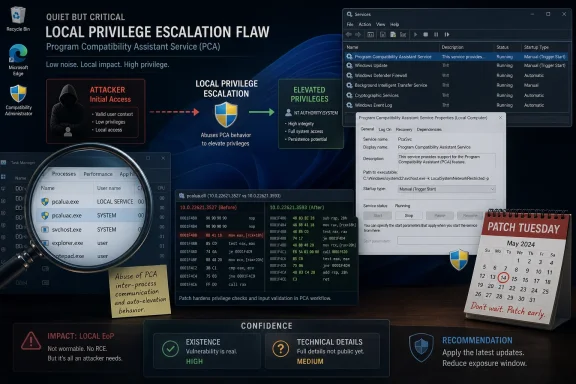 Microsoft’s Compatibility Helper Becomes Part of the Attack Surface
The Program Compatibility Assistant is one of those Windows components most users notice only when something old, unsigned, badly manifested, or confused by modern Windows rules refuses to behave. Its job is pragmatic: watch applications, detect common compatibility failures, and suggest or apply mitigations such as compatibility modes or administrative handling. In enterprise environments, administrators can control or disable parts of that behavior through policy, but the feature exists because Windows still carries an enormous burden of legacy software expectations.That makes PCA a classic Windows compromise: a convenience layer built to smooth over the friction between old assumptions and modern security boundaries. It observes programs, reasons about failures, and interacts with compatibility settings that can affect how software launches. None of that means the service is inherently dangerous, but it does mean the component sits closer to process-launch behavior, app metadata, and administrative expectations than its friendly name implies.
Elevation-of-privilege vulnerabilities are especially uncomfortable in such plumbing. A local attacker usually needs some existing execution path first, but once that condition is met, an EoP bug can turn a limited account, a compromised browser process, or a low-rights service context into a much more serious breach. In Windows incident response, this is often the difference between “malware ran” and “the machine is no longer trustworthy.”
CVE-2026-45487 therefore deserves attention even if the public record is thin. The advisory’s sparse technical description is itself part of the signal. Microsoft is telling administrators that the vulnerability is real enough to track and patch, while not publishing enough implementation detail to make the bug trivially reproducible from the advisory alone.
The Confidence Metric Is Doing More Work Than It Looks
The text attached to the metric in Microsoft’s advisory language is unusually revealing. It describes confidence as a measure of both the vulnerability’s existence and the credibility of the known technical details. In plain English, Microsoft is separating “we believe this is a real bug” from “the public knows exactly how this bug works.”That distinction matters. A vulnerability can be confirmed by the vendor while still being opaque to most defenders and attackers. Conversely, a vulnerability can circulate in rumor, proof-of-concept fragments, or third-party analysis before anyone is certain that the reported root cause is correct. The confidence metric is Microsoft’s way of expressing where CVE-2026-45487 sits on that spectrum.
For defenders, high confidence means the patch should not be treated as speculative housekeeping. For attackers, high confidence means the target is probably worth diffing. The more certain a vendor is that a vulnerability exists, the more attractive the patched binaries become to researchers trying to determine what changed between builds.
That is why confidence is not a passive metadata field. It is a tempo marker. It tells enterprise patch teams how seriously to prioritize the issue, but it also tells exploit developers that the advisory is not vapor. The race begins when the patch ships, not when Microsoft publishes a full root-cause write-up.
Local Bugs Still Win Enterprise Intrusions
Security teams often triage by distance. Remote unauthenticated vulnerabilities get the red lights; local privilege-escalation flaws get pushed into the second wave. That instinct is understandable, but it is also one of the ways Windows fleets get quietly burned.Most real intrusions are chains, not single events. A phishing attachment, malicious installer, browser exploit, stolen VPN credential, or exposed service account may provide initial code execution. The attacker then needs persistence, credential access, lateral movement, and higher privileges. Local EoP vulnerabilities are the connective tissue between those stages.
A Program Compatibility Assistant Service bug is not the obvious nightmare scenario of a public-facing server being popped over the network. It is more likely to matter on workstations, jump boxes, developer machines, shared desktops, or servers where an attacker already has a beachhead. That makes it operationally relevant precisely because those systems are where privilege boundaries are frequently stressed.
The uncomfortable lesson is that “local” does not mean “low risk.” It means “post-compromise useful.” In 2026, that is a large category of useful.
PCA’s Purpose Explains Why Administrators Should Not Hand-Wave the Component
The Program Compatibility Assistant exists because Microsoft has spent decades trying to make Windows both stricter and backwards-compatible. Older applications may expect to write into protected directories, modify registry locations they no longer own, launch child updaters with elevated rights, or infer OS behavior from version checks that stopped being reliable years ago. PCA tries to detect those failure modes and offer a survivable path.That mission puts PCA at an awkward intersection. It has to understand user-launched programs, compatibility shims, manifests, installer behavior, and cases where applications fail because they lacked the rights they assumed they had. A vulnerability in that neighborhood is immediately interesting because compatibility features often exist to bend normal execution rules without breaking the user experience.
This does not mean CVE-2026-45487 allows automatic administrator access through a compatibility dialog. The public advisory does not give enough detail to say that, and responsible analysis should not pretend otherwise. But the component’s role gives defenders a useful mental model: this is not an obscure codec parser or abandoned optional feature; it is part of the machinery Windows uses to keep desktop applications working across generations.
That is why disabling PCA is not a universal answer. Some enterprises may already suppress user-facing PCA prompts or tightly manage compatibility settings for performance, standardization, or security reasons. But policy control is not the same thing as remediation. If Microsoft has patched a vulnerable service component, administrators should assume the supported fix is the update, not a clever registry posture that may only change the visible behavior.
Sparse Advisories Are a Security Strategy, Not a Clerical Failure
Microsoft’s Security Update Guide has become terse by design. Administrators often complain that modern CVE entries provide too little: a title, an impact, affected products, severity scoring, exploitability notes, and perhaps a sentence describing a weakness class. The frustration is legitimate. Patch teams want to know whether a vulnerability is reachable in their environment, whether a compensating control matters, and whether a reboot can wait.But the other side of the ledger is exploit acceleration. A beautifully detailed advisory can become a blueprint. If the public text names the vulnerable interface, the required inputs, and the failed validation path, it may save defenders time while saving attackers more. Microsoft’s current approach often chooses operational ambiguity over technical transparency, especially when patches are fresh.
CVE-2026-45487 falls into that pattern. The advisory identifies the Windows component and impact category, but the surrounding metric language is more explicit about confidence than mechanics. That is not satisfying, but it is meaningful. Microsoft appears to be saying: we know enough to fix it, we are confident enough to disclose it, and we are not going to publish the exploit recipe on day one.
The practical result is a familiar burden shift. Enterprises cannot wait for a perfect public explanation before acting. They have to make deployment decisions from incomplete information, using severity, exploitability, asset exposure, and business tolerance as the guide.
Patch Diffing Turns Every Fix Into a Clue
The minute a Windows cumulative update ships, the vulnerability becomes more legible to people with the time and skill to compare binaries. Attackers do not need Microsoft to publish a proof of concept if they can inspect patched and unpatched versions of the relevant service, identify changed code paths, and work backward to the vulnerable condition. This is why the days immediately after Patch Tuesday matter.For a service-level EoP, exploit development may still require local access, reliable triggering, and environmental assumptions. Those requirements can slow mass exploitation, but they do not eliminate risk. In targeted intrusions, “works on fully patched-minus-one-month Windows 11” can be good enough.
That dynamic should shape rollout policy. The question is not whether every CVE becomes weaponized. Most do not. The question is whether the affected component and impact make the bug attractive enough to prioritize before routine patch windows drift into weeks. PCA may not be fashionable branding, but it is native Windows code in a privilege-sensitive area.
Administrators should also remember that public exploit availability is a lagging indicator. By the time a proof of concept appears on a repository, in a red-team toolkit, or in commodity malware, the defensive window has already narrowed. Patch diffing rewards speed, and slow enterprise deployment is exactly what it feeds on.
Workstations Are the Natural Blast Radius
The most obvious exposure for CVE-2026-45487 is the Windows client fleet. PCA is fundamentally tied to desktop application behavior, legacy compatibility, installers, and user-launched programs. That points toward endpoints rather than headless server roles as the place where defenders should first think through impact.Workstations are also where local privilege escalation delivers disproportionate value. They hold browser sessions, cached credentials, developer tokens, VPN clients, password managers, synchronization tools, and administrative consoles. A low-privilege foothold on a workstation can become a domain problem if the attacker can escalate, dump secrets, or hijack privileged workflows.
That does not excuse servers from attention. Windows Server systems can still carry desktop components, compatibility infrastructure, and administrative usage patterns that surprise inventory teams. But the first operational move should be to map the affected Windows builds in the endpoint estate, especially unmanaged devices, long-lived lab machines, kiosks, and systems that routinely run old line-of-business software.
There is also a policy wrinkle. Organizations that have aggressively managed PCA may have less visible user interaction with the feature, but they should not assume invisibility equals immunity. A vulnerable service can exist even when its prompts are suppressed. The difference between an exposed code path and a user-facing workflow is exactly the kind of nuance a terse advisory will not resolve for you.
The Enterprise Risk Is in the Patch Queue, Not the Panic Button
CVE-2026-45487 should not trigger theatrical emergency response by itself. There is no public basis, from the available advisory language, to describe it as remotely exploitable, wormable, or already abused in the wild. It is an elevation-of-privilege flaw in a Windows service, and that places it in a serious but familiar category.The right response is disciplined acceleration. Security teams should move it ahead of low-impact application fixes, fold it into the current Windows cumulative update deployment, and watch for any change in exploitability assessment. If Microsoft later updates the advisory with evidence of exploitation or more precise technical detail, the priority calculus changes.
For managed fleets, the hard part is not knowing whether to patch. It is sequencing the patch through rings without creating unnecessary operational outages. PCA touches compatibility, and compatibility is where older enterprise applications sometimes get superstitious. Test rings should include machines that run legacy installers, custom launchers, industrial software, old control-panel utilities, and internally packaged applications that rely on compatibility shims.
That testing should not become an excuse for indefinite delay. The cumulative-update model means organizations are rarely choosing one fix in isolation. Deferring the update because one component sounds obscure also defers unrelated security fixes in the same package. In modern Windows servicing, the patch bundle is the unit of risk.
Home Users Get the Simplest Advice, and It Is Still the Right One
For individual Windows users, CVE-2026-45487 is not a reason to go hunting through Services.msc and disabling things at random. The most reliable defense is to install the current Windows security update when it is offered, restart when required, and avoid running untrusted installers or “compatibility fix” tools from the web. Local privilege escalation usually starts with the user or another exploit getting code onto the machine first.That advice may sound boring, but boring is underrated. Windows security in 2026 is full of sophisticated mitigations, virtualization-backed protections, and cloud telemetry, yet the basic patch-and-reboot cycle remains the line between a known fixed bug and an avoidable compromise. The fact that a vulnerability has a CVE means defenders no longer get to call it theoretical.
Users should also resist the instinct to treat compatibility prompts as harmless background noise. PCA exists to help old software run, but any workflow that asks a user to rerun a program, apply compatibility settings, or approve elevation deserves attention. The presence of this CVE does not mean those prompts are malicious; it means the broader compatibility layer is security-relevant.
The safest posture is simple: update Windows, run current software, and be skeptical of legacy utilities that demand administrative rights without a clear reason. That combination blocks more real-world compromise chains than any single clever tweak.
Microsoft’s Language Shows the New Vulnerability Economy
The most interesting part of CVE-2026-45487 may be the way the advisory frames knowledge. Microsoft is not merely cataloging a bug; it is managing disclosure in an ecosystem where every sentence can be mined by defenders, exploit brokers, bug hunters, ransomware operators, and automated analysis systems. The confidence metric is a small window into that balancing act.The old model of vulnerability disclosure imagined a relatively linear path: researcher reports bug, vendor confirms, patch ships, details emerge. The modern model is messier. Binary diffing, AI-assisted reverse engineering, vulnerability databases, exploit prediction, and red-team tooling all compress the time between disclosure and weaponization. Even sparse advisories become inputs.
That is why Microsoft’s careful phrasing matters. When the company says a metric reflects confidence in the existence of the vulnerability and credibility of technical details, it is acknowledging that disclosure is not binary. There are degrees of knowledge, and those degrees affect urgency.
For Windows administrators, the lesson is to read advisory metadata as operational intelligence, not decoration. Confidence, exploitability, attack vector, privileges required, user interaction, and affected product tables are all imperfect. Together, they form the decision surface for patch prioritization.
The PCA Bug Belongs in This Month’s First Wave
CVE-2026-45487 is not the kind of vulnerability that should dominate every security meeting, but it is exactly the kind that should not be allowed to sink to the bottom of the queue. Its value to an attacker increases after initial access, and that is where many Windows compromises become expensive.- The vulnerability is a Windows Program Compatibility Assistant Service elevation-of-privilege issue disclosed on June 9, 2026.
- The public advisory emphasizes confidence in the vulnerability’s existence without providing detailed root-cause mechanics.
- The likely operational risk is local privilege escalation after an attacker has already obtained code execution on a Windows system.
- Workstations and systems running legacy or compatibility-sensitive software deserve particular attention during update testing.
- Disabling PCA prompts or managing compatibility policy should not be treated as a substitute for applying Microsoft’s security update.
- Patch teams should prioritize the relevant Windows cumulative updates before public exploit details or patch-diff analysis narrow the defensive window.
References
- Primary source: MSRC
Published: 2026-06-09T07:00:00-07:00
Security Update Guide - Microsoft Security Response Center
 msrc.microsoft.com
- Official source: learn.microsoft.com
User Account Control architecture | Microsoft Learn
Learn about the User Account Control (UAC) architecture.learn.microsoft.com - Related coverage: datacomm.com
- Related coverage: threats.kaspersky.com
Kaspersky Threats — KLA88954
threats.kaspersky.com
- Related coverage: rapid7.com
Rapid7 Vulnerability Database
Rapid7's VulnDB is curated repository of vetted computer software exploits and exploitable vulnerabilities.www.rapid7.com - Related coverage: windowsforum.com
CVE-2026-24287: Patch Windows Kernel Elevation of Privilege Now | Windows Forum
Microsoft’s security tracker today lists CVE-2026-24287 as a Windows kernel elevation-of-privilege (EoP) vulnerability that can be abused by an authorized...windowsforum.com
- Related coverage: unit42.paloaltonetworks.com
Microsoft WSUS Remote Code Execution (CVE-2025-59287) Actively Exploited in the Wild (Updated November 3)
CVE-2025-59287 is a critical RCE vulnerability identified in Microsoft’s WSUS. Our observations from cases show a consistent methodology.unit42.paloaltonetworks.com - Related coverage: aha.org
