

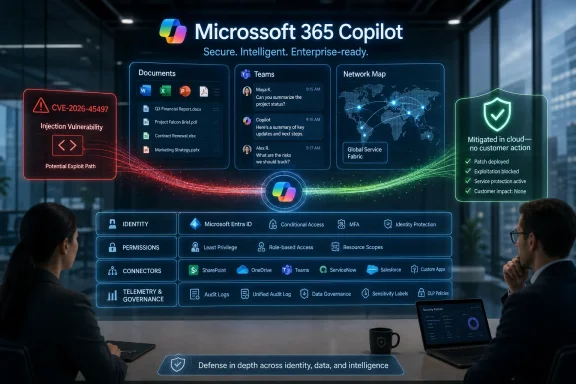
Microsoft disclosed CVE-2026-45497 on June 4, 2026, as a Critical remote code execution vulnerability in Microsoft 365 Copilot caused by command injection, already mitigated in Microsoft’s cloud service with no customer patch or configuration action required. That last clause is the part that should calm administrators, but it should not end the conversation. A server-side fix does not erase the significance of the bug; it changes the shape of the risk from emergency patching to trust, telemetry, and architectural scrutiny. Copilot is no longer a sidebar feature in Office — it is becoming a privileged interface to corporate memory.
The most important operational fact is simple: Microsoft says the vulnerability has already been fully mitigated. There is no KB package to install, no build number to chase, and no admin-center toggle being pushed as a workaround. For tenants consuming Microsoft 365 Copilot as a cloud service, the “patch” happened inside Microsoft’s service boundary.
That is how cloud security advisories increasingly work. The customer sees the CVE after the vulnerable service has been changed, rather than receiving a file, MSI, cumulative update, or monthly Patch Tuesday entry. This can feel unsatisfying to IT teams trained to measure security work in deployment rings and reboot windows, but it is also the bargain Microsoft has been selling for years: software-as-a-service means the vendor can remediate service-side defects faster than most enterprises can schedule a change-control meeting.
The uncomfortable part is that this was not a cosmetic bug. Microsoft classified the issue as Critical, listed the impact as remote code execution, and described the weakness as improper neutralization of command elements — in plain English, command injection. Even with high attack complexity and low required privileges, the category matters because command injection is not a theoretical AI-safety parlor trick. It is one of the oldest ways software turns attacker-controlled text into unintended execution.
Microsoft’s advisory says the vulnerability was not publicly disclosed and was not known to be exploited at the time of publication. It also labels exploit code maturity as unproven. That lowers the immediate panic level, but it does not make the disclosure boring. A Critical RCE in a cloud AI service that touches Microsoft 365 data is exactly the kind of event that tells us where enterprise attack surfaces are moving.
The “high complexity” flag deserves careful reading. It means successful exploitation depends on conditions beyond the attacker’s direct control, not that exploitation is impossible or irrelevant. Many real-world enterprise attacks begin with exactly that kind of constraint: the attacker needs the right tenant configuration, the right identity, the right content path, or the right service behavior to line up.
The low-privilege requirement is also worth dwelling on. In a traditional Windows vulnerability, low privileges might mean a foothold on a box before escalation. In a Microsoft 365 context, low privileges can mean a compromised user account, an over-permissioned test identity, a malicious insider, or a partner account that has just enough access to interact with Copilot. That is not a rare precondition in the era of stolen tokens, OAuth abuse, and identity-centric intrusions.
The changed-scope rating is where administrators should pause. Scope changes when exploiting one component affects resources governed by a different security authority. In a service like Copilot, that is the architectural question in miniature: the assistant is an interface, but it is also a broker among documents, messages, meetings, plugins, search indexes, and tenant-specific permissions. If something goes wrong at that broker layer, the blast radius is not always intuitive.
That does not mean customers should imagine their laptops being instantly taken over by a rogue prompt. The advisory points to Microsoft Copilot as the affected component and Microsoft 365 Copilot as the affected product. The risk belongs to the service environment and whatever downstream systems the vulnerable command path could reach, not to a local Windows executable waiting for a Patch Tuesday reboot.
But command injection in a cloud service can be more subtle than command injection on a local host. The attacker’s goal may not be a persistent implant in the old sense. It may be data access, service manipulation, lateral reach inside connected workflows, or a way to make a trusted automation layer perform an action it should never have performed.
That is why the confidentiality impact being rated high matters more than the availability impact being low. The worst plausible consequence is not that Copilot becomes briefly unavailable; it is that a service designed to understand a tenant’s information estate becomes a path to expose sensitive material. In Microsoft 365, the crown jewels are often not binaries. They are executive email, legal documents, Teams transcripts, SharePoint files, HR spreadsheets, and the permission graph connecting all of it.
It would be an equal mistake to say the AI angle is irrelevant. Microsoft 365 Copilot is not merely another web app with a chatbot bolted on. It is a conversational interface that can reason over organizational content, invoke services, summarize material users did not explicitly open, and sit inside the daily workflow of people who may have broad access without realizing it.
That makes Copilot a new kind of aggregation point. Classic enterprise security often worries about where data is stored. Copilot forces organizations to worry about where data is interpreted. The assistant’s value comes from stitching together context across services, but the security model has to ensure that the stitching never becomes an execution or disclosure primitive.
Prompt injection gets much of the attention in AI security discussions, especially after earlier research showed how crafted content could manipulate assistant behavior. CVE-2026-45497 is a reminder that AI products still contain ordinary code paths, service connectors, parsers, sanitizers, and back-end execution logic. The chatbot is the visible surface; the security boundary is buried underneath it.
But “no action” should not be read as “no review.” For security teams, this is an opportunity to revisit the assumptions around Copilot deployment, especially in organizations that rushed pilots into production. The most important controls around Copilot are not necessarily Copilot-specific; they are identity hygiene, least privilege, sensitivity labeling, data lifecycle management, and logging.
If a vulnerability requires only low privileges, then the quality of those low-privilege accounts matters. If the likely consequence is data exposure, then the state of the tenant’s information governance matters. If the vulnerable component can affect other security scopes, then admin teams need to know which connectors, plugins, agents, and integrations are enabled.
That does not mean every organization should disable Copilot in reaction to this CVE. It means the decision to enable Copilot should be treated as a security architecture decision, not only a productivity rollout. The safest Copilot tenant is not the one that has never had a CVE; it is the one where a Copilot CVE has less to steal, less to invoke, and fewer accidental paths into sensitive workflows.
That is progress, but it is imperfect progress. Traditional CVEs tell administrators what to patch and how urgently to patch it. Cloud CVEs often tell them what already happened inside someone else’s environment. The customer is left to infer whether logs should be reviewed, whether suspicious activity might have occurred before mitigation, and whether similar service components remain exposed.
Microsoft says the issue was not exploited and not publicly disclosed at publication. That is reassuring, but cloud customers have learned to ask a second question: what would they be able to verify independently? In many SaaS incidents, tenant defenders cannot inspect the vulnerable code path, cannot reproduce the issue, and cannot review service-side telemetry beyond what the vendor exposes.
This is the new asymmetry of cloud security. Microsoft can fix quickly because it controls the service. Customers can respond slowly because they do not control, and often cannot see, the service. Better transparency helps, but it does not fully replace actionable tenant-level evidence.
Many organizations have years of inherited SharePoint permissions, stale Teams membership, overshared OneDrive folders, broad distribution lists, and legacy groups whose purpose nobody remembers. Copilot does not create those problems, but it can make them easier to discover and use. A vulnerability that affects Copilot therefore lands in an ecosystem where the line between “allowed access” and “appropriate access” is already blurry.
That is why the low-privilege condition in CVE-2026-45497 should not lull administrators. Low-privilege accounts in Microsoft 365 are not powerless. They can often read, search, share, create, invite, run add-ins, consent to apps within policy, interact with agents, and trigger workflows. In a mature tenant those abilities are constrained. In a messy tenant they become an attacker’s starting kit.
The security posture around Copilot should start with the boring work. Review external sharing. Clean up sensitive sites. Enforce conditional access. Limit app consent. Monitor anomalous search and access patterns. Make sure labels and data loss prevention policies reflect reality rather than a compliance slide deck from two years ago. AI security is glamorous only after the basics have failed.
But defenders should understand what such labels can and cannot promise. They describe Microsoft’s knowledge at publication, not an eternal state of the world. They do not mean nobody ever encountered the vulnerable path. They do not mean similar flaws do not exist elsewhere. They do not mean attackers will ignore the advisory now that the weakness class and product area are public.
The value of a CVE to attackers is not always the specific exploit. Sometimes it is a map of where vendors are finding weaknesses. A Critical command-injection flaw in Copilot tells offensive researchers that the glue between natural-language interfaces and back-end execution remains a rich target. Even after this particular bug is gone, the design pattern will be studied.
That is especially true because Microsoft credited internal researchers. Internal discovery often means the public receives fewer technical details than it would after an outside research write-up. That is safer in the short term, but it also means defenders get less color about exploit preconditions, detection opportunities, and tenant-level indicators.
That does not make Windows administrators irrelevant. It makes their job broader. The modern Windows estate is tied to Entra ID, Microsoft 365, Defender, Purview, SharePoint, Teams, Exchange Online, and a growing set of Copilot experiences. A vulnerability in a cloud assistant can affect the same users, data, and business processes that administrators are responsible for protecting on the endpoint.
The endpoint still matters because identity compromise usually starts somewhere. Phishing, token theft, malicious browser extensions, unmanaged devices, and session hijacking all feed into cloud-service risk. If a vulnerability requires an authorized attacker, then endpoint and identity defenses are part of the exploit chain whether or not the vulnerable code runs on Windows.
The management mindset has to change accordingly. Patch compliance remains necessary, but it is no longer enough. Administrators need dashboards that show risky OAuth grants, overexposed files, impossible travel, privileged role activation, anomalous Copilot usage, and suspicious automation. The boundary between Windows security and Microsoft 365 security is now mostly an accounting fiction.
A better response is to ask what this CVE would have meant if exploitation had occurred. Which users have Copilot licenses? Which departments use it heavily? Which high-value repositories are visible to those users? Which plugins, connectors, or agents are enabled? Are prompts and responses logged in a way security teams can actually use? Are Purview and Defender signals being reviewed together, or do they live in separate consoles owned by separate teams?
Organizations should also revisit how they communicate these advisories internally. Executives may hear “Critical remote code execution” and assume emergency downtime. Administrators may hear “no customer action” and assume no risk. Security leaders need to bridge the gap: this was fixed by Microsoft, there is no patch to deploy, but the class of issue reinforces why Copilot governance matters.
The best security review after this CVE is not a hunt for a nonexistent KB. It is a tenant-readiness exercise. If the next Copilot vulnerability involved confirmed exploitation, would the organization know what was exposed, who touched it, and how to contain the affected identities and data paths?
 Microsoft Fixed the Fire Before Publishing the Smoke
The most important operational fact is simple: Microsoft says the vulnerability has already been fully mitigated. There is no KB package to install, no build number to chase, and no admin-center toggle being pushed as a workaround. For tenants consuming Microsoft 365 Copilot as a cloud service, the “patch” happened inside Microsoft’s service boundary.That is how cloud security advisories increasingly work. The customer sees the CVE after the vulnerable service has been changed, rather than receiving a file, MSI, cumulative update, or monthly Patch Tuesday entry. This can feel unsatisfying to IT teams trained to measure security work in deployment rings and reboot windows, but it is also the bargain Microsoft has been selling for years: software-as-a-service means the vendor can remediate service-side defects faster than most enterprises can schedule a change-control meeting.
The uncomfortable part is that this was not a cosmetic bug. Microsoft classified the issue as Critical, listed the impact as remote code execution, and described the weakness as improper neutralization of command elements — in plain English, command injection. Even with high attack complexity and low required privileges, the category matters because command injection is not a theoretical AI-safety parlor trick. It is one of the oldest ways software turns attacker-controlled text into unintended execution.
Microsoft’s advisory says the vulnerability was not publicly disclosed and was not known to be exploited at the time of publication. It also labels exploit code maturity as unproven. That lowers the immediate panic level, but it does not make the disclosure boring. A Critical RCE in a cloud AI service that touches Microsoft 365 data is exactly the kind of event that tells us where enterprise attack surfaces are moving.
The Score Says High Complexity; the Product Says High Stakes
The CVSS vector for CVE-2026-45497 is a study in tension. On one side, the base score is 7.7, attack complexity is high, and the attacker needs low privileges. On the other, the attack vector is network-based, user interaction is not required, scope is changed, and confidentiality impact is high. The temporal score drops to 6.7 because Microsoft says an official fix exists and exploitation is unproven, but the base conditions still describe a serious class of failure.The “high complexity” flag deserves careful reading. It means successful exploitation depends on conditions beyond the attacker’s direct control, not that exploitation is impossible or irrelevant. Many real-world enterprise attacks begin with exactly that kind of constraint: the attacker needs the right tenant configuration, the right identity, the right content path, or the right service behavior to line up.
The low-privilege requirement is also worth dwelling on. In a traditional Windows vulnerability, low privileges might mean a foothold on a box before escalation. In a Microsoft 365 context, low privileges can mean a compromised user account, an over-permissioned test identity, a malicious insider, or a partner account that has just enough access to interact with Copilot. That is not a rare precondition in the era of stolen tokens, OAuth abuse, and identity-centric intrusions.
The changed-scope rating is where administrators should pause. Scope changes when exploiting one component affects resources governed by a different security authority. In a service like Copilot, that is the architectural question in miniature: the assistant is an interface, but it is also a broker among documents, messages, meetings, plugins, search indexes, and tenant-specific permissions. If something goes wrong at that broker layer, the blast radius is not always intuitive.
Command Injection Looks Different When the Shell Is a Cloud Service
The phrase remote code execution usually conjures images of a vulnerable parser, a memory corruption flaw, or a payload landing on a server. CVE-2026-45497 is different in presentation because it sits inside Microsoft 365 Copilot, a managed cloud service rather than a customer-owned Windows workload. Still, Microsoft’s description is direct: an authorized attacker could execute code over a network because special command elements were not neutralized properly.That does not mean customers should imagine their laptops being instantly taken over by a rogue prompt. The advisory points to Microsoft Copilot as the affected component and Microsoft 365 Copilot as the affected product. The risk belongs to the service environment and whatever downstream systems the vulnerable command path could reach, not to a local Windows executable waiting for a Patch Tuesday reboot.
But command injection in a cloud service can be more subtle than command injection on a local host. The attacker’s goal may not be a persistent implant in the old sense. It may be data access, service manipulation, lateral reach inside connected workflows, or a way to make a trusted automation layer perform an action it should never have performed.
That is why the confidentiality impact being rated high matters more than the availability impact being low. The worst plausible consequence is not that Copilot becomes briefly unavailable; it is that a service designed to understand a tenant’s information estate becomes a path to expose sensitive material. In Microsoft 365, the crown jewels are often not binaries. They are executive email, legal documents, Teams transcripts, SharePoint files, HR spreadsheets, and the permission graph connecting all of it.
The AI Angle Is Not Magic, but It Changes the Perimeter
It would be a mistake to treat every Copilot vulnerability as proof that large language models are uniquely unsecurable. CVE-2026-45497 is tied to command injection, a conventional software weakness with a long lineage. The AI wrapper may be new, but the underlying lesson is old: never let untrusted input cross into execution contexts without strict boundaries.It would be an equal mistake to say the AI angle is irrelevant. Microsoft 365 Copilot is not merely another web app with a chatbot bolted on. It is a conversational interface that can reason over organizational content, invoke services, summarize material users did not explicitly open, and sit inside the daily workflow of people who may have broad access without realizing it.
That makes Copilot a new kind of aggregation point. Classic enterprise security often worries about where data is stored. Copilot forces organizations to worry about where data is interpreted. The assistant’s value comes from stitching together context across services, but the security model has to ensure that the stitching never becomes an execution or disclosure primitive.
Prompt injection gets much of the attention in AI security discussions, especially after earlier research showed how crafted content could manipulate assistant behavior. CVE-2026-45497 is a reminder that AI products still contain ordinary code paths, service connectors, parsers, sanitizers, and back-end execution logic. The chatbot is the visible surface; the security boundary is buried underneath it.
“No Customer Action” Is Not the Same as “Nothing to Learn”
Microsoft’s advisory says no action is required for users of the service. That is operationally useful and probably true in the narrow patching sense. An administrator cannot deploy a fix that Microsoft has already applied, and there is no local update package to validate.But “no action” should not be read as “no review.” For security teams, this is an opportunity to revisit the assumptions around Copilot deployment, especially in organizations that rushed pilots into production. The most important controls around Copilot are not necessarily Copilot-specific; they are identity hygiene, least privilege, sensitivity labeling, data lifecycle management, and logging.
If a vulnerability requires only low privileges, then the quality of those low-privilege accounts matters. If the likely consequence is data exposure, then the state of the tenant’s information governance matters. If the vulnerable component can affect other security scopes, then admin teams need to know which connectors, plugins, agents, and integrations are enabled.
That does not mean every organization should disable Copilot in reaction to this CVE. It means the decision to enable Copilot should be treated as a security architecture decision, not only a productivity rollout. The safest Copilot tenant is not the one that has never had a CVE; it is the one where a Copilot CVE has less to steal, less to invoke, and fewer accidental paths into sensitive workflows.
Microsoft’s Transparency Push Is Becoming a Stress Test
Microsoft has been publishing more cloud-service CVEs, partly to give customers better visibility into vulnerabilities that do not map neatly onto downloadable updates. CVE-2026-45497 fits that model. The service was fixed, the CVE was published, and the advisory exists as a transparency artifact rather than an instruction sheet.That is progress, but it is imperfect progress. Traditional CVEs tell administrators what to patch and how urgently to patch it. Cloud CVEs often tell them what already happened inside someone else’s environment. The customer is left to infer whether logs should be reviewed, whether suspicious activity might have occurred before mitigation, and whether similar service components remain exposed.
Microsoft says the issue was not exploited and not publicly disclosed at publication. That is reassuring, but cloud customers have learned to ask a second question: what would they be able to verify independently? In many SaaS incidents, tenant defenders cannot inspect the vulnerable code path, cannot reproduce the issue, and cannot review service-side telemetry beyond what the vendor exposes.
This is the new asymmetry of cloud security. Microsoft can fix quickly because it controls the service. Customers can respond slowly because they do not control, and often cannot see, the service. Better transparency helps, but it does not fully replace actionable tenant-level evidence.
Enterprise Defenders Should Treat Copilot as an Identity Amplifier
The practical risk around Microsoft 365 Copilot is not just that it might contain bugs. All software contains bugs. The risk is that Copilot magnifies existing permission decisions across a more convenient and more automated interface.Many organizations have years of inherited SharePoint permissions, stale Teams membership, overshared OneDrive folders, broad distribution lists, and legacy groups whose purpose nobody remembers. Copilot does not create those problems, but it can make them easier to discover and use. A vulnerability that affects Copilot therefore lands in an ecosystem where the line between “allowed access” and “appropriate access” is already blurry.
That is why the low-privilege condition in CVE-2026-45497 should not lull administrators. Low-privilege accounts in Microsoft 365 are not powerless. They can often read, search, share, create, invite, run add-ins, consent to apps within policy, interact with agents, and trigger workflows. In a mature tenant those abilities are constrained. In a messy tenant they become an attacker’s starting kit.
The security posture around Copilot should start with the boring work. Review external sharing. Clean up sensitive sites. Enforce conditional access. Limit app consent. Monitor anomalous search and access patterns. Make sure labels and data loss prevention policies reflect reality rather than a compliance slide deck from two years ago. AI security is glamorous only after the basics have failed.
The Absence of Exploitation Buys Time, Not Immunity
Microsoft’s “not exploited” assessment is good news. So is the “unproven” exploit maturity rating. Together, they suggest this was not a public scramble to close an actively abused hole.But defenders should understand what such labels can and cannot promise. They describe Microsoft’s knowledge at publication, not an eternal state of the world. They do not mean nobody ever encountered the vulnerable path. They do not mean similar flaws do not exist elsewhere. They do not mean attackers will ignore the advisory now that the weakness class and product area are public.
The value of a CVE to attackers is not always the specific exploit. Sometimes it is a map of where vendors are finding weaknesses. A Critical command-injection flaw in Copilot tells offensive researchers that the glue between natural-language interfaces and back-end execution remains a rich target. Even after this particular bug is gone, the design pattern will be studied.
That is especially true because Microsoft credited internal researchers. Internal discovery often means the public receives fewer technical details than it would after an outside research write-up. That is safer in the short term, but it also means defenders get less color about exploit preconditions, detection opportunities, and tenant-level indicators.
Windows Admins Are Watching a Cloud Patch Tuesday Without the Patch
For WindowsForum readers, the most interesting part of CVE-2026-45497 may be how little it resembles the patching rituals that built the Windows security calendar. There is no cumulative update, no WSUS approval, no Intune deployment report, no out-of-band package, and no machine inventory query to confirm exposure. The affected product is Microsoft 365 Copilot, and the remediation happened in Microsoft’s cloud.That does not make Windows administrators irrelevant. It makes their job broader. The modern Windows estate is tied to Entra ID, Microsoft 365, Defender, Purview, SharePoint, Teams, Exchange Online, and a growing set of Copilot experiences. A vulnerability in a cloud assistant can affect the same users, data, and business processes that administrators are responsible for protecting on the endpoint.
The endpoint still matters because identity compromise usually starts somewhere. Phishing, token theft, malicious browser extensions, unmanaged devices, and session hijacking all feed into cloud-service risk. If a vulnerability requires an authorized attacker, then endpoint and identity defenses are part of the exploit chain whether or not the vulnerable code runs on Windows.
The management mindset has to change accordingly. Patch compliance remains necessary, but it is no longer enough. Administrators need dashboards that show risky OAuth grants, overexposed files, impossible travel, privileged role activation, anomalous Copilot usage, and suspicious automation. The boundary between Windows security and Microsoft 365 security is now mostly an accounting fiction.
The Real Audit Starts After Microsoft Says It Is Fixed
Because there is no customer patch, the obvious temptation is to file CVE-2026-45497 under “vendor mitigated” and move on. That may be acceptable for a help desk queue. It is not enough for a serious security program.A better response is to ask what this CVE would have meant if exploitation had occurred. Which users have Copilot licenses? Which departments use it heavily? Which high-value repositories are visible to those users? Which plugins, connectors, or agents are enabled? Are prompts and responses logged in a way security teams can actually use? Are Purview and Defender signals being reviewed together, or do they live in separate consoles owned by separate teams?
Organizations should also revisit how they communicate these advisories internally. Executives may hear “Critical remote code execution” and assume emergency downtime. Administrators may hear “no customer action” and assume no risk. Security leaders need to bridge the gap: this was fixed by Microsoft, there is no patch to deploy, but the class of issue reinforces why Copilot governance matters.
The best security review after this CVE is not a hunt for a nonexistent KB. It is a tenant-readiness exercise. If the next Copilot vulnerability involved confirmed exploitation, would the organization know what was exposed, who touched it, and how to contain the affected identities and data paths?
The Copilot CVE Turns Governance From Slideware Into Survival Gear
CVE-2026-45497 should not trigger panic, but it should sharpen priorities. The immediate service-side fix reduces operational urgency; the product category increases strategic urgency.- Microsoft disclosed CVE-2026-45497 on June 4, 2026, as a Critical remote code execution vulnerability in Microsoft 365 Copilot.
- Microsoft says the vulnerability was caused by command injection and has already been fully mitigated in the cloud service.
- The advisory lists no public disclosure and no known exploitation at the time Microsoft published it.
- The CVSS profile combines high attack complexity with network reach, low required privileges, no user interaction, changed scope, and high confidentiality impact.
- Administrators do not need to deploy a patch, but they should review Copilot licensing, identity controls, permissions, connectors, logging, and data governance.
- The larger lesson is that Copilot security depends as much on tenant hygiene as on Microsoft’s service-side engineering.
References
- Primary source: MSRC
Published: 2026-06-04T07:00:00-07:00
Security Update Guide - Microsoft Security Response Center
 msrc.microsoft.com
