

Microsoft’s June 9, 2026 advisory for CVE-2026-45583 identifies a Microsoft Exchange Server remote code execution vulnerability, putting on-premises mail infrastructure back in the familiar position of needing fast patch triage despite limited public technical detail. The important part is not that every Exchange bug becomes the next ProxyShell. It is that Exchange remains one of the few Microsoft server products where a single vulnerable edge service can still sit directly between the public Internet and Active Directory. For administrators, the first job is not panic; it is disciplined exposure management.
Exchange security advisories have a way of flattening nuance. The words remote code execution land differently when the product is a mail server, because mail servers are rarely tucked safely behind perfect segmentation, pristine identity boundaries, and leisurely maintenance windows. They are reachable, stateful, identity-rich systems that process hostile input for a living.
CVE-2026-45583 arrives in that context. Microsoft’s naming puts it in the most consequential category of Exchange vulnerabilities: code execution from a distance, rather than a local privilege escalation or a purely informational leak. Even when the public advisory does not provide exploit mechanics, the product and impact are enough to justify urgent attention.
That does not mean every Exchange RCE is equal. Some require authentication, some require a specific server role, some depend on user interaction, and some are only practical in unusual configurations. But Exchange history has trained defenders to treat early ambiguity as a temporary state, not a comfort.
The lesson from the last several years is that Exchange vulnerabilities often become clearer after defenders have already had to make their patching decisions. Waiting for a proof-of-concept exploit to appear is not a risk-management strategy; it is a bet that attackers will be slower than your change board.
That metric matters because security teams are drowning in vulnerability noise. A vulnerability with shaky details, no vendor acknowledgment, and uncertain impact deserves a different operational response from one confirmed by the vendor of the affected technology. CVE-2026-45583 sits in the latter world because Microsoft has assigned and published the issue through its Security Update Guide.
That does not mean the public knows everything attackers would need to weaponize it. It means the existence of the defect is not rumor. For defenders, that distinction is crucial: uncertainty about exploit technique is not uncertainty about whether the vulnerability is real.
There is an uncomfortable asymmetry here. Microsoft can responsibly withhold technical detail to slow copycat exploitation, while attackers may still reverse-engineer patches, diff binaries, or buy access to private research. The public may be short on mechanics, but the clock starts when the advisory and update ship.
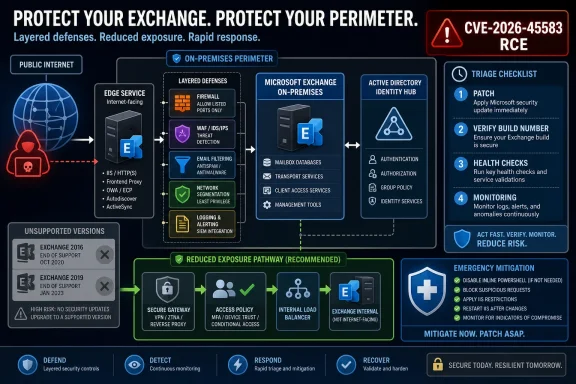
The support picture has also changed. Exchange Server 2016 and Exchange Server 2019 reached end of support on October 14, 2025, while Exchange Server Subscription Edition became the supported path forward for on-premises deployments. Organizations still running older builds without the right support or extended security arrangements are not just behind on features; they are taking on a different class of vulnerability-management risk.
That lifecycle reality should shape how CVE-2026-45583 is interpreted. A supported Exchange SE deployment with current security updates, functioning emergency mitigations, and monitored Internet exposure is a very different target from a forgotten Exchange 2016 host kept alive for one connector nobody wants to document.
The vulnerability itself may be new, but the administrative failure modes are old. Unsupported builds, expired certificates, stale cumulative updates, broken health checks, and servers left exposed for “temporary” coexistence are where Exchange advisories become incidents.
That is why severity labels can be both useful and dangerous. They are useful for sorting emergency work. They are dangerous when they become a substitute for reading the advisory, checking affected builds, and understanding how a particular environment is exposed.
For Exchange, the practical question is always layered. Is Outlook on the web exposed to the Internet? Are Exchange Web Services reachable? Is the server hybrid-connected to Microsoft 365? Are there legacy namespaces still routed through a load balancer? Is the machine also carrying technical debt from old cumulative updates?
The first-order answer is simple: apply the relevant security update when available and verify that it actually installed. The second-order answer is harder: reduce the number of ways an unauthenticated or low-privileged actor can reach Exchange in the first place.
There is a reason for that sparseness. Detailed root-cause descriptions can help defenders, but they can also collapse the time between patch release and weaponized exploit. Microsoft’s calculus is that most customers are better served by applying the update than by reading a bug-class anatomy lesson on day one.
The problem is that modern enterprise patching is not a push button. Exchange updates can require schema awareness, compatibility checks, backup validation, service restart planning, load balancer coordination, and post-install health verification. Sparse advisories leave defenders to make high-consequence decisions with incomplete information.
That gap is where mature operations separate themselves. The best teams do not wait for perfect information. They maintain accurate Exchange inventories, know which servers are Internet-facing, keep a rollback plan that does not become an excuse for delay, and rehearse the boring parts before Patch Tuesday makes them urgent.
Those servers are the ones that make CVE-2026-45583 more than a line item. They are also the servers least likely to be patched first. If nobody owns the application dependency, nobody wants to reboot the box.
Exchange’s proximity to identity makes neglect especially costly. A compromised mail server can expose message contents, credentials, authentication flows, address books, and internal routing information. In hybrid environments, the blast radius can extend beyond the server itself if trust relationships and service principals are poorly governed.
This is why Exchange vulnerability response should begin with inventory, not heroics. Security teams need to know where Exchange is still running, which versions and builds are installed, which namespaces are exposed, and whether any deployment is outside supported servicing channels.
That last sentence contains the catch. Emergency mitigation is not magic. It does not rescue unsupported builds, guarantee coverage for every vulnerability class, or remove the need to install security updates. It is a bridge, not a destination.
For CVE-2026-45583, administrators should verify the status of Exchange health tooling, mitigation services, and update readiness rather than assuming protection exists because a feature name sounds reassuring. A service that is disabled, blocked from the Internet, or running on an unsupported baseline will not deliver the operational safety net many organizations think they have.
The healthier posture is layered. Use emergency mitigations where available, but treat them as a way to buy time for patching and validation. If they become a substitute for patching, they have quietly become another form of technical debt.
That distinction matters because failed or partial Exchange updates can leave organizations in a dangerous middle state. The server may look patched from one dashboard while components remain inconsistent. Health checks, build-number validation, and controlled client testing are not bureaucratic garnish; they are the evidence that the risk actually changed.
The same applies to servers believed to be decommissioned. If DNS still points to them, load balancers still route to them, or firewall rules still expose them, they remain part of the attack surface. A dead Exchange server with a live listener is not dead in any way that matters to an attacker.
For administrators dealing with CVE-2026-45583, the best workflow is brutally practical: identify, patch, verify, monitor, and then reduce exposure. The reduction step is often skipped, but it is the part that makes the next advisory less painful.
CVE-2026-45583 should not be automatically folded into that lineage as if history guarantees disaster. Responsible analysis requires restraint when technical details are limited. There may be constraints that significantly reduce exploitability in practice.
But restraint is not complacency. The reason Exchange advisories draw attention is that the downside risk is unusually large. If an Exchange RCE turns out to be broadly reachable and easy to exploit, defenders who waited for certainty will already be behind.
The right mental model is probability times impact. Even if the probability is not fully known on day one, the impact side of the equation is high enough to justify aggressive validation and patch planning.
Security teams should avoid two bad reactions. The first is theatrical panic, where every Exchange advisory becomes an all-hands emergency before anyone checks exposure. The second is procedural sleepwalking, where a confirmed vendor vulnerability waits behind routine monthly maintenance because the advisory did not publish exploit code.
CVE-2026-45583 belongs between those extremes. Treat it as a serious Exchange RCE, verify whether your systems are affected, deploy the applicable update or mitigation, and look closely at any unsupported Exchange 2016 or 2019 footprint that remains after the October 2025 support cutoff.
This is also a moment to revisit whether on-premises Exchange still earns its keep. Some organizations genuinely need it. Others are carrying it because nobody has forced the final migration conversation. Vulnerability advisories have a way of turning architectural procrastination into operational risk.
 Exchange Is Still the Server Microsoft Cannot Make Boring
Exchange security advisories have a way of flattening nuance. The words remote code execution land differently when the product is a mail server, because mail servers are rarely tucked safely behind perfect segmentation, pristine identity boundaries, and leisurely maintenance windows. They are reachable, stateful, identity-rich systems that process hostile input for a living.CVE-2026-45583 arrives in that context. Microsoft’s naming puts it in the most consequential category of Exchange vulnerabilities: code execution from a distance, rather than a local privilege escalation or a purely informational leak. Even when the public advisory does not provide exploit mechanics, the product and impact are enough to justify urgent attention.
That does not mean every Exchange RCE is equal. Some require authentication, some require a specific server role, some depend on user interaction, and some are only practical in unusual configurations. But Exchange history has trained defenders to treat early ambiguity as a temporary state, not a comfort.
The lesson from the last several years is that Exchange vulnerabilities often become clearer after defenders have already had to make their patching decisions. Waiting for a proof-of-concept exploit to appear is not a risk-management strategy; it is a bet that attackers will be slower than your change board.
The Metric Microsoft Is Pointing At Is Really About Certainty
The text accompanying this advisory focuses on the degree of confidence in the vulnerability and the credibility of known technical details. In CVSS language, that is the report confidence idea: how much trust should defenders place in the claim that the vulnerability exists, and how much is known about it.That metric matters because security teams are drowning in vulnerability noise. A vulnerability with shaky details, no vendor acknowledgment, and uncertain impact deserves a different operational response from one confirmed by the vendor of the affected technology. CVE-2026-45583 sits in the latter world because Microsoft has assigned and published the issue through its Security Update Guide.
That does not mean the public knows everything attackers would need to weaponize it. It means the existence of the defect is not rumor. For defenders, that distinction is crucial: uncertainty about exploit technique is not uncertainty about whether the vulnerability is real.
There is an uncomfortable asymmetry here. Microsoft can responsibly withhold technical detail to slow copycat exploitation, while attackers may still reverse-engineer patches, diff binaries, or buy access to private research. The public may be short on mechanics, but the clock starts when the advisory and update ship.
The Exchange Risk Model Has Shifted, But It Has Not Gone Away
Microsoft would prefer most organizations to be in Exchange Online, where the patching model is centralized and the attack surface is Microsoft’s problem first. That is not the same as saying on-premises Exchange is dead. Plenty of organizations still run Exchange Server for hybrid identity, compliance, latency, sovereignty, legacy workflows, or simple institutional gravity.The support picture has also changed. Exchange Server 2016 and Exchange Server 2019 reached end of support on October 14, 2025, while Exchange Server Subscription Edition became the supported path forward for on-premises deployments. Organizations still running older builds without the right support or extended security arrangements are not just behind on features; they are taking on a different class of vulnerability-management risk.
That lifecycle reality should shape how CVE-2026-45583 is interpreted. A supported Exchange SE deployment with current security updates, functioning emergency mitigations, and monitored Internet exposure is a very different target from a forgotten Exchange 2016 host kept alive for one connector nobody wants to document.
The vulnerability itself may be new, but the administrative failure modes are old. Unsupported builds, expired certificates, stale cumulative updates, broken health checks, and servers left exposed for “temporary” coexistence are where Exchange advisories become incidents.
Remote Code Execution Is a Category, Not a Complete Threat Model
The phrase remote code execution is powerful because it describes an outcome, not a path. It tells defenders what could happen if exploitation succeeds: attacker-controlled code may run in the context exposed by the vulnerable component. It does not, by itself, tell us whether exploitation is pre-authenticated, whether it requires a mailbox, whether the attacker must persuade a user to open something, or whether specific mitigations interrupt the chain.That is why severity labels can be both useful and dangerous. They are useful for sorting emergency work. They are dangerous when they become a substitute for reading the advisory, checking affected builds, and understanding how a particular environment is exposed.
For Exchange, the practical question is always layered. Is Outlook on the web exposed to the Internet? Are Exchange Web Services reachable? Is the server hybrid-connected to Microsoft 365? Are there legacy namespaces still routed through a load balancer? Is the machine also carrying technical debt from old cumulative updates?
The first-order answer is simple: apply the relevant security update when available and verify that it actually installed. The second-order answer is harder: reduce the number of ways an unauthenticated or low-privileged actor can reach Exchange in the first place.
The Thin Advisory Is Part of the Security Trade-Off
Administrators often complain, with some justification, that Microsoft vulnerability pages can be too sparse. A title, an impact category, a CVSS vector, and a table of affected products may be enough for compliance tracking, but not enough for a security engineer trying to model exploitability in a messy enterprise.There is a reason for that sparseness. Detailed root-cause descriptions can help defenders, but they can also collapse the time between patch release and weaponized exploit. Microsoft’s calculus is that most customers are better served by applying the update than by reading a bug-class anatomy lesson on day one.
The problem is that modern enterprise patching is not a push button. Exchange updates can require schema awareness, compatibility checks, backup validation, service restart planning, load balancer coordination, and post-install health verification. Sparse advisories leave defenders to make high-consequence decisions with incomplete information.
That gap is where mature operations separate themselves. The best teams do not wait for perfect information. They maintain accurate Exchange inventories, know which servers are Internet-facing, keep a rollback plan that does not become an excuse for delay, and rehearse the boring parts before Patch Tuesday makes them urgent.
The Real Exposure Is Often the Server Nobody Owns
In a clean architecture diagram, Exchange is a known service with known owners and known maintenance windows. In real networks, Exchange can be a half-retired bridge between eras. It may exist because a multifunction printer needs SMTP relay, a legal archive still expects journaling, or an identity migration was “almost finished” two years ago.Those servers are the ones that make CVE-2026-45583 more than a line item. They are also the servers least likely to be patched first. If nobody owns the application dependency, nobody wants to reboot the box.
Exchange’s proximity to identity makes neglect especially costly. A compromised mail server can expose message contents, credentials, authentication flows, address books, and internal routing information. In hybrid environments, the blast radius can extend beyond the server itself if trust relationships and service principals are poorly governed.
This is why Exchange vulnerability response should begin with inventory, not heroics. Security teams need to know where Exchange is still running, which versions and builds are installed, which namespaces are exposed, and whether any deployment is outside supported servicing channels.
Emergency Mitigation Is a Seat Belt, Not a Repair Shop
Microsoft’s Exchange Emergency Mitigation Service has become an important part of the on-premises Exchange defense story. It can apply temporary mitigations for certain known threats before a full security update is deployed, assuming the server is new enough, configured correctly, and able to receive mitigation metadata.That last sentence contains the catch. Emergency mitigation is not magic. It does not rescue unsupported builds, guarantee coverage for every vulnerability class, or remove the need to install security updates. It is a bridge, not a destination.
For CVE-2026-45583, administrators should verify the status of Exchange health tooling, mitigation services, and update readiness rather than assuming protection exists because a feature name sounds reassuring. A service that is disabled, blocked from the Internet, or running on an unsupported baseline will not deliver the operational safety net many organizations think they have.
The healthier posture is layered. Use emergency mitigations where available, but treat them as a way to buy time for patching and validation. If they become a substitute for patching, they have quietly become another form of technical debt.
Patch Management Has to Include Proof, Not Just Intent
Exchange updates have a long history of humbling administrators who confuse “approved for deployment” with “successfully installed everywhere.” A vulnerability response is not complete when the ticket changes state. It is complete when every affected server is verified at the expected build, services are healthy, event logs are reviewed, and client access paths behave normally.That distinction matters because failed or partial Exchange updates can leave organizations in a dangerous middle state. The server may look patched from one dashboard while components remain inconsistent. Health checks, build-number validation, and controlled client testing are not bureaucratic garnish; they are the evidence that the risk actually changed.
The same applies to servers believed to be decommissioned. If DNS still points to them, load balancers still route to them, or firewall rules still expose them, they remain part of the attack surface. A dead Exchange server with a live listener is not dead in any way that matters to an attacker.
For administrators dealing with CVE-2026-45583, the best workflow is brutally practical: identify, patch, verify, monitor, and then reduce exposure. The reduction step is often skipped, but it is the part that makes the next advisory less painful.
Exchange’s Past Is Not a Prediction, But It Is a Warning
The Exchange ecosystem still lives in the shadow of earlier mass exploitation campaigns. ProxyLogon, ProxyShell, and later Exchange chains taught defenders that attackers prize mail infrastructure not because it is glamorous, but because it is useful. Mail servers are excellent footholds, intelligence sources, and lateral-movement platforms.CVE-2026-45583 should not be automatically folded into that lineage as if history guarantees disaster. Responsible analysis requires restraint when technical details are limited. There may be constraints that significantly reduce exploitability in practice.
But restraint is not complacency. The reason Exchange advisories draw attention is that the downside risk is unusually large. If an Exchange RCE turns out to be broadly reachable and easy to exploit, defenders who waited for certainty will already be behind.
The right mental model is probability times impact. Even if the probability is not fully known on day one, the impact side of the equation is high enough to justify aggressive validation and patch planning.
The Practical Answer Is Less Dramatic Than the Headline
For all the anxiety remote code execution creates, the immediate defensive playbook is familiar. The hard part is not knowing what to do; it is doing it consistently across all the servers, subsidiaries, inherited environments, and “temporary” exceptions that accumulate in real organizations.Security teams should avoid two bad reactions. The first is theatrical panic, where every Exchange advisory becomes an all-hands emergency before anyone checks exposure. The second is procedural sleepwalking, where a confirmed vendor vulnerability waits behind routine monthly maintenance because the advisory did not publish exploit code.
CVE-2026-45583 belongs between those extremes. Treat it as a serious Exchange RCE, verify whether your systems are affected, deploy the applicable update or mitigation, and look closely at any unsupported Exchange 2016 or 2019 footprint that remains after the October 2025 support cutoff.
This is also a moment to revisit whether on-premises Exchange still earns its keep. Some organizations genuinely need it. Others are carrying it because nobody has forced the final migration conversation. Vulnerability advisories have a way of turning architectural procrastination into operational risk.
The Admin Checklist Microsoft’s Wording Implies
The most useful reading of CVE-2026-45583 is not as a standalone scare, but as a pressure test of Exchange hygiene. A confirmed RCE advisory tells administrators to move quickly; the report-confidence framing tells them the vulnerability’s existence is not speculative; the lack of public exploit detail tells them not to wait for a fuller attacker playbook.- Organizations should identify every Exchange Server instance, including hybrid, relay-only, lab, disaster-recovery, and supposedly decommissioned systems.
- Administrators should confirm the installed Exchange build against Microsoft’s current supported servicing baseline before assuming that an update applies cleanly.
- Internet-facing Exchange access should be reviewed immediately, especially Outlook on the web, Exchange admin paths, legacy namespaces, and load-balanced endpoints.
- Exchange Emergency Mitigation Service status should be checked, but temporary mitigations should not be treated as a replacement for security updates.
- Unsupported Exchange 2016 and Exchange 2019 systems should be treated as architectural risk unless they are covered by an appropriate extended security arrangement or migration plan.
- Patch success should be proven with build verification, health checks, log review, and client-access testing rather than inferred from deployment-tool status alone.
References
- Primary source: MSRC
Published: 2026-06-09T07:00:00-07:00

Security Update Guide - Microsoft Security Response Center
msrc.microsoft.com
- Related coverage: tomsguide.com
Do you use Microsoft Exchange? Hackers are actively exploiting a new zero-day flaw | Tom's Guide
Microsoft warns of a new zero-day vulnerability that leaves Exchange open to hackers.www.tomsguide.com - Related coverage: techradar.com
Microsoft urges users to be on alert following high-severity flaw in hybrid Exchange deployments
Security bug allowed hackers to move from on-prem to the cloudwww.techradar.com
- Related coverage: windowscentral.com
"I have proof for every single word": This security researcher's GitHub and Microsoft accounts were deleted after claiming a Windows 11 exploit in BitLocker is by design | Windows Central
Microsoft seemingly bans a security researcher from GitHub, sparking threats of retaliation and a bug bounty controversy.www.windowscentral.com - Official source: learn.microsoft.com
[MS-OAPXBC]: Informative References
[MSFT-CVE-2021-33781] Microsoft Corporation, Azure AD Security Feature Bypass Vulnerability , CVE-2021-33781, July 13,learn.microsoft.com - Related coverage: api.urlscan.io

api.msrc.microsoft.com - urlscan.io
urlscan.io - Website scanner for suspicious and malicious URLs
api.urlscan.io
- Related coverage: bleepingcomputer.com
- Related coverage: deepwiki.com
MSRC API Reference | microsoft/MSRC-Microsoft-Security-Updates-API | DeepWiki
This document provides technical reference information for the Microsoft Security Response Center (MSRC) CVRF API that underlies the MsrcSecurityUpdates PowerShell module. This covers the REST API enddeepwiki.com
- Related coverage: sra.io
