

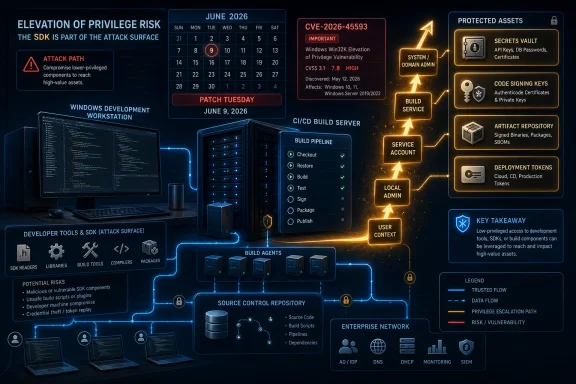
The Developer Workstation Is Back in the Blast Radius
Elevation-of-privilege bugs are rarely the vulnerabilities that make executives interrupt dinner. They do not usually begin with a remote unauthenticated attacker kicking in the front door from the internet. Their danger is quieter and more operational: they turn a foothold into control, and they tend to matter most after another defense has already failed.
That makes a Windows SDK vulnerability easy to underrate. The SDK is not, for most users, a visible application. It is a collection of headers, libraries, tools, metadata, signing-adjacent workflows, and developer plumbing that sits behind the software people actually run. But in modern Windows environments, developer workstations and build agents are privileged assets by design. They hold source code, secrets, package credentials, signing material, deployment tokens, and access to internal systems that ordinary endpoints never see.
That is why CVE-2026-45593 deserves attention beyond the narrow population of people who knowingly installed the Windows SDK. In many organizations, the SDK arrives indirectly through Visual Studio workloads, CI images, packaged build environments, or legacy toolchains that have not been re-baselined in years. The machine that compiles code may be less monitored than the machine that hosts production, but it is often closer to the crown jewels.
Microsoft has not publicly turned this advisory into a dramatic exploit narrative, and that restraint is worth preserving. A thin advisory is not a license to invent a proof-of-concept in prose. But the affected product category tells its own story: if a local attacker can use an SDK component to gain more privilege on a developer or build system, the practical risk is not confined to that one box. It can become a software supply-chain problem.
Microsoft’s Confidence Metric Is Doing More Work Than It Seems
The text attached to CVE-2026-45593 points to the CVSS idea of report confidence: how much certainty exists that the vulnerability is real, and how credible the known technical details are. This is one of those scoring fields that many patch dashboards flatten into noise. It should not be ignored.
Report confidence is not the same thing as exploit maturity. It does not say whether ransomware crews are using the bug today, whether exploit code is on GitHub, or whether a red team can weaponize it before lunch. Instead, it answers a more basic question: do we believe the vulnerability exists, and do we trust the available technical account enough to act?
In Microsoft’s ecosystem, that answer carries weight because MSRC is both the coordinating authority and, for Microsoft products, the vendor with the best access to source, telemetry, and engineering owners. When Microsoft assigns a CVE and publishes an advisory through the Security Update Guide, the vulnerability has crossed a threshold. It may still lack colorful public detail, but it is no longer a rumor bouncing around a mailing list.
That distinction matters for defenders because patch triage often rewards the wrong kind of certainty. Teams may wait for a blog post, a exploit demo, or a scanner signature before treating a flaw as urgent. By then, the useful window may have closed. A confirmed EoP in a sensitive toolchain component should move because the vendor has validated enough of the issue to publish and service it, not because the internet has made it entertaining.
The Windows SDK Is Infrastructure, Even When It Looks Like Tooling
The phrase “Windows SDK” sounds narrower than it is. To developers, it is part of the foundation for building Windows applications and interacting with Windows APIs. To IT, it may appear as a dependency bundled into development images. To security teams, it should be understood as executable tooling that runs on machines with unusually valuable access.
That last framing is the one enterprises too often miss. The industry has spent years learning to treat CI/CD systems as production-critical infrastructure, but endpoint security programs still sometimes classify developer machines as merely “user workstations with compilers.” That is a category error. A compromised developer workstation can become a path into repositories, artifact stores, package registries, test environments, and deployment systems.
An elevation-of-privilege flaw in the SDK does not automatically mean an attacker can poison a release. The chain would still require local access, a vulnerable component, and a useful post-exploitation objective. But attackers rarely need a single vulnerability to do everything. They assemble paths. A phishing payload, a stolen developer credential, a malicious dependency, or an exposed remote management channel can provide the first step; a local privilege escalation can supply the persistence and access needed for the second.
That is why developer tooling vulnerabilities deserve a different kind of scrutiny than ordinary desktop application flaws. The installed base may be smaller, but the machines are richer targets. In risk terms, population size is not destiny.
Patch Tuesday Still Hides the Most Interesting Stories in the Middle Rows
June 2026’s Patch Tuesday cycle arrived with the usual gravity: dozens upon dozens of Microsoft vulnerabilities, a handful of actively exploited issues, and a predictable scramble among patch managers to identify what must be deployed first. In that environment, a Windows SDK EoP can disappear into the spreadsheet.
That is the weakness of severity-first patching. CVSS is useful, but it is not context. A local EoP on a kiosk is not the same as a local EoP on a build agent with access to release signing. A vulnerability in a component installed only on developer workstations may score below an internet-facing remote code execution bug while still being more relevant to a software company’s most sensitive systems.
The smarter approach is to rank CVE-2026-45593 by where the Windows SDK lives. If it is on a disposable lab VM, the urgency may be ordinary. If it is on a persistent build server, a golden developer image, a code-signing workstation, or a self-hosted CI runner, the calculus changes. Those are not just endpoints; they are production-adjacent systems with privileged trust relationships.
Microsoft’s advisory model will not do that prioritization for you. It can identify the product, impact, and servicing path. It cannot know whether your build agent has a long-lived token to publish packages or whether your developers routinely run test harnesses as administrator. That local context is the difference between checking a compliance box and actually reducing risk.
The Absence of Public Detail Is Not a Comfort Blanket
Security teams are understandably wary of vague advisories. A CVE with limited public technical detail can feel less actionable than one with a full exploit chain, affected file names, and reproduction steps. But limited disclosure cuts both ways.
On one hand, a lack of public technical detail may slow opportunistic attackers who rely on advisories as free research leads. On the other hand, it also leaves defenders with less ability to build compensating detections, validate exposure, or understand whether a vulnerable component exists in a particular image. The gap becomes especially uncomfortable with developer tooling, where installed components may vary dramatically from one workload to another.
This is where Microsoft’s confidence language becomes important again. If the vulnerability is acknowledged by the vendor, the rational response is not to wait for perfect public detail. It is to reduce exposure through updates, inventory, and least privilege while assuming that more detail may become available later to both defenders and attackers.
There is a familiar pattern here. Many Windows EoP bugs do not begin as public spectacles. They become important when paired with something else, folded into intrusion playbooks, or rediscovered after patch diffing. Attackers do not need Microsoft to publish a tutorial. They need enough signal to know where to look and enough time to compare old and new components.
Build Systems Need Patch Discipline Without Breaking the Factory
Patching developer infrastructure is harder than patching ordinary endpoints because build reproducibility matters. A toolchain update can change compiler behavior, SDK metadata, generated binaries, dependency resolution, or test outcomes. That friction is real, and administrators should not pretend otherwise.
But “we cannot patch because builds might change” is not a security strategy. It is a deferred outage. The better model is to separate reproducibility from neglect: pin known-good toolchain versions, maintain updated build images, test patches in parallel pipelines, and retire vulnerable images once validation is complete. Organizations that already use immutable CI images are in a better position because they can rebuild and roll forward rather than hand-patch artisanal servers.
For Windows shops, this is also a reminder to inventory SDK versions explicitly. Many asset inventories know the OS build, browser version, and Office channel. Fewer can answer which Windows SDK versions are installed across developer laptops and build hosts. Fewer still can map those installations to Visual Studio workloads, container images, self-hosted runners, and legacy build machines hiding under desks or in forgotten VM clusters.
That mapping is where the security work begins. If you cannot identify where the SDK is installed, you cannot make a risk-based decision about CVE-2026-45593. You can only hope that broader patching catches it.
Least Privilege Is Still the Control Everyone Praises and Few Enforce
Elevation-of-privilege vulnerabilities exploit the gap between what a user or process can do now and what it could do after the bug is triggered. The obvious defense is to shrink that gap. The hard part is doing so without breaking developer workflows that have spent years assuming local administrator rights.
Windows development has a long history of admin-by-default habits: installing drivers, registering components, writing into protected directories, running local services, debugging privileged processes, and testing installers. Some of those tasks genuinely require elevation. Many do not. The problem is that organizations often stop distinguishing between the two once a team has been granted broad local admin rights.
CVE-2026-45593 should prompt a fresh look at that bargain. If every developer already runs as a local administrator all day, an EoP flaw may appear less meaningful on paper. In practice, that environment is already conceding too much. If build agents run under overprivileged service accounts, a local escalation bug may become one step in a much larger compromise.
The more mature pattern is not to deny developers the tools they need. It is to make elevation deliberate, auditable, and time-limited. Privileged access management for workstations, separate admin accounts, just-in-time elevation, controlled build service identities, and hardened CI runners all reduce the value of a local EoP. They also make future vulnerabilities less dramatic, because the default state is less permissive.
Supply-Chain Security Starts Before the Package Is Published
The security industry often talks about software supply-chain attacks at the moment of distribution: a poisoned package, a malicious update, a compromised signing key, a backdoored release. That is the visible end of the story. The beginning is usually more mundane. Someone gets access to a system that had more trust than it should have.
Developer machines and build systems are trust concentrators. They authenticate to repositories. They fetch dependencies. They generate artifacts. They may sign binaries or hand them to a signing service. They may publish to internal feeds or external marketplaces. A vulnerability in tooling that runs in that environment deserves attention because it sits upstream of everything users eventually install.
This does not mean CVE-2026-45593 is a supply-chain attack by itself. That would overstate the known facts. The more accurate point is that an SDK EoP belongs to the class of vulnerabilities that can support supply-chain compromise when combined with initial access and weak operational controls.
That is a useful distinction. Defenders do not need panic; they need architecture. They need build agents that are ephemeral where possible, secrets that are scoped and rotated, signing operations that are isolated, and release processes that require more than one compromised workstation to alter production artifacts. A single Windows SDK patch will not deliver that architecture, but it is a timely forcing function.
Microsoft’s Sparse Advisories Put More Burden on Enterprise Interpretation
Microsoft’s Security Update Guide has become more machine-readable and operationally useful over the years, but its individual CVE entries are often sparse. That is partly by design. Vendors do not want to hand attackers a blueprint before patches have propagated, and enterprise customers generally want clear remediation more than dramatic storytelling.
The tradeoff is that administrators must interpret short advisories in context. A product name, impact type, CVSS vector, exploitability assessment, and affected build list are not a complete risk model. They are inputs. For CVE-2026-45593, the product name may be the most important input because it points defenders toward development estates rather than ordinary Windows fleets alone.
This is also where vulnerability management platforms can mislead. If a scanner flags the SDK on a low-priority endpoint and misses a manually installed copy on a build server, the dashboard will look cleaner than reality. If the organization tracks Windows cumulative updates but not developer component updates, remediation may appear complete while toolchain exposure remains.
Enterprise defenders should resist the urge to treat every Microsoft CVE as just another Windows Update event. Some are OS servicing problems. Some are application problems. Some are ecosystem problems. A Windows SDK EoP sits uncomfortably between endpoint management and engineering operations, which is exactly where ownership gaps tend to live.
The Practical Response Is Boring, Which Is Why It Works
The right response to CVE-2026-45593 is not dramatic. It is inventory, patch, validate, and harden. That may sound unsatisfying, but it is the work that turns a vendor advisory into reduced risk.
Start with exposure. Identify machines with the Windows SDK installed, including developer workstations, Visual Studio environments, build servers, CI runners, test VMs, and base images used for Windows builds. Pay special attention to systems that are persistent, domain-joined, or connected to repositories and artifact stores.
Then validate the servicing path. In some environments, the fix may arrive through Visual Studio Installer updates, SDK component updates, Windows servicing channels, or refreshed build images rather than a single obvious patch button. The exact mechanism depends on how the SDK was installed and managed. That is why asset context matters before remediation begins.
Finally, reduce the blast radius while patching moves. Review local admin rights, build service account privileges, secret storage, and signing workflows. If a developer endpoint compromise can directly become a production release compromise, CVE-2026-45593 is not the only problem. It is just the latest excuse to fix the architecture.
The SDK Advisory That Should Change the Patch Queue
CVE-2026-45593 is not the loudest kind of Microsoft vulnerability, but it is the kind that exposes whether an organization understands its own development estate. The concrete response should be narrow enough to execute and broad enough to improve the next incident.
- Organizations should identify every system with the Windows SDK installed, not just machines that appear in standard Windows endpoint patch reports.
- Build servers, self-hosted CI runners, code-signing workstations, and developer golden images should receive higher priority than ordinary lab machines.
- Security teams should treat Microsoft’s publication of the advisory as sufficient confirmation that the vulnerability is real, even if public technical detail remains limited.
- Engineering teams should validate SDK updates against reproducible builds rather than using build stability as a reason to defer security servicing indefinitely.
- Administrators should review local administrator rights and service account privileges on developer systems because EoP flaws are most damaging when the baseline is already overprivileged.
- Supply-chain controls should assume that developer infrastructure can be targeted and should limit what any single compromised workstation or build agent can publish.
The lesson of CVE-2026-45593 is not that every Windows SDK installation is suddenly a crisis. It is that the boundary between “developer tooling” and “production security” has largely collapsed. Microsoft can ship the advisory and the fix, but only customers can decide whether their build systems are treated like critical infrastructure or like a corner of IT too specialized to govern. The organizations that make that decision now will be better prepared for the next toolchain vulnerability, which is unlikely to arrive with more warning or a cleaner ownership model.