

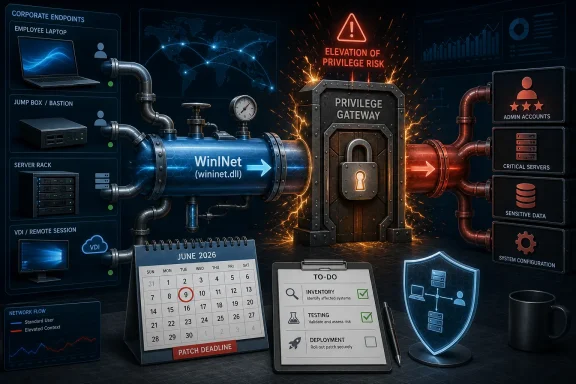
WinINet Is Legacy Code That Still Sits in Modern Workflows
WinINet has one of those Windows component names that sounds frozen in the Internet Explorer era. That is partly true, but also misleading. The library has long provided client-side internet protocol support for Windows applications, including HTTP and FTP-style behaviors, proxy handling, caching, cookies, and authentication-related network behavior.
That makes wininet.dll different from a standalone app vulnerability. You do not need to be an Internet Explorer user in 2026 to care about a bug in a shared Windows networking component. If an application relies on WinINet, the boundary is no longer “the browser”; it is whatever workflow, script, launcher, helper, installer, or enterprise tool ends up touching that code path.
Elevation-of-privilege vulnerabilities are especially awkward in this layer because they do not usually begin the attack. They improve it. An attacker who already has some local foothold, a compromised user context, or a way to trigger vulnerable behavior may use the flaw to gain more authority than they were supposed to have.
That distinction matters for risk conversations. CVE-2026-45592 is not framed as a remote-code-execution panic button from the public description alone. It is a privilege escalation issue in a component that can be reached through the everyday application stack, which is exactly why it should not be dismissed as low-theater housekeeping.
The Confidence Metric Says More Than the Sparse Advisory
The user-supplied MSRC text centers on a metric that often gets overlooked: confidence in the existence of the vulnerability and the credibility of known technical details. In CVSS terms, this is the Report Confidence idea. It asks whether the public record merely hints at a possible weakness, whether researchers have partially corroborated it, or whether the vendor has confirmed the vulnerability.
That sounds bureaucratic until you are the person deciding how hard to push an emergency change window. A confirmed flaw from the vendor is not the same thing as a rumor in a mailing list or a reverse-engineering note with caveats. It tells defenders that the underlying condition is real enough for Microsoft to assign a CVE, publish guidance, and attach it to update servicing.
It also tells attackers something. The less public detail Microsoft provides, the harder it is to build a reliable exploit from the advisory alone. But the more confidence Microsoft expresses in the vulnerability’s existence, the more attractive the patch becomes as a target for diffing, especially once binaries are available across patched and unpatched systems.
That is the paradox of Patch Tuesday in 2026. The advisory may be sparse for good reasons, yet the patch itself becomes the most detailed public artifact. For defenders, that means the clock does not start when exploit code appears; it starts when the update ships.
Elevation of Privilege Is Where Intrusions Become Incidents
Windows administrators have learned to triage remote-code-execution flaws first because they sound like the front door being kicked in. Elevation-of-privilege bugs sound more conditional, and often they are. But modern intrusions are chains, not single events, and privilege escalation is the link that turns a compromised account into a durable compromise.
A user-level foothold is noisy and limited. SYSTEM-level execution, administrator rights, or access to protected local resources changes the equation. It can allow credential theft, security-tool tampering, lateral movement preparation, persistence, and the modification of system state in ways that ordinary user rights should block.
That is why a local or adjacent EoP issue in a broadly deployed Windows component is rarely “just local.” Attackers do not complain that a privilege escalation bug requires prior access; they collect such bugs precisely because prior access is common. Phishing, stolen credentials, malicious installers, browser downloads, exposed remote access, and commodity malware all create the first step.
CVE-2026-45592 therefore belongs in the same mental bucket as other post-compromise accelerants. It may not be the initial spark, but it can become the accelerant that lets a small fire reach the server room.
The Browser Boundary Has Been Gone for Years
WinINet’s name tempts people to reason about this flaw as though it were a browser bug. That is too narrow. Windows networking libraries often sit behind application features that users do not perceive as web activity: license checks, update retrieval, embedded help panes, authentication handoffs, content previewers, enterprise portals, legacy line-of-business clients, and automation utilities.
The result is a messy exposure model. One organization may barely touch WinINet in high-risk workflows. Another may have a decade-old internal application that uses it constantly under the hood. A third may not know either way because the dependency is buried inside vendor software.
This is where Windows patch management becomes more empirical than theoretical. The question is not whether a human opens Internet Explorer, because that is yesterday’s boundary. The question is whether supported Windows builds ship the vulnerable component and whether any local workflow can be induced to exercise it under useful attacker-controlled conditions.
For home users, the answer is simpler: install the cumulative update when it is offered, and do not try to outguess component-level security fixes. For enterprise IT, the answer is more operational: test line-of-business applications quickly, but do not let the lack of a flashy exploit narrative turn a confirmed EoP into indefinite deferral.
Sparse Detail Is a Defensive Feature, Not a Defect
Microsoft’s public vulnerability entries often frustrate defenders because they omit the very details security teams want: exploit prerequisites, affected code paths, proof-of-concept shape, and realistic attack chains. That frustration is valid. It is also part of the design.
A vendor advisory has two audiences. Defenders need enough information to prioritize, deploy, and monitor. Attackers need enough information to reproduce. Every extra sentence that helps one side may help the other, particularly for a Windows component whose patched binaries can be compared after release.
That does not mean defenders should accept opacity as a permanent state. Security teams should track whether Microsoft later revises exploitability assessments, adds FAQ material, changes affected-product tables, or acknowledges exploitation in the wild. MSRC entries are living records, and the first publication is not always the last meaningful version.
For now, the lack of public technical detail should be read conservatively. It does not prove the flaw is easy to exploit, and it does not prove the flaw is harmless. It proves only that Microsoft has chosen to publish the vulnerability at a level of abstraction that supports patching without handing over a recipe.
The Real Patch Question Is Blast Radius
The practical question for administrators is not whether wininet.dll exists. It does. The better question is how quickly the organization can reduce the number of unpatched systems that expose the vulnerable code.
That starts with the obvious inventory: supported Windows client and server releases, especially systems that process untrusted content, run user-facing applications, or support remote interactive work. Developer workstations, help desk machines, jump boxes, VDI images, and shared management systems deserve attention because privilege escalation on those endpoints can have consequences far beyond the local device.
Server prioritization requires nuance. A server that never hosts interactive users and has a tightly controlled application surface may face different practical exposure than an RDS host, Citrix worker, build agent, or management server. But “server” is not a magic shield; many Windows Server systems run third-party agents and administrative tooling that may touch user-mode networking libraries.
The best patch programs do not treat every CVE as identical. They also do not wait for perfect exploit intelligence before acting on a confirmed Microsoft component vulnerability. CVE-2026-45592 is a reminder that boring DLLs can define real attack paths.
Patch Diffing Turns Quiet Fixes Into Public Research
There is a predictable lifecycle after a Windows security update lands. Researchers and attackers obtain old and new binaries, compare changed functions, inspect call paths, and build hypotheses about the fixed bug. The more widely deployed the component, the more interesting that work becomes.
WinINet is a plausible candidate for exactly that kind of scrutiny because it is old, shared, and reachable by many applications. Even if no public exploit exists at publication time, the patch can narrow the search space. A small change in a security-sensitive path can become the breadcrumb trail.
This is not an argument against patching, of course. It is an argument against slow patching. Once a fix is public, unpatched systems become easier to study by contrast. The disclosure may be responsible, but the post-disclosure environment is competitive.
That race is especially unforgiving for organizations with long validation cycles. If a security update takes three weeks to reach desktops, the organization is effectively betting that nobody will weaponize the diff faster than its change-management process can move. Sometimes that bet wins. It is still a bet.
Home PCs Need Less Theater and More Routine
For Windows enthusiasts and home users, CVE names can feel abstract. The action is not. Keep Windows Update enabled, install the June 2026 security update when it appears for your supported build, and restart rather than leaving the machine in a half-patched state.
The more complicated advice is to stop treating “I do not use that app” as a sufficient answer to component vulnerabilities. A bug in a shared DLL is not the same as a bug in a program you can simply avoid launching. Windows applications often call platform components invisibly.
Security-conscious users should also watch for the usual second-order problems after Patch Tuesday: failed installs, update rollback loops, VPN or proxy oddities, and security software compatibility issues. Those operational problems matter because they create the temptation to pause updates entirely, which is how a manageable component flaw becomes a lingering exposure.
If an update causes trouble, the better response is targeted troubleshooting, not permanent avoidance. The difference between delaying for testing and drifting into unpatched status is one of the oldest, least glamorous dividing lines in Windows security.
Enterprise IT Should Treat This as a Chain-Breaker
In an enterprise, CVE-2026-45592 should be evaluated as a chain-breaker. It may interrupt the path from a compromised user context to higher privilege. That makes it relevant to ransomware defense, credential protection, endpoint detection reliability, and lateral movement containment.
The obvious control is patch deployment. The less obvious controls are the ones that reduce the usefulness of any EoP that survives. Least privilege, application control, credential isolation, tamper protection, endpoint monitoring, and segmentation all make post-compromise escalation less rewarding.
Administrators should also review where interactive users and sensitive privileges overlap. A privileged admin browsing the web, opening email attachments, or testing software on a management workstation is still one of the most efficient ways to turn a local bug into a domain problem. Component vulnerabilities punish sloppy privilege boundaries.
The right posture is not panic. It is disciplined urgency. Test quickly, deploy broadly, monitor for failures, and pay extra attention to systems where user activity and administrative reach coexist.
The June Patch Cycle Rewards Teams That Already Know Their Windows Estate
CVE-2026-45592 is the kind of vulnerability that exposes the difference between asset management as a spreadsheet and asset management as an operating capability. If you know which Windows builds you run, which update rings they belong to, and which applications are most sensitive to networking-stack changes, this is routine. If you do not, every component-level CVE becomes a scavenger hunt.
The first group can move through pilot, broad deployment, and exception handling with confidence. The second group spends the critical first days asking what it owns. Attackers benefit from that ambiguity because uncertainty lengthens patch timelines.
This is why component vulnerabilities are so useful as management tests. They do not always provide a spectacular story, but they reveal whether the organization can respond to a confirmed platform flaw without improvising the basics. Inventory, update telemetry, rollback criteria, and exception expiry dates matter more than a dramatic advisory.
For WindowsForum readers, that may be the most practical lesson. Patch Tuesday is not merely a monthly content drop from Redmond. It is a recurring audit of whether your Windows estate is legible to you.
The WinINet Fix Leaves a Short List of Sensible Moves
The public record around CVE-2026-45592 is thin by design, but the operational response does not need to be mysterious. Treat the advisory as a confirmed Windows component issue, not as a curiosity about old internet APIs, and make decisions based on exposure, privilege boundaries, and patch velocity.
- Install the applicable June 2026 Windows security update on supported systems rather than waiting for public exploit code to appear.
- Prioritize endpoints and servers where ordinary user activity intersects with administrative tools, remote access, development workflows, or sensitive credentials.
- Do not dismiss the vulnerability because of the WinINet name; shared Windows libraries can be reached by applications that users do not think of as browsers.
- Watch the MSRC entry for revisions, especially any change in exploitability assessment, affected-product scope, or acknowledgement of exploitation.
- Treat patch failures and compatibility exceptions as time-limited incidents with owners, deadlines, and compensating controls.
The main mistake would be to demand a cinematic exploit story before acting. Elevation-of-privilege vulnerabilities are often quiet until they are chained, and by then they are no longer quiet in the incident report.
Microsoft’s advisory for CVE-2026-45592 is sparse, but its message is clear enough: a confirmed privilege boundary problem exists in a Windows networking component with broad historical reach, and the fix belongs in the June patch rhythm. The forward-looking lesson is that Windows security in 2026 is less about one famous browser or one exposed service than about the shared components underneath thousands of workflows. The teams that patch those layers quickly, understand where privilege really lives, and refuse to confuse low detail with low risk will be the ones least surprised when today’s quiet DLL entry becomes tomorrow’s exploit chain.