

Microsoft disclosed CVE-2026-45586 on June 9, 2026, as a Windows Collaborative Translation Framework, or CTFMON, elevation-of-privilege vulnerability affecting Windows systems and addressed through the June Patch Tuesday security updates, with Microsoft listing exploitation as detected in the wild. The plain-English version is sharper: a component most users never think about has again landed in the privileged middle of Windows’ security model. That matters because CTFMON sits close to text input, language services, and user-session plumbing — exactly the kind of old-but-essential subsystem attackers like when they already have a foothold. The bug is not a remote worm, but for defenders it belongs in the uncomfortable category of vulnerabilities that turn “limited user” into “much more than limited.”
CTFMON has always had a strange public life. To ordinary users, it is the thing that appears in Task Manager and prompts anxious searches for “is ctfmon.exe a virus?” To Windows itself, it is part of the text-input machinery that helps make modern desktops usable across languages, input methods, accessibility features, speech, handwriting, and the complicated edge cases of typing into every kind of application.
That mundane role is exactly why security engineers pay attention to it. Input services are not a decorative layer on top of the operating system; they cross application boundaries, user-interface boundaries, and sometimes trust boundaries. A framework that brokers text and input across processes can become a powerful attack surface if its permission checks, object ownership, message handling, or interprocess assumptions are wrong.
CVE-2026-45586 is therefore less surprising than it first appears. Windows is full of legacy-adjacent subsystems that have been modernized, wrapped, patched, and resecured over time without ever being removed, because removing them would break the desktop. Attackers do not need the most glamorous component in Windows; they need the component that is loaded, reachable, widely deployed, and trusted enough to be useful.
The important distinction is that this is an elevation-of-privilege flaw. It does not, by itself, mean an attacker can reach across the internet and instantly compromise a fully patched machine. But once an attacker has code execution as a standard user — through phishing, a malicious document, a browser exploit chain, stolen credentials, or another foothold — a local privilege escalation can be the step that turns a messy intrusion into administrative control.
The signal in this case is the combination of component and exploitation status. A CTFMON elevation-of-privilege bug would already deserve attention because it touches a mature Windows subsystem with a history of security scrutiny. If Microsoft says exploitation has been detected, it moves from “patch in the regular cycle” to “treat as part of an active threat-management queue.”
That does not mean every Windows PC is being hunted through this exact flaw. It does mean defenders should assume someone has worked out enough of the vulnerability to use it operationally, or at least that credible exploitation has reached Microsoft’s threshold for public acknowledgement. In the vulnerability-management world, that is a very different risk profile from a theoretical bug found in code review and quietly patched before weaponization.
There is also a practical reason this class of vulnerability receives attention from attackers. Local privilege escalation flaws are reusable building blocks. They fit behind many kinds of initial access, and they can be swapped into intrusion playbooks without changing the whole operation. A phishing lure, remote access trojan, or commodity loader becomes more dangerous when paired with a dependable way to escape standard-user constraints.
That compatibility burden is one of Windows’ greatest commercial strengths and one of its longest-running security debts. Microsoft cannot simply simplify the desktop into a clean modern design without punishing the customers who keep Windows entrenched in business, government, education, and industry. The result is a constant engineering compromise: lock down old surfaces without breaking the behaviors that customers quietly depend on.
CTFMON lives in that compromise. It is not flashy, and it is not optional for many users. In multilingual environments, accessibility-heavy deployments, and organizations with complex input requirements, text services are infrastructure. A breakage in this area can look like keyboards not working, language switching failing, text boxes refusing input, search fields going dead, or line-of-business applications behaving unpredictably.
That is why “just disable it” is usually the wrong answer. Security hardening that breaks input is not hardening; it is self-inflicted downtime. The useful response to CVE-2026-45586 is not to rip CTFMON out of Windows, but to patch quickly, validate business-critical input workflows, and monitor for signs that local privilege escalation is being chained with initial-access activity.
A standard user account is inconvenient for an attacker. It limits access to system files, credential material, endpoint controls, protected processes, and administrative tooling. A successful elevation-of-privilege exploit changes the economics: persistence becomes easier, defense evasion becomes more plausible, credential theft becomes richer, and lateral movement becomes less noisy.
That is why administrators should resist the temptation to rank this bug solely by whether it is “remote.” In mature environments, attackers often arrive through routes that do not immediately grant administrator rights. A local privilege escalation vulnerability can supply the missing rung on the ladder.
The operational question is not whether CVE-2026-45586 is the first step. It is whether it can become the second or third step after a user opens the wrong file, runs the wrong installer, signs in to the wrong fake portal, or executes a payload delivered through another vulnerability. In that role, a Windows desktop component can matter as much as a server-side bug.
For CVE-2026-45586, the visible facts point to a confirmed Windows elevation-of-privilege issue in the Collaborative Translation Framework, with patching delivered through the normal Windows update channel. The missing details are the ones defenders always want: what object is mishandled, what privilege boundary is crossed, what telemetry should light up, whether exploitation requires special local conditions, and which builds are most exposed in practice.
That lack of detail should not be mistaken for lack of seriousness. If anything, sparse public detail can increase the importance of disciplined patch operations. When defenders cannot write a perfect detection because the root cause is not public, the patch itself becomes the primary control.
There is also a timing issue. Once a Patch Tuesday update ships, attackers can compare patched and unpatched binaries. Even if only a small group knew how to exploit a flaw before disclosure, the update can start a reverse-engineering race. Organizations that wait weeks for desktop patches may be giving that race too much room.
That matters for a vulnerability like this because old desktop assumptions linger longest in the environments slowest to modernize. Aging fleets tend to have more local admin exceptions, more legacy input components, more third-party utilities that hook into user sessions, and more complicated language or accessibility configurations that no one wants to touch unless forced.
Patch availability is only one part of the problem. The real work is proving that deployment will not break the workflows that keep users productive. For CTFMON-adjacent fixes, that means paying attention to typing, IMEs, remote desktops, virtual desktops, kiosk-like setups, assistive technologies, and applications that rely on unusual text-entry paths.
This is where security and endpoint engineering have to meet. A vulnerability-management dashboard can show missing patches, but it cannot tell you whether a Japanese IME in a finance department, a screen-reader workflow in HR, or a remote-app publishing setup in operations still behaves correctly after the update. The right answer is accelerated patching with targeted validation, not blind delay.
Remote Desktop Services, jump boxes, management servers, application servers with interactive logons, and legacy administrative workflows can all create user-session attack surfaces. In many real networks, the most valuable Windows systems are not pure headless servers; they are machines where admins sign in, run tools, copy files, launch consoles, and bridge trust zones.
That is precisely where a local privilege escalation can become painful. If an attacker compromises a lower-privileged account on a management host and can elevate locally, the blast radius may extend far beyond that one machine. The server’s role in the environment can amplify what would otherwise look like a local issue.
For domain controllers and other high-value systems, the answer remains the boring answer: minimize interactive logons, restrict administrative paths, harden jump hosts, keep endpoint detection active, and patch. CVE-2026-45586 is not a reason to invent a new security philosophy; it is a reminder that the old one is still under-tested in many networks.
The lesson was not “CTFMON is broken forever.” It was that old Windows desktop protocols can have surprising reach. Interfaces built for cooperation between applications, input methods, and services may predate current expectations about isolation, integrity levels, sandboxing, and hostile same-user or cross-process behavior.
CVE-2026-45586 fits that historical pattern, even without public root-cause detail. When an elevation-of-privilege issue appears in this part of Windows, experienced defenders do not treat it as an isolated curiosity. They see a familiar class of risk: glue code, session services, and compatibility layers that are necessary precisely because the Windows desktop is so extensible.
That is not a condemnation of Microsoft alone. Every long-lived platform accumulates layers. The difference is that Windows’ installed base and backward-compatibility promise make its layers unusually valuable to attackers. If a component is present on hundreds of millions of machines and participates in trusted user-session behavior, it is worth studying.
For CVE-2026-45586, the vendor acknowledgement is the anchor. Microsoft has assigned the CVE, published the advisory, and shipped remediation through the security update process. That gives defenders high confidence that the vulnerability exists and that patching is the intended fix.
The exploitation signal raises confidence in a different direction. It suggests the issue is not merely theoretical, even if public exploit details remain limited. From a risk perspective, that combination is awkward: defenders may not have enough technical detail to hunt perfectly, while attackers may already have enough detail to use it.
That asymmetry is common in active-exploitation cases. Vendors often minimize public implementation detail to slow copycat exploitation. Defenders, meanwhile, are left to prioritize patching based on trust in the advisory, endpoint telemetry, and the strategic importance of the affected component. It is not satisfying, but it is the reality of patch management when the vulnerability is live.
For administrators, the response should be more deliberate. Patch rings still matter, but the timing should compress. Test groups should include systems with multiple keyboard layouts, IMEs, accessibility tools, Remote Desktop usage, VDI sessions, and any line-of-business applications known to be fragile around text input. The goal is not to avoid the update; it is to find breakage early enough that deployment does not stall.
Security teams should also look sideways from the patch. If this flaw is being exploited, it is probably being chained with something else. That means reviewing recent alerts involving suspicious local process launches, unexpected child processes from user-session components, failed or unusual privilege changes, tampering with endpoint controls, and activity from accounts that should not be performing administrative actions.
There is a limit to how precise that hunting can be without exploit details. Still, defenders can search for the shape of post-exploitation: newly created services, unusual scheduled tasks, credential-access tooling, suspicious PowerShell or script execution, unexpected binaries in user-writable paths, and lateral movement attempts following an initial desktop compromise. The elevation may be local, but the campaign around it rarely stays local.
Those are the systems where a local privilege escalation can linger. They may not be the crown jewels, but they are often connected to enough internal resources to matter. They may also have looser controls because they are treated as exceptions rather than first-class assets.
CTFMON’s role makes that middle even more relevant. Machines with unusual input requirements, multilingual users, accessibility dependencies, or legacy desktop configurations are often the same machines administrators hesitate to change. If the patch is delayed because “we need to make sure typing still works,” then validation needs to happen quickly and explicitly, not become a reason for indefinite deferral.
Attackers do not need perfect coverage. They need one neglected endpoint, one compromised user, one local escalation, and one path onward. Vulnerability management is won or lost in that unglamorous middle.
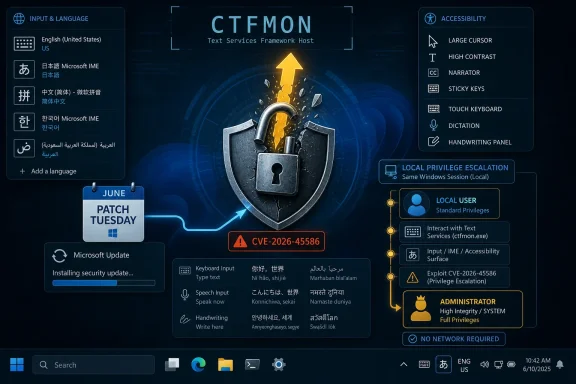 CTFMON Is the Kind of Windows Plumbing Attackers Learn to Love
CTFMON has always had a strange public life. To ordinary users, it is the thing that appears in Task Manager and prompts anxious searches for “is ctfmon.exe a virus?” To Windows itself, it is part of the text-input machinery that helps make modern desktops usable across languages, input methods, accessibility features, speech, handwriting, and the complicated edge cases of typing into every kind of application.That mundane role is exactly why security engineers pay attention to it. Input services are not a decorative layer on top of the operating system; they cross application boundaries, user-interface boundaries, and sometimes trust boundaries. A framework that brokers text and input across processes can become a powerful attack surface if its permission checks, object ownership, message handling, or interprocess assumptions are wrong.
CVE-2026-45586 is therefore less surprising than it first appears. Windows is full of legacy-adjacent subsystems that have been modernized, wrapped, patched, and resecured over time without ever being removed, because removing them would break the desktop. Attackers do not need the most glamorous component in Windows; they need the component that is loaded, reachable, widely deployed, and trusted enough to be useful.
The important distinction is that this is an elevation-of-privilege flaw. It does not, by itself, mean an attacker can reach across the internet and instantly compromise a fully patched machine. But once an attacker has code execution as a standard user — through phishing, a malicious document, a browser exploit chain, stolen credentials, or another foothold — a local privilege escalation can be the step that turns a messy intrusion into administrative control.
The June Patch Tuesday Signal Is Louder Than the CVE Summary
Microsoft’s Security Update Guide entries are often terse by design. They identify the affected component, severity, exploitation status, and remediation path, but they rarely provide the kind of implementation detail defenders and researchers would like on day one. That restraint is understandable; detailed root-cause analysis can help administrators, but it can also hand exploit developers a map.The signal in this case is the combination of component and exploitation status. A CTFMON elevation-of-privilege bug would already deserve attention because it touches a mature Windows subsystem with a history of security scrutiny. If Microsoft says exploitation has been detected, it moves from “patch in the regular cycle” to “treat as part of an active threat-management queue.”
That does not mean every Windows PC is being hunted through this exact flaw. It does mean defenders should assume someone has worked out enough of the vulnerability to use it operationally, or at least that credible exploitation has reached Microsoft’s threshold for public acknowledgement. In the vulnerability-management world, that is a very different risk profile from a theoretical bug found in code review and quietly patched before weaponization.
There is also a practical reason this class of vulnerability receives attention from attackers. Local privilege escalation flaws are reusable building blocks. They fit behind many kinds of initial access, and they can be swapped into intrusion playbooks without changing the whole operation. A phishing lure, remote access trojan, or commodity loader becomes more dangerous when paired with a dependable way to escape standard-user constraints.
The Old Windows Desktop Still Has Modern Security Consequences
The Collaborative Translation Framework and the broader Text Services Framework exist because Windows is not one program. It is a platform expected to support old Win32 applications, modern app models, accessibility tools, enterprise language packs, touch keyboards, IMEs, Office workflows, remote sessions, and niche business software written before today’s security assumptions hardened.That compatibility burden is one of Windows’ greatest commercial strengths and one of its longest-running security debts. Microsoft cannot simply simplify the desktop into a clean modern design without punishing the customers who keep Windows entrenched in business, government, education, and industry. The result is a constant engineering compromise: lock down old surfaces without breaking the behaviors that customers quietly depend on.
CTFMON lives in that compromise. It is not flashy, and it is not optional for many users. In multilingual environments, accessibility-heavy deployments, and organizations with complex input requirements, text services are infrastructure. A breakage in this area can look like keyboards not working, language switching failing, text boxes refusing input, search fields going dead, or line-of-business applications behaving unpredictably.
That is why “just disable it” is usually the wrong answer. Security hardening that breaks input is not hardening; it is self-inflicted downtime. The useful response to CVE-2026-45586 is not to rip CTFMON out of Windows, but to patch quickly, validate business-critical input workflows, and monitor for signs that local privilege escalation is being chained with initial-access activity.
Local Privilege Escalation Is the Quiet Middle of the Attack Chain
Security headlines tend to reward remote code execution and zero-click compromise. Those are frightening for good reasons, especially when they hit exposed services or default configurations. But local privilege escalation is often where an intrusion becomes durable.A standard user account is inconvenient for an attacker. It limits access to system files, credential material, endpoint controls, protected processes, and administrative tooling. A successful elevation-of-privilege exploit changes the economics: persistence becomes easier, defense evasion becomes more plausible, credential theft becomes richer, and lateral movement becomes less noisy.
That is why administrators should resist the temptation to rank this bug solely by whether it is “remote.” In mature environments, attackers often arrive through routes that do not immediately grant administrator rights. A local privilege escalation vulnerability can supply the missing rung on the ladder.
The operational question is not whether CVE-2026-45586 is the first step. It is whether it can become the second or third step after a user opens the wrong file, runs the wrong installer, signs in to the wrong fake portal, or executes a payload delivered through another vulnerability. In that role, a Windows desktop component can matter as much as a server-side bug.
Microsoft’s Terse Advisory Leaves Defenders With a Familiar Gap
Microsoft’s public vulnerability language often creates a tension for IT teams. The company gives enough information to justify patching but not always enough to build precise detections around exploit mechanics. That is especially true for Windows internals vulnerabilities, where the difference between a safe description and an exploit recipe can be thin.For CVE-2026-45586, the visible facts point to a confirmed Windows elevation-of-privilege issue in the Collaborative Translation Framework, with patching delivered through the normal Windows update channel. The missing details are the ones defenders always want: what object is mishandled, what privilege boundary is crossed, what telemetry should light up, whether exploitation requires special local conditions, and which builds are most exposed in practice.
That lack of detail should not be mistaken for lack of seriousness. If anything, sparse public detail can increase the importance of disciplined patch operations. When defenders cannot write a perfect detection because the root cause is not public, the patch itself becomes the primary control.
There is also a timing issue. Once a Patch Tuesday update ships, attackers can compare patched and unpatched binaries. Even if only a small group knew how to exploit a flaw before disclosure, the update can start a reverse-engineering race. Organizations that wait weeks for desktop patches may be giving that race too much room.
Windows 10 Holdouts Have Less Room for Complacency
The Windows endpoint landscape in 2026 is more fragmented than Microsoft would like. Windows 11 is the strategic client platform, but Windows 10 remains present in many organizations because hardware refreshes are expensive, application validation takes time, and some business units treat operating-system migration as a tax rather than a security project.That matters for a vulnerability like this because old desktop assumptions linger longest in the environments slowest to modernize. Aging fleets tend to have more local admin exceptions, more legacy input components, more third-party utilities that hook into user sessions, and more complicated language or accessibility configurations that no one wants to touch unless forced.
Patch availability is only one part of the problem. The real work is proving that deployment will not break the workflows that keep users productive. For CTFMON-adjacent fixes, that means paying attention to typing, IMEs, remote desktops, virtual desktops, kiosk-like setups, assistive technologies, and applications that rely on unusual text-entry paths.
This is where security and endpoint engineering have to meet. A vulnerability-management dashboard can show missing patches, but it cannot tell you whether a Japanese IME in a finance department, a screen-reader workflow in HR, or a remote-app publishing setup in operations still behaves correctly after the update. The right answer is accelerated patching with targeted validation, not blind delay.
Servers Are Not Exempt Just Because CTFMON Sounds Like a Desktop Problem
It is tempting to file CTFMON under “client-side Windows oddities” and move on. That would be too casual. Windows Server installations may have different exposure depending on role, configuration, desktop experience, remote access patterns, and installed components, but administrators should not assume that a user-session subsystem is irrelevant on servers.Remote Desktop Services, jump boxes, management servers, application servers with interactive logons, and legacy administrative workflows can all create user-session attack surfaces. In many real networks, the most valuable Windows systems are not pure headless servers; they are machines where admins sign in, run tools, copy files, launch consoles, and bridge trust zones.
That is precisely where a local privilege escalation can become painful. If an attacker compromises a lower-privileged account on a management host and can elevate locally, the blast radius may extend far beyond that one machine. The server’s role in the environment can amplify what would otherwise look like a local issue.
For domain controllers and other high-value systems, the answer remains the boring answer: minimize interactive logons, restrict administrative paths, harden jump hosts, keep endpoint detection active, and patch. CVE-2026-45586 is not a reason to invent a new security philosophy; it is a reminder that the old one is still under-tested in many networks.
The CTFMON Name Carries Security Baggage for a Reason
CTFMON and related text-service internals have attracted attention before. The most famous modern reminder came from public research in 2019 that examined long-standing weaknesses in Windows’ CTF mechanisms and showed how obscure interprocess protocols can become security-critical when they sit across desktop trust boundaries. Microsoft patched that era’s issues, but the broader lesson survived the specific bugs.The lesson was not “CTFMON is broken forever.” It was that old Windows desktop protocols can have surprising reach. Interfaces built for cooperation between applications, input methods, and services may predate current expectations about isolation, integrity levels, sandboxing, and hostile same-user or cross-process behavior.
CVE-2026-45586 fits that historical pattern, even without public root-cause detail. When an elevation-of-privilege issue appears in this part of Windows, experienced defenders do not treat it as an isolated curiosity. They see a familiar class of risk: glue code, session services, and compatibility layers that are necessary precisely because the Windows desktop is so extensible.
That is not a condemnation of Microsoft alone. Every long-lived platform accumulates layers. The difference is that Windows’ installed base and backward-compatibility promise make its layers unusually valuable to attackers. If a component is present on hundreds of millions of machines and participates in trusted user-session behavior, it is worth studying.
Confidence Is Not Just a CVSS Field
The user-supplied metric language points to an important idea: confidence in a vulnerability is not only about severity. It is about how much is known, who has confirmed it, whether technical details are credible, and how much practical knowledge attackers may already possess.For CVE-2026-45586, the vendor acknowledgement is the anchor. Microsoft has assigned the CVE, published the advisory, and shipped remediation through the security update process. That gives defenders high confidence that the vulnerability exists and that patching is the intended fix.
The exploitation signal raises confidence in a different direction. It suggests the issue is not merely theoretical, even if public exploit details remain limited. From a risk perspective, that combination is awkward: defenders may not have enough technical detail to hunt perfectly, while attackers may already have enough detail to use it.
That asymmetry is common in active-exploitation cases. Vendors often minimize public implementation detail to slow copycat exploitation. Defenders, meanwhile, are left to prioritize patching based on trust in the advisory, endpoint telemetry, and the strategic importance of the affected component. It is not satisfying, but it is the reality of patch management when the vulnerability is live.
The Patch Is the Fix, but the Response Should Be Wider
For individual Windows users, the practical instruction is simple: install the June 2026 security updates and reboot when required. If Windows Update is paused, deferred, or failing, this is the kind of vulnerability that argues against waiting for convenience. A local privilege escalation bug under active exploitation is exactly what cumulative updates are meant to close.For administrators, the response should be more deliberate. Patch rings still matter, but the timing should compress. Test groups should include systems with multiple keyboard layouts, IMEs, accessibility tools, Remote Desktop usage, VDI sessions, and any line-of-business applications known to be fragile around text input. The goal is not to avoid the update; it is to find breakage early enough that deployment does not stall.
Security teams should also look sideways from the patch. If this flaw is being exploited, it is probably being chained with something else. That means reviewing recent alerts involving suspicious local process launches, unexpected child processes from user-session components, failed or unusual privilege changes, tampering with endpoint controls, and activity from accounts that should not be performing administrative actions.
There is a limit to how precise that hunting can be without exploit details. Still, defenders can search for the shape of post-exploitation: newly created services, unusual scheduled tasks, credential-access tooling, suspicious PowerShell or script execution, unexpected binaries in user-writable paths, and lateral movement attempts following an initial desktop compromise. The elevation may be local, but the campaign around it rarely stays local.
The Real Risk Is the Unpatched Middle
The easiest machines to patch are not always the machines attackers want. Consumer PCs update automatically. Cloud-managed endpoints move quickly if policy allows. The systems that lag are often the awkward middle: shared workstations, lab machines, training rooms, factory PCs, remote offices, VDI templates, developer boxes, old laptops assigned to contractors, and servers that administrators are afraid to reboot.Those are the systems where a local privilege escalation can linger. They may not be the crown jewels, but they are often connected to enough internal resources to matter. They may also have looser controls because they are treated as exceptions rather than first-class assets.
CTFMON’s role makes that middle even more relevant. Machines with unusual input requirements, multilingual users, accessibility dependencies, or legacy desktop configurations are often the same machines administrators hesitate to change. If the patch is delayed because “we need to make sure typing still works,” then validation needs to happen quickly and explicitly, not become a reason for indefinite deferral.
Attackers do not need perfect coverage. They need one neglected endpoint, one compromised user, one local escalation, and one path onward. Vulnerability management is won or lost in that unglamorous middle.
The CTFMON Fix Belongs Near the Front of June’s Queue
The right reading of CVE-2026-45586 is neither panic nor complacency. It is a Windows local privilege escalation in a widely present user-session subsystem, acknowledged and patched by Microsoft, with enough exploitation signal to justify accelerated handling.- Organizations should deploy the June 2026 Windows security updates promptly, especially on endpoints and interactive servers where users or administrators sign in regularly.
- Test rings should include multilingual input, IMEs, accessibility tools, Remote Desktop sessions, VDI images, and applications known to depend on unusual text-entry behavior.
- Security teams should assume the vulnerability may be used after initial access, not as the initial access method itself.
- Administrators should review high-value systems for unnecessary interactive logons, because local privilege escalation is most dangerous where the local machine has broader administrative reach.
- Delayed or exception-based patching should be documented and time-limited, not left as an open-ended risk because the affected component sounds obscure.
References
- Primary source: MSRC
Published: 2026-06-09T07:00:00-07:00
Security Update Guide - Microsoft Security Response Center
 msrc.microsoft.com
- Related coverage: wiz.io
CVE-2023-32009 Impact, Exploitability, and Mitigation Steps | Wiz
Understand the critical aspects of CVE-2023-32009 with a detailed vulnerability assessment, exploitation potential, affected technologies, and remediation guidance.www.wiz.io - Related coverage: sentinelone.com
CVE-2023-32009: Windows 10 1607 Privilege Escalation Flaw
CVE-2023-32009 is a privilege escalation vulnerability in Windows 10 1607 Collaborative Translation Framework. Learn about its impact, affected versions, and fixes.www.sentinelone.com
- Related coverage: thewindowsupdate.com
- Official source: microsoft.com
MSRC - Microsoft Security Response Center
The Microsoft Security Response Center is part of the defender community and on the front line of security response evolution. For over twenty years, we have been engaged with security researchers working to protect customers and the broader ecosystem.www.microsoft.com
- Related coverage: sra.io
- Official source: learn.microsoft.com
Text Services Framework - Win32 apps | Microsoft Learn
learn.microsoft.com - Related coverage: windows-faq.de
CTF Ladeprogramm (CTFMON.exe) - Windows FAQ
CTFMON.exe, auch bekannt als das "CTF Ladeprogramm", ist für viele Windows Anwender ein unbekannter Prozess im Windows Task-Manager.www.windows-faq.de - Related coverage: windowsforum.com
CTF Loader Troubleshooting: Fix Text Services Framework in Windows | Windows Forum
CTF Loader (ctfmon.exe) is a legitimate Windows component that quietly underpins handwriting, speech recognition, input method editors (IMEs), the language...windowsforum.com - Related coverage: baboo.com.br
CTFMon (ctfmon.exe): conheça-o em detalhe | BABOO
O arquivo ctfmon ou CtfMon.exe é um processo que gerencia as opções de linguagem e dispositivos de entrada que utilizam reconhecimento de voz ou escrita.www.baboo.com.br - Related coverage: techlasi.com
Is ctfmon.exe a Virus? Everything Windows Users Need to Know in 2026
If you have ever opened Task Manager and spotted a process called ctfmon.exe running in the background, you are not alone. Many Windows users see it andtechlasi.com - Related coverage: ccm.net
Disable Ctfmon.exe at startup on Windows 10
Ctfmon.exe is a Microsoft Office process that works with the Windows operating system. This process activates the language bar and alternative user input. It is a non-essential system process that runs in the background, even after quitting all programs. This article will show you how to disable it.ccm.net - Related coverage: ctfmon.vercel.app

CTF.DEEPDIVE :: Input Pipeline Reverse Engineering
ctfmon.vercel.app
- Related coverage: everything.explained.today
Text Services Framework Explained
The Text Services Framework is a COM framework and API in the Microsoft Windows operating system that supports advanced text ...everything.explained.today - Related coverage: support.itsolver.net
How to Resolve Ctfmon Issues - Complete Troubleshooting Guide – IT Solver Support
Encountering issues with text input on Windows, such as being unable to type in the search bar, Sticky Notes, or login fields, often...support.itsolver.net - Related coverage: memoryforensic.com
