

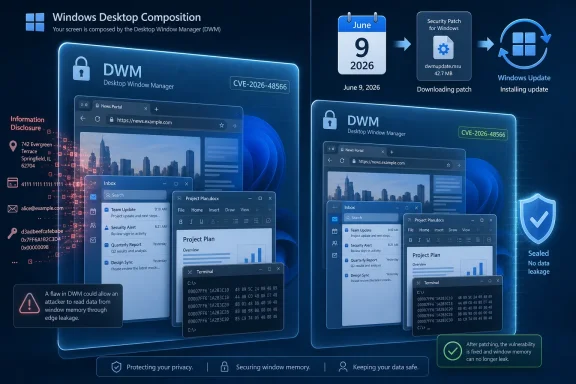
Microsoft’s Quiet DWM Fix Lands in a Noisy Patch Tuesday
CVE-2026-48566 arrives in a familiar Microsoft cadence: a terse Security Update Guide entry, an “Important” severity label, and just enough detail to tell defenders where to look without handing attackers a tutorial. That sparseness frustrates vulnerability managers, but it is also how many Windows platform bugs are disclosed when the fix is available and the technical blast radius is bounded.
The affected component, Windows DWM Core Library, is part of the Desktop Window Manager stack that underpins the modern Windows graphical experience. DWM is not a decorative extra. It is the composition layer that helps draw windows, manage visual effects, and maintain the desktop experience users take for granted across Windows 10, Windows 11, and Windows Server installations with graphical sessions.
That does not mean every DWM flaw is equally dangerous. A local information disclosure vulnerability is not the same operational event as an unauthenticated wormable service bug. But Windows history has shown repeatedly that local memory disclosures can matter because they help attackers defeat mitigations, map process state, or stabilize a follow-on exploit that would otherwise be unreliable.
This is why CVE-2026-48566 deserves attention out of proportion to its plain-looking title. The title says “information disclosure.” The component says “desktop composition.” The patch vehicle says “install the cumulative update.” The defensive reading is: fix it, verify it, and do not let the modest label obscure the role such bugs often play in multi-stage compromise.
The Confidence Metric Is the Subtext, Not the Footnote
The text supplied with the advisory points to a confidence concept: how certain we are that a vulnerability exists and how credible the public technical details are. In practical terms, that metric is about the difference between a rumor, a plausible research lead, and a vendor-confirmed security issue with an assigned CVE and a patch.
CVE-2026-48566 is in the last category. Microsoft has acknowledged it, assigned it a CVE, and issued security updates. For administrators, that is more important than whether exploit code has been published or whether third-party writeups have reverse-engineered the root cause.
This is where patch triage often goes wrong. Teams sometimes treat missing public exploit details as a reason to defer a fix, when in reality the absence of detail may simply mean responsible disclosure worked as intended. Attackers can reverse patches too, and a low-drama advisory can become more technically legible once binaries are compared before and after Patch Tuesday.
The confidence metric cuts both ways. High confidence that the vulnerability exists increases urgency, even when public technical detail remains thin. Low public detail may reduce copy-paste exploitation in the short term, but it does not make the underlying bug imaginary.
DWM Is a Local Surface, but Local Does Not Mean Harmless
The phrase local attacker is one of the most misunderstood terms in Windows security bulletins. It does not necessarily mean someone sitting at the keyboard. It can mean code already running under a low-privileged account, a malicious document that achieved initial execution through another bug, a compromised browser renderer, a rogue insider, or malware trying to graduate from foothold to persistence.
DWM’s placement makes that especially relevant. The desktop stack is exposed to interactive user sessions, graphics operations, windowing behavior, handles, shared memory, and cross-process boundaries that have accumulated complexity over decades. It is exactly the kind of subsystem where memory disclosure can reveal addresses, object layouts, or fragments of data that make a later step easier.
An information disclosure bug rarely closes the deal by itself. Its value is usually in removing uncertainty. If a separate exploit needs a memory address, a kernel object hint, or a way to pierce address-space layout randomization, a disclosure primitive can turn a flaky attack into a repeatable one.
That is why defenders should resist ranking CVE-2026-48566 only by its impact word. “Disclosure” sounds passive. In exploit engineering, disclosure can be the reconnaissance stage performed by the victim machine itself.
Microsoft’s Minimalism Leaves Defenders Reading Between the Lines
The Security Update Guide has become Microsoft’s machine-readable clearinghouse for vulnerability response, but it is not designed to satisfy curiosity. Its job is to tell enterprises which products are affected, which updates remediate the issue, how Microsoft scores the bug, and whether known exploitation or public disclosure changes the priority calculus.
For CVE-2026-48566, the central facts are sufficient for operational response: the vulnerability is in Windows DWM Core Library, the impact is information disclosure, the severity is Important, and the remedy is to deploy the June 2026 security updates. The missing parts are the ones researchers want most: root cause, reachable code path, proof-of-concept conditions, and what specific information could be exposed.
That absence should not be filled with invention. Unless Microsoft or a credible researcher publishes more detail, defenders should avoid treating the bug as a known arbitrary memory read, a kernel compromise, or an exploit chain component. The honest position is narrower: Microsoft has confirmed an information disclosure flaw in a sensitive Windows component, and supported systems should be updated.
There is a useful discipline in that restraint. Overstating the bug encourages alert fatigue. Understating it encourages patch debt. The right posture is to act on the vendor-confirmed risk while keeping the technical speculation on a leash.
The DWM Pattern Has Become Familiar Enough to Matter
CVE-2026-48566 does not appear in isolation. DWM Core Library has been a recurring Patch Tuesday tenant, with Microsoft repeatedly addressing information disclosure and elevation-of-privilege issues in the desktop composition stack across recent Windows release cycles. Some have been ordinary memory-safety defects; some have mattered more because they sat close to exploitation paths used in the wild.
That repetition should not be read as proof that DWM is uniquely broken. It is proof that complex, privileged, backward-compatible graphics and windowing infrastructure remains hard to secure. Windows has to support old applications, new graphics drivers, remote sessions, accessibility tools, sandboxed workloads, multi-monitor desktops, and enterprise management overlays. Every one of those requirements adds interfaces and assumptions.
The more important lesson is architectural. Modern Windows security increasingly depends on layers: memory-safe coding practices where possible, runtime mitigations, process isolation, privilege boundaries, exploit detection, and rapid servicing. An information leak in one layer can erode the value of another.
That is why Microsoft’s steady stream of local fixes matters even when no single CVE dominates headlines. The desktop is still an attack surface. Local bugs still matter. Patch Tuesday still carries the maintenance burden for the security model everyone relies on between major Windows releases.
For Home Users, the Right Move Is Boring and Effective
For most Windows enthusiasts and home users, CVE-2026-48566 does not require a special mitigation plan. It requires letting Windows Update do its job, rebooting when prompted, and not assuming that “Important” means optional. If your system is supported and receiving the June 2026 cumulative update, the fix should arrive through the normal update process.
The risk profile for home users is usually indirect. A local information disclosure flaw becomes relevant after some other event has already put malicious code on the machine. That event might be a trojanized installer, a malicious script, a browser exploit, a cracked game utility, or a phishing attachment that convinced the user to run something.
In that setting, the DWM bug is not the front door. It is a tool that may help an intruder move around once inside. Removing it is part of reducing the number of sharp objects available to malware after initial execution.
This is also a reminder that Windows security is not only about antivirus signatures and browser warnings. Monthly cumulative updates quietly remove exploit primitives from the platform. The user who patches promptly has fewer old assumptions for malware authors to rely on.
For Administrators, the Question Is Exposure by Session Type
Enterprise administrators should think about CVE-2026-48566 through the lens of where interactive Windows sessions exist. Workstations are obvious. So are VDI pools, Remote Desktop Session Host servers, jump boxes, engineering workstations, kiosk systems, shared lab machines, and admin desktops used to manage sensitive infrastructure.
Servers without a desktop experience may look less exposed, but Windows Server estates are rarely uniform. Some systems run full GUI installations for vendor supportability, legacy management tooling, or operational convenience. Others are accessed through RDP even if the workload itself is not desktop-centric.
The patching priority should rise where low-privileged code execution is more plausible or where the session has access to sensitive administration surfaces. A developer workstation with build secrets, a helpdesk jump host, or a shared RDS environment deserves more urgency than an isolated, non-interactive system already on a short patch window.
This does not mean administrators need an emergency out-of-band response for every DWM information disclosure CVE. It means they should avoid lumping all “local info disclosure” bugs into the same deferral bucket. Context turns a modest vulnerability into a meaningful operational risk.
Patch Tuesday Triage Still Rewards the Teams That Know Their Estate
The June 2026 Patch Tuesday release is large enough that many organizations will triage by severity, exploit status, asset class, and business risk. That is rational. Not every CVE can receive equal attention in the first 24 hours, and not every environment can reboot every Windows machine immediately without consequence.
But CVE-2026-48566 is a good example of why asset awareness beats spreadsheet sorting. If a vulnerability touches a broadly deployed Windows component, the question is not just “what is the CVSS score?” It is “where does this component run in our environment, under what user context, and alongside what higher-value targets?”
A workstation fleet with good update compliance may absorb the fix automatically. A VDI environment with golden images and staged rollouts may need image maintenance and validation. A regulated enterprise may need evidence that both client and server SKUs have received the applicable cumulative update. A managed service provider may need to prove tenant-by-tenant compliance.
The practical work is unglamorous. Confirm applicability. Deploy updates to test rings. Watch for graphics, remote session, and application compatibility regressions. Move to broader deployment once telemetry looks clean. Document exceptions, because exceptions have a habit of becoming tomorrow’s incident report.
Exploitability Is Not a Binary Switch
Security teams often ask whether a vulnerability is being exploited in the wild. It is the right question, but it is not the only question. A flaw can have no known exploitation today and still be worth prompt remediation because attackers learn from patches, especially in Windows components with wide deployment and predictable update availability.
Information disclosure vulnerabilities are especially susceptible to under-prioritization because their impact is less cinematic. They do not encrypt files, open shells, or crash services in the advisory text. Their output may be as small as a pointer, a heap fragment, or a piece of state that only matters when paired with another vulnerability.
That pairing is the point. Exploit chains are assembled from parts. A sandbox escape may need a leak. A privilege escalation may need a stable address. A bypass may need a kernel or user-mode clue. The final compromise gets the headline, but the supporting disclosure bug may have made it reliable enough to ship.
CVE-2026-48566 should therefore be treated as a confirmed weakness in a common Windows subsystem, not as a standalone catastrophe. That middle ground is where mature patch management lives.
The Absence of Workarounds Changes the Conversation
When Microsoft publishes a vulnerability with no practical workaround, defenders have fewer strategic choices. They can patch, delay, isolate, or accept risk. For a desktop component like DWM, disabling the affected functionality is generally not realistic without breaking the operating model users and administrators depend on.
That makes update hygiene the main control. Endpoint detection and response tools may catch exploitation attempts if they produce suspicious behavior, but they cannot be assumed to block an unknown memory disclosure primitive. Least privilege helps, but the advisory already assumes an authorized attacker, which means low privilege may be enough to begin the relevant path.
Application control, attack surface reduction rules, and standard user operation still matter. They reduce the chance that untrusted code runs locally in the first place. But once local code is running, a patched platform is a stronger platform than one relying on detection alone.
This is one reason cumulative updates remain the center of Windows defense despite all the industry excitement around AI detection, behavioral analytics, and managed response. The cleanest exploit chain is the one denied a working primitive before it starts.
The “Important” Label Should Not Be Read as “Later”
Microsoft’s severity labels are useful, but they are not a substitute for judgment. “Critical” often signals remote code execution or wormable potential. “Important” frequently covers local privilege escalation, information disclosure, spoofing, and other flaws that require preconditions but still carry real security consequences.
CVE-2026-48566 fits that second category. It likely requires local access or local code execution, and it is not presented as a remote unauthenticated compromise. That lowers immediate internet-scale urgency. It does not lower the need to remediate across supported Windows systems.
Administrators who patch only the Critical column are effectively betting that attackers will not combine bugs. That is a bad bet. Real intrusions rarely respect advisory categories; they chain credential theft, phishing, misconfiguration, local escalation, and memory disclosure into whatever path gets them to the objective.
The better rule is to prioritize Critical and known-exploited vulnerabilities first, then close the Important Windows platform issues in the same cycle unless testing reveals a concrete blocker. CVE-2026-48566 belongs in that second wave, not in a forgotten backlog.
The Researcher’s Temptation Is to Overread the Silence
There will almost certainly be attempts to infer the root cause of CVE-2026-48566 from patch diffing, symbol changes, crash behavior, or comparisons with earlier DWM vulnerabilities. That work can be valuable. It can also produce confident guesses that outrun the evidence.
For now, the responsible public reading is limited. Microsoft has confirmed a Windows DWM Core Library information disclosure vulnerability and issued a fix. The advisory language supplied by the user highlights confidence in the existence of the vulnerability and the credibility of known details, not a public explanation of the bug’s internals.
That distinction matters for WindowsForum readers because technical curiosity can morph into operational misclassification. If someone claims the bug leaks a specific class of memory, bypasses a named mitigation, or affects only one narrow Windows build, ask whether that claim comes from Microsoft, a reproducible independent analysis, or speculation.
Until stronger evidence appears, defenders should keep the vulnerability in the “confirmed and patched, technically under-described” bucket. That is enough to act. It is not enough to embellish.
The June DWM Fix Belongs in the First Maintenance Window
CVE-2026-48566 is a classic case where the right answer is neither alarm nor apathy. It is a confirmed Windows vulnerability in a ubiquitous desktop component, delivered through the monthly servicing channel, with limited public technical detail and no obvious compensating control better than applying the update.
That means Windows administrators should treat it as part of the June 2026 baseline rather than a boutique security project. The systems most deserving of early attention are those with interactive users, shared sessions, administrative workflows, or elevated business value. The systems most likely to be missed are the ones outside normal workstation management: persistent VDI images, lab machines, kiosks, vendor-managed servers, and rarely rebooted admin boxes.
The concrete lessons are straightforward:
- CVE-2026-48566 is a Microsoft-confirmed Windows DWM Core Library information disclosure vulnerability fixed in the June 9, 2026 Patch Tuesday release.
- The vulnerability should be prioritized for systems that host interactive desktop sessions, especially administrator workstations, RDS hosts, VDI pools, and shared Windows machines.
- The lack of public exploit detail should not be treated as evidence that the bug is unimportant, because patch diffing can change attacker knowledge after release.
- The practical mitigation is to install the applicable cumulative security update and verify deployment through normal endpoint, server, or image-management tooling.
- Information disclosure bugs are most dangerous when paired with other vulnerabilities, so they should be closed as part of chain-breaking defense rather than judged only in isolation.
CVE-2026-48566 will probably not be the vulnerability people remember from June 2026 if larger zero-days and critical server flaws dominate the month’s response. But the quiet Windows bugs are often the ones that measure the health of an organization’s security program: whether it patches broadly, understands where its interactive surfaces live, and treats confirmed platform weaknesses as engineering work rather than headline material. The attackers who matter are patient assemblers of small advantages, and the defenders who keep winning are the ones who remove those advantages before they become a chain.