

Microsoft disclosed CVE-2026-45605 on June 9, 2026, as an Important-rated Windows Bluetooth Service elevation-of-privilege vulnerability caused by a use-after-free flaw and patched it across supported Windows client and server releases through the June security update cycle. The interesting part is not that Bluetooth had another memory-safety bug; Windows has lived with that class of defect for decades. The real story is that Microsoft’s own scoring says this one is locally exploitable with low complexity, low privileges, no user interaction, and confirmed technical confidence, while still being assessed as “exploitation less likely.” That tension is exactly where administrators should focus.
CVE-2026-45605 is not a wormable remote-code-execution headline. It does not, based on Microsoft’s advisory, let an unauthenticated attacker reach across the internet and compromise a machine merely because Bluetooth exists. It is a local elevation-of-privilege flaw, which means an attacker already needs a foothold of some kind before this bug becomes useful.
That distinction matters, but it should not comfort anyone too much. Local privilege escalation is the connective tissue of modern compromise: phishing gets code running, browser or document bugs establish initial access, and an EoP bug turns a constrained user context into something more dangerous. In that chain, CVE-2026-45605 is not the front door; it is a potential stairwell.
Microsoft describes the vulnerability as a use-after-free issue in the Windows Bluetooth Service that allows an authorized attacker to elevate privileges locally. The phrase is terse, but the implications are familiar. A use-after-free bug means software continues to reference memory after it should no longer be valid, opening the door to memory corruption if an attacker can shape what occupies that freed region next.
The advisory assigns the flaw a CVSS 3.1 base score of 7.8, placing it in high-score territory even though Microsoft’s maximum severity label is Important rather than Critical. That split reflects a long-standing Microsoft habit: privilege-escalation bugs often sit below the marketing blast radius of remote code execution, even when successful exploitation could have serious consequences for confidentiality, integrity, and availability.
The attack vector is local. That is the first limiting factor and the first clue about how defenders should think about the bug. Nothing in the published advisory says that an attacker can exploit it simply by being physically nearby with a rogue headset, phone, or beacon.
That does not make the Bluetooth component irrelevant. Windows Bluetooth support is not a decorative subsystem on modern PCs; it is part of the everyday device fabric for keyboards, mice, headsets, phones, authentication accessories, conference-room gear, and embedded workplace hardware. A bug in that service therefore lands in a component that is widely present, often enabled by default, and frequently overlooked in server and endpoint hardening conversations.
The better mental model is not “Bluetooth attack from across the room.” It is “a Windows service with elevated trust has a memory-safety flaw reachable by a local authorized attacker.” That is a less cinematic framing, but it is the one that matters for enterprise risk.
That is why the “Important” label should not be read as “optional.” Microsoft’s own scoring gives the bug a high base score because privilege escalation can turn a limited intrusion into a much more durable one. The attacker may start as a standard user or a constrained process, but the value of an EoP bug lies in escaping those constraints.
The temporal score is lower because Microsoft says exploit code maturity is unproven and an official fix exists. That is sensible scoring discipline. A vulnerability with no public exploit and a patch already available is not the same operational emergency as a weaponized zero-day.
But the base conditions are still uncomfortable. Low complexity and no user interaction make a bug more attractive once someone works out the exploitation path. Even if the first public proof-of-concept never appears, private exploit development does not wait for GitHub.
Confirmed does not mean defenders have every technical detail. It does not mean exploit code is public. It does mean the vendor has enough confidence in the vulnerability’s existence and technical basis to publish a CVE and ship fixes.
That matters because there is a persistent bad habit in patch triage: teams downgrade anything without a flashy exploit write-up. In many organizations, “no exploit observed” quietly becomes “no problem.” CVE-2026-45605 shows why that shortcut is dangerous.
The vulnerability can be both not publicly exploited and still real. It can be both hard to weaponize in the wild today and still useful in a chained attack tomorrow. Report Confidence is a reminder that absence of public drama is not absence of defect.
But “less likely” is not “not exploitable.” It is a probabilistic assessment at publication time, and those assessments age. Local privilege-escalation bugs often become more interesting after patch diffing, when researchers and attackers compare vulnerable and fixed binaries to infer the repaired code path.
The exploitability assessment should influence sequencing, not justify deferral. If a domain controller has emergency exposure to a known exploited remote vulnerability, that goes first. If a Windows laptop fleet has Bluetooth enabled, users with local execution pathways, and inconsistent patch compliance, CVE-2026-45605 still belongs in the near-term deployment window.
The patch already exists, which changes the question. The decision is no longer whether to mitigate an uncertain bug with an awkward workaround. The decision is whether to apply Microsoft’s June updates before somebody else turns the advisory into a reproducible technique.
For Windows 10 21H2 and 22H2, the relevant update is KB5094127, with fixed builds 10.0.19044.7417 and 10.0.19045.7417 respectively. For Windows 11 23H2, Microsoft lists KB5093998 and build 10.0.22631.7219. For Windows 11 24H2 and 25H2, KB5094126 applies, with builds 10.0.26100.8655 and 10.0.26200.8655.
The server side is just as important. Windows Server 2016 receives KB5094122 and build 10.0.14393.9234, Windows Server 2019 receives KB5094123 and build 10.0.17763.8880, Windows Server 2022 receives KB5094128 and build 10.0.20348.5256, and Windows Server 2025 receives KB5094125 with build 10.0.26100.32995. Server Core entries are included for the supported server versions where applicable.
That list also includes Windows 11 version 26H1 with KB5095051 and build 10.0.28000.2269. Its appearance is a reminder that Microsoft’s servicing matrix now spans release trains that many enterprises may not yet have standardized on, but which are already relevant to patch metadata and inventory tooling.
The existence of a server update does not prove that every server is practically exposed in the same way as a laptop. Many servers have no Bluetooth hardware, no radio stack in use, and much tighter local access controls. Still, Windows component servicing is rarely a perfect map of physical feature usage.
The practical lesson is inventory discipline. Server teams should not ask, “Do we use Bluetooth?” and stop there. They should ask whether the affected component exists, whether the relevant update is applicable, whether the machine is in a supported servicing state, and whether local access paths exist that make privilege escalation meaningful.
That last point is crucial. On a hardened server, “local attacker” may sound remote from reality. On a server with exposed management tools, shared admin workstations, third-party agents, scheduled-task sprawl, or weak segmentation, local code execution is not a theoretical state. It is often the second step after credentials or tooling are abused.
These bugs are stubborn because they live at the boundary between correctness and timing. Code frees an object; another path still believes it can use it; an attacker tries to influence what happens in between. Depending on the component, exploitability can range from painful to surprisingly reliable.
Microsoft has invested heavily in exploit mitigations, safer languages, compiler hardening, sandbox boundaries, and hardware-backed defenses. Those investments matter. They can turn straightforward memory corruption into a more difficult exploit development exercise.
Yet CVE entries like this keep surfacing because Windows is vast, old, and filled with components that must preserve compatibility across hardware, drivers, services, and legacy behaviors. Bluetooth is especially messy because it is a protocol and device ecosystem as much as it is a Windows feature. It touches hardware vendors, drivers, pairing flows, service logic, and user-mode conveniences.
A browser exploit that lands in a low-integrity context needs a way up. A malicious document opened by a standard user needs a way out. A stolen help-desk credential needs a way to become more useful on the endpoint where it first runs. Local EoP bugs solve exactly those problems.
For ransomware crews, privilege escalation is not academic. Higher privileges mean better credential access, easier tampering with security tools, broader file-system reach, and more reliable persistence. For espionage actors, it can mean stealthier collection and deeper footholds.
CVE-2026-45605 does not need to be the first exploit in an intrusion to matter. In fact, its most realistic value is probably as a post-compromise accelerator. That is precisely why defenders should resist the urge to rank it only by whether an attacker can reach it from the internet.
Windows fleets are often divided into neat administrative categories: office endpoints, developer workstations, shared kiosks, rugged devices, conference-room PCs, virtual desktops, servers, and privileged access workstations. Bluetooth cuts across those categories unevenly. Some machines need it daily; some inherited it by default; some should never have had it enabled.
A good response therefore combines patching with hygiene. Update compliance closes the known vulnerability. Device and service review reduces the future attack surface.
On managed endpoints, Bluetooth may be controlled through policy, hardware profiles, device installation restrictions, and security baselines. In highly controlled environments, disabling Bluetooth where it is not needed remains a rational hardening step. In normal knowledge-worker environments, blanket disablement may be unrealistic, so update enforcement and endpoint detection become more important.
That is the healthy version of vulnerability handling. It gives Microsoft time to produce fixes and gives defenders a clear publication date, update identifiers, affected-product table, and exploitability assessment. It also means attackers now have the same high-level clue that defenders do.
Patch Tuesday publication is a dual-use event. It informs administrators, but it also tells reverse engineers where to look. Once a bug is fixed, the diff becomes a map, especially for those who know how to compare service binaries and reason backward from changed code.
That does not mean panic is warranted. It means the clock starts when the advisory ships, not when exploit code appears.
The proper middle gear is fast, measured deployment. Test the June updates against representative systems, watch for known deployment issues, push to higher-risk endpoint rings, then move aggressively through the rest of the fleet. Machines used by developers, administrators, help-desk staff, and power users deserve particular attention because local privilege escalation is more valuable when the user context already intersects with sensitive systems.
For home users and enthusiasts, the advice is less elaborate. Install the June 2026 Windows updates and reboot. If Bluetooth is not used, disabling it can reduce unnecessary exposure, but patching is still the clean fix because Windows components are serviced as part of the broader operating system.
For enterprises, the real risk is not that one Bluetooth EoP bug exists. The real risk is that a known, confirmed, low-complexity local escalation remains unpatched on thousands of laptops long after Microsoft has shipped the fix.
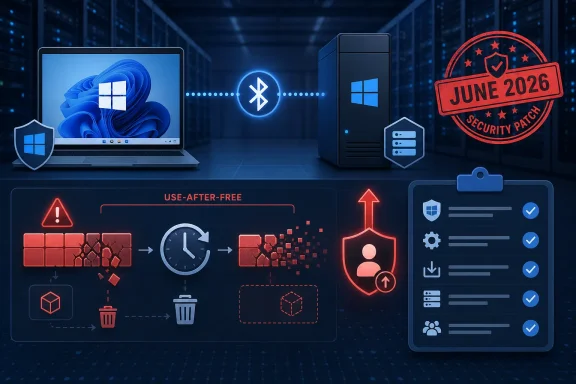 Microsoft Puts a Local Bug in the “Do Not Ignore” Column
CVE-2026-45605 is not a wormable remote-code-execution headline. It does not, based on Microsoft’s advisory, let an unauthenticated attacker reach across the internet and compromise a machine merely because Bluetooth exists. It is a local elevation-of-privilege flaw, which means an attacker already needs a foothold of some kind before this bug becomes useful.That distinction matters, but it should not comfort anyone too much. Local privilege escalation is the connective tissue of modern compromise: phishing gets code running, browser or document bugs establish initial access, and an EoP bug turns a constrained user context into something more dangerous. In that chain, CVE-2026-45605 is not the front door; it is a potential stairwell.
Microsoft describes the vulnerability as a use-after-free issue in the Windows Bluetooth Service that allows an authorized attacker to elevate privileges locally. The phrase is terse, but the implications are familiar. A use-after-free bug means software continues to reference memory after it should no longer be valid, opening the door to memory corruption if an attacker can shape what occupies that freed region next.
The advisory assigns the flaw a CVSS 3.1 base score of 7.8, placing it in high-score territory even though Microsoft’s maximum severity label is Important rather than Critical. That split reflects a long-standing Microsoft habit: privilege-escalation bugs often sit below the marketing blast radius of remote code execution, even when successful exploitation could have serious consequences for confidentiality, integrity, and availability.
The Bluetooth Label Is Less Exotic Than It Sounds
Bluetooth vulnerabilities carry a certain cultural baggage. They summon images of parking-lot attacks, hostile peripherals, and radio-range mischief. CVE-2026-45605, at least from the information Microsoft has published, should not be read that way.The attack vector is local. That is the first limiting factor and the first clue about how defenders should think about the bug. Nothing in the published advisory says that an attacker can exploit it simply by being physically nearby with a rogue headset, phone, or beacon.
That does not make the Bluetooth component irrelevant. Windows Bluetooth support is not a decorative subsystem on modern PCs; it is part of the everyday device fabric for keyboards, mice, headsets, phones, authentication accessories, conference-room gear, and embedded workplace hardware. A bug in that service therefore lands in a component that is widely present, often enabled by default, and frequently overlooked in server and endpoint hardening conversations.
The better mental model is not “Bluetooth attack from across the room.” It is “a Windows service with elevated trust has a memory-safety flaw reachable by a local authorized attacker.” That is a less cinematic framing, but it is the one that matters for enterprise risk.
The CVSS Vector Says More Than the Severity Word
The most useful line in Microsoft’s entry is the CVSS vector: local attack vector, low attack complexity, low privileges required, no user interaction, unchanged scope, and high impact across confidentiality, integrity, and availability. In plain English, Microsoft is saying that an attacker with basic access to the machine does not need a victim to click through anything, does not need special environmental conditions, and could meaningfully compromise the system if exploitation succeeds.That is why the “Important” label should not be read as “optional.” Microsoft’s own scoring gives the bug a high base score because privilege escalation can turn a limited intrusion into a much more durable one. The attacker may start as a standard user or a constrained process, but the value of an EoP bug lies in escaping those constraints.
The temporal score is lower because Microsoft says exploit code maturity is unproven and an official fix exists. That is sensible scoring discipline. A vulnerability with no public exploit and a patch already available is not the same operational emergency as a weaponized zero-day.
But the base conditions are still uncomfortable. Low complexity and no user interaction make a bug more attractive once someone works out the exploitation path. Even if the first public proof-of-concept never appears, private exploit development does not wait for GitHub.
“Confirmed” Is the Word That Should Stop the Skimming
The user-supplied excerpt points to the CVSS Report Confidence metric, and that is the part of this advisory that deserves more attention than it usually gets. Microsoft lists the confidence as Confirmed. That means the issue is not merely suspected, vaguely reported, or inferred from strange behavior.Confirmed does not mean defenders have every technical detail. It does not mean exploit code is public. It does mean the vendor has enough confidence in the vulnerability’s existence and technical basis to publish a CVE and ship fixes.
That matters because there is a persistent bad habit in patch triage: teams downgrade anything without a flashy exploit write-up. In many organizations, “no exploit observed” quietly becomes “no problem.” CVE-2026-45605 shows why that shortcut is dangerous.
The vulnerability can be both not publicly exploited and still real. It can be both hard to weaponize in the wild today and still useful in a chained attack tomorrow. Report Confidence is a reminder that absence of public drama is not absence of defect.
Microsoft’s Exploitability Call Is a Prioritization Hint, Not a Hall Pass
Microsoft says the vulnerability was not publicly disclosed and was not exploited at the time of original publication. It also rates exploitation as less likely. That is valuable information, especially for administrators staring at a June patch bundle that likely contains more than one uncomfortable item.But “less likely” is not “not exploitable.” It is a probabilistic assessment at publication time, and those assessments age. Local privilege-escalation bugs often become more interesting after patch diffing, when researchers and attackers compare vulnerable and fixed binaries to infer the repaired code path.
The exploitability assessment should influence sequencing, not justify deferral. If a domain controller has emergency exposure to a known exploited remote vulnerability, that goes first. If a Windows laptop fleet has Bluetooth enabled, users with local execution pathways, and inconsistent patch compliance, CVE-2026-45605 still belongs in the near-term deployment window.
The patch already exists, which changes the question. The decision is no longer whether to mitigate an uncertain bug with an awkward workaround. The decision is whether to apply Microsoft’s June updates before somebody else turns the advisory into a reproducible technique.
The Affected List Shows How Wide the Windows Surface Really Is
Microsoft’s security update table covers a broad set of Windows releases: Windows 10, Windows 11, and multiple Windows Server generations, including Server Core installations. That breadth is the quiet feature of this advisory. The Bluetooth Service may feel like a client-side concern, but the patch matrix reaches far beyond consumer laptops.For Windows 10 21H2 and 22H2, the relevant update is KB5094127, with fixed builds 10.0.19044.7417 and 10.0.19045.7417 respectively. For Windows 11 23H2, Microsoft lists KB5093998 and build 10.0.22631.7219. For Windows 11 24H2 and 25H2, KB5094126 applies, with builds 10.0.26100.8655 and 10.0.26200.8655.
The server side is just as important. Windows Server 2016 receives KB5094122 and build 10.0.14393.9234, Windows Server 2019 receives KB5094123 and build 10.0.17763.8880, Windows Server 2022 receives KB5094128 and build 10.0.20348.5256, and Windows Server 2025 receives KB5094125 with build 10.0.26100.32995. Server Core entries are included for the supported server versions where applicable.
That list also includes Windows 11 version 26H1 with KB5095051 and build 10.0.28000.2269. Its appearance is a reminder that Microsoft’s servicing matrix now spans release trains that many enterprises may not yet have standardized on, but which are already relevant to patch metadata and inventory tooling.
Server Core in the Patch Table Should Change the Conversation
Administrators often treat Bluetooth as a laptop problem. That is understandable; the most visible Bluetooth estate is the user endpoint estate. But Microsoft’s inclusion of Server Core installations complicates the tidy mental separation between desktop convenience features and server hardening.The existence of a server update does not prove that every server is practically exposed in the same way as a laptop. Many servers have no Bluetooth hardware, no radio stack in use, and much tighter local access controls. Still, Windows component servicing is rarely a perfect map of physical feature usage.
The practical lesson is inventory discipline. Server teams should not ask, “Do we use Bluetooth?” and stop there. They should ask whether the affected component exists, whether the relevant update is applicable, whether the machine is in a supported servicing state, and whether local access paths exist that make privilege escalation meaningful.
That last point is crucial. On a hardened server, “local attacker” may sound remote from reality. On a server with exposed management tools, shared admin workstations, third-party agents, scheduled-task sprawl, or weak segmentation, local code execution is not a theoretical state. It is often the second step after credentials or tooling are abused.
Use-After-Free Bugs Keep Winning Because Memory Safety Is Still Uneven
CVE-2026-45605 is another entry in a long ledger of Windows memory-safety debt. A use-after-free vulnerability is not a configuration typo, a missing registry flag, or a policy mistake. It is a programming defect in which object lifetime management goes wrong.These bugs are stubborn because they live at the boundary between correctness and timing. Code frees an object; another path still believes it can use it; an attacker tries to influence what happens in between. Depending on the component, exploitability can range from painful to surprisingly reliable.
Microsoft has invested heavily in exploit mitigations, safer languages, compiler hardening, sandbox boundaries, and hardware-backed defenses. Those investments matter. They can turn straightforward memory corruption into a more difficult exploit development exercise.
Yet CVE entries like this keep surfacing because Windows is vast, old, and filled with components that must preserve compatibility across hardware, drivers, services, and legacy behaviors. Bluetooth is especially messy because it is a protocol and device ecosystem as much as it is a Windows feature. It touches hardware vendors, drivers, pairing flows, service logic, and user-mode conveniences.
Local Privilege Escalation Is Where Attack Chains Become Campaigns
Security teams sometimes under-rank local EoP bugs because they lack the spectacle of remote compromise. That is a mistake born of thinking about vulnerabilities one at a time rather than as parts of an attack sequence. Very few serious intrusions remain confined to the first process that gets compromised.A browser exploit that lands in a low-integrity context needs a way up. A malicious document opened by a standard user needs a way out. A stolen help-desk credential needs a way to become more useful on the endpoint where it first runs. Local EoP bugs solve exactly those problems.
For ransomware crews, privilege escalation is not academic. Higher privileges mean better credential access, easier tampering with security tools, broader file-system reach, and more reliable persistence. For espionage actors, it can mean stealthier collection and deeper footholds.
CVE-2026-45605 does not need to be the first exploit in an intrusion to matter. In fact, its most realistic value is probably as a post-compromise accelerator. That is precisely why defenders should resist the urge to rank it only by whether an attacker can reach it from the internet.
The Bluetooth Service Is Also an Asset-Management Test
The patch for CVE-2026-45605 is straightforward in concept: apply the relevant June 2026 cumulative or security update for the affected Windows build. The difficulty lies in knowing where that update is missing, where it failed, and where the underlying feature is unnecessarily exposed.Windows fleets are often divided into neat administrative categories: office endpoints, developer workstations, shared kiosks, rugged devices, conference-room PCs, virtual desktops, servers, and privileged access workstations. Bluetooth cuts across those categories unevenly. Some machines need it daily; some inherited it by default; some should never have had it enabled.
A good response therefore combines patching with hygiene. Update compliance closes the known vulnerability. Device and service review reduces the future attack surface.
On managed endpoints, Bluetooth may be controlled through policy, hardware profiles, device installation restrictions, and security baselines. In highly controlled environments, disabling Bluetooth where it is not needed remains a rational hardening step. In normal knowledge-worker environments, blanket disablement may be unrealistic, so update enforcement and endpoint detection become more important.
The Acknowledgement Hints at Coordinated Disclosure, Not Chaos
Microsoft credits a researcher identified as “hazard” in the advisory. That acknowledgement matters less for celebrity value than for process. The vulnerability appears to have moved through coordinated disclosure: report, confirmation, patch, public advisory.That is the healthy version of vulnerability handling. It gives Microsoft time to produce fixes and gives defenders a clear publication date, update identifiers, affected-product table, and exploitability assessment. It also means attackers now have the same high-level clue that defenders do.
Patch Tuesday publication is a dual-use event. It informs administrators, but it also tells reverse engineers where to look. Once a bug is fixed, the diff becomes a map, especially for those who know how to compare service binaries and reason backward from changed code.
That does not mean panic is warranted. It means the clock starts when the advisory ships, not when exploit code appears.
Patch Management Needs a Better Middle Gear
CVE-2026-45605 is a perfect example of why patch programs need more nuance than “emergency” and “eventually.” It is not a publicly exploited zero-day, according to Microsoft. It is also not low-impact housekeeping.The proper middle gear is fast, measured deployment. Test the June updates against representative systems, watch for known deployment issues, push to higher-risk endpoint rings, then move aggressively through the rest of the fleet. Machines used by developers, administrators, help-desk staff, and power users deserve particular attention because local privilege escalation is more valuable when the user context already intersects with sensitive systems.
For home users and enthusiasts, the advice is less elaborate. Install the June 2026 Windows updates and reboot. If Bluetooth is not used, disabling it can reduce unnecessary exposure, but patching is still the clean fix because Windows components are serviced as part of the broader operating system.
For enterprises, the real risk is not that one Bluetooth EoP bug exists. The real risk is that a known, confirmed, low-complexity local escalation remains unpatched on thousands of laptops long after Microsoft has shipped the fix.
The June Bluetooth Fix Belongs in the First Serious Patch Ring
The concrete lesson from CVE-2026-45605 is that defenders should treat it as a confirmed privilege-escalation flaw with a practical patch path, not as a Bluetooth curiosity. Microsoft’s exploitability assessment lowers the heat, but the CVSS vector keeps the issue firmly in the serious-work queue.- Microsoft released the CVE-2026-45605 advisory and fixes on June 9, 2026, as part of the June Windows security update cycle.
- The vulnerability is a use-after-free flaw in the Windows Bluetooth Service that can allow local elevation of privilege by an authorized attacker.
- Microsoft rates the issue Important, while the CVSS 3.1 base score is 7.8 because exploitation requires low privileges, low complexity, and no user interaction.
- Microsoft says the vulnerability was not publicly disclosed or exploited at publication time and assesses exploitation as less likely.
- The affected update matrix spans Windows 10, Windows 11, Windows Server 2016, Windows Server 2019, Windows Server 2022, Windows Server 2025, and relevant Server Core installations.
- Administrators should verify installation of the relevant June updates and review whether Bluetooth is enabled on systems that do not need it.
References
- Primary source: MSRC
Published: 2026-06-09T07:00:00-07:00
Security Update Guide - Microsoft Security Response Center
 msrc.microsoft.com
