

On June 9, 2026, Microsoft published CVE-2026-45647 as an elevation-of-privilege vulnerability in Microsoft Defender for Endpoint for Mac, placing a security flaw in an enterprise endpoint agent squarely inside the monthly patching conversation for mixed Windows and macOS fleets. The uncomfortable part is not simply that Defender has another vulnerability. It is that the product meant to police endpoints also sits in a privileged position on those endpoints. When that software breaks, the blast radius is measured not only in CVSS math but in trust.
Microsoft’s public entry for CVE-2026-45647 is spare in the way many Security Update Guide records are spare: enough to tell administrators that the issue exists, what broad class of risk it represents, and where to look for remediation, but not enough to reconstruct the bug. That restraint is not accidental. Vulnerability advisories are now read by defenders, procurement teams, insurers, exploit brokers, and ransomware operators at the same time.
Microsoft Defender for Endpoint for Mac is not a cosmetic port of Windows Defender with a different icon. In enterprise deployments, it is part antivirus, part EDR sensor, part policy enforcement point, and part telemetry pipeline into Microsoft’s broader security stack. It runs close enough to the operating system to inspect files, monitor behavior, enforce controls, and report suspicious activity upstream.
That proximity is exactly what makes an elevation-of-privilege flaw interesting. Endpoint security software needs privileged access to do useful work; attackers want privileged access to do lasting work. A vulnerability in that layer does not automatically mean remote compromise, but it does mean that a compromised user context may have a more attractive road upward than it should.
For WindowsForum readers, the macOS label should not be a reason to tune out. Defender for Endpoint is increasingly a cross-platform control plane, and many organizations now manage Windows laptops, Macs, Linux servers, mobile devices, and cloud workloads from the same security console. The security boundary that matters to administrators is no longer “Windows versus Mac.” It is the managed endpoint estate.
That shift has made Microsoft’s non-Windows security tooling strategically important. Defender has become one of the ways Microsoft keeps enterprise security gravity centered on its cloud, even when the device itself is running Apple’s operating system. CVE-2026-45647 is a reminder that cross-platform security agents inherit the risk of both worlds: Microsoft’s security stack and Apple’s endpoint model.
A phishing payload, malicious browser extension, poisoned developer dependency, or stolen local credential may get an attacker onto a Mac. That access may initially be limited. The attacker then needs higher privileges to disable protections, access sensitive files, install persistence, dump secrets, monitor other users, or move laterally.
That is why EoP vulnerabilities in endpoint agents matter. Security products frequently possess permissions that ordinary applications do not. They may have Full Disk Access, kernel or system extension privileges, network extension entitlements, tamper protection mechanisms, launch daemons, privileged helpers, and update components. Each of those pieces is defensible in isolation; together, they form a large and unusually sensitive attack surface.
The usual enterprise reflex is to treat endpoint security software as a control, not an asset that needs the same aggressive vulnerability management as everything else. CVE-2026-45647 pushes against that habit. The software watching the endpoint must also be watched.
When a vendor acknowledges a vulnerability, confidence in existence is high even if the root cause remains undisclosed. Microsoft’s listing is therefore not rumor, forum chatter, or a speculative scanner finding. It is a vendor-recognized issue in a named product. That puts it in a different operational category from unconfirmed research claims.
But confidence in existence is not the same as confidence in exploitability details. A public advisory can confirm that a bug exists without revealing whether exploitation requires local access, user interaction, race timing, unusual configuration, a vulnerable helper process, a privileged update path, or a particular macOS permission state. For defenders, that ambiguity is frustrating. For vendors, it is often deliberate.
This is the modern advisory bargain. Microsoft gives enterprises enough to prioritize patching and inventory work. It withholds enough to avoid publishing a recipe. The problem is that attackers do not always need a recipe; they need a direction.
Modern macOS endpoints can hold source code, production credentials, SSH keys, browser sessions, cloud admin tokens, customer documents, and privileged collaboration access. A developer Mac may be more valuable to an attacker than a typical Windows office laptop. An executive Mac may have less local domain importance but far more strategic access.
Microsoft Defender for Endpoint for Mac sits inside that reality. Its value comes from bringing those devices into the same detection and response loop as Windows systems. Its risk comes from the fact that it must integrate deeply with macOS mechanisms that are deliberately restrictive, frequently updated, and sometimes hostile to old assumptions about background security tooling.
Apple’s security architecture has steadily moved toward entitlements, transparency prompts, system extensions, privacy controls, and user-approved permissions. Security vendors have adapted, but adaptation often means privileged helper tools, configuration profiles, management extensions, and special permissions. That is fertile ground for subtle privilege-boundary mistakes.
That does not mean endpoint security products are uniquely unsafe. It means they are uniquely attractive. An attacker who can exploit or abuse a security agent may gain not just privileges but stealth, persistence, or the ability to interfere with detection. Even when the bug is not directly exploitable at scale, the mere presence of a high-privilege agent changes the local attack graph.
This is especially important on macOS because many users assume Apple’s platform model narrows the window for endpoint compromise. It does, in some ways. But enterprise security agents are intentionally granted exceptions to normal application limits. The very permissions that allow Defender to scan, monitor, and respond are the same permissions that make a privilege mistake consequential.
Administrators should therefore avoid the comforting language of “just a local privilege escalation.” Local does not mean low impact. It means the attacker needs a first step before using this step. In 2026, first steps are not rare.
That creates a process gap. The Windows team may track Microsoft CVEs. The Mac management team may track Jamf, Intune, Kandji, or Mosyle compliance. The SOC may track Defender health. The vulnerability management team may track scanner output. CVE-2026-45647 sits at the intersection of all four.
If the organization’s patch process assumes that “Microsoft CVE” equals “Windows Update,” this kind of issue can drift. If the Mac team assumes Defender updates are purely the SOC’s concern, it can drift again. If security assumes automatic updates always work, the known history of endpoint agent update problems should make them more cautious.
The operational question is simple: can the organization prove which Macs have the fixed Defender for Endpoint build? If the answer requires three teams, two dashboards, and a week of spreadsheet reconciliation, the vulnerability has already exposed a governance weakness.
Security teams still need to verify version state, update health, and policy consistency. A Mac that is enrolled but stale is not meaningfully protected by the existence of a newer build. A device that lost required permissions after an operating-system upgrade may appear present in inventory while operating at reduced capability. A laptop that has been asleep, offline, traveling, or blocked from Microsoft update endpoints may miss the window in which administrators assume it was fixed.
Defender for Endpoint on macOS has had its share of release-note caveats, including known issues around upgrade behavior, performance, crashes, and macOS permission interactions. That is not unusual for a complex endpoint agent, but it reinforces the point: “deployed” and “healthy” are different states.
For CVE-2026-45647, the right posture is not panic. It is verification. Mac fleets should be queried for Defender platform version, release channel, update recency, sensor health, Full Disk Access status, network extension status, and MDM profile enforcement. The vulnerability may be the headline, but stale management data is the silent failure mode.
A vulnerability in a rarely used desktop utility may have the same numerical score as a vulnerability in an endpoint security platform deployed to every laptop used by senior engineers. The real-world risk is not the same. Context decides whether a CVE is noise, a ticket, a war room, or an audit finding.
Defender for Endpoint occupies a privileged security role. It also feeds Microsoft Defender XDR, security operations workflows, vulnerability management views, incident timelines, and automated response logic. If its local posture is suspect, organizations have to think beyond the individual Mac. They have to ask whether the telemetry they trust is complete, whether tamper attempts would be visible, and whether response actions would still work.
That is where the “known technical details” metric becomes more than scoring trivia. The less public detail defenders have, the more they must lean on hygiene, update verification, and behavioral monitoring. The less public detail attackers have, the less likely commodity exploitation becomes immediately. Both things can be true at once.
The public absence of exploit code does not prove private absence of exploit code. Security researchers, red teams, brokers, and adversaries all reverse-engineer patches. When a fix ships, the diff can become the roadmap. For endpoint agents, where binaries are distributed broadly and updates can be compared, the clock starts quickly.
At the same time, defenders should not inflate uncertainty into certainty. There is no responsible basis to claim that CVE-2026-45647 is being widely exploited unless Microsoft or another credible source says so. The better editorial reading is narrower: Microsoft has acknowledged an elevation-of-privilege issue in Defender for Endpoint for Mac, and the product category makes timely remediation important even without public exploit details.
That distinction matters. Security communication fails when every issue is treated as either trivial or apocalyptic. Most enterprise risk lives in the middle.
A Microsoft Defender for Endpoint for Mac vulnerability forces those dialects into the same room. That is healthy, if uncomfortable. Enterprises that treat Mac security as a boutique practice will miss the broader lesson: endpoint risk has become platform-independent, while endpoint management remains platform-specific.
The best organizations solve this with common outcomes rather than common tooling. Every endpoint must report its security agent version. Every endpoint must show last successful update. Every endpoint must meet a minimum supported OS baseline. Every endpoint must maintain required security permissions. Every endpoint must be removable from trust if its posture cannot be proven.
That is the right abstraction. The Mac-specific details matter, but the governance model should not depend on whether the device has a Windows logo.
It also creates concentration risk. When Microsoft’s security tooling has a flaw, the affected population can be enormous. When it spans operating systems, the issue lands in organizations that may not think of themselves as Microsoft-heavy on the endpoint. A company using Macs, Google Workspace, and AWS may still depend on Microsoft Defender for Endpoint as its security agent.
That is the quiet significance of CVE-2026-45647. It is not merely “a Mac bug.” It is a Microsoft security-platform bug on Apple endpoints. That combination reflects how enterprise IT actually works now: identity in one cloud, files in another, endpoints across multiple operating systems, and security telemetry flowing into a vendor platform that promises to make sense of it all.
The more central that platform becomes, the more its own vulnerabilities deserve disciplined attention.
Next comes version validation. Do not assume the presence of the Defender app means the protected components are current. Check the platform version, release channel, last update time, and whether the device is receiving updates from the expected source. Where Microsoft documents a fixed build or remediation path, that should become the compliance floor.
Then comes permission validation. On macOS, endpoint security agents can fail in ways that look administrative rather than binary. Full Disk Access, network extensions, system extensions, background services, and configuration profiles all affect real protection. A patched agent that lacks required permissions may not be the security win the dashboard implies.
Finally, watch for post-exploitation behavior rather than waiting for exploit-specific indicators. If a local privilege escalation exists, attackers may use it to modify protected paths, interfere with security services, install launch persistence, alter logs, access sensitive data, or stage lateral movement. Those behaviors are more durable detection targets than the exploit mechanics Microsoft has not published.
Microsoft’s public entry for CVE-2026-45647 is spare in the way many Security Update Guide records are spare: enough to tell administrators that the issue exists, what broad class of risk it represents, and where to look for remediation, but not enough to reconstruct the bug. That restraint is not accidental. Vulnerability advisories are now read by defenders, procurement teams, insurers, exploit brokers, and ransomware operators at the same time.
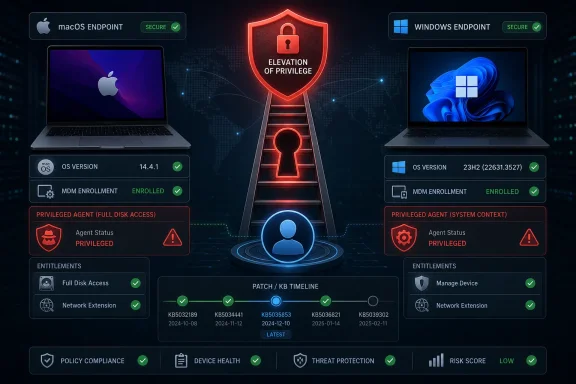 Defender’s Mac Problem Is Really an Endpoint Trust Problem
Microsoft Defender for Endpoint for Mac is not a cosmetic port of Windows Defender with a different icon. In enterprise deployments, it is part antivirus, part EDR sensor, part policy enforcement point, and part telemetry pipeline into Microsoft’s broader security stack. It runs close enough to the operating system to inspect files, monitor behavior, enforce controls, and report suspicious activity upstream.That proximity is exactly what makes an elevation-of-privilege flaw interesting. Endpoint security software needs privileged access to do useful work; attackers want privileged access to do lasting work. A vulnerability in that layer does not automatically mean remote compromise, but it does mean that a compromised user context may have a more attractive road upward than it should.
For WindowsForum readers, the macOS label should not be a reason to tune out. Defender for Endpoint is increasingly a cross-platform control plane, and many organizations now manage Windows laptops, Macs, Linux servers, mobile devices, and cloud workloads from the same security console. The security boundary that matters to administrators is no longer “Windows versus Mac.” It is the managed endpoint estate.
That shift has made Microsoft’s non-Windows security tooling strategically important. Defender has become one of the ways Microsoft keeps enterprise security gravity centered on its cloud, even when the device itself is running Apple’s operating system. CVE-2026-45647 is a reminder that cross-platform security agents inherit the risk of both worlds: Microsoft’s security stack and Apple’s endpoint model.
Elevation of Privilege Is the Middle Act Attackers Love
Elevation-of-privilege bugs rarely get the same public attention as remote code execution flaws. They lack the cinematic appeal of “send one packet, own the box.” But in real intrusions, privilege escalation is often the middle act that turns an initial foothold into an operational beachhead.A phishing payload, malicious browser extension, poisoned developer dependency, or stolen local credential may get an attacker onto a Mac. That access may initially be limited. The attacker then needs higher privileges to disable protections, access sensitive files, install persistence, dump secrets, monitor other users, or move laterally.
That is why EoP vulnerabilities in endpoint agents matter. Security products frequently possess permissions that ordinary applications do not. They may have Full Disk Access, kernel or system extension privileges, network extension entitlements, tamper protection mechanisms, launch daemons, privileged helpers, and update components. Each of those pieces is defensible in isolation; together, they form a large and unusually sensitive attack surface.
The usual enterprise reflex is to treat endpoint security software as a control, not an asset that needs the same aggressive vulnerability management as everything else. CVE-2026-45647 pushes against that habit. The software watching the endpoint must also be watched.
Microsoft’s Sparse Advisory Is a Signal, Not a Void
The user-supplied MSRC language about confidence in the existence of a vulnerability points to one of the least understood parts of vulnerability scoring: how much the public actually knows. Security teams often obsess over severity scores while overlooking the maturity of the available information. That is a mistake.When a vendor acknowledges a vulnerability, confidence in existence is high even if the root cause remains undisclosed. Microsoft’s listing is therefore not rumor, forum chatter, or a speculative scanner finding. It is a vendor-recognized issue in a named product. That puts it in a different operational category from unconfirmed research claims.
But confidence in existence is not the same as confidence in exploitability details. A public advisory can confirm that a bug exists without revealing whether exploitation requires local access, user interaction, race timing, unusual configuration, a vulnerable helper process, a privileged update path, or a particular macOS permission state. For defenders, that ambiguity is frustrating. For vendors, it is often deliberate.
This is the modern advisory bargain. Microsoft gives enterprises enough to prioritize patching and inventory work. It withholds enough to avoid publishing a recipe. The problem is that attackers do not always need a recipe; they need a direction.
The Mac Endpoint Is No Longer a Soft Exception
For years, Macs in the enterprise benefited from a kind of security exceptionalism. They were fewer in number, often concentrated among executives, developers, designers, and power users, and commonly treated as a special support category rather than a mainstream managed fleet. That era is over.Modern macOS endpoints can hold source code, production credentials, SSH keys, browser sessions, cloud admin tokens, customer documents, and privileged collaboration access. A developer Mac may be more valuable to an attacker than a typical Windows office laptop. An executive Mac may have less local domain importance but far more strategic access.
Microsoft Defender for Endpoint for Mac sits inside that reality. Its value comes from bringing those devices into the same detection and response loop as Windows systems. Its risk comes from the fact that it must integrate deeply with macOS mechanisms that are deliberately restrictive, frequently updated, and sometimes hostile to old assumptions about background security tooling.
Apple’s security architecture has steadily moved toward entitlements, transparency prompts, system extensions, privacy controls, and user-approved permissions. Security vendors have adapted, but adaptation often means privileged helper tools, configuration profiles, management extensions, and special permissions. That is fertile ground for subtle privilege-boundary mistakes.
The Agent Is Part of the Attack Surface
Security teams are comfortable inventorying vulnerable applications. They are less comfortable admitting that their security agents are applications too. Defender for Endpoint, CrowdStrike Falcon, SentinelOne, Sophos, Jamf Protect, Trellix, and others all run code, update code, parse untrusted input, inspect files, expose local services or helpers, and coordinate with cloud backends.That does not mean endpoint security products are uniquely unsafe. It means they are uniquely attractive. An attacker who can exploit or abuse a security agent may gain not just privileges but stealth, persistence, or the ability to interfere with detection. Even when the bug is not directly exploitable at scale, the mere presence of a high-privilege agent changes the local attack graph.
This is especially important on macOS because many users assume Apple’s platform model narrows the window for endpoint compromise. It does, in some ways. But enterprise security agents are intentionally granted exceptions to normal application limits. The very permissions that allow Defender to scan, monitor, and respond are the same permissions that make a privilege mistake consequential.
Administrators should therefore avoid the comforting language of “just a local privilege escalation.” Local does not mean low impact. It means the attacker needs a first step before using this step. In 2026, first steps are not rare.
Patch Tuesday Still Has a Cross-Platform Blind Spot
Microsoft’s monthly security rhythm is built around Windows, Office, Exchange, Azure, SQL Server, Visual Studio, .NET, and the other familiar pillars of the Microsoft estate. But Defender for Endpoint for Mac does not fit neatly into the old Patch Tuesday mental model. It is a Microsoft security product running on Apple hardware, often updated through Microsoft’s own channels, managed by MDM, and validated by enterprise security teams that may not report to the same people who patch Windows.That creates a process gap. The Windows team may track Microsoft CVEs. The Mac management team may track Jamf, Intune, Kandji, or Mosyle compliance. The SOC may track Defender health. The vulnerability management team may track scanner output. CVE-2026-45647 sits at the intersection of all four.
If the organization’s patch process assumes that “Microsoft CVE” equals “Windows Update,” this kind of issue can drift. If the Mac team assumes Defender updates are purely the SOC’s concern, it can drift again. If security assumes automatic updates always work, the known history of endpoint agent update problems should make them more cautious.
The operational question is simple: can the organization prove which Macs have the fixed Defender for Endpoint build? If the answer requires three teams, two dashboards, and a week of spreadsheet reconciliation, the vulnerability has already exposed a governance weakness.
Automatic Updates Are Not a Strategy by Themselves
Microsoft’s security products often update automatically, and that is generally good. Antivirus engines, signatures, platform components, and EDR agents cannot wait for quarterly maintenance windows. But automatic updating is a delivery mechanism, not an assurance mechanism.Security teams still need to verify version state, update health, and policy consistency. A Mac that is enrolled but stale is not meaningfully protected by the existence of a newer build. A device that lost required permissions after an operating-system upgrade may appear present in inventory while operating at reduced capability. A laptop that has been asleep, offline, traveling, or blocked from Microsoft update endpoints may miss the window in which administrators assume it was fixed.
Defender for Endpoint on macOS has had its share of release-note caveats, including known issues around upgrade behavior, performance, crashes, and macOS permission interactions. That is not unusual for a complex endpoint agent, but it reinforces the point: “deployed” and “healthy” are different states.
For CVE-2026-45647, the right posture is not panic. It is verification. Mac fleets should be queried for Defender platform version, release channel, update recency, sensor health, Full Disk Access status, network extension status, and MDM profile enforcement. The vulnerability may be the headline, but stale management data is the silent failure mode.
CVSS Does Not Capture Security Product Irony
The scoring language around vulnerability confidence is useful, but it cannot fully describe the irony of a security product becoming part of an attacker’s chain. CVSS can account for privileges required, user interaction, scope, confidentiality, integrity, and availability. It struggles to express institutional dependence.A vulnerability in a rarely used desktop utility may have the same numerical score as a vulnerability in an endpoint security platform deployed to every laptop used by senior engineers. The real-world risk is not the same. Context decides whether a CVE is noise, a ticket, a war room, or an audit finding.
Defender for Endpoint occupies a privileged security role. It also feeds Microsoft Defender XDR, security operations workflows, vulnerability management views, incident timelines, and automated response logic. If its local posture is suspect, organizations have to think beyond the individual Mac. They have to ask whether the telemetry they trust is complete, whether tamper attempts would be visible, and whether response actions would still work.
That is where the “known technical details” metric becomes more than scoring trivia. The less public detail defenders have, the more they must lean on hygiene, update verification, and behavioral monitoring. The less public detail attackers have, the less likely commodity exploitation becomes immediately. Both things can be true at once.
The Absence of Exploit Details Cuts Both Ways
A sparse advisory can lead to complacency. If there is no proof-of-concept exploit, no dramatic blog post, no exploit chain diagram, and no CISA emergency directive, some organizations will down-rank the issue. That is understandable, but not always wise.The public absence of exploit code does not prove private absence of exploit code. Security researchers, red teams, brokers, and adversaries all reverse-engineer patches. When a fix ships, the diff can become the roadmap. For endpoint agents, where binaries are distributed broadly and updates can be compared, the clock starts quickly.
At the same time, defenders should not inflate uncertainty into certainty. There is no responsible basis to claim that CVE-2026-45647 is being widely exploited unless Microsoft or another credible source says so. The better editorial reading is narrower: Microsoft has acknowledged an elevation-of-privilege issue in Defender for Endpoint for Mac, and the product category makes timely remediation important even without public exploit details.
That distinction matters. Security communication fails when every issue is treated as either trivial or apocalyptic. Most enterprise risk lives in the middle.
Mixed Fleets Need One Patch Language
CVE-2026-45647 is also a language problem. Windows administrators speak in KBs, cumulative updates, build numbers, servicing channels, and reboot deadlines. Mac administrators speak in MDM profiles, configuration profiles, PPPC permissions, launch daemons, package receipts, extension approvals, and macOS release compatibility. Security operations teams speak in alerts, device health, exposure score, incidents, and containment actions.A Microsoft Defender for Endpoint for Mac vulnerability forces those dialects into the same room. That is healthy, if uncomfortable. Enterprises that treat Mac security as a boutique practice will miss the broader lesson: endpoint risk has become platform-independent, while endpoint management remains platform-specific.
The best organizations solve this with common outcomes rather than common tooling. Every endpoint must report its security agent version. Every endpoint must show last successful update. Every endpoint must meet a minimum supported OS baseline. Every endpoint must maintain required security permissions. Every endpoint must be removable from trust if its posture cannot be proven.
That is the right abstraction. The Mac-specific details matter, but the governance model should not depend on whether the device has a Windows logo.
Microsoft’s Security Stack Has Become Too Important to Treat Casually
Microsoft has spent years expanding Defender from a built-in Windows antivirus into a sprawling security platform. Defender for Endpoint, Defender for Cloud, Defender XDR, Defender Vulnerability Management, Microsoft Sentinel, and Security Copilot now form a major part of the company’s enterprise security strategy. That scale creates benefits: integrated telemetry, broad coverage, rapid response, and centralized management.It also creates concentration risk. When Microsoft’s security tooling has a flaw, the affected population can be enormous. When it spans operating systems, the issue lands in organizations that may not think of themselves as Microsoft-heavy on the endpoint. A company using Macs, Google Workspace, and AWS may still depend on Microsoft Defender for Endpoint as its security agent.
That is the quiet significance of CVE-2026-45647. It is not merely “a Mac bug.” It is a Microsoft security-platform bug on Apple endpoints. That combination reflects how enterprise IT actually works now: identity in one cloud, files in another, endpoints across multiple operating systems, and security telemetry flowing into a vendor platform that promises to make sense of it all.
The more central that platform becomes, the more its own vulnerabilities deserve disciplined attention.
Administrators Should Read the Advisory Like Operators, Not Archivists
The practical response starts with inventory. Security teams should identify all macOS devices running Microsoft Defender for Endpoint and separate active, healthy, stale, and unknown devices. Unknown is not a neutral category. Unknown is where old laptops, executive exceptions, lab systems, developer machines, and broken enrollments hide.Next comes version validation. Do not assume the presence of the Defender app means the protected components are current. Check the platform version, release channel, last update time, and whether the device is receiving updates from the expected source. Where Microsoft documents a fixed build or remediation path, that should become the compliance floor.
Then comes permission validation. On macOS, endpoint security agents can fail in ways that look administrative rather than binary. Full Disk Access, network extensions, system extensions, background services, and configuration profiles all affect real protection. A patched agent that lacks required permissions may not be the security win the dashboard implies.
Finally, watch for post-exploitation behavior rather than waiting for exploit-specific indicators. If a local privilege escalation exists, attackers may use it to modify protected paths, interfere with security services, install launch persistence, alter logs, access sensitive data, or stage lateral movement. Those behaviors are more durable detection targets than the exploit mechanics Microsoft has not published.
The Defender Mac Lesson Fits in Five Operational Sentences
CVE-2026-45647 is a narrow advisory with a broader message: endpoint security software must be patched, measured, and challenged like any other privileged code. That does not make Defender for Endpoint for Mac untrustworthy. It makes blind trust in any security agent obsolete.- Microsoft has acknowledged CVE-2026-45647 as an elevation-of-privilege vulnerability in Microsoft Defender for Endpoint for Mac.
- The risk is most relevant after an attacker already has some local foothold on a Mac, because privilege escalation can turn limited access into deeper control.
- Mac fleets managed through Intune, Jamf, Kandji, Mosyle, or other MDM platforms should verify Defender version state rather than assuming automatic updates completed.
- Security teams should validate Defender health and macOS permissions, including the controls that allow the agent to inspect files, network activity, and system behavior.
- The advisory’s limited technical detail reduces immediate public exploit guidance, but it also means defenders must rely on patch hygiene and behavioral monitoring.
- Organizations with mixed Windows and macOS estates should treat this as a cross-platform endpoint governance issue, not a Mac-only exception.
References
- Primary source: MSRC
Published: 2026-06-09T07:00:00-07:00
Security Update Guide - Microsoft Security Response Center
 msrc.microsoft.com
- Official source: learn.microsoft.com
Microsoft Defender for Endpoint release notes - Microsoft Defender for Endpoint | Microsoft Learn
This article describes releases of Microsoft Defender for Endpoint on Windows, macOS, Linux, Android, and iOS.learn.microsoft.com - Official source: microsoft.com
CVE-2026-31431: Copy Fail vulnerability enables Linux root privilege escalation across cloud environments | Microsoft Security Blog
A high-severity Linux vulnerability, “Copy Fail” (CVE-2026-31431), enables root privilege escalation across cloud environments and Kubernetes workloads. With a working exploit already in the wild, organizations should act quickly to detect, mitigate, and reduce risk.www.microsoft.com - Related coverage: cvefeed.io
Microsoft > Defender for endpoint Vulnerability Maturity Index CVE
Product security and vulnerability maturity CVE Indexcvefeed.io - Related coverage: techradar.com
Microsoft confirms two major Defender security issues — so update now or face possible attack | TechRadar
CISA confirms two bugs being actively exploited in the wildwww.techradar.com - Related coverage: datacomm.com
- Related coverage: api.urlscan.io

api.msrc.microsoft.com - urlscan.io
urlscan.io - Website scanner for suspicious and malicious URLs
api.urlscan.io
- Related coverage: sra.io
- Related coverage: changeflow.com
- Related coverage: sentinelone.com
CVE-2025-26684: Microsoft Defender Privilege Escalation
CVE-2025-26684 is a privilege escalation vulnerability in Microsoft Defender for Endpoint. Learn about its impact, affected versions, and mitigation methods.www.sentinelone.com
- Related coverage: cve.yack.one
Defender For Endpoint - Yack CVE
View all 12 CVE security vulnerabilities affecting Defender For Endpoint. Track critical security issues and updates.cve.yack.one
