

Microsoft disclosed CVE-2026-45654 on June 9, 2026, as an Important Windows Secure Boot security feature bypass affecting Windows 11 24H2, 25H2, 26H1, and Windows Server 2025, with official fixes delivered through June Patch Tuesday cumulative updates. The flaw is not being described as exploited in the wild, and Microsoft rates exploitation as less likely. But the uncomfortable part is not the exploitability label; it is that yet another Secure Boot issue lands in the narrow, high-consequence space between firmware trust, Windows boot integrity, and secrets protected by virtualization-based security.
Secure Boot vulnerabilities are easy to understate because they often require local access, administrative privileges, or a pre-existing foothold. CVE-2026-45654 has all the markings of that quieter category: local attack vector, high privileges required, no user interaction, and no reported public exploit at publication. On paper, that sounds like a second-stage problem rather than a front-door breach.
That is true, but it is incomplete. Secure Boot is not just another Windows feature that can be patched and forgotten after a reboot. It is part of the chain of trust that decides whether the operating system, kernel protections, and later security assumptions are standing on solid ground.
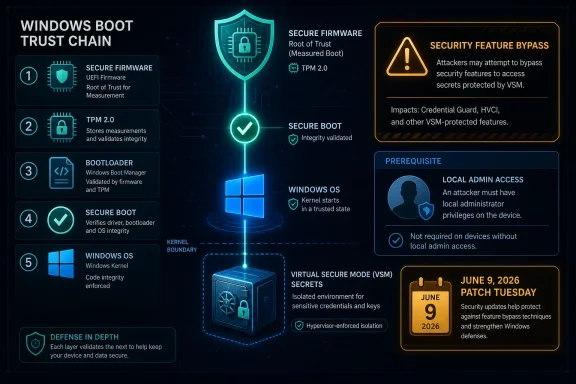
Microsoft’s own summary is brief: a protection mechanism failure in Windows Secure Boot allows an authorized attacker to bypass a security feature locally. The advisory goes further in its FAQ, saying successful exploitation could bypass Secure Boot and expose Virtual Secure Mode secrets. That moves the bug out of the realm of abstract boot hygiene and into the territory of credential protection, guarded memory, and the security model Windows has increasingly pushed enterprises to rely on.
The key phrase here is security feature bypass. This is not remote code execution, and Microsoft does not label it Critical. But security feature bypasses are often how attackers convert an already-compromised machine into a machine that remains compromised, resists cleanup, or yields secrets that were supposed to survive even a messy endpoint incident.
That is a very specific risk shape. An attacker must already have significant control over the target system, which is why this is not an internet-worm scenario. But once that threshold is crossed, the attack is not described as difficult, and the result can reach beyond the originally vulnerable boot component.
The changed-scope rating matters. Microsoft says exploitation could affect security protections beyond the vulnerable component and expose Virtual Secure Mode secrets. In practical Windows terms, that points toward the trust boundary around VBS-backed protections, including the kind of isolation used to protect sensitive material from the normal operating system environment.
This is the old endpoint security bargain in miniature. Windows assumes that if an attacker gets far enough, some protections still hold. Secure Boot, TPM-backed measurements, BitLocker configurations, Credential Guard, and VBS are all part of a layered claim: compromise should not automatically mean total collapse. CVE-2026-45654 is notable because it sits in the machinery that makes that claim believable.
That is different from exploit maturity. Microsoft marks exploit code maturity as Unproven, says the issue was not publicly disclosed before release, says it has not seen exploitation, and assesses exploitation as less likely. Those are meaningful calming signals, especially for administrators already juggling the rest of June Patch Tuesday.
The mistake would be to read “Confirmed” as “actively under attack.” The other mistake would be to read “less likely” as “unimportant.” In Secure Boot land, the worst bugs often do not start life as mass exploitation events. They become valuable when chained with privilege escalation, stolen admin access, malicious insiders, evil-maid scenarios, or post-compromise persistence.
That is why the advisory’s confidence metric deserves attention. It tells defenders that Microsoft believes the technical finding is real. It also tells attackers that there is a confirmed class of weakness worth studying, even if the public record does not yet include a working exploit.
The relevant updates are delivered through June 9, 2026 security updates. Windows 11 24H2 and 25H2 systems receive the fix through KB5094126, while Windows Server 2025 receives KB5094125. Windows 11 26H1 systems receive KB5095051. Microsoft lists fixed builds including 26100.8655 for Windows 11 24H2, 26200.8655 for Windows 11 25H2, 28000.2269 for Windows 11 26H1, and 26100.32995 for Windows Server 2025.
For consumers, that likely means the usual advice: install the cumulative update, reboot, and do not disable Secure Boot in firmware because of vague internet advice. For enterprises, the more important work is confirming that patched build numbers actually land on the hardware that matters.
The machines most worth prioritizing are not necessarily the most numerous. Domain controllers, virtualization hosts, admin workstations, developer systems with production credentials, privileged access workstations, jump boxes, and servers holding identity infrastructure should be treated as higher-value targets. A Secure Boot bypass with possible VSM secret exposure is most interesting where secrets are dense.
CVE-2026-45654 is not being presented with the same dramatic public exploitation profile. Microsoft’s advisory does not describe a known bootkit, and it does not frame the June 2026 update as a months-long revocation campaign. That is important. We should not import the worst assumptions from previous Secure Boot incidents where Microsoft has not stated them.
Still, the reason WindowsForum readers should care is that Secure Boot advisories live in a part of the system where normal patch thinking can fail. A regular application bug usually has a straightforward state: vulnerable before patch, fixed after patch. Boot-chain security can involve firmware configuration, OS build, recovery partitions, bootable media, BitLocker recovery posture, and revocation state.
That does not mean every Secure Boot CVE is a deployment nightmare. It means administrators should resist the reflex to mark the ticket closed simply because Windows Update reports success on a random sample of endpoints. With boot-trust issues, validation is part of remediation.
This matters because modern Windows security has shifted from “keep malware out” to “limit what malware can do after it gets in.” Credential Guard, virtualization-based protections, and hardware-backed trust exist because enterprises assume some endpoints will be compromised. The point is to prevent that compromise from becoming domain compromise.
A local administrator requirement sounds reassuring until you remember how often local administrator is a midpoint rather than an endpoint in real intrusions. Attackers phish a user, exploit a browser or document chain, steal tokens, move laterally, elevate locally, and then hunt for credentials or persistence. A bug requiring high privileges can still be valuable if it turns local control into access to secrets that should have remained isolated.
That is the real argument for patching quickly even when exploitation is marked less likely. The vulnerability is not an easy initial access vector. It is the kind of weakness that can make later-stage compromise more consequential.
But the acknowledgement does support one conclusion: this is not a vague bug-class placeholder dumped into Patch Tuesday without technical substance. The report confidence is Confirmed, and the advisory includes a clear enough impact statement to identify Secure Boot bypass and VSM secret exposure as the concern.
The public details remain intentionally limited. That is normal for a freshly patched boot-chain vulnerability, especially one that Microsoft says has no public exploit and no observed exploitation. Vendors often reveal just enough for defenders to prioritize and just little enough to avoid handing attackers a recipe.
That leaves administrators in the familiar middle ground. They cannot audit every detail of the flaw from Microsoft’s advisory alone, but they can make reasonable decisions from the risk shape: modern Windows only, local high-privilege prerequisite, low complexity after prerequisites, high confidentiality and integrity impact, and an official fix now available.
The places to slow down are the usual ones: devices with custom bootloaders, dual-boot setups, unusual firmware settings, specialized recovery workflows, or systems where BitLocker recovery handling is brittle. A Secure Boot-related patch may install cleanly, but any update touching boot trust deserves a little more caution than a routine browser engine fix.
Administrators should also make sure their inventory actually distinguishes Windows 11 24H2, 25H2, and 26H1, rather than lumping all Windows 11 devices into one dashboard view. Build-level confirmation matters here because Microsoft has published fixed build numbers. If a management console only says “compliant” without showing the resulting OS build, it is not giving you the evidence you want.
The same applies to Server Core. Headless servers are easy to patch in theory and easy to neglect in practice when reboot windows are scarce. Because Windows Server 2025 and Server Core are both listed, server teams should not assume this is a client-only Secure Boot concern.
For a home user on a fully patched Windows 11 laptop with Secure Boot enabled and no one else touching the machine, the risk is probably modest. For a corporate laptop used by a domain admin, a security engineer, or a build-system maintainer, a local post-compromise Secure Boot bypass has a different weight. For a server that anchors identity or virtualization infrastructure, the same CVE sits closer to the center of the blast radius.
The vulnerability also underscores a wider Windows security reality: Microsoft is asking customers to trust more hardware-backed and virtualization-backed controls, while attackers are increasingly interested in the transitions between firmware, boot manager, hypervisor, and OS. Those transitions are hard to reason about, hard to patch perfectly, and hard for customers to verify independently.
That is why the important word in the advisory may not be “Important.” It may be Confirmed. Microsoft is saying the vulnerability exists, the fix is available, and the affected platforms are identifiable. The responsible move is not panic; it is closing the gap before the technical details age into attacker knowledge.
 Secure Boot Is Still a Boundary Microsoft Cannot Treat as Routine
Secure Boot vulnerabilities are easy to understate because they often require local access, administrative privileges, or a pre-existing foothold. CVE-2026-45654 has all the markings of that quieter category: local attack vector, high privileges required, no user interaction, and no reported public exploit at publication. On paper, that sounds like a second-stage problem rather than a front-door breach.That is true, but it is incomplete. Secure Boot is not just another Windows feature that can be patched and forgotten after a reboot. It is part of the chain of trust that decides whether the operating system, kernel protections, and later security assumptions are standing on solid ground.
Microsoft’s own summary is brief: a protection mechanism failure in Windows Secure Boot allows an authorized attacker to bypass a security feature locally. The advisory goes further in its FAQ, saying successful exploitation could bypass Secure Boot and expose Virtual Secure Mode secrets. That moves the bug out of the realm of abstract boot hygiene and into the territory of credential protection, guarded memory, and the security model Windows has increasingly pushed enterprises to rely on.
The key phrase here is security feature bypass. This is not remote code execution, and Microsoft does not label it Critical. But security feature bypasses are often how attackers convert an already-compromised machine into a machine that remains compromised, resists cleanup, or yields secrets that were supposed to survive even a messy endpoint incident.
The CVSS Score Hides a More Interesting Story
CVE-2026-45654 carries a CVSS 3.1 base score of 7.9, with a temporal score of 6.9. That lands in the familiar “Important but not panic” band for Microsoft administrators. The vector tells the more useful story: local attack vector, low attack complexity, high privileges required, no user interaction, changed scope, high confidentiality impact, high integrity impact, and no availability impact.That is a very specific risk shape. An attacker must already have significant control over the target system, which is why this is not an internet-worm scenario. But once that threshold is crossed, the attack is not described as difficult, and the result can reach beyond the originally vulnerable boot component.
The changed-scope rating matters. Microsoft says exploitation could affect security protections beyond the vulnerable component and expose Virtual Secure Mode secrets. In practical Windows terms, that points toward the trust boundary around VBS-backed protections, including the kind of isolation used to protect sensitive material from the normal operating system environment.
This is the old endpoint security bargain in miniature. Windows assumes that if an attacker gets far enough, some protections still hold. Secure Boot, TPM-backed measurements, BitLocker configurations, Credential Guard, and VBS are all part of a layered claim: compromise should not automatically mean total collapse. CVE-2026-45654 is notable because it sits in the machinery that makes that claim believable.
“Confirmed” Does Not Mean “Weaponized,” and That Distinction Matters
The user-facing snippet in Microsoft’s advisory focuses on report confidence, and for good reason. Microsoft marks report confidence as Confirmed, meaning the vulnerability is not speculative. Either detailed reports exist, functional reproduction is possible, source-level evidence supports the claim, or the vendor has confirmed the issue.That is different from exploit maturity. Microsoft marks exploit code maturity as Unproven, says the issue was not publicly disclosed before release, says it has not seen exploitation, and assesses exploitation as less likely. Those are meaningful calming signals, especially for administrators already juggling the rest of June Patch Tuesday.
The mistake would be to read “Confirmed” as “actively under attack.” The other mistake would be to read “less likely” as “unimportant.” In Secure Boot land, the worst bugs often do not start life as mass exploitation events. They become valuable when chained with privilege escalation, stolen admin access, malicious insiders, evil-maid scenarios, or post-compromise persistence.
That is why the advisory’s confidence metric deserves attention. It tells defenders that Microsoft believes the technical finding is real. It also tells attackers that there is a confirmed class of weakness worth studying, even if the public record does not yet include a working exploit.
The Patch List Is Narrow, but the Fleet Implications Are Not
The affected products listed by Microsoft are concentrated in the newest Windows stack: Windows 11 version 24H2, Windows 11 version 25H2, Windows 11 version 26H1, and Windows Server 2025, including Server Core. That makes this a modern-platform issue, not a legacy clean-up exercise.The relevant updates are delivered through June 9, 2026 security updates. Windows 11 24H2 and 25H2 systems receive the fix through KB5094126, while Windows Server 2025 receives KB5094125. Windows 11 26H1 systems receive KB5095051. Microsoft lists fixed builds including 26100.8655 for Windows 11 24H2, 26200.8655 for Windows 11 25H2, 28000.2269 for Windows 11 26H1, and 26100.32995 for Windows Server 2025.
For consumers, that likely means the usual advice: install the cumulative update, reboot, and do not disable Secure Boot in firmware because of vague internet advice. For enterprises, the more important work is confirming that patched build numbers actually land on the hardware that matters.
The machines most worth prioritizing are not necessarily the most numerous. Domain controllers, virtualization hosts, admin workstations, developer systems with production credentials, privileged access workstations, jump boxes, and servers holding identity infrastructure should be treated as higher-value targets. A Secure Boot bypass with possible VSM secret exposure is most interesting where secrets are dense.
Secure Boot’s History Makes Administrators Wary of Simple Patch Narratives
Secure Boot has a long tail. Windows administrators remember that some Secure Boot fixes are not merely a file replacement but a sequence involving boot managers, revocations, recovery media, firmware behavior, and device-specific surprises. The BlackLotus-era mitigation work around older Secure Boot bypasses made this brutally clear: fixing the code path was only part of the job; making sure vulnerable boot components could no longer be trusted was the harder operational story.CVE-2026-45654 is not being presented with the same dramatic public exploitation profile. Microsoft’s advisory does not describe a known bootkit, and it does not frame the June 2026 update as a months-long revocation campaign. That is important. We should not import the worst assumptions from previous Secure Boot incidents where Microsoft has not stated them.
Still, the reason WindowsForum readers should care is that Secure Boot advisories live in a part of the system where normal patch thinking can fail. A regular application bug usually has a straightforward state: vulnerable before patch, fixed after patch. Boot-chain security can involve firmware configuration, OS build, recovery partitions, bootable media, BitLocker recovery posture, and revocation state.
That does not mean every Secure Boot CVE is a deployment nightmare. It means administrators should resist the reflex to mark the ticket closed simply because Windows Update reports success on a random sample of endpoints. With boot-trust issues, validation is part of remediation.
VSM Secrets Raise the Stakes Beyond Boot Purity
Microsoft’s mention of Virtual Secure Mode secrets is the advisory’s most important practical clue. VSM is the isolation foundation behind several Windows security features that try to keep secrets and sensitive operations away from the normal kernel and user mode environment. If Secure Boot is weakened in a way that threatens VSM-protected material, the risk becomes less about elegance and more about credential exposure.This matters because modern Windows security has shifted from “keep malware out” to “limit what malware can do after it gets in.” Credential Guard, virtualization-based protections, and hardware-backed trust exist because enterprises assume some endpoints will be compromised. The point is to prevent that compromise from becoming domain compromise.
A local administrator requirement sounds reassuring until you remember how often local administrator is a midpoint rather than an endpoint in real intrusions. Attackers phish a user, exploit a browser or document chain, steal tokens, move laterally, elevate locally, and then hunt for credentials or persistence. A bug requiring high privileges can still be valuable if it turns local control into access to secrets that should have remained isolated.
That is the real argument for patching quickly even when exploitation is marked less likely. The vulnerability is not an easy initial access vector. It is the kind of weakness that can make later-stage compromise more consequential.
The Acknowledgement Points to Serious Research, Not Drive-By Discovery
Microsoft credits Alon Leviev with Microsoft STORM in the acknowledgement. Leviev has become a familiar name in Windows security research circles, particularly around update and downgrade attack research. That does not prove this vulnerability is related to any prior technique, and Microsoft’s advisory does not give enough technical detail to connect those dots responsibly.But the acknowledgement does support one conclusion: this is not a vague bug-class placeholder dumped into Patch Tuesday without technical substance. The report confidence is Confirmed, and the advisory includes a clear enough impact statement to identify Secure Boot bypass and VSM secret exposure as the concern.
The public details remain intentionally limited. That is normal for a freshly patched boot-chain vulnerability, especially one that Microsoft says has no public exploit and no observed exploitation. Vendors often reveal just enough for defenders to prioritize and just little enough to avoid handing attackers a recipe.
That leaves administrators in the familiar middle ground. They cannot audit every detail of the flaw from Microsoft’s advisory alone, but they can make reasonable decisions from the risk shape: modern Windows only, local high-privilege prerequisite, low complexity after prerequisites, high confidentiality and integrity impact, and an official fix now available.
Enterprises Should Treat This as a Trust Validation Event
The right response is not emergency theater. It is disciplined verification. If your Windows estate is already receiving cumulative updates reliably, CVE-2026-45654 should flow through normal June Patch Tuesday rings, with acceleration for privileged and sensitive systems.The places to slow down are the usual ones: devices with custom bootloaders, dual-boot setups, unusual firmware settings, specialized recovery workflows, or systems where BitLocker recovery handling is brittle. A Secure Boot-related patch may install cleanly, but any update touching boot trust deserves a little more caution than a routine browser engine fix.
Administrators should also make sure their inventory actually distinguishes Windows 11 24H2, 25H2, and 26H1, rather than lumping all Windows 11 devices into one dashboard view. Build-level confirmation matters here because Microsoft has published fixed build numbers. If a management console only says “compliant” without showing the resulting OS build, it is not giving you the evidence you want.
The same applies to Server Core. Headless servers are easy to patch in theory and easy to neglect in practice when reboot windows are scarce. Because Windows Server 2025 and Server Core are both listed, server teams should not assume this is a client-only Secure Boot concern.
Microsoft’s “Less Likely” Rating Is a Starting Point, Not a Permission Slip
Microsoft’s exploitability assessment says exploitation is less likely. That is useful for triage, especially during a month with multiple vulnerabilities competing for attention. But the phrase has to be interpreted in the context of the environment, not as an absolute.For a home user on a fully patched Windows 11 laptop with Secure Boot enabled and no one else touching the machine, the risk is probably modest. For a corporate laptop used by a domain admin, a security engineer, or a build-system maintainer, a local post-compromise Secure Boot bypass has a different weight. For a server that anchors identity or virtualization infrastructure, the same CVE sits closer to the center of the blast radius.
The vulnerability also underscores a wider Windows security reality: Microsoft is asking customers to trust more hardware-backed and virtualization-backed controls, while attackers are increasingly interested in the transitions between firmware, boot manager, hypervisor, and OS. Those transitions are hard to reason about, hard to patch perfectly, and hard for customers to verify independently.
That is why the important word in the advisory may not be “Important.” It may be Confirmed. Microsoft is saying the vulnerability exists, the fix is available, and the affected platforms are identifiable. The responsible move is not panic; it is closing the gap before the technical details age into attacker knowledge.
June’s Secure Boot Fix Belongs in the High-Trust Patch Lane
CVE-2026-45654 is not a headline-grabbing zero-day, but it is exactly the sort of advisory that rewards mature patch operations. The organizations that handle it well will not be the ones that shout the loudest; they will be the ones that know which systems carry the most trust and can prove those systems reached the fixed builds.- CVE-2026-45654 is an Important Secure Boot security feature bypass disclosed by Microsoft on June 9, 2026.
- Microsoft says exploitation is less likely, with no public disclosure and no observed exploitation at the time of publication.
- The vulnerability requires local access and high privileges, but Microsoft rates attack complexity as low once those prerequisites are met.
- Successful exploitation could bypass Secure Boot and expose Virtual Secure Mode secrets, making privileged systems the most important patch targets.
- The affected platforms are Windows 11 versions 24H2, 25H2, 26H1, and Windows Server 2025, including Server Core.
- Administrators should verify fixed OS builds after installing KB5094126, KB5094125, or KB5095051, depending on platform.
References
- Primary source: MSRC
Published: 2026-06-09T07:00:00-07:00
Security Update Guide - Microsoft Security Response Center
 msrc.microsoft.com
