

Secure Boot Is Once Again the Boundary Everyone Assumes Is Already Solid
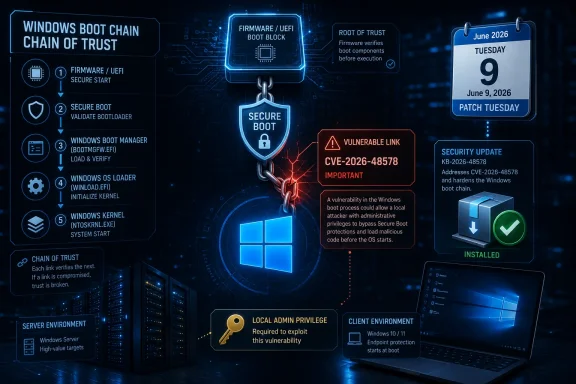
Secure Boot has become part of the background radiation of Windows security. It is a firmware-era promise that the machine will not simply run whatever boot code an attacker manages to place in front of the operating system. In modern Windows deployments, that promise underpins BitLocker expectations, kernel integrity assumptions, device health checks, and the general belief that the OS starts from a known-good position.
CVE-2026-48578 cuts into that assumption. Microsoft’s advisory describes the bug as a protection mechanism failure in Windows Secure Boot that allows an authorized attacker to bypass a security feature locally. In the FAQ, Microsoft is more direct: successful exploitation could bypass Secure Boot.
That wording matters. A Secure Boot bypass is rarely about popping Calculator or landing a remote shell over the network. It is about what happens before Windows has fully marshaled the defenses administrators spend so much time configuring: endpoint detection, credential isolation, kernel-mode controls, and storage protections that depend on a trustworthy boot path.
The vulnerability is scored as Important rather than Critical, and for good reason. The CVSS vector lists local attack vector, low attack complexity, no user interaction, and high privileges required. This is not a drive-by browser bug. But in the world of boot-chain attacks, “local admin required” is not the same as “ignore it.”
A domain compromise, stolen administrator token, malicious insider, compromised remote management tool, or attacker who has already landed with elevated rights can all turn a local privilege prerequisite into a staging condition. The story is not that CVE-2026-48578 is the first move in an intrusion. The story is that it may help make a later move more durable, more privileged, and harder to trust away.
Microsoft’s Score Tells a More Nuanced Story Than the Severity Badge
The headline numbers are easy to misread. Microsoft assigns CVE-2026-48578 a CVSS 3.1 base score of 7.9 and temporal score of 6.9, with a maximum severity of Important and an Elevation of Privilege impact. That puts the issue below the “drop everything” tier but above the sort of routine hardening item that can drift for months in a forgotten maintenance window.
The vector string explains the tension. Attack vector is local, attack complexity is low, privileges required are high, and user interaction is none. Scope is changed, confidentiality and integrity impact are high, and availability impact is none. In English: this is not easy to reach from afar, but once the right kind of attacker is already on the box, the consequence can cross a security boundary.
The “scope changed” piece is the most revealing part of the score. CVSS uses that term when exploitation affects resources beyond the vulnerable component’s own security authority. For Secure Boot, that is the point: the boot environment’s job is to create conditions the operating system can trust later. If that layer can be bypassed, the damage radiates upward.
Microsoft’s temporal metrics add another layer. Exploit code maturity is listed as unproven, and Microsoft says the vulnerability was not publicly disclosed and not exploited at the time of publication. Report confidence, however, is confirmed, and remediation level is official fix. That means defenders should not treat this as rumor, even if attackers do not yet appear to have a public playbook.
This is a classic enterprise patch-prioritization trap. The absence of known exploitation tempts teams to push the update behind louder vulnerabilities. But boot-chain flaws have a way of looking academic until a working technique appears, at which point remediation becomes slower than everyone wishes.
The Administrative Prerequisite Is a Speed Bump, Not a Wall
“Privileges Required: High” will calm some readers, especially those accustomed to ranking vulnerabilities by initial-access value. If an attacker already needs administrative control, the thinking goes, the game is already over. That is sometimes true for commodity endpoints, but it is a dangerously incomplete view for machines that anchor identity, virtualization, development, or production operations.
Administrative rights are not a single finish line. Windows security has layers that try to survive, constrain, or detect administrator abuse. Secure Boot is one of the mechanisms that helps protect the pre-OS and early-OS environment from being quietly reshaped by someone who already has powerful access.
A local administrator who can bypass Secure Boot may be able to alter the trust story of the machine in ways that ordinary post-exploitation tooling cannot. That does not automatically mean a universal bootkit, and Microsoft has not published exploit mechanics. It does mean the vulnerability belongs in the category of flaws that challenge recovery confidence.
This matters in incident response. If an attacker with administrative control merely creates a service, drops a scheduled task, or tampers with a registry value, responders have well-understood ways to hunt and rebuild confidence. If the boot chain itself is suspect, confidence becomes more expensive. The clean line between “remove persistence” and “reimage the host” gets blurrier.
That is why Secure Boot bypass advisories deserve a different mental bucket from ordinary elevation-of-privilege bugs. They are less about giving the attacker admin for the first time and more about what a capable attacker can do after admin is already obtained.
The Affected List Is Broad Enough to Make This a Fleet Problem
The advisory’s affected products span a wide set of Windows releases: Windows 10, Windows 11, and multiple Windows Server generations, including older server releases still appearing in supported channels. Microsoft lists updates for Windows Server 2012 and 2012 R2, Windows Server 2016, Windows Server 2019, Windows Server 2022, Windows Server 2025, Windows 10 versions including 1607, 1809, 21H2, and 22H2, and Windows 11 versions including 23H2, 24H2, 25H2, and 26H1.
That breadth is the operational story. Secure Boot is not a niche feature reserved for shiny new laptops; it is part of the baseline across client endpoints, servers, and long-lived infrastructure. A bypass that touches this many supported Windows versions becomes less a vulnerability-management ticket and more a fleet-hygiene test.
The patch mapping also shows the practical complexity. Different branches receive different KBs and build numbers, from Windows Server 2012-era rollups to current Windows 11 and Server 2025 security updates. In small environments, Windows Update may handle most of this invisibly. In larger estates, the challenge is proving every branch, architecture, and servicing channel actually landed on the fixed build.
There is also a lesson in the presence of older platforms. Organizations still carrying Windows Server 2012 or 2012 R2 under extended servicing arrangements often do so because the systems are hard to replace. Those are exactly the systems where boot-chain trust may matter most, because they often run line-of-business workloads, legacy authentication dependencies, or applications nobody wants to touch.
A vulnerability like CVE-2026-48578 punishes wishful inventory. If the asset list says “Windows servers” but cannot distinguish Server Core from Desktop Experience, x64 from ARM64, Windows 10 21H2 from 22H2, or supported from exception-based servicing, the patch process becomes guesswork. Secure Boot bypasses are a poor place to discover that your CMDB is more aspirational than real.
The BlackLotus Shadow Still Hangs Over Every Secure Boot Advisory
Every modern Secure Boot bypass now arrives under the shadow of BlackLotus. The point is not that CVE-2026-48578 is the same bug, uses the same technique, or is known to be exploited by the same class of malware. Microsoft has not said that. The point is that defenders have already seen what happens when a supposedly hardened boot boundary becomes part of an attacker’s persistence strategy.
BlackLotus changed the conversation because it made Secure Boot bypasses feel less hypothetical. Before then, many administrators understood Secure Boot as a compliance checkbox or firmware setting, not as an actively contested security boundary. Afterward, Secure Boot became a place where patching, revocation, firmware behavior, and operational caution all had to meet.
The painful part of boot-chain remediation is that patching Windows is sometimes only one layer of the fix. Some historical Secure Boot issues required careful sequencing, boot manager updates, revocation changes, recovery media considerations, and staged enforcement. CVE-2026-48578’s advisory presents an official fix through normal security updates, but administrators should still treat validation as more than a green icon in a patch console.
That means checking fixed builds, watching for boot failures in pilot rings, and being mindful of recovery media. A Secure Boot-related update that works flawlessly on a standard laptop fleet might still expose brittle firmware, stale images, or unsupported boot paths in older hardware and specialized server deployments.
The broader pattern is unmistakable. The boot chain is no longer a set-and-forget layer. It is part of the patch surface, part of incident response, and part of the trust contract between hardware, firmware, operating system, and enterprise policy.
Report Confidence Is the Metric That Should End the Shrug
The user-supplied excerpt focuses on report confidence, and it is the right metric to linger over. Microsoft lists report confidence as Confirmed. In CVSS terms, that means the vulnerability’s existence and technical credibility are not speculative from the vendor’s perspective.
That does not mean Microsoft has published a cookbook for exploitation. In fact, the advisory remains sparse on root cause and exploit mechanics, as Secure Boot advisories often are. But “confirmed” separates CVE-2026-48578 from the fog of tentative reports, theoretical concerns, or vague hardening notes.
For attackers, confirmed flaws are useful even when technical detail is limited. The advisory identifies the affected security boundary, the required privileges, the local attack path, and the fact that exploitation does not need user interaction. That is enough to focus research attention.
For defenders, confirmed should mean the debate shifts from “is this real?” to “where are we exposed, and how quickly can we prove remediation?” The lack of public exploitation is welcome, but it is not a reason to leave systems sitting on unfixed Secure Boot code.
This is where CVSS temporal scoring can mislead the casual reader. A temporal score of 6.9 suggests reduced urgency compared with a live exploit. But the same vector also says low attack complexity and high confidentiality and integrity impact. The vulnerability is less likely to be attacked today, according to Microsoft’s assessment, not harmless if it is attacked tomorrow.
Patch Tuesday’s Quiet Boot Bugs Are Often the Ones That Age Badly
Most Patch Tuesday attention goes to remote code execution bugs, browser engine flaws, Office preview-pane traps, and anything marked exploited in the wild. That is understandable. Security teams have finite time, and vulnerabilities with immediate weaponization deserve triage.
But boot-related vulnerabilities age differently. A remote code execution flaw may burn hot for a few weeks and then decline as patch coverage improves. A Secure Boot bypass can become part of a more durable research ecosystem, especially if attackers discover ways to combine it with administrative access, disk tampering, stolen credentials, or recovery environment abuse.
The advisory says exploitation is less likely at publication. That is useful intelligence, not a permanent guarantee. Exploitability assessments are snapshots in time, and the “unproven” status of exploit code can change once researchers and adversaries have had time to reverse patches and compare binaries.
There is also an asymmetry in remediation. Applying a normal OS update is straightforward for many endpoints, but proving that the boot trust chain is healthy across a diverse fleet can be harder. The longer the patch waits, the more machines drift, the more exceptions accumulate, and the more difficult it becomes to separate vulnerable systems from merely misreported ones.
A quiet Secure Boot bug is still a Secure Boot bug. The right response is measured urgency: not panic, not theatrical shutdowns, but a disciplined push through pilot, production, and verification rings.
Home Users Get the Easy Version, Administrators Get the Real One
For most home users, the practical advice is almost boring: install the June 2026 Windows security update, do not disable Secure Boot casually, and avoid running unknown administrative tools. The vulnerability requires high privileges and local exploitation, so a fully patched personal PC is not suddenly exposed to random internet scanning because of CVE-2026-48578.
Enthusiasts should still pay attention because Secure Boot tweaks are common in dual-boot, custom firmware, alternative OS, and hardware-modification circles. Many WindowsForum readers have at least one machine where Secure Boot is disabled for convenience, experimentation, or legacy compatibility. That may be a deliberate choice, but it should be understood as a trade-off rather than a harmless toggle.
Administrators have the harder job. They need to identify affected Windows versions, deploy the correct cumulative or security updates, confirm fixed build numbers, and watch for systems that fail to report or reboot. Server Core installations, old Windows Server branches, embedded workloads, and isolated management networks all deserve special scrutiny.
Virtualized environments add another wrinkle. Secure Boot may be enforced at the VM firmware layer, governed by hypervisor policy, or inconsistently applied across generations of virtual hardware. A Windows VM can be “patched” at the OS layer while still sitting in a broader infrastructure posture that deserves review.
Security teams should also think about detection and response. If a host was compromised by an administrator-level attacker before patching, simply applying the update may not answer whether the boot chain was previously tampered with. In higher-risk cases, teams may need to combine patching with offline inspection, measured boot telemetry, BitLocker recovery analysis, firmware review, or full rebuild decisions.
The Fix Is Official, but Verification Is the Work
Microsoft’s advisory lists official fixes through the Security Update Guide, with affected rows tied to KB articles and fixed build numbers. That is the center of gravity for action. Organizations should make sure June 2026 updates are not merely approved but installed, rebooted, and reflected in inventory.
The fixed build numbers give administrators a concrete way to check. Windows 11 24H2 systems, for example, are listed with fixed build 10.0.26100.8655; Windows 10 22H2 with 10.0.19045.7417; Windows Server 2022 with 10.0.20348.5256; Windows Server 2025 with 10.0.26100.32995. Those numbers matter because compliance dashboards can lie by omission when machines miss reboots or report stale scan data.
The update list also includes Windows 11 25H2 and 26H1 entries, which is a reminder that Microsoft’s servicing matrix is increasingly layered. Administrators should resist assuming one KB or one branch covers the entire estate. Patch compliance needs to be version-aware.
Because this is a Secure Boot issue, a prudent rollout should include boot validation in pilot groups. That does not mean treating the update as unusually risky by default. It means recognizing that boot-adjacent security changes can reveal weirdness in firmware, recovery partitions, BitLocker protectors, and aging deployment images.
The best operational posture is boring but strict: deploy promptly, verify builds, confirm reboots, monitor failures, and investigate systems that cannot be brought current. The “less likely” exploitability rating buys time for orderly execution, not permission to defer indefinitely.
The June Secure Boot Patch Leaves a Short Checklist Behind
CVE-2026-48578 is not the loudest kind of Microsoft vulnerability, but it is the kind that tests whether an organization treats platform trust as an operational discipline. The advisory gives defenders enough to act without giving attackers much of a public recipe. That balance should push teams toward verification rather than speculation.
- Microsoft released CVE-2026-48578 on June 9, 2026 as an Important Secure Boot security feature bypass affecting supported Windows client and server releases.
- Microsoft says the vulnerability is confirmed, not publicly disclosed, not known to be exploited, and assessed as exploitation less likely at publication.
- The CVSS vector requires local access and high privileges, but it also indicates low attack complexity, no user interaction, changed scope, and high confidentiality and integrity impact.
- The official remediation is to install the relevant June 2026 Windows security update and verify the resulting fixed build number for each affected branch.
- Administrators should treat this as a fleet-verification issue, especially on older servers, Server Core installations, virtual machines, and systems with nonstandard boot or recovery configurations.
- Incident responders should remember that a Secure Boot bypass is not just another local privilege issue, because trust in the boot chain affects how confidently a compromised machine can be cleaned and returned to service.
CVE-2026-48578 is a useful case study in modern Windows security: the most important boundary is often the one users never see, and the most important patch is sometimes the one that prevents yesterday’s administrator compromise from becoming tomorrow’s trusted boot. Microsoft has supplied the fix and says exploitation is less likely for now; the next step belongs to administrators, who must prove that the machines they trust at startup are actually starting from code they can trust.