

Microsoft disclosed CVE-2026-48575 on June 9, 2026, as an Important Windows Secure Boot security feature bypass affecting supported Windows client and server releases, with official fixes issued through security updates and no public disclosure or exploitation reported at publication time. The advisory’s dry wording understates the interesting part: this is a local, high-privilege flaw, yet it sits in the part of the Windows trust chain administrators are least comfortable disturbing. Secure Boot bugs do not usually resemble mass-worm emergencies, but they force IT teams to think below the operating system, where patching is slower, validation is harder, and recovery mistakes can be expensive. The practical message is simple: Microsoft says exploitation is less likely, but the fix belongs in the normal security-update pipeline, not in a “we’ll get to firmware later” drawer.
Secure Boot is one of those technologies that is most visible when something goes wrong. For ordinary users it is a checkbox in firmware settings, a Windows 11 requirement, and an occasional cause of boot drama. For defenders it is supposed to be the first serious gate in the trust chain, checking that early boot components have not been replaced before Windows and its endpoint stack are awake.
That is why a “security feature bypass” label matters even when the CVSS score is not Critical. Microsoft describes CVE-2026-48575 as a protection mechanism failure in Windows Secure Boot that allows an authorized attacker to bypass a security feature locally. In plain English, this is not a remote code execution bug that lets someone on the internet pop a machine over TCP; it is a flaw that becomes relevant when an attacker already has meaningful local control.
The advisory’s CVSS vector tells the story more precisely than the headline. Attack vector is local, attack complexity is low, privileges required are high, and no user interaction is required. The confidentiality and integrity impacts are both rated high, availability is rated none, and scope is changed — a detail that matters because a boot trust failure can cross the boundary between the component enforcing trust and the system that depends on it.
That combination is why the vulnerability lives in an awkward middle ground. It is not the kind of bug that should send home users into panic, but it is not safe to dismiss either. A bypass at boot time can undermine assumptions made by BitLocker, credential protection, kernel integrity, and post-boot monitoring, even if Microsoft has not said this specific CVE directly defeats each of those layers.
The “Privileges Required: High” metric is the biggest reason this vulnerability does not look like a fire alarm. An attacker needs administrative-level control over the vulnerable component before exploitation. That requirement filters out drive-by attacks and makes the vulnerability more relevant to post-compromise persistence, local privilege abuse chains, stolen-admin scenarios, evil-maid style attacks, and environments where attackers can touch machines or images.
But high privilege requirements can mislead executives and patch committees. In the real world, attackers often accumulate privileges before they pursue stealth. Once an adversary has local administrative control, the next goal is frequently to survive reboots, blind security tools, or move the compromise beneath the OS layer. Secure Boot bypasses are therefore less about the first foothold and more about what happens after the first foothold is obtained.
Microsoft’s own exploitability assessment cuts both ways. “Exploitation Less Likely” means the company is not warning customers about active exploitation or broadly available exploit code. Yet the report confidence is confirmed, and an official fix is available. That is the moment when enterprise security teams should avoid theatrics but still move.
That matters because Secure Boot advisories often arrive with little public technical detail. Vendors are cautious for good reason. A fully described boot bypass can become a recipe for durable compromise, and remediation may require coordination across Windows servicing, boot components, firmware behavior, recovery environments, and revocation mechanisms.
Here, Microsoft credits Alon Leviev with Microsoft STORM, which gives the disclosure a recognizable coordinated-research shape without exposing the underlying exploit path. That is a familiar MSRC balance: enough information for defenders to prioritize, not enough for casual attackers to copy and paste.
The result is a risk conversation built from metadata. We know the affected security feature, the privilege requirement, the exploitation assessment, the affected platforms, and the availability of updates. We do not know, from Microsoft’s public advisory alone, the exact vulnerable code path or whether practical exploitation depends on particular device states, boot configuration, recovery media, virtualization mode, or enterprise deployment choices.
That uncertainty should not paralyze patching. It should shape testing. Secure Boot fixes deserve validation on representative hardware because the failure mode administrators fear is not a blue-screen after login; it is a device that cannot boot, cannot unlock, or cannot complete recovery without hands-on intervention.
That breadth does not necessarily mean every Windows device faces the same practical risk. It means the vulnerable trust path or serviced component spans generations of Windows releases. This is one reason Secure Boot servicing is operationally different from patching a user-mode application. The same conceptual fix may land in cumulative updates across many product lines, but the operational reality varies wildly between a consumer laptop, a branch-office domain controller, a Hyper-V host, and a long-lived industrial workstation.
The KB mapping also matters for administrators tracking compliance. Windows 11 24H2 and 25H2 are tied to KB5094126 in the advisory, Windows Server 2025 to KB5094125, Windows 10 21H2 and 22H2 to KB5094127, Windows Server 2022 to KB5094128, Windows Server 2019 and Windows 10 1809 to KB5094123, Windows Server 2016 and Windows 10 1607 to KB5094122, Windows Server 2012 R2 to KB5094041, Windows Server 2012 to KB5094042, and Windows 11 26H1 to KB5095051. Those numbers are the handles administrators will actually see in reporting systems.
Build numbers also provide a sanity check after deployment. For example, the advisory lists Windows 11 24H2 fixed at 10.0.26100.8655, Windows 11 25H2 at 10.0.26200.8655, Windows Server 2025 at 10.0.26100.32995, and Windows 10 22H2 at 10.0.19045.7417. In larger estates, relying only on “installed update” status can be risky; confirming build state is often the cleaner audit trail.
The high-privilege requirement narrows the threat model further. A standard phishing victim probably does not become an immediate CVE-2026-48575 exploitation scenario. A compromised admin workstation, a malicious insider with device access, a stolen laptop where the attacker can manipulate boot state, or a server already under privileged control is a different story.
This is why the scope-change metric is worth attention. A Secure Boot bypass can affect trust beyond the component where the weakness resides. Boot controls are upstream of the OS, so a failure there can distort what downstream layers believe about system integrity.
Microsoft’s availability impact is none, which is useful. This is not framed as a denial-of-service bug. The concern is not that attackers crash systems; it is that they may bypass the very mechanism intended to prevent untrusted boot components from participating in startup.
CVE-2026-48575’s advisory does not, by itself, say customers must perform a complicated revocation ceremony. Microsoft lists official fixes through normal security updates. That is good news, because routine servicing is the path most organizations can execute at scale.
Still, the category carries institutional memory. The industry’s experience with BootHole and later Secure Boot bypasses showed that a signed-but-vulnerable boot component can remain dangerous if the ecosystem continues to trust it. Even after patches exist, defenders have to worry about old media, recovery environments, offline images, dual-boot configurations, and machines that drift away from standard update channels.
That is the hidden cost of boot-chain security. The vulnerable thing may be patched on a running Windows installation, but the estate contains more than running Windows installations. It contains ISO files, deployment shares, rescue drives, golden images, virtual machine templates, offline VHDs, and lab systems that wake up once a quarter and surprise everybody.
Home users running supported Windows 10 or Windows 11 releases should allow the cumulative update to install and reboot normally. There is no evidence in Microsoft’s advisory of active exploitation, and the attack requires high local privileges. The average user’s risk is less “someone on the internet immediately bypasses Secure Boot” and more “do not fall months behind on security updates.”
Enterprise administrators have more work because they own the edge cases. Servers with Secure Boot enabled, BitLocker-protected endpoints, VDI images, kiosk machines, developer laptops with unusual boot configurations, and ARM64 systems all deserve pilot coverage. It is not enough to test one clean Windows 11 x64 laptop and declare victory across the fleet.
The better operational question is not “Is this Critical?” but “Where would a boot trust regression hurt us most?” Domain controllers, Hyper-V hosts, remote branch servers, and devices that require BitLocker recovery keys from a help desk should be first in the validation ring. A boot security update that succeeds everywhere except a small class of remote machines can still create a painful incident.
This is where Windows administrators should resist the urge to treat CVE-2026-48575 as just another monthly CVE row. Review how your organization builds and stores recovery media. Check whether golden images are being serviced after Patch Tuesday or merely rebuilt when a major feature update arrives. Confirm that imaging teams know which KBs correspond to the affected releases.
BitLocker recovery planning also matters. Secure Boot state changes, boot component updates, and firmware settings can interact with recovery workflows. Microsoft’s advisory does not say this update triggers recovery prompts, but prudent administrators test with BitLocker-protected devices before broad rollout because the operational blast radius of recovery prompts can exceed the security story itself.
Virtualization adds another layer. Secure Boot inside virtual machines is now common, especially for Windows 11 guests and hardened server workloads. Hypervisor templates, shielded VM concepts, and lab images should be treated as part of the estate rather than exempt from it.
The frustration is understandable. Administrators need to decide whether to accelerate deployment, whether to treat certain device classes as higher risk, and whether compensating controls exist. Without root-cause detail, they must infer from CVSS, affected products, and patch behavior.
But sparse disclosure is also part of responsible handling for this class of vulnerability. Secure Boot bugs are not merely academic. A detailed exploit narrative can help attackers build persistence mechanisms that security tools may struggle to see. The public advisory therefore gives defenders a routing slip, not a blueprint.
That means IT teams should avoid inventing certainty. If an internal risk memo claims the bug definitely enables a specific bootkit technique, that goes beyond Microsoft’s public data. If the memo says the vulnerability is a confirmed local Secure Boot bypass with high privilege requirements and official updates available, that is grounded.
This is where Microsoft’s servicing model earns its keep. Even when the vulnerable logic sits in or near the boot trust story, the customer-facing remediation arrives through the familiar Windows update channels. Administrators can stage it, pilot it, report on it, and roll it into monthly compliance.
The downside is complacency. Because the update looks like any other cumulative update, teams may not perform the extra validation that boot-path changes deserve. The machines most likely to produce interesting failures are often the machines least represented in routine pilot rings: older servers, unusual OEM firmware, long-lived industrial endpoints, dual-boot workstations, and devices with customized boot policies.
There is also a timing issue. CVE-2026-48575 was released on June 9, 2026, which places it squarely in the Patch Tuesday rhythm. That helps scheduling, but it also means the vulnerability competes for attention with every other June advisory. Secure Boot should not be lost in the noise just because it lacks a zero-day tag.
That does not mean CVE-2026-48575 is automatically a bootkit free-for-all. Microsoft has not reported exploitation, public disclosure, or mature exploit code. The high-privilege local requirement remains a major constraint.
The strategic concern is different. Sophisticated attackers prize weaknesses that let them move down the stack. User-mode malware is noisy. Kernel tampering is harder. Boot-stage manipulation, when practical, can be more durable and more difficult to inspect with standard tools.
This is also why defenders should view Secure Boot as one part of a layered story. Device health attestation, BitLocker, TPM-backed protections, endpoint detection, least privilege, admin workstation hardening, and recovery-key hygiene all matter. A patch fixes the known vulnerability; it does not eliminate the need to reduce the number of people and processes that can reach high local privilege in the first place.
For enterprises, the right fast lane is a controlled one. Put representative Secure Boot-enabled systems in the pilot group. Include at least one BitLocker-protected endpoint, one modern Windows 11 machine, one older supported Windows 10 or LTSC-style device if present, one Server Core system if used, and one virtualization template. Then broaden deployment once boot and recovery behavior is understood.
For smaller shops, the advice is less glamorous but still important. Make sure backups and recovery keys are in order before any major patch cycle. Install the security update. Reboot. Confirm the machine comes back cleanly and reports the expected build.
For security teams, the after-action should include hunting for machines outside normal servicing. Unsupported or extended-support systems, lab networks, old deployment images, and rarely booted servers are exactly where boot-chain vulnerabilities age into long-term exposure.
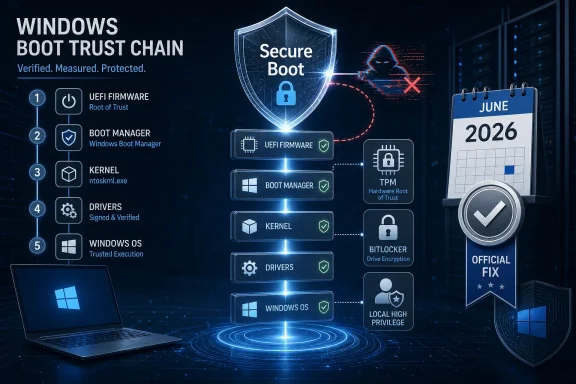 Secure Boot Fails Quietly Before Windows Can Defend Itself
Secure Boot is one of those technologies that is most visible when something goes wrong. For ordinary users it is a checkbox in firmware settings, a Windows 11 requirement, and an occasional cause of boot drama. For defenders it is supposed to be the first serious gate in the trust chain, checking that early boot components have not been replaced before Windows and its endpoint stack are awake.That is why a “security feature bypass” label matters even when the CVSS score is not Critical. Microsoft describes CVE-2026-48575 as a protection mechanism failure in Windows Secure Boot that allows an authorized attacker to bypass a security feature locally. In plain English, this is not a remote code execution bug that lets someone on the internet pop a machine over TCP; it is a flaw that becomes relevant when an attacker already has meaningful local control.
The advisory’s CVSS vector tells the story more precisely than the headline. Attack vector is local, attack complexity is low, privileges required are high, and no user interaction is required. The confidentiality and integrity impacts are both rated high, availability is rated none, and scope is changed — a detail that matters because a boot trust failure can cross the boundary between the component enforcing trust and the system that depends on it.
That combination is why the vulnerability lives in an awkward middle ground. It is not the kind of bug that should send home users into panic, but it is not safe to dismiss either. A bypass at boot time can undermine assumptions made by BitLocker, credential protection, kernel integrity, and post-boot monitoring, even if Microsoft has not said this specific CVE directly defeats each of those layers.
Microsoft’s “Important” Label Is Not a Comfort Blanket
Microsoft rates CVE-2026-48575 as Important, with a CVSS 3.1 base score of 7.9 and temporal score of 6.9. The company also says it was not publicly disclosed, was not exploited, and falls under “Exploitation Less Likely” at the time of publication. Those are meaningful signals, but they are not a permission slip to ignore it.The “Privileges Required: High” metric is the biggest reason this vulnerability does not look like a fire alarm. An attacker needs administrative-level control over the vulnerable component before exploitation. That requirement filters out drive-by attacks and makes the vulnerability more relevant to post-compromise persistence, local privilege abuse chains, stolen-admin scenarios, evil-maid style attacks, and environments where attackers can touch machines or images.
But high privilege requirements can mislead executives and patch committees. In the real world, attackers often accumulate privileges before they pursue stealth. Once an adversary has local administrative control, the next goal is frequently to survive reboots, blind security tools, or move the compromise beneath the OS layer. Secure Boot bypasses are therefore less about the first foothold and more about what happens after the first foothold is obtained.
Microsoft’s own exploitability assessment cuts both ways. “Exploitation Less Likely” means the company is not warning customers about active exploitation or broadly available exploit code. Yet the report confidence is confirmed, and an official fix is available. That is the moment when enterprise security teams should avoid theatrics but still move.
The Confirmed Metric Is Doing More Work Than It Seems
The user-facing MSRC text around report confidence is easy to skim past, but it is important here. CVE-2026-48575 is listed with report confidence as Confirmed. That means Microsoft is not merely tracking rumor, speculation, or an incomplete third-party claim; the vendor has sufficient confidence in the vulnerability and its technical basis.That matters because Secure Boot advisories often arrive with little public technical detail. Vendors are cautious for good reason. A fully described boot bypass can become a recipe for durable compromise, and remediation may require coordination across Windows servicing, boot components, firmware behavior, recovery environments, and revocation mechanisms.
Here, Microsoft credits Alon Leviev with Microsoft STORM, which gives the disclosure a recognizable coordinated-research shape without exposing the underlying exploit path. That is a familiar MSRC balance: enough information for defenders to prioritize, not enough for casual attackers to copy and paste.
The result is a risk conversation built from metadata. We know the affected security feature, the privilege requirement, the exploitation assessment, the affected platforms, and the availability of updates. We do not know, from Microsoft’s public advisory alone, the exact vulnerable code path or whether practical exploitation depends on particular device states, boot configuration, recovery media, virtualization mode, or enterprise deployment choices.
That uncertainty should not paralyze patching. It should shape testing. Secure Boot fixes deserve validation on representative hardware because the failure mode administrators fear is not a blue-screen after login; it is a device that cannot boot, cannot unlock, or cannot complete recovery without hands-on intervention.
The Affected List Is Broad Because the Boot Chain Is Shared
Microsoft’s affected-products table is expansive. The advisory includes Windows 11 versions 23H2, 24H2, 25H2, and 26H1 across x64 and ARM64 where applicable; Windows 10 versions including 21H2, 22H2, 1809, and 1607 in supported servicing contexts; and multiple Windows Server releases from Server 2012 and 2012 R2 through Server 2016, 2019, 2022, and 2025, including Server Core installations.That breadth does not necessarily mean every Windows device faces the same practical risk. It means the vulnerable trust path or serviced component spans generations of Windows releases. This is one reason Secure Boot servicing is operationally different from patching a user-mode application. The same conceptual fix may land in cumulative updates across many product lines, but the operational reality varies wildly between a consumer laptop, a branch-office domain controller, a Hyper-V host, and a long-lived industrial workstation.
The KB mapping also matters for administrators tracking compliance. Windows 11 24H2 and 25H2 are tied to KB5094126 in the advisory, Windows Server 2025 to KB5094125, Windows 10 21H2 and 22H2 to KB5094127, Windows Server 2022 to KB5094128, Windows Server 2019 and Windows 10 1809 to KB5094123, Windows Server 2016 and Windows 10 1607 to KB5094122, Windows Server 2012 R2 to KB5094041, Windows Server 2012 to KB5094042, and Windows 11 26H1 to KB5095051. Those numbers are the handles administrators will actually see in reporting systems.
Build numbers also provide a sanity check after deployment. For example, the advisory lists Windows 11 24H2 fixed at 10.0.26100.8655, Windows 11 25H2 at 10.0.26200.8655, Windows Server 2025 at 10.0.26100.32995, and Windows 10 22H2 at 10.0.19045.7417. In larger estates, relying only on “installed update” status can be risky; confirming build state is often the cleaner audit trail.
The Local-Attacker Caveat Still Leaves Room for Real Damage
Security teams sometimes treat local-only vulnerabilities as second-tier risks because they do not offer internet-scale reach. That logic is reasonable for triage, but it becomes brittle when the vulnerability affects a pre-OS security boundary. Local does not mean harmless; it means the attacker’s route to exploitation begins on or through the target system rather than over the network.The high-privilege requirement narrows the threat model further. A standard phishing victim probably does not become an immediate CVE-2026-48575 exploitation scenario. A compromised admin workstation, a malicious insider with device access, a stolen laptop where the attacker can manipulate boot state, or a server already under privileged control is a different story.
This is why the scope-change metric is worth attention. A Secure Boot bypass can affect trust beyond the component where the weakness resides. Boot controls are upstream of the OS, so a failure there can distort what downstream layers believe about system integrity.
Microsoft’s availability impact is none, which is useful. This is not framed as a denial-of-service bug. The concern is not that attackers crash systems; it is that they may bypass the very mechanism intended to prevent untrusted boot components from participating in startup.
Secure Boot Patching Is Still Haunted by Earlier Revocation Lessons
Anyone who administered Windows through earlier Secure Boot incidents knows the uncomfortable history. Fixing boot trust is rarely just a file replacement. In some cases, the industry has had to revoke trust in older bootloaders, update forbidden-signature databases, and coordinate across operating systems and firmware vendors without stranding machines.CVE-2026-48575’s advisory does not, by itself, say customers must perform a complicated revocation ceremony. Microsoft lists official fixes through normal security updates. That is good news, because routine servicing is the path most organizations can execute at scale.
Still, the category carries institutional memory. The industry’s experience with BootHole and later Secure Boot bypasses showed that a signed-but-vulnerable boot component can remain dangerous if the ecosystem continues to trust it. Even after patches exist, defenders have to worry about old media, recovery environments, offline images, dual-boot configurations, and machines that drift away from standard update channels.
That is the hidden cost of boot-chain security. The vulnerable thing may be patched on a running Windows installation, but the estate contains more than running Windows installations. It contains ISO files, deployment shares, rescue drives, golden images, virtual machine templates, offline VHDs, and lab systems that wake up once a quarter and surprise everybody.
The Admin Playbook Starts With Inventory, Not Panic
For most WindowsForum readers, the correct response is measured. Install the relevant June 2026 security updates through Windows Update, WSUS, Microsoft Configuration Manager, Intune, or whatever patch channel your environment trusts. Then verify build numbers and watch for known-issue updates from Microsoft.Home users running supported Windows 10 or Windows 11 releases should allow the cumulative update to install and reboot normally. There is no evidence in Microsoft’s advisory of active exploitation, and the attack requires high local privileges. The average user’s risk is less “someone on the internet immediately bypasses Secure Boot” and more “do not fall months behind on security updates.”
Enterprise administrators have more work because they own the edge cases. Servers with Secure Boot enabled, BitLocker-protected endpoints, VDI images, kiosk machines, developer laptops with unusual boot configurations, and ARM64 systems all deserve pilot coverage. It is not enough to test one clean Windows 11 x64 laptop and declare victory across the fleet.
The better operational question is not “Is this Critical?” but “Where would a boot trust regression hurt us most?” Domain controllers, Hyper-V hosts, remote branch servers, and devices that require BitLocker recovery keys from a help desk should be first in the validation ring. A boot security update that succeeds everywhere except a small class of remote machines can still create a painful incident.
The Recovery Partition and Offline Media Deserve a Second Look
One reason Secure Boot vulnerabilities linger is that organizations forget about bootable artifacts. A patched installed OS is only part of the story. If your recovery media, deployment images, or offline servicing paths contain outdated boot components, an attacker with the right access may have options that do not show up in standard endpoint compliance dashboards.This is where Windows administrators should resist the urge to treat CVE-2026-48575 as just another monthly CVE row. Review how your organization builds and stores recovery media. Check whether golden images are being serviced after Patch Tuesday or merely rebuilt when a major feature update arrives. Confirm that imaging teams know which KBs correspond to the affected releases.
BitLocker recovery planning also matters. Secure Boot state changes, boot component updates, and firmware settings can interact with recovery workflows. Microsoft’s advisory does not say this update triggers recovery prompts, but prudent administrators test with BitLocker-protected devices before broad rollout because the operational blast radius of recovery prompts can exceed the security story itself.
Virtualization adds another layer. Secure Boot inside virtual machines is now common, especially for Windows 11 guests and hardened server workloads. Hypervisor templates, shielded VM concepts, and lab images should be treated as part of the estate rather than exempt from it.
Microsoft’s Sparse Disclosure Is a Feature and a Frustration
Microsoft’s public language is intentionally sparse. The executive summary is a single sentence. The FAQ confirms that successful exploitation could bypass Secure Boot and explains the scope-change concept, but it does not describe the exploit path. For defenders who want crisp technical detail, that can feel unsatisfying.The frustration is understandable. Administrators need to decide whether to accelerate deployment, whether to treat certain device classes as higher risk, and whether compensating controls exist. Without root-cause detail, they must infer from CVSS, affected products, and patch behavior.
But sparse disclosure is also part of responsible handling for this class of vulnerability. Secure Boot bugs are not merely academic. A detailed exploit narrative can help attackers build persistence mechanisms that security tools may struggle to see. The public advisory therefore gives defenders a routing slip, not a blueprint.
That means IT teams should avoid inventing certainty. If an internal risk memo claims the bug definitely enables a specific bootkit technique, that goes beyond Microsoft’s public data. If the memo says the vulnerability is a confirmed local Secure Boot bypass with high privilege requirements and official updates available, that is grounded.
Patch Tuesday Turns Firmware Anxiety Into Windows Servicing Work
The most important practical detail is that Microsoft has issued official fixes. The remediation level is listed as Official Fix, and the affected-products table maps updates to supported Windows versions. That shifts the response from vulnerability monitoring into deployment management.This is where Microsoft’s servicing model earns its keep. Even when the vulnerable logic sits in or near the boot trust story, the customer-facing remediation arrives through the familiar Windows update channels. Administrators can stage it, pilot it, report on it, and roll it into monthly compliance.
The downside is complacency. Because the update looks like any other cumulative update, teams may not perform the extra validation that boot-path changes deserve. The machines most likely to produce interesting failures are often the machines least represented in routine pilot rings: older servers, unusual OEM firmware, long-lived industrial endpoints, dual-boot workstations, and devices with customized boot policies.
There is also a timing issue. CVE-2026-48575 was released on June 9, 2026, which places it squarely in the Patch Tuesday rhythm. That helps scheduling, but it also means the vulnerability competes for attention with every other June advisory. Secure Boot should not be lost in the noise just because it lacks a zero-day tag.
The Real Risk Is Post-Compromise Durability
A Secure Boot bypass is valuable to an attacker not because it opens the front door, but because it may help keep the back door from being noticed or removed. Modern Windows defenses assume the boot chain is trustworthy. If that assumption can be weakened, other protections may be operating on a compromised foundation.That does not mean CVE-2026-48575 is automatically a bootkit free-for-all. Microsoft has not reported exploitation, public disclosure, or mature exploit code. The high-privilege local requirement remains a major constraint.
The strategic concern is different. Sophisticated attackers prize weaknesses that let them move down the stack. User-mode malware is noisy. Kernel tampering is harder. Boot-stage manipulation, when practical, can be more durable and more difficult to inspect with standard tools.
This is also why defenders should view Secure Boot as one part of a layered story. Device health attestation, BitLocker, TPM-backed protections, endpoint detection, least privilege, admin workstation hardening, and recovery-key hygiene all matter. A patch fixes the known vulnerability; it does not eliminate the need to reduce the number of people and processes that can reach high local privilege in the first place.
The June Fix Belongs in the Fast Lane, Not the Emergency Lane
CVE-2026-48575 is a classic case where “do not panic” and “do not delay” are both true. Microsoft’s own metadata says exploitation is less likely and not observed. At the same time, the affected feature is foundational enough that deferring the update for months would be poor risk management.For enterprises, the right fast lane is a controlled one. Put representative Secure Boot-enabled systems in the pilot group. Include at least one BitLocker-protected endpoint, one modern Windows 11 machine, one older supported Windows 10 or LTSC-style device if present, one Server Core system if used, and one virtualization template. Then broaden deployment once boot and recovery behavior is understood.
For smaller shops, the advice is less glamorous but still important. Make sure backups and recovery keys are in order before any major patch cycle. Install the security update. Reboot. Confirm the machine comes back cleanly and reports the expected build.
For security teams, the after-action should include hunting for machines outside normal servicing. Unsupported or extended-support systems, lab networks, old deployment images, and rarely booted servers are exactly where boot-chain vulnerabilities age into long-term exposure.
The Secure Boot Advisory Leaves a Short, Concrete Checklist
CVE-2026-48575 is not the loudest kind of Windows vulnerability, but its location in the trust chain makes it operationally significant. The useful response is neither alarmist nor passive: patch, verify, and use the advisory as a prompt to clean up boot-related blind spots.- Microsoft published CVE-2026-48575 on June 9, 2026, as an Important Windows Secure Boot security feature bypass with a CVSS 3.1 base score of 7.9.
- The vulnerability requires local access and high privileges, has low attack complexity, requires no user interaction, and could bypass Secure Boot if successfully exploited.
- Microsoft says the vulnerability was not publicly disclosed, was not exploited, and was assessed as “Exploitation Less Likely” when the advisory was published.
- Official fixes are available through June 2026 security updates for supported Windows client and server releases, including Windows 10, Windows 11, and Windows Server versions from 2012 through 2025.
- Administrators should validate updates on Secure Boot-enabled, BitLocker-protected, ARM64, Server Core, virtualization, and older supported systems before broad deployment.
- Organizations should review recovery media, golden images, offline templates, and rarely updated systems because boot-chain exposure often survives outside normal endpoint patch reports.
References
- Primary source: MSRC
Published: 2026-06-09T07:00:00-07:00
Security Update Guide - Microsoft Security Response Center
 msrc.microsoft.com
