

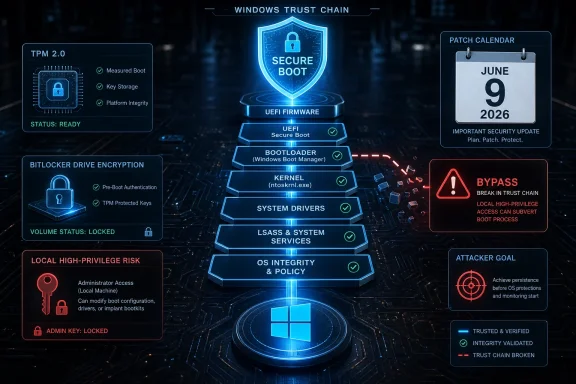
Microsoft published CVE-2026-48573 on June 9, 2026, describing an Important-severity Windows Secure Boot security feature bypass that can be exploited locally by an authorized attacker and is addressed through June security updates for supported Windows client and server releases. The advisory is not a red-alert remote code execution bug, and Microsoft says exploitation is less likely. But the interesting part is not the headline severity; it is the place this flaw occupies in Windows’ trust chain. Secure Boot bugs are rarely just another patching chore, because they sit at the boundary between the operating system Windows thinks it is loading and the machine state defenders have to trust before Windows starts.
Secure Boot is one of those technologies that disappears when it works. Most users know it only as a BIOS setting, a Windows 11 requirement, or the reason an old Linux USB stick refuses to start on a locked-down laptop. For enterprise administrators, it is more than firmware hygiene: it is part of the stack that supports measured boot, BitLocker expectations, device health claims, and confidence that the kernel did not arrive already compromised.
CVE-2026-48573 lands in that uncomfortable zone where the attack is local and privileged, yet the consequences can reach beyond the normal comfort of “the attacker already had admin.” Microsoft’s own CVSS vector gives the game away: local attack vector, low attack complexity, high privileges required, no user interaction, changed scope, high confidentiality impact, high integrity impact, and no availability impact. In plain English, this is not a browser drive-by. It is a way for someone with serious access to tamper with a trust boundary that Windows relies on before its usual defenses fully exist.
That distinction matters because modern Windows security is layered. Administrator rights are powerful, but Microsoft has spent years designing features that are supposed to make even administrator-level compromise less permanent and less invisible. Secure Boot is one of those brakes. When a Secure Boot bypass is in play, the question becomes whether an attacker can move from “I control this Windows session” to “I can influence what the device will trust at boot.”
Microsoft’s short executive summary says the vulnerability is a protection mechanism failure in Windows Secure Boot that allows an authorized local attacker to bypass a security feature. That is sparse even by MSRC standards, but the scoring fills in enough of the outline to tell administrators what kind of risk bucket this belongs in. This is about trust persistence and platform integrity, not ransomware detonating across the network five minutes after disclosure.
Those words are useful, but they can mislead if read like a weather forecast instead of a prioritization signal. The absence of known exploitation on June 9 does not mean Secure Boot bypasses are theoretical curiosities. The last few years have shown that boot-chain weaknesses are attractive precisely because they let attackers step around operating system assumptions, especially on targets where persistence and stealth are more valuable than speed.
The phrase security feature bypass also deserves more respect than it often gets in patch dashboards. A bypass does not usually mean the attacker gets a new beachhead from nothing. It means a safeguard that defenders counted on may not hold under specified conditions. In a Windows estate, those safeguards are often the difference between a rebuild and a forensic mystery.
The report confidence metric is “confirmed,” which is more than a bureaucratic field. It means Microsoft is not merely relaying a rumor or acknowledging a vague class of behavior. The vendor is saying the vulnerability exists and the available details are credible enough to score, patch, and publish. For would-be attackers, confirmed vendor acknowledgment is also a map marker: there is something real here, even if public exploit code has not appeared.
Windows security architecture increasingly assumes that compromise is not a single binary event. Credential theft, endpoint detection, virtualization-based security, BitLocker, Secure Boot, application control, and cloud-based device compliance all attempt to contain or at least expose an attacker who has crossed one boundary. A local administrator can do a lot, but a resilient platform tries to prevent that administrator from silently rewriting the foundations.
Secure Boot is part of that containment story. It is meant to ensure that boot components are trusted before control passes to Windows. If an authorized local attacker can bypass it, the attacker may gain a path to undermine assumptions made by later security layers. That is why the CVSS scope is marked changed: the vulnerable component and the impacted component do not live neatly inside the same security authority.
This is where enterprise risk diverges from consumer risk. On a home PC, the likely path to exploitation may be narrow enough that automatic updates are the whole practical answer. In a managed environment, local administrator access may exist on helpdesk tools, engineering workstations, lab machines, kiosk maintenance accounts, or third-party management agents. The relevant question is not whether every user can exploit the flaw. It is whether any attacker who obtains privileged local execution can turn one compromised endpoint into a more durable foothold.
That breadth is typical of boot-chain issues. Secure Boot is not a boutique feature bolted onto one release of Windows; it is part of the cross-version platform contract. When a flaw appears there, the blast radius follows the support matrix rather than the marketing matrix.
It is also a reminder that Windows security in 2026 is still anchored by older deployments. Windows Server 2012 and 2012 R2 remain in the conversation through extended servicing arrangements and enterprise realities. Windows 10, despite its consumer lifecycle pressure, still appears in supported enterprise contexts and on hardware that will not magically evaporate because Windows 11 exists.
For administrators, that makes inventory more important than outrage. The machines most likely to be forgotten are often the ones where Secure Boot matters most: unattended servers, remote sites, lab systems with relaxed controls, and specialty endpoints whose owners resist reboot windows. A Secure Boot bypass does not need to be internet-facing to become a long-term liability. It only needs a neglected device and a privileged attacker with a reason to care.
The lack of a detailed technical write-up is not surprising. Secure Boot vulnerabilities live in an awkward disclosure space. Too much detail can hand attackers a recipe for bootkit development; too little leaves defenders guessing which compensating controls matter most. Microsoft has chosen the usual middle path: publish the affected products, severity, score, exploitability judgment, and update vehicles, while holding back the kind of internals that would make for a satisfying reverse-engineering blog post.
That does not mean administrators are helpless. The advisory’s CVSS fields are unusually informative if read carefully. Low attack complexity and no user interaction mean exploitation should not depend on convincing a victim to click something once the attacker already has the required privileges. High privileges remain the big gating factor. High confidentiality and integrity impact mean a successful bypass could seriously compromise what the platform is supposed to protect, even if it does not directly crash systems or deny service.
The “official fix” remediation level is the part patch teams should care about most. This is not a mitigation-only entry asking administrators to set registry keys and wait. Microsoft shipped updates in the June 2026 release cycle. That turns the operational question from “what can we do?” into the more familiar but still painful “how quickly can we deploy and validate without breaking boot?”
That caution should not become paralysis. The history of Secure Boot maintenance has already taught Windows administrators that boot trust cannot be treated as a static factory setting. Certificates expire. Revocation databases evolve. Boot managers are updated. Firmware and operating system responsibilities overlap in ways that are messy, vendor-specific, and often poorly documented at the device level.
The lesson from CVE-2026-48573 is therefore not “slam every production server immediately and hope.” It is to treat Secure Boot servicing as a distinct operational discipline. Test on hardware classes that actually exist in the estate. Watch for BitLocker recovery prompts. Confirm that update rings include machines that spend most of their lives asleep, offline, or parked behind maintenance windows. Document firmware settings before a crisis forces someone to improvise at a remote console.
This is especially important for organizations that have used Secure Boot as a compliance checkbox. A checkbox says the feature is enabled. It does not say the machine’s boot trust state is healthy, current, and recoverable after a security update. CVE-2026-48573 is a reminder that platform security is a lifecycle, not a BIOS screenshot.
That scrutiny is overdue. For years, Secure Boot was often described in consumer-facing terms as a guard against rootkits. That was true but incomplete. In enterprise environments, it became part of a larger attestation and encryption story. BitLocker’s assumptions, endpoint compliance signals, and device trust models all benefit when the boot chain is not quietly subverted.
As more defenses move into hardware-backed or pre-OS territory, the incentive to attack those layers grows. That is the natural consequence of successful hardening. If EDR makes user-mode malware noisy, attackers move lower. If virtualization-based security protects secrets, attackers look for ways to influence the environment before those protections initialize. If cloud identity makes lateral movement harder, persistent local control of a strategic endpoint becomes more valuable.
CVE-2026-48573 does not prove a new bootkit wave by itself. Microsoft says it is not aware of exploitation. But the vulnerability belongs to a class that defenders should expect to remain active. The Windows boot chain is no longer a sleepy corner of platform engineering. It is contested terrain.
The most plausible risk is targeted post-compromise use. An attacker who already has privileged local access to a high-value endpoint could use a Secure Boot bypass to weaken platform guarantees, conceal persistence, or prepare for activity that survives normal remediation assumptions. The value of such a capability rises on machines that hold secrets, administer other systems, build software, manage identities, or sit outside easy physical reach.
That means prioritization should follow asset value as much as exposure. Domain controllers, privileged access workstations, build servers, security tooling hosts, jump boxes, executive laptops, and machines used by firmware or kernel developers deserve earlier attention than interchangeable kiosk endpoints. The exploit may be local, but the consequences of local compromise are not evenly distributed.
Home users should take the simpler path: install the June updates when offered and avoid disabling Secure Boot because a forum post says it improves compatibility. Enthusiasts who dual-boot or run unusual bootloaders should be more deliberate, because Secure Boot updates can intersect with nonstandard configurations. The answer is not to turn off the feature permanently; it is to understand which boot components are trusted and keep recovery media handy.
CVE-2026-48573’s weakness classification, reliance on a component that is not updateable, is particularly telling. The hardest security problems in platform trust often involve things that were designed to be stable, embedded, or difficult to change. Immutability is useful until the immutable thing is wrong. Then the industry needs revocation, replacement, migration, or elaborate compensating logic.
This is one reason Secure Boot fixes sometimes feel slower and scarier than ordinary patches. Updating a DLL is one thing. Changing what firmware trusts at boot is another. Microsoft has to balance closing bypasses against the risk of bricking or stranding legitimate systems that depend on older boot paths. Attackers only need one workable path; vendors have to preserve millions of valid ones while closing the invalid.
That tension will not disappear. If anything, it will become more visible as Windows leans harder on hardware-backed security. Pluton, TPM-backed measurements, virtualization-based security, kernel-mode code integrity, and device health attestation all rely on the early boot story being coherent. Secure Boot vulnerabilities are therefore not isolated defects. They are stress tests of Microsoft’s whole trusted computing bargain.
The danger is not that administrators lack imagination. It is that Secure Boot bugs can fall between teams. Endpoint teams may see them as Windows updates. Server teams may see them as firmware-adjacent. Security teams may see them as post-exploitation issues. Compliance teams may see Secure Boot enabled and assume the matter is closed. CVE-2026-48573 needs one owner per environment who can connect those views.
BitLocker deserves special mention. Secure Boot changes and boot-chain servicing can interact with recovery workflows, especially in environments with brittle key escrow, old imaging practices, or inconsistent firmware settings. Before broad deployment, administrators should confirm that recovery keys are escrowed where expected and that helpdesk procedures are ready for the small number of machines that may ask uncomfortable questions at startup.
This is also a good moment to review who has local administrator rights. A vulnerability that requires high privileges is far less useful in an environment where high privileges are rare, monitored, and time-bound. Conversely, it becomes more concerning in estates where every developer is a permanent admin, every support tool runs elevated, and old service accounts still have local control because removing them might break something.
 Secure Boot Fails Quietly Until It Fails Foundationally
Secure Boot is one of those technologies that disappears when it works. Most users know it only as a BIOS setting, a Windows 11 requirement, or the reason an old Linux USB stick refuses to start on a locked-down laptop. For enterprise administrators, it is more than firmware hygiene: it is part of the stack that supports measured boot, BitLocker expectations, device health claims, and confidence that the kernel did not arrive already compromised.CVE-2026-48573 lands in that uncomfortable zone where the attack is local and privileged, yet the consequences can reach beyond the normal comfort of “the attacker already had admin.” Microsoft’s own CVSS vector gives the game away: local attack vector, low attack complexity, high privileges required, no user interaction, changed scope, high confidentiality impact, high integrity impact, and no availability impact. In plain English, this is not a browser drive-by. It is a way for someone with serious access to tamper with a trust boundary that Windows relies on before its usual defenses fully exist.
That distinction matters because modern Windows security is layered. Administrator rights are powerful, but Microsoft has spent years designing features that are supposed to make even administrator-level compromise less permanent and less invisible. Secure Boot is one of those brakes. When a Secure Boot bypass is in play, the question becomes whether an attacker can move from “I control this Windows session” to “I can influence what the device will trust at boot.”
Microsoft’s short executive summary says the vulnerability is a protection mechanism failure in Windows Secure Boot that allows an authorized local attacker to bypass a security feature. That is sparse even by MSRC standards, but the scoring fills in enough of the outline to tell administrators what kind of risk bucket this belongs in. This is about trust persistence and platform integrity, not ransomware detonating across the network five minutes after disclosure.
The “Important” Label Should Not Lull Anyone Managing Real Machines
Microsoft rates CVE-2026-48573 as Important rather than Critical, and that is defensible under the usual severity grammar. The attacker needs high privileges. The exploit is local. Microsoft says it was not publicly disclosed and not known to be exploited at release. Its exploit code maturity is listed as unproven, with exploitation assessed as less likely.Those words are useful, but they can mislead if read like a weather forecast instead of a prioritization signal. The absence of known exploitation on June 9 does not mean Secure Boot bypasses are theoretical curiosities. The last few years have shown that boot-chain weaknesses are attractive precisely because they let attackers step around operating system assumptions, especially on targets where persistence and stealth are more valuable than speed.
The phrase security feature bypass also deserves more respect than it often gets in patch dashboards. A bypass does not usually mean the attacker gets a new beachhead from nothing. It means a safeguard that defenders counted on may not hold under specified conditions. In a Windows estate, those safeguards are often the difference between a rebuild and a forensic mystery.
The report confidence metric is “confirmed,” which is more than a bureaucratic field. It means Microsoft is not merely relaying a rumor or acknowledging a vague class of behavior. The vendor is saying the vulnerability exists and the available details are credible enough to score, patch, and publish. For would-be attackers, confirmed vendor acknowledgment is also a map marker: there is something real here, even if public exploit code has not appeared.
The High-Privilege Requirement Is a Gate, Not a Dismissal
The most common bad take on bugs like CVE-2026-48573 is that high privileges make them uninteresting. If an attacker already has admin, the argument goes, the game is already over. That was never a very good argument, and in 2026 it is almost quaint.Windows security architecture increasingly assumes that compromise is not a single binary event. Credential theft, endpoint detection, virtualization-based security, BitLocker, Secure Boot, application control, and cloud-based device compliance all attempt to contain or at least expose an attacker who has crossed one boundary. A local administrator can do a lot, but a resilient platform tries to prevent that administrator from silently rewriting the foundations.
Secure Boot is part of that containment story. It is meant to ensure that boot components are trusted before control passes to Windows. If an authorized local attacker can bypass it, the attacker may gain a path to undermine assumptions made by later security layers. That is why the CVSS scope is marked changed: the vulnerable component and the impacted component do not live neatly inside the same security authority.
This is where enterprise risk diverges from consumer risk. On a home PC, the likely path to exploitation may be narrow enough that automatic updates are the whole practical answer. In a managed environment, local administrator access may exist on helpdesk tools, engineering workstations, lab machines, kiosk maintenance accounts, or third-party management agents. The relevant question is not whether every user can exploit the flaw. It is whether any attacker who obtains privileged local execution can turn one compromised endpoint into a more durable foothold.
The Affected List Is a Map of Windows’ Long Tail
The update coverage for CVE-2026-48573 spans a broad slice of the Windows world. Microsoft lists Windows 11 versions 23H2, 24H2, 25H2, and 26H1, Windows 10 versions including 21H2 and 22H2, Windows Server 2012 and 2012 R2, Windows Server 2016, 2019, 2022, and 2025, including Server Core variants where applicable. The build numbers vary by branch, but the story is consistent: this is not a niche issue confined to one modern client SKU.That breadth is typical of boot-chain issues. Secure Boot is not a boutique feature bolted onto one release of Windows; it is part of the cross-version platform contract. When a flaw appears there, the blast radius follows the support matrix rather than the marketing matrix.
It is also a reminder that Windows security in 2026 is still anchored by older deployments. Windows Server 2012 and 2012 R2 remain in the conversation through extended servicing arrangements and enterprise realities. Windows 10, despite its consumer lifecycle pressure, still appears in supported enterprise contexts and on hardware that will not magically evaporate because Windows 11 exists.
For administrators, that makes inventory more important than outrage. The machines most likely to be forgotten are often the ones where Secure Boot matters most: unattended servers, remote sites, lab systems with relaxed controls, and specialty endpoints whose owners resist reboot windows. A Secure Boot bypass does not need to be internet-facing to become a long-term liability. It only needs a neglected device and a privileged attacker with a reason to care.
Microsoft’s Sparse Advisory Leaves the Hard Work to Operators
MSRC’s public page for CVE-2026-48573 gives enough to prioritize, but not enough to satisfy anyone who wants root-cause detail. The weakness is mapped to reliance on a component that is not updateable, and the summary refers to a protection mechanism failure. Microsoft credits Alon Leviev with Microsoft STORM, which signals coordinated internal or collaborative discovery rather than an anonymous dump of exploit code.The lack of a detailed technical write-up is not surprising. Secure Boot vulnerabilities live in an awkward disclosure space. Too much detail can hand attackers a recipe for bootkit development; too little leaves defenders guessing which compensating controls matter most. Microsoft has chosen the usual middle path: publish the affected products, severity, score, exploitability judgment, and update vehicles, while holding back the kind of internals that would make for a satisfying reverse-engineering blog post.
That does not mean administrators are helpless. The advisory’s CVSS fields are unusually informative if read carefully. Low attack complexity and no user interaction mean exploitation should not depend on convincing a victim to click something once the attacker already has the required privileges. High privileges remain the big gating factor. High confidentiality and integrity impact mean a successful bypass could seriously compromise what the platform is supposed to protect, even if it does not directly crash systems or deny service.
The “official fix” remediation level is the part patch teams should care about most. This is not a mitigation-only entry asking administrators to set registry keys and wait. Microsoft shipped updates in the June 2026 release cycle. That turns the operational question from “what can we do?” into the more familiar but still painful “how quickly can we deploy and validate without breaking boot?”
Boot Updates Demand More Respect Than Ordinary Cumulative Updates
Patching Secure Boot-adjacent issues is not psychologically the same as installing a browser fix or a kernel memory corruption patch. The failure mode administrators fear is obvious: a device that will not boot, a BitLocker recovery storm, or a fleet of remote machines suddenly requiring hands-on intervention. Even when those outcomes are unlikely, the fear is rational enough to slow deployment.That caution should not become paralysis. The history of Secure Boot maintenance has already taught Windows administrators that boot trust cannot be treated as a static factory setting. Certificates expire. Revocation databases evolve. Boot managers are updated. Firmware and operating system responsibilities overlap in ways that are messy, vendor-specific, and often poorly documented at the device level.
The lesson from CVE-2026-48573 is therefore not “slam every production server immediately and hope.” It is to treat Secure Boot servicing as a distinct operational discipline. Test on hardware classes that actually exist in the estate. Watch for BitLocker recovery prompts. Confirm that update rings include machines that spend most of their lives asleep, offline, or parked behind maintenance windows. Document firmware settings before a crisis forces someone to improvise at a remote console.
This is especially important for organizations that have used Secure Boot as a compliance checkbox. A checkbox says the feature is enabled. It does not say the machine’s boot trust state is healthy, current, and recoverable after a security update. CVE-2026-48573 is a reminder that platform security is a lifecycle, not a BIOS screenshot.
The Researcher Credit Points to a Broader Secure Boot Reckoning
The acknowledgment of Alon Leviev will catch the eye of readers who follow Windows internals and boot-chain research. Leviev has been associated with high-profile Windows security research, and the mention of Microsoft STORM suggests this vulnerability did not arrive as a random Patch Tuesday footnote. It fits a broader pattern: Secure Boot and adjacent trust mechanisms are getting more scrutiny because attackers and researchers both understand their strategic value.That scrutiny is overdue. For years, Secure Boot was often described in consumer-facing terms as a guard against rootkits. That was true but incomplete. In enterprise environments, it became part of a larger attestation and encryption story. BitLocker’s assumptions, endpoint compliance signals, and device trust models all benefit when the boot chain is not quietly subverted.
As more defenses move into hardware-backed or pre-OS territory, the incentive to attack those layers grows. That is the natural consequence of successful hardening. If EDR makes user-mode malware noisy, attackers move lower. If virtualization-based security protects secrets, attackers look for ways to influence the environment before those protections initialize. If cloud identity makes lateral movement harder, persistent local control of a strategic endpoint becomes more valuable.
CVE-2026-48573 does not prove a new bootkit wave by itself. Microsoft says it is not aware of exploitation. But the vulnerability belongs to a class that defenders should expect to remain active. The Windows boot chain is no longer a sleepy corner of platform engineering. It is contested terrain.
The Real Risk Is Not Mass Exploitation Tomorrow
There is a temptation in security coverage to sort every vulnerability into either “panic now” or “ignore safely.” CVE-2026-48573 belongs in neither pile. It is not the kind of unauthenticated remote bug that should send incident commanders sprinting into a bridge call. It is also not a routine nuisance that can be buried under driver updates and printer fixes.The most plausible risk is targeted post-compromise use. An attacker who already has privileged local access to a high-value endpoint could use a Secure Boot bypass to weaken platform guarantees, conceal persistence, or prepare for activity that survives normal remediation assumptions. The value of such a capability rises on machines that hold secrets, administer other systems, build software, manage identities, or sit outside easy physical reach.
That means prioritization should follow asset value as much as exposure. Domain controllers, privileged access workstations, build servers, security tooling hosts, jump boxes, executive laptops, and machines used by firmware or kernel developers deserve earlier attention than interchangeable kiosk endpoints. The exploit may be local, but the consequences of local compromise are not evenly distributed.
Home users should take the simpler path: install the June updates when offered and avoid disabling Secure Boot because a forum post says it improves compatibility. Enthusiasts who dual-boot or run unusual bootloaders should be more deliberate, because Secure Boot updates can intersect with nonstandard configurations. The answer is not to turn off the feature permanently; it is to understand which boot components are trusted and keep recovery media handy.
The Patch Tuesday Signal Is Bigger Than One CVE
June 2026’s Patch Tuesday arrives against a backdrop of increasing attention to firmware, certificates, bootloaders, and platform keys. That context matters because Secure Boot is not a single Microsoft switch. It is a chain involving UEFI firmware, Microsoft-signed components, OEM behavior, revocation lists, boot managers, and the operating system. A flaw in any part of that chain can complicate the guarantees users think they have.CVE-2026-48573’s weakness classification, reliance on a component that is not updateable, is particularly telling. The hardest security problems in platform trust often involve things that were designed to be stable, embedded, or difficult to change. Immutability is useful until the immutable thing is wrong. Then the industry needs revocation, replacement, migration, or elaborate compensating logic.
This is one reason Secure Boot fixes sometimes feel slower and scarier than ordinary patches. Updating a DLL is one thing. Changing what firmware trusts at boot is another. Microsoft has to balance closing bypasses against the risk of bricking or stranding legitimate systems that depend on older boot paths. Attackers only need one workable path; vendors have to preserve millions of valid ones while closing the invalid.
That tension will not disappear. If anything, it will become more visible as Windows leans harder on hardware-backed security. Pluton, TPM-backed measurements, virtualization-based security, kernel-mode code integrity, and device health attestation all rely on the early boot story being coherent. Secure Boot vulnerabilities are therefore not isolated defects. They are stress tests of Microsoft’s whole trusted computing bargain.
The Admin Playbook Starts With Boring Discipline
For all the architectural drama, the immediate response is intentionally mundane. Deploy the June 2026 security updates through normal management channels. Validate that updated systems land on the expected fixed builds. Watch for boot or recovery anomalies in pilot rings before expanding to sensitive or remote populations. Make sure exceptions are explicit, temporary, and owned.The danger is not that administrators lack imagination. It is that Secure Boot bugs can fall between teams. Endpoint teams may see them as Windows updates. Server teams may see them as firmware-adjacent. Security teams may see them as post-exploitation issues. Compliance teams may see Secure Boot enabled and assume the matter is closed. CVE-2026-48573 needs one owner per environment who can connect those views.
BitLocker deserves special mention. Secure Boot changes and boot-chain servicing can interact with recovery workflows, especially in environments with brittle key escrow, old imaging practices, or inconsistent firmware settings. Before broad deployment, administrators should confirm that recovery keys are escrowed where expected and that helpdesk procedures are ready for the small number of machines that may ask uncomfortable questions at startup.
This is also a good moment to review who has local administrator rights. A vulnerability that requires high privileges is far less useful in an environment where high privileges are rare, monitored, and time-bound. Conversely, it becomes more concerning in estates where every developer is a permanent admin, every support tool runs elevated, and old service accounts still have local control because removing them might break something.
The June Secure Boot Fix Belongs in the “Do Not Defer” Lane
CVE-2026-48573 is manageable, but manageable is not the same as optional. The concrete reading for WindowsForum readers is straightforward:- Microsoft released CVE-2026-48573 on June 9, 2026, as an Important Windows Secure Boot security feature bypass with a CVSS 3.1 base score of 7.9.
- Microsoft says the vulnerability was not publicly disclosed and had not been exploited when published, with exploitation assessed as less likely.
- The attack requires high privileges and local access, but successful exploitation could bypass Secure Boot and affect security scope beyond the vulnerable component.
- Security updates are available for supported Windows client and server versions, including Windows 10, Windows 11, and multiple Windows Server branches.
- Administrators should prioritize high-value and privileged systems first, while validating boot behavior, BitLocker recovery readiness, and fixed build deployment.
- The safest long-term response is not merely installing one update, but treating Secure Boot servicing as part of ongoing platform security operations.
References
- Primary source: MSRC
Published: 2026-06-09T07:00:00-07:00
Security Update Guide - Microsoft Security Response Center
 msrc.microsoft.com
