

Secure Boot Is No Longer a Set-and-Forget Promise
Secure Boot was sold to most PC users as an invisible protection: turn it on, keep Windows updated, and unsigned or untrusted boot code should not get a chance to run before the operating system takes control. That abstraction was useful because few users, and not many administrators, wanted to reason about firmware databases, certificate authorities, boot managers, and revocation lists before breakfast.
But every Secure Boot bypass drags that machinery back into view. CVE-2026-48576 belongs to the class of vulnerabilities that do not necessarily give an attacker a remote beachhead, but can weaken the trust boundary that makes later compromise harder to hide. In plain English, a Secure Boot bypass matters because it can allow malicious or outdated early boot components to survive in a place where endpoint agents and Windows security features are not yet fully awake.
That is why “security feature bypass” is a deceptively calm label. It does not sound as dramatic as remote code execution, and it may require local access, elevated privilege, physical access, or a chained attack depending on the specific flaw. Yet the bypassed feature is there precisely to contain damage after something else has gone wrong.
The practical consequence is that administrators should not rank this kind of bug only by whether it is wormable. Secure Boot is a foundation technology. When the foundation is in question, the blast radius is measured in trust, recovery confidence, imaging practices, incident response, and whether the next boot is really the clean slate defenders think it is.
Microsoft’s Confidence Language Is Doing More Work Than It Looks
The user-facing text around CVE-2026-48576 points to a metric that measures confidence in the existence of the vulnerability and the credibility of the known technical details. That may sound bureaucratic, but it is one of the more useful signals in a modern advisory. It tells defenders how much daylight exists between “someone reported something plausible” and “the vendor has confirmed enough technical reality to treat this as concrete risk.”
That distinction matters because vulnerability advisories now arrive in several states of maturity. Sometimes a CVE appears with full affected-version tables, exploitability assessments, workarounds, and patch guidance. Sometimes the public record says little more than the product, impact category, and a short description. In the second case, defenders are not being asked to ignore the issue; they are being asked to manage uncertainty.
For attackers, sparse detail can cut both ways. A confirmed vulnerability with rich technical write-up can accelerate exploit development. A thin advisory may slow opportunistic copycats, but it still flags a promising area of investigation for teams already fluent in firmware, bootloaders, and Windows internals. The confidence metric is therefore not academic; it is a rough proxy for how real the issue is and how much public attacker knowledge may already exist.
For administrators, the right reading is sober rather than theatrical. If Microsoft’s advisory machinery assigns a CVE and classifies it under Secure Boot security feature bypass, the vulnerability deserves tracking. But where details are limited, the response should be disciplined: identify affected assets, watch for updated MSRC guidance, validate patch applicability, and avoid inventing exploit mechanics that the public record does not yet support.
The Boot Chain Is a Supply Chain in Miniature
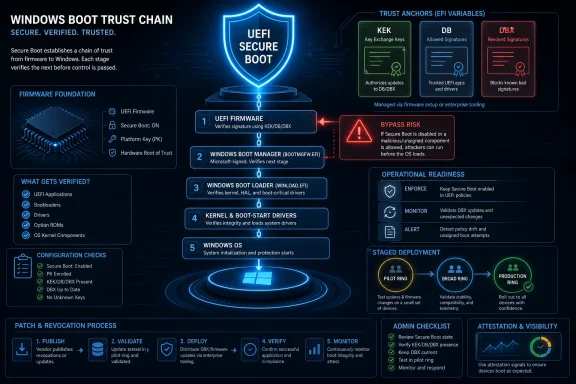
Secure Boot is often described as a cryptographic allow-list for early boot software, but that shorthand hides how many parties touch the chain. Microsoft signs Windows boot components. OEMs ship firmware and platform keys. UEFI databases define what is allowed and what is forbidden. Enterprises layer on BitLocker, measured boot, device health attestation, endpoint management, and recovery media.
That makes a Secure Boot vulnerability different from an ordinary application bug. A browser patch replaces code in a relatively familiar software stack. A boot-chain update may involve Windows servicing, firmware behavior, revocation databases, recovery partitions, deployment images, offline media, and hardware models that have accumulated years of vendor-specific quirks.
The last few years have made that complexity harder to ignore. Microsoft has been pushing the ecosystem away from older 2011-era Secure Boot certificates and toward newer 2023 certificate authorities because the older certificates begin expiring in 2026. That transition is not just an administrative nuisance; it is a reset of the trust anchors that make future revocations and boot protections possible.
CVE-2026-48576 therefore lands in an awkward season. Administrators are already being told to plan certificate updates, monitor device state, and test Secure Boot changes on representative hardware. A new Secure Boot bypass does not necessarily mean the certificate transition caused the flaw. But it does mean the same operational muscles are required: inventory, staged rollout, firmware awareness, and a healthy fear of untested boot changes at scale.
The BlackLotus Lesson Still Haunts Every Secure Boot Advisory
The industry’s current sensitivity to Secure Boot bypasses did not emerge from theory. BlackLotus, the UEFI bootkit associated with earlier Secure Boot bypass research and Microsoft mitigations, showed why patched-but-still-trusted boot components can become a long tail of risk. The painful lesson was that fixing code is not always enough when the ecosystem continues to trust older signed artifacts.
That is the uncomfortable part of boot security. Trust can outlive safety. A vulnerable boot manager, driver, or EFI application may remain cryptographically acceptable until a revocation mechanism says otherwise. But revocation is delicate because the wrong entry, deployed too quickly, can break boot on real machines.
This is why Microsoft’s Secure Boot mitigations often arrive in stages. The company has to balance stronger revocation against the possibility of leaving devices unbootable, especially in enterprises with old recovery media, dual-boot setups, bespoke imaging workflows, or hardware that has not received recent firmware. Security teams understandably want the shortest path to protection. Operations teams remember that a machine that cannot boot is also an incident.
CVE-2026-48576 should be viewed against that history. Even if the public details remain limited, the pattern is familiar: the weakness may sit in an early trust decision, the fix may depend on more than one update mechanism, and the most consequential work may happen after Patch Tuesday, when organizations discover which devices actually accepted the new state.
“Local” Does Not Mean “Low Risk” in the Firmware World
Many Secure Boot bypasses are not remote-code-execution bugs in the classic sense. They may require an attacker to already have administrative control, physical access, or the ability to tamper with boot media. That leads some organizations to downgrade them mentally: if the attacker is already local admin, what is left to protect?
A great deal, actually. Secure Boot exists partly because operating system compromise should not automatically become pre-operating-system persistence. If malware can move below Windows, it may survive reinstallation attempts, blind security tools, interfere with disk encryption expectations, or undermine the evidence defenders rely on during forensics. The value of the control is not that it prevents every initial compromise; it is that it limits where a compromise can entrench itself.
This is especially relevant for high-value laptops, developer workstations, privileged administrator devices, kiosks, and servers in locations where physical security is imperfect. It also matters for ransomware response. An organization trying to restore trust after an intrusion needs confidence that the boot path is known-good, not merely that Windows files were replaced.
That does not mean every desktop should be treated as if a nation-state implant is waiting in the EFI System Partition. It means Secure Boot bypasses occupy a strange middle tier: often not the first vulnerability exploited, but potentially decisive in the difference between a remediated incident and a compromised root of trust.
The 2026 Certificate Clock Raises the Stakes
The timing around Secure Boot in 2026 is unusually consequential because Microsoft’s older Secure Boot certificate infrastructure is aging out. The Microsoft Corporation KEK CA 2011 and Microsoft UEFI CA 2011 have June 2026 expiration timelines, while the Microsoft Windows Production PCA 2011 has an October 2026 expiration timeline. Microsoft’s newer guidance points OEMs and administrators toward 2023-era trust anchors, updated boot managers, and refreshed DB and DBX states.
This is not the kind of change most users will notice when everything works. A supported Windows device may receive updated certificates and boot components through normal servicing or vendor-provided firmware paths. But managed environments are not made of averages. They are made of mixed hardware fleets, older images, recovery tools, offline media, niche drivers, and business units that discover firmware dependencies only when something stops booting.
That is why CVE-2026-48576 should not be treated as a single item on a monthly patch spreadsheet. It belongs in the same operational conversation as Secure Boot certificate readiness. If a device cannot accept modern Secure Boot updates cleanly, its ability to benefit from future boot-chain protections may be limited.
The most dangerous assumption is that “fully patched Windows” and “healthy Secure Boot state” are always identical. They overlap, but they are not the same. Windows Update can deliver operating system fixes while firmware variables, boot media, and revocation databases remain in a state that deserves separate validation.
Where Enterprise IT Will Feel the Pain First
The first pain point is inventory. Many organizations know OS version, patch level, and hardware model, but fewer can confidently report Secure Boot certificate state, DBX currency, boot manager signing generation, and whether recovery media has been updated to match the fleet. Without that visibility, a Secure Boot advisory becomes a guessing game.
The second pain point is staged deployment. Boot-chain changes are exactly the kind of updates that should be tested against representative hardware before broad release. That is easy to say and hard to execute in a fleet with dozens of models, remote users, BitLocker policies, docking stations, PXE workflows, and field devices that cannot conveniently visit IT.
The third pain point is incident response. If an organization is hit by malware and later learns that a relevant Secure Boot bypass was present on affected machines, responders must decide whether ordinary rebuilds are enough. That can push teams toward firmware updates, disk reimaging from trusted media, Secure Boot database verification, and sometimes hardware replacement for devices that cannot be brought back to a trustworthy baseline.
The fourth pain point is communication. “We need to update Secure Boot certificates and possibly revocation data” is not a sentence that wins budget meetings. But “some devices may be unable to receive future boot protections if we do nothing” is a business risk. The story has to be translated from firmware mechanics into continuity, compliance, and recovery assurance.
Home Users Should Patch, But Not Panic
For Windows enthusiasts and home users, the advice is narrower but still meaningful. Keep Windows current, install firmware updates from the device maker when they are offered, and avoid disabling Secure Boot as a workaround for old utilities, unsigned drivers, or abandoned operating systems unless you understand the trade-off. Secure Boot is not perfect, but turning it off converts a bypass problem into a policy choice.
The complication for enthusiasts is dual booting and custom boot media. Linux distributions, rescue environments, imaging tools, and older USB installers may depend on bootloaders or signatures that interact differently with updated Secure Boot databases. A future revocation or certificate update can expose that fragility.
That does not mean Microsoft should freeze boot security to preserve every legacy workflow. It means users who rely on custom boot paths should test them before they need them. A recovery USB that worked in 2022 is not a recovery plan in 2026 unless it still boots on the machine in front of you.
BitLocker adds another layer. Secure Boot and TPM-measured boot are part of the trust story that helps determine whether a device starts normally or asks for recovery material. Firmware and Secure Boot changes can sometimes trigger recovery prompts. Sensible users should make sure recovery keys are backed up before making firmware or boot security changes, not after a blue recovery screen appears.
The Security Industry Has a Disclosure Vocabulary Problem
CVE-2026-48576 also illustrates a persistent weakness in vulnerability communication. The phrase “security feature bypass” covers a wide range of realities. It can describe a subtle policy failure with limited preconditions or a practical path around one of the most important controls on the platform. The category tells us the wall was bypassed, but not whether the attacker needed a ladder, a keycard, or a bulldozer.
CVSS scores help, but they are not a substitute for narrative. Exploitability assessments help, but they can change as researchers publish proof-of-concept work or attackers chain vulnerabilities in the wild. Report confidence helps, but only if readers understand that confidence in existence is different from public availability of exploit detail.
Microsoft is not alone in this. The entire vulnerability ecosystem compresses complicated engineering facts into fields that scanners can ingest. That machine-readable structure is necessary for patch management, but it can flatten judgment. A firmware-adjacent bypass with sparse public details may look less urgent than a loud application bug, even though the former may matter more to long-term trust.
The answer is not to turn every Secure Boot CVE into a five-alarm fire. It is to treat advisories as the beginning of risk analysis, not the end. Security teams should ask what the flaw affects, what preconditions are known, what mitigations are available, what assets depend most heavily on boot integrity, and what uncertainty remains.
The Real Patch Is the Process Around the Patch
If CVE-2026-48576 receives a conventional Windows update, many consumer machines will absorb it with little drama. That is the best-case version of modern servicing: the user clicks restart, the platform grows slightly safer, and nobody has to learn what a Key Exchange Key is. But enterprise reality is more layered.
The update may be only one piece of the response. Administrators may need to verify that firmware is current, confirm that Secure Boot remains enabled, ensure that bootable media uses updated components, and monitor event logs or management signals that report certificate and boot-state progress. The patch is the artifact; the process is the control.
This is where Windows management has become more demanding. The industry spent years pushing administrators toward rapid patch adoption, and rightly so. But boot-chain updates require a second skill: cautious sequencing. Moving too slowly leaves devices exposed to known bypasses. Moving too quickly without testing can strand machines in recovery or break boot workflows at the worst possible time.
The mature posture is not paralysis. It is rings, telemetry, rollback planning, recovery-key hygiene, and hardware sampling. Organizations that already treat firmware as part of endpoint management will handle this better than organizations that still see BIOS settings as something configured once during imaging and then forgotten.
The Windows Trust Stack Is Becoming More Visible
Microsoft’s broader security direction has been to push trust decisions earlier and deeper. Secure Boot, TPM-backed measurement, virtualization-based security, kernel-mode code integrity, and cloud-assisted device health all depend on the idea that Windows can reason about its own starting state. That architecture is powerful only if each layer can trust the layer beneath it.
Secure Boot is the first visible link in that chain for most administrators. When it works, it is boring. When it fails, every higher-level assurance starts to wobble. A vulnerability like CVE-2026-48576 is therefore not just about bootloaders; it is about the credibility of the stack that Windows increasingly uses to justify stronger defaults.
There is a tension here. The more Microsoft hardens Windows, the more consequential the maintenance of those hardening features becomes. A consumer can ignore the terminology, but an enterprise cannot ignore the dependency graph. A bypass in a foundational feature is not automatically catastrophic, but it is structurally important.
This is also why OEMs remain central to the story. Microsoft can publish guidance, ship updates, and maintain revocation content, but firmware behavior is not uniform across the PC ecosystem. The Windows platform is a partnership whether customers like it or not, and Secure Boot is where that partnership becomes operationally visible.
The CVE-2026-48576 Playbook Is Really a Secure Boot Readiness Test
The immediate response to CVE-2026-48576 should be practical, not theatrical. Organizations should track Microsoft’s advisory updates, apply relevant Windows and firmware updates through normal risk-based channels, and verify Secure Boot health rather than assuming it. The deeper lesson is that every Secure Boot CVE in 2026 doubles as a readiness test for the certificate transition and the next generation of boot-chain servicing.
- Administrators should confirm which Windows devices have Secure Boot enabled, which have current firmware, and which can report their certificate and revocation status through existing management tools.
- Patch teams should treat Secure Boot updates as staged infrastructure changes, with pilot rings that include older hardware, BitLocker-protected systems, remote laptops, and machines that rely on custom boot media.
- Recovery media, deployment images, and offline repair tools should be refreshed so that emergency workflows do not depend on boot components the platform may later distrust.
- Security teams should rank high-value endpoints, administrator workstations, and physically exposed systems ahead of ordinary low-risk desktops when validating boot-chain integrity.
- Incident responders should include Secure Boot state, firmware level, and boot media trust in post-compromise recovery plans, especially when persistence below the operating system is a plausible concern.
- Home users should keep Windows and firmware updated, preserve BitLocker recovery keys, and avoid disabling Secure Boot merely to accommodate outdated tools.
The reason this matters is not that CVE-2026-48576 is guaranteed to become the next famous bootkit headline. The reason is that Secure Boot has crossed from hidden platform feature into managed security surface. Windows users can still hope never to think about DB, DBX, KEK, or boot manager signatures, but administrators no longer have that luxury.
CVE-2026-48576 is a small entry in a much larger 2026 story: Windows boot trust is being renewed, tested, and made more operationally explicit all at once. The organizations that come out ahead will not be the ones that memorize every firmware acronym; they will be the ones that can prove their devices still start from a chain of trust they understand, can update, and can recover when the next bypass forces the industry to look beneath Windows again.