

Microsoft listed CVE-2026-8863 on June 9, 2026, as a UEFI Secure Boot security feature bypass vulnerability in its Security Update Guide, with the public entry emphasizing confidence in the vulnerability’s existence rather than publishing deep technical exploitation details. That distinction matters because Secure Boot bugs live in the narrowest and most consequential part of the Windows trust chain: the moment before Windows itself is fully in charge. This is not merely another Patch Tuesday item for administrators to clear from a dashboard. It is a reminder that the industry’s boot-security model is being repaired while still in motion.
The headline risk is familiar: a Secure Boot bypass can allow untrusted or vulnerable boot components to run despite a platform being configured to reject them. The practical risk is more complicated. Microsoft, OEMs, Linux distribution maintainers, hypervisor vendors, and enterprise administrators all share pieces of the same machinery, and no single update can safely yank every old trust anchor out of firmware overnight.
That is why CVE-2026-8863 lands in a particularly sensitive window. Secure Boot certificates issued in 2011 began expiring in June 2026, and Microsoft has already been pushing the ecosystem toward 2023-era certificate authorities for Windows boot loaders, third-party EFI applications, option ROMs, and database updates. A new bypass entry at this moment is not just a bug record. It is another stress test for the migration plan.
The public description around CVE-2026-8863 is deliberately thin. Microsoft’s page identifies the class of issue as a UEFI Secure Boot security feature bypass, and the metric language highlighted by the entry concerns “Report Confidence” — the degree to which the vulnerability is believed to exist and the credibility of the known technical details.
That is not filler. In CVSS terminology, report confidence is a temporal metric that helps separate rumor, partial disclosure, and vendor-confirmed vulnerability handling. In plainer operational language, it tells defenders how much weight to give the entry before exploit code, root-cause analysis, and affected-component specifics are broadly known.
For administrators, the discomfort is obvious. You want to know whether the vulnerable object is a Windows boot component, a signed third-party shim, an option ROM, a revocation gap, a certificate transition problem, or some other firmware-adjacent trust failure. Microsoft’s sparse public language does not answer all of that.
But the absence of detail is not the same as absence of risk. Secure Boot bypasses are often dangerous precisely because the public exploit recipe can lag behind the practical exposure. If an attacker can reuse a trusted-but-vulnerable pre-OS component, the question is not whether Windows Defender catches a malicious process later. The question is whether the platform allowed the attacker’s chosen code to run before Windows policy, kernel protections, and endpoint telemetry had a fair chance.
That distinction is the root of nearly every painful Secure Boot episode over the last decade. The feature can faithfully enforce trust decisions and still permit trouble if the trusted list contains components that should no longer be trusted. In that sense, Secure Boot is less like an antivirus engine and more like an airport gate: if a credential remains valid, the gate opens.
The hard part is revocation. Once a boot component has been signed and deployed across millions of systems, removing trust in it can break recovery media, dual-boot configurations, old servers, embedded devices, virtual machines, and hardware that has not received compatible firmware updates. A perfect security response might revoke aggressively. A survivable platform response often has to move in stages.
That tension explains Microsoft’s long, cautious handling of past Secure Boot issues. BlackLotus made the problem concrete for Windows defenders by demonstrating that signed, vulnerable boot components could become part of a real-world bootkit story. The industry lesson was not simply that a bug had been patched. It was that patching code and revoking trust are two different operations, and the second one can be more operationally dangerous than the first.
Microsoft’s newer 2023 certificate authorities are intended to carry the ecosystem forward. The transition includes new trust anchors such as Windows UEFI CA 2023, Microsoft UEFI CA 2023, Microsoft Option ROM UEFI CA 2023, and updated KEK material used to authorize DB and DBX changes. For current devices, this may arrive through Windows Update, OEM firmware, Intune, Group Policy, or a managed enterprise rollout.
The catch is that a Secure Boot certificate transition is not like updating Edge or installing a cumulative update. Firmware variables are involved. OEM behavior varies. Some systems need firmware updates before they can safely accept the new trust material. Some servers and virtual machines need explicit administrative action. Some environments must coordinate BitLocker recovery readiness before touching boot policy.
That makes a new Secure Boot bypass more than a line item in a vulnerability feed. It intersects with the same databases, certificates, boot managers, and revocation mechanisms that administrators are already being told to inventory. The security team may ask, “Are we exposed to CVE-2026-8863?” The infrastructure team may have to answer, “First we need to know which machines have completed the 2023 Secure Boot certificate migration.”
The boot chain is now an enterprise dependency. It determines whether new mitigations can be applied, whether vulnerable boot managers can be blocked, whether future DBX updates will be accepted, and whether devices can continue receiving boot-level protections after old certificates expire. A fleet with Secure Boot enabled but stale trust anchors is not in the same position as a fleet with Secure Boot enabled and current certificates.
This is where vulnerability management tools can mislead. A scanner may flag a Secure Boot CVE and offer a simple remediation status. But the real remediation path may involve BIOS updates, staged Windows updates, revocation policies, recovery-key escrow, reboot windows, and exception handling for specialty hardware. The dashboard compresses a boot-trust migration into a red or green square.
That compression is dangerous because Secure Boot mistakes tend to fail loudly. A bad application patch may crash a service. A bad boot-policy change can strand a laptop at BitLocker recovery or leave a server unable to start. In high-availability environments, that difference matters.
For CVE-2026-8863, the public signal is closer to confirmation than explanation. That means organizations should neither panic nor ignore it. The correct response is to treat the entry as a credible marker in a broader Secure Boot hardening program, while watching for later revisions that clarify affected products, exploitation requirements, mitigation steps, and revocation behavior.
This matters because the attacker’s knowledge and the defender’s knowledge do not always advance symmetrically. A public CVE entry with limited detail may protect users by withholding a recipe, but it also leaves defenders with ambiguous scoping. The balance is familiar in vulnerability disclosure, yet it is especially uncomfortable in firmware and boot security because independent verification is harder.
On a normal Windows flaw, a security team can often reproduce exposure in a lab, inspect file versions, validate registry keys, and confirm that a patch changed behavior. With Secure Boot, the evidence may live in firmware databases, UEFI variables, boot manager signatures, and event logs that vary by device class. The result is a lot more “trust but verify,” and a lot less one-click certainty.
That does not make them minor. It changes their strategic role. A boot bypass is often about persistence, stealth, and control beneath the operating system. It is attractive to sophisticated operators because it can sit below ordinary security tooling and complicate recovery. It is less attractive to noisy commodity malware that can get paid faster by stealing browser sessions or deploying ransomware from userland.
The practical enterprise concern is therefore targeted exposure. Executives’ laptops, developer workstations, domain-admin jump boxes, secure build systems, kiosks, lab machines, branch-office servers, and unmanaged hardware all deserve more scrutiny than a generic office desktop already enrolled in a well-managed update ring. The machines that matter most are the ones where boot trust failure would undermine incident response assumptions.
That is why administrators should resist treating this as an isolated CVE. The relevant question is not simply whether one update is installed. It is whether the fleet can accept future Secure Boot revocations and certificate updates without breaking.
When Microsoft signs something, or when firmware trusts a Microsoft CA that signs something, the decision can affect Windows-only systems, Linux dual-boot users, recovery environments, hypervisors, appliance vendors, and OEM tools. When Microsoft revokes something, the blast radius can be just as broad. This is the paradox of the Windows PC as an open hardware platform secured by a small number of widely trusted authorities.
The 2026 certificate rollover makes that paradox unavoidable. Microsoft needs to retire aging trust anchors and push the ecosystem toward newer certificates. But old devices, stale firmware, and third-party dependencies do not all move at the same speed. Security wants a clean cutover. Operations wants proof that Monday morning will still boot.
CVE-2026-8863 should be read in that context. Even if later details narrow the affected component, the broader message is that Secure Boot maintenance has become continuous work. Trust anchors age. Signed binaries become liabilities. Revocation lists grow. Firmware quirks turn security theory into deployment choreography.
The risk for home users is often indirect. They may not be targeted by a bespoke bootkit, but they may own devices that miss the 2023 certificate transition because firmware updates are ignored, OEM utilities are removed, or Windows Update is deferred indefinitely. A laptop can look healthy in day-to-day use while still lacking the trust material needed for future boot-level protections.
There is also a recovery-media trap. Many enthusiasts keep old USB installers, rescue environments, imaging tools, and dual-boot setups. As Secure Boot revocations and certificate transitions advance, some of that media may stop booting unless it has been rebuilt with current, trusted components. That is not a bug in the narrow sense; it is the security model finally refusing to trust old code.
For WindowsForum readers, the best habit is boring inventory. Know whether Secure Boot is enabled. Know whether the 2023 certificates are present. Know where BitLocker recovery keys live. Know whether your motherboard or laptop vendor has issued firmware that mentions Secure Boot certificate updates. The time to discover those facts is not after a revocation lands.
A credible runbook starts with visibility. Administrators need to collect Secure Boot state, certificate status, firmware versions, BitLocker readiness, and event-log indicators across representative hardware. They also need to know which devices are blocked from automatic remediation because of firmware limitations or policy choices. Without that, “apply the fix” is just a slogan.
Testing must be staged around hardware families, not merely Windows versions. Two Windows 11 machines on the same cumulative update may behave differently if their firmware handles UEFI variables differently. A server platform with a vendor-specific lifecycle may need OEM packages before Microsoft’s OS-level guidance can be safely applied. A VM created before a platform update may expose different Secure Boot certificates than one created afterward.
The rollback story is equally important. Some Secure Boot revocation actions are difficult or impossible to reverse while Secure Boot remains enabled, and a failed boot can turn a remote fix into a hands-on recovery event. Change windows, recovery keys, out-of-band management, and help-desk scripts are not administrative extras. They are part of the mitigation.
This has always been politically and technically awkward. Microsoft’s role as a signing authority for third-party UEFI software gives Linux distributions a path to boot on Secure Boot-enabled PCs, but it also means revocation decisions can affect non-Windows users who never thought of themselves as depending on Microsoft infrastructure. When a vulnerable shim or loader must be distrusted, the ecosystem has to coordinate replacements before revocations become broadly enforced.
For enthusiasts, that means old installers and niche distributions may be more fragile than mainstream current releases. A current Ubuntu, Fedora, Debian, or enterprise Linux image is more likely to track shim and Secure Boot updates than an abandoned rescue ISO sitting in a drawer. The same principle applies to disk utilities, imaging tools, and hypervisor media.
CVE-2026-8863 may or may not ultimately center on such a component; the public record is not detailed enough to say. But the class of vulnerability is exactly the one that can expose cross-platform dependencies. Secure Boot is a Windows security feature in many users’ minds, yet the trust chain it enforces is broader than Windows.
That is operationally treacherous. Humans are trained to equate “it booted” with “it is fine.” Secure Boot maintenance breaks that assumption. A machine can be functional today and unprepared for tomorrow’s revocation.
This is especially relevant for servers and long-lived endpoints. Workstations churn. Consumer laptops are replaced. Servers, lab machines, manufacturing PCs, and embedded Windows systems often live through many firmware generations, many OS servicing baselines, and many undocumented exceptions. They are exactly the devices least likely to enjoy a clean automatic certificate transition.
The same is true for virtual infrastructure. Administrators may assume VMs abstract away firmware headaches, but virtual firmware has its own certificate state and creation-time behavior. A VM template built before a platform change can propagate stale Secure Boot assumptions long after the host has moved on.
The better response is to accelerate the work Microsoft and OEMs were already pushing: certificate readiness, firmware currency, recovery planning, and staged revocation testing. Security teams should ask vendors for specifics, but they should not wait for perfect public detail before cleaning up the obvious prerequisites. If a device cannot accept modern Secure Boot trust material, it is already a problem.
This is also a useful moment to separate compliance from resilience. A checkbox that says Secure Boot is enabled does not prove the device is ready for the next DBX update. A patch-management report that says Windows is current does not prove firmware trust anchors are current. A vulnerability scanner that reports no exploit observed does not prove a bootkit would be visible if one appeared.
The boot layer forces uncomfortable humility. Defenders do not get as much telemetry there as they do inside Windows. That makes prevention, integrity, and disciplined update sequencing more important, not less.
The headline risk is familiar: a Secure Boot bypass can allow untrusted or vulnerable boot components to run despite a platform being configured to reject them. The practical risk is more complicated. Microsoft, OEMs, Linux distribution maintainers, hypervisor vendors, and enterprise administrators all share pieces of the same machinery, and no single update can safely yank every old trust anchor out of firmware overnight.
That is why CVE-2026-8863 lands in a particularly sensitive window. Secure Boot certificates issued in 2011 began expiring in June 2026, and Microsoft has already been pushing the ecosystem toward 2023-era certificate authorities for Windows boot loaders, third-party EFI applications, option ROMs, and database updates. A new bypass entry at this moment is not just a bug record. It is another stress test for the migration plan.
 Microsoft’s Sparse Entry Says Less Than Administrators Want, but More Than Attackers Need
The public description around CVE-2026-8863 is deliberately thin. Microsoft’s page identifies the class of issue as a UEFI Secure Boot security feature bypass, and the metric language highlighted by the entry concerns “Report Confidence” — the degree to which the vulnerability is believed to exist and the credibility of the known technical details.That is not filler. In CVSS terminology, report confidence is a temporal metric that helps separate rumor, partial disclosure, and vendor-confirmed vulnerability handling. In plainer operational language, it tells defenders how much weight to give the entry before exploit code, root-cause analysis, and affected-component specifics are broadly known.
For administrators, the discomfort is obvious. You want to know whether the vulnerable object is a Windows boot component, a signed third-party shim, an option ROM, a revocation gap, a certificate transition problem, or some other firmware-adjacent trust failure. Microsoft’s sparse public language does not answer all of that.
But the absence of detail is not the same as absence of risk. Secure Boot bypasses are often dangerous precisely because the public exploit recipe can lag behind the practical exposure. If an attacker can reuse a trusted-but-vulnerable pre-OS component, the question is not whether Windows Defender catches a malicious process later. The question is whether the platform allowed the attacker’s chosen code to run before Windows policy, kernel protections, and endpoint telemetry had a fair chance.
Secure Boot Is a Gate, Not a Guard Dog
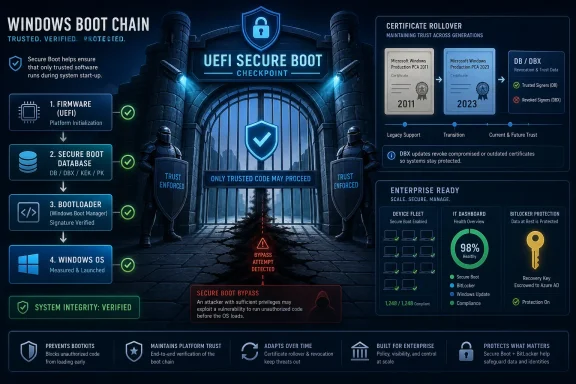
Secure Boot is often described as a feature that ensures only trusted software runs during startup. That shorthand is useful, but it can make the architecture sound more magical than it is. Secure Boot verifies signatures against databases stored in firmware; it does not prove that every signed component is still safe, well-designed, or invulnerable.That distinction is the root of nearly every painful Secure Boot episode over the last decade. The feature can faithfully enforce trust decisions and still permit trouble if the trusted list contains components that should no longer be trusted. In that sense, Secure Boot is less like an antivirus engine and more like an airport gate: if a credential remains valid, the gate opens.
The hard part is revocation. Once a boot component has been signed and deployed across millions of systems, removing trust in it can break recovery media, dual-boot configurations, old servers, embedded devices, virtual machines, and hardware that has not received compatible firmware updates. A perfect security response might revoke aggressively. A survivable platform response often has to move in stages.
That tension explains Microsoft’s long, cautious handling of past Secure Boot issues. BlackLotus made the problem concrete for Windows defenders by demonstrating that signed, vulnerable boot components could become part of a real-world bootkit story. The industry lesson was not simply that a bug had been patched. It was that patching code and revoking trust are two different operations, and the second one can be more operationally dangerous than the first.
The 2026 Certificate Cliff Turns Every Boot Bug Into a Migration Problem
CVE-2026-8863 arrives as the Windows ecosystem is already dealing with an unusually large maintenance event: the expiration of Microsoft Secure Boot certificates issued in 2011. Those certificates are not decorative. They are the roots and intermediates that let firmware trust updates to Secure Boot databases, Windows boot components, third-party boot loaders, and option ROMs.Microsoft’s newer 2023 certificate authorities are intended to carry the ecosystem forward. The transition includes new trust anchors such as Windows UEFI CA 2023, Microsoft UEFI CA 2023, Microsoft Option ROM UEFI CA 2023, and updated KEK material used to authorize DB and DBX changes. For current devices, this may arrive through Windows Update, OEM firmware, Intune, Group Policy, or a managed enterprise rollout.
The catch is that a Secure Boot certificate transition is not like updating Edge or installing a cumulative update. Firmware variables are involved. OEM behavior varies. Some systems need firmware updates before they can safely accept the new trust material. Some servers and virtual machines need explicit administrative action. Some environments must coordinate BitLocker recovery readiness before touching boot policy.
That makes a new Secure Boot bypass more than a line item in a vulnerability feed. It intersects with the same databases, certificates, boot managers, and revocation mechanisms that administrators are already being told to inventory. The security team may ask, “Are we exposed to CVE-2026-8863?” The infrastructure team may have to answer, “First we need to know which machines have completed the 2023 Secure Boot certificate migration.”
The Boot Chain Has Become an Enterprise Dependency, Not a Firmware Detail
For years, many Windows administrators treated Secure Boot as a setting checked during imaging and then mostly forgotten. It was enabled for Windows 11 readiness, required for some security baselines, audited for compliance, and occasionally cursed during dual-boot or recovery-media troubleshooting. That era is over.The boot chain is now an enterprise dependency. It determines whether new mitigations can be applied, whether vulnerable boot managers can be blocked, whether future DBX updates will be accepted, and whether devices can continue receiving boot-level protections after old certificates expire. A fleet with Secure Boot enabled but stale trust anchors is not in the same position as a fleet with Secure Boot enabled and current certificates.
This is where vulnerability management tools can mislead. A scanner may flag a Secure Boot CVE and offer a simple remediation status. But the real remediation path may involve BIOS updates, staged Windows updates, revocation policies, recovery-key escrow, reboot windows, and exception handling for specialty hardware. The dashboard compresses a boot-trust migration into a red or green square.
That compression is dangerous because Secure Boot mistakes tend to fail loudly. A bad application patch may crash a service. A bad boot-policy change can strand a laptop at BitLocker recovery or leave a server unable to start. In high-availability environments, that difference matters.
Report Confidence Is a Warning About the Shape of Disclosure
The user-facing definition of report confidence is unusually relevant here. It acknowledges that vulnerability knowledge exists on a spectrum. Sometimes the world knows only that a vulnerability exists. Sometimes researchers have a plausible theory about where it lives. Sometimes the vendor or author confirms the root cause and publishes enough detail for defenders and attackers alike to understand the mechanics.For CVE-2026-8863, the public signal is closer to confirmation than explanation. That means organizations should neither panic nor ignore it. The correct response is to treat the entry as a credible marker in a broader Secure Boot hardening program, while watching for later revisions that clarify affected products, exploitation requirements, mitigation steps, and revocation behavior.
This matters because the attacker’s knowledge and the defender’s knowledge do not always advance symmetrically. A public CVE entry with limited detail may protect users by withholding a recipe, but it also leaves defenders with ambiguous scoping. The balance is familiar in vulnerability disclosure, yet it is especially uncomfortable in firmware and boot security because independent verification is harder.
On a normal Windows flaw, a security team can often reproduce exposure in a lab, inspect file versions, validate registry keys, and confirm that a patch changed behavior. With Secure Boot, the evidence may live in firmware databases, UEFI variables, boot manager signatures, and event logs that vary by device class. The result is a lot more “trust but verify,” and a lot less one-click certainty.
The Enterprise Risk Is Not Mass Exploitation Tomorrow
The most tempting overreaction is to imagine CVE-2026-8863 as an instant mass-exploitation event. That is not usually how Secure Boot bypasses play out. These bugs tend to be most valuable to attackers who already have a foothold, physical access, administrative privileges, supply-chain reach, or a path to place pre-OS components on a target system.That does not make them minor. It changes their strategic role. A boot bypass is often about persistence, stealth, and control beneath the operating system. It is attractive to sophisticated operators because it can sit below ordinary security tooling and complicate recovery. It is less attractive to noisy commodity malware that can get paid faster by stealing browser sessions or deploying ransomware from userland.
The practical enterprise concern is therefore targeted exposure. Executives’ laptops, developer workstations, domain-admin jump boxes, secure build systems, kiosks, lab machines, branch-office servers, and unmanaged hardware all deserve more scrutiny than a generic office desktop already enrolled in a well-managed update ring. The machines that matter most are the ones where boot trust failure would undermine incident response assumptions.
That is why administrators should resist treating this as an isolated CVE. The relevant question is not simply whether one update is installed. It is whether the fleet can accept future Secure Boot revocations and certificate updates without breaking.
Microsoft Is Still Paying Down the Cost of Being the Ecosystem’s Signing Authority
Secure Boot on Windows PCs has always involved an uncomfortable centralization. Microsoft’s certificates are not just used for Windows. They are part of the practical trust fabric for much of the PC ecosystem, including third-party boot loaders and other pre-OS software that must run on commodity hardware. That gives Microsoft enormous responsibility and very little room for elegant failure.When Microsoft signs something, or when firmware trusts a Microsoft CA that signs something, the decision can affect Windows-only systems, Linux dual-boot users, recovery environments, hypervisors, appliance vendors, and OEM tools. When Microsoft revokes something, the blast radius can be just as broad. This is the paradox of the Windows PC as an open hardware platform secured by a small number of widely trusted authorities.
The 2026 certificate rollover makes that paradox unavoidable. Microsoft needs to retire aging trust anchors and push the ecosystem toward newer certificates. But old devices, stale firmware, and third-party dependencies do not all move at the same speed. Security wants a clean cutover. Operations wants proof that Monday morning will still boot.
CVE-2026-8863 should be read in that context. Even if later details narrow the affected component, the broader message is that Secure Boot maintenance has become continuous work. Trust anchors age. Signed binaries become liabilities. Revocation lists grow. Firmware quirks turn security theory into deployment choreography.
Home Users Are Not Exempt, but Their Job Is Different
For ordinary Windows users, the advice is simpler but not trivial. Keep Windows updated, install firmware updates from the device maker, avoid disabling Secure Boot casually, and make sure BitLocker recovery keys are backed up before major firmware or boot-security changes. That is not glamorous guidance, but it is the difference between a protected migration and a self-inflicted support nightmare.The risk for home users is often indirect. They may not be targeted by a bespoke bootkit, but they may own devices that miss the 2023 certificate transition because firmware updates are ignored, OEM utilities are removed, or Windows Update is deferred indefinitely. A laptop can look healthy in day-to-day use while still lacking the trust material needed for future boot-level protections.
There is also a recovery-media trap. Many enthusiasts keep old USB installers, rescue environments, imaging tools, and dual-boot setups. As Secure Boot revocations and certificate transitions advance, some of that media may stop booting unless it has been rebuilt with current, trusted components. That is not a bug in the narrow sense; it is the security model finally refusing to trust old code.
For WindowsForum readers, the best habit is boring inventory. Know whether Secure Boot is enabled. Know whether the 2023 certificates are present. Know where BitLocker recovery keys live. Know whether your motherboard or laptop vendor has issued firmware that mentions Secure Boot certificate updates. The time to discover those facts is not after a revocation lands.
Administrators Need a Boot-Trust Runbook, Not a Patch Note
Enterprise IT should treat CVE-2026-8863 as a prompt to formalize Secure Boot operations. Many organizations have patch runbooks, vulnerability SLAs, and endpoint compliance baselines. Fewer have a mature process for boot-trust changes, especially across mixed fleets of laptops, servers, VMs, specialized devices, and OEM generations.A credible runbook starts with visibility. Administrators need to collect Secure Boot state, certificate status, firmware versions, BitLocker readiness, and event-log indicators across representative hardware. They also need to know which devices are blocked from automatic remediation because of firmware limitations or policy choices. Without that, “apply the fix” is just a slogan.
Testing must be staged around hardware families, not merely Windows versions. Two Windows 11 machines on the same cumulative update may behave differently if their firmware handles UEFI variables differently. A server platform with a vendor-specific lifecycle may need OEM packages before Microsoft’s OS-level guidance can be safely applied. A VM created before a platform update may expose different Secure Boot certificates than one created afterward.
The rollback story is equally important. Some Secure Boot revocation actions are difficult or impossible to reverse while Secure Boot remains enabled, and a failed boot can turn a remote fix into a hands-on recovery event. Change windows, recovery keys, out-of-band management, and help-desk scripts are not administrative extras. They are part of the mitigation.
Linux and Dual-Boot Users Sit in the Blast Radius
Secure Boot’s Windows story is only half the story. Many dual-boot systems and Linux distributions rely on signed shim boot loaders that bridge Microsoft-trusted firmware and non-Windows operating systems. When Secure Boot bypasses involve signed third-party boot components, the remediation can ripple into Linux boot paths as well as Windows ones.This has always been politically and technically awkward. Microsoft’s role as a signing authority for third-party UEFI software gives Linux distributions a path to boot on Secure Boot-enabled PCs, but it also means revocation decisions can affect non-Windows users who never thought of themselves as depending on Microsoft infrastructure. When a vulnerable shim or loader must be distrusted, the ecosystem has to coordinate replacements before revocations become broadly enforced.
For enthusiasts, that means old installers and niche distributions may be more fragile than mainstream current releases. A current Ubuntu, Fedora, Debian, or enterprise Linux image is more likely to track shim and Secure Boot updates than an abandoned rescue ISO sitting in a drawer. The same principle applies to disk utilities, imaging tools, and hypervisor media.
CVE-2026-8863 may or may not ultimately center on such a component; the public record is not detailed enough to say. But the class of vulnerability is exactly the one that can expose cross-platform dependencies. Secure Boot is a Windows security feature in many users’ minds, yet the trust chain it enforces is broader than Windows.
The Most Dangerous Machines Are the Ones Everyone Assumes Are Fine
The sneakiest failure mode in this story is complacency. A device can boot normally, pass ordinary health checks, and receive monthly Windows updates while still being behind on Secure Boot certificate migration. Microsoft’s own guidance around certificate expiration has been careful to say that systems may continue operating without immediate disruption, even if their ability to receive future boot-level protections is weakened.That is operationally treacherous. Humans are trained to equate “it booted” with “it is fine.” Secure Boot maintenance breaks that assumption. A machine can be functional today and unprepared for tomorrow’s revocation.
This is especially relevant for servers and long-lived endpoints. Workstations churn. Consumer laptops are replaced. Servers, lab machines, manufacturing PCs, and embedded Windows systems often live through many firmware generations, many OS servicing baselines, and many undocumented exceptions. They are exactly the devices least likely to enjoy a clean automatic certificate transition.
The same is true for virtual infrastructure. Administrators may assume VMs abstract away firmware headaches, but virtual firmware has its own certificate state and creation-time behavior. A VM template built before a platform change can propagate stale Secure Boot assumptions long after the host has moved on.
CVE-2026-8863 Is a Test of Process More Than Panic
The right response to CVE-2026-8863 is not to disable Secure Boot, freeze updates, or wait for exploit drama. Disabling Secure Boot because of a Secure Boot bypass is like removing a door lock because lockpicks exist. It may make troubleshooting easier, but it gives up the protection the rest of the platform assumes is present.The better response is to accelerate the work Microsoft and OEMs were already pushing: certificate readiness, firmware currency, recovery planning, and staged revocation testing. Security teams should ask vendors for specifics, but they should not wait for perfect public detail before cleaning up the obvious prerequisites. If a device cannot accept modern Secure Boot trust material, it is already a problem.
This is also a useful moment to separate compliance from resilience. A checkbox that says Secure Boot is enabled does not prove the device is ready for the next DBX update. A patch-management report that says Windows is current does not prove firmware trust anchors are current. A vulnerability scanner that reports no exploit observed does not prove a bootkit would be visible if one appeared.
The boot layer forces uncomfortable humility. Defenders do not get as much telemetry there as they do inside Windows. That makes prevention, integrity, and disciplined update sequencing more important, not less.
The 2026 Secure Boot Fire Drill Has Already Started
CVE-2026-8863 should push administrators to treat Secure Boot as a living control rather than a BIOS-era checkbox. The concrete work is less dramatic than the vulnerability name, but it is the work that determines whether future mitigations can actually land.- Organizations should inventory Secure Boot state, firmware versions, BitLocker recovery readiness, and 2023 certificate presence across representative hardware families.
- Administrators should prioritize OEM firmware updates for systems that cannot accept current Secure Boot certificate material through Windows servicing alone.
- Security teams should track Microsoft’s revisions to CVE-2026-8863 because the public entry may gain affected-product, exploitability, or mitigation detail after the initial listing.
- Enterprises should test Secure Boot certificate and revocation changes in staged rings, with recovery keys and out-of-band access confirmed before broad deployment.
- Enthusiasts and dual-boot users should refresh old installers, rescue media, and Linux boot components rather than assuming years-old signed EFI binaries will remain trusted indefinitely.
- No one should treat disabling Secure Boot as a remediation unless a vendor explicitly documents it as a temporary recovery step for a specific failure condition.
References
- Primary source: MSRC
Published: 2026-06-09T07:00:00-07:00
Security Update Guide - Microsoft Security Response Center
 msrc.microsoft.com
- Official source: support.microsoft.com
Surface Secure Boot Certificates | Microsoft Support
Secure Boot in UEFI firmware verifies pre-boot software using trusted certificates. Microsoft will update expiring Windows Secure Boot certificates starting June 2026 to maintain device protection.support.microsoft.com - Related coverage: media.defense.gov
- Related coverage: cirt.gy
- Related coverage: tbs.tech
