

Microsoft’s Boot Chain Has Another Trust Problem
Secure Boot vulnerabilities are rarely about flashy remote compromise. They are about something more primitive and, in some ways, more consequential: whether the machine’s first promises can still be trusted before Windows, Defender, virtualization-based security, BitLocker policy, and endpoint agents have fully entered the conversation.
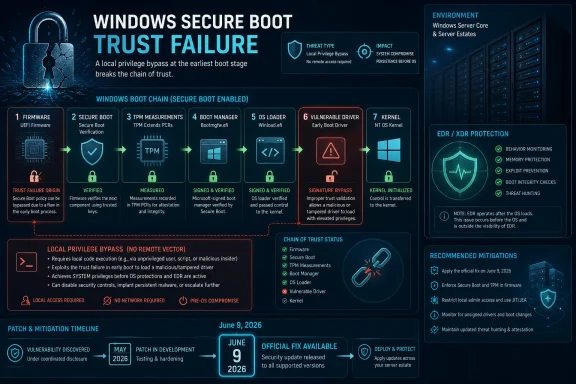
CVE-2026-48570 is described by Microsoft as a protection mechanism failure in Windows Secure Boot that allows an authorized attacker to bypass a security feature locally. The phrase is dry, but the affected feature is not. Secure Boot is supposed to make sure that only trusted boot components run before the operating system loads.
That is why Secure Boot bypasses punch above their CVSS headline. They are not usually the first link in an attack chain; they are the link that can make the later links harder to detect, harder to unwind, and more uncomfortable for incident responders. When the boot path is suspect, the operating system becomes a witness with a credibility problem.
Microsoft’s own severity rating is Important rather than Critical, and there are good reasons for that. The attacker needs high privileges, the attack vector is local, and Microsoft says exploitation is less likely. But those constraints do not make the issue irrelevant; they define the kind of adversary and post-compromise scenario where it matters most.
“High Privileges Required” Is a Boundary, Not a Dismissal
The most tempting way to wave away CVE-2026-48570 is to point at the CVSS vector. Local attack. Low complexity. High privileges required. No user interaction. No availability impact. That is not the shape of a worm, a drive-by exploit, or an email-borne disaster.
It is, however, the shape of a persistence and defense-evasion problem. If an attacker already has administrative control of a machine, the question changes from “Can they get in?” to “Can they stay in, hide better, weaken trust, or tamper with assumptions the defender relies on?” Secure Boot sits squarely in that second category.
The “authorized attacker” wording is also worth parsing carefully. Microsoft is not saying a random unauthenticated network attacker can flip a boot security guarantee from across the Internet. It is saying someone with meaningful control on the device can exploit a failure in a protection mechanism to bypass Secure Boot locally.
That distinction matters for patch prioritization, but it should not lull administrators into ignoring the bug. In modern Windows security architecture, local admin is not supposed to be the end of all meaningful boundaries. Microsoft has spent years building features that try to keep secrets, credentials, boot integrity, and hardware-backed trust separate even after parts of the OS are compromised. A Secure Boot bypass pressures those separations.
The score reflects that seriousness. CVE-2026-48570 carries a CVSS 3.1 base score of 7.9, with high confidentiality and integrity impact and a changed scope. In plain English, Microsoft is saying successful exploitation can have consequences beyond the component where the original failure lives.
The Confidence Metric Is Doing the Quiet Shouting
The user-supplied excerpt highlights the “Report Confidence” metric, and in this case that detail is not incidental. Microsoft marks CVE-2026-48570 as confirmed. In CVSS terms, that means the vendor or author has acknowledged the vulnerability, or the technical basis is sufficiently detailed and reproducible.
That is different from a speculative advisory, a thinly described bug class, or a vague “could lead to” note that later research may or may not support. Microsoft’s page says the weakness is CWE-693, protection mechanism failure, and the executive summary ties that failure directly to Windows Secure Boot. The available description is not a full exploit recipe, but it is enough to establish that this is a real issue in a sensitive part of the platform.
The temporal metrics complicate the picture further. Microsoft labels exploit code maturity as proof-of-concept while still assessing exploitation as less likely. That is not a contradiction. It means Microsoft believes some demonstration or technique exists, but that practical, broad, reliable exploitation is not expected to be common at publication time.
For defenders, that middle ground is familiar and uncomfortable. A proof of concept may be incomplete, environment-specific, or difficult to operationalize. But it also means attackers are not starting from a blank page. Once a boot-chain weakness has a confirmed vendor advisory and proof-of-concept maturity, the race is no longer theoretical; it is a question of who can turn constrained technique into reliable tradecraft.
The Patch Is Broad Because the Boot Surface Is Broad
The affected product list is not a niche corner of the Windows ecosystem. Microsoft lists Windows 10, Windows 11, and Windows Server releases across old and current branches, including Windows Server 2012 and 2012 R2, Windows Server 2016, Windows Server 2019, Windows Server 2022, Windows Server 2025, Windows 10 versions from long-lived enterprise branches through 22H2, and Windows 11 versions including 23H2, 24H2, 25H2, and 26H1.
That breadth is typical of Secure Boot servicing. The boot path is shared infrastructure, not a single app package. When Microsoft fixes something in that layer, the servicing blast radius often spans client, server, x64, ARM64, and Server Core variants.
The fixed build numbers also show the expected Patch Tuesday pattern. Windows 11 24H2 moves to build 26100.8655 for the listed client variants, Windows Server 2025 is listed with build 26100.32995, Windows 10 22H2 is listed at build 19045.7417, and Windows Server 2022 is listed at build 20348.5256. Older supported or extended-servicing platforms have their own KBs and build targets.
For administrators, the operative detail is not that every listed KB number must be memorized. It is that this is a cumulative servicing event that touches both endpoint fleets and server estates. Any organization still carrying older Windows Server versions through extended support has to treat the Secure Boot layer as part of its patch baseline, not as firmware trivia.
This is especially true for Server Core installations. A headless or minimized server footprint does not make the boot chain irrelevant. If anything, servers are where boot trust, measured boot, remote attestation, and recovery assumptions become operationally important during incident response.
Secure Boot Bugs Age Differently Than Ordinary Windows Bugs
Most Windows vulnerabilities lose urgency as patches roll out and exploit conditions become better understood. Secure Boot bugs can age in stranger ways because boot trust is entangled with signatures, revocation, firmware behavior, recovery partitions, and OEM implementation details.
The recent history of Secure Boot has trained administrators to be cautious. The BlackLotus episode showed how a bootkit could exploit weaknesses in the trust chain and how difficult it can be to remove trust from vulnerable boot components without risking machines that still depend on them. Microsoft’s staged handling of earlier Secure Boot revocations made one lesson painfully clear: fixing the code is not always the same as closing every path that old trusted code may provide.
CVE-2026-48570 is not described by Microsoft as actively exploited, and there is no public claim in the advisory that it resembles BlackLotus operationally. It would be irresponsible to conflate the two. But it is reasonable to view each new Secure Boot bypass through the historical lens of how long boot-chain cleanups can take and how much coordination they require.
The boot environment is conservative by design. It has to start machines reliably across hardware generations, recovery media, enterprise imaging workflows, dual-boot scenarios, and server lifecycle tools. That conservatism is exactly what makes Secure Boot valuable and exactly what can make revocation and remediation slow.
A browser bug can often be patched by replacing a browser. A boot trust bug can involve code, keys, firmware policy, recovery workflows, and the risk that an overzealous mitigation bricks machines or strands admins outside their own recovery path. That is why Secure Boot advisories deserve a slower, more operational reading than their short summaries invite.
The Local-Attacker Model Fits Real Intrusions Too Well
There is a bad habit in vulnerability triage: treating local privilege requirements as if they remove the vulnerability from real-world concern. In enterprise incidents, attackers frequently gain local administrative rights on at least some machines before defenders fully understand the intrusion. Once that happens, vulnerabilities requiring high privileges become tools for entrenchment.
CVE-2026-48570 is not an initial access bug. It is unlikely to be the thing that gets a phishing victim compromised or a server exposed. But if an attacker already controls a host and wants to weaken the trust boundary below Windows, a Secure Boot bypass is the kind of primitive that deserves attention.
The CVSS details sharpen that point. Attack complexity is low, user interaction is none, confidentiality impact is high, integrity impact is high, and scope is changed. The limiting factor is privileges, not complexity. That is a very different risk profile from a bug that requires a delicate race condition, a rare configuration, or user participation.
That does not mean every administrator should panic. It does mean the vulnerability belongs in the same mental bucket as post-exploitation hardening failures, credential protection bypasses, and bootkit-enabling weaknesses. It is not the front door; it is a way to make the house’s alarm system lie.
For security teams running EDR, BitLocker, virtualization-based security, and compliance attestation, boot integrity is part of the trust stack. A bypass does not automatically defeat every one of those controls, but it undermines the clean assumption that a patched Windows instance starts from a known-good boot sequence.
The “Less Likely” Label Still Leaves Work for Defenders
Microsoft’s exploitability assessment says exploitation is less likely. That matters. It tells administrators that Microsoft does not currently see this as a mass-exploitation emergency and that no active exploitation was reported at publication.
But “less likely” is not “not useful.” Exploitability assessments are snapshots made at original publication, not permanent guarantees. They can reflect required privileges, operational difficulty, limited proof-of-concept quality, and the absence of in-the-wild telemetry. They do not erase the vulnerability.
There is also a subtle asymmetry in Secure Boot bugs. Even if exploitation remains rare, the consequences can be disproportionately serious for the small number of machines where it is used. A bypass that appears only in targeted intrusions against administrators, developers, build systems, domain-adjacent servers, or high-value laptops can still be worth an adversary’s time.
For defenders, the right response is measured urgency. Patch through normal security update channels, verify that high-value devices receive the relevant cumulative updates, and pay attention to machines that cannot be updated quickly because of application certification, legacy hardware, or change-control delays.
The worst response is performative alarm. There is no public basis, from Microsoft’s advisory, to describe CVE-2026-48570 as a live mass exploitation crisis. The second-worst response is bureaucratic complacency: letting a boot-chain bypass drift into the “local admin only” pile where it waits for a later incident to become interesting.
Old Windows Versions Make the Boot Story Messier
The affected list includes platforms that many organizations would prefer not to admit are still operationally important. Windows Server 2012 and 2012 R2 are long past their mainstream era, yet they appear in the advisory with monthly rollup fixes. Windows 10 21H2 and 22H2 also appear, reflecting the complicated overlap of enterprise servicing, edition-specific support, and long-lived deployments.
This matters because Secure Boot trust is not managed in a vacuum. Older servers may run line-of-business applications that tolerate only narrow patch windows. Older endpoints may sit in labs, factories, clinics, branch offices, or disconnected environments where cumulative updates are delayed for months. The devices most likely to lag are often the devices where rebuilding trust after compromise is hardest.
There is also a cultural issue. Many admins think of Secure Boot as a client PC concern because of Windows 11 requirements and consumer BIOS settings. But Microsoft’s advisory spans server products, including Server Core. Boot trust is a server issue whenever the server’s identity, workload integrity, encryption posture, or recovery assumptions matter.
The practical question for legacy estates is not merely “Did Windows Update install?” It is whether the organization can prove that the relevant boot-chain update reached machines that are frequently omitted from ordinary endpoint reporting. Old WSUS collections, offline images, golden templates, and recovery media deserve a look when Secure Boot advisories appear.
That final category is easy to miss. If recovery media, deployment images, or build pipelines preserve outdated boot components, organizations may reintroduce vulnerable states after patching production systems. Secure Boot is a living chain, and its weakest link may be sitting in a deployment share rather than on today’s running desktop.
Alon Leviev’s Credit Is a Signal, Not a Full Story
Microsoft credits Alon Leviev with Microsoft STORM for the disclosure. Leviev has become a familiar name in Windows security research, particularly around update, downgrade, and trust-boundary issues. The acknowledgment does not give us the exploit details, but it does suggest coordinated research rather than a vague automated finding.
That matters because the absence of a public exploit narrative can make advisories feel abstract. In this case, the confirmed report confidence and proof-of-concept maturity indicate that Microsoft has enough concrete technical basis to patch and score the issue. We do not need a conference talk or a GitHub repository to understand that the vulnerability has moved beyond rumor.
The STORM reference is also notable. Microsoft uses STORM for internal security research and offensive-security-style work. When outside or named researchers collaborate with Microsoft teams, the resulting advisory often reflects a controlled disclosure path: enough information to patch and prioritize, not enough to immediately arm every copy-paste attacker.
That restraint is healthy. Boot-chain vulnerabilities are the kind of flaws where public detail can quickly become operationally useful to sophisticated attackers. The advisory gives defenders the key risk markers while withholding the machinery.
The tradeoff is that administrators must make decisions with incomplete visibility. That is normal in vulnerability management, but Secure Boot makes it more uncomfortable because the affected layer is less observable than an ordinary service, driver, or application. You cannot simply grep your web logs for evidence that your boot policy was bypassed.
Windows Security Keeps Moving Below the Operating System
CVE-2026-48570 is part of a larger shift in Windows security: the important battles are increasingly below, beside, or outside the traditional OS boundary. Firmware, bootloaders, virtualization-based security, TPM-backed measurements, cloud attestation, and update orchestration now sit at the center of Microsoft’s security story.
That shift is rational. Attackers have learned to target the assumptions that security products depend on. If endpoint agents trust the OS, and the OS trusts the boot path, and the boot path trusts signed components, then a weakness in any earlier layer can distort what later layers see.
Microsoft’s challenge is that Windows must support an enormous hardware and software ecosystem. Secure Boot is not just a Microsoft switch. It is an arrangement among firmware vendors, OEMs, Microsoft-signed components, Windows servicing, recovery behavior, and enterprise policy. That ecosystem gives Windows its reach, but it also makes trust changes slow and brittle.
For IT pros, the lesson is that Secure Boot should no longer be treated as a BIOS checkbox set once during imaging. It is part of patch management. It is part of incident response. It is part of asset inventory. And when Microsoft publishes a Secure Boot bypass, the relevant audience includes desktop admins, server admins, security engineers, and anyone responsible for deployment media.
CVE-2026-48570 reinforces that the boot layer is not static infrastructure. It is software, policy, and cryptographic trust that must be serviced like the rest of the platform.
The June Patch Demands a Boot-Trust Inventory
The concrete advice is not exotic, but it is more deliberate than “install the update.” Organizations should use the June 9, 2026 security release as a trigger to examine how well they can actually see and manage boot-chain exposure across Windows.
Consumer Windows users should allow the relevant cumulative update to install and reboot normally. Enterprise administrators should verify deployment through their usual patch compliance tools, but they should also pay special attention to devices outside the easy path: servers with maintenance exceptions, kiosks, lab systems, long-lived Windows 10 builds, and any system still on older Server releases.
Security teams should avoid overclaiming what this CVE means. Microsoft has not said it is exploited in the wild. Microsoft has not said the vulnerability is publicly disclosed. Microsoft has provided an official fix and assessed exploitation as less likely. Those are meaningful stabilizers.
At the same time, the confirmed report confidence and proof-of-concept maturity make this more than a theoretical paper cut. If your organization assigns risk based only on whether exploitation is “more likely,” you may underweight the strategic value of Secure Boot bypasses to post-compromise operators.
The Secure Boot Advisory in Administrator English
The useful reading of CVE-2026-48570 is not that the sky is falling. It is that Microsoft has patched a confirmed boot-chain security feature bypass with proof-of-concept maturity, broad platform exposure, and meaningful confidentiality and integrity impact if exploited.
- CVE-2026-48570 was released on June 9, 2026, and Microsoft rates it Important with a CVSS 3.1 base score of 7.9.
- The vulnerability is a Windows Secure Boot security feature bypass caused by a protection mechanism failure.
- Microsoft says exploitation is less likely, not publicly disclosed, and not observed in the wild at original publication.
- The attack requires local access and high privileges, but no user interaction and low attack complexity are listed in the CVSS metrics.
- Official fixes are available across Windows 10, Windows 11, and multiple Windows Server generations, including Server Core variants.
- The most exposed organizations are likely those with delayed patching, legacy Windows Server dependencies, unmanaged recovery media, or weak visibility into boot-chain update status.
CVE-2026-48570 will probably not be remembered as the loudest Patch Tuesday item of the year, and that may be appropriate. But Secure Boot flaws are not ordinary bugs; they are cracks in the foundation that the rest of Windows security assumes is solid. Microsoft has supplied the fix, and now the burden shifts to administrators to prove that the update reached not just the easy laptops, but the servers, images, and forgotten machines where boot trust quietly matters most.