

Microsoft disclosed CVE-2026-48568 on June 9, 2026, as an Important-rated Windows Secure Boot security feature bypass that can be exploited locally by an authorized attacker and is addressed through June Patch Tuesday updates across supported Windows client and server releases. The advisory is not a fireworks show of public exploit code or breathless “wormable” warnings. Its significance is quieter and, for Windows administrators, more familiar: another flaw in the fragile boundary between firmware trust, boot policy, and the operating system that assumes the early boot chain is already honest.
The important phrase in Microsoft’s description is not “local,” and it is not even “authorized attacker.” It is “Secure Boot.” When the thing being bypassed is the mechanism that decides what code is allowed to run before Windows fully wakes up, the usual patch-ranking reflexes need adjustment.
CVE-2026-48568 is categorized as a security feature bypass in Windows Secure Boot, caused by what Microsoft describes as a protection mechanism failure. In plain English, the vulnerable component is supposed to enforce a trust boundary during startup, and under the right local conditions it may fail to do so.
That does not mean an attacker can scan the internet, find a laptop, and jump straight into firmware. Microsoft’s CVSS vector says exploitation is local, requires high privileges, needs no user interaction, and has low attack complexity once those prerequisites are met. The advisory also says Microsoft is not aware of public disclosure or exploitation in the wild as of publication.
That combination is why the bug lands at “Important” rather than “Critical.” But the CVSS base score of 7.9 tells the other half of the story. Microsoft’s vector assigns high confidentiality and integrity impact, no availability impact, and a scope change, meaning a successful exploit can cross out of the original component’s security authority and affect something beyond it.
For readers who live in Windows Update dashboards, this is the uncomfortable middle category: not an internet-facing crisis, not a theoretical curiosity. It is a post-compromise hardening failure. If an attacker already has the level of access needed to attempt exploitation, Secure Boot is supposed to be one of the technologies that keeps that compromise from becoming more durable, stealthy, or foundational.
That will tempt some organizations to put the patch in the “later” bucket. After all, if the attacker already has high privileges, isn’t the game already over? In modern Windows security, that answer is too glib.
The point of Secure Boot is not to prevent every compromise. It is to make sure the machine starts from a known-good foundation, so that later protections — kernel-mode code integrity, virtualization-based security, credential protection, antimalware, BitLocker policy assumptions, and endpoint detection — are not asked to defend a system whose earliest execution path has already been subverted.
A Secure Boot bypass is therefore not just another local escalation story. It is a way to attack the assumptions below the operating system. If a malicious actor can manipulate the boot chain, they may be able to preserve access in a place that survives cleanup attempts, evade normal operating-system visibility, or undermine controls that depend on the integrity of early boot.
That is why these bugs have a nasty strategic shape. They are rarely the first step in an intrusion. They are the step an attacker wants after the first step worked.
That distinction matters because Secure Boot advisories often arrive with limited public detail. Microsoft has strong reasons not to hand out boot-chain bypass recipes, especially when many systems take time to update and when firmware-adjacent mitigations can have compatibility consequences. The lack of a public root-cause essay is not evidence that the flaw is vapor.
It does, however, create the familiar defender’s problem: a confirmed vulnerability with a sparse public description. Security teams must act on enough information to patch but not enough information to independently model every exploit path. In this case, the practical read is straightforward: Microsoft has validated the bug, considers exploitation less likely, but still requires customer action and a rebooting security update.
That is the kind of advisory that rewards disciplined patch operations rather than panic. The urgency is real, but it is not the same urgency as an Exchange pre-auth remote code execution bug or an actively exploited browser zero-day. The smart response is to put it in the next serious patch window, test the boot-sensitive systems first, and avoid letting “local only” become a synonym for “irrelevant.”
That breadth is a reminder that Secure Boot is not a single feature bolted onto one Windows release. It is a platform contract that spans UEFI firmware, boot managers, certificates, revocation policy, recovery environments, servicing stacks, and operating-system releases that may be separated by more than a decade.
The update mapping is correspondingly mundane but important. Windows 11 23H2 receives fixes through KB5093998, Windows 11 24H2 and 25H2 through KB5094126, Windows 11 26H1 through KB5095051, and Windows Server 2025 through KB5094125. Windows 10 21H2 and 22H2 are addressed through KB5094127, while older server lines receive their own June packages, including KB5094128 for Server 2022, KB5094123 for Server 2019 and Windows 10 1809, KB5094122 for Server 2016 and Windows 10 1607, and ESU rollups for Server 2012 and 2012 R2.
Every listed fix requires a reboot. For ordinary desktop patching that is a nuisance. For Secure Boot and server estates, it is the point at which planning becomes operationally meaningful.
Reboot-required boot-chain fixes can expose stale firmware, unusual recovery partitions, custom boot loaders, fragile dual-boot arrangements, and machines that have not had their startup path tested in months. The update may be simple; the estate receiving it often is not.
The phrase should lower the temperature, not end the conversation. Secure Boot bypasses have a history of seeming esoteric until a researcher, criminal operator, or nation-state team demonstrates why the boot boundary matters. Once a technique becomes practical, defenders inherit a harder problem than simply removing malware from a user profile or reinstalling an application.
A local high-privilege prerequisite also fits real-world intrusion chains. Attackers who phish credentials, abuse remote management tools, exploit a VPN appliance, or compromise an endpoint management platform often spend the next phase looking for persistence and defense evasion. A Secure Boot bypass is not attractive because it opens the front door. It is attractive because it can help an intruder bolt the back door into the frame.
That is why the right mental model is not “Can someone exploit this from across the internet?” It is “What happens if one of our already-compromised admin paths reaches a machine that still trusts a vulnerable boot path?” For domain-joined fleets, shared administrator credentials, remote support tooling, and loosely governed local admin rights turn local vulnerabilities into estate-level risk.
Microsoft’s multi-stage handling of earlier boot-manager revocations showed why the company moves cautiously. Revoking a boot component too aggressively can strand systems, break recovery media, or create a support disaster at global scale. Moving too slowly leaves defenders with a formally patched vulnerability but a lingering trust problem.
CVE-2026-48568 is not described as another BlackLotus, and Microsoft has not said it is being exploited. It should not be inflated into a repeat of that event without evidence. But it belongs to the same family of risk: weaknesses in the trust path that exists before Windows’ ordinary defenses are fully in charge.
For IT pros, the historical lesson is practical. Secure Boot fixes should be tracked not only as monthly cumulative updates but as part of a boot integrity program. That means knowing which machines can actually enforce Secure Boot, which ones have it disabled for legacy reasons, which ones depend on nonstandard boot media, and which recovery workflows might reintroduce old trust assumptions.
That matters because Secure Boot is not just a checkbox in firmware setup. It is a cryptographic trust system that depends on certificate authorities, signed boot components, revocation databases, OEM firmware behavior, and update delivery. When certificates age out, vendors have to move the ecosystem without breaking machines that may be old, embedded, unmanaged, or difficult to service.
The resulting operational posture is awkward. Windows users are told, correctly, that Secure Boot helps protect the system before the operating system loads. Administrators are then asked to trust a long chain of updates, some delivered through Windows Update, some through OEM channels, and some tied to firmware or recovery media that may not be centrally inventoried.
CVE-2026-48568 should be read against that background. It is one flaw, fixed in the June 2026 updates, but it appears in a year when the Secure Boot trust store itself is already changing. That makes documentation, inventory, and reboot validation more important than they would be for a routine user-mode patch.
For enthusiasts, the edge cases are more interesting. Dual-boot setups, custom bootloaders, older Linux shims, unsigned tools, rescue media, and firmware settings changed years ago can all complicate the practical meaning of Secure Boot. A Windows patch can close Microsoft’s side of the issue, but it cannot make a locally disabled or misconfigured boot policy meaningful.
Enterprise administrators have a longer checklist. They need to confirm deployment across supported Windows versions, including ESU-covered servers; schedule reboots for systems where boot failure would be more expensive than delayed patching; validate recovery media; and review endpoint management policies that create high-privilege local exposure in the first place.
The biggest mistake would be treating this as only a Windows Update compliance item. If a Secure Boot bypass matters, then so do local admin sprawl, physical access controls, BitLocker mode, firmware update cadence, recovery environment governance, and the ability to detect unexpected boot configuration changes.
This is where many patch reports become misleading. A system may show an update installed but still be waiting for restart. Another may have the OS fix but still rely on outdated firmware behavior. A third may be patched but booting with Secure Boot disabled because somebody turned it off two years ago to image a lab machine and never turned it back on.
Those are not exotic scenarios. They are the ordinary sediment of Windows estates that have lived through hardware refreshes, in-place upgrades, emergency repairs, and one-off exceptions. Boot security is full of those exceptions because boot failures are scary and administrators remember the machines that did not come back.
The discipline here is to measure the state that matters. Not simply whether KB5094126 or KB5094127 is present, but whether systems have restarted, whether Secure Boot is enabled where policy requires it, whether BitLocker recovery posture is understood before mass rebooting, and whether high-value systems are protected from unauthorized local administrative access.
That is especially true for Secure Boot, because many organizations assume its presence rather than continuously verify its effectiveness. A procurement baseline may require it. A Windows security baseline may mention it. A compliance dashboard may report it. But the actual startup path of a specific laptop, kiosk, lab workstation, or branch server may be messier than the policy abstraction.
CVE-2026-48568 is a reminder that defensive features are software too, surrounded by state, configuration, certificates, and trust decisions. They can fail. When they fail at the boot layer, the blast radius is conceptual as much as technical: tools above that layer may keep running, but their evidence is less comforting.
The useful response is not cynicism. Secure Boot remains a core part of modern Windows defense, and turning it off because bypasses exist is like removing locks because lockpicks exist. The useful response is to treat Secure Boot as a maintained control rather than a factory-installed virtue.
The important phrase in Microsoft’s description is not “local,” and it is not even “authorized attacker.” It is “Secure Boot.” When the thing being bypassed is the mechanism that decides what code is allowed to run before Windows fully wakes up, the usual patch-ranking reflexes need adjustment.
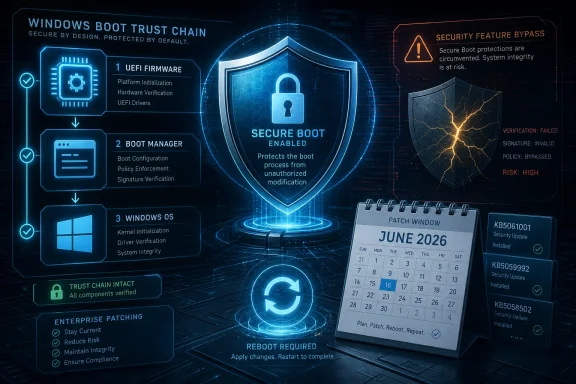 Secure Boot’s Worst Bugs Rarely Look Like Network Emergencies
CVE-2026-48568 is categorized as a security feature bypass in Windows Secure Boot, caused by what Microsoft describes as a protection mechanism failure. In plain English, the vulnerable component is supposed to enforce a trust boundary during startup, and under the right local conditions it may fail to do so.That does not mean an attacker can scan the internet, find a laptop, and jump straight into firmware. Microsoft’s CVSS vector says exploitation is local, requires high privileges, needs no user interaction, and has low attack complexity once those prerequisites are met. The advisory also says Microsoft is not aware of public disclosure or exploitation in the wild as of publication.
That combination is why the bug lands at “Important” rather than “Critical.” But the CVSS base score of 7.9 tells the other half of the story. Microsoft’s vector assigns high confidentiality and integrity impact, no availability impact, and a scope change, meaning a successful exploit can cross out of the original component’s security authority and affect something beyond it.
For readers who live in Windows Update dashboards, this is the uncomfortable middle category: not an internet-facing crisis, not a theoretical curiosity. It is a post-compromise hardening failure. If an attacker already has the level of access needed to attempt exploitation, Secure Boot is supposed to be one of the technologies that keeps that compromise from becoming more durable, stealthy, or foundational.
The Attacker Microsoft Describes Already Has a Foothold
The advisory’s “authorized attacker” language matters. CVE-2026-48568 is not framed as a drive-by vulnerability. Microsoft’s CVSS vector lists privileges required as high, which usually means the attacker already controls an administrator-equivalent context or some similarly powerful local position.That will tempt some organizations to put the patch in the “later” bucket. After all, if the attacker already has high privileges, isn’t the game already over? In modern Windows security, that answer is too glib.
The point of Secure Boot is not to prevent every compromise. It is to make sure the machine starts from a known-good foundation, so that later protections — kernel-mode code integrity, virtualization-based security, credential protection, antimalware, BitLocker policy assumptions, and endpoint detection — are not asked to defend a system whose earliest execution path has already been subverted.
A Secure Boot bypass is therefore not just another local escalation story. It is a way to attack the assumptions below the operating system. If a malicious actor can manipulate the boot chain, they may be able to preserve access in a place that survives cleanup attempts, evade normal operating-system visibility, or undermine controls that depend on the integrity of early boot.
That is why these bugs have a nasty strategic shape. They are rarely the first step in an intrusion. They are the step an attacker wants after the first step worked.
Microsoft’s Confidence Signal Cuts Both Ways
The user-facing metric that often gets overlooked here is report confidence. In CVSS terms, Microsoft marks the vulnerability’s report confidence as confirmed. That does not mean Microsoft has published exploit mechanics, and it does not mean defenders should expect working exploit code by dinner. It means the vendor is confident the vulnerability exists and that the known technical details are credible enough to ship updates and assign a complete CVSS vector.That distinction matters because Secure Boot advisories often arrive with limited public detail. Microsoft has strong reasons not to hand out boot-chain bypass recipes, especially when many systems take time to update and when firmware-adjacent mitigations can have compatibility consequences. The lack of a public root-cause essay is not evidence that the flaw is vapor.
It does, however, create the familiar defender’s problem: a confirmed vulnerability with a sparse public description. Security teams must act on enough information to patch but not enough information to independently model every exploit path. In this case, the practical read is straightforward: Microsoft has validated the bug, considers exploitation less likely, but still requires customer action and a rebooting security update.
That is the kind of advisory that rewards disciplined patch operations rather than panic. The urgency is real, but it is not the same urgency as an Exchange pre-auth remote code execution bug or an actively exploited browser zero-day. The smart response is to put it in the next serious patch window, test the boot-sensitive systems first, and avoid letting “local only” become a synonym for “irrelevant.”
The Patch Is Broad Because the Boot Chain Is Broad
CVE-2026-48568 affects a wide spread of Windows releases, including Windows 11 versions 23H2, 24H2, 25H2, and 26H1; Windows 10 releases such as 21H2 and 22H2; and Windows Server versions from 2012 and 2012 R2 under ESU through Server 2016, 2019, 2022, and 2025. The update set also covers both full and Server Core installations where applicable.That breadth is a reminder that Secure Boot is not a single feature bolted onto one Windows release. It is a platform contract that spans UEFI firmware, boot managers, certificates, revocation policy, recovery environments, servicing stacks, and operating-system releases that may be separated by more than a decade.
The update mapping is correspondingly mundane but important. Windows 11 23H2 receives fixes through KB5093998, Windows 11 24H2 and 25H2 through KB5094126, Windows 11 26H1 through KB5095051, and Windows Server 2025 through KB5094125. Windows 10 21H2 and 22H2 are addressed through KB5094127, while older server lines receive their own June packages, including KB5094128 for Server 2022, KB5094123 for Server 2019 and Windows 10 1809, KB5094122 for Server 2016 and Windows 10 1607, and ESU rollups for Server 2012 and 2012 R2.
Every listed fix requires a reboot. For ordinary desktop patching that is a nuisance. For Secure Boot and server estates, it is the point at which planning becomes operationally meaningful.
Reboot-required boot-chain fixes can expose stale firmware, unusual recovery partitions, custom boot loaders, fragile dual-boot arrangements, and machines that have not had their startup path tested in months. The update may be simple; the estate receiving it often is not.
“Exploitation Less Likely” Is Not a Permission Slip
Microsoft’s exploitability assessment says exploitation is less likely on the latest software release. That is useful, but it is not a promise. It is a probability judgment based on Microsoft’s view of the bug, available information, and the likely difficulty of turning the weakness into a reliable attack.The phrase should lower the temperature, not end the conversation. Secure Boot bypasses have a history of seeming esoteric until a researcher, criminal operator, or nation-state team demonstrates why the boot boundary matters. Once a technique becomes practical, defenders inherit a harder problem than simply removing malware from a user profile or reinstalling an application.
A local high-privilege prerequisite also fits real-world intrusion chains. Attackers who phish credentials, abuse remote management tools, exploit a VPN appliance, or compromise an endpoint management platform often spend the next phase looking for persistence and defense evasion. A Secure Boot bypass is not attractive because it opens the front door. It is attractive because it can help an intruder bolt the back door into the frame.
That is why the right mental model is not “Can someone exploit this from across the internet?” It is “What happens if one of our already-compromised admin paths reaches a machine that still trusts a vulnerable boot path?” For domain-joined fleets, shared administrator credentials, remote support tooling, and loosely governed local admin rights turn local vulnerabilities into estate-level risk.
BlackLotus Still Haunts the Conversation
No Secure Boot article can avoid the shadow of BlackLotus, the UEFI bootkit that forced Windows administrators to confront the slow machinery of boot revocation. The lesson from that episode was not merely that Secure Boot can be bypassed. It was that fixing Secure Boot is not always the same as revoking trust in everything that should no longer be trusted.Microsoft’s multi-stage handling of earlier boot-manager revocations showed why the company moves cautiously. Revoking a boot component too aggressively can strand systems, break recovery media, or create a support disaster at global scale. Moving too slowly leaves defenders with a formally patched vulnerability but a lingering trust problem.
CVE-2026-48568 is not described as another BlackLotus, and Microsoft has not said it is being exploited. It should not be inflated into a repeat of that event without evidence. But it belongs to the same family of risk: weaknesses in the trust path that exists before Windows’ ordinary defenses are fully in charge.
For IT pros, the historical lesson is practical. Secure Boot fixes should be tracked not only as monthly cumulative updates but as part of a boot integrity program. That means knowing which machines can actually enforce Secure Boot, which ones have it disabled for legacy reasons, which ones depend on nonstandard boot media, and which recovery workflows might reintroduce old trust assumptions.
The 2026 Certificate Clock Raises the Stakes
This advisory also lands during a broader Secure Boot transition. Microsoft has been preparing customers for the expiration of older Windows Secure Boot certificates originally issued in 2011, with expirations beginning in 2026. That certificate rollover is separate from CVE-2026-48568, but administrators will experience both as part of the same boot-trust maintenance burden.That matters because Secure Boot is not just a checkbox in firmware setup. It is a cryptographic trust system that depends on certificate authorities, signed boot components, revocation databases, OEM firmware behavior, and update delivery. When certificates age out, vendors have to move the ecosystem without breaking machines that may be old, embedded, unmanaged, or difficult to service.
The resulting operational posture is awkward. Windows users are told, correctly, that Secure Boot helps protect the system before the operating system loads. Administrators are then asked to trust a long chain of updates, some delivered through Windows Update, some through OEM channels, and some tied to firmware or recovery media that may not be centrally inventoried.
CVE-2026-48568 should be read against that background. It is one flaw, fixed in the June 2026 updates, but it appears in a year when the Secure Boot trust store itself is already changing. That makes documentation, inventory, and reboot validation more important than they would be for a routine user-mode patch.
Home Users Should Patch, But Enterprises Should Inventory
For most home users, the advice is refreshingly dull: install the June 2026 cumulative update, reboot when prompted, and avoid disabling Secure Boot to work around unrelated hardware or dual-boot annoyances unless you understand the consequences. The exploit model does not suggest mass remote compromise of consumer PCs.For enthusiasts, the edge cases are more interesting. Dual-boot setups, custom bootloaders, older Linux shims, unsigned tools, rescue media, and firmware settings changed years ago can all complicate the practical meaning of Secure Boot. A Windows patch can close Microsoft’s side of the issue, but it cannot make a locally disabled or misconfigured boot policy meaningful.
Enterprise administrators have a longer checklist. They need to confirm deployment across supported Windows versions, including ESU-covered servers; schedule reboots for systems where boot failure would be more expensive than delayed patching; validate recovery media; and review endpoint management policies that create high-privilege local exposure in the first place.
The biggest mistake would be treating this as only a Windows Update compliance item. If a Secure Boot bypass matters, then so do local admin sprawl, physical access controls, BitLocker mode, firmware update cadence, recovery environment governance, and the ability to detect unexpected boot configuration changes.
The Real Risk Lives Between Patch Tuesday and Reboot Wednesday
Every Patch Tuesday creates a lag between update availability and actual protection. With Secure Boot vulnerabilities, that lag is more visible because a reboot is not just a housekeeping step. It is when the machine returns through the path that the update is meant to protect.This is where many patch reports become misleading. A system may show an update installed but still be waiting for restart. Another may have the OS fix but still rely on outdated firmware behavior. A third may be patched but booting with Secure Boot disabled because somebody turned it off two years ago to image a lab machine and never turned it back on.
Those are not exotic scenarios. They are the ordinary sediment of Windows estates that have lived through hardware refreshes, in-place upgrades, emergency repairs, and one-off exceptions. Boot security is full of those exceptions because boot failures are scary and administrators remember the machines that did not come back.
The discipline here is to measure the state that matters. Not simply whether KB5094126 or KB5094127 is present, but whether systems have restarted, whether Secure Boot is enabled where policy requires it, whether BitLocker recovery posture is understood before mass rebooting, and whether high-value systems are protected from unauthorized local administrative access.
Attackers Like Features That Defenders Assume Are Working
Security feature bypass vulnerabilities are psychologically slippery. They do not always hand an attacker a shell. They make something defenders rely on less reliable than the policy says it is.That is especially true for Secure Boot, because many organizations assume its presence rather than continuously verify its effectiveness. A procurement baseline may require it. A Windows security baseline may mention it. A compliance dashboard may report it. But the actual startup path of a specific laptop, kiosk, lab workstation, or branch server may be messier than the policy abstraction.
CVE-2026-48568 is a reminder that defensive features are software too, surrounded by state, configuration, certificates, and trust decisions. They can fail. When they fail at the boot layer, the blast radius is conceptual as much as technical: tools above that layer may keep running, but their evidence is less comforting.
The useful response is not cynicism. Secure Boot remains a core part of modern Windows defense, and turning it off because bypasses exist is like removing locks because lockpicks exist. The useful response is to treat Secure Boot as a maintained control rather than a factory-installed virtue.
The June Fix Turns a Firmware-Sounding Bug Into an Operations Test
The concrete action is to deploy the relevant June 2026 security update and complete the required restart. The broader action is to use CVE-2026-48568 as a test of whether the organization actually knows the boot posture of its Windows estate.- Microsoft rates CVE-2026-48568 as Important, with a CVSS base score of 7.9 and a confirmed report confidence assessment.
- The vulnerability is a Windows Secure Boot security feature bypass caused by a protection mechanism failure and requires local high-privilege access to exploit.
- Microsoft says the issue was not publicly disclosed and was not known to be exploited when the advisory was published on June 9, 2026.
- The affected product list spans modern Windows 11 releases, Windows 10, and multiple Windows Server generations, including ESU-covered Server 2012 and 2012 R2.
- The fixes are delivered through June 2026 Windows security updates and require a reboot, which makes restart completion part of the security outcome.
- Administrators should verify Secure Boot state, recovery readiness, BitLocker assumptions, and local administrator exposure rather than treating the patch as a standalone checkbox.
References
- Primary source: MSRC
Published: 2026-06-09T07:00:00-07:00
Security Update Guide - Microsoft Security Response Center
 msrc.microsoft.com
