

Microsoft disclosed CVE-2026-45588 on June 9, 2026, as an Important-rated Windows Secure Boot security feature bypass affecting supported Windows client and server releases, with official fixes published for Windows 10, Windows 11, Windows Server 2012 through 2025, and related Server Core installations. The bug is not being advertised as a remote code execution emergency, and Microsoft says exploitation is less likely. But the details that matter sit lower in the boot chain, where a local, already-authorized attacker can reportedly bypass Secure Boot itself. That makes this less a panic story than a reminder that platform trust is only as durable as the update machinery beneath it.
Secure Boot vulnerabilities occupy a strange place in the Windows risk hierarchy. They often require local access, administrative privileges, or unusually specific attack conditions, which makes them look less urgent than internet-facing bugs. Yet their prize is much larger than their access requirements suggest: the ability to interfere with the assumptions Windows makes before Windows is fully in charge.
CVE-2026-45588 fits that pattern. Microsoft describes the weakness as a protection mechanism failure in Windows Secure Boot that allows an authorized attacker to bypass a security feature locally. The CVSS vector is telling: local attack vector, low attack complexity, high privileges required, no user interaction, changed scope, and high confidentiality and integrity impact. In plain English, this is not a wormable bug, but it is also not cosmetic.
That distinction matters because Secure Boot is part of the root-of-trust story Windows has been selling for more than a decade. It is supposed to help ensure that the firmware, bootloader, and early operating system path have not been swapped out for something hostile. If an attacker can bypass it after obtaining sufficient local control, the boundary between “compromised operating system” and “compromised platform” becomes harder to police.
The “Important” severity label is therefore accurate but incomplete. It communicates that most home users should install the monthly update rather than unplug the router in terror. It does not fully capture what a Secure Boot bypass means for defenders who rely on BitLocker, measured boot, virtualization-based security, credential isolation, and endpoint attestation to survive the messiness of real-world compromise.
The most interesting part of the vector is the scope change. Microsoft’s own FAQ explains that successful exploitation can affect resources beyond the security scope managed by the vulnerable component. In boot-chain terms, that means the vulnerability is not merely about one Windows component failing in isolation. It is about a security promise crossing a boundary where firmware, bootloaders, operating system policy, and higher-level protections all meet.
That is why a high-privilege local requirement should not lull administrators into complacency. Modern intrusions often unfold in stages. An attacker first gets user-level execution, then escalates privileges, then disables defenses, then persists. A Secure Boot bypass does not have to be the first move in that chain to be dangerous; it can be the move that lets the attacker make the compromise harder to eradicate.
Microsoft’s exploitability assessment says exploitation is less likely, with no known public disclosure and no known exploitation at the time of publication. That is good news. It also means this is the window in which patching is supposed to work best: before exploit code circulates, before commodity tooling absorbs the technique, and before defenders are forced into emergency imaging campaigns.
There is a subtle tension here. Microsoft rates the report confidence as confirmed, meaning the vulnerability’s existence and technical basis are credible. At the same time, exploit code maturity is listed as unproven. For defenders, that combination should read as: the bug is real, the fix exists, and the public exploitation story has not yet caught up.
That dependency is rational. If the pre-OS environment is compromised, higher-level controls can be made to lie. A bootkit can load before the operating system kernel, tamper with security decisions, or conceal itself from tools that operate after Windows has already started. Secure Boot is not magic, but it is one of the mechanisms meant to make those attacks substantially harder.
The awkward part is that Secure Boot itself is an ecosystem, not a single switch. It depends on UEFI firmware behavior, Microsoft-signed components, OEM implementation quality, revocation lists, update delivery, and the politics of not bricking old hardware. Every security boundary in that stack becomes part of the total assurance story.
CVE-2026-45588 is described at a high level, not as a full public technical teardown. That is typical for a just-patched vulnerability, and it is usually preferable to handing attackers a recipe on release day. But the broad class is familiar: a protection mechanism failure means the intended safeguard does not reliably enforce the security decision it exists to enforce.
For Windows administrators, the immediate question is not whether Secure Boot has suddenly become worthless. It has not. The better question is whether your fleet treats boot-chain updates with the same seriousness as browser, Exchange, VPN, or kernel patches. Many organizations do not, and that gap is exactly where Secure Boot bugs become operationally painful.
Local administrator control is common in breaches for depressingly practical reasons. Help desk workflows grant it, legacy software demands it, developer machines accumulate it, and attackers pursue it relentlessly after initial access. If a flaw requires high privileges, it narrows the pool of attackers who can use it. It does not eliminate the pool.
The security impact also depends on the asset. A single unmanaged home PC is one risk profile. A developer workstation with signing keys, a domain admin jump box, a kiosk fleet, or a server involved in sensitive workloads is another. Boot-chain compromise on those systems can create persistence and evidence problems that ordinary endpoint reimaging procedures may miss.
The “no user interaction” metric is also important. Once the attacker has the required local privilege level, exploitation does not require tricking another user into clicking something. That makes the flaw more relevant to post-compromise tooling, where automation and repeatability matter.
The attack complexity is marked low. CVSS does not say the attack is public or trivial, and Microsoft says exploitation is less likely. But low complexity means the successful conditions are not expected to require exotic environmental luck once the attacker has the necessary position. That is exactly the kind of detail defenders should file away when deciding whether to let a reboot-sensitive patch wait for the next maintenance cycle.
That breadth matters because Secure Boot lives at the intersection of old hardware, old operating systems, and current security expectations. Enterprises rarely run a pristine fleet. They run medical carts, factory PCs, point-of-sale systems, legacy domain services, lab equipment, and servers whose maintenance windows are negotiated like treaties. Those systems often sit precisely where boot-chain trust is most valuable and patching is most cumbersome.
Microsoft published fixes across multiple knowledge base packages and build numbers, with newer Windows 11 and Server releases receiving their own security updates and older platforms mapped to their servicing channels. That is normal Patch Tuesday plumbing, but in this case the plumbing is the story. Secure Boot fixes can require not just installation but successful reboot, validation, and occasionally firmware-aware change management.
The presence of Windows Server 2012 and 2012 R2 in the affected list will also raise eyebrows. These platforms are deep in extended support territory for organizations that still pay to keep them alive. Their inclusion is a reminder that the Windows ecosystem’s security boundary extends far beyond whatever Microsoft is promoting on new Copilot-branded hardware this quarter.
For sysadmins, the practical lesson is simple: do not assume this is only a Windows 11 issue because Secure Boot is now culturally associated with Windows 11 requirements. The advisory reaches much farther back, and older machines are often where the boot configuration is least standardized.
The difficulty is that boot-chain updates are not always psychologically treated like normal cumulative updates. Administrators worry about BitLocker recovery prompts, firmware oddities, bootloader regressions, dual-boot machines, and remote devices that do not have hands nearby. Those concerns are not imaginary. They are why staged rollout, recovery key escrow, and validation rings exist.
For managed Windows environments, the first order of business is inventory. Know which machines have Secure Boot enabled, which support it but do not enforce it, which are exempted for legacy reasons, and which are missing recent cumulative updates. A Secure Boot bypass patch is less useful if the estate cannot tell you where Secure Boot actually matters.
The second order of business is recovery readiness. If BitLocker is in use, recovery keys should be escrowed and tested before large-scale rollout. If remote systems are involved, administrators should know how they will handle a recovery screen on a device in a branch office, a warehouse, or a user’s home. The worst time to discover weak recovery operations is after a security update touches the boot path.
The third order of business is attestation. Organizations using Defender for Endpoint, Intune, Configuration Manager, third-party EDR, or compliance tooling should confirm that reporting distinguishes “update installed” from “device rebooted and running fixed build.” For this class of issue, pending reboot is not a footnote. It is the difference between assigned remediation and actual remediation.
For power users, the more interesting step is to check whether Secure Boot is enabled at all. Many upgraded or custom-built PCs support Secure Boot but may have it disabled due to legacy installation choices, old graphics cards, alternate operating systems, or manual firmware changes. A Secure Boot bypass matters most when Secure Boot is part of the machine’s intended security posture.
For enterprises, patching should be paired with a small audit of boot policy. That means checking Secure Boot state, BitLocker state, TPM readiness, recovery key escrow, and device health attestation across high-value endpoints first. If those signals are inconsistent, CVE-2026-45588 is a useful excuse to fix drift that probably predates this advisory.
Developers and security researchers should also pay attention to the acknowledgement. Microsoft credits Alon Leviev with Microsoft Offensive Research and Security Engineering. That detail points to coordinated work inside or alongside Microsoft’s offensive research orbit, not a random drive-by report with uncertain provenance. The “confirmed” report confidence aligns with that signal.
None of this requires treating every Windows laptop like a compromised bootkit crime scene. It does require recognizing that Secure Boot sits below many controls administrators think of as independent. When it fails, it is not just one feature that bends; it is the measuring stick used by other features.
That history is why every new Secure Boot advisory is read through a skeptical lens. Is the vulnerable component patched but still trusted somewhere? Does the fix require a revocation update? Will older installation media still boot? Could disaster recovery workflows depend on now-questionable boot components? Microsoft’s CVE-2026-45588 advisory does not present this as a public bootkit crisis, but the questions come with the territory.
The good news is that this advisory does not currently carry the worst labels. It is not publicly disclosed, not known exploited, and not assessed as more likely to be exploited. There is an official fix on release day. That is a cleaner starting position than defenders get with many high-profile boot-chain problems.
The bad news is that the industry’s boot security model remains operationally brittle. Secure Boot depends on a chain of trust, and chains are unforgiving metaphors. A weak link does not need to be everywhere to matter; it only needs to be present on the machine an attacker values.
That is why the right response is neither shrugging nor alarmism. Treat CVE-2026-45588 as a serious post-compromise risk with a patch available and no public exploitation reported. Move it through the same disciplined process you would use for a kernel or credential-protection issue: prioritize exposed and high-value systems, verify reboot completion, and watch for anomalies.
Each of those facts is defensible on its own. Together they tell a more nuanced story: Microsoft has fixed a real Secure Boot bypass before public exploitation, but the class of bug touches one of the most sensitive trust boundaries in Windows. That is why this patch deserves more than a passive “install when convenient” posture in managed environments.
The most concrete operational takeaways are not exotic. They are the same habits that separate resilient Windows fleets from wishful ones:
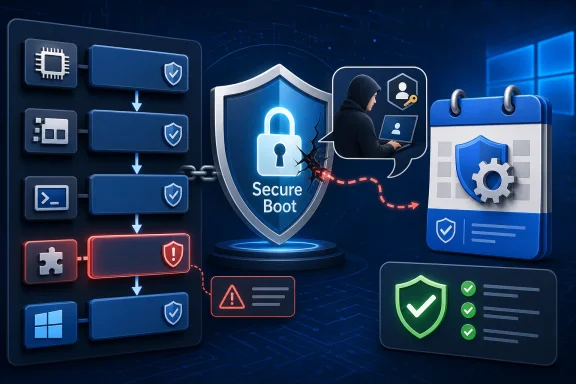 Microsoft’s Secure Boot Patch Is a Trust Problem, Not Just a Patch Problem
Secure Boot vulnerabilities occupy a strange place in the Windows risk hierarchy. They often require local access, administrative privileges, or unusually specific attack conditions, which makes them look less urgent than internet-facing bugs. Yet their prize is much larger than their access requirements suggest: the ability to interfere with the assumptions Windows makes before Windows is fully in charge.CVE-2026-45588 fits that pattern. Microsoft describes the weakness as a protection mechanism failure in Windows Secure Boot that allows an authorized attacker to bypass a security feature locally. The CVSS vector is telling: local attack vector, low attack complexity, high privileges required, no user interaction, changed scope, and high confidentiality and integrity impact. In plain English, this is not a wormable bug, but it is also not cosmetic.
That distinction matters because Secure Boot is part of the root-of-trust story Windows has been selling for more than a decade. It is supposed to help ensure that the firmware, bootloader, and early operating system path have not been swapped out for something hostile. If an attacker can bypass it after obtaining sufficient local control, the boundary between “compromised operating system” and “compromised platform” becomes harder to police.
The “Important” severity label is therefore accurate but incomplete. It communicates that most home users should install the monthly update rather than unplug the router in terror. It does not fully capture what a Secure Boot bypass means for defenders who rely on BitLocker, measured boot, virtualization-based security, credential isolation, and endpoint attestation to survive the messiness of real-world compromise.
The CVSS Score Hides the Real Drama in the Scope Change
The base score for CVE-2026-45588 is 7.9, with a temporal score of 6.9. That lands below Microsoft’s “Critical” tier, largely because exploitation is local and requires high privileges. But CVSS has a habit of flattening architectural risk into arithmetic, and Secure Boot is precisely where arithmetic can undersell the story.The most interesting part of the vector is the scope change. Microsoft’s own FAQ explains that successful exploitation can affect resources beyond the security scope managed by the vulnerable component. In boot-chain terms, that means the vulnerability is not merely about one Windows component failing in isolation. It is about a security promise crossing a boundary where firmware, bootloaders, operating system policy, and higher-level protections all meet.
That is why a high-privilege local requirement should not lull administrators into complacency. Modern intrusions often unfold in stages. An attacker first gets user-level execution, then escalates privileges, then disables defenses, then persists. A Secure Boot bypass does not have to be the first move in that chain to be dangerous; it can be the move that lets the attacker make the compromise harder to eradicate.
Microsoft’s exploitability assessment says exploitation is less likely, with no known public disclosure and no known exploitation at the time of publication. That is good news. It also means this is the window in which patching is supposed to work best: before exploit code circulates, before commodity tooling absorbs the technique, and before defenders are forced into emergency imaging campaigns.
There is a subtle tension here. Microsoft rates the report confidence as confirmed, meaning the vulnerability’s existence and technical basis are credible. At the same time, exploit code maturity is listed as unproven. For defenders, that combination should read as: the bug is real, the fix exists, and the public exploitation story has not yet caught up.
Secure Boot Keeps Becoming a Bigger Target Because It Became a Bigger Dependency
Secure Boot used to be discussed mostly in firmware circles and Linux dual-boot arguments. In today’s Windows estate, it is entangled with almost every serious security baseline. Windows 11 hardware requirements pushed TPM and Secure Boot deeper into mainstream consciousness, while enterprise security features increasingly assume that the machine starts from a trustworthy state.That dependency is rational. If the pre-OS environment is compromised, higher-level controls can be made to lie. A bootkit can load before the operating system kernel, tamper with security decisions, or conceal itself from tools that operate after Windows has already started. Secure Boot is not magic, but it is one of the mechanisms meant to make those attacks substantially harder.
The awkward part is that Secure Boot itself is an ecosystem, not a single switch. It depends on UEFI firmware behavior, Microsoft-signed components, OEM implementation quality, revocation lists, update delivery, and the politics of not bricking old hardware. Every security boundary in that stack becomes part of the total assurance story.
CVE-2026-45588 is described at a high level, not as a full public technical teardown. That is typical for a just-patched vulnerability, and it is usually preferable to handing attackers a recipe on release day. But the broad class is familiar: a protection mechanism failure means the intended safeguard does not reliably enforce the security decision it exists to enforce.
For Windows administrators, the immediate question is not whether Secure Boot has suddenly become worthless. It has not. The better question is whether your fleet treats boot-chain updates with the same seriousness as browser, Exchange, VPN, or kernel patches. Many organizations do not, and that gap is exactly where Secure Boot bugs become operationally painful.
The “Authorized Attacker” Language Should Not Be Misread as Comfort
Microsoft’s wording says an authorized attacker could exploit the vulnerability locally. That phrase can sound reassuring, because it implies the attacker already needs meaningful access. But in enterprise security, “already has admin” is not the end of the incident; it is often the midpoint.Local administrator control is common in breaches for depressingly practical reasons. Help desk workflows grant it, legacy software demands it, developer machines accumulate it, and attackers pursue it relentlessly after initial access. If a flaw requires high privileges, it narrows the pool of attackers who can use it. It does not eliminate the pool.
The security impact also depends on the asset. A single unmanaged home PC is one risk profile. A developer workstation with signing keys, a domain admin jump box, a kiosk fleet, or a server involved in sensitive workloads is another. Boot-chain compromise on those systems can create persistence and evidence problems that ordinary endpoint reimaging procedures may miss.
The “no user interaction” metric is also important. Once the attacker has the required local privilege level, exploitation does not require tricking another user into clicking something. That makes the flaw more relevant to post-compromise tooling, where automation and repeatability matter.
The attack complexity is marked low. CVSS does not say the attack is public or trivial, and Microsoft says exploitation is less likely. But low complexity means the successful conditions are not expected to require exotic environmental luck once the attacker has the necessary position. That is exactly the kind of detail defenders should file away when deciding whether to let a reboot-sensitive patch wait for the next maintenance cycle.
The Affected-Product List Is a Map of Windows’ Long Tail
The affected-product table stretches across a familiar cross-section of the Windows estate. It includes Windows 10 releases such as 1607, 1809, 21H2, and 22H2; Windows 11 versions 23H2, 24H2, 25H2, and 26H1; Windows Server 2012 and 2012 R2; Windows Server 2016, 2019, 2022, and 2025; and Server Core variants. The patch set is not limited to one shiny new release.That breadth matters because Secure Boot lives at the intersection of old hardware, old operating systems, and current security expectations. Enterprises rarely run a pristine fleet. They run medical carts, factory PCs, point-of-sale systems, legacy domain services, lab equipment, and servers whose maintenance windows are negotiated like treaties. Those systems often sit precisely where boot-chain trust is most valuable and patching is most cumbersome.
Microsoft published fixes across multiple knowledge base packages and build numbers, with newer Windows 11 and Server releases receiving their own security updates and older platforms mapped to their servicing channels. That is normal Patch Tuesday plumbing, but in this case the plumbing is the story. Secure Boot fixes can require not just installation but successful reboot, validation, and occasionally firmware-aware change management.
The presence of Windows Server 2012 and 2012 R2 in the affected list will also raise eyebrows. These platforms are deep in extended support territory for organizations that still pay to keep them alive. Their inclusion is a reminder that the Windows ecosystem’s security boundary extends far beyond whatever Microsoft is promoting on new Copilot-branded hardware this quarter.
For sysadmins, the practical lesson is simple: do not assume this is only a Windows 11 issue because Secure Boot is now culturally associated with Windows 11 requirements. The advisory reaches much farther back, and older machines are often where the boot configuration is least standardized.
The Fix Is Official, but Deployment Is Still the Hard Part
Microsoft lists the remediation level as official fix, which is the best possible state for a newly disclosed vulnerability. There is no need to wait for an emergency mitigation, registry workaround, or vendor firmware bulletin before beginning normal patch operations. Supported systems should receive the relevant June 2026 security update through the organization’s usual servicing channel.The difficulty is that boot-chain updates are not always psychologically treated like normal cumulative updates. Administrators worry about BitLocker recovery prompts, firmware oddities, bootloader regressions, dual-boot machines, and remote devices that do not have hands nearby. Those concerns are not imaginary. They are why staged rollout, recovery key escrow, and validation rings exist.
For managed Windows environments, the first order of business is inventory. Know which machines have Secure Boot enabled, which support it but do not enforce it, which are exempted for legacy reasons, and which are missing recent cumulative updates. A Secure Boot bypass patch is less useful if the estate cannot tell you where Secure Boot actually matters.
The second order of business is recovery readiness. If BitLocker is in use, recovery keys should be escrowed and tested before large-scale rollout. If remote systems are involved, administrators should know how they will handle a recovery screen on a device in a branch office, a warehouse, or a user’s home. The worst time to discover weak recovery operations is after a security update touches the boot path.
The third order of business is attestation. Organizations using Defender for Endpoint, Intune, Configuration Manager, third-party EDR, or compliance tooling should confirm that reporting distinguishes “update installed” from “device rebooted and running fixed build.” For this class of issue, pending reboot is not a footnote. It is the difference between assigned remediation and actual remediation.
Home Users Should Patch, but Enterprises Should Audit
For ordinary Windows users, the advice is boring in the best possible way. Install the June 2026 security updates, let the machine reboot, and do not defer indefinitely. The vulnerability is not known to be exploited, and it is not remotely reachable over the network, so there is no basis for consumer panic.For power users, the more interesting step is to check whether Secure Boot is enabled at all. Many upgraded or custom-built PCs support Secure Boot but may have it disabled due to legacy installation choices, old graphics cards, alternate operating systems, or manual firmware changes. A Secure Boot bypass matters most when Secure Boot is part of the machine’s intended security posture.
For enterprises, patching should be paired with a small audit of boot policy. That means checking Secure Boot state, BitLocker state, TPM readiness, recovery key escrow, and device health attestation across high-value endpoints first. If those signals are inconsistent, CVE-2026-45588 is a useful excuse to fix drift that probably predates this advisory.
Developers and security researchers should also pay attention to the acknowledgement. Microsoft credits Alon Leviev with Microsoft Offensive Research and Security Engineering. That detail points to coordinated work inside or alongside Microsoft’s offensive research orbit, not a random drive-by report with uncertain provenance. The “confirmed” report confidence aligns with that signal.
None of this requires treating every Windows laptop like a compromised bootkit crime scene. It does require recognizing that Secure Boot sits below many controls administrators think of as independent. When it fails, it is not just one feature that bends; it is the measuring stick used by other features.
The Ghost of BlackLotus Still Haunts Every Secure Boot Advisory
The Windows community has already lived through the lesson that Secure Boot fixes can be more complicated than ordinary patches. Previous boot-chain incidents showed that patching a vulnerable component is only part of the job; revocation, compatibility, and deployment sequencing can stretch the remediation story across months. Administrators remember that pain, and they are right to do so.That history is why every new Secure Boot advisory is read through a skeptical lens. Is the vulnerable component patched but still trusted somewhere? Does the fix require a revocation update? Will older installation media still boot? Could disaster recovery workflows depend on now-questionable boot components? Microsoft’s CVE-2026-45588 advisory does not present this as a public bootkit crisis, but the questions come with the territory.
The good news is that this advisory does not currently carry the worst labels. It is not publicly disclosed, not known exploited, and not assessed as more likely to be exploited. There is an official fix on release day. That is a cleaner starting position than defenders get with many high-profile boot-chain problems.
The bad news is that the industry’s boot security model remains operationally brittle. Secure Boot depends on a chain of trust, and chains are unforgiving metaphors. A weak link does not need to be everywhere to matter; it only needs to be present on the machine an attacker values.
That is why the right response is neither shrugging nor alarmism. Treat CVE-2026-45588 as a serious post-compromise risk with a patch available and no public exploitation reported. Move it through the same disciplined process you would use for a kernel or credential-protection issue: prioritize exposed and high-value systems, verify reboot completion, and watch for anomalies.
Patch Tuesday’s Small Print Carries the Boot Chain
CVE-2026-45588 is also a reminder of how much security meaning now hides inside Patch Tuesday tables. The headline line says “Important.” The table says Windows 10, Windows 11, multiple Server generations, multiple architectures, and Server Core. The CVSS row says local, low complexity, high privileges, no user interaction, changed scope, high confidentiality and integrity impact. The exploitability section says not disclosed, not exploited, less likely.Each of those facts is defensible on its own. Together they tell a more nuanced story: Microsoft has fixed a real Secure Boot bypass before public exploitation, but the class of bug touches one of the most sensitive trust boundaries in Windows. That is why this patch deserves more than a passive “install when convenient” posture in managed environments.
The most concrete operational takeaways are not exotic. They are the same habits that separate resilient Windows fleets from wishful ones:
- Organizations should deploy the June 2026 security updates for affected Windows client and server versions and verify that systems have rebooted into the fixed builds.
- Administrators should prioritize systems where Secure Boot, BitLocker, virtualization-based security, or device attestation are relied upon for compliance or incident containment.
- Security teams should treat successful local administrator compromise as a possible stepping stone to boot-chain tampering, not as a reason to dismiss the vulnerability.
- Fleet owners should confirm that BitLocker recovery keys are escrowed before broad rollout, especially for remote, branch, kiosk, and Server Core systems.
- Patch reporting should distinguish installed updates from completed remediation, because boot-chain fixes do not fully land until the machine restarts successfully.
- Older supported or extended-support Windows systems should not be ignored, because the affected list spans well beyond current Windows 11 releases.
References
- Primary source: MSRC
Published: 2026-06-09T07:00:00-07:00
Security Update Guide - Microsoft Security Response Center
 msrc.microsoft.com
