

Linux disclosed CVE-2026-45834 on May 26, 2026, for a Bluetooth L2CAP flaw in the kernel where
The temptation is to shrug because the fix is a NULL guard, not a cinematic remote-code-execution exploit. That would be a mistake. Kernel reliability bugs in networking-adjacent code are often where the glamorous vulnerability story ends and the sysadmin story begins: crashes, hard-to-reproduce panics, fleet variance, and the uncomfortable knowledge that a subsystem many machines barely use may still be compiled, loaded, and reachable.
CVE-2026-45834 sits in the Linux kernel’s Bluetooth L2CAP implementation, specifically in the callback path named
The public description is almost aggressively brief. The vulnerability has been “resolved,” the Bluetooth L2CAP callback receives a NULL guard, and the new check mirrors guards already present in nearby callbacks such as
That is both reassuring and mildly damning. Reassuring, because the patch appears conceptually simple. Damning, because the Linux kernel’s Bluetooth stack has been through years of scrutiny, fuzzing, sanitizers, distribution hardening, and real-world bug reports, yet still accumulates these edge-case lifecycle hazards.
A NULL pointer dereference is not automatically a privilege-escalation primitive. In many kernel contexts, it is more likely to produce a crash than code execution, especially on modern systems with low-memory mapping protections and common hardening defaults. But in kernel-land, a crash is not harmless. A remote-ish or proximity-triggered kernel panic on a workstation, kiosk, appliance, or industrial endpoint is still a security and availability event.
That distinction can break down quickly. A vulnerability in the Bluetooth stack may require physical proximity, a Bluetooth adapter, a specific state transition, or an already-established relationship between devices. Those constraints reduce mass exploitation risk. They do not eliminate targeted exploitation risk, and they certainly do not eliminate reliability risk when malformed or unexpected protocol behavior reaches kernel code.
The Linux Bluetooth stack is also used far beyond enthusiast laptops. It appears in point-of-sale terminals, medical-adjacent devices, signage systems, smart gateways, embedded controllers, thin clients, and lab machines that may be administered like servers but behave like desktops. In those environments, an attacker does not need a botnet-scale exploit to create trouble. They need a repeatable crash against the right box at the wrong time.
For WindowsForum readers, the name on the CVE may say Linux, but the operational blast radius can still land inside a Windows shop. Mixed fleets are normal now. Admin workstations run Windows with WSL. Developers test Linux kernels in virtual machines. Hyper-V hosts Linux guests. Edge devices report into Microsoft management stacks. A vulnerability does not have to target Windows itself to become a Windows administrator’s Tuesday.
The absence of a score creates a familiar problem. Many enterprise patch queues are still driven by severity labels and numeric thresholds. No score means no automatic urgency, and no automatic urgency often means “later,” unless a distribution advisory, vendor scanner, or internal policy supplies the missing context.
That is precisely where security teams should be careful. A CVSS score is an input, not a substitute for understanding where the affected code exists in your environment. If Bluetooth is disabled, drivers are not loaded, and the relevant kernel branch is not deployed, the practical exposure may be low. If Bluetooth is enabled across Linux laptops or embedded endpoints in public spaces, the same CVE deserves a faster look.
NVD’s delay also highlights a broader weakness in vulnerability operations. Kernel fixes frequently arrive as backports across multiple stable branches, and distributions may ship their own fixed package versions before every database has converged. If your scanner only understands the CVE after enrichment, your actual remediation path may lag the code reality.
The important detail is that there is no single “Linux version” answer for exposure. A mainline commit hash is useful to kernel developers, but most administrators consume kernels through Red Hat, Ubuntu, Debian, SUSE, Fedora, Arch, Android-derived vendors, appliance makers, or cloud images. The same fix can appear under different package versions, with different advisories, on different days.
That creates awkward communication. A developer may say the bug is fixed upstream. A distro may say a given release remains vulnerable. A scanner may say it cannot score the CVE. A sysadmin may see a kernel update that also includes dozens of unrelated changes and wonder whether rebooting a production box for a Bluetooth NULL dereference is sensible.
The answer depends on what kind of box it is. On a headless server with no Bluetooth hardware, no loaded Bluetooth modules, and strict module policy, this is unlikely to be the patch that justifies an emergency reboot by itself. On a Linux laptop fleet, kiosk fleet, maker lab, or embedded deployment with Bluetooth enabled, it belongs in the next practical update window.
Kernel networking and protocol stacks are full of these edges. Callbacks are registered, delayed work runs later, timers fire, sockets close, references are dropped, and error paths take unusual routes through code that ordinary testing rarely exercises. When a pointer is valid 99.9 percent of the time, the missing check can survive for years until fuzzing or an unlucky state transition proves otherwise.
Bluetooth makes that harder because it is stateful and messy. Pairing, authentication, feature exchange, channel creation, timeout handling, disconnection, controller quirks, and user-space interaction all layer on top of one another. A callback that “obviously” has a socket in the normal path may not have one in a teardown path, timeout path, or failed negotiation path.
That is why these small fixes matter. They are not glamorous, but they are a sign that kernel hardening is often an incremental cleanup of assumptions. Every guard that makes a callback tolerant of a missing object reduces the number of weird paths that can turn into a panic.
A kernel NULL pointer dereference can be “just” denial of service, but a denial-of-service condition against the kernel is not like crashing a tab in a browser. It can take down a machine. It can interrupt a point-of-sale terminal, knock a lab workstation out of a test run, disrupt a field device, or force a reboot that loses volatile state. In managed environments, repeated crashes also create diagnostic noise that costs real time.
The proximity aspect of Bluetooth changes the probability, not the category. The bug is unlikely to become the next internet worm. But proximity attacks are not imaginary in offices, airports, classrooms, hospitals, factories, conferences, and apartment buildings. The closer a device is to public or semi-public space, the less comforting “nearby attacker” becomes.
There is also the issue of exploit maturity. The public CVE text does not demonstrate exploitation, and administrators should not invent a worst-case scenario without evidence. But kernel bugs with simple crash behavior can still become useful primitives when combined with other flaws, configuration weaknesses, or device-specific behavior. Good triage avoids both panic and complacency.
WSL is the obvious example, though typical WSL instances do not expose Bluetooth hardware in the same way as a native Linux desktop. More relevant are Linux developer laptops, dual-boot machines, Hyper-V guests, Azure-hosted Linux workloads, on-prem appliances, network gear, containers running on Linux hosts, and embedded systems that report into Microsoft-centric identity and monitoring stacks. Windows administrators no longer get to define their perimeter by the Windows kernel alone.
The practical Windows angle is inventory. If your asset database knows every Windows build number but has only vague labels for Linux endpoints, small kernel CVEs become invisible until a scanner or outage forces the issue. Bluetooth bugs sharpen that problem because many organizations do not track radio interfaces as part of ordinary server vulnerability management.
This is also a reminder that “disable unused hardware” remains a serious control, not a compliance cliché. A Linux system with Bluetooth hardware absent, disabled in firmware, blocked by policy, or prevented from loading the relevant modules is in a different risk bucket than a mobile workstation advertising itself in a crowded building. The fix is still desirable, but the urgency changes.
That negotiation often turns on perceived severity. A Bluetooth NULL dereference with no NVD score will struggle to compete with browser zero-days, VPN vulnerabilities, identity-provider flaws, and actively exploited edge-device bugs. That is rational prioritization. But it should not become indefinite deferral.
The better approach is to fold this update into normal kernel maintenance. If your Linux desktops are already on a weekly or biweekly patch cadence, CVE-2026-45834 should ride that train. If your embedded or appliance fleet updates quarterly, this CVE should trigger a check that the vendor has picked up the relevant stable backport. If your servers do not use Bluetooth, it should still prompt a review of whether the modules are present and loadable.
There is also a regression tradeoff. Bluetooth fixes can land alongside other kernel changes that affect device support, power management, Wi-Fi coexistence, suspend/resume behavior, and peripheral compatibility. Administrators should test representative hardware, especially laptops and embedded devices, rather than assume a small security fix means a risk-free kernel update.
CVE-2026-45834 fits that pattern. The record tells us the affected subsystem, the function, the bug class, and the nature of the fix. It does not yet tell us exploitability, prerequisites, affected configurations, distribution-specific exposure, or real-world attack activity. Those gaps are not proof of safety; they are proof that triage still requires engineering judgment.
For defenders, the right question is not “Is this scary?” It is “Where do we run affected kernels with reachable Bluetooth?” That moves the discussion from abstract severity to concrete systems. A Linux laptop in a public-facing help desk, a kiosk with a Bluetooth peripheral, and a rack server without a Bluetooth controller do not deserve the same urgency.
For vendors, the record is another example of why terse CVEs are useful but insufficient. A five-line description can identify a fix, but it cannot explain operational risk to a school district, hospital, manufacturer, or small business. Distribution advisories, security trackers, and kernel maintainers fill in that gap over time, but the early hours of a CVE often belong to guesswork.
That is the likely world CVE-2026-45834 belongs to, even if the public record does not spell out a full reproducer. The function name, callback pattern, and comparison to already-guarded functions all point toward a state-machine edge rather than a simple input-validation mistake. The bug is less “someone forgot Bluetooth packets can be evil” and more “someone assumed this lifecycle path had already guaranteed an object.”
Those assumptions are the hardest bugs to eradicate. They are often locally reasonable. A function is written in the context of a call graph where an object is usually present, then later the call graph changes, or a timeout path is added, or a related callback learns a defensive check while a sibling callback does not. The codebase evolves, and invariants rot.
Security engineering is increasingly about making those invariants explicit. Reference counting, annotations, lockdep, sanitizers, fuzzers, and defensive checks all serve the same purpose: forcing the code to survive paths that humans did not intend but machines will eventually discover.
Many embedded products pin kernels for long periods, carry out-of-tree Bluetooth patches, or rely on vendor SDKs that lag upstream stable branches. The device may expose Bluetooth for provisioning, telemetry, peripherals, or maintenance even when the owner does not think of it as a Bluetooth system. A bug like CVE-2026-45834 can therefore persist in products long after it disappears from ordinary desktops.
That matters because embedded devices are often physically reachable and operationally unattended. A digital sign, warehouse scanner, lab controller, conference-room appliance, or medical-cart companion device can sit within Bluetooth range of strangers. If the worst credible impact is a crash, that crash may still be meaningful.
The fix path is also murkier. The owner may not control the kernel. The vendor may not publish CVE-specific advisories. The firmware update may bundle unrelated changes. In those environments, the best immediate mitigation may be disabling Bluetooth when it is not needed, limiting pairing modes, reducing discoverability, or using physical placement and radio policy to lower exposure while waiting for firmware.
Good inventory should separate hardware presence from software exposure. A machine may have a Bluetooth controller but no loaded kernel modules. It may have modules available but blocked. It may run a kernel branch that already includes the fix. It may sit in a location where proximity risk is negligible. Or it may be a public-facing workstation with Bluetooth active and no enforced update cadence.
That granularity is what turns CVE management from spreadsheet theater into risk management. Without it, teams either overreact by treating every kernel CVE as urgent or underreact by ignoring anything without a high CVSS score. Both approaches waste time.
For Linux administrators, the immediate checklist is familiar: check vendor advisories, confirm fixed package versions, update kernels, reboot into the fixed build, and verify that the running kernel is the expected one. For Windows-heavy teams, the extra step is to ask whether Linux devices are actually represented in the same operational view as Windows endpoints.
This is the old monolithic-kernel tradeoff in modern clothing. Linux gets performance, integration, and hardware reach by keeping substantial driver and protocol logic in kernel space. The price is that boring peripheral code can become a system-wide reliability boundary. If a radio protocol stack mishandles object lifetime, the rest of the machine may pay.
Windows has its own history with driver and Bluetooth stack defects, which is why this story should feel familiar rather than foreign. The architectural details differ, but the lesson is shared across platforms: code that sits near hardware, interrupts, timers, and network-like inputs must be treated as security-sensitive even when the feature looks consumer-grade.
The fix for CVE-2026-45834 is modest. The cultural correction is larger. Administrators should stop dividing vulnerabilities into “core” and “peripheral” too casually. Attackers, fuzzers, and malformed devices do not respect that boundary.
CVE-2026-45834 will probably not be remembered as a landmark Bluetooth vulnerability, and that is precisely why it is useful: it shows how modern security work often looks in practice, with a small guard in a deep subsystem forcing administrators to decide whether they truly know what is running, what is reachable, and what will still be vulnerable after the patch window closes.
l2cap_sock_state_change_cb() could dereference a NULL socket pointer, with fixes referenced across stable kernel commits and no NVD CVSS score assigned yet. The bug is small in code terms and large in operational meaning: another defensive check in the Bluetooth stack, another reminder that “local radio” is still kernel attack surface, and another patch-management item that will matter most to Linux desktops, embedded systems, and mixed Windows-Linux fleets.The temptation is to shrug because the fix is a NULL guard, not a cinematic remote-code-execution exploit. That would be a mistake. Kernel reliability bugs in networking-adjacent code are often where the glamorous vulnerability story ends and the sysadmin story begins: crashes, hard-to-reproduce panics, fleet variance, and the uncomfortable knowledge that a subsystem many machines barely use may still be compiled, loaded, and reachable.
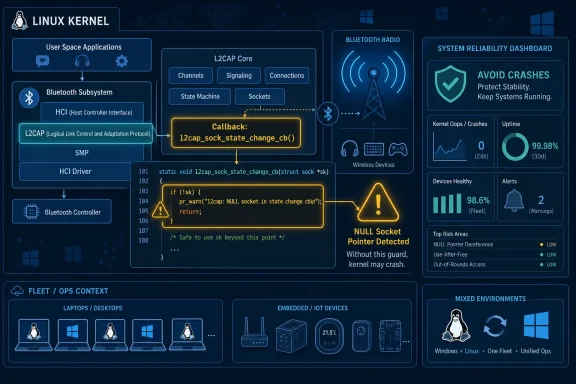 A One-Line Guard Tells a Longer Kernel Story
CVE-2026-45834 sits in the Linux kernel’s Bluetooth L2CAP implementation, specifically in the callback path named l2cap_sock_state_change_cb(). L2CAP, the Logical Link Control and Adaptation Protocol, is the Bluetooth layer that helps multiplex higher-level traffic over a controller connection. In plainer terms, it is part of the machinery that lets Bluetooth do more than simply pair a device.The public description is almost aggressively brief. The vulnerability has been “resolved,” the Bluetooth L2CAP callback receives a NULL guard, and the new check mirrors guards already present in nearby callbacks such as
l2cap_sock_resume_cb() and l2cap_sock_ready_cb(). That phrasing matters because it suggests the fix is not a new architecture, a new mitigation framework, or a novel security model. It is consistency applied to a callback family that should already have been treating a pointer as nullable.That is both reassuring and mildly damning. Reassuring, because the patch appears conceptually simple. Damning, because the Linux kernel’s Bluetooth stack has been through years of scrutiny, fuzzing, sanitizers, distribution hardening, and real-world bug reports, yet still accumulates these edge-case lifecycle hazards.
A NULL pointer dereference is not automatically a privilege-escalation primitive. In many kernel contexts, it is more likely to produce a crash than code execution, especially on modern systems with low-memory mapping protections and common hardening defaults. But in kernel-land, a crash is not harmless. A remote-ish or proximity-triggered kernel panic on a workstation, kiosk, appliance, or industrial endpoint is still a security and availability event.
Bluetooth Remains a Local Attack Surface With Remote Manners
Bluetooth occupies an awkward place in threat modeling. It is not the internet, but it is not quite local-only either. It is a radio interface, often enabled by default, often present on laptops and desktops, and frequently ignored in server-style vulnerability triage because it feels peripheral rather than central.That distinction can break down quickly. A vulnerability in the Bluetooth stack may require physical proximity, a Bluetooth adapter, a specific state transition, or an already-established relationship between devices. Those constraints reduce mass exploitation risk. They do not eliminate targeted exploitation risk, and they certainly do not eliminate reliability risk when malformed or unexpected protocol behavior reaches kernel code.
The Linux Bluetooth stack is also used far beyond enthusiast laptops. It appears in point-of-sale terminals, medical-adjacent devices, signage systems, smart gateways, embedded controllers, thin clients, and lab machines that may be administered like servers but behave like desktops. In those environments, an attacker does not need a botnet-scale exploit to create trouble. They need a repeatable crash against the right box at the wrong time.
For WindowsForum readers, the name on the CVE may say Linux, but the operational blast radius can still land inside a Windows shop. Mixed fleets are normal now. Admin workstations run Windows with WSL. Developers test Linux kernels in virtual machines. Hyper-V hosts Linux guests. Edge devices report into Microsoft management stacks. A vulnerability does not have to target Windows itself to become a Windows administrator’s Tuesday.
The Missing CVSS Score Is Not Permission to Wait Forever
At publication time, the NVD entry for CVE-2026-45834 is marked as awaiting enrichment, with no CVSS v4.0, v3.x, or v2.0 score from NVD. That is not unusual for newly received Linux kernel CVEs, especially now that kernel.org-originated records can arrive quickly with terse descriptions and commit references before broader scoring catches up.The absence of a score creates a familiar problem. Many enterprise patch queues are still driven by severity labels and numeric thresholds. No score means no automatic urgency, and no automatic urgency often means “later,” unless a distribution advisory, vendor scanner, or internal policy supplies the missing context.
That is precisely where security teams should be careful. A CVSS score is an input, not a substitute for understanding where the affected code exists in your environment. If Bluetooth is disabled, drivers are not loaded, and the relevant kernel branch is not deployed, the practical exposure may be low. If Bluetooth is enabled across Linux laptops or embedded endpoints in public spaces, the same CVE deserves a faster look.
NVD’s delay also highlights a broader weakness in vulnerability operations. Kernel fixes frequently arrive as backports across multiple stable branches, and distributions may ship their own fixed package versions before every database has converged. If your scanner only understands the CVE after enrichment, your actual remediation path may lag the code reality.
The Stable Kernel Machine Has Already Started Moving
The CVE references multiple stable kernel commits, indicating that the fix is being propagated across supported branches rather than living only in a future development tree. Debian’s tracker, for example, already distinguishes vulnerable and fixed package states across releases, with newer testing and unstable streams moving ahead of older lines. That pattern is familiar: upstream lands a small fix, stable maintainers backport it, distributions map it to their package versions, and administrators wait for their particular channel to catch up.The important detail is that there is no single “Linux version” answer for exposure. A mainline commit hash is useful to kernel developers, but most administrators consume kernels through Red Hat, Ubuntu, Debian, SUSE, Fedora, Arch, Android-derived vendors, appliance makers, or cloud images. The same fix can appear under different package versions, with different advisories, on different days.
That creates awkward communication. A developer may say the bug is fixed upstream. A distro may say a given release remains vulnerable. A scanner may say it cannot score the CVE. A sysadmin may see a kernel update that also includes dozens of unrelated changes and wonder whether rebooting a production box for a Bluetooth NULL dereference is sensible.
The answer depends on what kind of box it is. On a headless server with no Bluetooth hardware, no loaded Bluetooth modules, and strict module policy, this is unlikely to be the patch that justifies an emergency reboot by itself. On a Linux laptop fleet, kiosk fleet, maker lab, or embedded deployment with Bluetooth enabled, it belongs in the next practical update window.
The Bug Pattern Is Familiar Because the Callback Lifecycle Is Hard
The most revealing sentence in the CVE description is that the fix adds “the same NULL guard already present” in related callbacks. That is the scent of a lifecycle bug. Somewhere in the state machine, code is called after an object may no longer exist, before it is fully attached, or during a transition where the relationship between a channel and a socket is not guaranteed.Kernel networking and protocol stacks are full of these edges. Callbacks are registered, delayed work runs later, timers fire, sockets close, references are dropped, and error paths take unusual routes through code that ordinary testing rarely exercises. When a pointer is valid 99.9 percent of the time, the missing check can survive for years until fuzzing or an unlucky state transition proves otherwise.
Bluetooth makes that harder because it is stateful and messy. Pairing, authentication, feature exchange, channel creation, timeout handling, disconnection, controller quirks, and user-space interaction all layer on top of one another. A callback that “obviously” has a socket in the normal path may not have one in a teardown path, timeout path, or failed negotiation path.
That is why these small fixes matter. They are not glamorous, but they are a sign that kernel hardening is often an incremental cleanup of assumptions. Every guard that makes a callback tolerant of a missing object reduces the number of weird paths that can turn into a panic.
Denial of Service Is Still a Security Outcome
There is a long-running cultural problem in vulnerability coverage: if a bug does not obviously yield code execution, it is treated as second-class. That instinct is understandable, especially when security teams are drowning in CVEs. It is also too crude.A kernel NULL pointer dereference can be “just” denial of service, but a denial-of-service condition against the kernel is not like crashing a tab in a browser. It can take down a machine. It can interrupt a point-of-sale terminal, knock a lab workstation out of a test run, disrupt a field device, or force a reboot that loses volatile state. In managed environments, repeated crashes also create diagnostic noise that costs real time.
The proximity aspect of Bluetooth changes the probability, not the category. The bug is unlikely to become the next internet worm. But proximity attacks are not imaginary in offices, airports, classrooms, hospitals, factories, conferences, and apartment buildings. The closer a device is to public or semi-public space, the less comforting “nearby attacker” becomes.
There is also the issue of exploit maturity. The public CVE text does not demonstrate exploitation, and administrators should not invent a worst-case scenario without evidence. But kernel bugs with simple crash behavior can still become useful primitives when combined with other flaws, configuration weaknesses, or device-specific behavior. Good triage avoids both panic and complacency.
Windows Shops Should Care Because Linux Is Already in the Room
A Windows-first administrator might reasonably ask why this belongs on their radar. The answer is not that CVE-2026-45834 threatens Windows Bluetooth directly. It does not. The answer is that modern Windows environments increasingly contain Linux as infrastructure, tooling, development substrate, or appliance firmware.WSL is the obvious example, though typical WSL instances do not expose Bluetooth hardware in the same way as a native Linux desktop. More relevant are Linux developer laptops, dual-boot machines, Hyper-V guests, Azure-hosted Linux workloads, on-prem appliances, network gear, containers running on Linux hosts, and embedded systems that report into Microsoft-centric identity and monitoring stacks. Windows administrators no longer get to define their perimeter by the Windows kernel alone.
The practical Windows angle is inventory. If your asset database knows every Windows build number but has only vague labels for Linux endpoints, small kernel CVEs become invisible until a scanner or outage forces the issue. Bluetooth bugs sharpen that problem because many organizations do not track radio interfaces as part of ordinary server vulnerability management.
This is also a reminder that “disable unused hardware” remains a serious control, not a compliance cliché. A Linux system with Bluetooth hardware absent, disabled in firmware, blocked by policy, or prevented from loading the relevant modules is in a different risk bucket than a mobile workstation advertising itself in a crowded building. The fix is still desirable, but the urgency changes.
The Patch Is Simple; The Reboot Politics Are Not
Kernel patches bring a special operational tax: applying the package is not always the same as running the fixed code. In most distributions, the corrected kernel takes effect after a reboot, unless live patching is available and the vendor includes this particular fix in a livepatch stream. For desktop fleets, rebooting is annoying. For production systems, rebooting can become a negotiation.That negotiation often turns on perceived severity. A Bluetooth NULL dereference with no NVD score will struggle to compete with browser zero-days, VPN vulnerabilities, identity-provider flaws, and actively exploited edge-device bugs. That is rational prioritization. But it should not become indefinite deferral.
The better approach is to fold this update into normal kernel maintenance. If your Linux desktops are already on a weekly or biweekly patch cadence, CVE-2026-45834 should ride that train. If your embedded or appliance fleet updates quarterly, this CVE should trigger a check that the vendor has picked up the relevant stable backport. If your servers do not use Bluetooth, it should still prompt a review of whether the modules are present and loadable.
There is also a regression tradeoff. Bluetooth fixes can land alongside other kernel changes that affect device support, power management, Wi-Fi coexistence, suspend/resume behavior, and peripheral compatibility. Administrators should test representative hardware, especially laptops and embedded devices, rather than assume a small security fix means a risk-free kernel update.
The Kernel CVE Firehose Rewards Context, Not Alarm
Linux kernel CVE volume has become a management problem of its own. The kernel is enormous, actively developed, broadly deployed, and increasingly systematic about assigning CVEs to fixes that once might have appeared only as ordinary stable commits. That means more records, more terse descriptions, and more cases where the vulnerability database entry is less informative than the patch itself.CVE-2026-45834 fits that pattern. The record tells us the affected subsystem, the function, the bug class, and the nature of the fix. It does not yet tell us exploitability, prerequisites, affected configurations, distribution-specific exposure, or real-world attack activity. Those gaps are not proof of safety; they are proof that triage still requires engineering judgment.
For defenders, the right question is not “Is this scary?” It is “Where do we run affected kernels with reachable Bluetooth?” That moves the discussion from abstract severity to concrete systems. A Linux laptop in a public-facing help desk, a kiosk with a Bluetooth peripheral, and a rack server without a Bluetooth controller do not deserve the same urgency.
For vendors, the record is another example of why terse CVEs are useful but insufficient. A five-line description can identify a fix, but it cannot explain operational risk to a school district, hospital, manufacturer, or small business. Distribution advisories, security trackers, and kernel maintainers fill in that gap over time, but the early hours of a CVE often belong to guesswork.
Fuzzers Keep Finding the Edges Humans Normalize
The Linux Bluetooth stack has repeatedly benefited from fuzzing and sanitizer-driven testing. Tools such as KASAN make memory bugs visible by turning silent corruption or rare crashes into actionable reports. Stateful protocol fuzzing is especially valuable for Bluetooth because many defects are not in a single malformed packet but in the sequence of events that leads code into an unexpected state.That is the likely world CVE-2026-45834 belongs to, even if the public record does not spell out a full reproducer. The function name, callback pattern, and comparison to already-guarded functions all point toward a state-machine edge rather than a simple input-validation mistake. The bug is less “someone forgot Bluetooth packets can be evil” and more “someone assumed this lifecycle path had already guaranteed an object.”
Those assumptions are the hardest bugs to eradicate. They are often locally reasonable. A function is written in the context of a call graph where an object is usually present, then later the call graph changes, or a timeout path is added, or a related callback learns a defensive check while a sibling callback does not. The codebase evolves, and invariants rot.
Security engineering is increasingly about making those invariants explicit. Reference counting, annotations, lockdep, sanitizers, fuzzers, and defensive checks all serve the same purpose: forcing the code to survive paths that humans did not intend but machines will eventually discover.
Embedded Linux Is Where “Minor” Bluetooth Bugs Linger
Desktop distributions tend to move quickly. Rolling releases pick up fixes rapidly, mainstream distributions issue security updates, and users eventually reboot after enough reminders. Embedded Linux is less forgiving.Many embedded products pin kernels for long periods, carry out-of-tree Bluetooth patches, or rely on vendor SDKs that lag upstream stable branches. The device may expose Bluetooth for provisioning, telemetry, peripherals, or maintenance even when the owner does not think of it as a Bluetooth system. A bug like CVE-2026-45834 can therefore persist in products long after it disappears from ordinary desktops.
That matters because embedded devices are often physically reachable and operationally unattended. A digital sign, warehouse scanner, lab controller, conference-room appliance, or medical-cart companion device can sit within Bluetooth range of strangers. If the worst credible impact is a crash, that crash may still be meaningful.
The fix path is also murkier. The owner may not control the kernel. The vendor may not publish CVE-specific advisories. The firmware update may bundle unrelated changes. In those environments, the best immediate mitigation may be disabling Bluetooth when it is not needed, limiting pairing modes, reducing discoverability, or using physical placement and radio policy to lower exposure while waiting for firmware.
Security Teams Should Treat the CVE as a Prompt for Inventory
CVE-2026-45834 is not the kind of vulnerability that should send every organization into emergency mode. It is, however, exactly the kind of vulnerability that exposes weak inventory practices. If you cannot answer which Linux systems have Bluetooth enabled, you cannot triage this intelligently.Good inventory should separate hardware presence from software exposure. A machine may have a Bluetooth controller but no loaded kernel modules. It may have modules available but blocked. It may run a kernel branch that already includes the fix. It may sit in a location where proximity risk is negligible. Or it may be a public-facing workstation with Bluetooth active and no enforced update cadence.
That granularity is what turns CVE management from spreadsheet theater into risk management. Without it, teams either overreact by treating every kernel CVE as urgent or underreact by ignoring anything without a high CVSS score. Both approaches waste time.
For Linux administrators, the immediate checklist is familiar: check vendor advisories, confirm fixed package versions, update kernels, reboot into the fixed build, and verify that the running kernel is the expected one. For Windows-heavy teams, the extra step is to ask whether Linux devices are actually represented in the same operational view as Windows endpoints.
The Bluetooth Stack Is Becoming a Reliability Boundary
One reason Bluetooth bugs are easy to dismiss is that Bluetooth itself feels optional. Many users can live without a headset, mouse, keyboard, or file-transfer feature. But the kernel does not experience the subsystem as optional once it is loaded and handling events. A crash in peripheral code is still a crash in the operating system.This is the old monolithic-kernel tradeoff in modern clothing. Linux gets performance, integration, and hardware reach by keeping substantial driver and protocol logic in kernel space. The price is that boring peripheral code can become a system-wide reliability boundary. If a radio protocol stack mishandles object lifetime, the rest of the machine may pay.
Windows has its own history with driver and Bluetooth stack defects, which is why this story should feel familiar rather than foreign. The architectural details differ, but the lesson is shared across platforms: code that sits near hardware, interrupts, timers, and network-like inputs must be treated as security-sensitive even when the feature looks consumer-grade.
The fix for CVE-2026-45834 is modest. The cultural correction is larger. Administrators should stop dividing vulnerabilities into “core” and “peripheral” too casually. Attackers, fuzzers, and malformed devices do not respect that boundary.
The Small Patch That Should Change the Patch Conversation
The concrete facts are narrow, but the operational lessons are broader. CVE-2026-45834 does not need hype to be worth attention; it needs placement in the right maintenance lane.- CVE-2026-45834 affects the Linux kernel Bluetooth L2CAP code path in
l2cap_sock_state_change_cb()and was published by NVD on May 26, 2026. - The public fix adds a NULL check consistent with related L2CAP socket callbacks that already had similar guards.
- NVD had not assigned a CVSS score at the time of the initial record, so organizations should not rely on severity automation alone.
- Systems with Bluetooth disabled, unavailable, or blocked are likely in a lower practical risk category than Linux laptops, kiosks, and embedded devices with active Bluetooth.
- Administrators should track distribution-specific fixed kernel packages and remember that a reboot is usually required before the fixed kernel is actually running.
- Windows-centric teams should still account for Linux endpoints, appliances, and developer systems inside their managed environments.
CVE-2026-45834 will probably not be remembered as a landmark Bluetooth vulnerability, and that is precisely why it is useful: it shows how modern security work often looks in practice, with a small guard in a deep subsystem forcing administrators to decide whether they truly know what is running, what is reachable, and what will still be vulnerable after the patch window closes.
References
- Primary source: NVD / Linux Kernel
Published: 2026-05-28T01:05:49-07:00
NVD - CVE-2026-45834
 nvd.nist.gov
- Security advisory: MSRC
Published: 2026-05-28T01:05:49-07:00
Original feed URL
Security Update Guide - Microsoft Security Response Center
 msrc.microsoft.com
- Related coverage: windowsforum.com
CVE-2026-31510 Linux Bluetooth Fix: Prevent Null Deref in L2CAP | Windows Forum
Linux has published another Bluetooth kernel fix that looks small on the surface but matters for anyone tracking availability and stability risks in the...windowsforum.com - Related coverage: kernel.googlesource.com
- Related coverage: spinics.net
Re: [PATCH v2 RESEND] Bluetooth: L2CAP: Fix null-ptr-deref in l2cap_sock_state_change_cb() — Linux Bluetooth
Linux Bluetooth: Re: [PATCH v2 RESEND] Bluetooth: L2CAP: Fix null-ptr-deref in l2cap_sock_state_change_cb()www.spinics.net - Related coverage: files.bluetooth.com
