

Microsoft has published CVE-2026-45850 in its Security Update Guide for a Linux kernel IPVS flaw, disclosed by kernel.org on May 27, 2026, in which IPv6 extension headers can make TCP, UDP, or SCTP checksum validation fail before IP Virtual Server rewrites traffic. The bug is not a Windows kernel vulnerability, but it lands squarely in the infrastructure that many Windows shops now depend on: Linux load balancers, Kubernetes nodes, WSL-adjacent development stacks, and hybrid estates where “Microsoft security” no longer means “Windows only.” The important story is not that a checksum bug received a CVE. It is that modern Microsoft risk tracking increasingly has to follow packets beyond the Windows boundary.
A decade ago, a Microsoft security advisory about a Linux kernel flaw would have sounded like a category error. In 2026, it is just Tuesday. Azure, container platforms, GitHub-hosted development pipelines, Linux virtual machines, edge appliances, and mixed Windows/Linux server farms have made the old operating-system tribal lines operationally useless.
CVE-2026-45850 sits in IPVS, the Linux kernel’s IP Virtual Server subsystem. IPVS is not a flashy desktop component; it is plumbing for transport-layer load balancing, network address translation, and high-throughput service delivery. Precisely because it is plumbing, it is easy to ignore until a malformed packet or edge-case protocol behavior starts punching holes in assumptions.
The vulnerability description is terse: checksum validation fails for IPv6 traffic when extension headers appear before the protocol header. The fix is similarly plain: use the already-calculated protocol-header offset rather than assuming the transport header follows immediately after the base IPv6 header. That is the kind of small correction that can hide a large operational lesson.
Security teams often triage by brand. Windows CVE, Microsoft patch. Linux CVE, distro patch. Kubernetes CVE, platform team ticket. But the packet path rarely respects those categories. A Windows client talking to a cloud-hosted application may traverse Linux-based ingress, IPVS-backed load balancing, container networking, and virtual network appliances before the application ever sees a request.
IPv6 extension headers are part of the protocol’s design. They allow optional information to be placed between the IPv6 base header and the upper-layer protocol header, such as TCP, UDP, or SCTP. That flexibility is useful, but it also means network code must not assume that the transport header begins at a fixed offset.
IPVS had code paths for TCP, UDP, and SCTP checksum validation that effectively treated IPv6 packets as if the transport header followed the base IPv6 header directly. When extension headers were present, that assumption broke. The upstream patch passes the correct offset into the checksum functions and uses the actual transport protocol constants when calculating IPv6 pseudo-header checksums.
This is classic kernel-networking territory: a small-looking bug in a rarely discussed corner can produce inconsistent behavior under specific packet shapes. It may manifest as dropped traffic, failed validation, broken load balancing, or a security-relevant inconsistency in how packets are accepted and transformed. The CVE language says the vulnerability has been resolved, but it does not inflate the issue into something it is not.
That restraint matters. Not every CVE is an emergency, and not every network-stack bug is exploitable in the headline sense. But administrators who run IPVS in production should treat correctness bugs in packet validation seriously, because a load balancer that mishandles edge-case traffic can become the point where availability, policy enforcement, and observability all start lying at once.
In IPv4, options exist but are comparatively rare in everyday traffic. In IPv6, extension headers are built into the architecture and are explicitly used to chain additional metadata before the upper-layer protocol. Any code that shortcuts parsing by assuming a fixed header distance is gambling against the protocol.
CVE-2026-45850 is a reminder that supporting IPv6 is not the same as correctly handling all IPv6 packet structures. A component can accept IPv6 addresses, forward IPv6 traffic, and pass ordinary tests while still failing on packets that exercise extension-header paths. That gap is exactly where production bugs live.
The security community has seen this pattern before across different platforms: parser logic, offload logic, filtering logic, and checksum logic often diverge. One part of the stack knows where the transport header is; another part assumes it. One code path walks the extension-header chain; another grabs a constant offset. The failure is not ignorance of IPv6. It is partial IPv6 comprehension spread unevenly across the codebase.
For defenders, the lesson is not to panic about every extension header. The lesson is to stop treating IPv6 as an optional appendix to IPv4 operations. If IPv6 is enabled, routed, tunneled, load-balanced, or merely reachable, then the enterprise must test and monitor it as a first-class protocol.
Kubernetes operators will recognize IPVS as one of the data-plane modes historically used by kube-proxy. Linux Virtual Server technology has also been used for years in high-performance load-balancing designs. In practice, the administrator responsible for an affected packet path may not be the same person responsible for the Windows application that users complain about when traffic fails.
That disconnect is where hybrid infrastructure becomes brittle. The Windows team sees intermittent application failures. The network team sees no obvious firewall deny. The Linux platform team sees kernel messages or package advisories. The cloud team sees a health probe flapping. Everyone owns a slice of the path, and no one owns the whole failure until the incident bridge gets crowded.
CVE-2026-45850 is therefore more interesting as an operational signal than as a standalone bug. It tells enterprises to inventory whether IPVS is in their traffic path, whether IPv6 is enabled in that path, and whether their kernel versions include the fix. That is not glamorous work, but it is exactly the kind of work that separates mature infrastructure teams from lucky ones.
The affected files named in the public record are narrowly scoped: IPVS protocol handlers for SCTP, TCP, and UDP. That specificity should help administrators avoid vague fear. This is not “all Linux networking is broken.” It is a particular checksum-validation problem in a particular subsystem when IPv6 extension headers are involved.
That is the technical heart of the issue. The IPv6 base header’s “next header” value is not always TCP or UDP. It may point to an extension header, which then points to another header, and so on. If checksum code uses the wrong value or starts at the wrong offset, it can validate the wrong bytes or fail validation for traffic that should be handled correctly.
The public CVE record traces affected Linux versions back to IPVS changes introduced long ago, with fixed status appearing in newer stable lines. Debian’s tracker, for example, showed several stable releases still marked vulnerable while newer development releases had fixed versions available. That is normal in the Linux ecosystem, but it matters for patch planning.
The phrase “the vulnerability has been resolved” can mislead casual readers. It means the upstream fix exists and has been assigned to relevant code lines. It does not mean every distribution, appliance vendor, container host, or cloud image in your estate is already remediated.
This is where Linux patching differs sharply from the Windows cumulative-update rhythm. Microsoft can ship a Windows security update to a well-defined set of supported products on Patch Tuesday. Linux kernel fixes move through upstream stable trees, distribution backports, vendor kernels, appliance firmware, and managed-service abstractions. The same CVE can be fixed in one environment, pending in another, and hidden behind a vendor portal in a third.
This is especially true for organizations that have standardized on Microsoft management and security tooling while running large Linux estates. Defender for Cloud, Microsoft Sentinel, Azure Kubernetes Service, GitHub Advanced Security, and hybrid inventory tools all make Microsoft part of Linux risk management. The advisory surface has expanded because the customer surface has expanded.
The disclaimer text attached to the Knowledge Base-style material is boilerplate, but it has a certain brutal honesty. The information is provided as-is, with no warranty. Administrators still have to validate applicability, test patches, understand vendor status, and decide whether exposure exists in their own traffic paths.
That is uncomfortable but accurate. A CVE record can tell you that the Linux kernel had an IPVS checksum-validation bug. It cannot tell you whether your production Kubernetes cluster uses IPVS mode, whether IPv6 extension headers reach it, whether your distribution has backported the fix, or whether your appliance vendor quietly patched the kernel two weeks ago.
Security operations has become less about reading advisories and more about translating advisories into topology. CVE-2026-45850 asks a topology question: where does IPv6 traffic meet Linux IPVS in your environment?
A remote user authenticating through a portal may hit a Linux ingress controller. A line-of-business Windows app may sit behind a Linux load balancer. A developer building a Windows desktop client may test against services running in Linux containers. A corporate security dashboard may ingest telemetry from Linux network nodes that decide whether traffic reaches Windows workloads at all.
The operational impact of CVE-2026-45850 is therefore less about who “owns” Linux and more about who owns service availability. If IPVS drops or mishandles certain IPv6 traffic, the user-visible symptom may be a Windows application problem. If checksum validation behaves inconsistently, troubleshooting may begin at the wrong layer.
This is one reason mature IT organizations increasingly build cross-platform patch intelligence. They do not wait for the Windows team, Linux team, network team, and cloud team to independently discover the same dependency chain during an outage. They map the packet path, map the kernel dependencies, and treat shared infrastructure as shared risk.
The practical move is not dramatic. Check whether IPVS is present and active. Determine whether IPv6 is enabled and exposed in those paths. Review distribution and vendor advisories for fixed kernel versions. Patch or mitigate according to the systems actually carrying traffic, not according to the operating-system label on the application server.
But scanners will still play a major role here. Linux kernel CVEs often show up as “unpatched vulnerability” findings across distributions, cloud images, and appliances. Some findings will be accurate. Some will lag behind vendor backports. Some will flag a kernel package that contains the affected version number even though the relevant feature is not enabled in the environment.
That does not make scanners useless. It means their output must be reconciled against actual exposure. A system with no IPVS module loaded, no IPv6 traffic path, and no reachable load-balancing role may not deserve the same urgency as an internet-facing IPv6 load balancer handling production traffic. Conversely, an appliance with a vendor-managed kernel may be more exposed than its tidy management UI suggests.
The hard part is that kernel CVEs blur the line between “installed” and “reachable.” Vulnerable code may exist on disk without being used. Or it may be compiled into a kernel and silently exercised by a platform abstraction that administrators rarely inspect. The answer depends on runtime behavior.
For enterprises with change-control constraints, this is where mitigation planning becomes specific. If immediate kernel updates are not possible, teams can examine whether IPv6 extension-header traffic is needed, whether filtering is appropriate at controlled boundaries, whether IPVS use can be reduced, or whether traffic can be routed through patched nodes first. Those are engineering decisions, not magic CVE incantations.
A better approach is disciplined IPv6 governance. Know where IPv6 is enabled. Know where it is routed. Know which load balancers, firewalls, proxies, and service meshes inspect it. Know which telemetry sources actually see IPv6 extension headers rather than normalizing them away.
CVE-2026-45850 is a narrow bug, but it points toward a broad deficiency in many estates: IPv6 is often present without being owned. Security policies may mention it. Network diagrams may omit it. Monitoring tools may partially understand it. Application teams may assume it is someone else’s problem.
That gap is especially visible in hybrid Microsoft environments. Windows has long shipped with IPv6 enabled by default. Azure uses sophisticated virtual networking abstractions. Developers routinely run Linux containers on Windows workstations. The enterprise may think of itself as “mostly Windows” while IPv6-enabled Linux components quietly carry production traffic.
The right response is not fear of extension headers. It is refusing to let IPv6 be the shadow network inside the official network.
For administrators, that means the CVE publication date is not always the same as the engineering fix date, the distro package date, or the appliance firmware date. CVE-2026-45850 was published in late May 2026, but the stable patch mail for the 6.19 line was dated February 24, 2026. The security clock has multiple faces.
This matters because organizations that only react to CVE feeds may miss the earlier availability of upstream fixes, while organizations that only follow kernel stable updates may miss the later compliance signal. Neither view is sufficient on its own. Operations needs both the engineering timeline and the vulnerability-management timeline.
The best teams will fold this into normal kernel lifecycle management. They will not treat every medium-complexity networking CVE as a fire drill, but they also will not let load-balancer kernels drift indefinitely because “nothing is broken.” Packet-processing correctness is part of the security boundary.
That boundary is getting more complicated, not less. Hardware offload, virtual switching, eBPF programs, container overlays, service meshes, and cloud load balancers all interact with the assumptions made in kernel networking code. A checksum bug in IPVS is one tile in a much larger mosaic.
But underselling it would be a mistake too. Load balancers are high-leverage infrastructure, and checksum validation is part of the machinery that decides whether traffic is legitimate enough to transform and forward. When that machinery mishandles a standards-compliant packet structure, administrators should pay attention.
The most useful reading is pragmatic: this is a correctness and robustness flaw in a network path that may sit in front of critical services. It deserves inventory, patch validation, and exposure-based prioritization. It does not deserve superstition.
For Microsoft-centered shops, the bigger lesson is cultural. The security perimeter is no longer the Windows estate. It is the set of components that carry identity, traffic, telemetry, and management across platforms. Microsoft’s own advisory ecosystem now reflects that reality.
The forward-looking lesson is that Windows administrators, Linux engineers, cloud operators, and security teams need a shared language for these cross-platform faults before the next one arrives with a higher severity score. CVE-2026-45850 is manageable precisely because it is specific: a checksum-offset bug, in IPVS, triggered by IPv6 extension-header placement, fixed in upstream kernel code and flowing through vendor channels. The enterprises that handle it well will not be the ones with the loudest scanner dashboards; they will be the ones that know where their packets actually go.
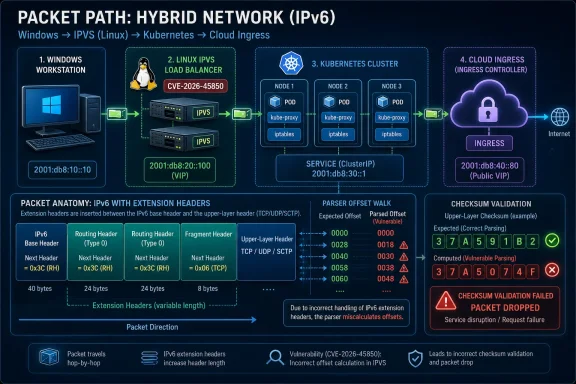 Microsoft’s Security Perimeter Now Runs Through the Linux Kernel
A decade ago, a Microsoft security advisory about a Linux kernel flaw would have sounded like a category error. In 2026, it is just Tuesday. Azure, container platforms, GitHub-hosted development pipelines, Linux virtual machines, edge appliances, and mixed Windows/Linux server farms have made the old operating-system tribal lines operationally useless.CVE-2026-45850 sits in IPVS, the Linux kernel’s IP Virtual Server subsystem. IPVS is not a flashy desktop component; it is plumbing for transport-layer load balancing, network address translation, and high-throughput service delivery. Precisely because it is plumbing, it is easy to ignore until a malformed packet or edge-case protocol behavior starts punching holes in assumptions.
The vulnerability description is terse: checksum validation fails for IPv6 traffic when extension headers appear before the protocol header. The fix is similarly plain: use the already-calculated protocol-header offset rather than assuming the transport header follows immediately after the base IPv6 header. That is the kind of small correction that can hide a large operational lesson.
Security teams often triage by brand. Windows CVE, Microsoft patch. Linux CVE, distro patch. Kubernetes CVE, platform team ticket. But the packet path rarely respects those categories. A Windows client talking to a cloud-hosted application may traverse Linux-based ingress, IPVS-backed load balancing, container networking, and virtual network appliances before the application ever sees a request.
The Bug Is Boring in the Way Dangerous Infrastructure Bugs Often Are
The flaw behind CVE-2026-45850 is not a cinematic remote-code-execution apocalypse. It is a protocol-accounting error in a load-balancing subsystem. The kernel code expected one layout, IPv6 permitted another, and the checksum path made the wrong assumption.IPv6 extension headers are part of the protocol’s design. They allow optional information to be placed between the IPv6 base header and the upper-layer protocol header, such as TCP, UDP, or SCTP. That flexibility is useful, but it also means network code must not assume that the transport header begins at a fixed offset.
IPVS had code paths for TCP, UDP, and SCTP checksum validation that effectively treated IPv6 packets as if the transport header followed the base IPv6 header directly. When extension headers were present, that assumption broke. The upstream patch passes the correct offset into the checksum functions and uses the actual transport protocol constants when calculating IPv6 pseudo-header checksums.
This is classic kernel-networking territory: a small-looking bug in a rarely discussed corner can produce inconsistent behavior under specific packet shapes. It may manifest as dropped traffic, failed validation, broken load balancing, or a security-relevant inconsistency in how packets are accepted and transformed. The CVE language says the vulnerability has been resolved, but it does not inflate the issue into something it is not.
That restraint matters. Not every CVE is an emergency, and not every network-stack bug is exploitable in the headline sense. But administrators who run IPVS in production should treat correctness bugs in packet validation seriously, because a load balancer that mishandles edge-case traffic can become the point where availability, policy enforcement, and observability all start lying at once.
IPv6 Extension Headers Keep Exposing Lazy Assumptions
IPv6 has spent years being “the future” while also being quietly present in enterprise networks, cloud platforms, endpoint stacks, and service meshes. The result is an awkward middle state: IPv6 is deployed enough to matter, but many operational assumptions were forged in an IPv4 world. Extension headers are where that mismatch repeatedly becomes visible.In IPv4, options exist but are comparatively rare in everyday traffic. In IPv6, extension headers are built into the architecture and are explicitly used to chain additional metadata before the upper-layer protocol. Any code that shortcuts parsing by assuming a fixed header distance is gambling against the protocol.
CVE-2026-45850 is a reminder that supporting IPv6 is not the same as correctly handling all IPv6 packet structures. A component can accept IPv6 addresses, forward IPv6 traffic, and pass ordinary tests while still failing on packets that exercise extension-header paths. That gap is exactly where production bugs live.
The security community has seen this pattern before across different platforms: parser logic, offload logic, filtering logic, and checksum logic often diverge. One part of the stack knows where the transport header is; another part assumes it. One code path walks the extension-header chain; another grabs a constant offset. The failure is not ignorance of IPv6. It is partial IPv6 comprehension spread unevenly across the codebase.
For defenders, the lesson is not to panic about every extension header. The lesson is to stop treating IPv6 as an optional appendix to IPv4 operations. If IPv6 is enabled, routed, tunneled, load-balanced, or merely reachable, then the enterprise must test and monitor it as a first-class protocol.
IPVS Is Quietly Everywhere in Modern Service Delivery
IPVS is not something most Windows administrators configure by hand. That does not mean they are unaffected by it. IPVS can appear under container platforms, Linux-based load balancers, high-availability clusters, and cloud-hosted service infrastructure that fronts Windows workloads.Kubernetes operators will recognize IPVS as one of the data-plane modes historically used by kube-proxy. Linux Virtual Server technology has also been used for years in high-performance load-balancing designs. In practice, the administrator responsible for an affected packet path may not be the same person responsible for the Windows application that users complain about when traffic fails.
That disconnect is where hybrid infrastructure becomes brittle. The Windows team sees intermittent application failures. The network team sees no obvious firewall deny. The Linux platform team sees kernel messages or package advisories. The cloud team sees a health probe flapping. Everyone owns a slice of the path, and no one owns the whole failure until the incident bridge gets crowded.
CVE-2026-45850 is therefore more interesting as an operational signal than as a standalone bug. It tells enterprises to inventory whether IPVS is in their traffic path, whether IPv6 is enabled in that path, and whether their kernel versions include the fix. That is not glamorous work, but it is exactly the kind of work that separates mature infrastructure teams from lucky ones.
The affected files named in the public record are narrowly scoped: IPVS protocol handlers for SCTP, TCP, and UDP. That specificity should help administrators avoid vague fear. This is not “all Linux networking is broken.” It is a particular checksum-validation problem in a particular subsystem when IPv6 extension headers are involved.
The Fix Shows How Long Tail Kernel Risk Really Works
The Linux kernel patch trail shows this was not a broad rewrite. It adjusted the checksum-checking functions so they receive the already-known transport-header offset and avoid recalculating it incorrectly. In the TCP and UDP paths, the patch also uses the specific transport protocol value rather than depending on the IPv6 header’s next-header field, which may describe an extension header rather than the final upper-layer protocol.That is the technical heart of the issue. The IPv6 base header’s “next header” value is not always TCP or UDP. It may point to an extension header, which then points to another header, and so on. If checksum code uses the wrong value or starts at the wrong offset, it can validate the wrong bytes or fail validation for traffic that should be handled correctly.
The public CVE record traces affected Linux versions back to IPVS changes introduced long ago, with fixed status appearing in newer stable lines. Debian’s tracker, for example, showed several stable releases still marked vulnerable while newer development releases had fixed versions available. That is normal in the Linux ecosystem, but it matters for patch planning.
The phrase “the vulnerability has been resolved” can mislead casual readers. It means the upstream fix exists and has been assigned to relevant code lines. It does not mean every distribution, appliance vendor, container host, or cloud image in your estate is already remediated.
This is where Linux patching differs sharply from the Windows cumulative-update rhythm. Microsoft can ship a Windows security update to a well-defined set of supported products on Patch Tuesday. Linux kernel fixes move through upstream stable trees, distribution backports, vendor kernels, appliance firmware, and managed-service abstractions. The same CVE can be fixed in one environment, pending in another, and hidden behind a vendor portal in a third.
Microsoft’s Advisory Is Also a Map of Customer Reality
The source material here comes from Microsoft’s Security Update Guide, not a Linux distribution’s release notes. That is the point. Microsoft’s customers now operate in environments where Linux kernel vulnerabilities can affect Microsoft workloads, Azure deployments, Windows endpoints, and enterprise identity flows.This is especially true for organizations that have standardized on Microsoft management and security tooling while running large Linux estates. Defender for Cloud, Microsoft Sentinel, Azure Kubernetes Service, GitHub Advanced Security, and hybrid inventory tools all make Microsoft part of Linux risk management. The advisory surface has expanded because the customer surface has expanded.
The disclaimer text attached to the Knowledge Base-style material is boilerplate, but it has a certain brutal honesty. The information is provided as-is, with no warranty. Administrators still have to validate applicability, test patches, understand vendor status, and decide whether exposure exists in their own traffic paths.
That is uncomfortable but accurate. A CVE record can tell you that the Linux kernel had an IPVS checksum-validation bug. It cannot tell you whether your production Kubernetes cluster uses IPVS mode, whether IPv6 extension headers reach it, whether your distribution has backported the fix, or whether your appliance vendor quietly patched the kernel two weeks ago.
Security operations has become less about reading advisories and more about translating advisories into topology. CVE-2026-45850 asks a topology question: where does IPv6 traffic meet Linux IPVS in your environment?
Windows Administrators Cannot Outsource This One to the Linux Team
For WindowsForum readers, the temptation is to file this under “Linux people problems.” That would be too narrow. Windows administrators increasingly depend on Linux-based infrastructure even when every business application they support runs on Windows Server, SQL Server, .NET, or Microsoft 365-adjacent services.A remote user authenticating through a portal may hit a Linux ingress controller. A line-of-business Windows app may sit behind a Linux load balancer. A developer building a Windows desktop client may test against services running in Linux containers. A corporate security dashboard may ingest telemetry from Linux network nodes that decide whether traffic reaches Windows workloads at all.
The operational impact of CVE-2026-45850 is therefore less about who “owns” Linux and more about who owns service availability. If IPVS drops or mishandles certain IPv6 traffic, the user-visible symptom may be a Windows application problem. If checksum validation behaves inconsistently, troubleshooting may begin at the wrong layer.
This is one reason mature IT organizations increasingly build cross-platform patch intelligence. They do not wait for the Windows team, Linux team, network team, and cloud team to independently discover the same dependency chain during an outage. They map the packet path, map the kernel dependencies, and treat shared infrastructure as shared risk.
The practical move is not dramatic. Check whether IPVS is present and active. Determine whether IPv6 is enabled and exposed in those paths. Review distribution and vendor advisories for fixed kernel versions. Patch or mitigate according to the systems actually carrying traffic, not according to the operating-system label on the application server.
The CVE Record Is Precise, but Enterprise Exposure Is Messier
The public record for CVE-2026-45850 identifies Linux as the affected product and points to IPVS files for SCTP, TCP, and UDP. It also identifies upstream stable commits associated with the fix. That is useful precision, and administrators should prefer it over vulnerability-scanner summaries that collapse nuance into a red badge.But scanners will still play a major role here. Linux kernel CVEs often show up as “unpatched vulnerability” findings across distributions, cloud images, and appliances. Some findings will be accurate. Some will lag behind vendor backports. Some will flag a kernel package that contains the affected version number even though the relevant feature is not enabled in the environment.
That does not make scanners useless. It means their output must be reconciled against actual exposure. A system with no IPVS module loaded, no IPv6 traffic path, and no reachable load-balancing role may not deserve the same urgency as an internet-facing IPv6 load balancer handling production traffic. Conversely, an appliance with a vendor-managed kernel may be more exposed than its tidy management UI suggests.
The hard part is that kernel CVEs blur the line between “installed” and “reachable.” Vulnerable code may exist on disk without being used. Or it may be compiled into a kernel and silently exercised by a platform abstraction that administrators rarely inspect. The answer depends on runtime behavior.
For enterprises with change-control constraints, this is where mitigation planning becomes specific. If immediate kernel updates are not possible, teams can examine whether IPv6 extension-header traffic is needed, whether filtering is appropriate at controlled boundaries, whether IPVS use can be reduced, or whether traffic can be routed through patched nodes first. Those are engineering decisions, not magic CVE incantations.
IPv6 Filtering Is Not a Substitute for IPv6 Competence
Some administrators will respond to any IPv6 bug by reaching for the nearest disable switch. That instinct is understandable, but it is not a strategy. IPv6 is deeply integrated into modern operating systems, cloud networks, and application stacks, and blanket disabling can create side effects that are harder to diagnose than the original risk.A better approach is disciplined IPv6 governance. Know where IPv6 is enabled. Know where it is routed. Know which load balancers, firewalls, proxies, and service meshes inspect it. Know which telemetry sources actually see IPv6 extension headers rather than normalizing them away.
CVE-2026-45850 is a narrow bug, but it points toward a broad deficiency in many estates: IPv6 is often present without being owned. Security policies may mention it. Network diagrams may omit it. Monitoring tools may partially understand it. Application teams may assume it is someone else’s problem.
That gap is especially visible in hybrid Microsoft environments. Windows has long shipped with IPv6 enabled by default. Azure uses sophisticated virtual networking abstractions. Developers routinely run Linux containers on Windows workstations. The enterprise may think of itself as “mostly Windows” while IPv6-enabled Linux components quietly carry production traffic.
The right response is not fear of extension headers. It is refusing to let IPv6 be the shadow network inside the official network.
The Real Patch Window Begins After the Upstream Fix
The kernel patch associated with this issue was circulating in stable review before the CVE appeared in public vulnerability trackers. That chronology is common for Linux kernel CVEs: bugs are fixed through normal development and stable processes, then later receive formal identifiers that help distributions and scanners track them.For administrators, that means the CVE publication date is not always the same as the engineering fix date, the distro package date, or the appliance firmware date. CVE-2026-45850 was published in late May 2026, but the stable patch mail for the 6.19 line was dated February 24, 2026. The security clock has multiple faces.
This matters because organizations that only react to CVE feeds may miss the earlier availability of upstream fixes, while organizations that only follow kernel stable updates may miss the later compliance signal. Neither view is sufficient on its own. Operations needs both the engineering timeline and the vulnerability-management timeline.
The best teams will fold this into normal kernel lifecycle management. They will not treat every medium-complexity networking CVE as a fire drill, but they also will not let load-balancer kernels drift indefinitely because “nothing is broken.” Packet-processing correctness is part of the security boundary.
That boundary is getting more complicated, not less. Hardware offload, virtual switching, eBPF programs, container overlays, service meshes, and cloud load balancers all interact with the assumptions made in kernel networking code. A checksum bug in IPVS is one tile in a much larger mosaic.
The Useful Lesson Is Smaller Than the Scary One
CVE-2026-45850 should not be oversold. The public description does not establish a wormable Windows-like emergency, and the affected code is specific. There is no value in turning every kernel bug into a breathless crisis.But underselling it would be a mistake too. Load balancers are high-leverage infrastructure, and checksum validation is part of the machinery that decides whether traffic is legitimate enough to transform and forward. When that machinery mishandles a standards-compliant packet structure, administrators should pay attention.
The most useful reading is pragmatic: this is a correctness and robustness flaw in a network path that may sit in front of critical services. It deserves inventory, patch validation, and exposure-based prioritization. It does not deserve superstition.
For Microsoft-centered shops, the bigger lesson is cultural. The security perimeter is no longer the Windows estate. It is the set of components that carry identity, traffic, telemetry, and management across platforms. Microsoft’s own advisory ecosystem now reflects that reality.
The Packet Path Is the Asset Inventory Now
The concrete work from this CVE is not glamorous, but it is clear. Treat the advisory as a prompt to verify the real packet path rather than as another abstract kernel entry in a scanner queue.- Organizations should identify whether Linux IPVS is active on load balancers, Kubernetes nodes, appliances, or service infrastructure that handles production traffic.
- Administrators should verify whether IPv6 is enabled and reachable on those paths, including internal-only segments that may not appear in internet-facing exposure reports.
- Patch teams should compare their running kernel packages against distribution and vendor-fixed versions, not just upstream version numbers.
- Security teams should interpret scanner findings in light of runtime exposure, because vulnerable code on disk is not always equivalent to vulnerable service behavior.
- Network teams should avoid treating blanket IPv6 disablement as a universal fix, especially in environments where cloud, Windows, or container components depend on IPv6 behavior.
- Incident responders should remember that a Linux load-balancing flaw can surface as a Windows application outage when the affected component sits upstream of the service.
The forward-looking lesson is that Windows administrators, Linux engineers, cloud operators, and security teams need a shared language for these cross-platform faults before the next one arrives with a higher severity score. CVE-2026-45850 is manageable precisely because it is specific: a checksum-offset bug, in IPVS, triggered by IPv6 extension-header placement, fixed in upstream kernel code and flowing through vendor channels. The enterprises that handle it well will not be the ones with the loudest scanner dashboards; they will be the ones that know where their packets actually go.
References
- Primary source: MSRC
Published: 2026-06-26T01:40:31-07:00
Security Update Guide - Microsoft Security Response Center
 msrc.microsoft.com
- Related coverage: vulnerability.circl.lu
Vulnerability-Lookup
Vulnerability-Lookup - Fast vulnerability lookup correlation from different sources.vulnerability.circl.lu - Related coverage: osv.dev

OSV - Open Source Vulnerabilities
Comprehensive vulnerability database for your open source projects and dependencies.
osv.dev
- Related coverage: ipv6.org.uk
