

CVE-2026-45934 is a Linux kernel Btrfs flaw disclosed by kernel.org and published by NVD on May 27, 2026, in which non-consecutive pending chunk allocations can make DUP chunk allocation overlap device extents and abort a filesystem transaction with EEXIST. The bug is not the sort of remote-code-execution headline that sends executives into emergency briefings, but it lands in a part of the stack where boring correctness is the product. When a filesystem loses confidence in its own allocation map, the practical result is downtime, forced read-only behavior, or a recovery window that nobody planned. The fix tells a familiar kernel story: the dangerous failure was not a missing lock, but an assumption that was true until enough ordinary background work made it false.
The first instinct when reading the failure report is to suspect concurrency. Btrfs chunk allocation is guarded by the expected locks, and the allocator’s state is not supposed to become incoherent simply because multiple things are happening at once. The bug report itself makes that point: the relevant allocation path is protected, and the bitmap that tracks allocated chunks is guarded as well.
That is what makes CVE-2026-45934 interesting. It is not a case where two callers crash through the same door simultaneously. It is a case where one caller reads the room correctly, then follows a shortcut in the floor plan that ignores a second obstacle.
The visible symptom is a transaction abort in
That distinction matters. Filesystems are conservative by design because optimism at the block layer becomes corruption. A transaction abort is noisy and disruptive, but it is also a defensive act. The system is saying: I cannot safely continue this operation under the assumptions I have.
Those in-flight allocations are called pending extents. They are not imaginary; they are real from the allocator’s perspective. They simply occupy a temporal gray zone between “known to this transaction” and “visible in the committed tree.”
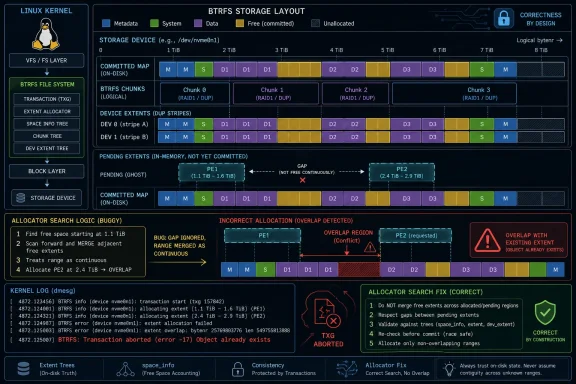
The flaw was that the adjustment logic effectively treated the first pending extent inside a candidate hole as the only pending extent it needed to reason about. If the allocator saw a pending extent, it could move the apparent start of the free region past that extent and treat the rest as usable. That works when there is only one pending extent in the range.
It fails when there are two non-consecutive pending extents with a real hole between them. The allocator can skip the first pending extent, count the space beyond it as a single usable hole, and accidentally include the second pending extent inside what it believes is free space. The next allocation can then overlap an existing pending allocation.
That is the heart of CVE-2026-45934: the allocator mistook a fragmented free-space picture for a continuous one. It did not need wild memory corruption or a maliciously crafted image to get there. It needed a sequence of legitimate chunk allocation and cleanup behavior that produced a shape the old helper function did not fully model.
DUP also means a single logical allocation has multiple physical stripes. If the allocator misidentifies free physical space, the overlap can appear in one of those stripes. In the sample described with the CVE, one stripe from an earlier metadata DUP chunk overlaps a stripe from a later metadata DUP chunk.
That overlap is not a theoretical embarrassment buried in a debug table. It is precisely the sort of contradiction that can cause a later insertion of device extents to fail. Btrfs tries to record a device extent, finds that the physical range is already represented, and aborts the transaction.
The report notes that the observed path involved forced chunk allocation, typically behind
That is the sort of wording sysadmins should read carefully. It does not mean every Btrfs filesystem is a ticking bomb. It does mean the bug belongs to a general allocator path, not merely to a test-only command.
The cleaner thread’s role is especially instructive. Btrfs can allocate block groups, mark some as unused, and later remove them in cleanup work. That cleanup can interleave with current-transaction allocations in a way that leaves several pending allocations with a gap in the middle.
In the simplified version, imagine three block groups allocated during one transaction. The cleaner comes through and removes the middle one. The committed device tree may not yet show the new extents the way the pending allocation bitmap does, leaving the allocator to reconcile a view that contains both committed history and in-flight changes.
The old logic could handle “there is a pending thing in this hole.” It could not correctly handle “there are multiple pending things in this hole, and the largest real free area may be somewhere between or after them.” That distinction is small in code and large in consequences.
This is why filesystem bugs often feel unfair. The failure requires a chain of events, and each event is normal. Allocation is normal. Cleanup is normal. Transactions are normal. Deferred visibility is normal. The bug appears only when the mental model connecting those pieces is too simple.
The fix changes the semantics of the hole-checking helper so it keeps looping until it finds a sufficiently large real hole or exhausts the pending extents in the candidate range. Instead of stopping after adjusting for one pending extent, the new logic walks through the relevant pending allocations and records usable holes as it goes.
That is a more robust model. A candidate hole is no longer accepted merely because its start has been moved past one obstacle. It must survive comparison against every pending extent that intersects the range.
The patch also splits the old helper into clearer pieces: one helper finds the first pending extent in a range, while another finds a real hole after accounting for pending extents. This kind of refactoring is easy to dismiss as code hygiene, but in filesystem code, naming and boundaries are part of the safety system. Ambiguous helpers invite future bugs because they hide assumptions about what has and has not been checked.
The change is also a reminder that the most consequential fixes are not always small one-liners. This one touches the allocator’s reasoning, adds documentation around range semantics, and makes the search behavior explicit. That is exactly where filesystem maintainers tend to spend effort after a subtle correctness failure: not just fixing the failing case, but narrowing the chance that the next maintainer reintroduces it.
This is not unusual in 2026. NIST’s vulnerability database has been operating under heavier submission volume and a more selective enrichment model, so fresh CVEs often arrive as shells: an identifier, a description, references, and little else. For enterprise vulnerability management systems that still treat NVD scoring as the center of gravity, that creates a delay between disclosure and prioritization.
Kernel CVEs make the problem worse because the practical risk depends heavily on configuration, filesystem use, distribution backports, and workload. A Btrfs allocator abort is not equivalent to a browser sandbox escape, even if both receive CVE IDs. It is also not harmless merely because it lacks a published CVSS score on day one.
The responsible approach is to read the underlying fix and distribution advisories rather than waiting for the database to finish its paperwork. In this case, the exploitability question is less important than the reliability question. If a vulnerable kernel can abort a transaction during Btrfs DUP chunk allocation, then administrators running Btrfs should care before a numerical score appears.
This is where vulnerability management and operations collide. Security teams want a severity number; storage teams want to know whether the filesystem can fall over during normal work. CVE-2026-45934 sits closer to the second camp, but modern patch queues do not have a clean column for “could ruin your maintenance window.”
The question is therefore not simply “is Linux fixed?” It is “has the kernel I actually boot received the Btrfs fix?” That answer depends on your distribution’s kernel stream and backport policy.
Rolling distributions may pick up the fix quickly as part of routine kernel movement. Enterprise distributions may carry older kernel versions with selected backports. Appliance vendors may lag behind both, especially where the filesystem stack is bundled into a storage product with its own validation process.
The version mentioned in the sample trace,
For anyone operating Btrfs in anger, the practical workflow is straightforward: check the distribution’s kernel changelog for the Btrfs fix, install the updated kernel when available, and reboot into it. Filesystem fixes do not help while the old kernel is still running.
Btrfs is not the default filesystem everywhere, but it is common enough in enthusiast and infrastructure niches to matter. It appears in openSUSE installations, NAS-oriented setups, snapshot-heavy desktops, lab servers, and systems where transparent compression or subvolumes are attractive. It is also a favorite of users who want filesystem-level features without building a ZFS workflow.
The impact path here is operational rather than cross-platform. A Windows admin may not be mounting Btrfs on a Windows workstation, but that same admin may depend on a Linux backup target, a VM host, or a build server whose storage layer uses Btrfs. If that host aborts filesystem transactions during metadata allocation, the outage still lands in the same ticket queue.
There is also a broader lesson for Windows professionals: modern infrastructure bugs increasingly live below the brand layer. The application says “backup succeeded,” the dashboard says “storage healthy,” the hypervisor says “guest online,” and then a kernel filesystem allocator decides it cannot reconcile its own metadata. The stack is only as boring as its least boring layer.
That does not mean there is no security relevance. Availability is part of security, and a local actor who can trigger pathological allocation behavior may have a route to disruption on systems where they can drive Btrfs activity. But the more realistic concern for most readers is accidental exposure under unlucky workload conditions.
The report’s reproduction used forced chunk allocation and deliberate timing manipulation. That makes weaponization less obvious. It also makes the bug feel like the kind that will be under-prioritized by scanners looking for clean exploit narratives.
That would be a mistake in storage environments. Filesystem aborts can cascade into remounts, failed services, incomplete backups, broken snapshots, or emergency maintenance. None of those outcomes require an attacker to be expensive.
The right severity language is therefore measured but not dismissive. This is not a panic patch for every Linux machine in a Windows shop. It is a meaningful stability fix for machines that run Btrfs, especially where DUP metadata allocation and active block-group churn are plausible.
In a healthier vulnerability ecosystem, those two layers would be fused quickly. In the current ecosystem, they often are not. The CVE record may lag behind the fix, and the severity score may arrive after the people who actually maintain systems have already made their decision.
That inversion changes how IT teams should work. Kernel patch notes and distribution advisories are no longer supplementary reading; they are the primary record for operational risk. If your security process waits for enriched metadata before allowing a kernel patch into the maintenance queue, you may be optimizing for database neatness over system resilience.
This is especially true for filesystems, network stacks, GPU drivers, and virtualization components. Bugs in these layers often produce weird local failure modes before they produce clean CVSS narratives. A transaction abort under Btrfs does not fit neatly into a spreadsheet designed around remote attackers, privileges required, and user interaction.
Administrators should also resist the opposite mistake: treating every kernel CVE as equally urgent. The point is not to panic-patch blindly. The point is to understand whether the affected subsystem is in your estate, whether the triggering conditions are realistic, and whether the vendor has already shipped the fix in a kernel you can deploy.
CVE-2026-45934 is not an indictment of Btrfs as a whole. Ext4, XFS, ZFS, NTFS, APFS, and every serious filesystem have had their share of bugs where a rare ordering or metadata state exposed an assumption. Filesystems are among the most hostile places to write code because they combine concurrency, persistence, crash recovery, and performance pressure.
But Btrfs users often run close to the edge of those features. Snapshot-heavy systems, aggressive cleanup, balancing, send/receive workflows, compression, and mixed workloads can create state transitions that simple desktop usage may never see. The more you rely on Btrfs-specific features, the more you should treat Btrfs-specific fixes as infrastructure patches rather than optional improvements.
Neglect is risky too. Some home labs and small businesses run NAS or backup systems for years without kernel maintenance because the box “just works.” Filesystem bugs are one reason that confidence can become dangerous. Storage systems do not need to be internet-facing to deserve timely kernel updates.
The boring recommendation remains the correct one: keep kernels current within the stability band your environment can tolerate, test storage upgrades before rolling them into production, and maintain backups that do not depend on the same filesystem instance you are trying to repair.
Those strings are the breadcrumbs. If they appear in logs on a Btrfs system, especially near forced chunk allocation, metadata allocation, or block-group cleanup activity, this CVE becomes more than an abstract patch note. It becomes a candidate explanation.
That does not mean every
The safest response to a suspected hit is not to run destructive repair commands first. Capture logs, identify the kernel build, check whether the fix is present, mount read-only if necessary, and take a block-level image before attempting invasive repair. Btrfs recovery tooling has improved, but
If the filesystem is still online and services are running, the immediate goal is containment: stop unnecessary writes, preserve evidence, and plan a controlled reboot into a fixed kernel. If the filesystem has already remounted read-only or aborted critical transactions, recovery should proceed from backups or images rather than hope.
For WindowsForum readers who run mixed environments, the action is not complicated, but it does require inventory discipline. Find the Linux systems that use Btrfs. Determine whether they use kernels containing the fix. Prioritize machines that act as storage targets, backup repositories, virtualization hosts, or snapshot-heavy development systems.
The absence of an NVD score should not be treated as absence of risk. It should be treated as absence of enriched paperwork. The kernel fix already explains the failure mode well enough for administrators to make a practical decision.
 A Filesystem Bug That Looks Like a Race but Isn’t
The first instinct when reading the failure report is to suspect concurrency. Btrfs chunk allocation is guarded by the expected locks, and the allocator’s state is not supposed to become incoherent simply because multiple things are happening at once. The bug report itself makes that point: the relevant allocation path is protected, and the bitmap that tracks allocated chunks is guarded as well.That is what makes CVE-2026-45934 interesting. It is not a case where two callers crash through the same door simultaneously. It is a case where one caller reads the room correctly, then follows a shortcut in the floor plan that ignores a second obstacle.
The visible symptom is a transaction abort in
btrfs_create_pending_block_groups(), triggered when Btrfs attempts to insert device extents and discovers that an object already exists. In Unix error-code language, that is EEXIST, error -17. In administrator language, it is a filesystem deciding that the metadata operation it is about to commit conflicts with reality and stopping rather than pretending the conflict is harmless.That distinction matters. Filesystems are conservative by design because optimism at the block layer becomes corruption. A transaction abort is noisy and disruptive, but it is also a defensive act. The system is saying: I cannot safely continue this operation under the assumptions I have.
The Bad Assumption Was Hidden in the Gap
Btrfs allocates storage in chunks, and the bug lives in the logic that searches for free device space. The allocator looks through the device tree for gaps between existing device extents. It then adjusts those apparent gaps by checking for allocations that have happened in the current transaction but have not yet landed in the committed device tree.Those in-flight allocations are called pending extents. They are not imaginary; they are real from the allocator’s perspective. They simply occupy a temporal gray zone between “known to this transaction” and “visible in the committed tree.”
The flaw was that the adjustment logic effectively treated the first pending extent inside a candidate hole as the only pending extent it needed to reason about. If the allocator saw a pending extent, it could move the apparent start of the free region past that extent and treat the rest as usable. That works when there is only one pending extent in the range.
It fails when there are two non-consecutive pending extents with a real hole between them. The allocator can skip the first pending extent, count the space beyond it as a single usable hole, and accidentally include the second pending extent inside what it believes is free space. The next allocation can then overlap an existing pending allocation.
That is the heart of CVE-2026-45934: the allocator mistook a fragmented free-space picture for a continuous one. It did not need wild memory corruption or a maliciously crafted image to get there. It needed a sequence of legitimate chunk allocation and cleanup behavior that produced a shape the old helper function did not fully model.
DUP Makes the Failure Easier to See
The report calls out DUP chunk allocation, and that is a crucial detail. In Btrfs, DUP stores duplicate copies of metadata on the same device, giving single-device filesystems some protection against localized damage. It is commonly associated with metadata redundancy rather than multi-disk mirroring.DUP also means a single logical allocation has multiple physical stripes. If the allocator misidentifies free physical space, the overlap can appear in one of those stripes. In the sample described with the CVE, one stripe from an earlier metadata DUP chunk overlaps a stripe from a later metadata DUP chunk.
That overlap is not a theoretical embarrassment buried in a debug table. It is precisely the sort of contradiction that can cause a later insertion of device extents to fail. Btrfs tries to record a device extent, finds that the physical range is already represented, and aborts the transaction.
The report notes that the observed path involved forced chunk allocation, typically behind
CONFIG_BTRFS_EXPERIMENTAL. That may tempt some users to wave it away as a lab-only problem. The uncomfortable part is the caveat that the pattern can theoretically happen to any DUP chunk allocation.That is the sort of wording sysadmins should read carefully. It does not mean every Btrfs filesystem is a ticking bomb. It does mean the bug belongs to a general allocator path, not merely to a test-only command.
The Cleaner Thread Was the Accomplice, Not the Culprit
The reproduction described by the kernel fix involves a deliberately stretched timing window. The tester delayed the cleaner thread and prevented certain unused metadata block groups from being deleted, then used forced chunk allocation to create the non-consecutive pending extent layout. That sort of setup is artificial, but artificial reproductions often reveal real production hazards.The cleaner thread’s role is especially instructive. Btrfs can allocate block groups, mark some as unused, and later remove them in cleanup work. That cleanup can interleave with current-transaction allocations in a way that leaves several pending allocations with a gap in the middle.
In the simplified version, imagine three block groups allocated during one transaction. The cleaner comes through and removes the middle one. The committed device tree may not yet show the new extents the way the pending allocation bitmap does, leaving the allocator to reconcile a view that contains both committed history and in-flight changes.
The old logic could handle “there is a pending thing in this hole.” It could not correctly handle “there are multiple pending things in this hole, and the largest real free area may be somewhere between or after them.” That distinction is small in code and large in consequences.
This is why filesystem bugs often feel unfair. The failure requires a chain of events, and each event is normal. Allocation is normal. Cleanup is normal. Transactions are normal. Deferred visibility is normal. The bug appears only when the mental model connecting those pieces is too simple.
The Fix Rewrites the Search, Not the Locks
The patch does not solve the problem by adding another big lock around the allocator. That would be the blunt response to a suspected race, and it would also miss the point. The allocator already had synchronization; what it lacked was a complete search over the pending extents inside a candidate range.The fix changes the semantics of the hole-checking helper so it keeps looping until it finds a sufficiently large real hole or exhausts the pending extents in the candidate range. Instead of stopping after adjusting for one pending extent, the new logic walks through the relevant pending allocations and records usable holes as it goes.
That is a more robust model. A candidate hole is no longer accepted merely because its start has been moved past one obstacle. It must survive comparison against every pending extent that intersects the range.
The patch also splits the old helper into clearer pieces: one helper finds the first pending extent in a range, while another finds a real hole after accounting for pending extents. This kind of refactoring is easy to dismiss as code hygiene, but in filesystem code, naming and boundaries are part of the safety system. Ambiguous helpers invite future bugs because they hide assumptions about what has and has not been checked.
The change is also a reminder that the most consequential fixes are not always small one-liners. This one touches the allocator’s reasoning, adds documentation around range semantics, and makes the search behavior explicit. That is exactly where filesystem maintainers tend to spend effort after a subtle correctness failure: not just fixing the failing case, but narrowing the chance that the next maintainer reintroduces it.
“Awaiting Enrichment” Is Now Part of the Story
The NVD entry for CVE-2026-45934 was published on May 27, 2026, but as of the record described, it was still awaiting enrichment. That means NVD had not yet supplied its own CVSS vector, severity score, CWE classification, or full product impact metadata.This is not unusual in 2026. NIST’s vulnerability database has been operating under heavier submission volume and a more selective enrichment model, so fresh CVEs often arrive as shells: an identifier, a description, references, and little else. For enterprise vulnerability management systems that still treat NVD scoring as the center of gravity, that creates a delay between disclosure and prioritization.
Kernel CVEs make the problem worse because the practical risk depends heavily on configuration, filesystem use, distribution backports, and workload. A Btrfs allocator abort is not equivalent to a browser sandbox escape, even if both receive CVE IDs. It is also not harmless merely because it lacks a published CVSS score on day one.
The responsible approach is to read the underlying fix and distribution advisories rather than waiting for the database to finish its paperwork. In this case, the exploitability question is less important than the reliability question. If a vulnerable kernel can abort a transaction during Btrfs DUP chunk allocation, then administrators running Btrfs should care before a numerical score appears.
This is where vulnerability management and operations collide. Security teams want a severity number; storage teams want to know whether the filesystem can fall over during normal work. CVE-2026-45934 sits closer to the second camp, but modern patch queues do not have a clean column for “could ruin your maintenance window.”
Linux Users Should Think in Backports, Not Just Mainline
The CVE references stable kernel commits, and the fix was carried through stable review material for recent kernel lines. For administrators, that matters more than the upstream commit hash itself. Very few production systems run exactly “upstream Linux”; they run Ubuntu, Debian, Fedora, Arch, SUSE, Red Hat derivatives, Proxmox, NAS appliances, container hosts, or custom vendor kernels.The question is therefore not simply “is Linux fixed?” It is “has the kernel I actually boot received the Btrfs fix?” That answer depends on your distribution’s kernel stream and backport policy.
Rolling distributions may pick up the fix quickly as part of routine kernel movement. Enterprise distributions may carry older kernel versions with selected backports. Appliance vendors may lag behind both, especially where the filesystem stack is bundled into a storage product with its own validation process.
The version mentioned in the sample trace,
6.19.0-rc6+, should not be read as a neat boundary for exposure. The bug was fixed upstream and backported through stable channels, but the affected range is best determined by the presence or absence of the specific patch in your vendor kernel. Kernel version strings are hints, not proof.For anyone operating Btrfs in anger, the practical workflow is straightforward: check the distribution’s kernel changelog for the Btrfs fix, install the updated kernel when available, and reboot into it. Filesystem fixes do not help while the old kernel is still running.
WindowsForum Readers Should Still Care About a Linux Filesystem CVE
At first glance, a Btrfs kernel bug may seem outside the WindowsForum center of gravity. But the boundary between Windows and Linux systems has become porous. Windows administrators increasingly manage Linux VMs, WSL environments, Hyper-V guests, container hosts, backup appliances, CI runners, and storage boxes that boot Linux under the hood.Btrfs is not the default filesystem everywhere, but it is common enough in enthusiast and infrastructure niches to matter. It appears in openSUSE installations, NAS-oriented setups, snapshot-heavy desktops, lab servers, and systems where transparent compression or subvolumes are attractive. It is also a favorite of users who want filesystem-level features without building a ZFS workflow.
The impact path here is operational rather than cross-platform. A Windows admin may not be mounting Btrfs on a Windows workstation, but that same admin may depend on a Linux backup target, a VM host, or a build server whose storage layer uses Btrfs. If that host aborts filesystem transactions during metadata allocation, the outage still lands in the same ticket queue.
There is also a broader lesson for Windows professionals: modern infrastructure bugs increasingly live below the brand layer. The application says “backup succeeded,” the dashboard says “storage healthy,” the hypervisor says “guest online,” and then a kernel filesystem allocator decides it cannot reconcile its own metadata. The stack is only as boring as its least boring layer.
This Is a Reliability CVE Wearing a Security Badge
Not every CVE maps cleanly to the way defenders think about threats. CVE-2026-45934 is a good example of a vulnerability that deserves tracking even if it does not immediately suggest remote exploitation. The failure mode is denial of service in the plainest operational sense: filesystem work can abort because metadata allocation collides with itself.That does not mean there is no security relevance. Availability is part of security, and a local actor who can trigger pathological allocation behavior may have a route to disruption on systems where they can drive Btrfs activity. But the more realistic concern for most readers is accidental exposure under unlucky workload conditions.
The report’s reproduction used forced chunk allocation and deliberate timing manipulation. That makes weaponization less obvious. It also makes the bug feel like the kind that will be under-prioritized by scanners looking for clean exploit narratives.
That would be a mistake in storage environments. Filesystem aborts can cascade into remounts, failed services, incomplete backups, broken snapshots, or emergency maintenance. None of those outcomes require an attacker to be expensive.
The right severity language is therefore measured but not dismissive. This is not a panic patch for every Linux machine in a Windows shop. It is a meaningful stability fix for machines that run Btrfs, especially where DUP metadata allocation and active block-group churn are plausible.
The Patch Queue Is the New Risk Register
The bigger story is the gap between CVE publication and actionable understanding. The NVD page gives administrators an identifier and a terse description. The kernel patch gives the real narrative: observed aborts, overlapping chunk maps, the false assumption about pending extents, and the revised allocator search.In a healthier vulnerability ecosystem, those two layers would be fused quickly. In the current ecosystem, they often are not. The CVE record may lag behind the fix, and the severity score may arrive after the people who actually maintain systems have already made their decision.
That inversion changes how IT teams should work. Kernel patch notes and distribution advisories are no longer supplementary reading; they are the primary record for operational risk. If your security process waits for enriched metadata before allowing a kernel patch into the maintenance queue, you may be optimizing for database neatness over system resilience.
This is especially true for filesystems, network stacks, GPU drivers, and virtualization components. Bugs in these layers often produce weird local failure modes before they produce clean CVSS narratives. A transaction abort under Btrfs does not fit neatly into a spreadsheet designed around remote attackers, privileges required, and user interaction.
Administrators should also resist the opposite mistake: treating every kernel CVE as equally urgent. The point is not to panic-patch blindly. The point is to understand whether the affected subsystem is in your estate, whether the triggering conditions are realistic, and whether the vendor has already shipped the fix in a kernel you can deploy.
Storage Bugs Punish Cleverness and Neglect Alike
Btrfs has long attracted users because it gives Linux administrators features that older filesystems do not: snapshots, subvolumes, checksumming, send/receive, compression, and flexible allocation profiles. Those features are powerful precisely because they push more intelligence into the filesystem. More intelligence also means more allocator states, more background cleanup, and more edge cases.CVE-2026-45934 is not an indictment of Btrfs as a whole. Ext4, XFS, ZFS, NTFS, APFS, and every serious filesystem have had their share of bugs where a rare ordering or metadata state exposed an assumption. Filesystems are among the most hostile places to write code because they combine concurrency, persistence, crash recovery, and performance pressure.
But Btrfs users often run close to the edge of those features. Snapshot-heavy systems, aggressive cleanup, balancing, send/receive workflows, compression, and mixed workloads can create state transitions that simple desktop usage may never see. The more you rely on Btrfs-specific features, the more you should treat Btrfs-specific fixes as infrastructure patches rather than optional improvements.
Neglect is risky too. Some home labs and small businesses run NAS or backup systems for years without kernel maintenance because the box “just works.” Filesystem bugs are one reason that confidence can become dangerous. Storage systems do not need to be internet-facing to deserve timely kernel updates.
The boring recommendation remains the correct one: keep kernels current within the stability band your environment can tolerate, test storage upgrades before rolling them into production, and maintain backups that do not depend on the same filesystem instance you are trying to repair.
The Practical Signal Hidden in the Stack Trace
For operators, the most useful part of the CVE description is not the CVE number but the diagnostic pattern. The sample showsBTRFS: Transaction aborted (error -17) and a warning around btrfs_create_pending_block_groups(). It also shows errno=-17 Object already exists.Those strings are the breadcrumbs. If they appear in logs on a Btrfs system, especially near forced chunk allocation, metadata allocation, or block-group cleanup activity, this CVE becomes more than an abstract patch note. It becomes a candidate explanation.
That does not mean every
EEXIST in a Btrfs log is CVE-2026-45934. Filesystems can reach similar-looking failures through different paths, including hardware faults, memory corruption, older bugs, or administrator experiments gone wrong. But the combination of pending block-group creation, device extent insertion, DUP allocation, and overlapping chunk maps is distinctive.The safest response to a suspected hit is not to run destructive repair commands first. Capture logs, identify the kernel build, check whether the fix is present, mount read-only if necessary, and take a block-level image before attempting invasive repair. Btrfs recovery tooling has improved, but
btrfs check --repair remains a last-resort tool, not a reflex.If the filesystem is still online and services are running, the immediate goal is containment: stop unnecessary writes, preserve evidence, and plan a controlled reboot into a fixed kernel. If the filesystem has already remounted read-only or aborted critical transactions, recovery should proceed from backups or images rather than hope.
The Useful Reading of CVE-2026-45934 Is Operational
This CVE is a reminder that the most important security decision may be a maintenance decision. Nobody needs to sensationalize a Btrfs allocator bug to make it matter. It sits in a part of Linux where correctness is inseparable from availability.For WindowsForum readers who run mixed environments, the action is not complicated, but it does require inventory discipline. Find the Linux systems that use Btrfs. Determine whether they use kernels containing the fix. Prioritize machines that act as storage targets, backup repositories, virtualization hosts, or snapshot-heavy development systems.
The absence of an NVD score should not be treated as absence of risk. It should be treated as absence of enriched paperwork. The kernel fix already explains the failure mode well enough for administrators to make a practical decision.
What the Overlapping Chunks Are Really Telling Admins
The concrete lessons from CVE-2026-45934 are narrow enough to act on and broad enough to remember the next time a quiet kernel CVE appears.- Systems running Btrfs should be checked for vendor kernels that include the fix for non-consecutive pending extents in chunk allocation.
- Administrators should pay attention to logs containing
BTRFS: Transaction aborted,errno=-17,Object already exists, andbtrfs_create_pending_block_groups. - DUP metadata configurations deserve particular attention because the reported failure involves overlapping physical stripes during DUP chunk allocation.
- NVD’s “awaiting enrichment” status should not delay operational triage when the upstream kernel patch already describes a plausible filesystem abort.
- Recovery from suspected filesystem allocator failures should begin with log capture, backups, and read-only preservation rather than immediate destructive repair attempts.
/mnt.References
- Primary source: NVD / Linux Kernel
Published: 2026-05-28T01:11:16-07:00
NVD - CVE-2026-45934
 nvd.nist.gov
- Security advisory: MSRC
Published: 2026-05-28T01:11:16-07:00
Original feed URL
Security Update Guide - Microsoft Security Response Center
 msrc.microsoft.com
- Official source: nist.gov
National Vulnerability Database
NIST maintains the National Vulnerability Database (NVD), a repository of information on software and hardware flaws that can compromise computer security. This is a key piece of the nation’s cybersecurity infrastructure.www.nist.gov - Related coverage: cve.imfht.com
CVE-2026-43361: btrfs: fix transaction abort when snapshotting received subvolumes - Vulnerability Platform
[高危] Overview A vulnerability exists in the Btrfs filesystem within the Linux kernel, allowing ordinary users to trigger an overflow of the metadata item b cve.imfht.com
- Related coverage: btrfs.readthedocs.io
- Related coverage: windowsforum.com
Btrfs CVE-2026-31519: broken subvolume dentries cause ENOENT and possible abort | Windows Forum
Background A newly published Linux kernel CVE is drawing attention to a subtle but very real Btrfs failure mode: subvolumes can wind up with broken...windowsforum.com
- Related coverage: labs.cloudsecurityalliance.org
NVD Enrichment Triage: Enterprise Vulnerability Programs Must Adapt
PDF documentlabs.cloudsecurityalliance.org
