

CVE-2026-45944, published by NVD on May 27, 2026 and sourced from kernel.org, fixes a Linux Intel VT-d IOMMU bug where the kernel could tear down a 128-bit context entry in pieces while hardware still considered it present. The immediate patch is small, but the lesson is not. This is the kind of vulnerability that reminds administrators that modern system security often depends less on spectacular cryptographic failure than on mundane ownership rules between software, compilers, CPUs, and devices. In other words, the dangerous word here is not “IOMMU.” It is almost.
The Linux kernel vulnerability behind CVE-2026-45944 lives in the Intel VT-d IOMMU driver, specifically in the logic that tears down a context entry. An IOMMU is the hardware-assisted traffic cop that sits between devices and system memory, translating and restricting DMA access in much the same spirit that an MMU does for CPU memory accesses. On systems that use virtualization, device passthrough, confidential computing primitives, or hardened DMA isolation, this machinery is not decorative plumbing. It is part of the trust boundary.
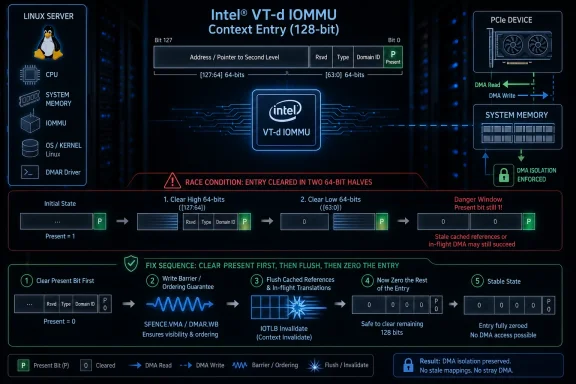
The bug is subtle because the kernel was not simply forgetting to clear a pointer or leaving an obvious stale mapping behind. Instead, the teardown path zeroed a 128-bit context entry using multiple 64-bit writes. During that brief transition, the hardware could observe a torn entry: some fields already cleared, while the Present bit still indicated that the entry was valid.
That is the sort of flaw that sounds academic until it is mapped onto real machines. Devices do not politely wait for the kernel to finish rearranging its tables. DMA engines, interrupt remappers, and translation caches can keep moving while software is in the middle of an update. If hardware sees a partially rewritten entry that still advertises itself as usable, the result is not a clean, deterministic refusal. The CVE description points to unpredictable behavior and spurious faults, which is cautious language for a class of mistakes that kernel developers try hard not to let exist at privilege boundaries.
The fix aligns the Linux driver with Intel VT-d invalidation guidance: clear the Present bit first, enforce ordering with a DMA write barrier, invalidate cached hardware references, and only then zero the rest of the entry. It also adds ordering on the setup side so that a context entry is fully initialized before the Present bit becomes visible. The theme is plain: validity must be the last thing software grants and the first thing it revokes.
The vulnerable behavior violated that contract during teardown. By zeroing the full entry in multiple writes, the kernel could temporarily create a state that no software engineer would design intentionally: an entry that still says “I am present” while its contents are being dismantled. Even if that state exists for only a handful of cycles, IOMMU hardware is allowed to be fast, parallel, and inconvenient.
The CVE text is also careful to avoid blaming x86 memory ordering in the usual simplistic way. x86 is famous for strong ordering, and that reputation often tempts people to assume that ordering problems belong mainly to weaker architectures. But this bug is not merely about whether a CPU core observes stores in sequence. The compiler may reorder writes to the two halves of the structure, and the hardware fetch of a 128-bit entry is not guaranteed to be atomic relative to two separate CPU writes.
That distinction matters for WindowsForum readers because it is the same class of problem that appears across operating systems, hypervisors, firmware, and device drivers. When software updates a structure consumed by independent hardware, “I wrote the fields in the right order in C” is not a synchronization primitive. The compiler, the CPU, the cache hierarchy, and the device all get a vote.
The corrected sequence treats the Present bit as an ownership handshake. First, software clears the bit to tell the IOMMU that the entry is no longer valid. Then it uses
The systems where this bug deserves closer attention are the ones that put Intel VT-d under constant operational stress. Virtualization hosts, KVM environments, VFIO passthrough rigs, container-heavy servers using device isolation, and enterprise Linux fleets with aggressive DMA protections all depend on IOMMU correctness. The more frequently a machine attaches, detaches, remaps, or reassigns devices, the more interesting a teardown race becomes.
There is also a practical distinction between exploitability and reliability. The CVE language emphasizes unpredictable behavior and spurious faults, which often show up first as mysterious instability: DMAR faults, device assignment failures, noisy logs, failed passthrough operations, or rare crashes during device lifecycle transitions. For administrators, those symptoms can be more expensive than a clean security alert because they blur the line between hardware flakiness, firmware quirks, kernel regressions, and misconfiguration.
That does not mean every VFIO hobbyist should assume their GPU passthrough setup has been silently unsafe. It means the right mitigation is boring and familiar: track your distribution’s kernel updates, confirm whether your shipped kernel includes the stable backport, and avoid inventing local workarounds unless you understand the IOMMU code path. Kernel security fixes often arrive as ordinary maintenance updates, and this one is likely to be consumed that way by most users.
The Windows angle is indirect but real. Many Windows enthusiasts run Linux hypervisors to host Windows VMs with PCIe passthrough, or they dual-boot and rely on firmware settings such as VT-d for both platforms. CVE-2026-45944 is not a Windows vulnerability, but it touches infrastructure that often exists precisely so Windows workloads can be isolated, accelerated, or virtualized.
C source code is a description from which the compiler produces machine code, not a notarized transcript of what the processor must do. In ordinary application programming, developers are trained to think of compiler reordering as something that matters primarily for multithreaded code. In kernel and driver development, the audience for a memory update may not be another CPU thread at all. It may be a device, an IOMMU, or a hardware cache that does not participate in the same abstractions as normal program logic.
That is why memory barriers exist in kernel code, and why they are so easy to misuse. A barrier such as
The setup path gets the mirror-image treatment. When setting an entry present, the driver must ensure the entry is fully initialized before the hardware can see the Present bit. Otherwise, the same class of bug appears in reverse: hardware may consume an entry that has been blessed before it has been completely built.
This is why the CVE is more interesting than its likely severity score may eventually suggest. The patch is not adding a giant new defense. It is making the existing defense true.
At a high level, VT-d lets the platform restrict what memory a device can access. That matters because DMA is powerful. A device that can read or write arbitrary physical memory can bypass ordinary OS-level protections. IOMMUs exist to make device access more explicit, more contained, and more compatible with virtualization.
Context entries are part of that machinery. They associate devices with translation structures and permissions. If a context entry is valid, hardware may use it to translate device-originated memory transactions. If it is invalid, hardware should not use its contents. The Present bit is therefore not just metadata. It is the gate between “this structure is live” and “this structure belongs to software.”
CVE-2026-45944 emerged because the old teardown sequence did not respect that gate strongly enough. Clearing the whole structure sounds safe in human terms: delete everything, leave nothing behind. But hardware protocol often demands a more careful order. First revoke the visible claim of validity. Then flush what hardware may have cached. Then clean the memory.
That ordering may feel backwards to people used to ordinary data cleanup. In security engineering, though, it is a familiar pattern. You do not destroy the evidence of ownership before telling the other party that ownership has ended. You revoke the credential, wait for the revocation to propagate, and only then shred the record.
For IT teams, that means the raw CVE description matters more than ever. A missing CVSS score should not freeze action, and it should not automatically downgrade concern. It simply means the analyst has to read the underlying bug. In this case, the evidence points to a kernel correctness issue in Intel VT-d context teardown, fixed by stable kernel commits, with operational relevance concentrated around systems that depend on IOMMU isolation and device assignment.
There is a trap here for vulnerability scanners. Without enrichment, tooling may struggle to tell an organization whether it is affected, whether the vulnerable code is reachable, or whether a particular distribution kernel has already backported the patch under a different version string. Enterprise Linux vendors routinely carry fixes without bumping to the newest upstream kernel release, so naive “kernel version less than X” logic can mislead in both directions.
Security teams should therefore map this CVE through their vendor advisories and package changelogs, not just upstream Git history. A cloud host running a vendor-maintained LTS kernel may receive the fix as a backport. A custom-built kernel may need the stable commit applied directly. A desktop distribution tracking recent kernels may pick it up quickly and quietly.
The uncomfortable reality is that infrastructure CVEs increasingly require infrastructure literacy. You cannot fully assess this one from the CVE ID alone. You need to know whether VT-d is enabled, whether the Intel IOMMU driver is in use, whether device assignment or DMA isolation is part of the workload, and whether your kernel build includes the corrected ordering.
The recommended sequence is conceptually simple but operationally strict. Clear Present first. Make the change visible. Invalidate caches. Then zero the entry. In the opposite direction, initialize first, order the writes, and expose Present last. These rules are easy to state and easy to violate in a codebase that has evolved across architectures, compilers, and performance assumptions.
Kernel developers often live in this tension. The fastest way to update a structure is not always the safest way to update a structure observed by hardware. The cleanest-looking C assignment may not preserve the protocol-level state transition. The most obvious teardown operation, clearing all fields, may briefly create a state that the hardware specification told software to avoid.
That is why stable backports matter. Bugs like this do not only belong to bleeding-edge kernels. They can sit in long-lived subsystems until someone revisits the exact semantics of an update path. Once fixed, the value is not limited to preventing a named CVE. It also reduces a class of weird IOMMU behavior that administrators might otherwise misdiagnose for years.
For Linux users, the right emotional register is neither complacency nor alarm. This is a serious correctness fix in privileged kernel code that protects memory from devices. It is also a narrow bug whose practical risk depends heavily on hardware, configuration, workload, and timing. Treat it like a kernel security update, not like a wormable Internet emergency.
That is why virtualization operators should pay attention to CVE-2026-45944 even if exploit details remain vague. The most likely first-order effect may be reliability rather than attacker-controlled compromise. But in a hypervisor context, reliability and isolation are intertwined. A device assignment path that produces unpredictable IOMMU behavior is automatically a security-relevant path.
VFIO users are a useful example. GPU passthrough enthusiasts often focus on IOMMU groups, ACS quirks, reset bugs, and firmware toggles. Enterprise operators using passthrough focus on performance, tenant boundaries, and operational repeatability. Both groups rely on the same basic promise: a device assigned to one domain should not be able to wander through memory it does not own.
CVE-2026-45944 does not prove that such wandering was practically achievable. The record does not claim a known exploit, and NVD had not scored it at publication. But the fix exists because the old transition could present hardware with a malformed valid entry. In memory isolation code, malformed-but-valid is exactly the category that deserves attention.
For Windows-heavy shops using Linux as the virtualization substrate, the patch should land on the host side. Updating Windows guests will not address a Linux VT-d driver issue. The host kernel owns the IOMMU programming model, and that is where the corrected ordering must live.
The practical response is straightforward for most environments. Keep kernel packages current. Reboot into the fixed kernel after installation. Verify that the running kernel, not merely the installed package, contains the update. In clustered virtualization environments, drain hosts before rebooting and roll the update in a controlled wave.
Custom kernel users have more work. If you build kernels for appliances, lab hypervisors, embedded systems, or performance-tuned hosts, you need to confirm whether your source tree includes the relevant stable patch. The fix is small enough to look deceptively easy to cherry-pick, but IOMMU code is not an ideal place for casual patch surgery. Pull from the appropriate stable branch where possible.
There is no sensible mitigation in disabling VT-d across the board. Turning off the IOMMU may avoid this specific code path, but it also removes a major DMA isolation mechanism and can break virtualization or passthrough workloads. For security-minded systems, disabling the IOMMU to avoid an IOMMU bug is usually the wrong trade unless a vendor explicitly recommends it for a narrow emergency.
Firmware settings are also not the primary fix. BIOS and UEFI toggles for VT-d determine whether the feature is available and used, but the vulnerable behavior described here is in Linux kernel teardown logic. The durable remediation is a corrected kernel.
 A Race at the Edge of the Memory Map Becomes a Security Bug
The Linux kernel vulnerability behind CVE-2026-45944 lives in the Intel VT-d IOMMU driver, specifically in the logic that tears down a context entry. An IOMMU is the hardware-assisted traffic cop that sits between devices and system memory, translating and restricting DMA access in much the same spirit that an MMU does for CPU memory accesses. On systems that use virtualization, device passthrough, confidential computing primitives, or hardened DMA isolation, this machinery is not decorative plumbing. It is part of the trust boundary.The bug is subtle because the kernel was not simply forgetting to clear a pointer or leaving an obvious stale mapping behind. Instead, the teardown path zeroed a 128-bit context entry using multiple 64-bit writes. During that brief transition, the hardware could observe a torn entry: some fields already cleared, while the Present bit still indicated that the entry was valid.
That is the sort of flaw that sounds academic until it is mapped onto real machines. Devices do not politely wait for the kernel to finish rearranging its tables. DMA engines, interrupt remappers, and translation caches can keep moving while software is in the middle of an update. If hardware sees a partially rewritten entry that still advertises itself as usable, the result is not a clean, deterministic refusal. The CVE description points to unpredictable behavior and spurious faults, which is cautious language for a class of mistakes that kernel developers try hard not to let exist at privilege boundaries.
The fix aligns the Linux driver with Intel VT-d invalidation guidance: clear the Present bit first, enforce ordering with a DMA write barrier, invalidate cached hardware references, and only then zero the rest of the entry. It also adds ordering on the setup side so that a context entry is fully initialized before the Present bit becomes visible. The theme is plain: validity must be the last thing software grants and the first thing it revokes.
The Present Bit Is Not a Boolean, It Is a Contract
It is tempting to read “Present bit” as a simple flag. In kernel and hardware code, flags are rarely that simple. A Present bit is a contract between software and hardware about who owns an entry, whether the entry can be consumed, and whether the other fields around it are meaningful.The vulnerable behavior violated that contract during teardown. By zeroing the full entry in multiple writes, the kernel could temporarily create a state that no software engineer would design intentionally: an entry that still says “I am present” while its contents are being dismantled. Even if that state exists for only a handful of cycles, IOMMU hardware is allowed to be fast, parallel, and inconvenient.
The CVE text is also careful to avoid blaming x86 memory ordering in the usual simplistic way. x86 is famous for strong ordering, and that reputation often tempts people to assume that ordering problems belong mainly to weaker architectures. But this bug is not merely about whether a CPU core observes stores in sequence. The compiler may reorder writes to the two halves of the structure, and the hardware fetch of a 128-bit entry is not guaranteed to be atomic relative to two separate CPU writes.
That distinction matters for WindowsForum readers because it is the same class of problem that appears across operating systems, hypervisors, firmware, and device drivers. When software updates a structure consumed by independent hardware, “I wrote the fields in the right order in C” is not a synchronization primitive. The compiler, the CPU, the cache hierarchy, and the device all get a vote.
The corrected sequence treats the Present bit as an ownership handshake. First, software clears the bit to tell the IOMMU that the entry is no longer valid. Then it uses
dma_wmb() to make that transition visible where it matters. Then it performs the invalidations needed to flush stale hardware knowledge. Only after that does it wipe the rest of the context entry.This Is a Kernel CVE Built for Cloud Hosts, Not Desktop Panic
For most desktop Linux users, CVE-2026-45944 is unlikely to be the kind of vulnerability that changes Tuesday afternoon. It does not describe a browser exploit, a remote packet trigger, or a trivial local privilege escalation with a public proof of concept. NVD had not yet assigned CVSS metrics at publication time, and the record was still awaiting enrichment. That absence should not be mistaken for proof of harmlessness, but it does argue against instant drama.The systems where this bug deserves closer attention are the ones that put Intel VT-d under constant operational stress. Virtualization hosts, KVM environments, VFIO passthrough rigs, container-heavy servers using device isolation, and enterprise Linux fleets with aggressive DMA protections all depend on IOMMU correctness. The more frequently a machine attaches, detaches, remaps, or reassigns devices, the more interesting a teardown race becomes.
There is also a practical distinction between exploitability and reliability. The CVE language emphasizes unpredictable behavior and spurious faults, which often show up first as mysterious instability: DMAR faults, device assignment failures, noisy logs, failed passthrough operations, or rare crashes during device lifecycle transitions. For administrators, those symptoms can be more expensive than a clean security alert because they blur the line between hardware flakiness, firmware quirks, kernel regressions, and misconfiguration.
That does not mean every VFIO hobbyist should assume their GPU passthrough setup has been silently unsafe. It means the right mitigation is boring and familiar: track your distribution’s kernel updates, confirm whether your shipped kernel includes the stable backport, and avoid inventing local workarounds unless you understand the IOMMU code path. Kernel security fixes often arrive as ordinary maintenance updates, and this one is likely to be consumed that way by most users.
The Windows angle is indirect but real. Many Windows enthusiasts run Linux hypervisors to host Windows VMs with PCIe passthrough, or they dual-boot and rely on firmware settings such as VT-d for both platforms. CVE-2026-45944 is not a Windows vulnerability, but it touches infrastructure that often exists precisely so Windows workloads can be isolated, accelerated, or virtualized.
The Compiler Is Part of the Threat Model
One of the more instructive details in the CVE description is the compiler. The record notes that while x86 provides strong write ordering, the compiler may reorder writes to the two 64-bit halves of the context entry. That line is not filler. It is the kernel development equivalent of a warning label.C source code is a description from which the compiler produces machine code, not a notarized transcript of what the processor must do. In ordinary application programming, developers are trained to think of compiler reordering as something that matters primarily for multithreaded code. In kernel and driver development, the audience for a memory update may not be another CPU thread at all. It may be a device, an IOMMU, or a hardware cache that does not participate in the same abstractions as normal program logic.
That is why memory barriers exist in kernel code, and why they are so easy to misuse. A barrier such as
dma_wmb() is not decorative ceremony. It tells the system that writes relevant to DMA-visible memory must become visible in the required order before software proceeds. In this fix, the barrier after clearing the Present bit is what helps turn a field update into an observable ownership transition.The setup path gets the mirror-image treatment. When setting an entry present, the driver must ensure the entry is fully initialized before the hardware can see the Present bit. Otherwise, the same class of bug appears in reverse: hardware may consume an entry that has been blessed before it has been completely built.
This is why the CVE is more interesting than its likely severity score may eventually suggest. The patch is not adding a giant new defense. It is making the existing defense true.
VT-d Makes the Bug Harder to Ignore
Intel VT-d, like AMD-Vi on AMD platforms, is one of those technologies that many users encounter only when something breaks. It appears in BIOS setup screens, Proxmox guides, VFIO tutorials, Hyper-V discussions, and security hardening checklists. When it works, it is invisible. When it fails, it produces terse errors and long forum threads.At a high level, VT-d lets the platform restrict what memory a device can access. That matters because DMA is powerful. A device that can read or write arbitrary physical memory can bypass ordinary OS-level protections. IOMMUs exist to make device access more explicit, more contained, and more compatible with virtualization.
Context entries are part of that machinery. They associate devices with translation structures and permissions. If a context entry is valid, hardware may use it to translate device-originated memory transactions. If it is invalid, hardware should not use its contents. The Present bit is therefore not just metadata. It is the gate between “this structure is live” and “this structure belongs to software.”
CVE-2026-45944 emerged because the old teardown sequence did not respect that gate strongly enough. Clearing the whole structure sounds safe in human terms: delete everything, leave nothing behind. But hardware protocol often demands a more careful order. First revoke the visible claim of validity. Then flush what hardware may have cached. Then clean the memory.
That ordering may feel backwards to people used to ordinary data cleanup. In security engineering, though, it is a familiar pattern. You do not destroy the evidence of ownership before telling the other party that ownership has ended. You revoke the credential, wait for the revocation to propagate, and only then shred the record.
The NVD Delay Leaves Administrators Doing Their Own Triage
The NVD entry for CVE-2026-45944 was published on May 27, 2026, with no NVD CVSS score, no completed weakness classification, and the familiar “awaiting enrichment” status. That is now a common feature of vulnerability work rather than an exception. The CVE system is producing records faster than enrichment pipelines can consistently add product mappings, severity vectors, and prioritization hints.For IT teams, that means the raw CVE description matters more than ever. A missing CVSS score should not freeze action, and it should not automatically downgrade concern. It simply means the analyst has to read the underlying bug. In this case, the evidence points to a kernel correctness issue in Intel VT-d context teardown, fixed by stable kernel commits, with operational relevance concentrated around systems that depend on IOMMU isolation and device assignment.
There is a trap here for vulnerability scanners. Without enrichment, tooling may struggle to tell an organization whether it is affected, whether the vulnerable code is reachable, or whether a particular distribution kernel has already backported the patch under a different version string. Enterprise Linux vendors routinely carry fixes without bumping to the newest upstream kernel release, so naive “kernel version less than X” logic can mislead in both directions.
Security teams should therefore map this CVE through their vendor advisories and package changelogs, not just upstream Git history. A cloud host running a vendor-maintained LTS kernel may receive the fix as a backport. A custom-built kernel may need the stable commit applied directly. A desktop distribution tracking recent kernels may pick it up quickly and quietly.
The uncomfortable reality is that infrastructure CVEs increasingly require infrastructure literacy. You cannot fully assess this one from the CVE ID alone. You need to know whether VT-d is enabled, whether the Intel IOMMU driver is in use, whether device assignment or DMA isolation is part of the workload, and whether your kernel build includes the corrected ordering.
The Patch Says More About Process Than Panic
The most revealing thing about the fix is that it does not invent a new concept. It follows the VT-d specification’s invalidation guidance. That makes CVE-2026-45944 less a story about a surprise hardware behavior than a story about software needing to honor hardware’s required lifecycle.The recommended sequence is conceptually simple but operationally strict. Clear Present first. Make the change visible. Invalidate caches. Then zero the entry. In the opposite direction, initialize first, order the writes, and expose Present last. These rules are easy to state and easy to violate in a codebase that has evolved across architectures, compilers, and performance assumptions.
Kernel developers often live in this tension. The fastest way to update a structure is not always the safest way to update a structure observed by hardware. The cleanest-looking C assignment may not preserve the protocol-level state transition. The most obvious teardown operation, clearing all fields, may briefly create a state that the hardware specification told software to avoid.
That is why stable backports matter. Bugs like this do not only belong to bleeding-edge kernels. They can sit in long-lived subsystems until someone revisits the exact semantics of an update path. Once fixed, the value is not limited to preventing a named CVE. It also reduces a class of weird IOMMU behavior that administrators might otherwise misdiagnose for years.
For Linux users, the right emotional register is neither complacency nor alarm. This is a serious correctness fix in privileged kernel code that protects memory from devices. It is also a narrow bug whose practical risk depends heavily on hardware, configuration, workload, and timing. Treat it like a kernel security update, not like a wormable Internet emergency.
Virtualization Turns Rare Timing Bugs Into Fleet Problems
A race window that looks vanishingly small on a single machine can become visible across a fleet. That is the arithmetic of modern infrastructure. If thousands of hosts repeatedly create and destroy device mappings, reassign PCIe devices, recover from errors, suspend and resume hardware, or churn through virtual machine lifecycles, low-probability timing bugs get more chances to happen.That is why virtualization operators should pay attention to CVE-2026-45944 even if exploit details remain vague. The most likely first-order effect may be reliability rather than attacker-controlled compromise. But in a hypervisor context, reliability and isolation are intertwined. A device assignment path that produces unpredictable IOMMU behavior is automatically a security-relevant path.
VFIO users are a useful example. GPU passthrough enthusiasts often focus on IOMMU groups, ACS quirks, reset bugs, and firmware toggles. Enterprise operators using passthrough focus on performance, tenant boundaries, and operational repeatability. Both groups rely on the same basic promise: a device assigned to one domain should not be able to wander through memory it does not own.
CVE-2026-45944 does not prove that such wandering was practically achievable. The record does not claim a known exploit, and NVD had not scored it at publication. But the fix exists because the old transition could present hardware with a malformed valid entry. In memory isolation code, malformed-but-valid is exactly the category that deserves attention.
For Windows-heavy shops using Linux as the virtualization substrate, the patch should land on the host side. Updating Windows guests will not address a Linux VT-d driver issue. The host kernel owns the IOMMU programming model, and that is where the corrected ordering must live.
The Stable Kernel Trail Is the Remediation Path
The CVE record points to stable kernel commits, which is the important remediation clue. Upstream Linux fixes are only the first step; distributions then decide how to backport, test, and ship them. Administrators should look for vendor-specific advisories or package changelog entries referencing CVE-2026-45944, Intel IOMMU, VT-d context entries, or the Present-bit teardown fix.The practical response is straightforward for most environments. Keep kernel packages current. Reboot into the fixed kernel after installation. Verify that the running kernel, not merely the installed package, contains the update. In clustered virtualization environments, drain hosts before rebooting and roll the update in a controlled wave.
Custom kernel users have more work. If you build kernels for appliances, lab hypervisors, embedded systems, or performance-tuned hosts, you need to confirm whether your source tree includes the relevant stable patch. The fix is small enough to look deceptively easy to cherry-pick, but IOMMU code is not an ideal place for casual patch surgery. Pull from the appropriate stable branch where possible.
There is no sensible mitigation in disabling VT-d across the board. Turning off the IOMMU may avoid this specific code path, but it also removes a major DMA isolation mechanism and can break virtualization or passthrough workloads. For security-minded systems, disabling the IOMMU to avoid an IOMMU bug is usually the wrong trade unless a vendor explicitly recommends it for a narrow emergency.
Firmware settings are also not the primary fix. BIOS and UEFI toggles for VT-d determine whether the feature is available and used, but the vulnerable behavior described here is in Linux kernel teardown logic. The durable remediation is a corrected kernel.
The Small Flag That Should Drive the Patch Queue
CVE-2026-45944 is not a household-name vulnerability, but it is concrete enough to act on. The useful takeaways are less about panic and more about prioritizing the right machines.- Systems using Intel VT-d with Linux IOMMU support should be checked for kernel updates that include the context-entry teardown fix.
- Virtualization hosts, VFIO passthrough systems, and servers relying on DMA isolation deserve higher priority than ordinary desktops.
- The absence of an NVD CVSS score on May 27, 2026 should not be treated as evidence that the issue is irrelevant.
- Updating the Linux host kernel is the meaningful remediation; updating Windows guests or changing guest drivers does not fix the host IOMMU path.
- Administrators should verify the running kernel after patching, because an installed kernel package does not protect a system until the machine boots into it.
- Disabling VT-d is generally a poor mitigation unless a trusted vendor advisory recommends it for a specific deployment.
References
- Primary source: NVD / Linux Kernel
Published: 2026-05-28T01:05:48-07:00
NVD - CVE-2026-45944
 nvd.nist.gov
- Security advisory: MSRC
Published: 2026-05-28T01:05:48-07:00
Original feed URL
Security Update Guide - Microsoft Security Response Center
 msrc.microsoft.com
- Official source: nist.gov
National Vulnerability Database
NIST maintains the National Vulnerability Database (NVD), a repository of information on software and hardware flaws that can compromise computer security. This is a key piece of the nation’s cybersecurity infrastructure.www.nist.gov - Related coverage: patchew.org
- Related coverage: lkml.indiana.edu
- Related coverage: mail-archive.com
[PATCH v2 4/7] iommu/vt-d: Handle non-page aligned address
www.mail-archive.com
- Related coverage: docs.redhat.com
- Related coverage: labs.cloudsecurityalliance.org
NVD Enrichment Triage: Enterprise Vulnerability Programs Must Adapt
PDF documentlabs.cloudsecurityalliance.org
- Related coverage: first.org
The National Vulnerability Database Ms. Tanya Brewer NVD Program Manager June 2024
PDF documentwww.first.org
- Related coverage: docs.riscv.org
