

CVE-2026-45956, published by NVD on May 27, 2026, covers a Linux kernel flaw in the Exynos DRM VIDI driver where an ioctl path could look up the wrong device context and potentially trigger crashes or memory-safety failures. The bug is obscure, hardware-specific, and still awaiting NVD enrichment, but it is not trivial. It is a reminder that kernel security is often decided not by dramatic remote exploits, but by whether one pointer really points at the object the code thinks it does. For administrators, distro maintainers, and anyone shipping Linux on ARM-based display hardware, the practical lesson is blunt: the boring graphics stack is still part of the attack surface.
The CVE description is unusually plain by vulnerability-database standards. In
That distinction sounds like inside baseball until you remember what kernel code does with pointers. If a function believes it has a valid display-driver context but is actually holding unrelated device data, the result is not merely a failed lookup. The code may dereference garbage, walk through invalid structures, or behave correctly just long enough to make the eventual failure confusing.
The kernel fix changes the lookup model. Instead of assuming the DRM master device can yield the VIDI context, the driver stores the VIDI device pointer in
That is why CVE-2026-45956 is worth more attention than its niche component name suggests. The vulnerable path lives in graphics plumbing, but the bug class is familiar across the kernel: a subsystem boundary gets blurred, object ownership becomes implicit, and an ioctl gives user space a way to poke the confusion.
That is precisely where mistakes can persist. DRM drivers sit at an awkward intersection of hardware-specific state, shared graphics infrastructure, device binding, memory management, and user-space ioctls. They are written as kernel code, exposed through kernel interfaces, and frequently shaped by SoC vendor architectures that were never designed for elegance.
The vulnerable function’s name tells part of the story:
Here, the issue was not a classic unchecked length field or an obvious missing permission gate. It was an assumption about where the driver context lived. The master DRM device and the VIDI component device were both real kernel objects, but only one of them owned the data the function wanted. The code crossed that line and treated the wrong object as authoritative.
That kind of bug can survive review because it often looks plausible. A master device is not a random pointer. It belongs to the same subsystem. It has driver data. The code compiles, the types line up well enough, and common paths may not immediately explode. The failure emerges when the subsystem’s internal topology matters more than the convenience of a nearby pointer.
They should be careful. A missing NVD score is not a risk rating. It is an administrative state in a vulnerability ecosystem that has been under visible strain from high CVE volume. In the meantime, kernel.org’s record and the stable-branch patches are the more actionable sources of truth for anyone maintaining affected kernels.
The description itself is broad about possible impact: null pointer dereferences, garbage value accesses, out-of-bounds errors, use-after-free errors, and more. That range is not a promise that every affected system is exploitable for privilege escalation. It is an admission that once kernel code starts interpreting the wrong memory as a driver context, the possible failure modes depend heavily on layout, timing, configuration, and call path.
For defenders, that uncertainty cuts both ways. It may mean many real-world systems merely crash or never expose the path in a useful way. It also means risk cannot be safely reduced to “no score, no problem.” Memory-safety failures in kernel ioctl handlers deserve attention even when the exploitability analysis is incomplete.
This is especially true for distributions and product vendors. Enterprise vulnerability management often waits for severity numbers, CPE mappings, vendor advisories, and scanner plugins. Kernel security does not always move on that schedule. Sometimes the patch is the signal.
That matters. Kernel memory corruption can be severe, but severity depends on reachability. An attacker needs access to the relevant device node or ioctl interface, an affected kernel configuration, the Exynos DRM VIDI component present or reachable, and system conditions that make the wrong-context access controllable rather than merely fatal. Those constraints are substantial.
This is not the sort of vulnerability that should panic a fleet of conventional x86 Windows endpoints or cloud Linux VMs. Exynos is an ARM SoC family, and the affected driver lives in a specific Linux graphics stack. The systems of interest are more likely to be embedded Linux devices, development boards, Android-derived environments, appliance-style products, or specialized ARM deployments than mainstream corporate laptops.
Still, narrow does not mean irrelevant. Hardware-specific kernel flaws are exactly the vulnerabilities that downstream product teams can underestimate because they do not resemble headline-grabbing OpenSSL, Exchange, or browser bugs. If the vulnerable code is present in an appliance image, kiosk, media device, automotive-adjacent stack, lab system, or board support package, the fact that the bug is obscure will not protect it.
The most realistic near-term consequence is probably stability rather than remote compromise. A bad ioctl path in a graphics driver can produce crashes and hard-to-debug failures. But security engineering has learned the hard way that “probably just a crash” is not a satisfying conclusion when the crash occurs in privileged kernel code and the root cause involves type confusion or stale object assumptions.
That matters more than the CVSS vacuum. Linux kernel CVEs often arrive after the actual patch has already moved through mailing lists and stable queues. The operational question is not “what score did NVD assign today?” but “which kernel versions in my environment include the fixed commit, and which vendor packages have absorbed the backport?”
The backport pattern also helps explain why the visible patch may appear before many enterprise tools understand the CVE. Kernel maintainers work in commits and stable trees. Security scanners work in identifiers, package versions, metadata enrichment, and sometimes delayed vendor mapping. The gap between those two worlds is where a lot of patch-management confusion lives.
For administrators, the answer is mundane but necessary. Track your distribution’s kernel advisory stream, not only NVD. If you maintain custom kernels, board-support packages, or vendor forks, inspect whether the relevant Exynos DRM VIDI fix has been applied. If you ship products, do not assume your upstream stable base automatically landed in your production firmware.
This is one of the reasons Linux kernel security remains difficult for non-specialists. A CVE can describe a function-level bug, stable commits can fix it across branches, and a vendor kernel can still remain vulnerable because it carries a customized driver snapshot from somewhere between those points in time.
Even a display driver for a relatively specific SoC participates in that broader pattern. The user-space side of graphics needs ways to ask the kernel for state changes. The kernel side must translate those requests into hardware operations without trusting user space, racing teardown paths, or confusing one device’s state with another’s. That is a demanding contract.
CVE-2026-45956 sits in a particularly instructive corner of that contract. It is not about shader compilers or GPU command streams, the components that usually get the security spotlight. It is about driver binding and context lookup. The vulnerability exists because the function reached through the wrong object relationship before doing its work.
That should sound familiar to anyone who has followed kernel hardening. Many serious kernel bugs are not failures of clever cryptography or exotic CPU behavior. They are failures to maintain invariants: this pointer is still alive, this file belongs to that device, this private data came from the object we think it did, this teardown path cannot race this ioctl. Once those invariants break, the rest of the code becomes unsafe by default.
The lesson for WindowsForum’s audience is broader than Linux-on-Exynos. Windows display drivers, Linux DRM drivers, mobile GPU stacks, and hypervisor graphics devices all sit near trust boundaries. The details differ, but the theme repeats: display plumbing is no longer merely display plumbing. It is privileged, stateful, user-reachable code.
But hardware-specific bugs have their own risk profile. They often live in products whose software update paths are weaker than the update paths for general-purpose operating systems. A server fleet may receive kernel patches through a disciplined package pipeline. An embedded device may depend on a vendor firmware release that arrives late, rarely, or never.
This is where the Linux ecosystem’s strength becomes complicated. The same kernel can support everything from hyperscale servers to development boards to consumer electronics. A fix can land upstream quickly, yet the device that actually matters to a user may be several layers removed from upstream. Silicon vendors, board vendors, OEMs, integrators, and product teams all get a turn at either preserving or losing the patch.
Exynos hardware has appeared in phones, tablets, boards, and embedded contexts over the years. Not every such device uses the same kernel configuration, exposes the same interfaces, or remains within support. That makes blanket claims risky. It also makes inventory essential.
The systems most likely to care are not necessarily the most visible ones. A lab full of ARM boards, an internal hardware test platform, a signage controller, a media appliance, or a custom Linux image with Exynos display support may be a better candidate for review than a generic desktop. Security teams should resist both extremes: this is neither a universal emergency nor a harmless footnote.
Good kernel fixes tend to do this. They remove ambiguity instead of adding a local null check and calling it done. A null check might prevent one crash. A correct ownership path prevents a class of wrong-object behavior from recurring in the same location.
The bind and unbind detail also matters. Device lifetime is one of the hardest parts of driver security. If the driver stores a pointer when the component becomes part of the DRM device, it must also clear it when that component is removed. Otherwise, today’s wrong-context bug can become tomorrow’s stale-pointer bug.
This is why small patches often carry more architectural meaning than their diff size suggests. The code is not merely being told “use a different variable.” It is being told that the private DRM structure must explicitly remember which VIDI device it owns, and that the ioctl path must respect that ownership.
For maintainers of out-of-tree drivers, the pattern is worth copying. If an ioctl depends on component-specific private data, make the component relationship explicit. Do not rely on a nearby parent, master, or aggregate device to produce the right object unless the subsystem contract guarantees it.
The more mature approach is to classify by exposure and ownership. Do you run affected Exynos-based kernels? Is the Exynos DRM VIDI driver built, loadable, or active? Are untrusted users or sandboxed processes able to reach the relevant DRM device nodes? Is the system an embedded product where kernel updates are slow? Those questions matter more than the presence of a red number.
This is where Windows administrators who also manage Linux infrastructure can get tripped up. Windows vulnerability servicing usually centers on vendor bulletins, cumulative updates, and product-defined applicability. Linux kernel vulnerability handling often requires mapping upstream commits to downstream packages and sometimes to custom vendor trees. The unit of truth is not always the CVE record.
There is also a cultural mismatch. The kernel community frequently fixes bugs because they are plainly wrong, then CVE assignment and database enrichment follow. Enterprise tooling often wants the reverse: a scored CVE first, remediation later. CVE-2026-45956 is a case where the fix exists, the issue is described, and the scoring infrastructure is still catching up.
Security teams should not treat that lag as permission to wait forever. They should treat it as a prompt to improve how they ingest kernel fixes. If a system is in scope, patch. If it is not in scope, document why. If nobody knows whether it is in scope, that is an asset-inventory problem wearing a vulnerability-management mask.
A bug like CVE-2026-45956 can therefore have a strange lifecycle. Upstream fixes the object lookup. Stable trees carry the patch. Major distributions absorb it. But a product kernel built around an older Exynos vendor tree may not receive the change unless someone actively ports it.
That “someone” is often unclear. The silicon vendor may have moved on. The board vendor may support only a narrow kernel branch. The OEM may consider the product mature. The customer may not have source-level visibility. Meanwhile, the vulnerability record sits in a public database, describing a real kernel bug that applies precisely to the sort of systems least likely to have seamless patching.
This is why embedded Linux security has become a supply-chain discipline. It is not enough to know that Linux fixed a vulnerability. Product teams need traceability from upstream commit to downstream firmware image. They need to know which kernel configuration options are enabled and which device nodes are exposed. They need release processes that can handle “small” driver fixes without waiting for a quarterly platform refresh.
The irony is that narrow hardware flaws can be easier for attackers to reason about in targeted environments. If an attacker knows the appliance model, kernel lineage, and exposed local interface, obscurity becomes less of a defense. The target set is smaller, but the software stack may be more static.
The kernel has added many mitigations over the years: slab hardening, refcount protections, kernel address-space layout randomization, hardened usercopy, control-flow defenses on some architectures, and more. Those measures raise the cost of exploitation. They do not make it safe for a driver to treat unrelated device data as a
That is the key distinction. Mitigations are guardrails. Correct object ownership is the road. When the road is wrong, guardrails may reduce the crash, complicate exploitation, or turn a memory corruption into a denial of service. They do not erase the vulnerability.
The growing interest in Rust for kernel drivers is relevant here, but it should not be oversold. Rust can help encode ownership and lifetime rules that C leaves to convention. Yet the existing kernel driver universe is vast, and many hardware-specific components will remain C for years. For now, disciplined review and boring pointer hygiene are still doing most of the work.
CVE-2026-45956 is a small data point in that larger argument. It shows that memory safety is not only about hostile packet parsers and exposed network daemons. It is also about internal driver relationships that become unsafe when the wrong object is trusted.
Start with inventory. Look for Linux systems using Samsung Exynos SoCs or kernels with Exynos DRM support enabled. Then determine whether the VIDI component is present in the build and whether the relevant ioctl path is reachable by users or applications. On distributions, follow the vendor kernel advisory and update channel. On custom kernels, compare against the stable commits referenced by the CVE and verify the fix in source.
The harder cases are products and appliances. If you receive firmware from a vendor, ask whether the CVE has been evaluated and whether the Exynos DRM VIDI fix is included. If you build firmware, pull the patch into your kernel tree and test display behavior around bind, unbind, and VIDI connection handling. If you cannot patch immediately, reduce local access to DRM device nodes where feasible and reassess whether untrusted code can reach them.
This is also a good moment to review assumptions about graphics-device permissions. Many Linux systems rely on groups, logind, udev rules, containers, or seat management to decide which processes can open DRM nodes. A driver bug becomes more serious when those nodes are broadly reachable by untrusted workloads.
Do not overcorrect, though. There is no public basis in the provided record for declaring a widespread remote-code-execution crisis. The right move is to patch affected kernels and improve exposure mapping, not to invent a bigger incident than the evidence supports.
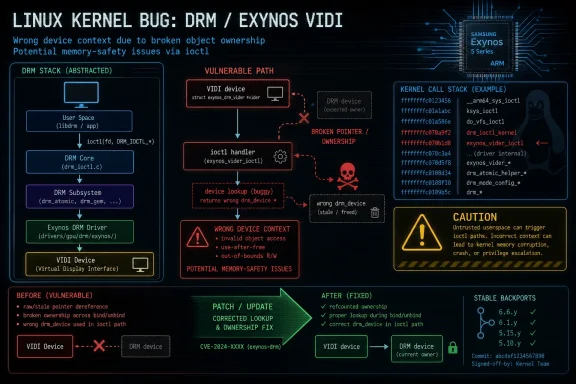 A Small Driver Bug Lands in the Big Kernel Security Machine
The CVE description is unusually plain by vulnerability-database standards. In vidi_connection_ioctl(), the Exynos DRM VIDI code retrieved driver_data from drm_dev->dev in order to obtain a struct vidi_context pointer. The problem is that drm_dev->dev is the Exynos DRM master device, not the VIDI component device whose driver data should be used.That distinction sounds like inside baseball until you remember what kernel code does with pointers. If a function believes it has a valid display-driver context but is actually holding unrelated device data, the result is not merely a failed lookup. The code may dereference garbage, walk through invalid structures, or behave correctly just long enough to make the eventual failure confusing.
The kernel fix changes the lookup model. Instead of assuming the DRM master device can yield the VIDI context, the driver stores the VIDI device pointer in
exynos_drm_private->vidi_dev during bind, clears it during unbind, and uses that private pointer inside the ioctl path. In security terms, the patch does not add a grand new mitigation. It restores the code’s object model so the driver stops asking the wrong device for the right answer.That is why CVE-2026-45956 is worth more attention than its niche component name suggests. The vulnerable path lives in graphics plumbing, but the bug class is familiar across the kernel: a subsystem boundary gets blurred, object ownership becomes implicit, and an ioctl gives user space a way to poke the confusion.
The VIDI Path Shows How Kernel Abstractions Leak
The Exynos DRM stack exists to support Samsung Exynos display hardware in the Linux kernel’s Direct Rendering Manager framework. VIDI, in this context, is not the consumer-facing feature most users will recognize. It is a driver component in a larger display pipeline, the kind of code that can spend years below the waterline of normal desktop and server attention.That is precisely where mistakes can persist. DRM drivers sit at an awkward intersection of hardware-specific state, shared graphics infrastructure, device binding, memory management, and user-space ioctls. They are written as kernel code, exposed through kernel interfaces, and frequently shaped by SoC vendor architectures that were never designed for elegance.
The vulnerable function’s name tells part of the story:
vidi_connection_ioctl(). An ioctl is one of the oldest and most flexible ways user space asks the kernel to do device-specific things. Flexibility is useful for graphics drivers, but it also means the kernel must be exceptionally disciplined about validating inputs, state, and object identity before doing anything with them.Here, the issue was not a classic unchecked length field or an obvious missing permission gate. It was an assumption about where the driver context lived. The master DRM device and the VIDI component device were both real kernel objects, but only one of them owned the data the function wanted. The code crossed that line and treated the wrong object as authoritative.
That kind of bug can survive review because it often looks plausible. A master device is not a random pointer. It belongs to the same subsystem. It has driver data. The code compiles, the types line up well enough, and common paths may not immediately explode. The failure emerges when the subsystem’s internal topology matters more than the convenience of a nearby pointer.
“Awaiting Enrichment” Does Not Mean “Awaiting Risk”
NVD currently lists CVE-2026-45956 without NVD-provided CVSS 4.0, CVSS 3.x, or CVSS 2.0 scoring. The record is marked as awaiting enrichment, meaning the database has received and published the CVE but has not yet completed the additional metadata work many scanners and dashboards depend on. That absence will tempt some teams to ignore it.They should be careful. A missing NVD score is not a risk rating. It is an administrative state in a vulnerability ecosystem that has been under visible strain from high CVE volume. In the meantime, kernel.org’s record and the stable-branch patches are the more actionable sources of truth for anyone maintaining affected kernels.
The description itself is broad about possible impact: null pointer dereferences, garbage value accesses, out-of-bounds errors, use-after-free errors, and more. That range is not a promise that every affected system is exploitable for privilege escalation. It is an admission that once kernel code starts interpreting the wrong memory as a driver context, the possible failure modes depend heavily on layout, timing, configuration, and call path.
For defenders, that uncertainty cuts both ways. It may mean many real-world systems merely crash or never expose the path in a useful way. It also means risk cannot be safely reduced to “no score, no problem.” Memory-safety failures in kernel ioctl handlers deserve attention even when the exploitability analysis is incomplete.
This is especially true for distributions and product vendors. Enterprise vulnerability management often waits for severity numbers, CPE mappings, vendor advisories, and scanner plugins. Kernel security does not always move on that schedule. Sometimes the patch is the signal.
The Exploitability Question Is Narrower Than the Bug Class
The first question many readers will ask is whether CVE-2026-45956 allows local privilege escalation. The honest answer, based on the public description, is that the record does not establish that. It describes possible memory corruption consequences, but it does not provide a proof of exploitability, a privilege boundary analysis, or a working exploit path.That matters. Kernel memory corruption can be severe, but severity depends on reachability. An attacker needs access to the relevant device node or ioctl interface, an affected kernel configuration, the Exynos DRM VIDI component present or reachable, and system conditions that make the wrong-context access controllable rather than merely fatal. Those constraints are substantial.
This is not the sort of vulnerability that should panic a fleet of conventional x86 Windows endpoints or cloud Linux VMs. Exynos is an ARM SoC family, and the affected driver lives in a specific Linux graphics stack. The systems of interest are more likely to be embedded Linux devices, development boards, Android-derived environments, appliance-style products, or specialized ARM deployments than mainstream corporate laptops.
Still, narrow does not mean irrelevant. Hardware-specific kernel flaws are exactly the vulnerabilities that downstream product teams can underestimate because they do not resemble headline-grabbing OpenSSL, Exchange, or browser bugs. If the vulnerable code is present in an appliance image, kiosk, media device, automotive-adjacent stack, lab system, or board support package, the fact that the bug is obscure will not protect it.
The most realistic near-term consequence is probably stability rather than remote compromise. A bad ioctl path in a graphics driver can produce crashes and hard-to-debug failures. But security engineering has learned the hard way that “probably just a crash” is not a satisfying conclusion when the crash occurs in privileged kernel code and the root cause involves type confusion or stale object assumptions.
Stable Backports Tell the Real Story
One of the useful signals in this CVE is the cluster of stable kernel references attached to the record. The fix has been propagated across multiple stable branches, which is the kernel project’s way of saying the bug is not just a theoretical cleanup for the development tree. It is something maintainers considered suitable for backporting.That matters more than the CVSS vacuum. Linux kernel CVEs often arrive after the actual patch has already moved through mailing lists and stable queues. The operational question is not “what score did NVD assign today?” but “which kernel versions in my environment include the fixed commit, and which vendor packages have absorbed the backport?”
The backport pattern also helps explain why the visible patch may appear before many enterprise tools understand the CVE. Kernel maintainers work in commits and stable trees. Security scanners work in identifiers, package versions, metadata enrichment, and sometimes delayed vendor mapping. The gap between those two worlds is where a lot of patch-management confusion lives.
For administrators, the answer is mundane but necessary. Track your distribution’s kernel advisory stream, not only NVD. If you maintain custom kernels, board-support packages, or vendor forks, inspect whether the relevant Exynos DRM VIDI fix has been applied. If you ship products, do not assume your upstream stable base automatically landed in your production firmware.
This is one of the reasons Linux kernel security remains difficult for non-specialists. A CVE can describe a function-level bug, stable commits can fix it across branches, and a vendor kernel can still remain vulnerable because it carries a customized driver snapshot from somewhere between those points in time.
Graphics Drivers Keep Becoming Security Boundaries
For years, the graphics stack has been treated as both performance-critical and security-sensitive. Modern GPUs and display controllers are not passive devices. They coordinate memory buffers, direct rendering, synchronization primitives, device files, and privileged kernel interfaces used by unprivileged applications.Even a display driver for a relatively specific SoC participates in that broader pattern. The user-space side of graphics needs ways to ask the kernel for state changes. The kernel side must translate those requests into hardware operations without trusting user space, racing teardown paths, or confusing one device’s state with another’s. That is a demanding contract.
CVE-2026-45956 sits in a particularly instructive corner of that contract. It is not about shader compilers or GPU command streams, the components that usually get the security spotlight. It is about driver binding and context lookup. The vulnerability exists because the function reached through the wrong object relationship before doing its work.
That should sound familiar to anyone who has followed kernel hardening. Many serious kernel bugs are not failures of clever cryptography or exotic CPU behavior. They are failures to maintain invariants: this pointer is still alive, this file belongs to that device, this private data came from the object we think it did, this teardown path cannot race this ioctl. Once those invariants break, the rest of the code becomes unsafe by default.
The lesson for WindowsForum’s audience is broader than Linux-on-Exynos. Windows display drivers, Linux DRM drivers, mobile GPU stacks, and hypervisor graphics devices all sit near trust boundaries. The details differ, but the theme repeats: display plumbing is no longer merely display plumbing. It is privileged, stateful, user-reachable code.
The Niche Hardware Problem Cuts Both Ways
A vulnerability in an Exynos-specific DRM component will not have the same blast radius as a flaw in a cross-platform network daemon. That is good news. Most enterprise Windows networks will never encounter this code path, and many Linux servers do not build or load the relevant driver.But hardware-specific bugs have their own risk profile. They often live in products whose software update paths are weaker than the update paths for general-purpose operating systems. A server fleet may receive kernel patches through a disciplined package pipeline. An embedded device may depend on a vendor firmware release that arrives late, rarely, or never.
This is where the Linux ecosystem’s strength becomes complicated. The same kernel can support everything from hyperscale servers to development boards to consumer electronics. A fix can land upstream quickly, yet the device that actually matters to a user may be several layers removed from upstream. Silicon vendors, board vendors, OEMs, integrators, and product teams all get a turn at either preserving or losing the patch.
Exynos hardware has appeared in phones, tablets, boards, and embedded contexts over the years. Not every such device uses the same kernel configuration, exposes the same interfaces, or remains within support. That makes blanket claims risky. It also makes inventory essential.
The systems most likely to care are not necessarily the most visible ones. A lab full of ARM boards, an internal hardware test platform, a signage controller, a media appliance, or a custom Linux image with Exynos display support may be a better candidate for review than a generic desktop. Security teams should resist both extremes: this is neither a universal emergency nor a harmless footnote.
The Patch Is a Design Correction, Not a Bandage
The most encouraging part of the fix is that it aligns the code with the driver’s real architecture. Storing the VIDI device pointer inexynos_drm_private->vidi_dev during bind and clearing it during unbind gives the ioctl path a deliberate route to the correct component device. That is cleaner than continuing to infer context from the DRM master device.Good kernel fixes tend to do this. They remove ambiguity instead of adding a local null check and calling it done. A null check might prevent one crash. A correct ownership path prevents a class of wrong-object behavior from recurring in the same location.
The bind and unbind detail also matters. Device lifetime is one of the hardest parts of driver security. If the driver stores a pointer when the component becomes part of the DRM device, it must also clear it when that component is removed. Otherwise, today’s wrong-context bug can become tomorrow’s stale-pointer bug.
This is why small patches often carry more architectural meaning than their diff size suggests. The code is not merely being told “use a different variable.” It is being told that the private DRM structure must explicitly remember which VIDI device it owns, and that the ioctl path must respect that ownership.
For maintainers of out-of-tree drivers, the pattern is worth copying. If an ioctl depends on component-specific private data, make the component relationship explicit. Do not rely on a nearby parent, master, or aggregate device to produce the right object unless the subsystem contract guarantees it.
Scanner-Driven Security Will Miss the Point Again
CVE-2026-45956 is almost perfectly designed to expose the limits of dashboard security. A scanner sees a CVE with no NVD score and incomplete enrichment. A package tool sees a kernel version that may or may not include a vendor backport. A security team sees an obscure driver name. The temptation is to defer.The more mature approach is to classify by exposure and ownership. Do you run affected Exynos-based kernels? Is the Exynos DRM VIDI driver built, loadable, or active? Are untrusted users or sandboxed processes able to reach the relevant DRM device nodes? Is the system an embedded product where kernel updates are slow? Those questions matter more than the presence of a red number.
This is where Windows administrators who also manage Linux infrastructure can get tripped up. Windows vulnerability servicing usually centers on vendor bulletins, cumulative updates, and product-defined applicability. Linux kernel vulnerability handling often requires mapping upstream commits to downstream packages and sometimes to custom vendor trees. The unit of truth is not always the CVE record.
There is also a cultural mismatch. The kernel community frequently fixes bugs because they are plainly wrong, then CVE assignment and database enrichment follow. Enterprise tooling often wants the reverse: a scored CVE first, remediation later. CVE-2026-45956 is a case where the fix exists, the issue is described, and the scoring infrastructure is still catching up.
Security teams should not treat that lag as permission to wait forever. They should treat it as a prompt to improve how they ingest kernel fixes. If a system is in scope, patch. If it is not in scope, document why. If nobody knows whether it is in scope, that is an asset-inventory problem wearing a vulnerability-management mask.
The Real Risk Is in Vendor Kernels Nobody Wants to Own
Mainline and stable Linux kernels are only part of the story. Many ARM devices run vendor kernels that diverged from upstream long ago. They may contain backported drivers, local modifications, old board files, nonstandard device-tree assumptions, and product-specific hacks that make security tracking painful.A bug like CVE-2026-45956 can therefore have a strange lifecycle. Upstream fixes the object lookup. Stable trees carry the patch. Major distributions absorb it. But a product kernel built around an older Exynos vendor tree may not receive the change unless someone actively ports it.
That “someone” is often unclear. The silicon vendor may have moved on. The board vendor may support only a narrow kernel branch. The OEM may consider the product mature. The customer may not have source-level visibility. Meanwhile, the vulnerability record sits in a public database, describing a real kernel bug that applies precisely to the sort of systems least likely to have seamless patching.
This is why embedded Linux security has become a supply-chain discipline. It is not enough to know that Linux fixed a vulnerability. Product teams need traceability from upstream commit to downstream firmware image. They need to know which kernel configuration options are enabled and which device nodes are exposed. They need release processes that can handle “small” driver fixes without waiting for a quarterly platform refresh.
The irony is that narrow hardware flaws can be easier for attackers to reason about in targeted environments. If an attacker knows the appliance model, kernel lineage, and exposed local interface, obscurity becomes less of a defense. The target set is smaller, but the software stack may be more static.
Memory Safety Keeps Winning the Argument
The Linux kernel is written mostly in C, and C gives driver code ample room to turn a mistaken assumption into a memory-safety issue. CVE-2026-45956 is not a buffer overflow in the old cartoon sense. It is the kind of pointer provenance problem that modern systems programming keeps trying to eliminate through stronger typing, ownership models, and runtime hardening.The kernel has added many mitigations over the years: slab hardening, refcount protections, kernel address-space layout randomization, hardened usercopy, control-flow defenses on some architectures, and more. Those measures raise the cost of exploitation. They do not make it safe for a driver to treat unrelated device data as a
struct vidi_context.That is the key distinction. Mitigations are guardrails. Correct object ownership is the road. When the road is wrong, guardrails may reduce the crash, complicate exploitation, or turn a memory corruption into a denial of service. They do not erase the vulnerability.
The growing interest in Rust for kernel drivers is relevant here, but it should not be oversold. Rust can help encode ownership and lifetime rules that C leaves to convention. Yet the existing kernel driver universe is vast, and many hardware-specific components will remain C for years. For now, disciplined review and boring pointer hygiene are still doing most of the work.
CVE-2026-45956 is a small data point in that larger argument. It shows that memory safety is not only about hostile packet parsers and exposed network daemons. It is also about internal driver relationships that become unsafe when the wrong object is trusted.
What Administrators Should Do Before the Score Arrives
The practical response to this CVE should be calm, targeted, and faster than waiting for perfect metadata. Most organizations can eliminate it from concern quickly because they do not run affected Exynos display stacks. The organizations that do run them should treat the upstream and stable fixes as the actionable event.Start with inventory. Look for Linux systems using Samsung Exynos SoCs or kernels with Exynos DRM support enabled. Then determine whether the VIDI component is present in the build and whether the relevant ioctl path is reachable by users or applications. On distributions, follow the vendor kernel advisory and update channel. On custom kernels, compare against the stable commits referenced by the CVE and verify the fix in source.
The harder cases are products and appliances. If you receive firmware from a vendor, ask whether the CVE has been evaluated and whether the Exynos DRM VIDI fix is included. If you build firmware, pull the patch into your kernel tree and test display behavior around bind, unbind, and VIDI connection handling. If you cannot patch immediately, reduce local access to DRM device nodes where feasible and reassess whether untrusted code can reach them.
This is also a good moment to review assumptions about graphics-device permissions. Many Linux systems rely on groups, logind, udev rules, containers, or seat management to decide which processes can open DRM nodes. A driver bug becomes more serious when those nodes are broadly reachable by untrusted workloads.
Do not overcorrect, though. There is no public basis in the provided record for declaring a widespread remote-code-execution crisis. The right move is to patch affected kernels and improve exposure mapping, not to invent a bigger incident than the evidence supports.
The VIDI Bug Teaches a Bigger Kernel Lesson
CVE-2026-45956’s concrete lessons are narrow, but they are useful precisely because they are concrete. This is not a branding exercise, not a speculative supply-chain panic, and not another generic reminder to “patch your systems.” It is a case study in how a single wrong device-context lookup can become a security defect inside privileged graphics code.- Systems that do not run Exynos DRM VIDI code are unlikely to be materially affected by this specific CVE.
- Systems that do run affected Exynos-based Linux kernels should prioritize vendor kernel updates or confirm that the stable backport has been applied.
- The absence of an NVD severity score on May 27, 2026, should not be interpreted as evidence that the vulnerability is low risk.
- Custom and vendor-maintained ARM kernels need source-level verification because upstream stable fixes do not automatically prove downstream firmware is patched.
- Access controls around DRM device nodes matter because ioctl reachability helps determine whether a kernel driver flaw is merely latent or practically exploitable.
- The patch is a reminder that explicit component ownership is safer than relying on master-device shortcuts in complex driver stacks.
References
- Primary source: NVD / Linux Kernel
Published: 2026-05-28T01:10:35-07:00
NVD - CVE-2026-45956
 nvd.nist.gov
- Security advisory: MSRC
Published: 2026-05-28T01:10:35-07:00
Original feed URL
Security Update Guide - Microsoft Security Response Center
 msrc.microsoft.com
- Official source: nist.gov
National Vulnerability Database
NIST maintains the National Vulnerability Database (NVD), a repository of information on software and hardware flaws that can compromise computer security. This is a key piece of the nation’s cybersecurity infrastructure.www.nist.gov - Related coverage: codebrowser.dev

exynos_drm_vidi.h source code [linux/drivers/gpu/drm/exynos/exynos_drm_vidi.h] - Codebrowser
Source code of linux/drivers/gpu/drm/exynos/exynos_drm_vidi.h linux v6.19-r on KDAB Codebrowser
codebrowser.dev
- Related coverage: first.org
The National Vulnerability Database Ms. Tanya Brewer NVD Program Manager June 2024
PDF documentwww.first.org
