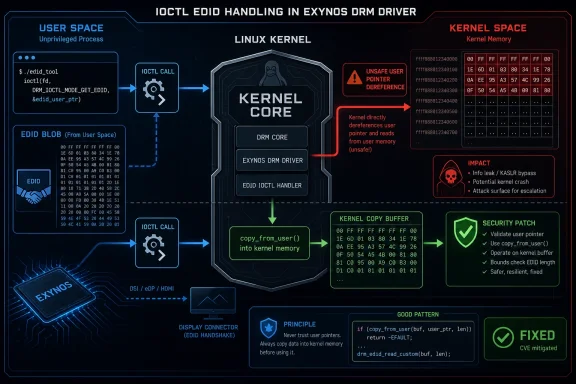
Linux kernel maintainers assigned CVE-2026-45958 on May 27, 2026, to a flaw in the Exynos DRM VIDI driver where
CVE-2026-45958 lives in
The problem described by the kernel fix is blunt. In
User-space memory is not trusted memory. It can be invalid, unmapped, changed concurrently, pointed at surprising places, or crafted to trigger exceptional behavior. The kernel has long provided APIs such as
That is why the patch does not need theatrical language to matter. The fix copies the EDID blob into kernel memory first and then operates on that kernel-owned buffer. It is the difference between reaching across a security boundary and asking the boundary guard to inspect the package before bringing it inside.
But in a graphics driver, EDID is not just a display convenience. It becomes input to kernel code that influences mode-setting, memory allocation, connector state, and device behavior. The moment a driver accepts EDID-like data through an ioctl, it has to treat that data as hostile unless proven otherwise.
That is the subtlety of CVE-2026-45958. The bug is not that EDID exists or that virtual display support is inherently dangerous. The bug is that a kernel path apparently trusted the address of user-provided data rather than copying the data through a hardened interface.
For WindowsForum readers used to the Windows driver model, the pattern will feel familiar even if the codebase is different. The security boundary between a user-mode client and a privileged kernel driver is a perennial source of vulnerabilities across operating systems. Graphics drivers, storage drivers, networking drivers, and vendor utilities all repeat the same story: a small shortcut around input handling becomes a large security concern because the code runs with enormous privilege.
An absent score often means the database workflow has not caught up with the disclosure, not that the vulnerability has been proved harmless. Kernel.org has supplied the core description and multiple stable-tree references, which is enough to establish that maintainers considered the bug security-relevant and backportable.
The practical assessment depends on deployment. A cloud VM without Exynos graphics exposure is not in the same risk category as an embedded device, ARM development board, Android-derived product, kiosk, thin client, or appliance using a vendor kernel with Exynos DRM enabled. Risk is contextual, and CVSS is only one way of compressing that context into a number.
The phrase “allows arbitrary kernel memory access from user space” deserves care. It does not automatically mean a remote attacker can compromise a system over the network. It does mean that a local path crossed a boundary it should not cross, and in kernel security that is enough to justify prompt patching where the affected driver is present.
That stable-backport pattern matters for administrators. Linux deployments rarely run one uniform kernel. Enterprise distributions, Android vendor trees, appliance SDKs, router firmware, container hosts, and developer boards all carry different kernels with different patch backlogs. A CVE like this becomes operationally relevant when your vendor maps the upstream fix into the kernel you actually boot.
The hard part is that many affected devices will not advertise themselves as “Linux desktops with Exynos DRM.” They may be signage players, development kits, smart displays, edge appliances, lab hardware, or internal products built on a board-support package. The vulnerable code can sit several layers beneath the product identity buyers recognize.
That is why the patch’s small size should not lull anyone into dismissing it. The kernel’s stable process exists because small correctness fixes can carry serious security implications. Here, the corrected pattern is exactly the kind of defensive coding that prevents user space from manipulating privileged code through a malformed pointer.
Drivers are especially difficult terrain. They sit between generic kernel infrastructure and messy hardware realities. They also expose custom control surfaces to user space, often through ioctl interfaces that are more flexible than elegant. That flexibility has a cost: every structure passed across the boundary needs rigorous validation, copying, lifetime management, and synchronization.
CVE-2026-45958 is also a reminder that “local” vulnerabilities are not academic. Many real attack chains begin with a foothold in user space and then look for a kernel bug to escape confinement, raise privileges, or tamper with system state. A graphics ioctl available to an untrusted local process can become part of that chain if the device node permissions and runtime context align.
This is where security engineering gets less glamorous and more important. The fix is not a new mitigation brand or a keynote feature. It is simply using the right primitive at the right boundary. That is how many serious vulnerabilities are prevented: not by magic, but by refusing to trust a pointer.
Exynos is especially relevant in embedded and mobile-adjacent contexts. A vulnerability in an Exynos DRM path may matter to a vendor kernel long after the upstream fix exists, because hardware enablement trees often lag mainline and because board vendors sometimes freeze kernels for product lifetime reasons. The devices most likely to be affected are also the devices least likely to receive transparent patch notes.
There is no reason to inflate this into a universal Linux emergency. A system must actually include the vulnerable code path and expose it in a usable way for the risk to become concrete. But there is also no reason to ignore it merely because the affected subsystem is specialized.
The right posture is inventory-driven. If you maintain Linux kernels on Exynos-based hardware, track the upstream commit, check your vendor’s kernel changelog, and verify whether the relevant stable fix has landed. If you do not run Exynos DRM at all, this CVE is mostly useful as a case study in driver hygiene.
That does not mean every raw kernel CVE should trigger an emergency change window. It means teams need a workflow that can distinguish “newly assigned but operationally irrelevant” from “narrow but present in our fleet.” The difference is not in the CVE headline; it is in the asset inventory.
The Linux kernel CVE pipeline has also produced a flood of records in recent years, many tied to upstream fixes that may or may not be exploitable in a given environment. That volume has made triage harder, not easier. CVE-2026-45958 fits the pattern: the description is technically meaningful, but the database entry is not yet enriched enough to tell a complete operational story by itself.
For administrators, the practical move is to reverse the usual question. Do not start with “How scary is this CVE?” Start with “Do we run the affected driver, and has our kernel absorbed the stable fix?” The first question invites speculation. The second creates work someone can actually complete.
The upstream wording also avoids overclaiming. It identifies the vulnerable function, explains the unsafe dereference, states the consequence in broad terms, and gives the remediation pattern. That is better than many vendor advisories that bury the substance under boilerplate.
For developers, the lesson is straightforward but worth repeating. If data originates in user space, the kernel must copy it through the appropriate helper, validate it, and operate on the copied version. If the data can change concurrently, the code must also account for lifetime and locking. A correct copy is not just a convenience; it is part of the security boundary.
For defenders, the lesson is to read the fix, not only the CVE shell. Scores compress risk, but patches reveal bug class, reachability, and likely operational exposure. In this case, the patch points to a classic boundary error in a specialized graphics path, which is exactly the sort of issue that should be patched without turning into theater.
That gap is where kernel security gets messy. The upstream project can fix the bug. Stable maintainers can backport it. Distribution maintainers can package it. But a product vendor still has to ship it, and an operator still has to install it. Every handoff introduces delay.
For Exynos-based devices, this is particularly relevant because many deployments live outside traditional enterprise patch tooling. They may be managed as appliances, not servers. They may be updated through firmware bundles, not package managers. They may sit in labs, conference rooms, retail sites, or industrial environments where “kernel update” is not a routine maintenance task.
A vulnerability like CVE-2026-45958 therefore belongs on the radar not because every reader is affected, but because it illustrates the class of issue that persists in the long tail. The fix exists. The question is whether it reaches the hardware that needs it.
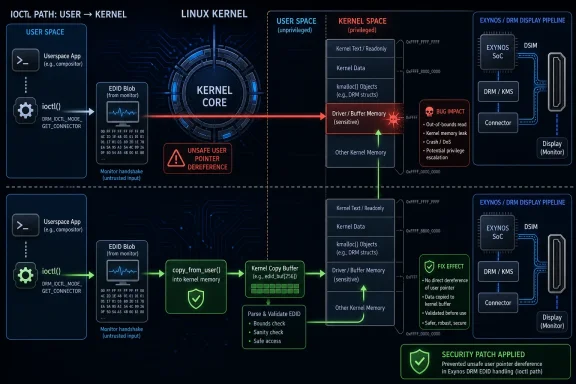
vidi_connection_ioctl() directly dereferenced a user-supplied EDID pointer instead of first copying it into kernel memory. The bug is narrow, hardware-specific, and still awaiting NVD scoring, but it is a textbook example of why kernel/user-space boundaries remain one of operating systems’ most unforgiving fault lines. The fix is small; the lesson is not. For administrators and device builders, this is less a panic button than a reminder that “obscure driver” does not mean “irrelevant attack surface.”
 A Small Display Driver Bug Crosses a Very Big Boundary
CVE-2026-45958 lives in drm/exynos, the Direct Rendering Manager driver stack for Samsung Exynos graphics hardware. The affected component, VIDI, is a virtual display path used inside the Exynos DRM subsystem, and the vulnerable path sits behind an ioctl: the old, familiar mechanism by which user space asks kernel drivers to do specialized work.The problem described by the kernel fix is blunt. In
vidi_connection_ioctl(), the driver treated vidi->edid as though it could safely read it directly, even though that value originated as a user pointer. In kernel programming, that is not a clerical mistake; it is a violation of one of the central rules of the architecture.User-space memory is not trusted memory. It can be invalid, unmapped, changed concurrently, pointed at surprising places, or crafted to trigger exceptional behavior. The kernel has long provided APIs such as
copy_from_user() precisely because dereferencing user pointers directly is a trap door into crashes, information disclosure, and sometimes more creative exploitation.That is why the patch does not need theatrical language to matter. The fix copies the EDID blob into kernel memory first and then operates on that kernel-owned buffer. It is the difference between reaching across a security boundary and asking the boundary guard to inspect the package before bringing it inside.
EDID Is Boring Until It Becomes an Attack Surface
EDID, or Extended Display Identification Data, is normally the sort of acronym users encounter only when a monitor refuses to negotiate the right resolution. It is the data structure displays use to describe their supported modes, timings, and capabilities. In most systems, it is plumbing: important, old, and invisible when it works.But in a graphics driver, EDID is not just a display convenience. It becomes input to kernel code that influences mode-setting, memory allocation, connector state, and device behavior. The moment a driver accepts EDID-like data through an ioctl, it has to treat that data as hostile unless proven otherwise.
That is the subtlety of CVE-2026-45958. The bug is not that EDID exists or that virtual display support is inherently dangerous. The bug is that a kernel path apparently trusted the address of user-provided data rather than copying the data through a hardened interface.
For WindowsForum readers used to the Windows driver model, the pattern will feel familiar even if the codebase is different. The security boundary between a user-mode client and a privileged kernel driver is a perennial source of vulnerabilities across operating systems. Graphics drivers, storage drivers, networking drivers, and vendor utilities all repeat the same story: a small shortcut around input handling becomes a large security concern because the code runs with enormous privilege.
The Missing CVSS Score Is Not a Safety Rating
At publication time, the NVD record for CVE-2026-45958 is marked as awaiting enrichment and does not yet carry CVSS 4.0, 3.x, or 2.0 scoring from NIST. That will tempt some readers to mentally file it as “unrated, therefore low priority.” That is the wrong inference.An absent score often means the database workflow has not caught up with the disclosure, not that the vulnerability has been proved harmless. Kernel.org has supplied the core description and multiple stable-tree references, which is enough to establish that maintainers considered the bug security-relevant and backportable.
The practical assessment depends on deployment. A cloud VM without Exynos graphics exposure is not in the same risk category as an embedded device, ARM development board, Android-derived product, kiosk, thin client, or appliance using a vendor kernel with Exynos DRM enabled. Risk is contextual, and CVSS is only one way of compressing that context into a number.
The phrase “allows arbitrary kernel memory access from user space” deserves care. It does not automatically mean a remote attacker can compromise a system over the network. It does mean that a local path crossed a boundary it should not cross, and in kernel security that is enough to justify prompt patching where the affected driver is present.
This Is the Kind of Bug Stable Trees Exist to Absorb
The references attached to the CVE point at multiple stable kernel commits, which tells its own story. This was not merely a mainline cleanup for future releases; it was pushed into maintained branches so downstream users could receive the correction without jumping to an entirely new kernel generation.That stable-backport pattern matters for administrators. Linux deployments rarely run one uniform kernel. Enterprise distributions, Android vendor trees, appliance SDKs, router firmware, container hosts, and developer boards all carry different kernels with different patch backlogs. A CVE like this becomes operationally relevant when your vendor maps the upstream fix into the kernel you actually boot.
The hard part is that many affected devices will not advertise themselves as “Linux desktops with Exynos DRM.” They may be signage players, development kits, smart displays, edge appliances, lab hardware, or internal products built on a board-support package. The vulnerable code can sit several layers beneath the product identity buyers recognize.
That is why the patch’s small size should not lull anyone into dismissing it. The kernel’s stable process exists because small correctness fixes can carry serious security implications. Here, the corrected pattern is exactly the kind of defensive coding that prevents user space from manipulating privileged code through a malformed pointer.
The Kernel/User Boundary Still Punishes Optimism
Modern kernels are full of defensive machinery: hardened usercopy checks, address space separation, sanitizers, lockdep, static analysis, fuzzing, and years of accumulated review practice. Yet this CVE shows how one direct dereference can still escape into a shipped path. The reason is not that kernel developers are careless; it is that the kernel is huge, old, hardware-specific, and full of code paths only a subset of users ever exercise.Drivers are especially difficult terrain. They sit between generic kernel infrastructure and messy hardware realities. They also expose custom control surfaces to user space, often through ioctl interfaces that are more flexible than elegant. That flexibility has a cost: every structure passed across the boundary needs rigorous validation, copying, lifetime management, and synchronization.
CVE-2026-45958 is also a reminder that “local” vulnerabilities are not academic. Many real attack chains begin with a foothold in user space and then look for a kernel bug to escape confinement, raise privileges, or tamper with system state. A graphics ioctl available to an untrusted local process can become part of that chain if the device node permissions and runtime context align.
This is where security engineering gets less glamorous and more important. The fix is not a new mitigation brand or a keynote feature. It is simply using the right primitive at the right boundary. That is how many serious vulnerabilities are prevented: not by magic, but by refusing to trust a pointer.
Exynos Narrows the Blast Radius, but It Does Not Erase It
Most x86 Windows users will never encounter this driver. That is the easy part of the story. The harder part is that the modern WindowsForum audience is not only desktop Windows users; it includes sysadmins running mixed fleets, developers building on Linux, people testing WSL-adjacent tooling, homelab operators, Android tinkerers, and IT teams responsible for devices that do not look like traditional PCs.Exynos is especially relevant in embedded and mobile-adjacent contexts. A vulnerability in an Exynos DRM path may matter to a vendor kernel long after the upstream fix exists, because hardware enablement trees often lag mainline and because board vendors sometimes freeze kernels for product lifetime reasons. The devices most likely to be affected are also the devices least likely to receive transparent patch notes.
There is no reason to inflate this into a universal Linux emergency. A system must actually include the vulnerable code path and expose it in a usable way for the risk to become concrete. But there is also no reason to ignore it merely because the affected subsystem is specialized.
The right posture is inventory-driven. If you maintain Linux kernels on Exynos-based hardware, track the upstream commit, check your vendor’s kernel changelog, and verify whether the relevant stable fix has landed. If you do not run Exynos DRM at all, this CVE is mostly useful as a case study in driver hygiene.
The NVD Lag Exposes a Familiar Patch-Management Gap
The CVE record’s “awaiting enrichment” status is not unusual, but it highlights a recurring problem for security teams. The most useful technical information often appears first in kernel commit messages, mailing lists, and stable queues, while vulnerability databases catch up later with scoring, CWE mapping, and normalized metadata. Organizations that wait for the database entry to become tidy can end up waiting past the point where a patch is already available.That does not mean every raw kernel CVE should trigger an emergency change window. It means teams need a workflow that can distinguish “newly assigned but operationally irrelevant” from “narrow but present in our fleet.” The difference is not in the CVE headline; it is in the asset inventory.
The Linux kernel CVE pipeline has also produced a flood of records in recent years, many tied to upstream fixes that may or may not be exploitable in a given environment. That volume has made triage harder, not easier. CVE-2026-45958 fits the pattern: the description is technically meaningful, but the database entry is not yet enriched enough to tell a complete operational story by itself.
For administrators, the practical move is to reverse the usual question. Do not start with “How scary is this CVE?” Start with “Do we run the affected driver, and has our kernel absorbed the stable fix?” The first question invites speculation. The second creates work someone can actually complete.
The Patch Says More Than the Score Will
When NVD eventually assigns metadata, the score may end up moderate, high, or otherwise bounded by local-access assumptions. But the essence of the vulnerability will not change: a kernel driver directly touched a user pointer where it should have copied from user space. That is the meaningful fact.The upstream wording also avoids overclaiming. It identifies the vulnerable function, explains the unsafe dereference, states the consequence in broad terms, and gives the remediation pattern. That is better than many vendor advisories that bury the substance under boilerplate.
For developers, the lesson is straightforward but worth repeating. If data originates in user space, the kernel must copy it through the appropriate helper, validate it, and operate on the copied version. If the data can change concurrently, the code must also account for lifetime and locking. A correct copy is not just a convenience; it is part of the security boundary.
For defenders, the lesson is to read the fix, not only the CVE shell. Scores compress risk, but patches reveal bug class, reachability, and likely operational exposure. In this case, the patch points to a classic boundary error in a specialized graphics path, which is exactly the sort of issue that should be patched without turning into theater.
The Real Risk Is in Forgotten Kernels
The systems most exposed to this kind of vulnerability are not usually the ones with the loudest patch dashboards. A mainstream Linux distribution on a well-managed server may absorb the fix through normal updates if the affected code is enabled at all. An embedded device running a vendor forked kernel from years ago may not.That gap is where kernel security gets messy. The upstream project can fix the bug. Stable maintainers can backport it. Distribution maintainers can package it. But a product vendor still has to ship it, and an operator still has to install it. Every handoff introduces delay.
For Exynos-based devices, this is particularly relevant because many deployments live outside traditional enterprise patch tooling. They may be managed as appliances, not servers. They may be updated through firmware bundles, not package managers. They may sit in labs, conference rooms, retail sites, or industrial environments where “kernel update” is not a routine maintenance task.
A vulnerability like CVE-2026-45958 therefore belongs on the radar not because every reader is affected, but because it illustrates the class of issue that persists in the long tail. The fix exists. The question is whether it reaches the hardware that needs it.
The Practical Story Fits in a Kernel Maintainer’s Diff
Security teams do not need to overcomplicate this one. CVE-2026-45958 is a local kernel-driver boundary bug in the Exynos DRM VIDI path, fixed by copying a user-supplied EDID buffer into kernel memory before use. The operational answer is asset inventory, kernel verification, and vendor follow-up.- Systems that do not include or expose the Exynos DRM VIDI driver are unlikely to be directly affected by this specific CVE.
- Exynos-based Linux devices, embedded products, development boards, and vendor kernels should be checked for the stable fix.
- The lack of an NVD CVSS score on May 27, 2026, should not be treated as evidence that the bug is harmless.
- The vulnerability requires attention because it crosses the user-kernel boundary, not because it has been publicly shown to enable remote compromise.
- The safest remediation path is to install a vendor kernel update or stable kernel release that includes the upstream fix, rather than attempting ad hoc local mitigation.
References
- Primary source: NVD / Linux Kernel
Published: 2026-05-28T01:06:37-07:00
NVD - CVE-2026-45958
 nvd.nist.gov
- Security advisory: MSRC
Published: 2026-05-28T01:06:37-07:00
Original feed URL
Security Update Guide - Microsoft Security Response Center
 msrc.microsoft.com
- Related coverage: lists.linaro.org
- Related coverage: korg.docs.kernel.org
- Related coverage: kernel.googlesource.com
- Related coverage: windowsforum.com
Exynos DRM VIDI Fix (CVE-2026-23227): Locking Context to Prevent Memory Races | Windows Forum
The CVE page for CVE-2026-23227 is currently unavailable, so the only reliable starting point is the upstream kernel fix description: “drm/exynos: vidi: use...windowsforum.com
- Related coverage: kernel.org

The Linux Kernel Archives
www.kernel.org
- Related coverage: isomer-user-content.by.gov.sg