

CVE-2026-46006 is a newly published Linux kernel vulnerability, disclosed by NVD on May 27, 2026, affecting Nouveau’s DRM graphics driver where a 32-bit integer overflow could undermine a relocation bounds check in push buffer handling. The bug is small enough to fit in a one-line patch, but it lands in the uncomfortable territory where GPU driver code, user-submitted command streams, and kernel memory safety meet. Its practical risk will depend heavily on distribution kernels, enabled hardware paths, and whether a local attacker can reach the vulnerable ioctl surface. The larger story is that Linux graphics drivers remain one of the kernel’s most complicated trust boundaries, even when the fix looks almost trivial.
The core of CVE-2026-46006 is not exotic. Nouveau’s
That means a carefully chosen offset near the top of the 32-bit range could wrap around before the bounds check happened. The comparison would then see a small number instead of the intended large one, potentially allowing an invalid relocation to pass validation. The fix casts the offset to
This is the sort of bug that makes security engineers wince because it is obvious only after someone points at it. The code is readable, the condition is plausible, and the intent is clear. But C’s integer promotion rules are doing something narrower than the human reader assumes.
For WindowsForum readers used to tracking Patch Tuesday bulletins, this is a familiar pattern in a different ecosystem. The patch is tiny; the affected code path is not. The difference between a harmless validation check and a kernel security issue can be a single cast placed on the wrong side of an addition.
The vulnerable code lives in push buffer relocation handling. In simplified terms, a push buffer is a stream of commands submitted toward the GPU, and relocations are the metadata that tell the driver how to patch or validate references to buffer objects. The kernel must assume that user space can be wrong, malicious, or both, so every offset and size calculation becomes part of the security perimeter.
That is why the arithmetic matters. The driver was trying to confirm that a relocation touched a valid four-byte region inside the buffer object. If the offset calculation wraps, the check can reason about the wrong address range. The bug is not that the driver forgot to check bounds; it is that the bounds check could be tricked by the type width of an intermediate expression.
In modern kernel security, those are often the most interesting failures. The unsafe operation is hidden inside a line that looks like defensive programming. The validation exists, but the validation itself rests on arithmetic assumptions that the compiler is under no obligation to share.
The CVE record says the issue was received from kernel.org on May 27, 2026. The upstream fix was already moving through the kernel stable machinery before the NVD page filled in its scoring details, and stable patch references show the change being queued for maintained kernel branches. That order of events is normal for Linux kernel CVEs: the fix often exists first, while vulnerability databases and vendor advisories catch up afterward.
The commit text is unusually direct. It explains the vulnerable condition, identifies the type mismatch, and states the remediation: cast to
That simplicity is also why administrators should not dismiss it. Small fixes can address high-impact failure modes, especially inside drivers that accept structured input from unprivileged local processes. Until downstream vendors classify the issue, the safest reading is cautious: this is a local kernel attack-surface bug in a GPU driver, not a remote internet worm, but it still belongs in the patch queue.
That distinction sounds academic until it becomes a vulnerability. In CVE-2026-46006, the expression did not fail because the programmer forgot the buffer size. It failed because the expression could produce the wrong value before the buffer size comparison ever got a chance to matter.
The kernel is full of code that combines user-controlled counts, offsets, lengths, indexes, and alignment units. Every such calculation has a question attached: what is the maximum value, and in what type is the intermediate result computed? If the answer is “probably big enough,” the code is already living dangerously.
Rust advocates often point to this class of issue as an argument for safer language adoption in kernel-adjacent code. That argument has merit, but it should not become a fantasy that language choice alone rewrites the installed base. The Linux kernel is a vast C project with decades of hardware knowledge embedded in it. For the foreseeable future, defensive arithmetic in C remains a first-line security control.
On Linux desktops, browsers, compositors, games, video tools, machine-learning frameworks, and GUI toolkits can all interact indirectly with GPU infrastructure. Even when an attacker cannot directly call every driver ioctl from a sandboxed process, graphics acceleration has repeatedly complicated sandbox boundaries. The GPU is a shared, high-performance device with a driver stack designed for throughput, not for minimalism.
Nouveau’s footprint is narrower than the proprietary NVIDIA stack and narrower than the universe of Linux systems as a whole. Many NVIDIA users run NVIDIA’s proprietary driver. Many servers have no relevant GPU exposure. But for systems that do use Nouveau, especially desktop Linux installations, developer workstations, lab machines, and certain live or rescue environments, DRM driver vulnerabilities are not theoretical curiosities.
For enterprise IT, the key question is not whether every Linux server is exposed. It is whether vulnerable kernels exist in places where local code execution is easy to obtain. Multi-user Linux workstations, university labs, CI runners with GPU access, remote desktop hosts, and containerized environments with device passthrough deserve more attention than a headless appliance with no NVIDIA hardware and no Nouveau loaded.
The right answer is usually somewhere in the middle. This is not an unauthenticated remote code execution bug in a default network service. It requires access to the relevant local graphics interface and a system configuration that uses the affected Nouveau path. But kernel driver bugs reachable from user space often sit in the category attackers like: local privilege escalation primitives that become valuable after an initial foothold.
A local attacker who already has code execution as an unprivileged user is not finished. They still need a way to escape sandboxes, gain root, tamper with other users, or persist. Kernel memory-safety bugs are one route. Whether CVE-2026-46006 becomes such a route in practice depends on what the wrapped relocation enables after validation fails, and that requires deeper exploit analysis than the CVE record provides.
The lack of a CVSS score should therefore influence prioritization, not awareness. If your vulnerability management tooling refuses to act until NVD assigns a number, this is the kind of case that exposes the weakness of score-driven patching. The upstream kernel already considered the bug worth fixing and backporting. That is operationally meaningful.
The stable references attached to the CVE indicate that the patch has been propagated across multiple stable commits. There was also evidence of at least one failed attempt to apply the upstream patch cleanly to an older stable branch, which is not unusual. Driver code evolves, and a one-line fix in one branch can require manual backporting in another.
That is where administrators need to avoid false certainty. Seeing a fix in one stable series does not prove that every long-term branch, distribution kernel, or vendor-supported build has it. Conversely, a distribution may carry the fix under its own patch numbering before public CVE scanners recognize it. Kernel security tracking is less a single switch than a chain of maintainers, backports, package builds, and reboot windows.
For practical purposes, the remediation is straightforward: install a kernel update from your distribution or vendor once available, then reboot into it. Kernel patches do not protect a running old kernel merely because the package is staged on disk. On Linux fleets, the reboot is part of the fix.
Developers run Linux desktops, WSL-adjacent tooling, dual-boot systems, Proxmox hosts, Ubuntu workstations, container hosts, GPU compute nodes, and lab machines that sit beside Windows endpoints on the same network. Security teams that patch Windows aggressively while treating Linux workstations as “developer-owned” exceptions are leaving exactly the sort of local attack surface that post-compromise operators enjoy.
There is also a conceptual lesson for Windows administrators. Display drivers have long been high-value kernel attack surface on Windows as well, and Microsoft has spent years moving pieces of the graphics stack, tightening driver models, and hardening kernel interfaces. The specific code here is Linux Nouveau, but the category is universal: graphics drivers are privileged parsers of complex user-controlled data.
That matters because GPU access is becoming more common, not less. AI tooling, hardware-accelerated browsers, remote rendering, video pipelines, and desktop virtualization all increase the number of systems where graphics hardware is not a luxury component but a production dependency. The more important GPUs become to ordinary workloads, the more important their driver security becomes to ordinary patch management.
Good security engineering often looks like this. A check becomes slightly more explicit. A type becomes slightly wider. An assumption becomes a cast. The visible change is tiny because the expensive work was recognizing where the implicit behavior diverged from the intended behavior.
There is a maintenance lesson here as well. Kernel code cannot rely on reviewers mentally simulating C integer promotions every time they see a bounds check. Projects need patterns, helper macros, static analysis, and review habits that make dangerous arithmetic look suspicious by default. In the best case, future code would express “offset plus size must fit within object” through a helper designed to catch overflow, not through open-coded arithmetic repeated across drivers.
This is not a criticism unique to Nouveau. Every mature kernel and driver ecosystem accumulates these hazards. The question is whether maintainers keep finding and eliminating them before attackers do, and whether users consume those fixes quickly enough for the discovery to matter.
For Linux desktop users, the exposure question begins with hardware and driver choice. If the system has an NVIDIA GPU but uses the proprietary NVIDIA driver, this specific Nouveau path may not be active. If the system uses Nouveau, especially on a general-purpose desktop or shared workstation, the update deserves normal kernel-security urgency.
For sysadmins, the inventory question is broader. Identify systems with NVIDIA hardware, loaded Nouveau modules, user-accessible DRM devices, or GPU passthrough into workloads. Then map those systems to the kernel branches your vendor supports and watch for the relevant security update.
For security teams, the process question may be the most important. A CVE with no NVD score can still represent a fixed kernel vulnerability. If your workflow cannot prioritize such items until enrichment arrives, your workflow is outsourcing judgment to a database that is intentionally downstream of the engineering work.
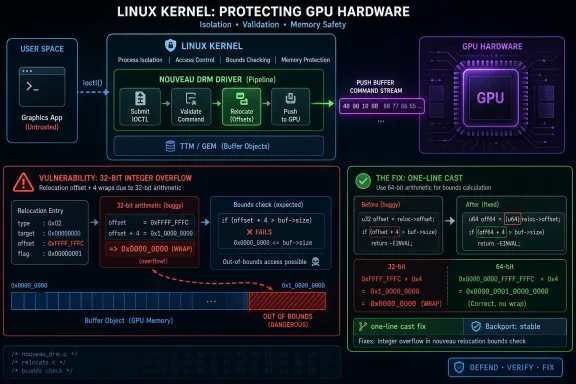 A One-Line Cast Exposes a Kernel-Sized Trust Problem
The core of CVE-2026-46006 is not exotic. Nouveau’s nouveau_gem_pushbuf_reloc_apply() function checked whether a relocation offset plus four bytes would exceed the backing buffer object’s size. The problem was that the offset field, reloc_bo_offset, is a __u32, and adding the literal 4 kept the arithmetic in 32-bit unsigned territory before the result was compared with a larger size_t.That means a carefully chosen offset near the top of the 32-bit range could wrap around before the bounds check happened. The comparison would then see a small number instead of the intended large one, potentially allowing an invalid relocation to pass validation. The fix casts the offset to
u64 before adding four, forcing the calculation into 64-bit arithmetic and preserving the intended bounds check.This is the sort of bug that makes security engineers wince because it is obvious only after someone points at it. The code is readable, the condition is plausible, and the intent is clear. But C’s integer promotion rules are doing something narrower than the human reader assumes.
For WindowsForum readers used to tracking Patch Tuesday bulletins, this is a familiar pattern in a different ecosystem. The patch is tiny; the affected code path is not. The difference between a harmless validation check and a kernel security issue can be a single cast placed on the wrong side of an addition.
Nouveau Sits Where User Space Hands Commands to the GPU
Nouveau is the open-source Linux driver for NVIDIA GPUs, living under the kernel’s Direct Rendering Manager subsystem. DRM drivers do a difficult job: they expose enough functionality for user-space graphics stacks to submit work to the GPU while preventing those submissions from corrupting kernel memory, other processes, or the device’s own bookkeeping. That boundary is especially delicate because graphics workloads are built around buffers, offsets, relocations, command streams, and memory mappings.The vulnerable code lives in push buffer relocation handling. In simplified terms, a push buffer is a stream of commands submitted toward the GPU, and relocations are the metadata that tell the driver how to patch or validate references to buffer objects. The kernel must assume that user space can be wrong, malicious, or both, so every offset and size calculation becomes part of the security perimeter.
That is why the arithmetic matters. The driver was trying to confirm that a relocation touched a valid four-byte region inside the buffer object. If the offset calculation wraps, the check can reason about the wrong address range. The bug is not that the driver forgot to check bounds; it is that the bounds check could be tricked by the type width of an intermediate expression.
In modern kernel security, those are often the most interesting failures. The unsafe operation is hidden inside a line that looks like defensive programming. The validation exists, but the validation itself rests on arithmetic assumptions that the compiler is under no obligation to share.
The NVD Entry Is Sparse, but the Patch Tells the Story
As of publication, NVD has marked CVE-2026-46006 as awaiting enrichment, with no NIST CVSS score or vector assigned. That absence should not be mistaken for a clean bill of health. It usually means the vulnerability record is still in the early processing stage, not that the issue is harmless.The CVE record says the issue was received from kernel.org on May 27, 2026. The upstream fix was already moving through the kernel stable machinery before the NVD page filled in its scoring details, and stable patch references show the change being queued for maintained kernel branches. That order of events is normal for Linux kernel CVEs: the fix often exists first, while vulnerability databases and vendor advisories catch up afterward.
The commit text is unusually direct. It explains the vulnerable condition, identifies the type mismatch, and states the remediation: cast to
u64 so the addition happens in 64-bit arithmetic. There is no elaborate redesign, no mitigation framework, and no sprawling subsystem refactor. The code changes from adding in 32 bits to adding in 64 bits.That simplicity is also why administrators should not dismiss it. Small fixes can address high-impact failure modes, especially inside drivers that accept structured input from unprivileged local processes. Until downstream vendors classify the issue, the safest reading is cautious: this is a local kernel attack-surface bug in a GPU driver, not a remote internet worm, but it still belongs in the patch queue.
Integer Overflow Is the Kernel Bug That Refuses to Retire
Integer overflow has been a known class of systems bug for decades, yet it remains stubbornly productive because it hides between language rules and developer intent. C will not automatically make an addition wider just because the eventual comparison is against a wider type. The operands drive the arithmetic, and the result is converted later.That distinction sounds academic until it becomes a vulnerability. In CVE-2026-46006, the expression did not fail because the programmer forgot the buffer size. It failed because the expression could produce the wrong value before the buffer size comparison ever got a chance to matter.
The kernel is full of code that combines user-controlled counts, offsets, lengths, indexes, and alignment units. Every such calculation has a question attached: what is the maximum value, and in what type is the intermediate result computed? If the answer is “probably big enough,” the code is already living dangerously.
Rust advocates often point to this class of issue as an argument for safer language adoption in kernel-adjacent code. That argument has merit, but it should not become a fantasy that language choice alone rewrites the installed base. The Linux kernel is a vast C project with decades of hardware knowledge embedded in it. For the foreseeable future, defensive arithmetic in C remains a first-line security control.
GPU Drivers Are Local Attack Surface, Not Peripheral Plumbing
It is tempting to treat graphics drivers as peripheral plumbing: important for displays and games, less important than network stacks and authentication systems. That view is obsolete. GPU drivers are among the most complex kernel components commonly reachable by ordinary desktop software.On Linux desktops, browsers, compositors, games, video tools, machine-learning frameworks, and GUI toolkits can all interact indirectly with GPU infrastructure. Even when an attacker cannot directly call every driver ioctl from a sandboxed process, graphics acceleration has repeatedly complicated sandbox boundaries. The GPU is a shared, high-performance device with a driver stack designed for throughput, not for minimalism.
Nouveau’s footprint is narrower than the proprietary NVIDIA stack and narrower than the universe of Linux systems as a whole. Many NVIDIA users run NVIDIA’s proprietary driver. Many servers have no relevant GPU exposure. But for systems that do use Nouveau, especially desktop Linux installations, developer workstations, lab machines, and certain live or rescue environments, DRM driver vulnerabilities are not theoretical curiosities.
For enterprise IT, the key question is not whether every Linux server is exposed. It is whether vulnerable kernels exist in places where local code execution is easy to obtain. Multi-user Linux workstations, university labs, CI runners with GPU access, remote desktop hosts, and containerized environments with device passthrough deserve more attention than a headless appliance with no NVIDIA hardware and no Nouveau loaded.
The Exploitability Gap Is Where Administrators Must Think Clearly
The public record for CVE-2026-46006 does not currently provide a full exploit chain, a NIST severity score, or a polished proof-of-concept. That creates a familiar ambiguity. Security teams must decide whether to treat the issue as routine kernel hygiene or as a potential privilege-escalation risk before all scoring agencies have caught up.The right answer is usually somewhere in the middle. This is not an unauthenticated remote code execution bug in a default network service. It requires access to the relevant local graphics interface and a system configuration that uses the affected Nouveau path. But kernel driver bugs reachable from user space often sit in the category attackers like: local privilege escalation primitives that become valuable after an initial foothold.
A local attacker who already has code execution as an unprivileged user is not finished. They still need a way to escape sandboxes, gain root, tamper with other users, or persist. Kernel memory-safety bugs are one route. Whether CVE-2026-46006 becomes such a route in practice depends on what the wrapped relocation enables after validation fails, and that requires deeper exploit analysis than the CVE record provides.
The lack of a CVSS score should therefore influence prioritization, not awareness. If your vulnerability management tooling refuses to act until NVD assigns a number, this is the kind of case that exposes the weakness of score-driven patching. The upstream kernel already considered the bug worth fixing and backporting. That is operationally meaningful.
Stable Backports Are the Real Security Boundary
Linux kernel users rarely run Linus Torvalds’ tree directly. They run distribution kernels, vendor kernels, cloud kernels, Android-derived kernels, enterprise long-term kernels, or embedded BSPs. For them, the important question is not merely whether upstream fixed CVE-2026-46006, but when that fix appears in the branch they actually boot.The stable references attached to the CVE indicate that the patch has been propagated across multiple stable commits. There was also evidence of at least one failed attempt to apply the upstream patch cleanly to an older stable branch, which is not unusual. Driver code evolves, and a one-line fix in one branch can require manual backporting in another.
That is where administrators need to avoid false certainty. Seeing a fix in one stable series does not prove that every long-term branch, distribution kernel, or vendor-supported build has it. Conversely, a distribution may carry the fix under its own patch numbering before public CVE scanners recognize it. Kernel security tracking is less a single switch than a chain of maintainers, backports, package builds, and reboot windows.
For practical purposes, the remediation is straightforward: install a kernel update from your distribution or vendor once available, then reboot into it. Kernel patches do not protect a running old kernel merely because the package is staged on disk. On Linux fleets, the reboot is part of the fix.
Windows Shops Should Still Care About a Linux GPU Bug
At first glance, CVE-2026-46006 looks outside the WindowsForum center of gravity. It is a Linux kernel issue in an open-source NVIDIA driver. But modern Windows environments are rarely Windows-only environments anymore.Developers run Linux desktops, WSL-adjacent tooling, dual-boot systems, Proxmox hosts, Ubuntu workstations, container hosts, GPU compute nodes, and lab machines that sit beside Windows endpoints on the same network. Security teams that patch Windows aggressively while treating Linux workstations as “developer-owned” exceptions are leaving exactly the sort of local attack surface that post-compromise operators enjoy.
There is also a conceptual lesson for Windows administrators. Display drivers have long been high-value kernel attack surface on Windows as well, and Microsoft has spent years moving pieces of the graphics stack, tightening driver models, and hardening kernel interfaces. The specific code here is Linux Nouveau, but the category is universal: graphics drivers are privileged parsers of complex user-controlled data.
That matters because GPU access is becoming more common, not less. AI tooling, hardware-accelerated browsers, remote rendering, video pipelines, and desktop virtualization all increase the number of systems where graphics hardware is not a luxury component but a production dependency. The more important GPUs become to ordinary workloads, the more important their driver security becomes to ordinary patch management.
The Fix Is Boring, Which Is Exactly Why It Matters
The patch for CVE-2026-46006 changes the arithmetic width of one expression. That is not the kind of fix that produces flashy release notes. It is the kind of fix that quietly prevents an attacker from turning a boundary condition into a memory-safety condition.Good security engineering often looks like this. A check becomes slightly more explicit. A type becomes slightly wider. An assumption becomes a cast. The visible change is tiny because the expensive work was recognizing where the implicit behavior diverged from the intended behavior.
There is a maintenance lesson here as well. Kernel code cannot rely on reviewers mentally simulating C integer promotions every time they see a bounds check. Projects need patterns, helper macros, static analysis, and review habits that make dangerous arithmetic look suspicious by default. In the best case, future code would express “offset plus size must fit within object” through a helper designed to catch overflow, not through open-coded arithmetic repeated across drivers.
This is not a criticism unique to Nouveau. Every mature kernel and driver ecosystem accumulates these hazards. The question is whether maintainers keep finding and eliminating them before attackers do, and whether users consume those fixes quickly enough for the discovery to matter.
The Patch Queue Says More Than the Scoreboard
The most concrete signal in this case is not the missing NVD score. It is the upstream fix and the stable backport activity around it. Administrators should read that as a prompt to check kernels, not as a reason to wait for a vulnerability dashboard to turn red.For Linux desktop users, the exposure question begins with hardware and driver choice. If the system has an NVIDIA GPU but uses the proprietary NVIDIA driver, this specific Nouveau path may not be active. If the system uses Nouveau, especially on a general-purpose desktop or shared workstation, the update deserves normal kernel-security urgency.
For sysadmins, the inventory question is broader. Identify systems with NVIDIA hardware, loaded Nouveau modules, user-accessible DRM devices, or GPU passthrough into workloads. Then map those systems to the kernel branches your vendor supports and watch for the relevant security update.
For security teams, the process question may be the most important. A CVE with no NVD score can still represent a fixed kernel vulnerability. If your workflow cannot prioritize such items until enrichment arrives, your workflow is outsourcing judgment to a database that is intentionally downstream of the engineering work.
The Nouveau Bug Leaves a Short Checklist in Its Wake
The narrow fix should not obscure the operational lesson: this is a kernel driver vulnerability with a small patch, an evolving public record, and a remediation path that depends on downstream kernel delivery. Treat it as a prompt to verify exposure rather than as a reason to panic.- Systems using the Linux Nouveau driver for NVIDIA GPUs should be considered the primary audience for CVE-2026-46006 remediation.
- The vulnerability arises from 32-bit unsigned arithmetic wrapping before a bounds comparison against the buffer object size.
- The upstream fix casts the relocation offset to 64-bit before adding four bytes, preserving the intended bounds check.
- NVD had not assigned a NIST CVSS score at the time of the initial record, so severity dashboards may lag behind upstream kernel reality.
- Distribution and vendor kernel updates are the practical remediation path, and systems must reboot into the fixed kernel for the patch to take effect.
- Mixed Windows and Linux environments should include developer workstations, GPU hosts, and lab systems in the same vulnerability management loop as traditional servers.
References
- Primary source: NVD / Linux Kernel
Published: 2026-05-28T01:12:45-07:00
NVD - CVE-2026-46006
 nvd.nist.gov
- Security advisory: MSRC
Published: 2026-05-28T01:12:45-07:00
Original feed URL
Security Update Guide - Microsoft Security Response Center
 msrc.microsoft.com
- Related coverage: kernel.org

The Linux Kernel Archives
www.kernel.org
- Related coverage: git.sceen.net
- Related coverage: kernel.googlesource.com
- Related coverage: dfsg-new-queue.debian.org

DFSG NEW Queue - Review: linux 6.12.86-1
dfsg-new-queue.debian.org
- Related coverage: support.bull.com
