

CVE-2026-46033 is a Linux kernel cryptographic API vulnerability, published by NVD on May 27, 2026, in which malformed
The technical story behind CVE-2026-46033 is almost comically narrow. The Linux kernel’s
The kernel already had a guardrail in one place. If software explicitly tried to set a non-zero authentication size of one, two, or three bytes,
That difference is the bug. Pick an ahash algorithm with a tiny digest size, such as the example given in the CVE record, and the AEAD core can initialize a transform with a default authsize that would have been rejected if a caller had tried to set it directly. In security terms, this is not a failure of cryptography. It is a failure of invariants.
The fix is correspondingly blunt: reject
AF_ALG is not inherently bad. Kernel crypto exists for legitimate consumers, including networking paths, IPsec, storage, and subsystems that need common cryptographic implementations. But once a kernel primitive becomes reachable through a user-space interface, its assumptions have to survive hostile composition. Attackers do not need to use an API the way its designer imagined; they only need to find a legal sequence of calls that steers execution into an illegal state.
CVE-2026-46033 is a textbook example. The unsafe condition is not “Linux accepts a bad packet from the network” or “a user can pass a negative length.” It is subtler: one validation path rejects short authentication tags, while another path allows a default short tag to be inherited from an algorithm instance. The out-of-bounds access comes later, when ESN tail handling proceeds under an assumption that instance creation failed to enforce.
This is why kernel attack surfaces are so unforgiving. The vulnerable state is assembled from individually plausible pieces: a crypto template, an ahash digest size, AEAD defaults, and a user-space interface. No single concept is exotic. The hazard emerges when the system composes them.
The point is not that CVE-2026-46033 is automatically another Copy Fail. The public record for this CVE currently describes an out-of-bounds access triggered by too-short tag handling, and NVD had not assigned a CVSS score at the time of publication. There is no need to inflate the finding into a confirmed local-root exploit when the available description does not say that.
But history affects risk perception. When a kernel component has recently produced a serious user-space-reachable bug, maintainers and defenders have reason to scrutinize adjacent validation mistakes more aggressively. A patch that might once have looked like belt-and-suspenders hardening now lands in a more suspicious context.
That is probably why the stable-kernel trail matters. The relevant fix was requested for stable and long-term-support kernels, not left as a theoretical improvement for future development trees. In the Linux world, that is the practical signal administrators should watch: not just whether a CVE exists, but whether maintainers think the fix belongs in kernels people are actually running.
That distinction matters because it tells defenders where to look. Rotating keys does not fix this. Disabling a cipher suite in an application may not touch it. FIPS paperwork may not save you if the vulnerable kernel code path is present and reachable.
The vulnerable logic sits around
The bug is therefore a mismatch between an internal contract and an initialization path. One part of the code knows that a short non-zero authsize is unsupported. Another part lets a transform begin life with exactly that unsupported value. The fix restores the contract at the earliest point where the bad state can be created.
WSL deserves a careful mention. WSL 2 uses a Microsoft-maintained Linux kernel, and its exposure profile is not identical to a general-purpose Linux server. Whether a given WSL installation is affected depends on the kernel version and configuration Microsoft ships and the availability of the relevant crypto modules and interfaces. The right posture is not panic, but inventory.
Cloud workloads are the more obvious target. Linux hosts used for Kubernetes nodes, CI runners, VPN endpoints, bastion boxes, and security tooling often allow low-privileged local users, service accounts, or containerized processes to interact with kernel interfaces in ways administrators rarely audit. If a vulnerability is reachable through AF_ALG, the question becomes whether untrusted or semi-trusted workloads can open the relevant socket family and instantiate the relevant algorithm.
Then there are appliances. Firewalls, VPN concentrators, storage devices, monitoring boxes, and “black box” security products often run Linux kernels under branded web interfaces. Their patch cadence may lag mainstream distributions, and their exposure may be hard to inspect. A vulnerability tied to IPsec-adjacent crypto code should at least make appliance owners check vendor advisories rather than assume irrelevance.
This is a recurring problem in operational security. Patch systems and dashboards often treat missing metadata as a kind of silence, and silence gets rounded down. A CVE without a score may fail to trigger the same urgency as one labeled high or critical, even when the underlying subsystem and reachability deserve attention.
For CVE-2026-46033, administrators should reason from the facts available. The vulnerable code is in the Linux kernel. The bad state can be reached through instance creation involving a short digest size. AF_ALG can trigger the ESN tail-handling path with a too-short tag. The resulting condition is described as an out-of-bounds access.
That is enough to justify patch tracking. It may not be enough to declare emergency maintenance across every fleet, especially without public evidence of exploitation or a confirmed privilege-escalation chain. But it is certainly enough to avoid waiting passively for a scoring database to catch up.
The CVE record lists multiple stable kernel references, which is a useful sign that the fix is not confined to one branch. Stable backports matter because most production Linux systems do not run a bleeding-edge mainline kernel. They run vendor kernels with long support windows, heavy patching, and distribution-specific version numbers that do not map cleanly to upstream releases.
That makes version checking harder than it should be. A raw
This is especially true in enterprise Linux. Red Hat, SUSE, Ubuntu, Debian, Oracle, Amazon Linux, and others routinely ship backported fixes without rebasing to the latest upstream kernel. The only reliable operational question is whether the vendor kernel package includes the specific
That does not mean every containerized environment is equally exposed. Seccomp profiles, capability drops, LSM policy, module availability, and namespace configuration all matter. Some hardened environments may block the relevant socket family or prevent access to algorithm instances. Others may run permissive defaults because the workloads were assumed to be benign.
The operational mistake is to think of this as a package inside a container image. Updating a base image will not patch the host kernel. Rebuilding application containers will not remove the vulnerable code path. Scanning container layers may not even see the issue, because the vulnerable component is not in the image filesystem.
Kubernetes adds another layer of indirection. Managed clusters may depend on cloud provider node images. Self-managed clusters may depend on an organization’s golden AMI or OS template. Edge clusters may depend on a hardware vendor’s firmware pipeline. The fix has to land on the node kernel, and the node has to reboot or otherwise activate the patched kernel.
The difficulty is dependency. Kernel crypto interfaces may be used by legitimate workloads, VPN stacks, test harnesses, or specialized applications. A broad block could be harmless on a typical web server and disruptive on a system that actually depends on kernel AEAD operations. Administrators should test rather than improvise on production hosts.
Module blacklisting may also be incomplete if functionality is built into the kernel rather than loaded as a module. Likewise, blocking one algorithm name may not account for alternate templates or future variations. The best mitigation is the one that matches the actual system configuration and threat model.
Still, reachability analysis is useful. If untrusted local users cannot log in, containers are tightly sandboxed, AF_ALG is blocked by policy, and the relevant crypto templates are unavailable, the near-term risk is different from a multi-tenant compute host where arbitrary workloads can exercise kernel interfaces. Security teams should classify systems accordingly while patching proceeds.
This is a classic software engineering failure, but kernel code makes it harsher. In user-space applications, an out-of-bounds access may crash a process or leak data within that process’s security boundary. In the kernel, the boundary is the operating system itself. A bug that begins as a corner-case validation mistake can become a denial-of-service, information disclosure, or exploitation primitive depending on surrounding conditions.
The
For maintainers, the right answer is defensive construction: reject impossible states early, centralize validation where possible, and treat user-space-reachable crypto templates as adversarial parsers. For administrators, the answer is more prosaic: track kernel fixes even when the affected subsystem sounds remote from everyday operations.
You want to know whether the system runs a kernel branch that has not yet received the fix. You want to know whether AF_ALG is available to the users or workloads you do not fully trust. You want to know whether
This is also a good moment to review whether low-privileged local code is part of your threat model. In 2026, “local attacker” no longer means a human at a keyboard. It can mean a compromised web app, a malicious plugin, a CI job from an untrusted pull request, a container escape attempt in progress, or a developer toolchain component running with user permissions.
The systems most worth prioritizing are the ones where local code execution is plausible and the kernel is a shared trust anchor. That includes build infrastructure, jump hosts, multi-user servers, container hosts, lab environments, and security appliances with shell access. If those machines are Linux, this CVE belongs in the patch queue.
authencesn instances can inherit an invalid one-to-three-byte authentication tag and let AF_ALG reach an out-of-bounds access path. The bug is not a Windows flaw, but it matters to WindowsForum readers because modern Windows estates increasingly include WSL, Linux VMs, containers, VPN gateways, appliances, and cloud workloads running Linux kernels. The lesson is bigger than one bounds check: kernel crypto plumbing is now an attack surface administrators have to treat like networking or filesystem code. This is another reminder that “obscure” subsystem bugs can become operationally relevant the moment they are reachable from user space.
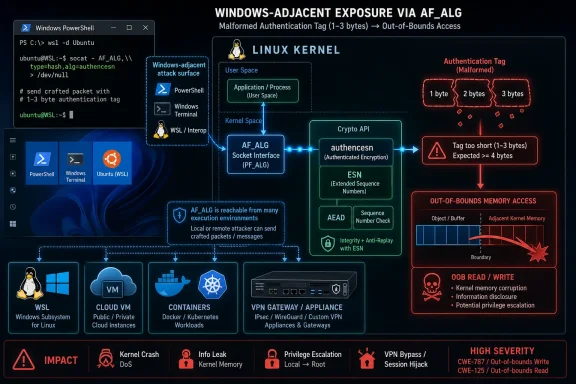 A Small Digest Size Exposes a Large Assumption
The technical story behind CVE-2026-46033 is almost comically narrow. The Linux kernel’s authencesn template, used in authenticated encryption paths associated with Extended Sequence Numbers, expects authentication sizes to be either zero or at least four bytes. That four-byte floor exists because the ESN encrypt and decrypt paths move four bytes of high-order sequence-number data at the tail end of authenticated data.The kernel already had a guardrail in one place. If software explicitly tried to set a non-zero authentication size of one, two, or three bytes,
crypto_authenc_esn_setauthsize() rejected it. But instance creation followed a different route: crypto_authenc_esn_create() copied the underlying hash algorithm’s digest size into the instance’s maximum authentication size without enforcing the same minimum.That difference is the bug. Pick an ahash algorithm with a tiny digest size, such as the example given in the CVE record, and the AEAD core can initialize a transform with a default authsize that would have been rejected if a caller had tried to set it directly. In security terms, this is not a failure of cryptography. It is a failure of invariants.
The fix is correspondingly blunt: reject
authencesn instances whose ahash digest size lands in the invalid non-zero range of one to three bytes. That prevents a transform from inheriting an unsupported default value in the first place. It is exactly the sort of patch that looks minor in a diff and major in a postmortem.AF_ALG Turns Kernel Crypto Into a User-Space Conversation
The reason this is a CVE rather than a tidy internal cleanup is AF_ALG. Linux exposes parts of its kernel cryptographic API to user space through the AF_ALG socket interface, allowing applications to request cryptographic operations via kernel-backed algorithms. That interface is powerful, useful, and, as the recent run ofauthencesn issues has shown, a source of awkward security exposure.AF_ALG is not inherently bad. Kernel crypto exists for legitimate consumers, including networking paths, IPsec, storage, and subsystems that need common cryptographic implementations. But once a kernel primitive becomes reachable through a user-space interface, its assumptions have to survive hostile composition. Attackers do not need to use an API the way its designer imagined; they only need to find a legal sequence of calls that steers execution into an illegal state.
CVE-2026-46033 is a textbook example. The unsafe condition is not “Linux accepts a bad packet from the network” or “a user can pass a negative length.” It is subtler: one validation path rejects short authentication tags, while another path allows a default short tag to be inherited from an algorithm instance. The out-of-bounds access comes later, when ESN tail handling proceeds under an assumption that instance creation failed to enforce.
This is why kernel attack surfaces are so unforgiving. The vulnerable state is assembled from individually plausible pieces: a crypto template, an ahash digest size, AEAD defaults, and a user-space interface. No single concept is exotic. The hazard emerges when the system composes them.
The Shadow of Copy Fail Hangs Over This Patch
CVE-2026-46033 lands in a year whenauthencesn has already had an uncomfortable turn in the spotlight. Earlier in 2026, another vulnerability in the same general area, widely discussed as Copy Fail, drew attention because researchers described a practical local privilege-escalation path involving authencesn, AF_ALG, and page-cache corruption. That bug was different in mechanism and impact, but it changed the way administrators should read any subsequent authencesn patch.The point is not that CVE-2026-46033 is automatically another Copy Fail. The public record for this CVE currently describes an out-of-bounds access triggered by too-short tag handling, and NVD had not assigned a CVSS score at the time of publication. There is no need to inflate the finding into a confirmed local-root exploit when the available description does not say that.
But history affects risk perception. When a kernel component has recently produced a serious user-space-reachable bug, maintainers and defenders have reason to scrutinize adjacent validation mistakes more aggressively. A patch that might once have looked like belt-and-suspenders hardening now lands in a more suspicious context.
That is probably why the stable-kernel trail matters. The relevant fix was requested for stable and long-term-support kernels, not left as a theoretical improvement for future development trees. In the Linux world, that is the practical signal administrators should watch: not just whether a CVE exists, but whether maintainers think the fix belongs in kernels people are actually running.
This Is a Validation Bug, Not a Crypto Break
There is a tendency to treat every vulnerability with the word “crypto” in it as if AES, HMAC, or some mathematical primitive has failed. That is not what is happening here. CVE-2026-46033 is about bounds, object construction, and API state, not a break in encryption.That distinction matters because it tells defenders where to look. Rotating keys does not fix this. Disabling a cipher suite in an application may not touch it. FIPS paperwork may not save you if the vulnerable kernel code path is present and reachable.
The vulnerable logic sits around
authencesn, an authenticated-encryption template connected with ESN handling. ESN, or Extended Sequence Numbers, exists because protocols such as IPsec ESP need to manage sequence-number space robustly at high packet volumes. The authentication tag size rule is implementation-specific in the sense that the kernel path expects enough space for the four bytes it moves.The bug is therefore a mismatch between an internal contract and an initialization path. One part of the code knows that a short non-zero authsize is unsupported. Another part lets a transform begin life with exactly that unsupported value. The fix restores the contract at the earliest point where the bad state can be created.
Windows Shops Should Not Dismiss a Linux Kernel CVE
A Windows-first administrator might be tempted to file this under “not our platform.” That is increasingly a dangerous reflex. Windows environments now routinely include Linux in three places: developer workstations running WSL, cloud estates running Linux VMs and containers, and network or security appliances whose management plane is Windows-adjacent even if the kernel underneath is not.WSL deserves a careful mention. WSL 2 uses a Microsoft-maintained Linux kernel, and its exposure profile is not identical to a general-purpose Linux server. Whether a given WSL installation is affected depends on the kernel version and configuration Microsoft ships and the availability of the relevant crypto modules and interfaces. The right posture is not panic, but inventory.
Cloud workloads are the more obvious target. Linux hosts used for Kubernetes nodes, CI runners, VPN endpoints, bastion boxes, and security tooling often allow low-privileged local users, service accounts, or containerized processes to interact with kernel interfaces in ways administrators rarely audit. If a vulnerability is reachable through AF_ALG, the question becomes whether untrusted or semi-trusted workloads can open the relevant socket family and instantiate the relevant algorithm.
Then there are appliances. Firewalls, VPN concentrators, storage devices, monitoring boxes, and “black box” security products often run Linux kernels under branded web interfaces. Their patch cadence may lag mainstream distributions, and their exposure may be hard to inspect. A vulnerability tied to IPsec-adjacent crypto code should at least make appliance owners check vendor advisories rather than assume irrelevance.
The Missing CVSS Score Is Not a Safety Rating
At publication time, NVD had the record marked as awaiting enrichment, with no NVD-provided CVSS v4, v3, or v2 score. That absence should not be misread as low severity. It means NVD had not yet completed its assessment, not that the vulnerability has been determined harmless.This is a recurring problem in operational security. Patch systems and dashboards often treat missing metadata as a kind of silence, and silence gets rounded down. A CVE without a score may fail to trigger the same urgency as one labeled high or critical, even when the underlying subsystem and reachability deserve attention.
For CVE-2026-46033, administrators should reason from the facts available. The vulnerable code is in the Linux kernel. The bad state can be reached through instance creation involving a short digest size. AF_ALG can trigger the ESN tail-handling path with a too-short tag. The resulting condition is described as an out-of-bounds access.
That is enough to justify patch tracking. It may not be enough to declare emergency maintenance across every fleet, especially without public evidence of exploitation or a confirmed privilege-escalation chain. But it is certainly enough to avoid waiting passively for a scoring database to catch up.
The Stable Kernel Pipeline Is the Real Remediation Story
For Linux administrators, the question is rarely whether the upstream patch exists. The question is when that patch appears in the kernel they actually boot. Between upstream commits, stable backports, distribution advisories, cloud images, livepatch channels, and appliance firmware, the path from fix to protection can be surprisingly long.The CVE record lists multiple stable kernel references, which is a useful sign that the fix is not confined to one branch. Stable backports matter because most production Linux systems do not run a bleeding-edge mainline kernel. They run vendor kernels with long support windows, heavy patching, and distribution-specific version numbers that do not map cleanly to upstream releases.
That makes version checking harder than it should be. A raw
uname -r string can tell you what family of kernel you are running, but not whether a vendor has backported a specific fix. Administrators need to consult distribution security notices, kernel changelogs, package metadata, or vendor errata rather than assume that an older-looking version is automatically vulnerable or a newer-looking one is automatically fixed.This is especially true in enterprise Linux. Red Hat, SUSE, Ubuntu, Debian, Oracle, Amazon Linux, and others routinely ship backported fixes without rebasing to the latest upstream kernel. The only reliable operational question is whether the vendor kernel package includes the specific
authencesn fix.Containers Do Not Contain the Kernel
Container operators should pay particular attention because this class of issue lives below the container boundary. A container shares the host kernel. If a process inside a container can reach a vulnerable kernel interface, the security properties of the container runtime become part of the exploitability discussion, not a magic shield.That does not mean every containerized environment is equally exposed. Seccomp profiles, capability drops, LSM policy, module availability, and namespace configuration all matter. Some hardened environments may block the relevant socket family or prevent access to algorithm instances. Others may run permissive defaults because the workloads were assumed to be benign.
The operational mistake is to think of this as a package inside a container image. Updating a base image will not patch the host kernel. Rebuilding application containers will not remove the vulnerable code path. Scanning container layers may not even see the issue, because the vulnerable component is not in the image filesystem.
Kubernetes adds another layer of indirection. Managed clusters may depend on cloud provider node images. Self-managed clusters may depend on an organization’s golden AMI or OS template. Edge clusters may depend on a hardware vendor’s firmware pipeline. The fix has to land on the node kernel, and the node has to reboot or otherwise activate the patched kernel.
Mitigation Is About Reachability, but Patching Is About Certainty
Until vendor kernels are patched, defenders naturally look for mitigations. For AF_ALG-related vulnerabilities, the instinct is to restrict access to the kernel crypto socket interface or unload modules. That can reduce exposure in some environments, but it is not a universal answer.The difficulty is dependency. Kernel crypto interfaces may be used by legitimate workloads, VPN stacks, test harnesses, or specialized applications. A broad block could be harmless on a typical web server and disruptive on a system that actually depends on kernel AEAD operations. Administrators should test rather than improvise on production hosts.
Module blacklisting may also be incomplete if functionality is built into the kernel rather than loaded as a module. Likewise, blocking one algorithm name may not account for alternate templates or future variations. The best mitigation is the one that matches the actual system configuration and threat model.
Still, reachability analysis is useful. If untrusted local users cannot log in, containers are tightly sandboxed, AF_ALG is blocked by policy, and the relevant crypto templates are unavailable, the near-term risk is different from a multi-tenant compute host where arbitrary workloads can exercise kernel interfaces. Security teams should classify systems accordingly while patching proceeds.
The Patch Teaches an Old Kernel Lesson Again
The deeper lesson is that kernel code cannot rely on “normal” construction paths being normal. If an invariant matters at use time, it needs to be enforced at every creation path that can produce the object. CVE-2026-46033 exists because one path rejected invalid authsizes and another path allowed them to become defaults.This is a classic software engineering failure, but kernel code makes it harsher. In user-space applications, an out-of-bounds access may crash a process or leak data within that process’s security boundary. In the kernel, the boundary is the operating system itself. A bug that begins as a corner-case validation mistake can become a denial-of-service, information disclosure, or exploitation primitive depending on surrounding conditions.
The
authencesn run of issues also highlights how hard it is to reason about security in layered APIs. AEAD, ahash, ESN, scatterlists, transform defaults, and socket interfaces are each understandable in isolation. The exploit-relevant behavior emerges when they intersect. That is where mature attackers spend their time.For maintainers, the right answer is defensive construction: reject impossible states early, centralize validation where possible, and treat user-space-reachable crypto templates as adversarial parsers. For administrators, the answer is more prosaic: track kernel fixes even when the affected subsystem sounds remote from everyday operations.
The Admin’s Test Is Whether This Kernel Can Be Reached
The practical triage starts with exposure, not branding. A desktop Linux VM used by one developer is not the same risk as a shared CI runner, and a locked-down appliance is not the same risk as a multi-tenant container node. The CVE description gives enough detail to ask sharper questions.You want to know whether the system runs a kernel branch that has not yet received the fix. You want to know whether AF_ALG is available to the users or workloads you do not fully trust. You want to know whether
authencesn and the relevant ahash construction can be instantiated. And you want to know how quickly your vendor will ship a kernel that includes the stable backport.This is also a good moment to review whether low-privileged local code is part of your threat model. In 2026, “local attacker” no longer means a human at a keyboard. It can mean a compromised web app, a malicious plugin, a CI job from an untrusted pull request, a container escape attempt in progress, or a developer toolchain component running with user permissions.
The systems most worth prioritizing are the ones where local code execution is plausible and the kernel is a shared trust anchor. That includes build infrastructure, jump hosts, multi-user servers, container hosts, lab environments, and security appliances with shell access. If those machines are Linux, this CVE belongs in the patch queue.
The Few Facts That Should Drive the Patch Queue
CVE-2026-46033 is not yet a fully enriched vulnerability record, but it is specific enough to act on. The important thing is to separate what is known from what is merely adjacent to louder kernel bugs.- The vulnerability affects Linux kernel
authencesninstance creation, where short non-zero ahash digest sizes could become invalid default authentication sizes. - The public description says AF_ALG can trigger ESN tail handling with a too-short tag and reach an out-of-bounds access.
- The fix rejects
authencesninstances whose ahash digest size is one, two, or three bytes, preserving the rule that authsize must be zero or at least four bytes. - NVD had not assigned its own CVSS score when the record was published, so teams should not treat the missing score as a low-risk assessment.
- Windows-only endpoints are not directly affected, but Windows-centric organizations may still be exposed through WSL, Linux VMs, containers, cloud nodes, VPN systems, and appliances.
- The reliable remediation path is a vendor kernel update or livepatch that includes the stable backport, followed by confirmation that the patched kernel is actually running.
References
- Primary source: NVD / Linux Kernel
Published: 2026-05-28T01:06:59-07:00
NVD - CVE-2026-46033
 nvd.nist.gov
- Security advisory: MSRC
Published: 2026-05-28T01:06:59-07:00
Original feed URL
Security Update Guide - Microsoft Security Response Center
 msrc.microsoft.com
- Related coverage: theregister.com
Linux cryptographic code flaw offers fast route to root
: Patches land for authencesn flaw enabling local privilege escalationwww.theregister.com - Related coverage: labs.cloudsecurityalliance.org
CSA research note linux copy fail CVE 2026 31431 20260503 csa styled
PDF documentlabs.cloudsecurityalliance.org
- Related coverage: trackr.live
- Related coverage: spinics.net
[GIT PULL] Crypto Fixes for 7.1 — Linux Kernel
Linux Kernel: [GIT PULL] Crypto Fixes for 7.1 www.spinics.net

- Related coverage: kernel.org
- Related coverage: csrc.nist.rip
