

CVE-2026-46068 is a newly published Linux kernel vulnerability, received by NVD on May 27, 2026, in which IBM Power NX 842 crypto compression context cleanup used
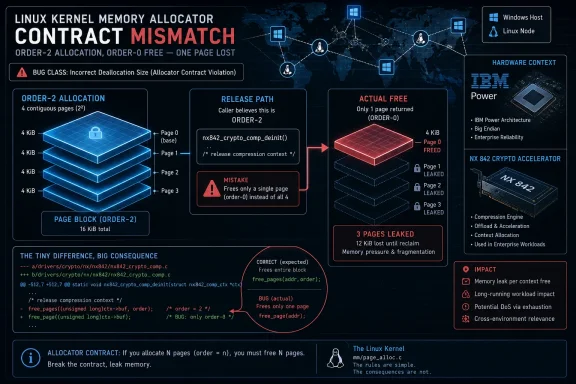
The heart of CVE-2026-46068 is almost comically small: the Linux kernel’s NX 842 crypto driver allocated bounce buffers with
That is the whole bug, and it is also the whole point. Modern kernel security work is full of these errors because allocators are contracts, not conveniences. If code asks the page allocator for four pages and later tells it to release one, the kernel has not simply misplaced a few kilobytes; it has created a path where repeated use can leak memory in privileged space.
The affected code lives under
That distinction matters because NVD’s page for the CVE currently says enrichment is still pending. There is no NVD CVSS score yet, no finalized vector, and no official weakness mapping published there at the time of the record’s initial posting. The absence of a score is not proof of safety, but it does mean administrators should resist the now-familiar ritual of treating every fresh CVE identifier as a fully assessed emergency.
A bounce buffer is a staging area. It exists because hardware and software often disagree about what memory layout, addressability, alignment, or access pattern is acceptable. Instead of handing data directly from one subsystem to another, the kernel may copy through a buffer that satisfies the device or algorithm’s constraints.
That makes bounce buffers boring in the best possible way. They are plumbing. But plumbing failures are exactly where kernel bugs tend to age badly, because nobody notices the drip until the ceiling stains. If a context allocation fails partway through, the error path should unwind everything it already allocated. If a context is later destroyed, its buffers should return cleanly to the allocator. CVE-2026-46068 says those paths were only partially returning what they took.
The fix touches both the allocation error path and the normal free path. That is important: this is not only a “failed initialization leaks memory” bug. The free routine itself used the wrong release function, so ordinary lifecycle cleanup for the crypto context could leave pages behind.
CVE-2026-46068 is unlikely to matter to a normal Windows 11 PC unless that PC is merely the console through which someone administers affected Linux infrastructure. It is not a Windows vulnerability. It is not a WSL-on-x86 vulnerability in the ordinary sense if the relevant NX 842 driver is not present, built, reachable, or running. It is not a browser exploit, a phishing primitive, or a remote-code-execution headline.
But the hybrid environment changes the operational meaning of “Linux-only.” A vulnerability in a specialized Linux driver can affect backup appliances, storage compression paths, enterprise Power systems, or distribution kernels that ship broad hardware support. The attack surface is narrower than the CVE feed implies, but the asset inventory question is broader than the component name suggests.
That is why the right response is not panic; it is scoping. Administrators should identify whether any Linux kernels in their environment include the NX 842 crypto driver and whether those systems run on hardware where it is meaningful. If the answer is no, the CVE becomes a tracking item. If the answer is yes, it becomes a patch-management item.
The danger is not that every one of these CVEs is equally exploitable. They are not. The danger is that organizations respond to the flood by ignoring all of them or, just as destructively, by treating all of them as equal. A missing CVSS score on day one should not mean “ignore.” A scary component name like
This is where mature patch operations matter more than vulnerability dashboards. A CVE such as this should flow into a normal kernel update process, with priority determined by exposure, platform, workload, and vendor guidance. For a Power Linux system using NX 842 acceleration, the fix deserves attention. For a fleet of Windows endpoints and x86 Linux VMs with no such driver path, the practical urgency is far lower.
Security teams have spent years asking for more transparency from open-source projects. Now that the Linux kernel is producing more granular vulnerability records, the complaint has shifted to noise. Both positions can be true: more records are useful, and more records are harder to triage.
That naming problem is not trivial. Security scanners and executive summaries compress nuance away. “Linux kernel crypto vulnerability” sounds far more urgent than “allocator mismatch in the IBM Power NX 842 compression context cleanup path.” The former sells dashboards; the latter helps engineers make decisions.
There is still a plausible denial-of-service angle whenever kernel memory can be leaked repeatedly. If a local or reachable path can allocate and free these contexts in a loop, unreleased pages could accumulate until memory pressure becomes visible. But the public record does not, by itself, establish a universal exploit path or a high-severity outcome.
That is the uncomfortable middle ground where many kernel CVEs live. The bug is real. The fix is correct. The exploitability depends on configuration, access, architecture, and workload. Anyone claiming certainty beyond that from the initial NVD text is getting ahead of the evidence.
For most organizations, that means waiting for the distribution vendor’s kernel advisory and installing the updated kernel package. On rolling or self-built systems, it means ensuring the relevant stable patch is present. On appliances, it means waiting for the appliance vendor, because kernel updates there are rarely something administrators can safely improvise.
The Linux stable process also explains why the CVE can appear after the fix is already moving. Kernel vulnerabilities are often documented after patches land or while they are being backported. That sequence can feel backward to people accustomed to branded vulnerability disclosures, embargo timelines, and coordinated vendor bulletins. In kernel land, the patch is often the primary artifact.
Windows administrators will recognize the shape even if the tooling differs. Microsoft’s monthly servicing model similarly compresses many individual fixes into cumulative updates. The difference is cultural visibility: Linux stable patches expose granular commits, mailing list review, and component-level reasoning, while Windows administrators more often consume aggregated KB packages and release notes.
For WSL users on ordinary Windows PCs, the relevant question is whether the WSL kernel contains and can exercise this driver path. In most consumer and developer scenarios, NX 842 on IBM Power hardware is not part of the picture. Treating this CVE as a WSL emergency would be misleading.
For Hyper-V and Azure operators, the question moves from the desktop to the inventory. Are there Linux guests on Power? Are there vendor appliances using a Linux kernel with NX support? Are there compression or crypto workloads that load this module? Are there kernels compiled with broad driver support even when the hardware is absent? These are mundane questions, but they are the questions that separate useful security operations from CVE theater.
For enterprise Windows admins, this is also a reminder that vulnerability ownership cannot be drawn cleanly along operating-system boundaries. The person responsible for patch compliance may not be the person who knows whether a Linux kernel config includes
In this case, the leaked unit is also not a few bytes on a heap. Order-2 page allocations are larger, contiguous page allocations. Leaking them repeatedly can matter under memory pressure, especially on systems that run long-lived workloads and rarely reboot. The impact may be less cinematic than code execution, but availability is still part of security.
The nuance is that potential denial of service is not the same as demonstrated denial of service. The initial CVE description does not describe an exploit, a reproducer, a privilege boundary, or a remote trigger. It describes a resolved bug and the allocator mismatch that caused it. That is enough to patch, but not enough to sensationalize.
The best way to think about CVE-2026-46068 is as a hygiene vulnerability in a privileged subsystem. It is a real defect in cleanup logic. It should be remediated through kernel updates. It should not be confused with the more severe Linux kernel flaws that enable local privilege escalation or cross-boundary data corruption.
CVE-2026-46068 hits both error cleanup and normal teardown, which makes it a clean example for code reviewers. Allocation and free APIs must be paired symmetrically. If a patch introduces an order constant during allocation, reviewers should look for that same constant during deallocation. If a function allocates multiple resources, every exit path needs to unwind the already-acquired subset in the reverse order or with equivalent care.
This is not glamorous security engineering, but it is the kind that prevents future CVEs. Static analysis can catch some allocator-family mismatches. Runtime leak detectors can catch others. Human review still matters because subsystem conventions are messy, and kernel APIs often encode meaning in names that look deceptively similar.
For developers who live mostly in Windows user space, this is a useful contrast. Managed runtimes and modern frameworks train us to think of cleanup as something the platform can often automate. Kernel C is less forgiving. One wrong helper name can leave physical pages behind.
The lack of a score should invite assessment rather than paralysis. A useful internal triage note would say what the bug is, what systems could plausibly contain the affected code, what vendors have shipped or will ship a fixed kernel, and whether any compensating controls exist. It would not merely copy the NVD page and wait for a number.
CVSS is especially awkward for kernel bugs with architecture-specific exposure. The same underlying code defect may be irrelevant on one fleet and significant on another. A Power server using NX acceleration is not in the same position as a Windows laptop, even though both may appear in the same enterprise vulnerability platform.
This is why security teams should enrich NVD enrichment with their own context. The public database can describe the vulnerability. Only the organization can describe exposure.
Kernel updates remain disruptive because they often require reboots, maintenance windows, live-patching eligibility checks, cluster draining, or appliance firmware releases. A four-line patch can still become a two-week operational task if the affected system sits under a database, storage array, or production workload. Severity determines urgency, but operational dependency determines timing.
The inventory problem is the harder part. Many organizations can answer “How many Windows 11 24H2 endpoints do we have?” faster than they can answer “Which Linux kernels include this driver and are running on hardware where it can be used?” That gap is not a Linux problem; it is an asset-management problem.
The practical workflow is familiar. Identify kernels. Map them to vendor advisories. Determine whether the affected driver is built in, loadable, or absent. Check whether the hardware and workload make the path reachable. Then patch through the normal channel.
CVE-2026-46068 is a small leak in a specialized Linux driver, but it points toward the future of vulnerability management: more granular records, more architecture-specific risk, more overlap between Windows and Linux operations, and less tolerance for hand-waving about “not our platform.” The fix is simple; the discipline it asks for is harder.
free_page() instead of matching free_pages() for order-2 bounce-buffer allocations. It is not the kind of flaw that should send Windows administrators scrambling to reimage fleets, but it is a useful reminder that the Linux kernel’s security story is increasingly a story about small allocator mismatches becoming tracked vulnerabilities. The practical risk appears narrow, the fix is tiny, and the broader lesson is larger than the patch. In mixed Windows-and-Linux estates, “not exploitable on my laptop” is no longer the same as “not operationally relevant.”
 A Four-Line Kernel Fix Becomes a CVE Because Memory Accounting Now Matters
The heart of CVE-2026-46068 is almost comically small: the Linux kernel’s NX 842 crypto driver allocated bounce buffers with __get_free_pages() using an order value of 2, meaning each buffer spans four pages, but later released those buffers with free_page(), a single-page free helper. The upstream fix replaces the mismatched calls with free_pages() and passes the same order used at allocation time.That is the whole bug, and it is also the whole point. Modern kernel security work is full of these errors because allocators are contracts, not conveniences. If code asks the page allocator for four pages and later tells it to release one, the kernel has not simply misplaced a few kilobytes; it has created a path where repeated use can leak memory in privileged space.
The affected code lives under
drivers/crypto/nx/, in the NX 842 compression path. This is not the everyday crypto stack most desktop users think of when they hear “kernel crypto.” NX is IBM’s hardware acceleration technology for Power systems, and 842 is a compression algorithm used in that ecosystem. In other words, this is a Linux kernel issue, but not a universal x86 laptop crisis.That distinction matters because NVD’s page for the CVE currently says enrichment is still pending. There is no NVD CVSS score yet, no finalized vector, and no official weakness mapping published there at the time of the record’s initial posting. The absence of a score is not proof of safety, but it does mean administrators should resist the now-familiar ritual of treating every fresh CVE identifier as a fully assessed emergency.
The Bug Is Small, but the Allocation Contract Is Not
Kernel memory bugs rarely look dramatic in a diff. Here, the code allocated two bounce buffers,sbounce and dbounce, with an order-2 allocation. On systems using 4 KB pages, each order-2 allocation is 16 KB, so the pair represents 32 KB of page-backed memory per context. On systems with different page sizes, the arithmetic changes, but the principle does not: order-N allocations must be freed with the same order.A bounce buffer is a staging area. It exists because hardware and software often disagree about what memory layout, addressability, alignment, or access pattern is acceptable. Instead of handing data directly from one subsystem to another, the kernel may copy through a buffer that satisfies the device or algorithm’s constraints.
That makes bounce buffers boring in the best possible way. They are plumbing. But plumbing failures are exactly where kernel bugs tend to age badly, because nobody notices the drip until the ceiling stains. If a context allocation fails partway through, the error path should unwind everything it already allocated. If a context is later destroyed, its buffers should return cleanly to the allocator. CVE-2026-46068 says those paths were only partially returning what they took.
The fix touches both the allocation error path and the normal free path. That is important: this is not only a “failed initialization leaks memory” bug. The free routine itself used the wrong release function, so ordinary lifecycle cleanup for the crypto context could leave pages behind.
This Is a Power-Focused Kernel Bug, Not a Windows Desktop Panic
For WindowsForum readers, the first question is obvious: why should a Windows community care about a Linux kernel CVE in an IBM Power crypto driver? The answer is that Windows estates rarely stop at Windows anymore. The same administrator who patches Windows 11, Windows Server, Hyper-V, Defender, and Microsoft 365 may also own WSL images, Linux build hosts, Kubernetes nodes, NAS appliances, embedded gateways, and Power-based back-end systems.CVE-2026-46068 is unlikely to matter to a normal Windows 11 PC unless that PC is merely the console through which someone administers affected Linux infrastructure. It is not a Windows vulnerability. It is not a WSL-on-x86 vulnerability in the ordinary sense if the relevant NX 842 driver is not present, built, reachable, or running. It is not a browser exploit, a phishing primitive, or a remote-code-execution headline.
But the hybrid environment changes the operational meaning of “Linux-only.” A vulnerability in a specialized Linux driver can affect backup appliances, storage compression paths, enterprise Power systems, or distribution kernels that ship broad hardware support. The attack surface is narrower than the CVE feed implies, but the asset inventory question is broader than the component name suggests.
That is why the right response is not panic; it is scoping. Administrators should identify whether any Linux kernels in their environment include the NX 842 crypto driver and whether those systems run on hardware where it is meaningful. If the answer is no, the CVE becomes a tracking item. If the answer is yes, it becomes a patch-management item.
The New Kernel CVE Machine Turns Maintenance Bugs Into Security Events
CVE-2026-46068 is also part of a larger pattern: the Linux kernel project now assigns CVEs to many fixes that historically might have passed through stable trees as ordinary bug fixes. That shift is uncomfortable for defenders because it inflates the volume of kernel CVEs, but it also reflects a sober truth. In kernel space, memory leaks, reference leaks, use-after-free bugs, bounds mistakes, and allocator mismatches can become security-relevant even when the original patch discussion is brief.The danger is not that every one of these CVEs is equally exploitable. They are not. The danger is that organizations respond to the flood by ignoring all of them or, just as destructively, by treating all of them as equal. A missing CVSS score on day one should not mean “ignore.” A scary component name like
crypto should not mean “drop everything.”This is where mature patch operations matter more than vulnerability dashboards. A CVE such as this should flow into a normal kernel update process, with priority determined by exposure, platform, workload, and vendor guidance. For a Power Linux system using NX 842 acceleration, the fix deserves attention. For a fleet of Windows endpoints and x86 Linux VMs with no such driver path, the practical urgency is far lower.
Security teams have spent years asking for more transparency from open-source projects. Now that the Linux kernel is producing more granular vulnerability records, the complaint has shifted to noise. Both positions can be true: more records are useful, and more records are harder to triage.
The Crypto Label Is More Misleading Than Helpful
The wordcrypto in the path will draw eyes, but this is not a cryptographic break. There is no indication from the public description that NX 842 encryption secrets are exposed, that compression output is corrupted in a way that enables direct privilege escalation, or that an attacker can recover keys. The vulnerable area is in the crypto driver tree because Linux’s crypto API covers compression algorithms as well as traditional encryption and hashing operations.That naming problem is not trivial. Security scanners and executive summaries compress nuance away. “Linux kernel crypto vulnerability” sounds far more urgent than “allocator mismatch in the IBM Power NX 842 compression context cleanup path.” The former sells dashboards; the latter helps engineers make decisions.
There is still a plausible denial-of-service angle whenever kernel memory can be leaked repeatedly. If a local or reachable path can allocate and free these contexts in a loop, unreleased pages could accumulate until memory pressure becomes visible. But the public record does not, by itself, establish a universal exploit path or a high-severity outcome.
That is the uncomfortable middle ground where many kernel CVEs live. The bug is real. The fix is correct. The exploitability depends on configuration, access, architecture, and workload. Anyone claiming certainty beyond that from the initial NVD text is getting ahead of the evidence.
Stable Kernel Backports Are the Real Delivery Mechanism
The fix for CVE-2026-46068 was not a sprawling redesign. It was backported through stable kernel channels, with multiple stable commit references attached to the CVE record. That tells administrators something important: remediation is expected to arrive through normal kernel package updates, not through a special mitigation flag or product-specific workaround.For most organizations, that means waiting for the distribution vendor’s kernel advisory and installing the updated kernel package. On rolling or self-built systems, it means ensuring the relevant stable patch is present. On appliances, it means waiting for the appliance vendor, because kernel updates there are rarely something administrators can safely improvise.
The Linux stable process also explains why the CVE can appear after the fix is already moving. Kernel vulnerabilities are often documented after patches land or while they are being backported. That sequence can feel backward to people accustomed to branded vulnerability disclosures, embargo timelines, and coordinated vendor bulletins. In kernel land, the patch is often the primary artifact.
Windows administrators will recognize the shape even if the tooling differs. Microsoft’s monthly servicing model similarly compresses many individual fixes into cumulative updates. The difference is cultural visibility: Linux stable patches expose granular commits, mailing list review, and component-level reasoning, while Windows administrators more often consume aggregated KB packages and release notes.
The Windows Angle Runs Through WSL, Hyper-V, Azure, and the Server Room
CVE-2026-46068 does not make Windows less secure. It does, however, expose a blind spot in Windows-first organizations that now depend on Linux in quiet places. WSL is the visible example, but it is not the most important one. The more consequential Linux systems are often the least visible: CI runners, container hosts, network appliances, storage controllers, database servers, and cloud workloads.For WSL users on ordinary Windows PCs, the relevant question is whether the WSL kernel contains and can exercise this driver path. In most consumer and developer scenarios, NX 842 on IBM Power hardware is not part of the picture. Treating this CVE as a WSL emergency would be misleading.
For Hyper-V and Azure operators, the question moves from the desktop to the inventory. Are there Linux guests on Power? Are there vendor appliances using a Linux kernel with NX support? Are there compression or crypto workloads that load this module? Are there kernels compiled with broad driver support even when the hardware is absent? These are mundane questions, but they are the questions that separate useful security operations from CVE theater.
For enterprise Windows admins, this is also a reminder that vulnerability ownership cannot be drawn cleanly along operating-system boundaries. The person responsible for patch compliance may not be the person who knows whether a Linux kernel config includes
CONFIG_CRYPTO_DEV_NX_COMPRESS. Bridging that gap is more valuable than forwarding another scanner export.Memory Leaks Are Not Automatically Low Risk
Security teams often downgrade memory leaks reflexively, and sometimes that is correct. A leak that requires rare hardware, privileged access, and repeated local triggering may be operationally minor. But kernel memory leaks deserve more respect than user-space leaks because the kernel is shared infrastructure. Exhausting kernel memory can degrade the whole system, not just one process.In this case, the leaked unit is also not a few bytes on a heap. Order-2 page allocations are larger, contiguous page allocations. Leaking them repeatedly can matter under memory pressure, especially on systems that run long-lived workloads and rarely reboot. The impact may be less cinematic than code execution, but availability is still part of security.
The nuance is that potential denial of service is not the same as demonstrated denial of service. The initial CVE description does not describe an exploit, a reproducer, a privilege boundary, or a remote trigger. It describes a resolved bug and the allocator mismatch that caused it. That is enough to patch, but not enough to sensationalize.
The best way to think about CVE-2026-46068 is as a hygiene vulnerability in a privileged subsystem. It is a real defect in cleanup logic. It should be remediated through kernel updates. It should not be confused with the more severe Linux kernel flaws that enable local privilege escalation or cross-boundary data corruption.
The Patch Shows Why Error Paths Are Security-Critical Code
Error paths are where many kernel bugs hide because they are hard to test and easy to overlook. The mainline success path gets exercised constantly. The failure path that runs only after one allocation succeeds and another fails may see far less real-world coverage. Yet when it does run, it must be just as correct.CVE-2026-46068 hits both error cleanup and normal teardown, which makes it a clean example for code reviewers. Allocation and free APIs must be paired symmetrically. If a patch introduces an order constant during allocation, reviewers should look for that same constant during deallocation. If a function allocates multiple resources, every exit path needs to unwind the already-acquired subset in the reverse order or with equivalent care.
This is not glamorous security engineering, but it is the kind that prevents future CVEs. Static analysis can catch some allocator-family mismatches. Runtime leak detectors can catch others. Human review still matters because subsystem conventions are messy, and kernel APIs often encode meaning in names that look deceptively similar.
For developers who live mostly in Windows user space, this is a useful contrast. Managed runtimes and modern frameworks train us to think of cleanup as something the platform can often automate. Kernel C is less forgiving. One wrong helper name can leave physical pages behind.
The Missing CVSS Score Should Slow the Hot Takes
At publication time, NVD had marked the CVE as awaiting enrichment and had not assigned its own CVSS 4.0, 3.x, or 2.0 score. That matters because severity numbers become policy triggers. A “critical” label can force emergency change windows; an “unscored” entry can vanish into backlog. Neither reaction is inherently correct.The lack of a score should invite assessment rather than paralysis. A useful internal triage note would say what the bug is, what systems could plausibly contain the affected code, what vendors have shipped or will ship a fixed kernel, and whether any compensating controls exist. It would not merely copy the NVD page and wait for a number.
CVSS is especially awkward for kernel bugs with architecture-specific exposure. The same underlying code defect may be irrelevant on one fleet and significant on another. A Power server using NX acceleration is not in the same position as a Windows laptop, even though both may appear in the same enterprise vulnerability platform.
This is why security teams should enrich NVD enrichment with their own context. The public database can describe the vulnerability. Only the organization can describe exposure.
The Vendor Patch Is Straightforward; The Inventory Is Not
There is no sign that administrators need to disable broad Linux crypto functionality, blacklist unrelated modules, or apply risky custom workarounds for this issue. The clean answer is to run a kernel containing the upstream fix or the distribution’s backport. That is simple in theory and slow in practice.Kernel updates remain disruptive because they often require reboots, maintenance windows, live-patching eligibility checks, cluster draining, or appliance firmware releases. A four-line patch can still become a two-week operational task if the affected system sits under a database, storage array, or production workload. Severity determines urgency, but operational dependency determines timing.
The inventory problem is the harder part. Many organizations can answer “How many Windows 11 24H2 endpoints do we have?” faster than they can answer “Which Linux kernels include this driver and are running on hardware where it can be used?” That gap is not a Linux problem; it is an asset-management problem.
The practical workflow is familiar. Identify kernels. Map them to vendor advisories. Determine whether the affected driver is built in, loadable, or absent. Check whether the hardware and workload make the path reachable. Then patch through the normal channel.
The Tiny NX 842 Fix Carries a Larger Message for Mixed Estates
CVE-2026-46068 is narrow enough that many readers will never touch an affected machine, but concrete enough to sharpen a few habits.- Administrators should treat this as a Linux kernel patching issue, not a Windows endpoint emergency.
- Teams running IBM Power Linux systems or vendor appliances with NX 842 support should prioritize vendor kernel updates once available.
- Security teams should avoid inflating the word
cryptointo a claim about broken encryption or key disclosure. - Vulnerability managers should not wait passively for NVD scoring before performing exposure-based triage.
- Windows-first organizations should include Linux guests, appliances, build systems, and cloud workloads in their CVE ownership model.
- Developers should read the patch as a reminder that allocator symmetry is security work, even when the diff looks trivial.
CVE-2026-46068 is a small leak in a specialized Linux driver, but it points toward the future of vulnerability management: more granular records, more architecture-specific risk, more overlap between Windows and Linux operations, and less tolerance for hand-waving about “not our platform.” The fix is simple; the discipline it asks for is harder.
References
- Primary source: NVD / Linux Kernel
Published: 2026-05-28T01:10:53-07:00
NVD - CVE-2026-46068
 nvd.nist.gov
- Security advisory: MSRC
Published: 2026-05-28T01:10:53-07:00
Original feed URL
Security Update Guide - Microsoft Security Response Center
 msrc.microsoft.com
- Related coverage: codebrowser.dev

nx-842.c source code [linux/drivers/crypto/nx/nx-842.c] - Codebrowser
Source code of linux/drivers/crypto/nx/nx-842.c linux v6.19-r on KDAB Codebrowser
codebrowser.dev
- Related coverage: stack.watch
- Related coverage: linuxiac.com
Fragnesia Is Yet Another Dirty Frag Style Linux Kernel Exploit
Fragnesia exposes another Linux kernel page-cache attack path, allowing local root escalation through ESP handling.linuxiac.com - Related coverage: kernel.org

- Related coverage: docs.redhat.com
