

CVE-2026-46069 is a Linux kernel Wi-Fi driver vulnerability, published by NVD on May 27, 2026, in the Marvell mwifiex adapter cleanup path, where a wakeup timer callback can keep running after driver teardown and touch memory that may already have been freed. The bug is small in code but large in implication: it is another reminder that kernel security often turns on mundane lifecycle details rather than cinematic remote exploits. For WindowsForum readers, the immediate takeaway is not panic, but inventory discipline. If you run Linux endpoints, appliances, embedded boards, virtualization hosts, or dual-boot laptops with Marvell wireless hardware, this is the sort of fix you want absorbed through normal kernel update channels before it becomes operational noise.
The fix for CVE-2026-46069 is almost comically modest: replace a non-synchronous timer deletion with a synchronous one. That sounds like the sort of patch that should live in a maintenance changelog, not a vulnerability database. But kernel bugs are often born in the gap between “the object is logically gone” and “the last CPU is finished touching it.”
The affected code sits in
That distinction matters. If
This is the textbook shape of a use-after-free. It does not require a grand architectural failure. It requires only a stale reference, a racing callback, and a teardown path that assumes deletion means quiescence.
In this case, the vulnerable sequence is easy to understand. The driver tries to stop a timer. It then continues toward freeing the adapter. But because the timer deletion is not synchronous, the callback may already be executing and may continue after the cleanup routine believes it has done its job.
The kernel has long distinguished between “remove this timer from future execution” and “ensure that no instance of this timer callback is running anywhere.” Those are not equivalent operations on a multicore system. CVE-2026-46069 is what happens when code treats them as if they are.
The patch uses
The practical risk is narrower than the phrase “Linux kernel vulnerability” may suggest. The flaw is in a specific Wi-Fi driver,
That narrowing matters for administrators. A cloud Linux VM with no Wi-Fi stack is a very different target from an industrial gateway, single-board computer, thin client, lab laptop, or embedded device using Marvell wireless. Kernel CVEs frequently look broad in feeds and narrow in fleet reality.
Still, “driver-specific” is not the same as “irrelevant.” Drivers execute in privileged kernel context, and memory corruption in that context is rarely something security teams can ignore indefinitely. The most conservative reading is that this is a kernel stability and memory-safety flaw with exploitation details not publicly established in the NVD entry.
That is why wireless driver bugs deserve more attention than their quiet patch titles usually receive. A Wi-Fi driver is not just a convenience component. It is a parser, a state machine, a power-management participant, and a kernel-resident interface to messy radio environments.
CVE-2026-46069 is not described as a packet parsing bug. The NVD description focuses on teardown timing, not hostile frames. But wireless devices are constantly entering and leaving power states, reconnecting, resetting, suspending, resuming, and being removed or reprobed. Those transitions are exactly where lifecycle mistakes tend to surface.
For enterprise IT, the question is less “Can someone weaponize this today?” and more “Do we know where this code runs?” If the answer is no, the vulnerability feed has done its job by exposing an asset-management blind spot.
But WindowsForum’s audience is not limited to single-OS desktops. Plenty of readers manage mixed fleets, run Linux servers beside Windows Server, use Hyper-V, maintain Proxmox or Ubuntu hosts, build Linux-based appliances, or keep dual-boot developer machines. In that world, a Linux kernel Wi-Fi driver CVE is part of the same operational surface.
WSL also deserves a careful caveat. Windows Subsystem for Linux 2 uses a Microsoft-maintained Linux kernel, but WSL generally does not expose physical Wi-Fi drivers to Linux distributions in the way a bare-metal Linux install does. For most WSL users, this CVE is unlikely to be directly relevant.
The more interesting Windows-adjacent exposure is the machine under the Windows admin’s desk that is not running Windows at all: a Linux-based access controller, kiosk, sensor gateway, backup appliance, test board, or hypervisor. Those are the systems that quietly accumulate kernel fixes until someone remembers they exist.
Timers, workqueues, tasklets, delayed work, callbacks, interrupts, reference counts, and device removal paths all force kernel code to answer the same question: who owns this memory right now? If the answer changes while another CPU is still executing, a correct-looking cleanup function can become a vulnerability.
The relevant difference between
This is why security hardening often looks boring. A single suffix,
The advantage is speed and breadth. Kernel fixes that might once have lived quietly in stable release notes now show up in vulnerability databases, giving scanners and patch systems a common identifier. The disadvantage is noise. Not every kernel CVE has the same exploitability, reach, or urgency, and many arrive before scoring, vendor advisories, or distro-specific impact statements are available.
CVE-2026-46069 sits squarely in that tension. It is real enough to receive a CVE and stable-tree references. It is also not yet enriched with NVD scoring, and the public description does not establish a remote attack path, a privilege-escalation recipe, or affected distribution packages.
That means defenders should resist both extremes. Ignoring it because it is “just a driver cleanup bug” is lazy. Treating it like an active internet-scale emergency is equally unsupported by the available record.
It is comforting because administrators should not need to become wireless-driver maintainers. If your distribution ships a supported kernel and backports the fix, normal patch management should handle the issue. The presence of multiple stable references suggests the fix is intended to propagate across maintained kernel branches.
It is frustrating because the lag between upstream kernel fixes, CVE publication, distribution advisories, and appliance firmware can be uneven. A scanner may flag the CVE before your vendor has published a package mapping. Or a vendor may ship a fixed kernel without making the CVE obvious in release notes.
This is where Linux patch management becomes less about individual CVEs and more about trust chains. If your systems track supported distro kernels and receive timely updates, CVE-2026-46069 becomes routine hygiene. If they run frozen vendor kernels from years ago, the real problem is bigger than this one timer.
Administrators can usually determine exposure by checking loaded modules, hardware inventory, kernel configuration, and distribution advisories. On embedded systems, that may require more digging because vendor kernels often carry custom module layouts, backports, or statically built drivers. A vulnerability scanner may not know the difference unless it has accurate kernel package intelligence.
The worst response is to chase the CVE identifier in isolation. Kernel version strings, distro backporting practices, and vendor patch policies routinely make naïve version comparisons misleading. A system can report an older upstream kernel version and still contain a backported fix.
That is especially true in enterprise distributions, where security fixes are often applied without rebasing to a newer upstream release. The evidence you want is not merely “kernel version greater than X.” It is a vendor statement, changelog entry, patch reference, or package advisory confirming that the affected code path has been corrected.
A local attacker with the ability to trigger device removal, reset paths, suspend/resume behavior, or driver teardown may be in a more interesting position than a remote attacker merely within radio range. But without more detail, that remains analysis rather than fact. The available description identifies the race; it does not map the race to a practical exploit.
That uncertainty should guide prioritization. Internet-facing remote code execution flaws demand one kind of response. Hardware-specific kernel cleanup races demand another: identify exposure, schedule kernel updates, watch vendor advisories, and avoid letting unsupported systems drift.
Security teams often struggle with CVEs that lack scores because their dashboards want a number. CVE-2026-46069 is a case where the absence of a score should push teams toward context rather than paralysis. The risk is not uniform; it depends heavily on whether the vulnerable driver is present and reachable.
That is not because embedded vendors are careless by default. Many have certification burdens, custom hardware dependencies, and update channels that are less forgiving than a general-purpose Linux distribution. But the result is predictable: small kernel bugs can persist in product lines long after they have been fixed upstream.
The mwifiex driver’s relevance to wireless-enabled embedded hardware makes that tail worth watching. A development board in a lab may not matter. The same code in a field-deployed gateway, industrial device, or medical-adjacent appliance may sit in a very different risk category.
For buyers, the lesson is to ask vendors boring questions before the emergency. How quickly do they ingest stable kernel fixes? Do they publish CVE mappings? Can they confirm whether a driver is enabled, modular, or absent? Do they provide firmware update tooling that operators can actually use?
A maintained Linux fleet can absorb this through regular kernel updates. An unmanaged one turns every small race condition into a forensic question later. That is the difference between patch management and vulnerability whack-a-mole.
For sysadmins, the correct posture is measured urgency. Confirm whether the driver is present. Track the fixed kernel from your vendor. Prioritize systems where Wi-Fi hardware is active, physical access is broad, or device reset paths are exposed to less-trusted users.
For security-minded Windows administrators, the broader lesson is familiar from the Windows driver world: kernel-mode hardware support is a privileged attack surface, even when the bug lives in some dusty corner of cleanup code. Drivers are where performance, power management, hardware quirks, and memory safety collide.
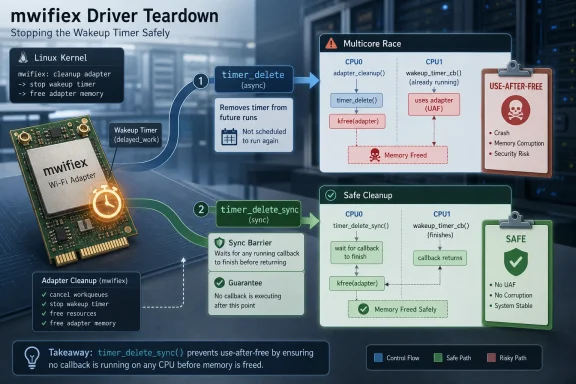 A One-Line Timer Fix Exposes the Kernel’s Hardest Problem
The fix for CVE-2026-46069 is almost comically modest: replace a non-synchronous timer deletion with a synchronous one. That sounds like the sort of patch that should live in a maintenance changelog, not a vulnerability database. But kernel bugs are often born in the gap between “the object is logically gone” and “the last CPU is finished touching it.”The affected code sits in
mwifiex_adapter_cleanup(), part of the Linux kernel’s Marvell Wi-Fi driver. During device removal or cleanup, the driver deletes wakeup_timer and later frees the adapter structure. The problem is that timer_delete() does not wait for a currently executing timer callback to finish.That distinction matters. If
wakeup_timer_fn is already running on another CPU when cleanup begins, it can continue reading or writing fields inside the adapter structure while teardown proceeds. Once mwifiex_free_adapter() releases that memory, the callback may still be holding a pointer into a corpse.This is the textbook shape of a use-after-free. It does not require a grand architectural failure. It requires only a stale reference, a racing callback, and a teardown path that assumes deletion means quiescence.
The Bug Lives in the Space Between Remove and Return
Driver cleanup is where many kernel subsystems reveal their sharp edges. Runtime paths tend to be heavily exercised because users connect, roam, suspend, resume, and transfer data all day. Removal paths, error paths, and late cleanup paths receive less attention, yet they run with the same privilege and memory-safety consequences.In this case, the vulnerable sequence is easy to understand. The driver tries to stop a timer. It then continues toward freeing the adapter. But because the timer deletion is not synchronous, the callback may already be executing and may continue after the cleanup routine believes it has done its job.
The kernel has long distinguished between “remove this timer from future execution” and “ensure that no instance of this timer callback is running anywhere.” Those are not equivalent operations on a multicore system. CVE-2026-46069 is what happens when code treats them as if they are.
The patch uses
timer_delete_sync(), which waits for any running callback to complete before returning. That changes the cleanup contract from hopeful to deterministic. The driver no longer frees the adapter while a timer callback may still be walking through its fields.NVD Has Not Scored It, and That Is Not the Same as Harmless
At publication, NVD lists CVE-2026-46069 as awaiting enrichment and has not assigned CVSS v4, v3, or v2 scoring. That absence should not be mistaken for a clean bill of health. It means the public record has not yet been fully classified by NVD’s enrichment process.The practical risk is narrower than the phrase “Linux kernel vulnerability” may suggest. The flaw is in a specific Wi-Fi driver,
mwifiex, used for Marvell wireless hardware. Systems that do not load the driver are not exposed to this particular bug in any meaningful operational sense.That narrowing matters for administrators. A cloud Linux VM with no Wi-Fi stack is a very different target from an industrial gateway, single-board computer, thin client, lab laptop, or embedded device using Marvell wireless. Kernel CVEs frequently look broad in feeds and narrow in fleet reality.
Still, “driver-specific” is not the same as “irrelevant.” Drivers execute in privileged kernel context, and memory corruption in that context is rarely something security teams can ignore indefinitely. The most conservative reading is that this is a kernel stability and memory-safety flaw with exploitation details not publicly established in the NVD entry.
Wi-Fi Drivers Are Where Old Hardware Meets Modern Threat Models
The mwifiex driver has been around for years because hardware outlives software fashions. Wi-Fi chips ship inside development boards, point-of-sale systems, ruggedized tablets, older laptops, IoT gateways, and specialty appliances that may remain in service long after consumer hardware has moved on.That is why wireless driver bugs deserve more attention than their quiet patch titles usually receive. A Wi-Fi driver is not just a convenience component. It is a parser, a state machine, a power-management participant, and a kernel-resident interface to messy radio environments.
CVE-2026-46069 is not described as a packet parsing bug. The NVD description focuses on teardown timing, not hostile frames. But wireless devices are constantly entering and leaving power states, reconnecting, resetting, suspending, resuming, and being removed or reprobed. Those transitions are exactly where lifecycle mistakes tend to surface.
For enterprise IT, the question is less “Can someone weaponize this today?” and more “Do we know where this code runs?” If the answer is no, the vulnerability feed has done its job by exposing an asset-management blind spot.
The Windows Angle Is Indirect, but Real
Windows users may be tempted to dismiss this as Linux housekeeping. On a pure Windows desktop, that is mostly fair. CVE-2026-46069 is not a Windows kernel bug, not a Windows Wi-Fi driver bug, and not something that affects the ordinary Windows networking stack.But WindowsForum’s audience is not limited to single-OS desktops. Plenty of readers manage mixed fleets, run Linux servers beside Windows Server, use Hyper-V, maintain Proxmox or Ubuntu hosts, build Linux-based appliances, or keep dual-boot developer machines. In that world, a Linux kernel Wi-Fi driver CVE is part of the same operational surface.
WSL also deserves a careful caveat. Windows Subsystem for Linux 2 uses a Microsoft-maintained Linux kernel, but WSL generally does not expose physical Wi-Fi drivers to Linux distributions in the way a bare-metal Linux install does. For most WSL users, this CVE is unlikely to be directly relevant.
The more interesting Windows-adjacent exposure is the machine under the Windows admin’s desk that is not running Windows at all: a Linux-based access controller, kiosk, sensor gateway, backup appliance, test board, or hypervisor. Those are the systems that quietly accumulate kernel fixes until someone remembers they exist.
The Patch Says More About Concurrency Than About Marvell
It would be easy to frame CVE-2026-46069 as a Marvell Wi-Fi oddity. That misses the larger lesson. The bug belongs to a broad family of cleanup-race defects that appear whenever asynchronous work survives longer than the object it references.Timers, workqueues, tasklets, delayed work, callbacks, interrupts, reference counts, and device removal paths all force kernel code to answer the same question: who owns this memory right now? If the answer changes while another CPU is still executing, a correct-looking cleanup function can become a vulnerability.
The relevant difference between
timer_delete() and timer_delete_sync() is a boundary line. The first prevents future timer execution but does not necessarily wait for a callback already in progress. The second waits for the in-flight callback to finish, which is exactly what a teardown path needs before freeing associated state.This is why security hardening often looks boring. A single suffix,
_sync, can decide whether the code merely requests cleanup or actually reaches a safe point. In userspace, that might be a race-condition bug. In the kernel, it can become memory corruption.The CVE Pipeline Is Catching More of Linux’s Maintenance Reality
The modern Linux kernel CVE stream has changed how administrators encounter bugs like this. Many entries now arrive with descriptions that are essentially cleaned-up commit messages: “In the Linux kernel, the following vulnerability has been resolved.” That language can feel strange to people accustomed to vendor advisories written after a dramatic disclosure process.The advantage is speed and breadth. Kernel fixes that might once have lived quietly in stable release notes now show up in vulnerability databases, giving scanners and patch systems a common identifier. The disadvantage is noise. Not every kernel CVE has the same exploitability, reach, or urgency, and many arrive before scoring, vendor advisories, or distro-specific impact statements are available.
CVE-2026-46069 sits squarely in that tension. It is real enough to receive a CVE and stable-tree references. It is also not yet enriched with NVD scoring, and the public description does not establish a remote attack path, a privilege-escalation recipe, or affected distribution packages.
That means defenders should resist both extremes. Ignoring it because it is “just a driver cleanup bug” is lazy. Treating it like an active internet-scale emergency is equally unsupported by the available record.
Stable Kernels Are the Real Delivery Mechanism
For most organizations, the fix will not arrive as a hand-applied patch from git.kernel.org. It will arrive through distribution kernel updates, appliance vendor firmware, board-support packages, or long-term-stable kernel refreshes. That is both comforting and frustrating.It is comforting because administrators should not need to become wireless-driver maintainers. If your distribution ships a supported kernel and backports the fix, normal patch management should handle the issue. The presence of multiple stable references suggests the fix is intended to propagate across maintained kernel branches.
It is frustrating because the lag between upstream kernel fixes, CVE publication, distribution advisories, and appliance firmware can be uneven. A scanner may flag the CVE before your vendor has published a package mapping. Or a vendor may ship a fixed kernel without making the CVE obvious in release notes.
This is where Linux patch management becomes less about individual CVEs and more about trust chains. If your systems track supported distro kernels and receive timely updates, CVE-2026-46069 becomes routine hygiene. If they run frozen vendor kernels from years ago, the real problem is bigger than this one timer.
Asset Inventory Beats Vulnerability Theater
The most useful response starts with a simple question: do any of your Linux systems loadmwifiex? If not, the CVE belongs in your records but not at the top of your emergency queue. If yes, the next question is whether those systems are already receiving a kernel that includes the fix.Administrators can usually determine exposure by checking loaded modules, hardware inventory, kernel configuration, and distribution advisories. On embedded systems, that may require more digging because vendor kernels often carry custom module layouts, backports, or statically built drivers. A vulnerability scanner may not know the difference unless it has accurate kernel package intelligence.
The worst response is to chase the CVE identifier in isolation. Kernel version strings, distro backporting practices, and vendor patch policies routinely make naïve version comparisons misleading. A system can report an older upstream kernel version and still contain a backported fix.
That is especially true in enterprise distributions, where security fixes are often applied without rebasing to a newer upstream release. The evidence you want is not merely “kernel version greater than X.” It is a vendor statement, changelog entry, patch reference, or package advisory confirming that the affected code path has been corrected.
Exploitability Remains the Missing Piece
The public record for CVE-2026-46069 describes a use-after-free condition during adapter cleanup, but it does not provide proof-of-concept exploit code or a demonstrated attack chain. That distinction matters. A memory safety bug in kernel code is serious, but exploitability depends on timing, attacker control, memory layout, reachable triggers, and whether the affected path can be induced by an unprivileged user or remote activity.A local attacker with the ability to trigger device removal, reset paths, suspend/resume behavior, or driver teardown may be in a more interesting position than a remote attacker merely within radio range. But without more detail, that remains analysis rather than fact. The available description identifies the race; it does not map the race to a practical exploit.
That uncertainty should guide prioritization. Internet-facing remote code execution flaws demand one kind of response. Hardware-specific kernel cleanup races demand another: identify exposure, schedule kernel updates, watch vendor advisories, and avoid letting unsupported systems drift.
Security teams often struggle with CVEs that lack scores because their dashboards want a number. CVE-2026-46069 is a case where the absence of a score should push teams toward context rather than paralysis. The risk is not uniform; it depends heavily on whether the vulnerable driver is present and reachable.
Embedded Linux Is Where This Could Linger
Desktop Linux users on mainstream distributions will likely receive the fix through ordinary kernel updates. The longer tail is embedded Linux. Devices built around board-support packages, vendor forks, and fixed-function appliances often lag behind upstream stable trees for months or years.That is not because embedded vendors are careless by default. Many have certification burdens, custom hardware dependencies, and update channels that are less forgiving than a general-purpose Linux distribution. But the result is predictable: small kernel bugs can persist in product lines long after they have been fixed upstream.
The mwifiex driver’s relevance to wireless-enabled embedded hardware makes that tail worth watching. A development board in a lab may not matter. The same code in a field-deployed gateway, industrial device, or medical-adjacent appliance may sit in a very different risk category.
For buyers, the lesson is to ask vendors boring questions before the emergency. How quickly do they ingest stable kernel fixes? Do they publish CVE mappings? Can they confirm whether a driver is enabled, modular, or absent? Do they provide firmware update tooling that operators can actually use?
The Real Security Boundary Is Maintenance
CVE-2026-46069 is not the sort of vulnerability that will dominate executive briefings. It has no catchy name, no logo, no confirmed mass exploitation, and no NVD score at the time of writing. But it is exactly the sort of flaw that separates well-maintained infrastructure from infrastructure that merely appears quiet.A maintained Linux fleet can absorb this through regular kernel updates. An unmanaged one turns every small race condition into a forensic question later. That is the difference between patch management and vulnerability whack-a-mole.
For sysadmins, the correct posture is measured urgency. Confirm whether the driver is present. Track the fixed kernel from your vendor. Prioritize systems where Wi-Fi hardware is active, physical access is broad, or device reset paths are exposed to less-trusted users.
For security-minded Windows administrators, the broader lesson is familiar from the Windows driver world: kernel-mode hardware support is a privileged attack surface, even when the bug lives in some dusty corner of cleanup code. Drivers are where performance, power management, hardware quirks, and memory safety collide.
The Small Race Windows Admins Should Not Ignore
CVE-2026-46069 is most useful when treated as a practical maintenance signal rather than a headline-grabbing crisis. It tells administrators to look for a specific Linux Wi-Fi driver, verify update paths, and remember that unsupported kernels accumulate risk one quiet fix at a time.- Systems that do not use the Linux
mwifiexdriver are unlikely to have meaningful exposure to this specific vulnerability. - Systems using Marvell Wi-Fi hardware with the affected driver should receive a kernel update that includes the
timer_delete_sync()cleanup fix. - NVD had not assigned a CVSS score at publication, so local asset context matters more than dashboard severity.
- WSL users are generally unlikely to be directly affected because WSL does not normally use physical Linux Wi-Fi drivers in the bare-metal sense.
- Embedded Linux devices and appliances are the places where this kind of upstream fix can remain unresolved longest.
References
- Primary source: NVD / Linux Kernel
Published: 2026-05-28T01:08:06-07:00
NVD - CVE-2026-46069
 nvd.nist.gov
- Security advisory: MSRC
Published: 2026-05-28T01:08:06-07:00
Original feed URL
Security Update Guide - Microsoft Security Response Center
 msrc.microsoft.com
- Related coverage: git.zx2c4.com
- Related coverage: cve.imfht.com
CVE-2025-38505: wifi: mwifiex: discard erroneous disassoc frames on STA interface - Vulnerability Platform
[-] Overview A vulnerability related to the driver in the Linux kernel has been fixed: in concurrent STA/AP mode, when host MLME is enabled, the firmware cve.imfht.com
- Related coverage: cvefeed.io
CVE-2026-23281 - wifi: libertas: fix use-after-free in lbs_free_adapter()
In the Linux kernel, the following vulnerability has been resolved: wifi: libertas: fix use-after-free in lbs_free_adapter() The lbs_free_adapter() function uses timer_delete() (non-synchronous) for both command_timer and tx_lockup_timer before the structure is freed. This is incorrect because...cvefeed.io - Related coverage: ubuntuupdates.org
- Related coverage: news2web.pasdenom.info
- Related coverage: lore-kernel.gnuweeb.org
- Related coverage: support.bull.com
