

CVE-2026-46077, published by NVD on May 27, 2026, covers a Linux kernel fix in the Atmel TDES crypto driver where DMA output was synchronized in the wrong direction before CPU consumption. The bug is narrow, hardware-specific, and still awaiting NVD enrichment, but it is exactly the kind of low-glamour kernel flaw that matters because it exposes how fragile driver correctness becomes on non-coherent platforms. For WindowsForum readers, the lesson is not “panic about Triple DES”; it is that embedded Linux, appliances, and edge hardware live or die by tiny assumptions most vulnerability dashboards flatten into a single CVE row.
The most tempting reading of CVE-2026-46077 is also the least useful one: a minor Linux kernel issue in an old-sounding crypto accelerator, unlikely to affect mainstream desktop users. That reading is not wrong in the narrow sense. The Atmel TDES driver is not the centerpiece of a modern Windows workstation, a cloud VM, or a typical x86 Linux laptop.
But kernel security has never been only about the median user. It is about the code that exists because hardware exists, and the hardware that keeps shipping inside routers, industrial systems, point-of-sale devices, storage controllers, developer boards, and long-lived embedded appliances. A driver can be obscure and still sit in the path of sensitive data.
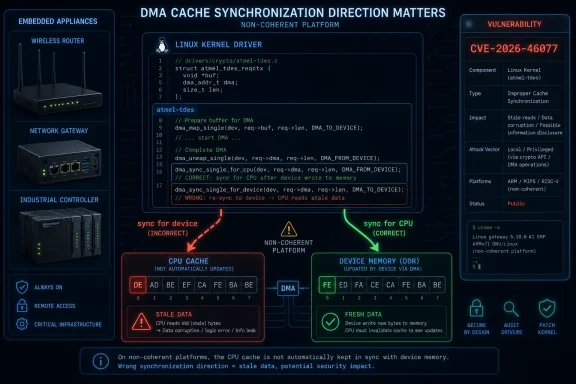
CVE-2026-46077 is a reminder that the Linux kernel is not one product so much as a civilization of device assumptions. Some processors maintain cache coherency between CPU and DMA-capable devices. Others do not. On the latter, the difference between “sync for the device” and “sync for the CPU” is not a semantic nit. It is the boundary between fresh data and stale data.
That is why this CVE deserves more attention than its currently empty NVD scoring fields suggest. There is no public CVSS score from NVD yet, no enriched weakness mapping, and no broad exploit narrative. Still, the underlying bug sits in a security-sensitive subsystem, touches cryptographic output, and was serious enough to be fixed across stable kernel branches.
The CVE description is unusually plain. Before DMA output is consumed by the CPU, the driver must synchronize
This is not a claim that Triple DES itself was mathematically weakened. It is not a timing attack against TDES, a key recovery attack, or a new cryptanalytic break. The vulnerability is in the plumbing around a hardware crypto engine: how the kernel hands memory to a device, how the device writes results back, and how the CPU is told that those results are ready to read.
That distinction matters because it changes the risk model. A broken cipher threatens every implementation of the cipher. A driver DMA synchronization bug threatens systems that use that driver, on architectures where cache coherency rules make the bug observable, under workloads that exercise the affected path. The blast radius is smaller, but the failure mode can still be ugly.
The phrase “stale cache data” sounds mundane until you apply it to cryptographic operations. Crypto code depends on exact bytes. A stale output buffer can mean incorrect plaintext, incorrect ciphertext, corrupted results, failed authentication at a higher layer, or behavior that leaks information through differences in what callers do next. The CVE record does not assert a specific exploit chain, and it would be irresponsible to invent one. But it is equally irresponsible to dismiss data freshness bugs in crypto paths as harmless housekeeping.
The price of that performance is coordination. The CPU has caches. Devices may see main memory differently than the CPU sees its cached view. On a fully coherent platform, hardware handles much of that complexity. On a non-coherent platform, software must explicitly synchronize memory so the device and CPU agree about what bytes exist at a given address.
The Linux DMA API expresses this through directions. If memory is being prepared for a device to read, the kernel uses the device-facing synchronization path. If memory has been written by a device and is about to be consumed by the CPU, the kernel uses the CPU-facing synchronization path. Those names are easy to skim past in code review. They are not interchangeable.
CVE-2026-46077 is therefore the kernel equivalent of opening the wrong door in an airlock. Nothing dramatic has to happen on every system. On some platforms, coherency may mask the bug. On others, the wrong synchronization direction can leave the CPU looking at an old copy of data while the hardware accelerator’s real output sits elsewhere in memory.
That is why these bugs often appear small until they are placed on the right hardware. Kernel code that behaves perfectly well on a developer’s workstation may fail on an embedded ARM board. Code that passes a functional test on one SoC may corrupt data on another. The Linux kernel’s portability is its strength, but portability also means one driver has to survive many memory models.
This is not an exotic academic concern. Non-coherent DMA remains relevant in embedded computing, older ARM platforms, microcontroller-adjacent Linux systems, and specialist SoCs. These are precisely the places where Atmel-class hardware acceleration may be found and where Linux often serves as the operating system under a vendor appliance, not as a desktop distribution chosen by an end user.
The problem for defenders is visibility. A sysadmin can look at a Windows Server fleet and inventory installed cumulative updates. A cloud administrator can query VM images. But embedded Linux often hides below the waterline. It is in VPN appliances, smart gateways, industrial panels, test equipment, storage boxes, and vendor-managed edge nodes. The kernel is there, but the patch process is mediated by a firmware image, a vendor portal, or an integrator who may not advertise kernel CVEs prominently.
That makes a low-profile kernel CVE more operationally interesting than it first appears. The systems most likely to care about this driver are not necessarily the systems with the best patch telemetry. They may also be systems with long uptime expectations and brittle maintenance windows, which means even a modest fix has to compete with business reluctance to touch “working” equipment.
The uncomfortable truth is that many organizations do not know whether they run the affected driver. They know the brand of the box, maybe the firmware version, and perhaps the support contract. They often do not know the kernel configuration, the crypto accelerator path, or whether the platform is coherent. That uncertainty is where small CVEs become asset-management problems.
At the same time, the crypto angle is not cosmetic. The affected driver implements hardware acceleration for DES and Triple DES algorithms, meaning its output may be part of encryption or decryption operations. If the CPU consumes stale output after a device operation, higher layers may make decisions based on bytes that are not the intended result.
In many cases, that would likely manifest as failures rather than clean exploitation. A decrypted block may be wrong. A test may fail. A protocol may reject data. A user-space caller may see corruption. But the security community has learned the hard way that “just corruption” is not a safe category when the corrupted data flows through parsers, authentication routines, protocol state machines, or error paths.
The age of Triple DES also complicates the story. TDES is legacy technology, and modern security guidance generally pushes users toward AES or newer constructions. But legacy cryptography frequently survives in payment systems, embedded communications, older VPN-like designs, and proprietary industrial protocols. A driver bug in a legacy crypto accelerator may therefore disproportionately affect environments already carrying technical debt.
This is the real lesson: crypto risk is not only about algorithms. It is about implementations, drivers, DMA mappings, memory ordering, cache behavior, and error handling. An organization can select a reputable algorithm and still be exposed by the machinery that moves bytes into and out of the accelerator.
The presence of several stable commit references also suggests the kernel maintainers viewed the issue as relevant to more than one release line. That does not automatically mean wide exposure. It means the vulnerable pattern existed in code paths worth fixing for supported users.
For administrators, the practical question is not “Which commit hash did upstream use?” but “When does my distribution or device vendor ship the fix?” In a conventional Linux server environment, the answer may arrive through ordinary kernel update channels. In embedded systems, the answer may be a firmware release, board support package update, or vendor advisory that never mentions the CVE in a way your vulnerability scanner can easily correlate.
Windows-heavy shops should not tune this out merely because the CVE is in Linux. Mixed environments are the default now. A Microsoft-centric business may still run Linux-based firewalls, appliances, container hosts, storage systems, monitoring probes, IoT gateways, Kubernetes nodes, WSL development environments, and CI runners. The interesting Linux kernel exposure is often not on someone’s desk. It is in the infrastructure surrounding it.
This is where vulnerability management needs nuance. A scanner that screams about every kernel CVE without hardware context becomes noise. A scanner that ignores embedded Linux because it is not in the domain inventory leaves blind spots. CVE-2026-46077 lives in the middle: probably not urgent for most general-purpose systems, but worth tracking where Atmel crypto hardware and non-coherent DMA platforms are plausible.
The lag is particularly important for Linux kernel CVEs because the kernel project has been assigning and publishing many CVEs tied to resolved commits. That model improves traceability, but it also creates a flood of records whose practical severity varies wildly. Some are plausible privilege-escalation bugs. Some are denial-of-service issues. Some are hardware-specific correctness fixes that become security issues only in particular configurations.
CVE databases were not designed to carry all of that nuance elegantly. A single identifier has to stand in for affected code, hardware dependency, exploitability assumptions, and downstream packaging reality. CVSS then tries to compress those variables into a vector. It is useful, but it is not magic.
For this CVE, the lack of an enriched score should push defenders toward context rather than complacency. Is
The industry still treats CVSS as the opening bid in a risk conversation, and sometimes as the whole conversation. This is a case where the opening bid has not even arrived. The right response is not to wait passively for a number; it is to identify whether the vulnerable component exists in your estate.
That is where CVE-2026-46077 earns its place in the conversation. It is not a consumer Windows vulnerability. It is a reminder that Windows estates depend on non-Windows infrastructure, and that the most obscure Linux kernel drivers may sit inside devices administrators rarely patch with the same discipline as PCs.
The risk is especially acute for organizations that bought appliances precisely to avoid managing Linux. The sales pitch is simplicity: a web UI, an update button, a support contract. Underneath, there may be an old kernel with a vendor patch stack, hardware-specific drivers, and a release cadence dictated more by certification than by upstream security flow.
If such a device includes Atmel crypto acceleration and runs a vulnerable kernel branch, the organization’s exposure depends on vendor action. The local admin may not be able to recompile a kernel, disable a driver, or apply an upstream patch without voiding support. That makes procurement and vendor management part of kernel security.
The other relevance is developer culture. Windows developers increasingly touch Linux through WSL, containers, cross-compilation, embedded SDKs, and CI images. A bug like this is not likely to be triggered inside a typical WSL environment, but the habit of reading kernel CVEs with hardware context is transferable. Not every CVE is a workstation emergency. Not every low-scoring driver issue is irrelevant.
If the driver is built as a module, administrators can check whether it is present and loaded. If it is built into a vendor kernel, the answer may require kernel configuration files, module listings, boot logs, vendor documentation, or support engagement. In appliance environments, the device vendor may be the only realistic source of confirmation.
The second triage step is architecture. The CVE’s stale-data warning is tied to non-coherent platforms. On coherent systems, the exact same code path may not produce the same visible failure. But defenders should be careful with that distinction. “Not exploitable on my architecture” is a conclusion, not an assumption. It requires evidence.
The third step is update mapping. Upstream stable commits are useful to kernel maintainers and distribution engineers, but most administrators consume fixes through packages or firmware. For Debian, Ubuntu, Red Hat family distributions, SUSE, Arch, and embedded vendors, the operational answer is the fixed kernel package or firmware build, not the upstream commit hash alone.
The fourth step is business impact. If a vulnerable device is a lab board, the response may be routine. If it is a field-deployed industrial gateway, the patch process may require testing, maintenance windows, and rollback planning. Security teams should resist both extremes: ignoring the bug because it is obscure, or forcing emergency downtime without evidence of reachable exposure.
But it does argue for kernel hygiene. Organizations should know which Linux kernels they run, which hardware-specific drivers are enabled, and which appliances depend on vendor-controlled firmware. They should also have a process for translating upstream kernel CVEs into estate-specific risk decisions.
The dirty secret of infrastructure security is that many teams only have this process for Windows and a handful of major Linux distributions. Everything else becomes “network device,” “appliance,” “OT,” or “vendor managed.” Those labels may be organizationally convenient, but attackers and bugs do not respect them.
CVE-2026-46077 should also nudge teams to revisit cryptographic legacy. If a system still depends on DES or Triple DES acceleration, why? Sometimes the answer is legitimate interoperability. Sometimes it is forgotten configuration drift. Sometimes it is an old protocol nobody wants to touch because it still works. Vulnerability management is more effective when it uses CVEs as prompts to ask these architectural questions.
The best outcome is boring: vendors ship fixed kernels, distributions backport the patch, affected embedded devices receive firmware updates, and most administrators never see a symptom. Boring is what good kernel maintenance looks like. But boring does not mean optional.
 A Small Driver Bug Says Something Larger About Kernel Risk
The most tempting reading of CVE-2026-46077 is also the least useful one: a minor Linux kernel issue in an old-sounding crypto accelerator, unlikely to affect mainstream desktop users. That reading is not wrong in the narrow sense. The Atmel TDES driver is not the centerpiece of a modern Windows workstation, a cloud VM, or a typical x86 Linux laptop.But kernel security has never been only about the median user. It is about the code that exists because hardware exists, and the hardware that keeps shipping inside routers, industrial systems, point-of-sale devices, storage controllers, developer boards, and long-lived embedded appliances. A driver can be obscure and still sit in the path of sensitive data.
CVE-2026-46077 is a reminder that the Linux kernel is not one product so much as a civilization of device assumptions. Some processors maintain cache coherency between CPU and DMA-capable devices. Others do not. On the latter, the difference between “sync for the device” and “sync for the CPU” is not a semantic nit. It is the boundary between fresh data and stale data.
That is why this CVE deserves more attention than its currently empty NVD scoring fields suggest. There is no public CVSS score from NVD yet, no enriched weakness mapping, and no broad exploit narrative. Still, the underlying bug sits in a security-sensitive subsystem, touches cryptographic output, and was serious enough to be fixed across stable kernel branches.
The Vulnerability Is a Direction Error, Not a Broken Cipher
The driver at the center of the issue isatmel-tdes, a Linux kernel driver for Atmel hardware acceleration of DES and Triple DES operations. DES is long obsolete for new security designs, and Triple DES has been steadily retired across the industry, but legacy cryptography does not vanish just because standards bodies and browser vendors move on. Embedded and industrial systems often keep old algorithms alive because protocols, hardware, certification cycles, and vendor support windows move slowly.The CVE description is unusually plain. Before DMA output is consumed by the CPU, the driver must synchronize
dma_addr_out with dma_sync_single_for_cpu(). Instead, the vulnerable code used dma_sync_single_for_device(). On non-coherent platforms, that can mean the CPU reads stale cache data rather than the data the device actually wrote.This is not a claim that Triple DES itself was mathematically weakened. It is not a timing attack against TDES, a key recovery attack, or a new cryptanalytic break. The vulnerability is in the plumbing around a hardware crypto engine: how the kernel hands memory to a device, how the device writes results back, and how the CPU is told that those results are ready to read.
That distinction matters because it changes the risk model. A broken cipher threatens every implementation of the cipher. A driver DMA synchronization bug threatens systems that use that driver, on architectures where cache coherency rules make the bug observable, under workloads that exercise the affected path. The blast radius is smaller, but the failure mode can still be ugly.
The phrase “stale cache data” sounds mundane until you apply it to cryptographic operations. Crypto code depends on exact bytes. A stale output buffer can mean incorrect plaintext, incorrect ciphertext, corrupted results, failed authentication at a higher layer, or behavior that leaks information through differences in what callers do next. The CVE record does not assert a specific exploit chain, and it would be irresponsible to invent one. But it is equally irresponsible to dismiss data freshness bugs in crypto paths as harmless housekeeping.
DMA Is Where Hardware Optimism Meets Kernel Reality
Direct Memory Access is one of those technologies that sounds simple at the whiteboard and gets complicated the moment real hardware enters the room. The device writes to memory without the CPU doing each byte copy. That is the point: DMA is fast because it lets hardware move data while the CPU gets out of the way.The price of that performance is coordination. The CPU has caches. Devices may see main memory differently than the CPU sees its cached view. On a fully coherent platform, hardware handles much of that complexity. On a non-coherent platform, software must explicitly synchronize memory so the device and CPU agree about what bytes exist at a given address.
The Linux DMA API expresses this through directions. If memory is being prepared for a device to read, the kernel uses the device-facing synchronization path. If memory has been written by a device and is about to be consumed by the CPU, the kernel uses the CPU-facing synchronization path. Those names are easy to skim past in code review. They are not interchangeable.
CVE-2026-46077 is therefore the kernel equivalent of opening the wrong door in an airlock. Nothing dramatic has to happen on every system. On some platforms, coherency may mask the bug. On others, the wrong synchronization direction can leave the CPU looking at an old copy of data while the hardware accelerator’s real output sits elsewhere in memory.
That is why these bugs often appear small until they are placed on the right hardware. Kernel code that behaves perfectly well on a developer’s workstation may fail on an embedded ARM board. Code that passes a functional test on one SoC may corrupt data on another. The Linux kernel’s portability is its strength, but portability also means one driver has to survive many memory models.
Non-Coherent Platforms Turn “Probably Fine” Into a Bug Class
The CVE record explicitly calls out non-coherent platforms, and that phrase does much of the work here. Cache-coherent systems make life easier by ensuring that CPU caches and device memory views remain consistent without driver authors having to micromanage every transition. Non-coherent systems require discipline. The driver must say, at the right time, who owns the buffer and which direction the data is moving.This is not an exotic academic concern. Non-coherent DMA remains relevant in embedded computing, older ARM platforms, microcontroller-adjacent Linux systems, and specialist SoCs. These are precisely the places where Atmel-class hardware acceleration may be found and where Linux often serves as the operating system under a vendor appliance, not as a desktop distribution chosen by an end user.
The problem for defenders is visibility. A sysadmin can look at a Windows Server fleet and inventory installed cumulative updates. A cloud administrator can query VM images. But embedded Linux often hides below the waterline. It is in VPN appliances, smart gateways, industrial panels, test equipment, storage boxes, and vendor-managed edge nodes. The kernel is there, but the patch process is mediated by a firmware image, a vendor portal, or an integrator who may not advertise kernel CVEs prominently.
That makes a low-profile kernel CVE more operationally interesting than it first appears. The systems most likely to care about this driver are not necessarily the systems with the best patch telemetry. They may also be systems with long uptime expectations and brittle maintenance windows, which means even a modest fix has to compete with business reluctance to touch “working” equipment.
The uncomfortable truth is that many organizations do not know whether they run the affected driver. They know the brand of the box, maybe the firmware version, and perhaps the support contract. They often do not know the kernel configuration, the crypto accelerator path, or whether the platform is coherent. That uncertainty is where small CVEs become asset-management problems.
The Crypto Angle Is Real, but It Should Not Be Overplayed
Security coverage has a bad habit of treating any bug near cryptography as automatically catastrophic. CVE-2026-46077 does not justify that leap. The public description does not say keys are exposed, remote attackers can execute code, or authentication can be bypassed. NVD has not yet assigned a severity score or vector. There is no public evidence in the provided record of active exploitation.At the same time, the crypto angle is not cosmetic. The affected driver implements hardware acceleration for DES and Triple DES algorithms, meaning its output may be part of encryption or decryption operations. If the CPU consumes stale output after a device operation, higher layers may make decisions based on bytes that are not the intended result.
In many cases, that would likely manifest as failures rather than clean exploitation. A decrypted block may be wrong. A test may fail. A protocol may reject data. A user-space caller may see corruption. But the security community has learned the hard way that “just corruption” is not a safe category when the corrupted data flows through parsers, authentication routines, protocol state machines, or error paths.
The age of Triple DES also complicates the story. TDES is legacy technology, and modern security guidance generally pushes users toward AES or newer constructions. But legacy cryptography frequently survives in payment systems, embedded communications, older VPN-like designs, and proprietary industrial protocols. A driver bug in a legacy crypto accelerator may therefore disproportionately affect environments already carrying technical debt.
This is the real lesson: crypto risk is not only about algorithms. It is about implementations, drivers, DMA mappings, memory ordering, cache behavior, and error handling. An organization can select a reputable algorithm and still be exposed by the machinery that moves bytes into and out of the accelerator.
Stable Kernel Backports Show the Fix Is Not Theoretical
The CVE record lists multiple stable kernel references, which is usually a sign that the fix has been propagated across maintained branches rather than left as a one-off mainline cleanup. That matters because Linux kernel CVEs often enter operational reality through stable backports. Most organizations are not running the latest mainline kernel; they are running a distribution kernel, a vendor kernel, or a long-term stable branch with selected fixes applied.The presence of several stable commit references also suggests the kernel maintainers viewed the issue as relevant to more than one release line. That does not automatically mean wide exposure. It means the vulnerable pattern existed in code paths worth fixing for supported users.
For administrators, the practical question is not “Which commit hash did upstream use?” but “When does my distribution or device vendor ship the fix?” In a conventional Linux server environment, the answer may arrive through ordinary kernel update channels. In embedded systems, the answer may be a firmware release, board support package update, or vendor advisory that never mentions the CVE in a way your vulnerability scanner can easily correlate.
Windows-heavy shops should not tune this out merely because the CVE is in Linux. Mixed environments are the default now. A Microsoft-centric business may still run Linux-based firewalls, appliances, container hosts, storage systems, monitoring probes, IoT gateways, Kubernetes nodes, WSL development environments, and CI runners. The interesting Linux kernel exposure is often not on someone’s desk. It is in the infrastructure surrounding it.
This is where vulnerability management needs nuance. A scanner that screams about every kernel CVE without hardware context becomes noise. A scanner that ignores embedded Linux because it is not in the domain inventory leaves blind spots. CVE-2026-46077 lives in the middle: probably not urgent for most general-purpose systems, but worth tracking where Atmel crypto hardware and non-coherent DMA platforms are plausible.
NVD’s Empty Score Is a Warning About Timing, Not Safety
As of the record supplied, CVE-2026-46077 is marked as awaiting NVD enrichment. There is no NVD CVSS 4.0 vector, no CVSS 3.x base score, and no CVSS 2.0 score. That absence is easy to misread. “No score” does not mean “no risk.” It means the enrichment process has not yet produced a standardized assessment.The lag is particularly important for Linux kernel CVEs because the kernel project has been assigning and publishing many CVEs tied to resolved commits. That model improves traceability, but it also creates a flood of records whose practical severity varies wildly. Some are plausible privilege-escalation bugs. Some are denial-of-service issues. Some are hardware-specific correctness fixes that become security issues only in particular configurations.
CVE databases were not designed to carry all of that nuance elegantly. A single identifier has to stand in for affected code, hardware dependency, exploitability assumptions, and downstream packaging reality. CVSS then tries to compress those variables into a vector. It is useful, but it is not magic.
For this CVE, the lack of an enriched score should push defenders toward context rather than complacency. Is
CONFIG_CRYPTO_DEV_ATMEL_TDES enabled? Is the atmel-tdes module present or loaded? Is the system built on Atmel/Microchip-era hardware with the relevant accelerator? Is the platform non-coherent? Is the affected code reachable by local users, kernel crypto API consumers, or only by tightly controlled services? Those questions matter more than a placeholder NVD page.The industry still treats CVSS as the opening bid in a risk conversation, and sometimes as the whole conversation. This is a case where the opening bid has not even arrived. The right response is not to wait passively for a number; it is to identify whether the vulnerable component exists in your estate.
The WindowsForum Relevance Is the Appliance Under the Desk
A Linux kernel CVE on WindowsForum might seem like a category error until you consider how Windows environments are actually built. The desktop may be Windows 11. The identity stack may be Entra ID. The endpoint management story may be Intune. But the branch office router, NAS, VPN concentrator, badge system, print appliance, lab controller, or OT gateway may be Linux underneath.That is where CVE-2026-46077 earns its place in the conversation. It is not a consumer Windows vulnerability. It is a reminder that Windows estates depend on non-Windows infrastructure, and that the most obscure Linux kernel drivers may sit inside devices administrators rarely patch with the same discipline as PCs.
The risk is especially acute for organizations that bought appliances precisely to avoid managing Linux. The sales pitch is simplicity: a web UI, an update button, a support contract. Underneath, there may be an old kernel with a vendor patch stack, hardware-specific drivers, and a release cadence dictated more by certification than by upstream security flow.
If such a device includes Atmel crypto acceleration and runs a vulnerable kernel branch, the organization’s exposure depends on vendor action. The local admin may not be able to recompile a kernel, disable a driver, or apply an upstream patch without voiding support. That makes procurement and vendor management part of kernel security.
The other relevance is developer culture. Windows developers increasingly touch Linux through WSL, containers, cross-compilation, embedded SDKs, and CI images. A bug like this is not likely to be triggered inside a typical WSL environment, but the habit of reading kernel CVEs with hardware context is transferable. Not every CVE is a workstation emergency. Not every low-scoring driver issue is irrelevant.
The Practical Exposure Test Starts With Hardware, Not Headlines
The first triage step for CVE-2026-46077 is to determine whether the affected driver can exist on the system. The Atmel TDES driver is associated with Atmel hardware acceleration support and appears as a configurable Linux kernel option. If the hardware is not present and the driver is not built, the practical exposure is likely absent.If the driver is built as a module, administrators can check whether it is present and loaded. If it is built into a vendor kernel, the answer may require kernel configuration files, module listings, boot logs, vendor documentation, or support engagement. In appliance environments, the device vendor may be the only realistic source of confirmation.
The second triage step is architecture. The CVE’s stale-data warning is tied to non-coherent platforms. On coherent systems, the exact same code path may not produce the same visible failure. But defenders should be careful with that distinction. “Not exploitable on my architecture” is a conclusion, not an assumption. It requires evidence.
The third step is update mapping. Upstream stable commits are useful to kernel maintainers and distribution engineers, but most administrators consume fixes through packages or firmware. For Debian, Ubuntu, Red Hat family distributions, SUSE, Arch, and embedded vendors, the operational answer is the fixed kernel package or firmware build, not the upstream commit hash alone.
The fourth step is business impact. If a vulnerable device is a lab board, the response may be routine. If it is a field-deployed industrial gateway, the patch process may require testing, maintenance windows, and rollback planning. Security teams should resist both extremes: ignoring the bug because it is obscure, or forcing emergency downtime without evidence of reachable exposure.
This Is a Test of Kernel Hygiene More Than Incident Response
There is no public signal in the supplied record that CVE-2026-46077 is being exploited in the wild. There is no NVD severity score yet. The bug is specific, and the affected driver is not a mainstream desktop component. That argues against dramatic incident-response language.But it does argue for kernel hygiene. Organizations should know which Linux kernels they run, which hardware-specific drivers are enabled, and which appliances depend on vendor-controlled firmware. They should also have a process for translating upstream kernel CVEs into estate-specific risk decisions.
The dirty secret of infrastructure security is that many teams only have this process for Windows and a handful of major Linux distributions. Everything else becomes “network device,” “appliance,” “OT,” or “vendor managed.” Those labels may be organizationally convenient, but attackers and bugs do not respect them.
CVE-2026-46077 should also nudge teams to revisit cryptographic legacy. If a system still depends on DES or Triple DES acceleration, why? Sometimes the answer is legitimate interoperability. Sometimes it is forgotten configuration drift. Sometimes it is an old protocol nobody wants to touch because it still works. Vulnerability management is more effective when it uses CVEs as prompts to ask these architectural questions.
The best outcome is boring: vendors ship fixed kernels, distributions backport the patch, affected embedded devices receive firmware updates, and most administrators never see a symptom. Boring is what good kernel maintenance looks like. But boring does not mean optional.
The Tiny Atmel Fix Leaves a Clear Admin Trail
The concrete lesson from CVE-2026-46077 is that administrators should treat it as a targeted exposure check, not a universal Linux fire drill. The vulnerability sits at the intersection of a specific crypto driver, DMA synchronization semantics, and hardware cache behavior. That makes context the whole game.- Systems without the Atmel TDES driver enabled or present are unlikely to be affected in any practical way.
- Systems using Atmel or Microchip-era SoCs with hardware DES/TDES acceleration deserve closer inspection, especially if they run vendor kernels or long-term embedded firmware.
- The most relevant platforms are likely to be embedded, appliance, or specialist Linux systems rather than ordinary x86 desktops and servers.
- NVD’s missing CVSS score should not be treated as a safety signal, because the record is still awaiting enrichment.
- The durable fix path is a kernel or firmware update that includes the upstream stable correction to the DMA synchronization direction.
- Security teams should use this CVE to improve inventory of Linux-based appliances that support Windows-centric networks but do not show up in ordinary endpoint patch dashboards.
References
- Primary source: NVD / Linux Kernel
Published: 2026-05-28T01:10:19-07:00
NVD - CVE-2026-46077
 nvd.nist.gov
- Security advisory: MSRC
Published: 2026-05-28T01:10:19-07:00
Original feed URL
Security Update Guide - Microsoft Security Response Center
 msrc.microsoft.com
- Related coverage: kernel.org
- Related coverage: cateee.net
- Related coverage: lists.debian.org
- Official source: github.com
GitHub - thesofproject/linux-firmware: Fork of Linux Firmware Repo - https://git.kernel.org/pub/scm/linux/kernel/git/firmware/linux-firmware.git/ · GitHub
Fork of Linux Firmware Repo - https://git.kernel.org/pub/scm/linux/kernel/git/firmware/linux-firmware.git/ - thesofproject/linux-firmware github.com


- Related coverage: windowsforum.com
CVE-2026-31658 Fixes Linux altera-tse DMA Memory Leak After dma_map_single Failure | Windows Forum
CVE-2026-31658: Linux Kernel Altera TSE Driver Memory Leak Fixed After DMA Mapping Failure Published: April 26, 2026 CVE: CVE-2026-31658 Component: Linux...windowsforum.com - Related coverage: codebrowser.dev

atmel-tdes.c source code [linux/drivers/crypto/atmel-tdes.c] - Codebrowser
Source code of linux/drivers/crypto/atmel-tdes.c linux v6.19-r on KDAB Codebrowser
codebrowser.dev
- Related coverage: kernel.googlesource.com
- Related coverage: archive.fosdem.org
