

CVE-2026-46121 is a Linux kernel use-after-free flaw published by NVD on May 28, 2026, affecting the DAMON sysfs schemes interface where concurrent reads and writes of
DAMON, short for Data Access MONitor, is one of those kernel subsystems that sounds academic until you need it. It observes memory access patterns and can drive policy decisions around reclamation, placement, and tuning. In other words, it lives close to the machinery that decides how memory is watched and acted upon.
CVE-2026-46121 sits inside the sysfs interface for DAMON schemes, specifically around a
The failure mode is classic kernel concurrency: one process writes a new value, freeing the old buffer, while another process reads through a separate open file handle and may observe memory that has already been released. The kernel patch does not introduce some grand redesign. It wraps the direct read and write paths with the same lock discipline already used elsewhere.
That is why the patch is simultaneously unglamorous and important. Kernel security is often a story of small invariants being made explicit: if one path needs a lock because the object may disappear, the neighboring path probably needs the same lock before an attacker, fuzzer, or unlucky admin script proves it.
It is a local kernel memory-safety bug in a specialized Linux interface. Exploitation would appear to require access to the relevant DAMON sysfs files and the ability to trigger the racing read/write pattern. In many production systems, access to such kernel tuning interfaces is limited to privileged users or tightly controlled service accounts.
That does not make the bug irrelevant. Use-after-free defects in kernel code deserve attention because they can sometimes become more than crashes. Depending on memory layout, object reuse, hardening settings, and reachable privileges, a seemingly minor race can become information disclosure, denial of service, or in worse cases a step toward local privilege escalation.
But the rational response is not to treat every kernel CVE as a five-alarm breach. The rational response is to identify which systems expose DAMON sysfs controls, which kernels include the affected code, which distributions have picked up the fix, and how quickly those systems normally receive kernel updates.
This matters because enterprise vulnerability workflows often overfit to CVSS. A scanner sees a CVE, waits for a score, then sorts the queue. But kernel CVEs frequently arrive with a patch-first cadence: the upstream fix exists, stable branches absorb it, distributions backport it, and scoring lags behind the operational reality.
For administrators, the absence of a score should not be read as “safe.” It should be read as “not yet classified by NVD.” That is a different thing. The substance of the issue is already clear enough: a race in DAMON sysfs can produce a use-after-free, and the fix is to serialize direct sysfs reads and writes with
The more useful question is not whether NVD eventually calls this low, medium, or high. The useful question is whether your kernel contains the vulnerable code path and whether your update channel has already absorbed one of the referenced stable commits.
The fix itself adds locking around
The use of
This is not a feature patch masquerading as security work. It is an invariant patch. The kernel already recognized that reads during parameter commits needed protection because sysfs objects might be torn down or changed. The bug was that the direct user-facing file operations were left outside that same protection boundary.
DAMON’s sysfs interface is particularly interesting because it exists for administrators and tools that want to inspect or steer memory behavior. That is legitimate functionality, but it means the code is exposed to userspace interaction patterns that kernel developers must assume will be concurrent, adversarial, and weird. Scripts open multiple file descriptors. Monitoring agents poll. Configuration tools rewrite values while other tools read them.
The CVE description even notes a subtle boundary: reads do not race in the same way when the same open file is used by the writer, thanks to kernfs open-file locking. But separate open files are common, and separate open files are enough. Kernel security bugs often live in exactly that gap between a protected common case and an unprotected plausible case.
For Windows administrators who mostly encounter Linux through WSL or cloud images, this is the part worth internalizing. Linux’s “everything is a file” model does not mean everything is simple. Some of those files are doors into deeply stateful kernel machinery.
For most Windows desktop users, CVE-2026-46121 is unlikely to be directly actionable. WSL users generally do not manage the same kernel stream as a bare-metal Linux distribution, and Microsoft ships WSL kernel updates through its own channels. Unless a user has installed a custom WSL kernel or is running privileged Linux workloads that expose DAMON controls, this CVE should not trigger emergency desktop triage.
For sysadmins, the calculus changes. A Windows shop with Linux-based monitoring nodes, container hosts, backup appliances, or developer build infrastructure should still track kernel CVEs even when the vulnerable subsystem sounds obscure. Lateral movement does not care whether the box was purchased as a “Linux server” or inherited as part of a vendor appliance.
The most practical Windows-world concern is not that CVE-2026-46121 becomes the next wormable disaster. It is that mixed estates often have weaker patch accountability for “secondary” Linux systems than for domain-joined Windows endpoints. The box nobody owns is the one that keeps the vulnerable kernel longest.
That is progress, but it has a cost. Every new control surface needs lifetime rules, locking rules, permissions, documentation, tests, and backports. A subsystem that begins as a performance and observability feature can become a security boundary once userspace can write to it.
CVE-2026-46121 is therefore not an indictment of DAMON. It is evidence of DAMON maturing. The kernel community found a race, split the fix into targeted commits, routed it toward stable kernels, and assigned a CVE. That is how maintenance should work.
The uncomfortable truth is that the security industry often notices subsystems only when they break. Memory monitoring, cgroups integration, sysfs controls, and reclaim policies are not glamorous. But they are precisely the places where cloud-era Linux has grown more capable, and therefore more complex.
Local kernel bugs matter because attackers often land first as low-privilege users, compromised services, container workloads, or malicious build jobs. Once inside, the distance between “can run code” and “can control the host” is the security boundary that local kernel flaws try to cross. Even if CVE-2026-46121 never becomes a practical privilege-escalation primitive, it belongs to that class of bugs administrators should not wave away reflexively.
That said, local does still matter for prioritization. A remotely exploitable pre-authentication service bug deserves a different response from a race in a specialized sysfs interface. The trick is to avoid both extremes: do not panic, and do not ignore it because the bug report contains the words
In enterprise terms, CVE-2026-46121 should be handled as part of routine kernel hygiene unless local untrusted users can access the relevant DAMON controls. Shared research boxes, developer shells, container hosts, and multi-tenant systems deserve faster scrutiny than single-purpose appliances with locked-down access.
These are not rhetorical questions. Sysfs permissions, mount options, namespace boundaries, and distribution defaults can change the practical risk of a kernel interface. A bug reachable only by root is usually less urgent than one reachable by a service account, and a bug reachable from inside a container is more interesting still.
Administrators should also be careful with broad assumptions about distribution kernels. Enterprise vendors often backport fixes without changing the upstream version number in the way a casual
The right operational move is to follow your vendor’s kernel advisory stream, not to manually match every upstream commit hash. Upstream tells us what was fixed. Your distribution tells you when that fix reached your supported package.
Kernel code makes this pattern dangerous because freed memory may be reused quickly and because the kernel runs with privileges userspace can only dream of. Locks, reference counts, RCU, and careful object-lifetime rules exist to prevent precisely this class of bug. When they are applied inconsistently, the result is a race condition that may be hard to hit accidentally but attractive to anyone who can loop operations at high speed.
The sysfs setting makes the pattern easier to understand. One terminal reads a file. Another terminal writes the same logical setting through a separate file descriptor. The kernel’s internal object changes underneath the reader. The fix is to make those operations agree on the same serialization rule.
This is why fuzzers and race detectors have become central to kernel hardening. Human reviewers are good at understanding intended flows. Tools are better at abusing all the flows developers assume nobody will use at the same time.
That increased granularity is good for transparency but awkward for risk management. Security teams get more identifiers, more records awaiting enrichment, more scanner findings, and more cases where the operational answer is simply “update to the vendor-fixed kernel.” The number of CVEs rises, but the number of emergency-grade incidents does not rise in lockstep.
CVE-2026-46121 fits that newer pattern. It is specific, patchable, and rooted in a concrete commit history. It does not arrive with a dramatic name, logo, or public proof-of-concept. Its importance lies less in spectacle than in the cumulative reality that kernel maintenance is a continuous process, not a quarterly event.
For Windows-heavy organizations, this is a cultural adjustment. Patch Tuesday encourages a monthly rhythm. Linux kernel security, especially across mixed distributions and appliances, often behaves more like a stream. Waiting for a single neat calendar moment can leave edge systems drifting.
Containers share the host kernel. That is the central convenience and the central risk. A flaw in the host kernel is not “inside” one container in the same way a vulnerable library might be. If a containerized process can reach a vulnerable kernel interface, the boundary between tenant and host becomes the thing under test.
Most production Kubernetes environments should already restrict access to sensitive sysfs paths, privileged containers, host mounts, and broad capabilities. The problem is that real environments accumulate exceptions. A monitoring agent runs privileged. A storage plugin gets host mounts. A debugging container is left behind after an incident. A CI runner trades isolation for convenience.
CVE-2026-46121 is not a reason to redesign a container platform overnight. It is a reason to audit whether kernel tuning surfaces are exposed more widely than intended. The fix is kernel-side, but the defense-in-depth lesson is configuration-side.
That is risky categorization. Backup devices, firewalls, storage controllers, hyperconverged nodes, and monitoring appliances may run Linux kernels with vendor modifications. They may also expose web interfaces, SSH, agents, or plugins that create local execution paths. A local kernel bug can become relevant if another bug or weak credential gets an attacker onto the box.
For CVE-2026-46121 specifically, the question for appliance vendors is straightforward: does the shipped kernel include the affected DAMON sysfs code, and if so, has the stable fix been backported? Customers may not get commit-level answers, but they should expect an advisory or patched firmware if the component is present.
This is where vulnerability management becomes less about scanning and more about contracts. If a vendor ships a Linux kernel, the vendor owns kernel CVE triage. If it cannot tell customers whether a kernel CVE applies, that uncertainty is itself an operational risk.
Stable kernel trees pick up commits. Distributions evaluate and backport them. Cloud images are rebuilt. Appliances wait for firmware. Live patching programs decide whether a given flaw is suitable for hot patching or requires a reboot. Administrators then discover that “kernel updated” and “host actually running the updated kernel” are not the same statement.
That last point is perennial. Linux can install a fixed kernel package while still running the old one until reboot. In server fleets, reboot coordination is often the real vulnerability-management bottleneck. A narrow kernel CVE can linger for weeks because nobody wants to disturb a busy host for a bug that lacks a CVSS score.
There is no universal answer. Critical multi-tenant hosts deserve more aggressive reboot windows. Lab workstations and single-user systems can follow normal update cadence. But administrators should avoid the false comfort of installed packages when the running kernel remains unchanged.
Start with the obvious places: WSL developer machines, Hyper-V guests, Azure Linux VMs, Kubernetes nodes, Git runners, monitoring servers, security tools, and NAS or backup platforms. Then move to the less obvious ones: vendor virtual appliances, lab images, old dual-boot laptops, and “temporary” Linux hosts created for migrations that became permanent.
The next step is not to manually panic over
This is where Windows and Linux administration disciplines meet. Inventory, ownership, patch cadence, reboot policy, and least privilege matter more than the logo on the boot screen.
The concrete lessons are not dramatic, but they are actionable.
memcg_path could race and expose freed memory. The bug is narrow, technical, and not yet scored by NVD, but it is also a useful reminder that modern kernel risk often hides in observability and tuning interfaces rather than headline-grabbing network daemons. For WindowsForum readers running Linux in WSL, Hyper-V, Azure, containers, appliances, or dual-boot lab machines, this is less a panic button than a patch-management signal. The kernel’s memory-management plumbing keeps getting more dynamic, and every sysfs knob is now part of the attack surface conversation.
 A Small Race in a Powerful Memory Tool
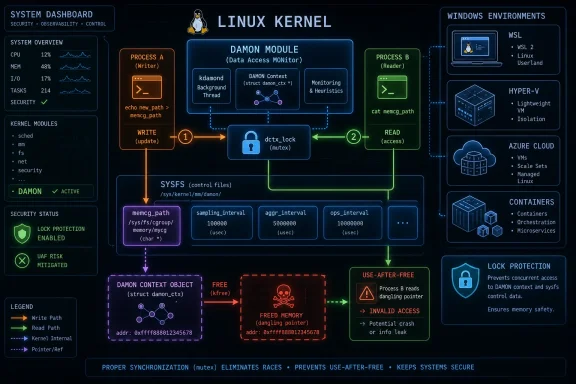
DAMON, short for Data Access MONitor, is one of those kernel subsystems that sounds academic until you need it. It observes memory access patterns and can drive policy decisions around reclamation, placement, and tuning. In other words, it lives close to the machinery that decides how memory is watched and acted upon.CVE-2026-46121 sits inside the sysfs interface for DAMON schemes, specifically around a
memcg_path file exposed to userspace. The path can be read and written by users, and the same value can also be read indirectly when DAMON parameters are committed online or offline. That distinction matters because one path through the code was protected by damon_sysfs_lock, while the direct user-driven sysfs reads and writes were not.The failure mode is classic kernel concurrency: one process writes a new value, freeing the old buffer, while another process reads through a separate open file handle and may observe memory that has already been released. The kernel patch does not introduce some grand redesign. It wraps the direct read and write paths with the same lock discipline already used elsewhere.
That is why the patch is simultaneously unglamorous and important. Kernel security is often a story of small invariants being made explicit: if one path needs a lock because the object may disappear, the neighboring path probably needs the same lock before an attacker, fuzzer, or unlucky admin script proves it.
The Vulnerability Is Real, but Its Blast Radius Looks Contained
The most important fact about CVE-2026-46121 is what it is not. It is not a remotely reachable bug in a default internet-facing service. It is not a Windows vulnerability. It is not currently accompanied by an NVD CVSS score, public exploit chain, or vendor advisory claiming broad active exploitation.It is a local kernel memory-safety bug in a specialized Linux interface. Exploitation would appear to require access to the relevant DAMON sysfs files and the ability to trigger the racing read/write pattern. In many production systems, access to such kernel tuning interfaces is limited to privileged users or tightly controlled service accounts.
That does not make the bug irrelevant. Use-after-free defects in kernel code deserve attention because they can sometimes become more than crashes. Depending on memory layout, object reuse, hardening settings, and reachable privileges, a seemingly minor race can become information disclosure, denial of service, or in worse cases a step toward local privilege escalation.
But the rational response is not to treat every kernel CVE as a five-alarm breach. The rational response is to identify which systems expose DAMON sysfs controls, which kernels include the affected code, which distributions have picked up the fix, and how quickly those systems normally receive kernel updates.
NVD’s “Awaiting Enrichment” Label Is Doing More Work Than Usual
The NVD entry for CVE-2026-46121 is currently marked as awaiting enrichment. That means the record exists, the kernel.org-sourced description is present, and references to stable kernel commits are listed, but NVD has not yet supplied its own CVSS scoring or product configuration analysis.This matters because enterprise vulnerability workflows often overfit to CVSS. A scanner sees a CVE, waits for a score, then sorts the queue. But kernel CVEs frequently arrive with a patch-first cadence: the upstream fix exists, stable branches absorb it, distributions backport it, and scoring lags behind the operational reality.
For administrators, the absence of a score should not be read as “safe.” It should be read as “not yet classified by NVD.” That is a different thing. The substance of the issue is already clear enough: a race in DAMON sysfs can produce a use-after-free, and the fix is to serialize direct sysfs reads and writes with
damon_sysfs_lock.The more useful question is not whether NVD eventually calls this low, medium, or high. The useful question is whether your kernel contains the vulnerable code path and whether your update channel has already absorbed one of the referenced stable commits.
The Patch Says More Than the CVE Entry
The patch history is unusually readable for a kernel memory race. The series was framed as a two-patch fix for use-after-free conditions involving bothmemcg_path and path files in the DAMON sysfs interface. CVE-2026-46121 covers the memcg_path side of that series.The fix itself adds locking around
memcg_path_show() and memcg_path_store(). In the read path, the code attempts to acquire damon_sysfs_lock, emits either the stored memory-control-group path or an empty string, then unlocks. In the write path, it allocates and copies the new path, attempts to acquire the same lock, frees the old path, assigns the new one, and releases the lock.The use of
mutex_trylock() rather than a blocking lock is also telling. If the lock cannot be acquired, the sysfs operation returns -EBUSY rather than waiting indefinitely. That is a tradeoff that fits sysfs: userspace can retry, while the kernel avoids more complicated interactions with existing control flows.This is not a feature patch masquerading as security work. It is an invariant patch. The kernel already recognized that reads during parameter commits needed protection because sysfs objects might be torn down or changed. The bug was that the direct user-facing file operations were left outside that same protection boundary.
Sysfs Is a Control Plane, Not a Documentation Folder
A recurring mistake in Linux operations is treating sysfs as if it were a passive catalog of facts. It is not. Sysfs is a live control plane made of files, permissions, object lifetimes, and side effects. Reading and writing those files can exercise kernel code that is every bit as sensitive as an ioctl, a procfs handler, or a device node.DAMON’s sysfs interface is particularly interesting because it exists for administrators and tools that want to inspect or steer memory behavior. That is legitimate functionality, but it means the code is exposed to userspace interaction patterns that kernel developers must assume will be concurrent, adversarial, and weird. Scripts open multiple file descriptors. Monitoring agents poll. Configuration tools rewrite values while other tools read them.
The CVE description even notes a subtle boundary: reads do not race in the same way when the same open file is used by the writer, thanks to kernfs open-file locking. But separate open files are common, and separate open files are enough. Kernel security bugs often live in exactly that gap between a protected common case and an unprotected plausible case.
For Windows administrators who mostly encounter Linux through WSL or cloud images, this is the part worth internalizing. Linux’s “everything is a file” model does not mean everything is simple. Some of those files are doors into deeply stateful kernel machinery.
The Windows Angle Is Indirect but Not Imaginary
WindowsForum readers are right to ask why a Linux kernel CVE belongs in their threat model at all. The answer is that modern Windows environments are rarely Windows-only. Linux appears in WSL distributions, Hyper-V guests, Kubernetes nodes, security appliances, NAS boxes, build runners, CI workers, developer laptops, and cloud images that sit beside or underneath Windows workloads.For most Windows desktop users, CVE-2026-46121 is unlikely to be directly actionable. WSL users generally do not manage the same kernel stream as a bare-metal Linux distribution, and Microsoft ships WSL kernel updates through its own channels. Unless a user has installed a custom WSL kernel or is running privileged Linux workloads that expose DAMON controls, this CVE should not trigger emergency desktop triage.
For sysadmins, the calculus changes. A Windows shop with Linux-based monitoring nodes, container hosts, backup appliances, or developer build infrastructure should still track kernel CVEs even when the vulnerable subsystem sounds obscure. Lateral movement does not care whether the box was purchased as a “Linux server” or inherited as part of a vendor appliance.
The most practical Windows-world concern is not that CVE-2026-46121 becomes the next wormable disaster. It is that mixed estates often have weaker patch accountability for “secondary” Linux systems than for domain-joined Windows endpoints. The box nobody owns is the one that keeps the vulnerable kernel longest.
DAMON’s Promise Comes With a Maintenance Cost
DAMON exists because memory management is no longer a static background service. Large systems need visibility into access patterns. Cloud platforms want efficiency. Administrators want ways to reclaim memory intelligently rather than treating RAM as a black box. Kernel developers have responded by exposing smarter instrumentation and policy hooks.That is progress, but it has a cost. Every new control surface needs lifetime rules, locking rules, permissions, documentation, tests, and backports. A subsystem that begins as a performance and observability feature can become a security boundary once userspace can write to it.
CVE-2026-46121 is therefore not an indictment of DAMON. It is evidence of DAMON maturing. The kernel community found a race, split the fix into targeted commits, routed it toward stable kernels, and assigned a CVE. That is how maintenance should work.
The uncomfortable truth is that the security industry often notices subsystems only when they break. Memory monitoring, cgroups integration, sysfs controls, and reclaim policies are not glamorous. But they are precisely the places where cloud-era Linux has grown more capable, and therefore more complex.
The “Local Only” Comfort Blanket Has Worn Thin
There was a time when “local vulnerability” sounded almost dismissive. If an attacker needed local access, the thinking went, the real failure had already happened. That framing is increasingly obsolete.Local kernel bugs matter because attackers often land first as low-privilege users, compromised services, container workloads, or malicious build jobs. Once inside, the distance between “can run code” and “can control the host” is the security boundary that local kernel flaws try to cross. Even if CVE-2026-46121 never becomes a practical privilege-escalation primitive, it belongs to that class of bugs administrators should not wave away reflexively.
That said, local does still matter for prioritization. A remotely exploitable pre-authentication service bug deserves a different response from a race in a specialized sysfs interface. The trick is to avoid both extremes: do not panic, and do not ignore it because the bug report contains the words
mm/ and sysfs.In enterprise terms, CVE-2026-46121 should be handled as part of routine kernel hygiene unless local untrusted users can access the relevant DAMON controls. Shared research boxes, developer shells, container hosts, and multi-tenant systems deserve faster scrutiny than single-purpose appliances with locked-down access.
The Permissions Question Is the One Admins Should Ask First
The patch fixes the kernel race, but exposure still begins with access. Who can read and write the relevant DAMON sysfs files? Are they root-only? Are any automation accounts permitted to manipulate them? Are containerized workloads able to see or influence host sysfs paths? Has a vendor agent enabled DAMON tuning behind the scenes?These are not rhetorical questions. Sysfs permissions, mount options, namespace boundaries, and distribution defaults can change the practical risk of a kernel interface. A bug reachable only by root is usually less urgent than one reachable by a service account, and a bug reachable from inside a container is more interesting still.
Administrators should also be careful with broad assumptions about distribution kernels. Enterprise vendors often backport fixes without changing the upstream version number in the way a casual
uname -r check might imply. Conversely, custom kernels, vendor appliances, and lab builds can lag stable trees even when the base distribution looks current.The right operational move is to follow your vendor’s kernel advisory stream, not to manually match every upstream commit hash. Upstream tells us what was fixed. Your distribution tells you when that fix reached your supported package.
The Race Pattern Is More Familiar Than the Component Name
Strip away the DAMON-specific names and CVE-2026-46121 becomes a familiar programming failure. A pointer is shared between readers and writers. The writer replaces the object and frees the old allocation. A reader sees the pointer at the wrong time and dereferences memory whose lifetime has ended.Kernel code makes this pattern dangerous because freed memory may be reused quickly and because the kernel runs with privileges userspace can only dream of. Locks, reference counts, RCU, and careful object-lifetime rules exist to prevent precisely this class of bug. When they are applied inconsistently, the result is a race condition that may be hard to hit accidentally but attractive to anyone who can loop operations at high speed.
The sysfs setting makes the pattern easier to understand. One terminal reads a file. Another terminal writes the same logical setting through a separate file descriptor. The kernel’s internal object changes underneath the reader. The fix is to make those operations agree on the same serialization rule.
This is why fuzzers and race detectors have become central to kernel hardening. Human reviewers are good at understanding intended flows. Tools are better at abusing all the flows developers assume nobody will use at the same time.
Kernel CVEs Are Becoming More Granular, Not Necessarily More Catastrophic
A casual glance at recent kernel CVE feeds can make Linux look like it is constantly on fire. The reality is more complicated. The kernel project and its security process now assign CVEs to many narrowly scoped fixes that previously might have been absorbed into stable updates with little public fanfare.That increased granularity is good for transparency but awkward for risk management. Security teams get more identifiers, more records awaiting enrichment, more scanner findings, and more cases where the operational answer is simply “update to the vendor-fixed kernel.” The number of CVEs rises, but the number of emergency-grade incidents does not rise in lockstep.
CVE-2026-46121 fits that newer pattern. It is specific, patchable, and rooted in a concrete commit history. It does not arrive with a dramatic name, logo, or public proof-of-concept. Its importance lies less in spectacle than in the cumulative reality that kernel maintenance is a continuous process, not a quarterly event.
For Windows-heavy organizations, this is a cultural adjustment. Patch Tuesday encourages a monthly rhythm. Linux kernel security, especially across mixed distributions and appliances, often behaves more like a stream. Waiting for a single neat calendar moment can leave edge systems drifting.
Containers Make “Host Kernel” Bugs Everyone’s Problem
The container angle deserves careful wording because not every host exposes DAMON sysfs controls to containers, and a properly configured container should not have arbitrary write access to host kernel interfaces. Still, containers are one reason local kernel bugs remain strategically important.Containers share the host kernel. That is the central convenience and the central risk. A flaw in the host kernel is not “inside” one container in the same way a vulnerable library might be. If a containerized process can reach a vulnerable kernel interface, the boundary between tenant and host becomes the thing under test.
Most production Kubernetes environments should already restrict access to sensitive sysfs paths, privileged containers, host mounts, and broad capabilities. The problem is that real environments accumulate exceptions. A monitoring agent runs privileged. A storage plugin gets host mounts. A debugging container is left behind after an incident. A CI runner trades isolation for convenience.
CVE-2026-46121 is not a reason to redesign a container platform overnight. It is a reason to audit whether kernel tuning surfaces are exposed more widely than intended. The fix is kernel-side, but the defense-in-depth lesson is configuration-side.
Appliances and Vendor Kernels Are the Slow Lane
The systems most likely to lag behind kernel fixes are not always the ones with the most users. They are appliances, embedded distributions, and vendor-managed Linux images where the customer cannot easily inspect the patch level or replace the kernel. In Windows-centered environments, these boxes often sit in the mental category of “infrastructure,” not “Linux servers.”That is risky categorization. Backup devices, firewalls, storage controllers, hyperconverged nodes, and monitoring appliances may run Linux kernels with vendor modifications. They may also expose web interfaces, SSH, agents, or plugins that create local execution paths. A local kernel bug can become relevant if another bug or weak credential gets an attacker onto the box.
For CVE-2026-46121 specifically, the question for appliance vendors is straightforward: does the shipped kernel include the affected DAMON sysfs code, and if so, has the stable fix been backported? Customers may not get commit-level answers, but they should expect an advisory or patched firmware if the component is present.
This is where vulnerability management becomes less about scanning and more about contracts. If a vendor ships a Linux kernel, the vendor owns kernel CVE triage. If it cannot tell customers whether a kernel CVE applies, that uncertainty is itself an operational risk.
The Fix Is Simple; The Rollout Is the Hard Part
Upstream fixes are often clean in ways enterprise rollouts are not. The code change for CVE-2026-46121 is modest. The operational question is how it travels from kernel.org to the machines that matter.Stable kernel trees pick up commits. Distributions evaluate and backport them. Cloud images are rebuilt. Appliances wait for firmware. Live patching programs decide whether a given flaw is suitable for hot patching or requires a reboot. Administrators then discover that “kernel updated” and “host actually running the updated kernel” are not the same statement.
That last point is perennial. Linux can install a fixed kernel package while still running the old one until reboot. In server fleets, reboot coordination is often the real vulnerability-management bottleneck. A narrow kernel CVE can linger for weeks because nobody wants to disturb a busy host for a bug that lacks a CVSS score.
There is no universal answer. Critical multi-tenant hosts deserve more aggressive reboot windows. Lab workstations and single-user systems can follow normal update cadence. But administrators should avoid the false comfort of installed packages when the running kernel remains unchanged.
Microsoft Shops Should Treat This as a Linux Inventory Test
The practical value of CVE-2026-46121 for many WindowsForum readers is that it tests whether the organization actually knows where Linux is. The answer is often less tidy than the asset database suggests.Start with the obvious places: WSL developer machines, Hyper-V guests, Azure Linux VMs, Kubernetes nodes, Git runners, monitoring servers, security tools, and NAS or backup platforms. Then move to the less obvious ones: vendor virtual appliances, lab images, old dual-boot laptops, and “temporary” Linux hosts created for migrations that became permanent.
The next step is not to manually panic over
memcg_path. It is to check whether those systems receive kernel updates from a supported source and whether the relevant update stream has addressed the CVE. If a system runs an unsupported kernel, the security story is already weak regardless of this specific bug.This is where Windows and Linux administration disciplines meet. Inventory, ownership, patch cadence, reboot policy, and least privilege matter more than the logo on the boot screen.
The Signal Hidden in a One-Line Sysfs Race
CVE-2026-46121 will probably not be remembered as a landmark vulnerability. That is precisely why it is useful. It shows the everyday shape of kernel security in 2026: narrow races, specialized subsystems, upstream fixes, delayed enrichment, and operational ambiguity in the middle.The concrete lessons are not dramatic, but they are actionable.
- CVE-2026-46121 is a Linux kernel DAMON sysfs use-after-free involving concurrent access to
memcg_path, not a Windows flaw or a remotely reachable service vulnerability. - The fix protects direct sysfs reads and writes with
damon_sysfs_lock, aligning them with locking already used for other DAMON parameter-reading paths. - NVD had published the record on May 28, 2026, but had not yet assigned CVSS severity or completed enrichment at the time of review.
- Systems with untrusted local users, privileged containers, shared development shells, or exposed kernel tuning interfaces deserve faster attention than single-purpose locked-down hosts.
- Windows-heavy organizations should use this CVE as a prompt to validate Linux inventory, vendor kernel support, and reboot practices across WSL, Hyper-V, Azure, appliances, and container infrastructure.
References
- Primary source: NVD / Linux Kernel
Published: 2026-05-29T01:09:12-07:00
NVD - CVE-2026-46121
 nvd.nist.gov
- Security advisory: MSRC
Published: 2026-05-29T01:09:12-07:00
Original feed URL
Security Update Guide - Microsoft Security Response Center
 msrc.microsoft.com
- Related coverage: spinics.net
[RFC PATCH 0/2] mm/damon/sysfs-schemes: fix use-after-free for [memcg_]path — Linux Kernel
Linux Kernel: [RFC PATCH 0/2] mm/damon/sysfs-schemes: fix use-after-free for [memcg_]path www.spinics.net
- Related coverage: lists.openwall.net
- Related coverage: kernel.googlesource.com
- Related coverage: vulert.com
Memory Leak and Sysfs Interface Disruption in Linux Kernel due to DAMON Directory Setup Failure
Learn about CVE-2026-23144, a vulnerability in the Linux Kernel that can cause memory leaks and sysfs interface issues. Update your system to the latest patched versions to mitigate risks.vulert.com
