

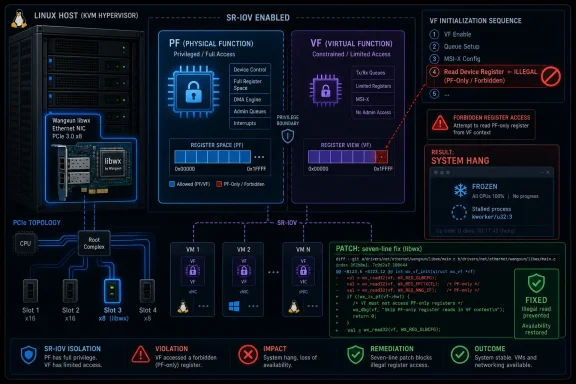
libwx Ethernet driver when a virtual function reads a physical-function-only register during initialization and can hang the system. The fix is small, but the lesson is not. This is the kind of bug that looks like a driver footnote until it lands in the middle of a virtualization host, a lab cluster, or an appliance stack that depends on SR-IOV behaving like plumbing. For WindowsForum readers, the story is less “Linux has another CVE” than “modern networking stacks keep turning hardware boundaries into software assumptions, and the assumptions keep cracking.”
A Seven-Line Patch Exposes a Bigger Virtualization Problem
The kernel change behind CVE-2026-46142 is almost comically modest. In the Wangxun libwx driver, code that previously read WX_CFG_PORT_ST to determine a bus function now checks whether the PCI device is a virtual function. If it is, the driver derives the function ID from PCI_FUNC(pdev->devfn) instead of touching the restricted register.
That is exactly the kind of fix kernel maintainers like: narrow, understandable, easy to backport, and tied to a known regression. The patch identifies WX_CFG_PORT_ST as a physical-function-restricted register, which means a virtual function should not be reading it in the first place. When a VF did read it during initialization, the result was an illegal register access and, according to the CVE description, a system hang.
The practical impact is denial of service, not remote code execution. There is no public indication from the supplied record that this bug leaks memory, grants privileges, or allows packet-driven compromise across the network. But a hang at VF initialization is still serious in the places where VFs are used: dense hosts, container platforms, network appliances, storage nodes, and virtualized workloads that rely on direct-ish access to NIC resources.
The uncomfortable part is that the kernel was not doing something exotic. It was trying to discover topology and identity. In a virtualized hardware model, even that can be dangerous if the code forgets which side of the privilege boundary it is running on.
The PF/VF Split Is a Security Boundary, Not Just a Performance Feature
SR-IOV is often sold as a speed story. A physical NIC exposes a physical function, or PF, controlled by the host, and multiple virtual functions, or VFs, that can be assigned to guests or isolated workloads. The payoff is lower overhead and better throughput because the guest or workload can interact with a slice of the hardware more directly than it would through a fully emulated device.
But the PF/VF split is also a boundary. The PF is supposed to have broader configuration authority. The VF is supposed to be constrained. The entire design depends on the hardware, firmware, driver, hypervisor, and operating system agreeing about who may touch which registers, who may reset what, and who may infer device state from where.
CVE-2026-46142 is a reminder that this boundary can be violated accidentally. The bug was not a malicious VF writing to a privileged register; it was the driver initializing a VF as though one read path were safe for both PF and VF contexts. That distinction matters because it tells administrators what sort of risk they are dealing with. This is not an attacker slipping through a carefully guarded gate; it is the gate being built into a path the kernel itself walks during normal setup.
That makes the problem both easier and harder to reason about. Easier, because the fix is deterministic: do not read the PF-only register from the VF path. Harder, because the failure mode appears at the intersection of driver code, PCI function identity, and vendor-specific register rules. Those intersections are exactly where large estates become difficult to audit.
“Awaiting Enrichment” Does Not Mean “Awaiting Reality”
The NVD entry is marked as awaiting enrichment, with no CVSS v4, v3, or v2 score from NIST at publication time. That often tempts readers to treat the vulnerability as unfinished or less important. In this case, the absence of a score should be read more narrowly: NVD had not yet completed its metadata work when the record appeared.
The kernel-side facts are already concrete. The description identifies the affected area, the forbidden register access, the trigger during VF initialization, and the observed failure mode. The upstream patch was submitted in late April 2026 and accepted into the networking tree before the CVE record reached NVD near the end of May.
That chronology matters. Linux kernel CVEs increasingly arrive as formal labels attached to already-fixed bugs rather than as dramatic disclosures followed by a scramble. For defenders, this means the CVE database is not always the earliest signal. Mailing lists, stable trees, vendor kernel changelogs, and distribution advisories often show the remediation path before NVD has filled in the severity fields.
This is a cultural mismatch between vulnerability management dashboards and kernel development. Dashboards want a score. Kernel maintainers want a patch. Administrators need both, but if they wait for the score before tracking exposure, they may be late to the operational reality.
The Affected Population Is Narrow, but Not Trivial
The affected code lives under drivers/net/ethernet/wangxun/libwx, which points to Wangxun Ethernet hardware support rather than a universal Linux networking flaw. Most desktop Linux users will never encounter this driver. Most Windows users will only care if they administer Linux infrastructure, run mixed hypervisor fleets, or operate appliances that embed Linux under a management UI.
That narrowness should not be mistaken for irrelevance. NIC driver issues are disproportionately important in infrastructure because network devices sit on the path to everything else. A host that hangs during VF initialization may not merely lose one workload; it may interrupt tenant networking, storage access, clustering, or failover behavior.
There is also a supply-chain wrinkle. Many organizations do not think of themselves as “running Linux” when Linux is inside a storage appliance, network security box, virtualization node, Kubernetes worker, or edge gateway. If that appliance uses the relevant Wangxun hardware and a kernel carrying the buggy code, the operational exposure may exist even if nobody in the organization installed a general-purpose Linux distribution by hand.
The first triage question is therefore not “Do we run Linux on laptops?” It is “Do any of our hosts or appliances use Wangxun NICs with SR-IOV virtual functions enabled?” That is a much narrower and more useful question, and in many environments it will quickly reduce the concern to a small number of systems.
The Crash Class Still Matters in a World Obsessed With RCE
Security culture has a bias toward remote code execution and privilege escalation. Those are the vulnerabilities that make headlines, launch emergency weekends, and justify board-level briefings. A system hang caused by illegal register access does not carry the same cinematic force.
But denial of service at the hardware-driver boundary can be operationally severe. A hang is not a graceful failure. It may require a watchdog reset, host reboot, workload evacuation, or manual intervention depending on how the platform responds. In virtualized environments, one low-level host failure can ripple outward faster than a single compromised process.
The most important distinction is triggerability. The public description says the hang occurs when a VF is initialized. That points toward local or administrative paths: creating VFs, binding them, assigning them, booting guests that use them, or otherwise exercising the VF setup path. It does not, from the available record, support claims of remote packet-triggered exploitation.
That should shape the response. This is not a panic patch for every Linux machine on the internet. It is a targeted stability and availability fix for systems using a particular driver path. The right reaction is inventory, kernel tracking, and maintenance-window planning — not generic fear.
The Fix Shows the Kernel at Its Best and Its Most Fragile
There is something reassuring about the patch. It recognizes the VF case explicitly and uses PCI function information already available from the device function number. That is cleaner than trying to make a restricted register read safe, hiding the fault, or papering over the hang after it happens.
It also demonstrates why kernel regressions can be so hard to prevent. The offending behavior appears connected to an earlier change described as fixing a device bus LAN ID. That earlier fix likely made sense in one context, then turned out to be unsafe in another. Hardware support code is full of this sort of conditional truth: correct for the PF, wrong for the VF; correct for one board, wrong for another; correct before firmware changes, wrong afterward.
This is not a criticism of one driver maintainer. It is the nature of operating systems that abstract hardware but cannot fully escape it. Every driver is a treaty between generic kernel models and the peculiarities of silicon. The treaty holds until an untested clause is invoked.
The kernel process handled this in the expected way: a small patch, a clear commit message, stable backport tagging, and propagation to maintained trees. That process is boring by design. The boringness is the defense.
Windows Admins Should Care Because Their Estates Are No Longer Windows-Only
A Windows-focused audience might reasonably ask why a Linux kernel NIC bug belongs on WindowsForum. The answer is that the boundary between Windows administration and Linux infrastructure has been dissolving for years. Hyper-V estates host Linux guests. Windows shops run Kubernetes nodes. Security appliances, NAS boxes, backup targets, and cloud images routinely depend on Linux kernels that administrators may never log into directly.
Even Microsoft’s own ecosystem has made Linux literacy unavoidable. Azure is full of Linux workloads, WSL has normalized Linux tooling on Windows desktops, and hybrid environments increasingly mix Windows Server with Linux-based infrastructure services. A NIC driver hang on a Linux host can absolutely become a Windows outage if the affected host carries domain-adjacent services, storage paths, monitoring agents, CI runners, or virtual desktops.
The relevant mental model is not “Windows versus Linux.” It is “Which layer owns the hardware, and which workloads depend on it staying alive?” If the hardware-owning layer is Linux, then Linux driver CVEs become part of a Windows administrator’s risk surface.
That does not mean every Windows admin needs to read kernel diffs over breakfast. It means vulnerability triage has to follow dependency chains rather than brand labels. If Windows services depend on Linux virtualization hosts or appliances, then the health of those kernels is part of the Windows service story.
The CVE Flood Is Making Kernel Risk Look Stranger Than It Is
Kernel.org’s role as a CVE Numbering Authority has changed the texture of Linux vulnerability reporting. Many bugs that would once have been “just” stable fixes now arrive with CVE identifiers. That has benefits: better traceability, easier compliance mapping, and fewer silent fixes buried in changelogs. It also creates noise.
CVE-2026-46142 is a good example of both sides. The identifier is useful because it gives security teams a handle for tracking vendor advisories and distribution updates. It is also easy to overread because the CVE shell initially lacks NVD scoring and broader context. A scanner may flag it with the same visual urgency as a far more exploitable kernel flaw, even though the affected driver and trigger conditions are comparatively specific.
This is where mature vulnerability management has to move beyond score-chasing. A CVSS number, once assigned, will help classify severity. It will not answer whether your estate uses the driver, whether SR-IOV is enabled, whether VFs are initialized in production, whether your distribution has backported the fix, or whether a maintenance reboot is more disruptive than the actual exposure.
The kernel CVE era rewards organizations that can connect low-level technical facts to asset inventory. Everyone else gets a red badge and a shrug.
Patch Management Starts With Finding the Hardware
The immediate remediation path is straightforward: consume a kernel that includes the libwx fix from upstream or from your distribution vendor. For source-based or custom-kernel environments, the patch is small enough to review directly. For enterprise distributions, the safer path is to wait for the vendor kernel update unless the affected systems are unstable or exposed to frequent VF lifecycle operations.
Before patching, administrators should identify whether the relevant driver is present and loaded. On Linux hosts, that means checking PCI devices, loaded modules, kernel configuration, and vendor hardware inventory. In virtualized environments, it also means checking whether SR-IOV is enabled in firmware, exposed by the host, and actively used by guests or containers.
The next question is operational: how often are VFs initialized? A host that statically configures VFs at boot may be exposed primarily during boot or reconfiguration. A dynamic environment that creates and tears down VFs as workloads move may encounter the problematic path more often. The same bug can therefore have very different risk profiles across two estates with identical hardware.
Mitigation, short of patching, is mostly about avoiding the trigger. If a system is affected and unstable, administrators may disable SR-IOV for the device, avoid assigning VFs, or fall back to a different networking mode until a fixed kernel is available. Those workarounds carry performance and architecture costs, so they should be treated as temporary measures rather than permanent policy.
The Most Important Signal Is in the Commit Message
The phrase “PF restricted register” is the heart of this CVE. It tells us the failure was not random memory corruption or an ambiguous race. It was a privilege-model violation at the device register level.
That is also why the fix is conceptually clean. For a VF, the driver does not need to ask the PF-only register for the LAN ID. It can derive the bus function from PCI metadata available to the VF context. The patch therefore removes the illegal access rather than trying to catch the resulting fault.
This matters for trust. When a fix changes behavior by narrowing access to what the VF is actually allowed to know, it aligns the software model with the hardware model. When fixes merely suppress errors, administrators have to worry that the underlying boundary confusion remains. Here, the repair appears to correct the boundary crossing itself.
There is still a broader lesson for driver authors. Any code path shared between PF and VF contexts deserves suspicion. If a register read, reset sequence, interrupt setup, or capability probe was written for physical functions first, it should not be assumed safe for virtual functions without explicit confirmation.
The Patch Is Small; the Inventory Work Is Not
For organizations that do not use Wangxun hardware, CVE-2026-46142 will be closed almost as soon as it is opened. That is fine. A good vulnerability process should discard non-applicable findings quickly.
For organizations that do use the hardware, the work is not complicated, but it is exacting. Confirm the driver. Confirm the kernel branch. Confirm whether the fix has been backported. Confirm whether VFs are used. Confirm whether the vulnerable path is reachable in normal operations. Then decide whether the update can wait for the next kernel cycle or needs a targeted maintenance window.
The trap is treating all kernel CVEs as either existential emergencies or ignorable background noise. This one is neither. It is a concrete availability bug with a narrow technical scope and a clear fix. That makes it a test of whether the vulnerability-management process can do proportional response.
The best teams will not debate whether a no-score NVD entry is “real.” They will map it to assets, check vendor kernels, and move on with evidence.
A Small Driver Bug Draws a Big Operational Map
The practical readout from CVE-2026-46142 is narrower than the CVE label first suggests, but sharper than a casual glance implies. The issue sits at the intersection of Wangxun NIC support, Linux kernel driver initialization, SR-IOV virtual functions, and availability-sensitive systems.
- Systems that do not use the Wangxun
libwxdriver are unlikely to be affected by this specific vulnerability. - Systems that use the driver but do not enable or initialize virtual functions may have a much lower practical exposure.
- Systems that assign VFs to guests, containers, or appliance workloads should prioritize confirming whether their kernel includes the fix.
- The public record points to a system hang during VF initialization, not to remote code execution or privilege escalation.
- The absence of an NVD score on May 28, 2026 should not delay basic inventory and patch tracking.
- Temporary mitigations should focus on avoiding VF initialization on affected systems until a fixed kernel is deployed.
The larger significance of CVE-2026-46142 is that it shows how modern infrastructure fails: not always through spectacular exploits, but through tiny mismatches between privilege, hardware, and abstraction. A virtual function reached for a physical-function-only register, and the machine could hang. The fix will disappear into stable kernels and distribution updates, as it should, but the pattern will remain. As more estates lean on SR-IOV, SmartNICs, DPUs, and hardware offload, the next availability incident may again be hiding in a place that looks too small to matter until it is the thing keeping the host from coming back.
References
- CVE-2026-46142 net: libwx: fix VF illegal register access NVD / Linux Kernel · 2026-05-29T01:09:01-07:00