

On May 28, 2026, NVD published CVE-2026-46147, a Linux kernel vulnerability from kernel.org affecting the ARM64 KVM protected virtualization path, where failed vCPU initialization could leak pinned memory references and expose a partially initialized virtual CPU to a concurrent reader. It is not the kind of CVE that will light up consumer Windows desktops, and that is precisely why it is worth paying attention to. The bug lives in a narrow corner of modern virtualization, but the failure mode is a familiar one: cleanup that does not quite clean up, and publication of state before the state is truly ready. For WindowsForum readers running mixed estates, ARM servers, nested virtualization labs, or Linux-backed cloud infrastructure, this is another reminder that “Linux kernel CVE” is not a single risk category.
CVE-2026-46147 is easy to misread because its description is dense with kernel vocabulary:
The first part is a cleanup failure. If the kernel successfully pinned shared memory for a host vCPU and its SVE state, then later hit an error, the old error path jumped past the unpinning work. That meant the kernel could permanently retain pin references it should have dropped.
The second part is a publication-ordering failure. A new vCPU pointer could be stored in
Those two bugs are technically different, but architecturally related. Both come from the same pressure point in kernel engineering: the moment an object moves from private construction to shared visibility. In high-level application code, that is often a matter of style. In a hypervisor-adjacent kernel path, it is a matter of correctness, isolation, and system stability.
That does not make the bug irrelevant to a Windows-oriented audience. Many Windows shops now run infrastructure that is not purely Windows: Linux hosts run CI, container platforms, edge appliances, cloud workers, hypervisors, storage services, network functions, and security tooling. Increasingly, those systems include ARM hardware, whether in hyperscale cloud instances, developer boards, internal labs, or appliance-style deployments.
The CVE also matters because virtualization boundaries are now part of ordinary enterprise security design. Administrators who once thought of hypervisors as a datacenter specialty now deal with them through WSL, Hyper-V, KVM, cloud VMs, Android virtualization, confidential computing, endpoint isolation, sandboxing, and test infrastructure. A flaw in a vCPU initialization path is not glamorous, but it sits in the machinery that decides what code can safely share a machine.
NVD had not assigned CVSS scores at the time of publication in the submitted record, and that absence should temper both alarm and dismissal. No score means the ecosystem is still waiting for enrichment, not that the issue is harmless. Kernel.org’s description tells us what was fixed; it does not, by itself, prove exploitability in every deployment.
Pin leaks do not always have the theatrical shape of remote code execution. They often look like machines that slowly lose resources, operations that fail under pressure, or subsystems that become unreliable after repeated attempts to create and tear down state. In the virtualization world, that can matter because management layers frequently retry failed operations.
A malicious or buggy local actor that can repeatedly trigger the failing path may be able to apply pressure over time. Even when privilege escalation is not demonstrated, a permanent reference leak can become a denial-of-service primitive if the leaked resource is scarce enough or if the path can be exercised often enough. That is why kernel maintainers treat these bugs seriously even when the public CVE text does not read like a Hollywood exploit chain.
The SVE detail is also notable. ARM’s Scalable Vector Extension is part of the performance and compute story for modern ARM systems, but it adds more architectural state for the kernel and hypervisor to manage. Every additional register file, context blob, and per-vCPU structure increases the importance of exact cleanup semantics.
In other words, the bug is not “just” a leak. It is a leak at the boundary between the host kernel’s virtualization model and the protected execution world KVM is trying to build on ARM64.
This is the kind of bug that makes kernel developers reach for memory barriers and makes everyone else’s eyes glaze over. But the concept is simple: on modern multicore systems, “I wrote field A, then field B, then stored the pointer” is not always enough to guarantee another CPU observes those writes in the same meaningful order. Compilers and processors are allowed to reorder or delay visibility in ways that are legal unless the code explicitly says otherwise.
The fix uses
The CVE description notes that
That is how good kernel fixes often look. They do not merely plug the crash someone found today. They encode the invariant the code should have had all along.
That makes initialization order especially important. If the host and hypervisor disagree about whether a vCPU exists, whether its memory is pinned, or whether its object is fully initialized, the resulting failure is not just an accounting problem. It can become a crack in the abstraction that pKVM is supposed to provide.
The fix described in CVE-2026-46147 is therefore a small example of a large engineering challenge. Protected virtualization adds security value by reducing implicit trust, but it also increases the number of transitions where state must be copied, pinned, validated, published, and later unwound. Each transition is an opportunity for a leak, race, or ordering mistake.
This is not an argument against pKVM. It is an argument against pretending that hardware-assisted isolation removes software complexity. The more ambitious the isolation model, the more exact the surrounding kernel code must become.
Microsoft itself has spent years making Linux part of the Windows developer and cloud story. WSL brought Linux userlands to Windows desktops. Azure gives customers Linux and Windows fleets side by side. Windows Server shops increasingly consume services backed by Linux infrastructure they do not directly administer.
That does not mean every Windows admin must become an ARM64 KVM specialist. It does mean vulnerability management cannot stop at the Windows Update dashboard. If a business depends on Linux virtualization hosts, ARM build runners, or cloud services with customer-managed kernels, CVE-2026-46147 belongs in the same triage conversation as any other kernel update.
The practical question is not “Do we run Windows?” It is “Do any systems we rely on run affected Linux kernels on ARM64 with KVM/pKVM functionality in play?” In 2026, that question has a broader reach than many asset inventories admit.
CVSS scoring is useful, but kernel bugs frequently resist clean scoring. A vulnerability may be highly deployment-dependent: severe in one configuration, unreachable in another, and irrelevant on a different architecture. ARM64 KVM pKVM code is exactly the kind of area where blanket severity language can mislead.
The bug also combines two effects that score differently in practice. A pin leak suggests resource exhaustion or denial of service under certain triggering conditions. A publication-ordering race suggests possible use of partially initialized state, which could manifest as instability, a crash, or something more serious depending on reachable code paths and attacker control.
Until distributors and platform vendors publish their advisories, the responsible posture is measured urgency. Track the fixed kernel versions, identify exposed systems, and patch through normal kernel maintenance windows unless a vendor later elevates the issue for your specific environment.
This is classic defensive kernel work. The easiest resource leaks to create are the ones hidden in “goto cleanup” paths where one label releases one subset of state and another label releases a different subset. That pattern is efficient, common, and often correct, but it becomes treacherous as initialization grows more conditional.
The inline unpinning before falling through to the existing unlock path is an important detail. It means the fix does not merely add another cleanup label and hope future readers understand the difference. It makes the corrective action local to the failure returned by the new helper.
The memory-ordering fix is similarly explicit.
Good security fixes are often like this. They turn an implicit assumption into an explicit rule.
That shift changes the operational profile of bugs like CVE-2026-46147. A vulnerability limited to ARM64 KVM is still limited, but the population behind that limit is no longer exotic. It includes public cloud instances, internal development systems, specialized appliances, and edge deployments where patch cadence can be uneven.
The pKVM angle narrows the field again, but it also points toward where the industry is moving. Confidential computing, protected VMs, hardened hypervisors, and reduced-trust hosts are not fringe ideas anymore. They are vendor roadmap material, compliance talking points, and increasingly part of real deployments.
That means today’s obscure pKVM initialization fix is also tomorrow’s design lesson. As more systems lean on protected virtualization, the boring details of pinning, ordering, and teardown become part of the security perimeter.
It is tempting to rank every kernel CVE by the most dramatic outcome imaginable. That is bad security practice. The right analysis starts with reachability: who can trigger vCPU initialization, under what permissions, on what kernel versions, with which KVM configuration, and how often? The answers may vary sharply between a developer workstation, a managed cloud image, a phone-derived ARM platform, and a hardened virtualization host.
Still, lack of a public exploit is not the same as lack of value to an attacker. Bugs involving lifetime management and concurrent visibility are precisely the sort of primitives that can become more meaningful when combined with other weaknesses. A leak can create pressure. A race can create weird state. Weird state is where kernel exploitation research often begins.
For most administrators, the takeaway is not to panic. It is to avoid complacency just because the CVE text is not accompanied by a catchy name, logo, or proof-of-concept video.
The submitted record lists stable kernel commit references, which tells us the fix has moved through the kernel stable machinery. From an operations standpoint, the next step is downstream confirmation: Debian, Ubuntu, Red Hat, SUSE, Oracle, Amazon Linux, Android-derived vendors, appliance vendors, and cloud image maintainers all have their own timelines and packaging practices.
This is especially important for ARM64 because deployments are less uniform than the x86 server world. Some systems track mainstream distributions closely. Others rely on board support packages, vendor forks, embedded images, or cloud-provider kernels. The same CVE can be patched promptly in one branch and linger in another.
For Windows-heavy shops with a few Linux dependencies, this is where inventory discipline pays off. You do not need to memorize KVM internals. You do need to know which teams own Linux hosts, which of those hosts are ARM64, and whether kernel updates are automatic, scheduled, or nobody’s explicit job.
Start with architecture. Systems running x86_64 kernels are not the primary subject of this CVE. Then look for Linux hosts using ARM64 virtualization, especially those involved in KVM, protected KVM, cloud workloads, test infrastructure, or multi-tenant execution.
Next, check kernel packages against your distributor’s security status. If you operate vendor appliances or managed images, do not assume upstream stable commits are already present. Ask for the vendor’s fixed build or advisory if the system matters to production.
Finally, treat reboot planning as part of the patch. Kernel fixes do not protect a running host until the fixed kernel is actually booted. In virtualization clusters, that may mean draining workloads, moving guests, coordinating maintenance windows, or accepting temporary capacity reduction.
The CVE description itself acknowledges that the current lock may serialize the store and load. The maintainers still chose to harden the publication pattern. That is a mature engineering instinct: if the code’s safety depends on a subtle assumption, make the assumption executable.
This matters because kernel code evolves. Today’s lock-protected path can become tomorrow’s fast path. A future optimization can remove or narrow a lock. A reader can be added in a place where the old ordering guarantee is no longer obvious. When release/acquire semantics are attached to the actual publication event, the invariant travels with the code.
Security is often described in terms of attackers and exploits, but much of it is really about preserving invariants under maintenance pressure. CVE-2026-46147 is a small case study in that discipline.
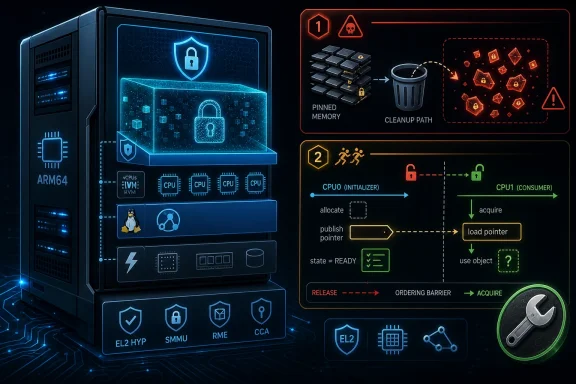 A Small KVM Fix Exposes a Larger Virtualization Truth
CVE-2026-46147 is easy to misread because its description is dense with kernel vocabulary: __pkvm_init_vcpu(), hyp_pin_shared_mem(), smp_store_release(), smp_load_acquire(), host SVE state pages, and protected KVM. Strip away the names, and the issue is a two-part initialization bug in the path that prepares a virtual CPU for use by KVM on ARM64.The first part is a cleanup failure. If the kernel successfully pinned shared memory for a host vCPU and its SVE state, then later hit an error, the old error path jumped past the unpinning work. That meant the kernel could permanently retain pin references it should have dropped.
The second part is a publication-ordering failure. A new vCPU pointer could be stored in
hyp_vm->vcpus[] before the object behind that pointer was guaranteed to be fully initialized from the perspective of a concurrent loader. The fix uses release/acquire memory ordering so that a reader cannot legitimately observe the pointer without also observing the writes that made the object valid.Those two bugs are technically different, but architecturally related. Both come from the same pressure point in kernel engineering: the moment an object moves from private construction to shared visibility. In high-level application code, that is often a matter of style. In a hypervisor-adjacent kernel path, it is a matter of correctness, isolation, and system stability.
The Risk Is Narrow, but the Class of Bug Is Not
The most important practical point is that this is an ARM64 KVM issue, not a Windows kernel flaw, not an x86 desktop flaw, and not a universal Linux disaster. It concerns KVM’s ARM64 protected virtualization machinery, which means the immediately relevant population is a subset of Linux systems using ARM64 virtualization features. A Windows 11 laptop on Intel or AMD hardware is not suddenly exposed because this CVE exists.That does not make the bug irrelevant to a Windows-oriented audience. Many Windows shops now run infrastructure that is not purely Windows: Linux hosts run CI, container platforms, edge appliances, cloud workers, hypervisors, storage services, network functions, and security tooling. Increasingly, those systems include ARM hardware, whether in hyperscale cloud instances, developer boards, internal labs, or appliance-style deployments.
The CVE also matters because virtualization boundaries are now part of ordinary enterprise security design. Administrators who once thought of hypervisors as a datacenter specialty now deal with them through WSL, Hyper-V, KVM, cloud VMs, Android virtualization, confidential computing, endpoint isolation, sandboxing, and test infrastructure. A flaw in a vCPU initialization path is not glamorous, but it sits in the machinery that decides what code can safely share a machine.
NVD had not assigned CVSS scores at the time of publication in the submitted record, and that absence should temper both alarm and dismissal. No score means the ecosystem is still waiting for enrichment, not that the issue is harmless. Kernel.org’s description tells us what was fixed; it does not, by itself, prove exploitability in every deployment.
The Pin Leak Is the Boring Bug That Can Still Hurt
The first half of CVE-2026-46147 is a resource lifetime problem. A kernel path pins host vCPU and SVE-related memory so the protected hypervisor side can safely access what it needs. If later validation fails, those pins must be released. The vulnerable path failed to do that in at least one error sequence.Pin leaks do not always have the theatrical shape of remote code execution. They often look like machines that slowly lose resources, operations that fail under pressure, or subsystems that become unreliable after repeated attempts to create and tear down state. In the virtualization world, that can matter because management layers frequently retry failed operations.
A malicious or buggy local actor that can repeatedly trigger the failing path may be able to apply pressure over time. Even when privilege escalation is not demonstrated, a permanent reference leak can become a denial-of-service primitive if the leaked resource is scarce enough or if the path can be exercised often enough. That is why kernel maintainers treat these bugs seriously even when the public CVE text does not read like a Hollywood exploit chain.
The SVE detail is also notable. ARM’s Scalable Vector Extension is part of the performance and compute story for modern ARM systems, but it adds more architectural state for the kernel and hypervisor to manage. Every additional register file, context blob, and per-vCPU structure increases the importance of exact cleanup semantics.
In other words, the bug is not “just” a leak. It is a leak at the boundary between the host kernel’s virtualization model and the protected execution world KVM is trying to build on ARM64.
Publication Before Initialization Is Where Races Become Security Bugs
The second half of the CVE is more subtle and arguably more interesting. The vulnerable code could publish a pointer to a new vCPU object using a bare store. Another path,pkvm_load_hyp_vcpu(), could then read that pointer and potentially see the object before all of its initialization was reliably visible.This is the kind of bug that makes kernel developers reach for memory barriers and makes everyone else’s eyes glaze over. But the concept is simple: on modern multicore systems, “I wrote field A, then field B, then stored the pointer” is not always enough to guarantee another CPU observes those writes in the same meaningful order. Compilers and processors are allowed to reorder or delay visibility in ways that are legal unless the code explicitly says otherwise.
The fix uses
smp_store_release() when publishing the vCPU pointer and smp_load_acquire() when reading it. In plain English, the writer promises that earlier initialization writes become visible before the pointer is treated as published, and the reader promises that once it sees the pointer, it also sees the initialized state that came before it. This is not decoration; it is the contract that makes lockless and semi-lockless code sane.The CVE description notes that
vm_table_lock currently serializes the store and load. That makes the issue sound theoretical at first glance. The maintainers’ point is that relying on the current lock shape is brittle when nested object initialization is involved, especially if future code grows a lockless path or if the apparent locking does not provide the full ordering guarantee developers assumed.That is how good kernel fixes often look. They do not merely plug the crash someone found today. They encode the invariant the code should have had all along.
Protected KVM Raises the Price of Ordinary Mistakes
Protected KVM, or pKVM, exists because the old assumption that the host kernel is always fully trusted no longer fits every threat model. The idea is to reduce what the host can do to protected guests by shifting some enforcement into a more privileged hypervisor layer. On ARM64, that means the kernel’s virtualization code is not merely launching VMs; it is participating in a more delicate partitioning of trust.That makes initialization order especially important. If the host and hypervisor disagree about whether a vCPU exists, whether its memory is pinned, or whether its object is fully initialized, the resulting failure is not just an accounting problem. It can become a crack in the abstraction that pKVM is supposed to provide.
The fix described in CVE-2026-46147 is therefore a small example of a large engineering challenge. Protected virtualization adds security value by reducing implicit trust, but it also increases the number of transitions where state must be copied, pinned, validated, published, and later unwound. Each transition is an opportunity for a leak, race, or ordering mistake.
This is not an argument against pKVM. It is an argument against pretending that hardware-assisted isolation removes software complexity. The more ambitious the isolation model, the more exact the surrounding kernel code must become.
Windows Admins Should Care Because Their Infrastructure Already Does
A Windows-first administrator might reasonably ask why an ARM64 KVM CVE belongs on their radar. The answer is that modern Windows environments are rarely Windows-only environments. The build server may be Linux. The Kubernetes worker may be Linux. The cloud instance running a line-of-business dependency may be Linux on ARM. The developer’s local stack may depend on a Linux VM even when the corporate endpoint standard is Windows.Microsoft itself has spent years making Linux part of the Windows developer and cloud story. WSL brought Linux userlands to Windows desktops. Azure gives customers Linux and Windows fleets side by side. Windows Server shops increasingly consume services backed by Linux infrastructure they do not directly administer.
That does not mean every Windows admin must become an ARM64 KVM specialist. It does mean vulnerability management cannot stop at the Windows Update dashboard. If a business depends on Linux virtualization hosts, ARM build runners, or cloud services with customer-managed kernels, CVE-2026-46147 belongs in the same triage conversation as any other kernel update.
The practical question is not “Do we run Windows?” It is “Do any systems we rely on run affected Linux kernels on ARM64 with KVM/pKVM functionality in play?” In 2026, that question has a broader reach than many asset inventories admit.
The Absence of a CVSS Score Is Not an Absence of Meaning
NVD’s record for CVE-2026-46147 was marked as awaiting enrichment in the submitted detail, with no CVSS 4.0, 3.x, or 2.0 score assigned by NIST. That status is common for newly received kernel CVEs, especially when the description arrives before downstream vendors have completed impact analysis. It should not be confused with a clean bill of health.CVSS scoring is useful, but kernel bugs frequently resist clean scoring. A vulnerability may be highly deployment-dependent: severe in one configuration, unreachable in another, and irrelevant on a different architecture. ARM64 KVM pKVM code is exactly the kind of area where blanket severity language can mislead.
The bug also combines two effects that score differently in practice. A pin leak suggests resource exhaustion or denial of service under certain triggering conditions. A publication-ordering race suggests possible use of partially initialized state, which could manifest as instability, a crash, or something more serious depending on reachable code paths and attacker control.
Until distributors and platform vendors publish their advisories, the responsible posture is measured urgency. Track the fixed kernel versions, identify exposed systems, and patch through normal kernel maintenance windows unless a vendor later elevates the issue for your specific environment.
The Patch Tells the Story Better Than the CVE Label
The CVE text says the fix extracts aregister_hyp_vcpu() helper to perform checks and the final store. That restructuring matters because it narrows the dangerous zone. Instead of scattering validation, pinning, registration, and cleanup across a fragile control flow, the patch separates the moment of registration from the error paths that must undo pinned resources.This is classic defensive kernel work. The easiest resource leaks to create are the ones hidden in “goto cleanup” paths where one label releases one subset of state and another label releases a different subset. That pattern is efficient, common, and often correct, but it becomes treacherous as initialization grows more conditional.
The inline unpinning before falling through to the existing unlock path is an important detail. It means the fix does not merely add another cleanup label and hope future readers understand the difference. It makes the corrective action local to the failure returned by the new helper.
The memory-ordering fix is similarly explicit.
smp_store_release() and smp_load_acquire() are not broad hammers; they document the intended relationship between object initialization and pointer publication. Future maintainers reading the code see not just that a pointer is stored, but that storing it is the point at which the object becomes visible to other CPUs.Good security fixes are often like this. They turn an implicit assumption into an explicit rule.
Cloud ARM Makes Kernel Corner Cases Less Corner-Case
For years, ARM64 kernel virtualization bugs could be mentally filed away as niche, embedded, or hyperscaler-only. That filing system is obsolete. ARM servers are now a real option for cloud workloads, CI pipelines, scale-out services, and power-sensitive infrastructure. Even organizations that never buy an ARM server may rent one without thinking much about the underlying architecture.That shift changes the operational profile of bugs like CVE-2026-46147. A vulnerability limited to ARM64 KVM is still limited, but the population behind that limit is no longer exotic. It includes public cloud instances, internal development systems, specialized appliances, and edge deployments where patch cadence can be uneven.
The pKVM angle narrows the field again, but it also points toward where the industry is moving. Confidential computing, protected VMs, hardened hypervisors, and reduced-trust hosts are not fringe ideas anymore. They are vendor roadmap material, compliance talking points, and increasingly part of real deployments.
That means today’s obscure pKVM initialization fix is also tomorrow’s design lesson. As more systems lean on protected virtualization, the boring details of pinning, ordering, and teardown become part of the security perimeter.
The Exploit Story Is Still Unwritten
The public record supplied for CVE-2026-46147 does not establish a working exploit, a remote attack path, or a privilege-escalation chain. It describes a resolved kernel vulnerability and the mechanics of the fix. That distinction matters.It is tempting to rank every kernel CVE by the most dramatic outcome imaginable. That is bad security practice. The right analysis starts with reachability: who can trigger vCPU initialization, under what permissions, on what kernel versions, with which KVM configuration, and how often? The answers may vary sharply between a developer workstation, a managed cloud image, a phone-derived ARM platform, and a hardened virtualization host.
Still, lack of a public exploit is not the same as lack of value to an attacker. Bugs involving lifetime management and concurrent visibility are precisely the sort of primitives that can become more meaningful when combined with other weaknesses. A leak can create pressure. A race can create weird state. Weird state is where kernel exploitation research often begins.
For most administrators, the takeaway is not to panic. It is to avoid complacency just because the CVE text is not accompanied by a catchy name, logo, or proof-of-concept video.
Distribution Backports Will Matter More Than Mainline Version Numbers
Linux kernel vulnerability management is rarely as simple as “upgrade to version X.” Enterprise and distribution kernels backport fixes aggressively, often carrying security patches without moving to a visibly new upstream kernel series. That means administrators need vendor advisories, package changelogs, and kernel build metadata rather than a single upstream version comparison.The submitted record lists stable kernel commit references, which tells us the fix has moved through the kernel stable machinery. From an operations standpoint, the next step is downstream confirmation: Debian, Ubuntu, Red Hat, SUSE, Oracle, Amazon Linux, Android-derived vendors, appliance vendors, and cloud image maintainers all have their own timelines and packaging practices.
This is especially important for ARM64 because deployments are less uniform than the x86 server world. Some systems track mainstream distributions closely. Others rely on board support packages, vendor forks, embedded images, or cloud-provider kernels. The same CVE can be patched promptly in one branch and linger in another.
For Windows-heavy shops with a few Linux dependencies, this is where inventory discipline pays off. You do not need to memorize KVM internals. You do need to know which teams own Linux hosts, which of those hosts are ARM64, and whether kernel updates are automatic, scheduled, or nobody’s explicit job.
The Right Response Is Inventory First, Then Patch
CVE-2026-46147 should trigger a targeted review, not a fleet-wide panic. The affected area is specific enough that many organizations will find no exposure at all. But the organizations that do have exposure may not discover it from their Windows-centric tooling.Start with architecture. Systems running x86_64 kernels are not the primary subject of this CVE. Then look for Linux hosts using ARM64 virtualization, especially those involved in KVM, protected KVM, cloud workloads, test infrastructure, or multi-tenant execution.
Next, check kernel packages against your distributor’s security status. If you operate vendor appliances or managed images, do not assume upstream stable commits are already present. Ask for the vendor’s fixed build or advisory if the system matters to production.
Finally, treat reboot planning as part of the patch. Kernel fixes do not protect a running host until the fixed kernel is actually booted. In virtualization clusters, that may mean draining workloads, moving guests, coordinating maintenance windows, or accepting temporary capacity reduction.
The Lesson Hidden in the Memory Barrier
The most interesting part of this CVE may be the one least likely to appear in risk dashboards. The memory-ordering fix is a reminder that correctness in concurrent kernel code is not merely about locks being present somewhere nearby. It is about the exact visibility contract between writer and reader.The CVE description itself acknowledges that the current lock may serialize the store and load. The maintainers still chose to harden the publication pattern. That is a mature engineering instinct: if the code’s safety depends on a subtle assumption, make the assumption executable.
This matters because kernel code evolves. Today’s lock-protected path can become tomorrow’s fast path. A future optimization can remove or narrow a lock. A reader can be added in a place where the old ordering guarantee is no longer obvious. When release/acquire semantics are attached to the actual publication event, the invariant travels with the code.
Security is often described in terms of attackers and exploits, but much of it is really about preserving invariants under maintenance pressure. CVE-2026-46147 is a small case study in that discipline.
This Is the Patch Window ARM64 Virtualization Operators Should Not Waste
The concrete response to CVE-2026-46147 is straightforward, but it depends on knowing whether you are in the affected population. Most readers will not need emergency action on personal Windows systems. Operators of ARM64 Linux virtualization hosts should treat it as a normal but real kernel security maintenance item.- Systems that do not run Linux on ARM64 are outside the core scope of this CVE.
- Systems that run Linux on ARM64 but do not use KVM or protected KVM features are less likely to have practical exposure, though vendor guidance should still govern patch decisions.
- Hosts that create or manage KVM virtual CPUs on ARM64 should be checked against distributor or vendor kernel updates.
- Administrators should verify that the fixed kernel is booted after patching, not merely installed on disk.
- Security teams should avoid over-relying on the missing NVD CVSS score while the record remains awaiting enrichment.
- Asset inventories should identify ARM64 Linux virtualization nodes explicitly, because Windows-centered management views may not surface them clearly.
References
- Primary source: NVD / Linux Kernel
Published: 2026-05-29T01:07:53-07:00
NVD - CVE-2026-46147
 nvd.nist.gov
- Security advisory: MSRC
Published: 2026-05-29T01:07:53-07:00
Original feed URL
Security Update Guide - Microsoft Security Response Center
 msrc.microsoft.com
- Related coverage: lists.debian.org
- Related coverage: mail-archive.com
[RFC PATCH 1/3] arm64: KVM: defer kvm_init() to finalise_pkvm() when pKVM is enabled
www.mail-archive.com
- Related coverage: lore-kernel.gnuweeb.org
- Related coverage: codebrowser.dev

