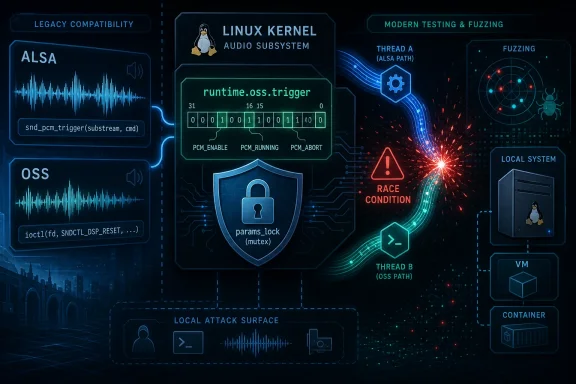
Linux kernel maintainers published CVE-2026-46157 on May 28, 2026, after fixing a race in the ALSA PCM OSS compatibility layer where concurrent access to
CVE-2026-46157 sits in ALSA, the Advanced Linux Sound Architecture, specifically in the PCM OSS compatibility path. ALSA has long been the kernel’s mainstream audio subsystem, while OSS, the Open Sound System interface, is the older Unix audio model that many Linux systems keep around for compatibility with legacy applications and old device expectations.
The vulnerable field,
That sounds abstract until you remember what a bit field is. Writing one bit field is not always a neat, isolated update to one logical value; depending on layout and compiler behavior, a write can touch storage that contains neighboring bit fields. In a kernel subsystem, that is a recipe for state confusion: one thread thinks it is changing an audio trigger flag, while another path may observe or clobber nearby state.
The fix is not a sweeping redesign. Kernel maintainers wrapped accesses to
The timing also matters. The CVE was published by NVD on May 28, 2026, but the underlying patch appeared earlier in the kernel development flow. That is increasingly normal for Linux kernel CVEs: a fix lands in public trees, stable backports follow, and then the vulnerability record catches up with a terse description that looks almost identical to the commit message.
That is why this CVE should not be dismissed as “just audio.” Audio device interfaces are local, but local attack surface is still attack surface. Modern privilege escalation chains often start with an unprivileged process hammering a kernel interface that was never designed with today’s concurrency testing intensity in mind.
The description says the problem was spotted by fuzzing. That detail is more important than the bland phrasing suggests. Fuzzers are very good at finding races in unloved code because they do not care whether a subsystem is fashionable, documented, or pleasant to use. They care only that a kernel interface accepts inputs and can be driven into odd timing windows.
For administrators, this is the part that should feel familiar from Windows driver land. Old compatibility paths, vendor drivers, codec stacks, print subsystems, media parsers, and device shims often outlive the applications that made them necessary. They become quiet liabilities because they receive less human attention while automated testing becomes more aggressive.
The kernel community’s response here is also familiar: identify the missing lock, apply the smallest safe synchronization fix, and propagate it through stable branches. That is good engineering. But it also underlines how much of operating system security is not about spectacular design flaws; it is about closing thousands of tiny gaps where “probably safe” concurrent access turns out not to be safe at all.
NVD enrichment is a classification process, not the moment a bug becomes real. The kernel.org source record already described the vulnerability and linked to stable commits. The absence of a score simply means the centralized database had not yet attached vector strings and severity metadata.
This matters because many patch workflows still over-index on CVSS. If a vulnerability lacks a score, it may fall below operational thresholds or fail to trigger automation. That is understandable for overloaded teams, but it is also a blind spot for Linux kernel CVEs, where upstream fixes can precede the full scoring and downstream advisory machinery.
The practical risk profile is likely local rather than remote. An attacker would generally need a way to reach the affected ALSA OSS PCM path, and exploitation would depend on kernel configuration, device permissions, timing, and whether the relevant compatibility interface is available. But “local” does not mean harmless on multi-user systems, shared Linux workstations, CI hosts, lab machines, thin clients, and embedded devices.
There is also a difference between demonstrated exploitability and bug class concern. A data race in a bit field can be hard to turn into reliable privilege escalation, but it can still cause denial of service, undefined behavior, or state corruption. Kernel maintainers do not need a polished exploit to justify fixing a race that fuzzing has shown can confuse runtime operation.
That does not mean every Windows 11 machine is directly exposed to CVE-2026-46157. WSL 2 uses a Microsoft-provided Linux kernel, and its device exposure model is not the same as a conventional bare-metal Linux desktop. A kernel audio vulnerability in upstream ALSA does not automatically translate into a practical WSL attack path.
But mixed environments are where “not my platform” thinking becomes dangerous. A Windows admin may own the endpoint management stack while Linux kernels live inside developer workstations, build hosts, container nodes, virtualization clusters, or specialized appliances. The patching responsibility may be split across teams, but the attacker does not care which org chart box owns the kernel.
The more relevant Windows-world comparison is driver attack surface. Windows admins understand that a local kernel driver bug can matter even when the affected hardware is mundane. Audio, GPU, printer, Bluetooth, storage, and network drivers all process local input from user-mode code. The Linux kernel’s in-tree subsystem model changes the packaging, not the underlying risk.
For shops running Linux desktops alongside Windows, the question is simple: are kernels being updated as consistently as browsers and endpoint agents? If not, this CVE is another reminder that workstation hardening is not complete when the Windows estate is tidy but the adjacent Linux fleet is allowed to drift.
That is the kind of patch maintainers like because it narrows the bug without inventing new architecture. It also tells us something about the nature of the flaw. The problem was not that ALSA lacked a locking model; it was that one field had escaped the coverage it needed.
The affected functions are telling.
By bringing the trigger bit field under
There is also a quiet compiler point here. The Linux kernel has spent years becoming more explicit about data races, memory ordering, and lockless access. In C, unsynchronized concurrent access is not just a philosophical cleanliness issue; it can interact with compiler assumptions and hardware ordering in ways that surprise even experienced programmers. A mutex is sometimes the least clever and most correct answer.
CVE-2026-46157 is a good example. It is precise enough for kernel developers, but sparse for administrators. It names the subsystem, the field, the race, the bit-field hazard, the functions, and the lock. It does not tell a security team whether their distribution is affected, whether their kernel config includes the relevant code, whether exploitation is plausible, or whether a compensating control exists.
That gap is where vulnerability management gets hard. A CVE record is not a risk assessment. It is a structured pointer to a flaw. Administrators still need to map upstream fixes to distribution kernels, vendor advisories, appliance firmware, live patch streams, and reboot windows.
For Linux kernel issues, that mapping is especially messy because distributions backport patches. A system can be running a kernel version number that appears old while still containing the fix. Conversely, a custom kernel can carry a newer base version while missing a stable backport. Version-string auditing is often not enough.
This is where Windows admins may envy and distrust Linux at the same time. Linux patch visibility is excellent if you live in git, mailing lists, and distro changelogs. It is much less friendly if your tool expects every risk to arrive as a clean severity score with a vendor-branded bulletin and a single patch identifier.
That conservatism is one of Linux’s strengths. It is also one of security’s recurring costs. Every compatibility path must be maintained not only for correctness under normal use but also for hostile use, weird timing, fuzzed inputs, and interactions with modern locking expectations.
The audio subsystem is an especially interesting case because it spans low-latency operations, asynchronous state changes, file descriptors, polling, memory buffers, DMA concepts, and user-space frameworks. Even when a particular compatibility shim is obscure, it sits on top of machinery that must coordinate with the rest of the kernel.
The phrase “as spotted by fuzzing” should be read as a warning label for old interfaces. Fuzzing does not respect the social distinction between “main path” and “compatibility path.” If an interface can be opened, configured, polled, and raced, it can be tested at machine speed until assumptions collapse.
For endpoint defenders, the lesson is to reduce unnecessary exposure. If OSS compatibility modules or legacy device nodes are not needed, there is a reasonable hardening argument for disabling or restricting them where operationally feasible. That is not a substitute for patching, but it can reduce the number of reachable kernel surfaces available to untrusted local code.
Enterprise Linux distributions will typically fold this kind of fix into kernel update channels after their own validation. Rolling distributions may pick it up quickly through stable kernel updates. Embedded vendors and appliance makers may lag because kernel updates are tied to firmware releases, certification, or vendor maintenance windows.
This creates the familiar patching asymmetry. The systems most likely to be casually updated—developer laptops, enthusiast desktops, rolling-release boxes—may receive the fix quickly. The systems most likely to be forgotten—appliances, lab machines, media boxes, industrial panels, and “temporary” Linux hosts that became permanent—may carry the bug longer.
For administrators, the useful task is not to memorize the commit hashes. It is to check whether your vendor has shipped a kernel update containing the ALSA OSS race fix and whether that update has actually been deployed. If you build kernels internally, the task is to verify that the relevant stable patch is present in your tree.
There is a second operational wrinkle: kernel fixes usually require a reboot unless live patching is available and covers the specific change. Security teams can mark the package as installed and still leave the vulnerable kernel running. That problem is not unique to Linux, but kernel CVEs make it painfully visible.
Still, the bug class is familiar enough to take seriously. Kernel data races can produce denial-of-service conditions, unpredictable behavior, memory corruption, or control-flow opportunities depending on what state is corrupted and how reliably an attacker can steer timing. Bit-field races add a specific ugliness because adjacent logical fields may share underlying storage.
The ALSA OSS path likely requires local interaction with audio device interfaces. That narrows the threat model. But local kernel bugs are exactly what sandbox escapes, multi-user system attacks, and post-compromise privilege escalation chains tend to consume.
The phrase “confuses the operation completely” in the underlying description is not a formal exploit claim. It is a maintainer’s warning that the resulting state can become nonsensical. In kernel security, nonsensical state is often where deeper analysis begins, even if most such bugs never become practical exploits.
A sober reading is therefore best: CVE-2026-46157 is not a panic event, but it is a real kernel correctness bug in a reachable compatibility layer. Patch it through normal kernel update channels, prioritize exposed multi-user or developer systems, and do not wait for NVD scoring if your distribution already ships the fix.
Operating systems collect these taxes everywhere. Windows carries Win32 behaviors that cannot simply disappear. Linux carries decades of user-space ABI expectations. macOS carries frameworks and translation layers. The promise that old software keeps working is one of the reasons platforms survive, but it means old edges remain testable by new tools.
There is an uncomfortable truth here for anyone who likes clean architecture diagrams: security work often happens in the sediment. The newest components get marketing names and threat models. The older layers get bug fixes, backports, and terse commit messages. Attackers and fuzzers do not share the industry’s preference for the new.
This also explains why small CVEs now arrive in such volume. The kernel is not suddenly fragile because a race in an OSS audio bit field got a CVE. Rather, the reporting and assignment pipeline has become more explicit about bugs that previously might have appeared only as stable patches. That visibility is useful, but it requires readers to distinguish between “patch promptly” and “drop everything.”
For WindowsForum’s mixed audience, the right mental model is Patch Tuesday without the single Tuesday. Linux kernel fixes arrive continuously, distribution packaging adds another layer, and vulnerability databases may trail the code. The discipline is the same: know your exposure, know your update source, and know whether the fixed kernel is actually running.
runtime.oss.trigger could corrupt adjacent bit fields and destabilize audio handling. The bug is not a glamorous remote-code-execution headline, and the National Vulnerability Database had not assigned a CVSS score at publication time. But it is exactly the kind of low-level kernel flaw that matters because it lives at the boundary between legacy compatibility, local device access, fuzzing, and kernel memory semantics. For WindowsForum readers, the lesson is not “Linux audio is broken”; it is that old compatibility surfaces keep producing modern security work long after most users forget they exist.
 A Small Audio Race Exposes a Big Maintenance Problem
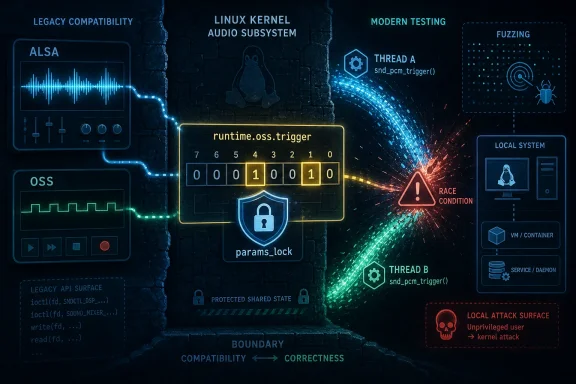
CVE-2026-46157 sits in ALSA, the Advanced Linux Sound Architecture, specifically in the PCM OSS compatibility path. ALSA has long been the kernel’s mainstream audio subsystem, while OSS, the Open Sound System interface, is the older Unix audio model that many Linux systems keep around for compatibility with legacy applications and old device expectations.The vulnerable field,
runtime.oss.trigger, is not a user-facing feature anyone is likely to brag about in a changelog. It is a bit field used inside the runtime state for OSS-style PCM behavior. The issue, as described by the kernel CVE entry, is that this field could be accessed concurrently without the locking needed to serialize reads and writes.That sounds abstract until you remember what a bit field is. Writing one bit field is not always a neat, isolated update to one logical value; depending on layout and compiler behavior, a write can touch storage that contains neighboring bit fields. In a kernel subsystem, that is a recipe for state confusion: one thread thinks it is changing an audio trigger flag, while another path may observe or clobber nearby state.
The fix is not a sweeping redesign. Kernel maintainers wrapped accesses to
runtime.oss.trigger with the existing params_lock mutex in snd_pcm_oss_get_trigger() and snd_pcm_oss_poll(). In security terms, this is a classic small patch with a larger message: if a field participates in shared runtime state, it belongs under the same synchronization discipline as the rest of that state.The timing also matters. The CVE was published by NVD on May 28, 2026, but the underlying patch appeared earlier in the kernel development flow. That is increasingly normal for Linux kernel CVEs: a fix lands in public trees, stable backports follow, and then the vulnerability record catches up with a terse description that looks almost identical to the commit message.
The Bug Lives Where Legacy Interfaces Meet Modern Fuzzers
The OSS compatibility layer is not where most desktop Linux users spend their time in 2026. PipeWire, PulseAudio, JACK, and ALSA’s native APIs dominate the everyday audio stack, while/dev/dsp-style OSS expectations belong to an older era. Yet compatibility code remains part of the kernel’s attack surface when it is built, loaded, reachable, or exposed inside a container, appliance, kiosk, workstation, or test environment.That is why this CVE should not be dismissed as “just audio.” Audio device interfaces are local, but local attack surface is still attack surface. Modern privilege escalation chains often start with an unprivileged process hammering a kernel interface that was never designed with today’s concurrency testing intensity in mind.
The description says the problem was spotted by fuzzing. That detail is more important than the bland phrasing suggests. Fuzzers are very good at finding races in unloved code because they do not care whether a subsystem is fashionable, documented, or pleasant to use. They care only that a kernel interface accepts inputs and can be driven into odd timing windows.
For administrators, this is the part that should feel familiar from Windows driver land. Old compatibility paths, vendor drivers, codec stacks, print subsystems, media parsers, and device shims often outlive the applications that made them necessary. They become quiet liabilities because they receive less human attention while automated testing becomes more aggressive.
The kernel community’s response here is also familiar: identify the missing lock, apply the smallest safe synchronization fix, and propagate it through stable branches. That is good engineering. But it also underlines how much of operating system security is not about spectacular design flaws; it is about closing thousands of tiny gaps where “probably safe” concurrent access turns out not to be safe at all.
No CVSS Score Does Not Mean No Risk
At the time of the NVD entry’s initial publication, CVE-2026-46157 was still marked as awaiting enrichment, with no NVD-provided CVSS 4.0, CVSS 3.x, or CVSS 2.0 score. That can make the vulnerability look less urgent in dashboards that sort by severity. It should not make administrators conclude the bug is irrelevant.NVD enrichment is a classification process, not the moment a bug becomes real. The kernel.org source record already described the vulnerability and linked to stable commits. The absence of a score simply means the centralized database had not yet attached vector strings and severity metadata.
This matters because many patch workflows still over-index on CVSS. If a vulnerability lacks a score, it may fall below operational thresholds or fail to trigger automation. That is understandable for overloaded teams, but it is also a blind spot for Linux kernel CVEs, where upstream fixes can precede the full scoring and downstream advisory machinery.
The practical risk profile is likely local rather than remote. An attacker would generally need a way to reach the affected ALSA OSS PCM path, and exploitation would depend on kernel configuration, device permissions, timing, and whether the relevant compatibility interface is available. But “local” does not mean harmless on multi-user systems, shared Linux workstations, CI hosts, lab machines, thin clients, and embedded devices.
There is also a difference between demonstrated exploitability and bug class concern. A data race in a bit field can be hard to turn into reliable privilege escalation, but it can still cause denial of service, undefined behavior, or state corruption. Kernel maintainers do not need a polished exploit to justify fixing a race that fuzzing has shown can confuse runtime operation.
The Windows Angle Is WSL, Virtualization, and Mixed Estates
WindowsForum readers may reasonably ask why a Linux ALSA OSS CVE belongs in their feed. The answer is that modern Windows estates are rarely Windows-only. Developers run Linux under WSL, enterprises run Linux guests on Hyper-V, security teams maintain Linux appliances, and home labs increasingly mix Windows desktops with Linux servers, NAS boxes, containers, and media systems.That does not mean every Windows 11 machine is directly exposed to CVE-2026-46157. WSL 2 uses a Microsoft-provided Linux kernel, and its device exposure model is not the same as a conventional bare-metal Linux desktop. A kernel audio vulnerability in upstream ALSA does not automatically translate into a practical WSL attack path.
But mixed environments are where “not my platform” thinking becomes dangerous. A Windows admin may own the endpoint management stack while Linux kernels live inside developer workstations, build hosts, container nodes, virtualization clusters, or specialized appliances. The patching responsibility may be split across teams, but the attacker does not care which org chart box owns the kernel.
The more relevant Windows-world comparison is driver attack surface. Windows admins understand that a local kernel driver bug can matter even when the affected hardware is mundane. Audio, GPU, printer, Bluetooth, storage, and network drivers all process local input from user-mode code. The Linux kernel’s in-tree subsystem model changes the packaging, not the underlying risk.
For shops running Linux desktops alongside Windows, the question is simple: are kernels being updated as consistently as browsers and endpoint agents? If not, this CVE is another reminder that workstation hardening is not complete when the Windows estate is tidy but the adjacent Linux fleet is allowed to drift.
The Patch Is Boring in the Best Possible Way
The fix for CVE-2026-46157 is conceptually straightforward: use the existingparams_lock mutex to protect runtime.oss.trigger access in the relevant OSS PCM functions. No new subsystem, no feature flag, no risky security theater. Just put the shared field under the lock that already guards the surrounding parameter state.That is the kind of patch maintainers like because it narrows the bug without inventing new architecture. It also tells us something about the nature of the flaw. The problem was not that ALSA lacked a locking model; it was that one field had escaped the coverage it needed.
The affected functions are telling.
snd_pcm_oss_get_trigger() sounds like a read path, while snd_pcm_oss_poll() sits in the readiness-notification world where user space asks whether an audio stream can proceed. Poll paths are classic places for concurrency bugs because they are used to observe state while other threads, interrupts, or file operations are changing it.By bringing the trigger bit field under
params_lock, the patch makes the OSS PCM view of runtime state more coherent. That is not just about satisfying a race detector. It reduces the chance that one path observes a half-updated or accidentally overwritten state and makes a wrong decision about stream operation.There is also a quiet compiler point here. The Linux kernel has spent years becoming more explicit about data races, memory ordering, and lockless access. In C, unsynchronized concurrent access is not just a philosophical cleanliness issue; it can interact with compiler assumptions and hardware ordering in ways that surprise even experienced programmers. A mutex is sometimes the least clever and most correct answer.
The Kernel’s CVE Firehose Has Changed the Meaning of Vulnerability News
The Linux kernel project’s handling of CVEs has changed the rhythm of vulnerability reporting. Many kernel CVEs now read like commit messages because that is effectively what they are: a bug fix in the kernel tree receives a CVE record, often with a short description extracted from the patch rationale. The result is a stream of records that can look alarming in aggregate and under-explained in isolation.CVE-2026-46157 is a good example. It is precise enough for kernel developers, but sparse for administrators. It names the subsystem, the field, the race, the bit-field hazard, the functions, and the lock. It does not tell a security team whether their distribution is affected, whether their kernel config includes the relevant code, whether exploitation is plausible, or whether a compensating control exists.
That gap is where vulnerability management gets hard. A CVE record is not a risk assessment. It is a structured pointer to a flaw. Administrators still need to map upstream fixes to distribution kernels, vendor advisories, appliance firmware, live patch streams, and reboot windows.
For Linux kernel issues, that mapping is especially messy because distributions backport patches. A system can be running a kernel version number that appears old while still containing the fix. Conversely, a custom kernel can carry a newer base version while missing a stable backport. Version-string auditing is often not enough.
This is where Windows admins may envy and distrust Linux at the same time. Linux patch visibility is excellent if you live in git, mailing lists, and distro changelogs. It is much less friendly if your tool expects every risk to arrive as a clean severity score with a vendor-branded bulletin and a single patch identifier.
Legacy Audio Is Still Kernel Attack Surface
The ALSA OSS layer exists because compatibility has value. Old binaries, old games, old embedded applications, old device assumptions, and niche workflows may still expect OSS-like behavior. Removing that support would break someone, somewhere, and the kernel has historically been conservative about breaking user space.That conservatism is one of Linux’s strengths. It is also one of security’s recurring costs. Every compatibility path must be maintained not only for correctness under normal use but also for hostile use, weird timing, fuzzed inputs, and interactions with modern locking expectations.
The audio subsystem is an especially interesting case because it spans low-latency operations, asynchronous state changes, file descriptors, polling, memory buffers, DMA concepts, and user-space frameworks. Even when a particular compatibility shim is obscure, it sits on top of machinery that must coordinate with the rest of the kernel.
The phrase “as spotted by fuzzing” should be read as a warning label for old interfaces. Fuzzing does not respect the social distinction between “main path” and “compatibility path.” If an interface can be opened, configured, polled, and raced, it can be tested at machine speed until assumptions collapse.
For endpoint defenders, the lesson is to reduce unnecessary exposure. If OSS compatibility modules or legacy device nodes are not needed, there is a reasonable hardening argument for disabling or restricting them where operationally feasible. That is not a substitute for patching, but it can reduce the number of reachable kernel surfaces available to untrusted local code.
The Real Question Is Distribution Exposure
The upstream CVE tells us the flaw exists in the Linux kernel and has been resolved by stable commits. It does not, by itself, tell every user whether their installed system is vulnerable. That depends on kernel version, distribution backports, configuration, and whether ALSA OSS PCM support is present and reachable.Enterprise Linux distributions will typically fold this kind of fix into kernel update channels after their own validation. Rolling distributions may pick it up quickly through stable kernel updates. Embedded vendors and appliance makers may lag because kernel updates are tied to firmware releases, certification, or vendor maintenance windows.
This creates the familiar patching asymmetry. The systems most likely to be casually updated—developer laptops, enthusiast desktops, rolling-release boxes—may receive the fix quickly. The systems most likely to be forgotten—appliances, lab machines, media boxes, industrial panels, and “temporary” Linux hosts that became permanent—may carry the bug longer.
For administrators, the useful task is not to memorize the commit hashes. It is to check whether your vendor has shipped a kernel update containing the ALSA OSS race fix and whether that update has actually been deployed. If you build kernels internally, the task is to verify that the relevant stable patch is present in your tree.
There is a second operational wrinkle: kernel fixes usually require a reboot unless live patching is available and covers the specific change. Security teams can mark the package as installed and still leave the vulnerable kernel running. That problem is not unique to Linux, but kernel CVEs make it painfully visible.
Exploitability Is Unclear, but the Class Is Familiar
No public CVSS score was available from NVD at initial publication, and the CVE description does not present a weaponized exploit. That should keep the rhetoric restrained. There is no basis, from the public record alone, to claim that CVE-2026-46157 is being exploited in the wild or that it provides a reliable privilege escalation path.Still, the bug class is familiar enough to take seriously. Kernel data races can produce denial-of-service conditions, unpredictable behavior, memory corruption, or control-flow opportunities depending on what state is corrupted and how reliably an attacker can steer timing. Bit-field races add a specific ugliness because adjacent logical fields may share underlying storage.
The ALSA OSS path likely requires local interaction with audio device interfaces. That narrows the threat model. But local kernel bugs are exactly what sandbox escapes, multi-user system attacks, and post-compromise privilege escalation chains tend to consume.
The phrase “confuses the operation completely” in the underlying description is not a formal exploit claim. It is a maintainer’s warning that the resulting state can become nonsensical. In kernel security, nonsensical state is often where deeper analysis begins, even if most such bugs never become practical exploits.
A sober reading is therefore best: CVE-2026-46157 is not a panic event, but it is a real kernel correctness bug in a reachable compatibility layer. Patch it through normal kernel update channels, prioritize exposed multi-user or developer systems, and do not wait for NVD scoring if your distribution already ships the fix.
The Compatibility Tax Comes Due in Kernel Locks
The most interesting thing about CVE-2026-46157 is not the audio stack. It is the maintenance pattern. A legacy compatibility interface carried a concurrency assumption that fuzzing invalidated, and the repair was to align one field with an existing lock. That is the compatibility tax in miniature.Operating systems collect these taxes everywhere. Windows carries Win32 behaviors that cannot simply disappear. Linux carries decades of user-space ABI expectations. macOS carries frameworks and translation layers. The promise that old software keeps working is one of the reasons platforms survive, but it means old edges remain testable by new tools.
There is an uncomfortable truth here for anyone who likes clean architecture diagrams: security work often happens in the sediment. The newest components get marketing names and threat models. The older layers get bug fixes, backports, and terse commit messages. Attackers and fuzzers do not share the industry’s preference for the new.
This also explains why small CVEs now arrive in such volume. The kernel is not suddenly fragile because a race in an OSS audio bit field got a CVE. Rather, the reporting and assignment pipeline has become more explicit about bugs that previously might have appeared only as stable patches. That visibility is useful, but it requires readers to distinguish between “patch promptly” and “drop everything.”
For WindowsForum’s mixed audience, the right mental model is Patch Tuesday without the single Tuesday. Linux kernel fixes arrive continuously, distribution packaging adds another layer, and vulnerability databases may trail the code. The discipline is the same: know your exposure, know your update source, and know whether the fixed kernel is actually running.
The Practical Signal Hidden in a Tiny ALSA CVE
CVE-2026-46157 does not need melodrama to matter. Its value is that it gives administrators a concrete reminder of how kernel risk really accumulates: a compatibility path here, a missing lock there, a fuzzing report, a stable backport, and then a CVE record that arrives before the scoring machinery has finished its paperwork.- Systems running Linux kernels with ALSA OSS PCM compatibility should be updated when their distribution or vendor ships the fix for CVE-2026-46157.
- The absence of an NVD CVSS score at initial publication should not be treated as evidence that the vulnerability is harmless.
- The most plausible exposure is local access to the affected audio compatibility path, not remote network exploitation.
- Administrators should verify the running kernel, not merely the installed kernel package, because kernel updates often require a reboot.
- Environments that do not need OSS audio compatibility can consider disabling or restricting legacy audio interfaces as part of broader hardening.
- Windows-centric teams should include Linux guests, WSL-related kernels, appliances, and developer machines in vulnerability review rather than assuming this is someone else’s platform.
References
- Primary source: NVD / Linux Kernel
Published: 2026-05-29T01:06:14-07:00
NVD - CVE-2026-46157
 nvd.nist.gov
- Security advisory: MSRC
Published: 2026-05-29T01:06:14-07:00
Original feed URL
Security Update Guide - Microsoft Security Response Center
 msrc.microsoft.com
- Related coverage: spinics.net
[PATCH] ALSA: pcm: oss: Fix data race at accessing runtime.oss.trigger — Linux Kernel
Linux Kernel: [PATCH] ALSA: pcm: oss: Fix data race at accessing runtime.oss.trigger www.spinics.net
- Related coverage: cve.mitre.org
- Related coverage: cve.imfht.com
CVE-2026-43126: ALSA: mixer: oss: Add card disconnect checkpoints - Vulnerability Platform
[HIGH 7.8] Overview This vulnerability affects the Linux kernel ALSA OSS mixer layer. Because the OSS mixer layer invokes operations separately, pending calls ma cve.imfht.com
- Related coverage: osv.dev

OSV - Open Source Vulnerabilities
Comprehensive vulnerability database for your open source projects and dependencies.
osv.dev
- Related coverage: windowsforum.com
CVE-2026-43126 ALSA OSS Linux Kernel Bug: Patch the Disconnect UAF Risk | Windows Forum
CVE-2026-43126 is a Linux kernel vulnerability published on May 6, 2026, in the ALSA OSS mixer compatibility layer, where missing disconnect checks could...windowsforum.com - Related coverage: patchew.org