

The Linux kernel vulnerability now tracked as CVE-2026-46088 was published by NVD on May 27, 2026, after kernel.org assigned a flaw in ALSA’s control code involving
CVE-2026-46088 sits in the Advanced Linux Sound Architecture, better known as ALSA, which is the kernel-side audio subsystem most Linux users never think about until audio breaks. The affected function initializes names for enumerated mixer/control elements, walking a supplied names buffer while decrementing a remaining-length counter. The flaw appears when the buffer length has already been exhausted but the loop still has more items to process: the next iteration can call
In ordinary C-library intuition, that sounds boring.
That is the whole story in miniature: the code was already headed toward an error, but the hardening layer got there first and got there violently. The fix is equally small. Add a guard at the top of the loop so that an exhausted buffer is handled as an error before
The tempting reaction to CVE-2026-46088 is to dismiss it as yet another niche kernel CVE with no NVD score at publication time. That would miss the broader lesson. The vulnerability is a tidy example of how the Linux kernel’s security surface is now shaped as much by compiler behavior, sanitizers, fuzzers, and hardening options as by traditional attacker-controlled memory corruption.
The underlying bug is not exotic. A loop advances a pointer and shrinks a counter. The counter can reach zero before the loop is finished. The next operation assumes the pointer-and-length pair is still meaningful. This is precisely the kind of edge case that defensive C code has been tripping over for decades.
What makes this case modern is the failure mode. Without fortification, the function may simply reject the malformed input. With fortification, the kernel may panic because the compiler-generated safety checks evaluate assumptions about object size before the function’s logical error handling runs. In other words, the code’s intended failure path was present, but it was placed one step too late.
That ordering matters. Kernel hardening is often described as a net that catches memory mistakes before they become exploitable. CVE-2026-46088 shows the other side of that bargain: if hardened helpers are called with exhausted or inconsistent bounds, the system may fail closed in a way that is operationally disruptive. A panic is safer than silent memory corruption, but it is still a denial of service.
This is why “just a panic” is not a serious risk classification by itself. A kernel panic on a developer laptop is a nuisance. A kernel panic on an embedded audio device, a kiosk, a fleet-managed Linux workstation, a lab automation box, or a phone-derived platform can mean service interruption, data loss, or a remote-hands visit. The practical severity depends less on the CVE’s prose than on who can reach the vulnerable code path and under what privileges.
The vulnerable function is in ALSA control handling, not in a flashy codec parser or a network-facing daemon. That matters because control elements are how user space asks the kernel about knobs exposed by sound cards and drivers. Enumerated names are the human-readable choices attached to those controls: input source names, mode names, route names, and similar strings.
The CVE description says the function walks through a names buffer while decrementing
The patch changes that assumption. Before measuring a name, the function now checks whether there is any buffer left to measure. If not, it returns the same class of invalid-argument failure the later empty-name path would have produced. This is not a redesign of ALSA. It is a repair of a boundary condition.
Small fixes like this are easy to underestimate because they lack cinematic exploit narratives. But the kernel is full of state machines that are only safe if every transition is ordered correctly. In CVE-2026-46088, “check before measuring” is the difference between returning an error and breaking the machine.
Kernel developers are no longer writing against a single mental model of C execution. They are writing against the C language, the kernel’s abstractions, the compiler’s optimizer, architecture-specific trap behavior, sanitizers used in test builds, and fortification behavior used in production or near-production configurations. The code may be logically wrong in one environment, harmless in another, and panic-inducing in a third.
That conservatism is a feature. If the kernel cannot prove the access is safe, it may trap rather than continue. But a feature that turns undefined or suspicious memory handling into an immediate crash also raises the operational cost of sloppy boundary checking. The code must not merely be correct in the abstract; it must be written so that hardened primitives never see impossible or exhausted bounds.
This is part of a wider trend across both Linux and Windows ecosystems. Microsoft has spent years pushing compiler-assisted security, control-flow enforcement, memory-safe components, and hardened runtime checks. The Linux community has followed its own path through KASAN, UBSAN, FORTIFY, hardened allocators, and fuzz-driven discovery. Across platforms, the message is the same: increasingly, security bugs are found not because a human spotted a bad line but because instrumentation forced the system to confess.
A human reviewer might look at the ALSA control code and see that
That is how the exhausted-buffer case appears. The function is not necessarily dealing with a classic overflowing string. It is dealing with the mismatch between “there are still items to initialize” and “there are no bytes left from which a valid name can be read.” The bug is in the gap between the metadata and the payload.
Fuzzing is especially effective against subsystems like ALSA because they contain old interfaces, driver-specific assumptions, and lots of structured-but-not-obvious input. Audio controls are not usually the first place security teams look for catastrophic risk, which is exactly why automated testing keeps finding meaningful defects there. Boring code often has the longest memory.
For enterprise defenders, the lesson is not that Xiaomi found a bug in Linux audio. The lesson is that the kernel is now being stress-tested by parties whose device fleets and threat models differ from the traditional server distribution world. Smartphone vendors, embedded vendors, cloud providers, and security researchers all push different corners of the same shared codebase. The fixes then flow back into stable kernels that everyone else consumes.
This is where patch management culture often goes wrong. Too many organizations use CVSS as a substitute for engineering judgment. If a score is missing, the item gets parked. If a score is medium, the item gets batched. If a score is high, it gets attention. That workflow is understandable at scale, but kernel CVEs often require more nuance.
For CVE-2026-46088, the currently public impact is a kernel panic triggered by a fortified
The real triage question is therefore not “what number did NVD assign?” It is “does our kernel include the vulnerable code, is ALSA enabled, can untrusted users or devices reach this path, and do our builds use the relevant fortification behavior?” Those answers vary by distribution, kernel branch, configuration, and deployment role.
That variability is why Linux vulnerability management remains harder than the spreadsheet view suggests. A CVE identifier gives everyone a common label. It does not tell you whether your Ubuntu desktop, Debian server, Android-derived appliance, Fedora workstation, Proxmox host, or custom Yocto image is exposed in the same way.
That distinction matters. If you run mainline kernels, the upstream commit trail tells you exactly where to look. If you run a distribution kernel, the version string may not obviously map to the upstream fixed commit because vendors backport patches while keeping older version numbers. Red Hat, Debian, Ubuntu, SUSE, Fedora, Arch, Android vendors, and embedded suppliers all have their own release and advisory pipelines.
For WindowsForum’s audience, this is analogous to the difference between a Microsoft source fix and the cumulative update that actually lands on endpoints. The CVE is the label. The advisory is the explanation. The patch package is what changes the machine. In Linux, that patch package is often a kernel build with hundreds of unrelated changes bundled alongside the security fix.
The safest operational posture is simple but not always easy: track the vendor kernel, not just upstream headlines. If your distribution ships a kernel update that mentions ALSA, sound core, FORTIFY, or CVE-2026-46088, test and deploy it through the normal kernel-update process. If you maintain a custom kernel, pull the relevant stable fix for your branch rather than assuming the bug is too small to matter.
Custom kernels are where this kind of CVE becomes quietly dangerous. Teams trim drivers, disable features, carry local patches, and pin versions for certification. They may also enable hardening options precisely because they care about security. That can create the ironic combination this CVE illustrates: a hardened build that is more likely to panic on a latent bug than a softer build that returns an error.
Developers run Linux under Windows Subsystem for Linux. Enterprises run Linux virtual machines on Hyper-V and Azure. Security teams manage Linux-based appliances. Desktop fleets include dual-boot machines, lab systems, thin clients, and embedded controllers. Android devices, many of them Linux-kernel-derived, sit on corporate networks and sometimes run vendor-customized kernels that lag upstream.
WSL deserves a careful distinction. WSL 2 uses a Microsoft-maintained Linux kernel in a virtualized environment, and it is not a general-purpose physical audio stack in the same sense as a desktop Linux distribution driving hardware through ALSA. That does not automatically make every ALSA CVE relevant to WSL users. It does mean administrators should treat WSL kernel servicing as part of endpoint hygiene rather than assuming Linux vulnerabilities stop at the Windows boundary.
The bigger exposure is often outside the laptop. Think conference-room hardware, point-of-sale terminals, industrial panels, medical devices, media endpoints, classroom labs, and Android-based enterprise devices. ALSA may be present because audio is part of the product, even if the device’s business purpose is not “sound.” If the vendor’s kernel includes the vulnerable code and exposes a reachable control path, the CVE becomes a supply-chain patching question.
This is where Windows-centric IT teams can get blindsided. They may have mature processes for Patch Tuesday but weaker visibility into Linux kernels embedded in “non-computer” assets. CVE-2026-46088 is probably not the scariest item in that backlog, but it is a useful reminder that Linux kernel maintenance is now a mainstream endpoint-management problem.
A kernel panic is not an application crash. It is the operating system saying it cannot safely continue. On a workstation, the user loses work and reboots. On a server, workloads fail over if you are lucky and go dark if you are not. On an embedded device, the watchdog may recover the system, or it may strand the device in a reboot loop if the triggering condition persists.
The public description does not establish a remote trigger. It also does not prove exploitation by an unprivileged local user across all deployments. That uncertainty should temper the rhetoric. But it should not erase the impact. If malformed control data can be supplied by a local process, test harness, compromised component, or hostile peripheral path in a given configuration, a panic becomes a practical attack against availability.
Availability is security. That is not a slogan; it is how hospitals, factories, retail floors, classrooms, and operations centers experience computing. A system that preserves memory safety by crashing may be making the correct security decision, but the business still sees downtime.
For security teams, the useful classification is not “panic equals low priority.” It is “panic plus reachable trigger equals availability risk.” CVE-2026-46088 should be evaluated through that lens.
The function already knew empty names were invalid. What it did not enforce soon enough was that the buffer still contained at least one byte from which a name could be read. Once
This is defensive programming at its most practical. Do not ask a hardened primitive to sort out a state your own code can reject first. Do not rely on a later semantic check to protect an earlier memory-safety assumption. Do not assume that a call with a zero maximum length is harmless just because its mathematical return value is defined.
Those rules sound elementary, but kernel code is full of places where historical assumptions meet new compiler instrumentation. A helper that was once a benign wrapper can become a trap point. A compiler that once emitted straightforward code can now fold in object-size analysis. A test configuration that once found bugs slowly can now fuzz its way into edge cases at scale.
CVE-2026-46088 is therefore less a story about a spectacular bug than about maintenance gravity. As hardening improves, the kernel’s tolerance for ambiguous boundary states shrinks. Code that used to muddle through malformed inputs is increasingly required to prove its invariants before touching shared helpers.
For administrators and technically inclined users, the concrete actions are straightforward:
The right lesson is not that ALSA is uniquely fragile or that compiler hardening is dangerous. The right lesson is that modern kernel security is an ecosystem of code, compilers, configurations, fuzzers, vendors, and backport pipelines. A defect can live in the space between them. In this case, a missing guard before
That collision should interest Windows administrators precisely because it is not exotic. Mixed estates now depend on Linux kernels in places that do not look like Linux servers, and the operational boundary between “Windows environment” and “Linux vulnerability” is thinner than procurement diagrams suggest. CVE-2026-46088 is unlikely to be the vulnerability that defines 2026, but it is a clean reminder of the work ahead: inventory the kernels you actually run, follow the vendors who patch them, and treat small boundary checks as the difference between graceful failure and a machine that stops cold.
snd_ctl_elem_init_enum_names() and a missing buffer-length guard before a fortified strnlen() call. The bug is not, on current public evidence, a headline-grabbing remote compromise. It is more interesting than that: a small defensive-programming omission that turns into a kernel panic because modern hardening machinery is doing exactly what it was designed to do. For WindowsForum readers who live mostly in Microsoft land but increasingly administer WSL, Linux servers, appliances, Android-derived devices, and mixed endpoint fleets, this is the kind of vulnerability that rewards careful reading rather than reflexive panic.CVE-2026-46088 sits in the Advanced Linux Sound Architecture, better known as ALSA, which is the kernel-side audio subsystem most Linux users never think about until audio breaks. The affected function initializes names for enumerated mixer/control elements, walking a supplied names buffer while decrementing a remaining-length counter. The flaw appears when the buffer length has already been exhausted but the loop still has more items to process: the next iteration can call
strnlen() with a maximum length of zero.In ordinary C-library intuition, that sounds boring.
strnlen(p, 0) returns zero, the existing error path notices an empty name, and the function fails. But kernel builds with CONFIG_FORTIFY_SOURCE do not treat this as an ordinary library call. The fortified implementation checks object bounds before the caller gets to inspect the return value, and when Clang cannot prove the size of the pointer being advanced inside the loop, the safety check can trigger a BRK exception and panic the kernel.That is the whole story in miniature: the code was already headed toward an error, but the hardening layer got there first and got there violently. The fix is equally small. Add a guard at the top of the loop so that an exhausted buffer is handled as an error before
strnlen() is invoked at all.
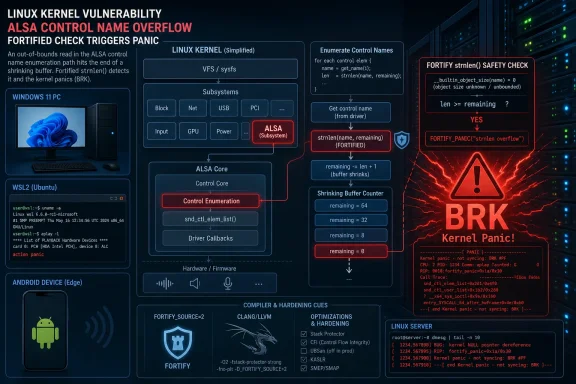 A One-Line Guard Exposes a Much Larger Kernel Reality
The tempting reaction to CVE-2026-46088 is to dismiss it as yet another niche kernel CVE with no NVD score at publication time. That would miss the broader lesson. The vulnerability is a tidy example of how the Linux kernel’s security surface is now shaped as much by compiler behavior, sanitizers, fuzzers, and hardening options as by traditional attacker-controlled memory corruption.The underlying bug is not exotic. A loop advances a pointer and shrinks a counter. The counter can reach zero before the loop is finished. The next operation assumes the pointer-and-length pair is still meaningful. This is precisely the kind of edge case that defensive C code has been tripping over for decades.
What makes this case modern is the failure mode. Without fortification, the function may simply reject the malformed input. With fortification, the kernel may panic because the compiler-generated safety checks evaluate assumptions about object size before the function’s logical error handling runs. In other words, the code’s intended failure path was present, but it was placed one step too late.
That ordering matters. Kernel hardening is often described as a net that catches memory mistakes before they become exploitable. CVE-2026-46088 shows the other side of that bargain: if hardened helpers are called with exhausted or inconsistent bounds, the system may fail closed in a way that is operationally disruptive. A panic is safer than silent memory corruption, but it is still a denial of service.
This is why “just a panic” is not a serious risk classification by itself. A kernel panic on a developer laptop is a nuisance. A kernel panic on an embedded audio device, a kiosk, a fleet-managed Linux workstation, a lab automation box, or a phone-derived platform can mean service interruption, data loss, or a remote-hands visit. The practical severity depends less on the CVE’s prose than on who can reach the vulnerable code path and under what privileges.
ALSA Is Infrastructure, Not Just “Sound”
ALSA has an unfortunate branding problem in security discussions. “Audio bug” sounds peripheral, almost consumer-grade, as if the worst outcome is a broken volume slider. In the Linux kernel, audio is not merely a desktop feature. It is a web of device drivers, control interfaces, mixer abstractions, compatibility paths, and user-space APIs that can exist on servers, appliances, mobile devices, and specialized hardware even when no one is playing music.The vulnerable function is in ALSA control handling, not in a flashy codec parser or a network-facing daemon. That matters because control elements are how user space asks the kernel about knobs exposed by sound cards and drivers. Enumerated names are the human-readable choices attached to those controls: input source names, mode names, route names, and similar strings.
The CVE description says the function walks through a names buffer while decrementing
buf_len. If the number of expected items outlives the available buffer, the loop can ask for the length of a string at a point where no buffer remains. The existing empty-name check is conceptually correct, but it assumes calling strnlen() is safe even when the maximum length is zero.The patch changes that assumption. Before measuring a name, the function now checks whether there is any buffer left to measure. If not, it returns the same class of invalid-argument failure the later empty-name path would have produced. This is not a redesign of ALSA. It is a repair of a boundary condition.
Small fixes like this are easy to underestimate because they lack cinematic exploit narratives. But the kernel is full of state machines that are only safe if every transition is ordered correctly. In CVE-2026-46088, “check before measuring” is the difference between returning an error and breaking the machine.
The Compiler Is Now Part of the Threat Model
The most revealing phrase in the public description is not “ALSA” or “kernel fuzz testing.” It is the line about Clang losing track of the pointer’s object size inside the loop. That sentence says more about contemporary systems security than any CVSS vector eventually will.Kernel developers are no longer writing against a single mental model of C execution. They are writing against the C language, the kernel’s abstractions, the compiler’s optimizer, architecture-specific trap behavior, sanitizers used in test builds, and fortification behavior used in production or near-production configurations. The code may be logically wrong in one environment, harmless in another, and panic-inducing in a third.
CONFIG_FORTIFY_SOURCE exists to make common unsafe string and memory operations less dangerous. It uses compile-time and run-time information about object sizes to detect invalid accesses. When the compiler can reason about the object, the check can be precise. When it cannot, especially after pointer arithmetic through a loop, the check may become conservative.That conservatism is a feature. If the kernel cannot prove the access is safe, it may trap rather than continue. But a feature that turns undefined or suspicious memory handling into an immediate crash also raises the operational cost of sloppy boundary checking. The code must not merely be correct in the abstract; it must be written so that hardened primitives never see impossible or exhausted bounds.
This is part of a wider trend across both Linux and Windows ecosystems. Microsoft has spent years pushing compiler-assisted security, control-flow enforcement, memory-safe components, and hardened runtime checks. The Linux community has followed its own path through KASAN, UBSAN, FORTIFY, hardened allocators, and fuzz-driven discovery. Across platforms, the message is the same: increasingly, security bugs are found not because a human spotted a bad line but because instrumentation forced the system to confess.
Fuzzing Found the Kind of Bug Humans Miss
The CVE description credits kernel fuzz testing through Xiaomi Smartphone. That detail is easy to skim past, but it is central to understanding why this bug surfaced. Fuzzers are very good at producing inputs that are legal enough to reach deep code but malformed enough to upset assumptions nobody wrote down.A human reviewer might look at the ALSA control code and see that
strnlen() is bounded by buf_len, then see that name_len == 0 produces an error, and move on. A fuzzer does not reason that way. It keeps mutating counts, buffers, strings, and item totals until the function arrives at a state that looks absurd to a person but perfectly reachable to the machine.That is how the exhausted-buffer case appears. The function is not necessarily dealing with a classic overflowing string. It is dealing with the mismatch between “there are still items to initialize” and “there are no bytes left from which a valid name can be read.” The bug is in the gap between the metadata and the payload.
Fuzzing is especially effective against subsystems like ALSA because they contain old interfaces, driver-specific assumptions, and lots of structured-but-not-obvious input. Audio controls are not usually the first place security teams look for catastrophic risk, which is exactly why automated testing keeps finding meaningful defects there. Boring code often has the longest memory.
For enterprise defenders, the lesson is not that Xiaomi found a bug in Linux audio. The lesson is that the kernel is now being stress-tested by parties whose device fleets and threat models differ from the traditional server distribution world. Smartphone vendors, embedded vendors, cloud providers, and security researchers all push different corners of the same shared codebase. The fixes then flow back into stable kernels that everyone else consumes.
NVD’s “Awaiting Enrichment” Label Should Not Become an Excuse
At the time this record appeared, NVD had not yet supplied CVSS 4.0, CVSS 3.x, or CVSS 2.0 scoring. The record was marked as awaiting enrichment. That creates an awkward window for administrators: the CVE exists, the fix exists, but the familiar severity label has not caught up.This is where patch management culture often goes wrong. Too many organizations use CVSS as a substitute for engineering judgment. If a score is missing, the item gets parked. If a score is medium, the item gets batched. If a score is high, it gets attention. That workflow is understandable at scale, but kernel CVEs often require more nuance.
For CVE-2026-46088, the currently public impact is a kernel panic triggered by a fortified
strnlen() path in ALSA control initialization. That suggests denial-of-service impact rather than direct privilege escalation, at least based on the record’s wording and the patch rationale. But a local denial of service can still matter, particularly on shared systems, production appliances, or managed endpoints where unprivileged users may be able to interact with sound controls.The real triage question is therefore not “what number did NVD assign?” It is “does our kernel include the vulnerable code, is ALSA enabled, can untrusted users or devices reach this path, and do our builds use the relevant fortification behavior?” Those answers vary by distribution, kernel branch, configuration, and deployment role.
That variability is why Linux vulnerability management remains harder than the spreadsheet view suggests. A CVE identifier gives everyone a common label. It does not tell you whether your Ubuntu desktop, Debian server, Android-derived appliance, Fedora workstation, Proxmox host, or custom Yocto image is exposed in the same way.
Stable Backports Are the Real Security Boundary
The public references tied to CVE-2026-46088 point to multiple stable kernel commits, which is normal for Linux kernel fixes. A patch lands upstream, then gets backported across supported stable branches. Administrators rarely consume “the fix” as a single universal commit; they consume a distribution kernel update that includes one of those backports.That distinction matters. If you run mainline kernels, the upstream commit trail tells you exactly where to look. If you run a distribution kernel, the version string may not obviously map to the upstream fixed commit because vendors backport patches while keeping older version numbers. Red Hat, Debian, Ubuntu, SUSE, Fedora, Arch, Android vendors, and embedded suppliers all have their own release and advisory pipelines.
For WindowsForum’s audience, this is analogous to the difference between a Microsoft source fix and the cumulative update that actually lands on endpoints. The CVE is the label. The advisory is the explanation. The patch package is what changes the machine. In Linux, that patch package is often a kernel build with hundreds of unrelated changes bundled alongside the security fix.
The safest operational posture is simple but not always easy: track the vendor kernel, not just upstream headlines. If your distribution ships a kernel update that mentions ALSA, sound core, FORTIFY, or CVE-2026-46088, test and deploy it through the normal kernel-update process. If you maintain a custom kernel, pull the relevant stable fix for your branch rather than assuming the bug is too small to matter.
Custom kernels are where this kind of CVE becomes quietly dangerous. Teams trim drivers, disable features, carry local patches, and pin versions for certification. They may also enable hardening options precisely because they care about security. That can create the ironic combination this CVE illustrates: a hardened build that is more likely to panic on a latent bug than a softer build that returns an error.
The Windows Angle Is WSL, Devices, and Fleet Reality
A Linux ALSA CVE is not a Windows vulnerability. It does not mean Windows audio is affected, and it does not imply a flaw in Microsoft’s kernel. But modern Windows environments are rarely Windows-only environments. The relevance comes through the messy reality of mixed computing.Developers run Linux under Windows Subsystem for Linux. Enterprises run Linux virtual machines on Hyper-V and Azure. Security teams manage Linux-based appliances. Desktop fleets include dual-boot machines, lab systems, thin clients, and embedded controllers. Android devices, many of them Linux-kernel-derived, sit on corporate networks and sometimes run vendor-customized kernels that lag upstream.
WSL deserves a careful distinction. WSL 2 uses a Microsoft-maintained Linux kernel in a virtualized environment, and it is not a general-purpose physical audio stack in the same sense as a desktop Linux distribution driving hardware through ALSA. That does not automatically make every ALSA CVE relevant to WSL users. It does mean administrators should treat WSL kernel servicing as part of endpoint hygiene rather than assuming Linux vulnerabilities stop at the Windows boundary.
The bigger exposure is often outside the laptop. Think conference-room hardware, point-of-sale terminals, industrial panels, medical devices, media endpoints, classroom labs, and Android-based enterprise devices. ALSA may be present because audio is part of the product, even if the device’s business purpose is not “sound.” If the vendor’s kernel includes the vulnerable code and exposes a reachable control path, the CVE becomes a supply-chain patching question.
This is where Windows-centric IT teams can get blindsided. They may have mature processes for Patch Tuesday but weaker visibility into Linux kernels embedded in “non-computer” assets. CVE-2026-46088 is probably not the scariest item in that backlog, but it is a useful reminder that Linux kernel maintenance is now a mainstream endpoint-management problem.
Denial of Service Still Has Teeth
Security culture has an unfortunate habit of treating denial-of-service bugs as second-class citizens unless they affect Internet-facing services. That makes sense if the comparison is remote code execution versus a crash. It makes less sense when the crash is a kernel panic on a system whose value lies in staying up.A kernel panic is not an application crash. It is the operating system saying it cannot safely continue. On a workstation, the user loses work and reboots. On a server, workloads fail over if you are lucky and go dark if you are not. On an embedded device, the watchdog may recover the system, or it may strand the device in a reboot loop if the triggering condition persists.
The public description does not establish a remote trigger. It also does not prove exploitation by an unprivileged local user across all deployments. That uncertainty should temper the rhetoric. But it should not erase the impact. If malformed control data can be supplied by a local process, test harness, compromised component, or hostile peripheral path in a given configuration, a panic becomes a practical attack against availability.
Availability is security. That is not a slogan; it is how hospitals, factories, retail floors, classrooms, and operations centers experience computing. A system that preserves memory safety by crashing may be making the correct security decision, but the business still sees downtime.
For security teams, the useful classification is not “panic equals low priority.” It is “panic plus reachable trigger equals availability risk.” CVE-2026-46088 should be evaluated through that lens.
The Patch Is Small Because the Principle Is Old
The fix for CVE-2026-46088 is conceptually boring: checkbuf_len before calling strnlen(). That is exactly why it is worth discussing. The best kernel security patches often look obvious after the fact. Their importance lies in making an implicit precondition explicit.The function already knew empty names were invalid. What it did not enforce soon enough was that the buffer still contained at least one byte from which a name could be read. Once
buf_len reaches zero, measuring the string is no longer a safe way to discover that the name is invalid. The error must be raised before the helper is called.This is defensive programming at its most practical. Do not ask a hardened primitive to sort out a state your own code can reject first. Do not rely on a later semantic check to protect an earlier memory-safety assumption. Do not assume that a call with a zero maximum length is harmless just because its mathematical return value is defined.
Those rules sound elementary, but kernel code is full of places where historical assumptions meet new compiler instrumentation. A helper that was once a benign wrapper can become a trap point. A compiler that once emitted straightforward code can now fold in object-size analysis. A test configuration that once found bugs slowly can now fuzz its way into edge cases at scale.
CVE-2026-46088 is therefore less a story about a spectacular bug than about maintenance gravity. As hardening improves, the kernel’s tolerance for ambiguous boundary states shrinks. Code that used to muddle through malformed inputs is increasingly required to prove its invariants before touching shared helpers.
The Practical Playbook Is Short, but It Is Not Optional
The useful response to this CVE is neither alarmism nor indifference. Treat it as a kernel maintenance item with availability implications, especially where ALSA is enabled and local or device-originated inputs can reach sound controls. The absence of an NVD score at publication should slow hot takes, not patch planning.For administrators and technically inclined users, the concrete actions are straightforward:
- Check whether your Linux distribution or device vendor has shipped a kernel update that includes the ALSA control fix associated with CVE-2026-46088.
- Prioritize systems where untrusted local users, sandbox escapes, test workloads, or device-facing software can interact with ALSA controls.
- Remember that vendor kernels may be fixed through backports even when the visible kernel version number does not jump to a new upstream release.
- Include WSL, Linux virtual machines, embedded appliances, Android-derived devices, and lab hardware in the inventory conversation rather than limiting review to traditional Linux servers.
- If you maintain custom kernels, pull the appropriate stable-branch fix and test it under the same hardening configuration you ship.
- Do not wait for a CVSS score to decide whether a kernel panic in your environment would be operationally significant.
CVE-2026-46088 Is a Small Bug With a Big Maintenance Message
The Linux kernel community will keep producing CVEs that look like this: narrow subsystem, terse patch, fuzz-found edge case, incomplete scoring at first publication, and a fix that seems almost embarrassingly simple. That is not noise. It is what mature systems maintenance looks like when billions of devices depend on shared low-level code.The right lesson is not that ALSA is uniquely fragile or that compiler hardening is dangerous. The right lesson is that modern kernel security is an ecosystem of code, compilers, configurations, fuzzers, vendors, and backport pipelines. A defect can live in the space between them. In this case, a missing guard before
strnlen() let an exhausted buffer state collide with fortification logic and turn an ordinary error into a panic.That collision should interest Windows administrators precisely because it is not exotic. Mixed estates now depend on Linux kernels in places that do not look like Linux servers, and the operational boundary between “Windows environment” and “Linux vulnerability” is thinner than procurement diagrams suggest. CVE-2026-46088 is unlikely to be the vulnerability that defines 2026, but it is a clean reminder of the work ahead: inventory the kernels you actually run, follow the vendors who patch them, and treat small boundary checks as the difference between graceful failure and a machine that stops cold.
References
- Primary source: NVD / Linux Kernel
Published: 2026-05-28T01:05:05-07:00
NVD - CVE-2026-46088
 nvd.nist.gov
- Security advisory: MSRC
Published: 2026-05-28T01:05:05-07:00
Original feed URL
Security Update Guide - Microsoft Security Response Center
 msrc.microsoft.com
- Related coverage: spinics.net
[RESEND PATCH] ALSA: control: Validate buf_len before strnlen() in snd_ctl_elem_init_enum_names() — Linux Kernel
Linux Kernel: [RESEND PATCH] ALSA: control: Validate buf_len before strnlen() in snd_ctl_elem_init_enum_names() www.spinics.net
- Related coverage: opennet.ru
- Related coverage: cve.imfht.com
CVE-2026-43279: ALSA: usb-audio: Add sanity check for OOB writes at silencing - Vulnerability Platform
[HIGH 7.8] Overview A out-of-bounds (OOB) write vulnerability exists in the Linux kernel's ALSA usb-audio driver. In implicit feedback mode, the consistency betw cve.imfht.com
- Related coverage: docs.redhat.com
