

CVE-2026-46170 is a newly published Linux kernel vulnerability from kernel.org, entered into the NVD on May 28, 2026, involving Multipath TCP address retransmission cleanup logic that can mishandle a final socket reference during an ADD_ADDR timer callback. The bug is not a flashy remote-code-execution headline; it is a kernel lifetime-management failure in a networking subsystem many users never knowingly touch. That makes it easy to underrate and easy to mishandle. For administrators, the real story is not the missing CVSS score, but the reminder that modern vulnerability management increasingly starts before the database record is fully enriched.
The description attached to CVE-2026-46170 is terse even by kernel-CVE standards. In plain terms, the flaw sits in the Multipath TCP path manager, specifically around retransmission of an
The failure mode is rooted in socket reference counting. During timer handling, the socket is held while the retransmission timer is reset, then released at the end of the handler. If that reference is the last one, the code path needs to free the socket correctly. The bug is that the obvious fix — switching from the low-level
That is the kind of bug that rarely makes sense in a scanner dashboard. It is not an “open port equals compromise” issue. It is kernel concurrency logic, where a timer, a socket reference, and a cleanup path collide in a way that can leave resources unreleased or cause the kernel to wait on itself.
For WindowsForum readers, the Linux angle is not academic. Windows estates increasingly contain Linux in WSL, Hyper-V guests, Azure images, containers, network appliances, Kubernetes nodes, security tooling, and developer workstations. A kernel networking CVE can be outside the traditional Windows patch cycle and still inside the operational blast radius of a Windows-heavy organization.
This matters because many vulnerability programs still treat NVD enrichment as the moment a vulnerability becomes “real.” That model was already strained before 2026. It is even less reliable now, as the volume of CVE records has forced more triage pressure onto downstream consumers.
Kernel.org’s role as the source is significant. This is not a third-party scanner inventing a weakness from static analysis, nor a speculative blog post hanging a CVE number on an edge case. The record reflects a resolved vulnerability in the Linux kernel, with stable-branch commit references attached.
But the record does not yet tell administrators the part they most want: which packaged kernels in which distributions are affected, how easily the condition can be triggered, and whether the likely impact is denial of service, memory leakage, resource exhaustion, or something narrower. Until vendors map the commits into their own advisories, the safest reading is disciplined uncertainty rather than panic.
The vulnerable area concerns the path manager, the component responsible for negotiating and maintaining those additional paths.
Timer-driven retry logic is exactly where reference-counting mistakes become dangerous. A timer callback often runs after the world around it has changed. The socket may be closing, another thread may be releasing the last reference, and cleanup code may already be halfway through dismantling the structure the timer still knows about.
CVE-2026-46170 appears to sit in that narrow but important territory: not the glamorous beginning of a connection, but the less visible end-of-life handling when retries, references, and shutdown all overlap. These bugs tend to be hard to weaponize reliably but painful when they occur, because they surface as hangs, leaks, or kernel-level instability rather than tidy application errors.
Then comes the trap. If
That is the heart of the bug: a cleanup path that is correct from one angle but deadlocks from another. The fix therefore has to teach the code that the timer is already done when it has not been rescheduled, so the destruction path does not try to synchronously stop the callback currently executing. This is not a one-line “use the safer API” story; it is a lifecycle fix.
That distinction matters for backports. Kernel stable fixes are often applied across multiple maintained branches, but distributors may carry patches differently, especially in enterprise kernels with heavy backporting. Administrators should not assume that matching a marketing kernel version is enough. The practical question is whether the specific stable commit or its equivalent has landed in the vendor package they deploy.
CVE-2026-46170 fits that pattern. The record tells us the affected subsystem, the flawed behavior, and the corrective logic. It does not yet give a severity score, exploitability assessment, affected product list, or distribution matrix. For a security team staring at a vulnerability queue, that can feel like being handed a smoke alarm without a floor plan.
This is where mature patch management has to distinguish between database completeness and engineering reality. The kernel fix exists because maintainers found a real correctness problem. Whether that problem is urgent for a given organization depends on exposure, configuration, workload, and vendor packaging.
The worst response is to ignore it until a score appears. The second-worst response is to treat every unscored kernel CVE as an emergency. The better response is to ask a narrower set of questions: Is MPTCP enabled or available? Are systems running kernels in affected stable lines? Is the workload network-facing or multi-tenant? Has the distribution already shipped the fix?
WSL has made Linux kernels part of developer endpoints. Azure and other clouds have made Linux guests part of ordinary enterprise infrastructure. Containers have made Linux kernel behavior relevant even to teams that mostly ship .NET, PowerShell, and Windows desktop software. Security appliances, VPN gateways, observability tools, and build runners commonly sit on Linux foundations.
CVE-2026-46170 is especially relevant to environments that treat Linux as invisible plumbing. If a Linux node hangs, leaks resources, or behaves unpredictably under network edge cases, the incident may first appear as a failed build, a stuck service, a degraded cluster, or an unreachable appliance. The team that owns the symptom may not be the team watching kernel CVEs.
That is the operational lesson. Cross-platform estates need a kernel-patching inventory that is not organized solely around operating-system branding. If the Linux kernel is present, whether in a VM, a container host, a WSL environment, or a vendor appliance, it belongs in the vulnerability conversation.
That does not make it unimportant. Availability bugs in kernel networking can be serious, particularly on systems that handle shared workloads. A local or network-adjacent trigger that can degrade a host may be enough to matter in a multi-tenant environment, a container platform, or an appliance with strict uptime requirements.
Still, there is no public evidence in the supplied record of active exploitation, privilege escalation, or remote code execution. Administrators should resist the urge to invent a more dramatic vulnerability than the facts support. The correct stance is to patch through normal kernel update channels, accelerate where MPTCP exposure is plausible, and wait for distribution advisories before declaring enterprise-wide emergency conditions.
The uncertainty is not a flaw in the article; it is a fact of the record. NVD enrichment is pending, and kernel CVEs often require vendor-specific mapping before their practical severity becomes clear. A Red Hat, Ubuntu, Debian, SUSE, Arch, Android, or appliance advisory may eventually provide the missing operational detail.
For everyone else, the next step is vendor mapping. Distribution kernels are not simple copies of upstream point releases. Enterprise vendors often backport fixes while keeping older version numbers. Consumer and rolling distributions may pull newer stable kernels faster but with less centralized advisory language. Cloud images add another layer because the image, the running kernel, and the reboot state may not match.
The practical workflow is unglamorous but effective. Identify systems where MPTCP could matter. Check the vendor kernel changelog or security tracker for CVE-2026-46170 or the corresponding patch description. Apply the relevant kernel update. Reboot where required, because a patched kernel package sitting on disk does not protect a machine still running the old image.
This is also a reminder to audit systems that do not look like servers. Developer laptops with WSL, CI runners, network test rigs, and lab machines can sit outside formal patch windows. They may also be the places where unusual transport features are more likely to be enabled, tested, or accidentally exposed.
That inconsistency is now part of the job. Security teams need a process for CVEs in the awkward middle stage: published by a credible source, fixed upstream, but not yet enriched into a neat NVD package. Waiting for the dashboard to become tidy is a governance decision, not a technical requirement.
A good vulnerability program should be able to record interim judgments. “Kernel.org-published MPTCP lifetime bug; no NVD score yet; monitor distribution advisories; patch through normal kernel update cycle; prioritize exposed MPTCP-capable systems” is a useful statement. “Unknown severity, no action” is not.
There is also a communication lesson. Executives and service owners often understand critical CVSS numbers, but they do not understand unscored kernel lifecycle bugs. The security team’s job is to translate uncertainty without exaggeration: this is a real upstream-fixed kernel flaw, not currently a known mass-exploitation event, and the right response is timely patching plus inventory validation.
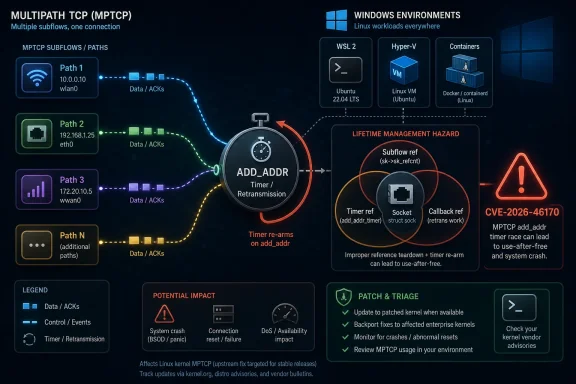 A Small MPTCP Bug Exposes a Bigger Weakness in Patch Triage
The description attached to CVE-2026-46170 is terse even by kernel-CVE standards. In plain terms, the flaw sits in the Multipath TCP path manager, specifically around retransmission of an ADD_ADDR signal. MPTCP uses that mechanism to advertise additional addresses that a peer may use for the same logical connection.The failure mode is rooted in socket reference counting. During timer handling, the socket is held while the retransmission timer is reset, then released at the end of the handler. If that reference is the last one, the code path needs to free the socket correctly. The bug is that the obvious fix — switching from the low-level
__sock_put() to sock_put() — creates a second problem when the freeing path tries to synchronously stop the very timer currently running.That is the kind of bug that rarely makes sense in a scanner dashboard. It is not an “open port equals compromise” issue. It is kernel concurrency logic, where a timer, a socket reference, and a cleanup path collide in a way that can leave resources unreleased or cause the kernel to wait on itself.
For WindowsForum readers, the Linux angle is not academic. Windows estates increasingly contain Linux in WSL, Hyper-V guests, Azure images, containers, network appliances, Kubernetes nodes, security tooling, and developer workstations. A kernel networking CVE can be outside the traditional Windows patch cycle and still inside the operational blast radius of a Windows-heavy organization.
The Missing Score Is Not a Missing Risk
At publication, NVD had not assigned CVSS 4.0, CVSS 3.x, or CVSS 2.0 scores to CVE-2026-46170. That absence should not be read as evidence that the vulnerability is harmless. It means the record was still awaiting enrichment, and the burden of interpretation temporarily shifts to kernel maintainers, distributions, and local risk owners.This matters because many vulnerability programs still treat NVD enrichment as the moment a vulnerability becomes “real.” That model was already strained before 2026. It is even less reliable now, as the volume of CVE records has forced more triage pressure onto downstream consumers.
Kernel.org’s role as the source is significant. This is not a third-party scanner inventing a weakness from static analysis, nor a speculative blog post hanging a CVE number on an edge case. The record reflects a resolved vulnerability in the Linux kernel, with stable-branch commit references attached.
But the record does not yet tell administrators the part they most want: which packaged kernels in which distributions are affected, how easily the condition can be triggered, and whether the likely impact is denial of service, memory leakage, resource exhaustion, or something narrower. Until vendors map the commits into their own advisories, the safest reading is disciplined uncertainty rather than panic.
MPTCP Is Niche Until It Is in Your Path
Multipath TCP is designed to let a single logical TCP connection use multiple network paths. That can mean Wi-Fi and cellular on a mobile device, multiple interfaces on a server, or more resilient transport across changing network conditions. It is an elegant idea, but elegance in the kernel often comes with sharp concurrency edges.The vulnerable area concerns the path manager, the component responsible for negotiating and maintaining those additional paths.
ADD_ADDR is part of the protocol machinery that tells a peer about another address available for the connection. Retransmission exists because networks drop packets, peers miss signals, and protocols need retry logic.Timer-driven retry logic is exactly where reference-counting mistakes become dangerous. A timer callback often runs after the world around it has changed. The socket may be closing, another thread may be releasing the last reference, and cleanup code may already be halfway through dismantling the structure the timer still knows about.
CVE-2026-46170 appears to sit in that narrow but important territory: not the glamorous beginning of a connection, but the less visible end-of-life handling when retries, references, and shutdown all overlap. These bugs tend to be hard to weaponize reliably but painful when they occur, because they surface as hangs, leaks, or kernel-level instability rather than tidy application errors.
The Fix Says More Than the CVE Blurb
The CVE description says the socket is held insk_reset_timer() and released at the end. If that was the last reference, the socket would not be freed when using the wrong release primitive. Moving to sock_put() is necessary because it invokes the full destruction path when the final reference disappears.Then comes the trap. If
sock_put() frees the socket, sk_free() eventually calls sk_stop_timer_sync(). That routine is designed to wait for a timer handler to finish. But if it is called from the same timer handler, the kernel can end up waiting for itself indefinitely.That is the heart of the bug: a cleanup path that is correct from one angle but deadlocks from another. The fix therefore has to teach the code that the timer is already done when it has not been rescheduled, so the destruction path does not try to synchronously stop the callback currently executing. This is not a one-line “use the safer API” story; it is a lifecycle fix.
That distinction matters for backports. Kernel stable fixes are often applied across multiple maintained branches, but distributors may carry patches differently, especially in enterprise kernels with heavy backporting. Administrators should not assume that matching a marketing kernel version is enough. The practical question is whether the specific stable commit or its equivalent has landed in the vendor package they deploy.
Linux Kernel CVEs Are Becoming More Numerous and Less Self-Explanatory
The Linux kernel project’s CVE process has changed the vulnerability landscape. More kernel fixes now receive CVE identifiers, including flaws that previously might have been visible only as commit messages on stable mailing lists. That is good for transparency, but it also creates a new class of vulnerability record: technically accurate, operationally incomplete, and initially hard to prioritize.CVE-2026-46170 fits that pattern. The record tells us the affected subsystem, the flawed behavior, and the corrective logic. It does not yet give a severity score, exploitability assessment, affected product list, or distribution matrix. For a security team staring at a vulnerability queue, that can feel like being handed a smoke alarm without a floor plan.
This is where mature patch management has to distinguish between database completeness and engineering reality. The kernel fix exists because maintainers found a real correctness problem. Whether that problem is urgent for a given organization depends on exposure, configuration, workload, and vendor packaging.
The worst response is to ignore it until a score appears. The second-worst response is to treat every unscored kernel CVE as an emergency. The better response is to ask a narrower set of questions: Is MPTCP enabled or available? Are systems running kernels in affected stable lines? Is the workload network-facing or multi-tenant? Has the distribution already shipped the fix?
Windows Shops Still Own This Linux Risk
It is tempting for Windows administrators to file this under “Linux people’s problem.” That was easier a decade ago. It is much less defensible in 2026.WSL has made Linux kernels part of developer endpoints. Azure and other clouds have made Linux guests part of ordinary enterprise infrastructure. Containers have made Linux kernel behavior relevant even to teams that mostly ship .NET, PowerShell, and Windows desktop software. Security appliances, VPN gateways, observability tools, and build runners commonly sit on Linux foundations.
CVE-2026-46170 is especially relevant to environments that treat Linux as invisible plumbing. If a Linux node hangs, leaks resources, or behaves unpredictably under network edge cases, the incident may first appear as a failed build, a stuck service, a degraded cluster, or an unreachable appliance. The team that owns the symptom may not be the team watching kernel CVEs.
That is the operational lesson. Cross-platform estates need a kernel-patching inventory that is not organized solely around operating-system branding. If the Linux kernel is present, whether in a VM, a container host, a WSL environment, or a vendor appliance, it belongs in the vulnerability conversation.
The Most Likely Impact Is Reliability, Not Hollywood Exploitation
Based on the published description, CVE-2026-46170 reads primarily like a denial-of-service or reliability flaw rather than a direct confidentiality breach. The key phrase is the indefinite wait: a code path can end up waiting for the same timer handler to finish. In kernel space, that kind of self-dependency can translate into hangs, stalls, or resource-management failure.That does not make it unimportant. Availability bugs in kernel networking can be serious, particularly on systems that handle shared workloads. A local or network-adjacent trigger that can degrade a host may be enough to matter in a multi-tenant environment, a container platform, or an appliance with strict uptime requirements.
Still, there is no public evidence in the supplied record of active exploitation, privilege escalation, or remote code execution. Administrators should resist the urge to invent a more dramatic vulnerability than the facts support. The correct stance is to patch through normal kernel update channels, accelerate where MPTCP exposure is plausible, and wait for distribution advisories before declaring enterprise-wide emergency conditions.
The uncertainty is not a flaw in the article; it is a fact of the record. NVD enrichment is pending, and kernel CVEs often require vendor-specific mapping before their practical severity becomes clear. A Red Hat, Ubuntu, Debian, SUSE, Arch, Android, or appliance advisory may eventually provide the missing operational detail.
Patch Management Now Starts at the Commit, Not the Score
The three stable commit references attached to the CVE are the most actionable part of the current record. They indicate that fixes have been applied in stable kernel branches, even if packaged distribution updates are still catching up. For teams that build their own kernels, track stable directly, or maintain appliances, that is enough to begin verification.For everyone else, the next step is vendor mapping. Distribution kernels are not simple copies of upstream point releases. Enterprise vendors often backport fixes while keeping older version numbers. Consumer and rolling distributions may pull newer stable kernels faster but with less centralized advisory language. Cloud images add another layer because the image, the running kernel, and the reboot state may not match.
The practical workflow is unglamorous but effective. Identify systems where MPTCP could matter. Check the vendor kernel changelog or security tracker for CVE-2026-46170 or the corresponding patch description. Apply the relevant kernel update. Reboot where required, because a patched kernel package sitting on disk does not protect a machine still running the old image.
This is also a reminder to audit systems that do not look like servers. Developer laptops with WSL, CI runners, network test rigs, and lab machines can sit outside formal patch windows. They may also be the places where unusual transport features are more likely to be enabled, tested, or accidentally exposed.
The Real Test Is Whether Your Tools Can Handle an Unenriched CVE
Many vulnerability scanners will ingest CVE-2026-46170 before they can explain it well. Some will show it as unknown severity. Some will suppress it until vendor metadata appears. Others may attach a generic Linux-kernel rule that overstates or understates relevance.That inconsistency is now part of the job. Security teams need a process for CVEs in the awkward middle stage: published by a credible source, fixed upstream, but not yet enriched into a neat NVD package. Waiting for the dashboard to become tidy is a governance decision, not a technical requirement.
A good vulnerability program should be able to record interim judgments. “Kernel.org-published MPTCP lifetime bug; no NVD score yet; monitor distribution advisories; patch through normal kernel update cycle; prioritize exposed MPTCP-capable systems” is a useful statement. “Unknown severity, no action” is not.
There is also a communication lesson. Executives and service owners often understand critical CVSS numbers, but they do not understand unscored kernel lifecycle bugs. The security team’s job is to translate uncertainty without exaggeration: this is a real upstream-fixed kernel flaw, not currently a known mass-exploitation event, and the right response is timely patching plus inventory validation.
The ADD_ADDR Bug Leaves Administrators With a Concrete Checklist
CVE-2026-46170 is not the vulnerability that should send every administrator sprinting into an emergency bridge call. It is the kind of vulnerability that rewards teams with good inventory, disciplined patch processes, and the humility to treat unscored records as unfinished rather than irrelevant. The absence of a CVSS score should slow down overconfident automation, not human judgment.- Administrators should track distribution advisories for CVE-2026-46170 rather than relying solely on the initial NVD record.
- Systems using custom, upstream, or fast-moving kernels should verify whether the referenced stable fixes or equivalent patches are present.
- Linux hosts that support network-facing, multi-tenant, container, appliance, or developer workloads deserve earlier attention than isolated lab machines.
- Windows-heavy environments should include WSL, Hyper-V guests, Azure Linux images, CI runners, and vendor appliances in the affected-asset search.
- Teams should treat missing CVSS data as a triage gap to manage, not as proof that the vulnerability has no operational impact.
References
- Primary source: NVD / Linux Kernel
Published: 2026-05-29T01:06:28-07:00
NVD - CVE-2026-46170
 nvd.nist.gov
- Security advisory: MSRC
Published: 2026-05-29T01:06:28-07:00
Original feed URL
Security Update Guide - Microsoft Security Response Center
 msrc.microsoft.com
- Official source: nist.gov
National Vulnerability Database
NIST maintains the National Vulnerability Database (NVD), a repository of information on software and hardware flaws that can compromise computer security. This is a key piece of the nation’s cybersecurity infrastructure.www.nist.gov - Related coverage: kernel.googlesource.com
- Related coverage: kernel.org

The Linux Kernel Archives
www.kernel.org
- Related coverage: labs.cloudsecurityalliance.org
NVD Enrichment Triage: Guidance for AI Security Programs
PDF documentlabs.cloudsecurityalliance.org
- Related coverage: first.org
The National Vulnerability Database Ms. Tanya Brewer NVD Program Manager June 2024
PDF documentwww.first.org
