
CVE-2026-46187 is a newly published Linux kernel vulnerability, disclosed by kernel.org on May 28, 2026, that fixes a use-after-free race in the RSI Wi-Fi driver when a kernel thread exits itself before external shutdown code tries to stop it. The bug is narrow, driver-specific, and still awaiting NVD enrichment, but it is a useful reminder that modern kernel security is often won or lost in the unglamorous bookkeeping of object lifetime. For WindowsForum readers, the story is not “Linux Wi-Fi is broken”; it is that cross-platform fleets, dual-boot laptops, WSL-adjacent development rigs, embedded gateways, and Linux-based appliances all inherit risk from drivers most users never think about. The patch is small, but the lesson is large: in kernel code, a thread that has already died can still hurt you if somebody else believes it is alive.
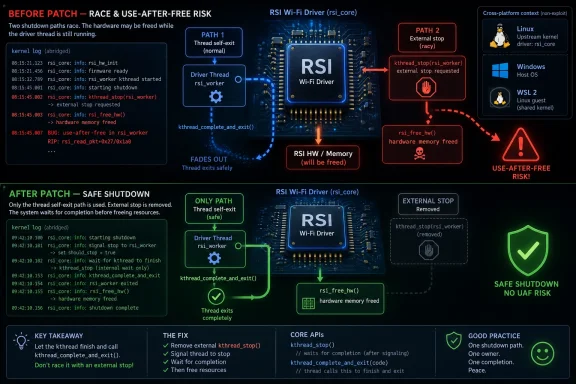
The official description of CVE-2026-46187 is terse in the way kernel CVEs often are. The RSI driver used two different shutdown patterns for the same kernel thread: a self-exit path using
The vulnerable case appears when the order reverses. If the thread completes and exits on its own, the kernel thread object may already be gone by the time the external shutdown path later tries to stop it. That second touch can become a use-after-free, the class of memory safety bug where code reaches back into memory after the object it expects has been released.
That is the whole vulnerability in plain English. Not a remote worm. Not a flashy cryptographic break. Not the sort of bug that sends executives to morning television. But kernel history is full of these “small” ordering mistakes because the kernel is a place where a stale pointer is not merely a bug report; it can be a crash, a denial of service, or, under the right conditions, part of a larger exploit chain.
The patch reflects that modesty. Rather than redesigning the RSI threading model, the fix removes the redundant external
A missing CVSS score does not mean a vulnerability is harmless. It means the enrichment pipeline has not yet produced a normalized severity statement. In the kernel ecosystem, especially with the modern practice of assigning CVEs to many upstream fixes, the first useful artifact is often not the NVD page at all. It is the patch, the affected subsystem, the stable backport trail, and the distribution kernel advisory that eventually lands in your update channel.
Here, the patch tells a reasonably contained story. The affected code sits in the RSI wireless driver, not in the generic TCP/IP stack, not in the mac80211 core, and not in a default-everywhere Windows interoperability layer. The trigger is a race during thread shutdown, not an obvious packet parsing flaw exposed to any nearby attacker with a radio.
That distinction matters. Wi-Fi vulnerabilities can sound intrinsically scary because wireless is ambient and local attackers do not need a cable. But this particular CVE, based on the available description, is about driver thread lifetime during teardown. The most credible immediate impact is system instability or a local kernel fault on systems using the affected driver, with exploitability depending on hardware presence, module loading, race timing, and whether an attacker can influence the relevant shutdown sequence.
That is not a dismissal. It is the opposite: it is how serious operators avoid both panic and complacency. Treat it as a kernel memory safety fix that deserves to be picked up through stable updates, not as evidence that every Linux laptop on Wi-Fi is suddenly exposed to a drive-by compromise.
But narrow does not mean irrelevant. Linux lives in places Windows admins may manage indirectly: access-control devices, industrial panels, kiosks, small gateways, lab instruments, developer boards, and oddball appliances whose wireless modules were selected years ago and forgotten. A vulnerability in a less common driver can matter precisely because the device using it is not on anyone’s normal patch radar.
This is where Windows-heavy shops often get caught out. The endpoint management console may be excellent for Windows 11, Microsoft Defender for Endpoint may give clean posture reporting, and Intune may know exactly which laptops missed Tuesday’s cumulative update. Meanwhile, a small Linux device in a conference room, warehouse, or test lab may be running a vendor kernel with a Wi-Fi driver nobody has inventoried.
The practical first question is therefore not “what is the CVSS?” It is “do we run this driver anywhere?” On Linux systems, administrators can check loaded modules, kernel configuration, device IDs, distribution advisories, and vendor firmware release notes. If the driver is not built, not loaded, and the hardware is absent, this CVE is mostly a tracking item. If it is present on a managed device, it belongs in the next kernel update cycle.
The RSI bug is especially instructive because the logic was not obviously reckless. There was a self-exit path and an external-stop path, both plausible mechanisms in kernel threading. Each can be correct in isolation. The problem is that the driver allowed both to operate on the same lifetime without a single, unambiguous owner of the final transition.
Race conditions are often born from “usually.” Usually, the stop call happens first. Usually, the object still exists. Usually, the test machine behaves. The kernel, however, is a machine for making “usually” fail under load, timing variation, fuzzing, hotplug, suspend/resume, error unwinding, and all the strange edge cases hardware drivers accumulate over years.
The bug was reportedly found in the orbit of syzbot, Google’s automated kernel fuzzing system, which has become one of the Linux ecosystem’s most relentless discoverers of weird lifetime failures. That is another important signal. Many modern kernel CVEs are not found by attackers crafting exploits in the dark; they are found by machines repeatedly driving subsystems into states human testers would rarely reach.
There is an elegance in that restraint. Security fixes sometimes introduce sprawling refactors that reduce one class of bug while quietly creating another. Here, the change is deliberately minimal. It does not ask every caller to learn a new contract; it tightens the contract inside the helper that kills the RSI thread.
That minimalism also makes backporting easier. The CVE record lists multiple stable kernel commits, which indicates the fix has been propagated across maintained branches rather than left only in a development tree. For enterprise and appliance environments, stable backports are the difference between “the bug is fixed upstream” and “the bug is fixed in a kernel I might actually run.”
The catch is that backports still have to move through distribution and vendor pipelines. A mainline stable commit does not magically update Ubuntu, Debian, Fedora, Red Hat, SUSE, Arch, embedded Yocto builds, or vendor-maintained appliance kernels on the same day. Operators should look for distribution-specific kernel packages, not cherry-pick random patches into production unless they already run that sort of kernel maintenance process.
But the modern Windows environment is rarely Windows-only. Developers dual-boot. Security teams run Linux sensors. Hyper-V hosts may sit beside Linux appliances. Windows admins increasingly manage mixed fleets through cloud dashboards, endpoint detection platforms, and vulnerability scanners that do not care about old operating-system tribal lines.
There is also the WSL confusion to clear up. Windows Subsystem for Linux does not turn Windows into a Linux Wi-Fi driver host. WSL workloads do not load the RSI kernel module to manage the physical wireless adapter. If your only Linux exposure is WSL on Windows, CVE-2026-46187 is not a direct WSL panic item.
The more realistic exposure sits in physical or virtual Linux kernels that include the affected driver. A dual-boot machine using Linux on bare metal may be relevant. A Linux-based kiosk with wireless hardware may be relevant. An embedded device using an affected vendor kernel may be relevant. A Windows PC merely sharing a network with such a system is not automatically in scope based on the public description.
For security teams, the right response is to add context rather than wait passively. Is the affected driver enabled in your kernel? Is the module loaded? Is the hardware present? Does the device operate in an untrusted physical environment? Can local users trigger Wi-Fi device reset, suspend/resume, module unload, interface teardown, or other code paths that might exercise the race?
Those questions matter more than an eventual decimal score. A local lab device with no untrusted users, no affected hardware, and no loaded RSI module is a very different risk from a fleet of Linux-based wireless gateways in a public venue. The CVE identifier is the start of triage, not the triage itself.
There is another reason not to over-index on the score: kernel exploitability is often nonlinear. A use-after-free may be practically unexploitable in one configuration and dangerous in another, depending on allocator behavior, hardening options, object layout, timing control, and reachable trigger paths. The safe operational conclusion is not to dramatize the bug; it is to avoid leaving known kernel memory-safety fixes unapplied for months.
Rolling distributions may receive the fix quickly as part of routine kernel updates. Enterprise distributions may backport the patch into older versioned kernels while keeping the external kernel version number familiar. Embedded vendors may take longer, especially if they maintain heavily customized kernel trees. The slowest case is often the most operationally important: a “set and forget” appliance whose web UI says everything is current while its underlying kernel is years behind.
This CVE therefore belongs in the broader discipline of kernel update hygiene. Kernel updates are disruptive because they require reboot planning, especially on servers and appliances. That friction encourages deferral. But driver lifetime fixes are exactly the kind of changes that accumulate silently until a device hits an unlucky edge case in production.
Windows administrators already understand this pattern from firmware and driver servicing. A bug may live below the application layer, affect only certain hardware, and still justify attention because the failure mode is system-wide. Linux kernel maintenance is the same story with different packaging.
That has changed the CVE landscape. Years ago, many administrators expected CVEs to map to attacker-reported vulnerabilities, vendor advisories, or dramatic research writeups. Today, a steady stream of kernel CVEs comes from automated testing finding bugs that may or may not have a known exploit path. Some are severe. Some are mostly correctness fixes. Many sit in between.
This can feel like noise, but it is actually progress. Bugs found by fuzzers and fixed upstream before they are weaponized are the security process working as designed. The challenge is that vulnerability management systems are often bad at expressing this nuance. They want a red/yellow/green answer; kernel maintenance often gives you a gray one.
CVE-2026-46187 is a classic gray case. The bug is real. The patch is real. The affected surface is probably limited. The exploitability is not publicly established. The operational advice remains simple: if your systems ship or load the RSI driver, take the fixed kernel through your normal update path.
If you know which wireless chipsets exist across your Linux estate, you can triage CVE-2026-46187 quickly. If you know which kernel modules are enabled and which packages provide them, you can decide whether the vulnerability is exploitable, merely present, or irrelevant. If you do not know, every driver CVE becomes a scavenger hunt.
This is especially true for mixed Windows and Linux organizations. The Windows side may have superb hardware reporting through endpoint management. The Linux side may be a patchwork of Ansible facts, cloud images, manually maintained spreadsheets, and vendor portals. The gap is not glamorous, but attackers and outages do not care whether the asset database was boring to build.
For smaller shops, the practical approach is less elaborate. Identify Linux systems that use Wi-Fi at all. Check whether any use RSI/Redpine/Silicon Labs wireless hardware or load the relevant
Linux kernel CVEs often fall between teams. Security sees the CVE but lacks kernel context. Infrastructure owns patching but waits for severity. Network teams own wireless appliances but may not track Linux kernel advisories. Desktop teams assume Linux is outside their lane. In that gap, a small driver bug can linger indefinitely.
The remedy is to assign decisions, not anxiety. Somebody should be responsible for determining whether affected code exists in the environment. Somebody should track the vendor or distribution update. Somebody should decide whether a reboot window is needed. If the answer is “not affected,” record why; future auditors and incident responders will thank you.
This is also where vulnerability scanners need tuning. A scanner that flags CVE-2026-46187 solely because a kernel source package includes the driver may overstate the issue. A scanner that ignores it because there is no NVD score may understate it. The best tools correlate installed kernel versions, backported fixes, loaded modules, and vendor advisories. The best teams verify the tool’s conclusion.
The bug shows why upstream patches deserve attention even before enrichment databases catch up. It shows why hardware-specific drivers can matter in enterprise risk, even when the hardware is uncommon. It shows why stable kernel updates are security work, not just maintenance. And it shows why mixed-platform administrators should resist treating Linux devices as invisible just because the Windows fleet is better instrumented.
The most important phrase in the disclosure is not “Wi-Fi” or even “use-after-free.” It is lifetime race. That is the kernel’s perennial enemy: two paths, one object, and no shared agreement about who owns the end. The RSI fix restores that agreement by making the shutdown path wait for completion rather than stop a thread that may already be gone.
 A Tiny Wi-Fi Driver Race Becomes a CVE Because Lifetime Bugs Still Matter
The official description of CVE-2026-46187 is terse in the way kernel CVEs often are. The RSI driver used two different shutdown patterns for the same kernel thread: a self-exit path using kthread_complete_and_exit() and an external stop path using kthread_stop(). Most of the time the external stop happened first, and nothing especially dramatic followed.The vulnerable case appears when the order reverses. If the thread completes and exits on its own, the kernel thread object may already be gone by the time the external shutdown path later tries to stop it. That second touch can become a use-after-free, the class of memory safety bug where code reaches back into memory after the object it expects has been released.
That is the whole vulnerability in plain English. Not a remote worm. Not a flashy cryptographic break. Not the sort of bug that sends executives to morning television. But kernel history is full of these “small” ordering mistakes because the kernel is a place where a stale pointer is not merely a bug report; it can be a crash, a denial of service, or, under the right conditions, part of a larger exploit chain.
The patch reflects that modesty. Rather than redesigning the RSI threading model, the fix removes the redundant external
kthread_stop() call and waits for the self-exit completion. In other words, the driver now respects the thread’s own exit protocol instead of racing it with a second authority trying to clean up the same object.The Patch Says More Than the Scorecard Does
As of publication, NVD has not assigned CVSS 4.0, CVSS 3.x, or CVSS 2.0 scores to CVE-2026-46187. That will annoy vulnerability dashboards because dashboards like numbers, colors, thresholds, and sortable columns. It should not prevent administrators from understanding the operational significance.A missing CVSS score does not mean a vulnerability is harmless. It means the enrichment pipeline has not yet produced a normalized severity statement. In the kernel ecosystem, especially with the modern practice of assigning CVEs to many upstream fixes, the first useful artifact is often not the NVD page at all. It is the patch, the affected subsystem, the stable backport trail, and the distribution kernel advisory that eventually lands in your update channel.
Here, the patch tells a reasonably contained story. The affected code sits in the RSI wireless driver, not in the generic TCP/IP stack, not in the mac80211 core, and not in a default-everywhere Windows interoperability layer. The trigger is a race during thread shutdown, not an obvious packet parsing flaw exposed to any nearby attacker with a radio.
That distinction matters. Wi-Fi vulnerabilities can sound intrinsically scary because wireless is ambient and local attackers do not need a cable. But this particular CVE, based on the available description, is about driver thread lifetime during teardown. The most credible immediate impact is system instability or a local kernel fault on systems using the affected driver, with exploitability depending on hardware presence, module loading, race timing, and whether an attacker can influence the relevant shutdown sequence.
That is not a dismissal. It is the opposite: it is how serious operators avoid both panic and complacency. Treat it as a kernel memory safety fix that deserves to be picked up through stable updates, not as evidence that every Linux laptop on Wi-Fi is suddenly exposed to a drive-by compromise.
The RSI Driver Is the Narrow Doorway
The “RSI” in this context refers to the wireless driver family historically associated with Redpine Signals hardware, later part of Silicon Labs’ Wi-Fi portfolio. These are not the dominant Intel, Qualcomm, Realtek, or MediaTek chipsets most consumer laptop owners see when they run hardware inventory. That alone narrows the blast radius.But narrow does not mean irrelevant. Linux lives in places Windows admins may manage indirectly: access-control devices, industrial panels, kiosks, small gateways, lab instruments, developer boards, and oddball appliances whose wireless modules were selected years ago and forgotten. A vulnerability in a less common driver can matter precisely because the device using it is not on anyone’s normal patch radar.
This is where Windows-heavy shops often get caught out. The endpoint management console may be excellent for Windows 11, Microsoft Defender for Endpoint may give clean posture reporting, and Intune may know exactly which laptops missed Tuesday’s cumulative update. Meanwhile, a small Linux device in a conference room, warehouse, or test lab may be running a vendor kernel with a Wi-Fi driver nobody has inventoried.
The practical first question is therefore not “what is the CVSS?” It is “do we run this driver anywhere?” On Linux systems, administrators can check loaded modules, kernel configuration, device IDs, distribution advisories, and vendor firmware release notes. If the driver is not built, not loaded, and the hardware is absent, this CVE is mostly a tracking item. If it is present on a managed device, it belongs in the next kernel update cycle.
Use-After-Free Remains the Kernel’s Most Stubborn Genre
The phrase use-after-free has become security wallpaper, but it describes a very specific failure of memory ownership. One part of the system frees an object; another part continues to act as if the object remains valid. In user-space software, that is bad enough. In the kernel, where code runs with high privilege and manages shared resources for the entire operating system, it is worse.The RSI bug is especially instructive because the logic was not obviously reckless. There was a self-exit path and an external-stop path, both plausible mechanisms in kernel threading. Each can be correct in isolation. The problem is that the driver allowed both to operate on the same lifetime without a single, unambiguous owner of the final transition.
Race conditions are often born from “usually.” Usually, the stop call happens first. Usually, the object still exists. Usually, the test machine behaves. The kernel, however, is a machine for making “usually” fail under load, timing variation, fuzzing, hotplug, suspend/resume, error unwinding, and all the strange edge cases hardware drivers accumulate over years.
The bug was reportedly found in the orbit of syzbot, Google’s automated kernel fuzzing system, which has become one of the Linux ecosystem’s most relentless discoverers of weird lifetime failures. That is another important signal. Many modern kernel CVEs are not found by attackers crafting exploits in the dark; they are found by machines repeatedly driving subsystems into states human testers would rarely reach.
The Fix Is Boring in the Best Possible Way
The patch changes the shutdown behavior so the driver increments the thread-done indicator, signals the event, and waits for completion instead of callingkthread_stop() on a thread that may already have self-exited. This is exactly the kind of fix kernel maintainers tend to prefer when the defect is well understood: remove the competing lifetime operation and let one path own the teardown.There is an elegance in that restraint. Security fixes sometimes introduce sprawling refactors that reduce one class of bug while quietly creating another. Here, the change is deliberately minimal. It does not ask every caller to learn a new contract; it tightens the contract inside the helper that kills the RSI thread.
That minimalism also makes backporting easier. The CVE record lists multiple stable kernel commits, which indicates the fix has been propagated across maintained branches rather than left only in a development tree. For enterprise and appliance environments, stable backports are the difference between “the bug is fixed upstream” and “the bug is fixed in a kernel I might actually run.”
The catch is that backports still have to move through distribution and vendor pipelines. A mainline stable commit does not magically update Ubuntu, Debian, Fedora, Red Hat, SUSE, Arch, embedded Yocto builds, or vendor-maintained appliance kernels on the same day. Operators should look for distribution-specific kernel packages, not cherry-pick random patches into production unless they already run that sort of kernel maintenance process.
The Windows Angle Is Not as Remote as It Looks
At first glance, a Linux RSI Wi-Fi driver CVE may seem outside the WindowsForum beat. Windows does not use this Linux driver. Windows Wi-Fi stacks have their own driver models, their own vendor packages, and their own update mechanics. A Windows 11 laptop with an Intel AX211 card is not affected by this kernel bug simply because the CVE exists.But the modern Windows environment is rarely Windows-only. Developers dual-boot. Security teams run Linux sensors. Hyper-V hosts may sit beside Linux appliances. Windows admins increasingly manage mixed fleets through cloud dashboards, endpoint detection platforms, and vulnerability scanners that do not care about old operating-system tribal lines.
There is also the WSL confusion to clear up. Windows Subsystem for Linux does not turn Windows into a Linux Wi-Fi driver host. WSL workloads do not load the RSI kernel module to manage the physical wireless adapter. If your only Linux exposure is WSL on Windows, CVE-2026-46187 is not a direct WSL panic item.
The more realistic exposure sits in physical or virtual Linux kernels that include the affected driver. A dual-boot machine using Linux on bare metal may be relevant. A Linux-based kiosk with wireless hardware may be relevant. An embedded device using an affected vendor kernel may be relevant. A Windows PC merely sharing a network with such a system is not automatically in scope based on the public description.
The Missing Severity Score Should Not Become an Excuse
NVD’s “awaiting enrichment” status is becoming a familiar limbo for kernel CVEs. The Linux kernel project now issues CVEs for a broad set of fixes that resolve potentially security-relevant bugs, and enrichment databases often lag behind the initial publication. That creates a frustrating period when scanners can identify a CVE but cannot yet tell a neat severity story.For security teams, the right response is to add context rather than wait passively. Is the affected driver enabled in your kernel? Is the module loaded? Is the hardware present? Does the device operate in an untrusted physical environment? Can local users trigger Wi-Fi device reset, suspend/resume, module unload, interface teardown, or other code paths that might exercise the race?
Those questions matter more than an eventual decimal score. A local lab device with no untrusted users, no affected hardware, and no loaded RSI module is a very different risk from a fleet of Linux-based wireless gateways in a public venue. The CVE identifier is the start of triage, not the triage itself.
There is another reason not to over-index on the score: kernel exploitability is often nonlinear. A use-after-free may be practically unexploitable in one configuration and dangerous in another, depending on allocator behavior, hardening options, object layout, timing control, and reachable trigger paths. The safe operational conclusion is not to dramatize the bug; it is to avoid leaving known kernel memory-safety fixes unapplied for months.
Stable Kernels Are the Real Security Boundary
For most administrators, the actionable unit is not the upstream commit hash. It is the kernel package delivered by a trusted distribution or vendor. That is where the fix arrives with ABI expectations, regression testing, signed packages, and dependency handling.Rolling distributions may receive the fix quickly as part of routine kernel updates. Enterprise distributions may backport the patch into older versioned kernels while keeping the external kernel version number familiar. Embedded vendors may take longer, especially if they maintain heavily customized kernel trees. The slowest case is often the most operationally important: a “set and forget” appliance whose web UI says everything is current while its underlying kernel is years behind.
This CVE therefore belongs in the broader discipline of kernel update hygiene. Kernel updates are disruptive because they require reboot planning, especially on servers and appliances. That friction encourages deferral. But driver lifetime fixes are exactly the kind of changes that accumulate silently until a device hits an unlucky edge case in production.
Windows administrators already understand this pattern from firmware and driver servicing. A bug may live below the application layer, affect only certain hardware, and still justify attention because the failure mode is system-wide. Linux kernel maintenance is the same story with different packaging.
Fuzzers Are Now Part of the Security Supply Chain
One subtle but important aspect of this bug is how ordinary the discovery path has become. Kernel fuzzers pound code with strange sequences, invalid states, and timing-sensitive operations. They do not care whether a driver is popular. They care whether the code can be coerced into violating its assumptions.That has changed the CVE landscape. Years ago, many administrators expected CVEs to map to attacker-reported vulnerabilities, vendor advisories, or dramatic research writeups. Today, a steady stream of kernel CVEs comes from automated testing finding bugs that may or may not have a known exploit path. Some are severe. Some are mostly correctness fixes. Many sit in between.
This can feel like noise, but it is actually progress. Bugs found by fuzzers and fixed upstream before they are weaponized are the security process working as designed. The challenge is that vulnerability management systems are often bad at expressing this nuance. They want a red/yellow/green answer; kernel maintenance often gives you a gray one.
CVE-2026-46187 is a classic gray case. The bug is real. The patch is real. The affected surface is probably limited. The exploitability is not publicly established. The operational advice remains simple: if your systems ship or load the RSI driver, take the fixed kernel through your normal update path.
Hardware Inventory Is the Unfashionable Control That Wins Here
Security vendors prefer controls that demo well: AI triage, exploit prediction, behavioral analytics, attack graphs. Those tools have their place. But this CVE is a reminder that the humble hardware inventory can beat all of them to the first useful answer.If you know which wireless chipsets exist across your Linux estate, you can triage CVE-2026-46187 quickly. If you know which kernel modules are enabled and which packages provide them, you can decide whether the vulnerability is exploitable, merely present, or irrelevant. If you do not know, every driver CVE becomes a scavenger hunt.
This is especially true for mixed Windows and Linux organizations. The Windows side may have superb hardware reporting through endpoint management. The Linux side may be a patchwork of Ansible facts, cloud images, manually maintained spreadsheets, and vendor portals. The gap is not glamorous, but attackers and outages do not care whether the asset database was boring to build.
For smaller shops, the practical approach is less elaborate. Identify Linux systems that use Wi-Fi at all. Check whether any use RSI/Redpine/Silicon Labs wireless hardware or load the relevant
rsi modules. Then watch your distribution’s kernel updates and apply the fixed packages when available. You do not need a grand program to avoid being surprised by a niche driver.The Real Risk Is Delay by Ambiguity
The most dangerous moment for a CVE like this is not publication day. It is the month after publication, when the vulnerability has no score, no headlines, no exploit chatter, and no obvious owner inside the organization. Everyone assumes someone else will decide whether it matters.Linux kernel CVEs often fall between teams. Security sees the CVE but lacks kernel context. Infrastructure owns patching but waits for severity. Network teams own wireless appliances but may not track Linux kernel advisories. Desktop teams assume Linux is outside their lane. In that gap, a small driver bug can linger indefinitely.
The remedy is to assign decisions, not anxiety. Somebody should be responsible for determining whether affected code exists in the environment. Somebody should track the vendor or distribution update. Somebody should decide whether a reboot window is needed. If the answer is “not affected,” record why; future auditors and incident responders will thank you.
This is also where vulnerability scanners need tuning. A scanner that flags CVE-2026-46187 solely because a kernel source package includes the driver may overstate the issue. A scanner that ignores it because there is no NVD score may understate it. The best tools correlate installed kernel versions, backported fixes, loaded modules, and vendor advisories. The best teams verify the tool’s conclusion.
The Lesson From This Driver Bug Fits the Next One Too
CVE-2026-46187 will probably not become the defining Linux security story of 2026. It is too specific, too low-drama, and too dependent on conditions that many systems will not meet. But it is precisely the kind of CVE that teaches good habits because it denies everyone the comfort of a simple headline.The bug shows why upstream patches deserve attention even before enrichment databases catch up. It shows why hardware-specific drivers can matter in enterprise risk, even when the hardware is uncommon. It shows why stable kernel updates are security work, not just maintenance. And it shows why mixed-platform administrators should resist treating Linux devices as invisible just because the Windows fleet is better instrumented.
The most important phrase in the disclosure is not “Wi-Fi” or even “use-after-free.” It is lifetime race. That is the kernel’s perennial enemy: two paths, one object, and no shared agreement about who owns the end. The RSI fix restores that agreement by making the shutdown path wait for completion rather than stop a thread that may already be gone.
The Patch Is Small, but the Checklist Is Concrete
For administrators, the right response is disciplined and unsentimental. Do not inflate CVE-2026-46187 into a universal wireless emergency, and do not ignore it because NVD has not yet assigned a score.- Systems that do not build, ship, or load the RSI wireless driver are unlikely to be directly affected by this specific bug.
- Systems using RSI, Redpine, or related Silicon Labs wireless hardware should be prioritized for kernel updates once distribution or vendor packages include the fix.
- WSL users on Windows are not directly exposed through WSL because WSL does not manage the physical Wi-Fi adapter with the Linux RSI driver.
- Vulnerability teams should avoid treating the missing NVD score as a risk rating and should instead triage based on hardware, loaded modules, kernel version, and vendor backport status.
- Embedded Linux appliances deserve special attention because their kernels often lag upstream while remaining outside normal Windows endpoint management.
- Reboot planning is part of the fix, because kernel driver patches generally do not protect a running system until the updated kernel is booted.
References
- Primary source: NVD / Linux Kernel
Published: 2026-05-29T01:07:46-07:00

NVD - CVE-2026-46187
nvd.nist.gov
- Security advisory: MSRC
Published: 2026-05-29T01:07:46-07:00
Original feed URL

Security Update Guide - Microsoft Security Response Center
msrc.microsoft.com
- Related coverage: spinics.net

[PATCH] wifi: rsi: fix kthread lifetime race between self-exit and external-stop — Linux Kernel
Linux Kernel: [PATCH] wifi: rsi: fix kthread lifetime race between self-exit and external-stop
www.spinics.net
- Related coverage: lore-kernel.gnuweeb.org
- Related coverage: cve.imfht.com
CVE-2026-31579: wireguard: device: use exit_rtnl callback instead of manual rtnl_lock in pre_exit
## Overview The Linux kernel WireGuard driver manually acquires `rtnl_lock` in the `pernet .pre_exit` callback. If another thread holds `rtnl_mutex`, it can cause a deadlock during the cleanup proce cve.imfht.com
- Related coverage: lists.debian.org
- Related coverage: support.bull.com
