

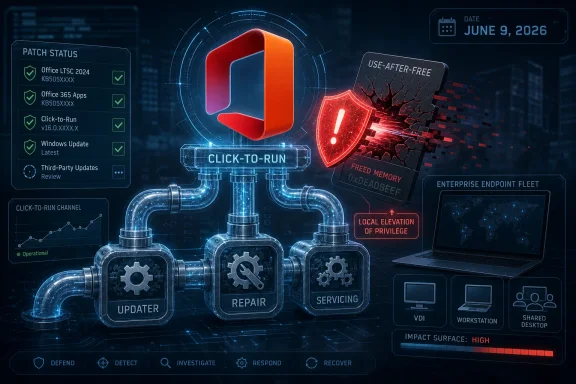
Microsoft disclosed CVE-2026-47293 on June 9, 2026, as a high-severity Microsoft Office Click-to-Run elevation-of-privilege vulnerability affecting Office 2019, caused by a use-after-free flaw that can let an authorized local attacker gain elevated privileges. The important part is not that Office has another bug; Office always has another bug. The important part is that Microsoft’s servicing machinery has again become part of the attack surface. For administrators, this is the kind of vulnerability that turns a routine Patch Tuesday spreadsheet into a question about trust in the plumbing beneath Microsoft 365 and perpetual Office.
Click-to-Run began life as a deployment convenience. It let Microsoft stream Office, isolate pieces of the installation, and push updates with less ceremony than the old MSI era. In the Microsoft 365 age, it is no longer merely an installer; it is the maintenance layer that keeps Word, Excel, Outlook, PowerPoint, and the broader Office estate moving.
That makes CVE-2026-47293 more interesting than its terse advisory title suggests. An elevation-of-privilege flaw in Click-to-Run is not the same story as a malicious spreadsheet exploiting a parser bug. It points at the system that installs, updates, repairs, and orchestrates Office itself.
Microsoft describes the issue as a use-after-free condition in Microsoft Office Click-to-Run that allows an authorized attacker to elevate privileges locally. The CVSS 3.1 score is 7.0, which puts it in the “High” bucket, but the vector matters more than the label: local attack vector, high attack complexity, low privileges required, no user interaction, unchanged scope, and high impact to confidentiality, integrity, and availability.
That combination is familiar to defenders. It is not a remote worm. It is not a zero-click email disaster. It is the quieter kind of bug that becomes valuable after an attacker already has a foothold.
A phishing payload, stolen credential, vulnerable browser extension, malicious Teams message, exposed VPN account, or misconfigured endpoint can provide initial access. Once inside, the attacker’s next problem is usually privilege. They need to escape the narrow permissions of the user context, disable protections, dump credentials, move laterally, tamper with security tooling, or implant persistence somewhere that survives reboot and cleanup.
That is where a vulnerability like CVE-2026-47293 earns its place in the playbook. It does not open the front door from the internet, but it may help an intruder who has already climbed through a window find the keys to the rest of the building.
The CVSS vector makes this tension plain. Microsoft’s scoring indicates exploitation requires local access and some preexisting privilege, but no additional user interaction once the attack is staged. The high attack complexity is meaningful; it suggests exploitation is not a simple one-liner under normal conditions. But “high complexity” is not the same as “low risk,” particularly once researchers, criminal groups, and defenders have all had time to diff patches and study the changed components.
The fact that the weakness class is familiar does not make it harmless. In a privileged or semi-privileged updater component, memory safety issues can become especially uncomfortable because the affected code may sit close to sensitive operations: file replacement, service control, package validation, repair workflows, or inter-process communication with higher-trust components.
Microsoft’s public description does not provide enough detail to say precisely which Click-to-Run path is affected. That restraint is normal on disclosure day. The vendor wants customers to patch before adversaries have a recipe.
But this is also why the “Report Confidence” language in vulnerability scoring matters. When the vendor acknowledges the issue, assigns a CVE, publishes a CVSS vector, identifies the weakness as use-after-free, and releases servicing guidance, defenders should treat the vulnerability as real even if exploit details remain thin. The absence of a public proof of concept is not evidence of safety; it is merely a temporary lack of public tooling.
That distinction matters. Some advisories begin as vague claims, partial reports, or third-party observations. Others are confirmed by the vendor that owns the code. CVE-2026-47293 falls into the latter practical category: it appears in Microsoft’s Security Update Guide with Microsoft’s own framing, a CVE identifier, a severity score, and a technical weakness classification.
For defenders, that raises urgency even when details are sparse. A vendor-confirmed elevation-of-privilege bug in a ubiquitous Office servicing component is not something to leave in the “wait for more information” pile. The correct interpretation is: Microsoft has acknowledged enough to patch, and that means enterprise administrators have enough to act.
There is a second-order effect as well. Report confidence can also imply how much attackers may be able to learn. If a patch ships and the advisory identifies the affected component and bug class, a capable researcher can compare old and new binaries. Patch diffing is not magic, but it is routine. The window between disclosure and reliable exploit development is unpredictable, not infinite.
That makes the affected surface broad in a way that vulnerability counts do not capture. A single Office servicing issue can touch finance teams living in Excel, executives using Outlook, call centers running shared desktops, lab systems with pinned Office builds, and contractors on semi-managed devices. The presence of Office is so ordinary that it can become invisible.
The published affected product information currently points to Office 2019. That is notable because Office 2019 remains a common perpetual-license deployment in organizations that avoided subscription licensing or froze application stacks for compatibility. These are also the environments where patch velocity can be uneven.
Administrators should resist the temptation to treat “Office 2019” as a narrow consumer footnote. Perpetual Office deployments often exist precisely in places where change control is slow: regulated environments, air-gapped or semi-connected networks, industrial support workstations, and machines tied to old macros or add-ins. A vulnerability in that estate can linger long after the headline cycle moves on.
Office update channels, deferred rings, management policies, CDN access, Configuration Manager baselines, Intune assignments, offline installers, language packs, shared computer activation, and VDI golden images can all complicate what should be a straightforward update. Click-to-Run’s biggest strength—centralized, continual servicing—also means local deviations matter. A machine that has not checked in, a channel that is paused, or an image that was cloned before remediation can become the weak link.
This is where many organizations should spend their time. Not on speculation about weaponization, but on inventory and validation. Which endpoints have Office 2019? Which builds are actually installed? Which update channel do they follow? Which machines have not reported a successful Office update since June 9, 2026?
The less dramatic work is the work that reduces risk. A vulnerability like CVE-2026-47293 is an argument for knowing the state of Office with the same confidence many organizations reserve for Windows cumulative updates.
CVE-2026-47293 should push administrators to look beyond the Office patch itself. Are users running as standard users? Are local administrator passwords managed and rotated? Are Office processes constrained by attack surface reduction rules where appropriate? Are suspicious child processes from Office components logged and investigated? Are update and repair operations generating telemetry that defenders can actually see?
None of those controls replaces patching. But they can shape the blast radius if patching is delayed or if exploitation emerges before every endpoint is remediated.
There is also a lesson for security vendors. Servicing components do not always look like traditional malware launch points, but they are high-value targets because they are trusted by design. Detection logic that focuses only on document macros or Outlook attachments can miss the more subtle abuse of installers, updaters, scheduled tasks, services, and repair tools.
It is also frequently austere. Affected product, CVSS score, impact, exploitation assessment, and a one-sentence description are often all customers get at first. For administrators trying to triage dozens of vulnerabilities in a maintenance window, that can be enough to start. For security teams trying to understand whether a bug threatens a specific configuration, it can be frustratingly thin.
CVE-2026-47293 shows the tradeoff. The advisory gives defenders enough to know that this is a local privilege escalation issue in Click-to-Run, tied to use-after-free, rated High, and requiring attention. It does not explain the vulnerable code path, the triggering condition, or whether particular deployment settings change exposure.
That opacity has a purpose. Over-sharing exploit mechanics on disclosure day can accelerate weaponization. But under-sharing operational nuance can also delay patching in risk-based environments where every maintenance action competes with uptime, compatibility, and business pressure.
That does not mean Office 2019 is inherently unsafe. It means it is more likely to appear in environments that intentionally chose stability over continuous change. Those environments may have good reasons: add-in compatibility, licensing predictability, offline operation, or application validation requirements.
But attackers do not grade on procurement rationale. A vulnerable Office 2019 installation is useful whether it exists because of a well-documented exception, a forgotten image, or a department that bought licenses years ago and never revisited the decision. Legacy does not have to be abandoned to become risky; it only has to become under-observed.
The practical move is not to shame organizations for running perpetual Office. It is to make those installations visible, assign owners, and ensure Office security updates have the same governance as Windows and browser updates. If Office is important enough to keep installed, it is important enough to patch on purpose.
But “no public exploit” is a weak foundation for delay. Local elevation bugs become attractive when they fit into broader intrusion chains, and attackers often care less about novelty than reliability. If a bug works across enough endpoints and helps bypass a meaningful privilege boundary, it can be valuable even without flashy remote reach.
The high attack complexity score may reduce the likelihood of opportunistic exploitation, at least initially. It does not remove the incentive for capable actors to study the patch. Nor does it protect organizations that routinely lag Office servicing by weeks or months.
A sensible risk posture treats exploitation status as one input, not the decision. Vendor-confirmed, high-severity, local privilege escalation in a common enterprise component should be patched promptly unless there is a specific compatibility reason to defer. And if there is a deferral, it should be documented, time-limited, and monitored.
First, identify Office 2019 installations and confirm their Click-to-Run update state. Second, push the relevant Office security updates through the organization’s normal tooling. Third, validate that the patched builds are actually present on endpoints rather than merely approved in a console. Fourth, watch for suspicious local privilege escalation behavior, especially on machines that had delayed Office updates.
Organizations using management tools should also review update channel policies and any pause or deferral settings. A deferred update ring is not a problem by itself; an undocumented deferral that no one remembers is. The same goes for VDI images and packaged application layers, which can quietly reintroduce vulnerable builds after the live fleet has been patched.
Security teams should coordinate with desktop engineering rather than treating this as a purely vulnerability-management ticket. Office servicing is often owned by one team, endpoint detection by another, and change control by a third. CVE-2026-47293 sits across all three.
Enterprise reality is messier. Devices sleep. Users travel. Business units resist restarts. Legacy add-ins break. Network egress is restricted. Change windows are political. Some machines are known only to the person who will retire next quarter.
That gap is where vulnerabilities persist. CVE-2026-47293 is not a catastrophe by itself, but it is another reminder that Microsoft’s modern security posture depends on operational discipline outside Microsoft’s walls. The vendor can publish a fix; it cannot force every unmanaged or under-managed Office installation to absorb it.
For WindowsForum readers, this is the part worth taking personally. The patch cycle is not just a Microsoft ritual. It is an inventory test, a governance test, and a telemetry test.
 The Office Bug Is Really a Servicing Bug
Click-to-Run began life as a deployment convenience. It let Microsoft stream Office, isolate pieces of the installation, and push updates with less ceremony than the old MSI era. In the Microsoft 365 age, it is no longer merely an installer; it is the maintenance layer that keeps Word, Excel, Outlook, PowerPoint, and the broader Office estate moving.That makes CVE-2026-47293 more interesting than its terse advisory title suggests. An elevation-of-privilege flaw in Click-to-Run is not the same story as a malicious spreadsheet exploiting a parser bug. It points at the system that installs, updates, repairs, and orchestrates Office itself.
Microsoft describes the issue as a use-after-free condition in Microsoft Office Click-to-Run that allows an authorized attacker to elevate privileges locally. The CVSS 3.1 score is 7.0, which puts it in the “High” bucket, but the vector matters more than the label: local attack vector, high attack complexity, low privileges required, no user interaction, unchanged scope, and high impact to confidentiality, integrity, and availability.
That combination is familiar to defenders. It is not a remote worm. It is not a zero-click email disaster. It is the quieter kind of bug that becomes valuable after an attacker already has a foothold.
A High Score With a Local Shape
The phrase “local elevation of privilege” can sound almost reassuring, especially when compared with remote code execution. That is a mistake. Modern intrusions are rarely one-bug affairs; they are chains.A phishing payload, stolen credential, vulnerable browser extension, malicious Teams message, exposed VPN account, or misconfigured endpoint can provide initial access. Once inside, the attacker’s next problem is usually privilege. They need to escape the narrow permissions of the user context, disable protections, dump credentials, move laterally, tamper with security tooling, or implant persistence somewhere that survives reboot and cleanup.
That is where a vulnerability like CVE-2026-47293 earns its place in the playbook. It does not open the front door from the internet, but it may help an intruder who has already climbed through a window find the keys to the rest of the building.
The CVSS vector makes this tension plain. Microsoft’s scoring indicates exploitation requires local access and some preexisting privilege, but no additional user interaction once the attack is staged. The high attack complexity is meaningful; it suggests exploitation is not a simple one-liner under normal conditions. But “high complexity” is not the same as “low risk,” particularly once researchers, criminal groups, and defenders have all had time to diff patches and study the changed components.
Use-After-Free Is an Old Class With New Consequences
Use-after-free vulnerabilities are not glamorous anymore because they are so well known. They occur when software continues to use memory after it has been freed, creating an opening for corruption, unexpected behavior, and potentially attacker-controlled execution paths. In security engineering terms, this is old plumbing failing in predictable ways.The fact that the weakness class is familiar does not make it harmless. In a privileged or semi-privileged updater component, memory safety issues can become especially uncomfortable because the affected code may sit close to sensitive operations: file replacement, service control, package validation, repair workflows, or inter-process communication with higher-trust components.
Microsoft’s public description does not provide enough detail to say precisely which Click-to-Run path is affected. That restraint is normal on disclosure day. The vendor wants customers to patch before adversaries have a recipe.
But this is also why the “Report Confidence” language in vulnerability scoring matters. When the vendor acknowledges the issue, assigns a CVE, publishes a CVSS vector, identifies the weakness as use-after-free, and releases servicing guidance, defenders should treat the vulnerability as real even if exploit details remain thin. The absence of a public proof of concept is not evidence of safety; it is merely a temporary lack of public tooling.
Report Confidence Is the Quiet Metric That Changes the Temperature
The user-facing CVSS score gets the headline, but the confidence metric tells security teams how solid the ground is beneath the advisory. In CVSS terms, report confidence measures how certain the community can be that the vulnerability exists and how credible the available technical details are.That distinction matters. Some advisories begin as vague claims, partial reports, or third-party observations. Others are confirmed by the vendor that owns the code. CVE-2026-47293 falls into the latter practical category: it appears in Microsoft’s Security Update Guide with Microsoft’s own framing, a CVE identifier, a severity score, and a technical weakness classification.
For defenders, that raises urgency even when details are sparse. A vendor-confirmed elevation-of-privilege bug in a ubiquitous Office servicing component is not something to leave in the “wait for more information” pile. The correct interpretation is: Microsoft has acknowledged enough to patch, and that means enterprise administrators have enough to act.
There is a second-order effect as well. Report confidence can also imply how much attackers may be able to learn. If a patch ships and the advisory identifies the affected component and bug class, a capable researcher can compare old and new binaries. Patch diffing is not magic, but it is routine. The window between disclosure and reliable exploit development is unpredictable, not infinite.
Click-to-Run Sits on More Machines Than Admins Like to Admit
Office Click-to-Run is not obscure. It is the default servicing model for many modern Office deployments and has been central to Microsoft’s Office distribution strategy for years. Even organizations that think of themselves as “cloud-first” often have a thick layer of local Office clients sitting on endpoints, VDI images, shared workstations, and legacy line-of-business machines.That makes the affected surface broad in a way that vulnerability counts do not capture. A single Office servicing issue can touch finance teams living in Excel, executives using Outlook, call centers running shared desktops, lab systems with pinned Office builds, and contractors on semi-managed devices. The presence of Office is so ordinary that it can become invisible.
The published affected product information currently points to Office 2019. That is notable because Office 2019 remains a common perpetual-license deployment in organizations that avoided subscription licensing or froze application stacks for compatibility. These are also the environments where patch velocity can be uneven.
Administrators should resist the temptation to treat “Office 2019” as a narrow consumer footnote. Perpetual Office deployments often exist precisely in places where change control is slow: regulated environments, air-gapped or semi-connected networks, industrial support workstations, and machines tied to old macros or add-ins. A vulnerability in that estate can linger long after the headline cycle moves on.
The Patch Is Simple; The Estate Is Not
For a home user, the remediation story is usually uncomplicated: let Office update. For IT departments, the question is less whether a patch exists and more whether every affected installation will actually receive it.Office update channels, deferred rings, management policies, CDN access, Configuration Manager baselines, Intune assignments, offline installers, language packs, shared computer activation, and VDI golden images can all complicate what should be a straightforward update. Click-to-Run’s biggest strength—centralized, continual servicing—also means local deviations matter. A machine that has not checked in, a channel that is paused, or an image that was cloned before remediation can become the weak link.
This is where many organizations should spend their time. Not on speculation about weaponization, but on inventory and validation. Which endpoints have Office 2019? Which builds are actually installed? Which update channel do they follow? Which machines have not reported a successful Office update since June 9, 2026?
The less dramatic work is the work that reduces risk. A vulnerability like CVE-2026-47293 is an argument for knowing the state of Office with the same confidence many organizations reserve for Windows cumulative updates.
Elevation Bugs Are Where Endpoint Security Gets Tested
Local privilege escalation vulnerabilities are a test of layered defense. If an attacker already has a user foothold, endpoint controls decide whether that foothold becomes a full compromise. The answer depends on how well the environment limits user rights, protects credentials, monitors suspicious process behavior, and prevents tampering with security agents.CVE-2026-47293 should push administrators to look beyond the Office patch itself. Are users running as standard users? Are local administrator passwords managed and rotated? Are Office processes constrained by attack surface reduction rules where appropriate? Are suspicious child processes from Office components logged and investigated? Are update and repair operations generating telemetry that defenders can actually see?
None of those controls replaces patching. But they can shape the blast radius if patching is delayed or if exploitation emerges before every endpoint is remediated.
There is also a lesson for security vendors. Servicing components do not always look like traditional malware launch points, but they are high-value targets because they are trusted by design. Detection logic that focuses only on document macros or Outlook attachments can miss the more subtle abuse of installers, updaters, scheduled tasks, services, and repair tools.
Microsoft’s Sparse Advisory Style Helps Attackers and Defenders in Different Ways
Microsoft’s Security Update Guide is built for scale. It tracks a large monthly flow of CVEs across Windows, Office, Azure, Edge, SQL Server, developer tools, and enterprise services. The format is efficient, searchable, and operationally useful.It is also frequently austere. Affected product, CVSS score, impact, exploitation assessment, and a one-sentence description are often all customers get at first. For administrators trying to triage dozens of vulnerabilities in a maintenance window, that can be enough to start. For security teams trying to understand whether a bug threatens a specific configuration, it can be frustratingly thin.
CVE-2026-47293 shows the tradeoff. The advisory gives defenders enough to know that this is a local privilege escalation issue in Click-to-Run, tied to use-after-free, rated High, and requiring attention. It does not explain the vulnerable code path, the triggering condition, or whether particular deployment settings change exposure.
That opacity has a purpose. Over-sharing exploit mechanics on disclosure day can accelerate weaponization. But under-sharing operational nuance can also delay patching in risk-based environments where every maintenance action competes with uptime, compatibility, and business pressure.
Office 2019 Is the Canary for the Perpetual-License Problem
The visible affected product entry for CVE-2026-47293 is Office 2019, and that detail should sharpen the enterprise story. Subscription Microsoft 365 Apps installations are often updated aggressively because Microsoft’s model nudges them in that direction. Perpetual Office deployments, by contrast, can sit in slower lanes.That does not mean Office 2019 is inherently unsafe. It means it is more likely to appear in environments that intentionally chose stability over continuous change. Those environments may have good reasons: add-in compatibility, licensing predictability, offline operation, or application validation requirements.
But attackers do not grade on procurement rationale. A vulnerable Office 2019 installation is useful whether it exists because of a well-documented exception, a forgotten image, or a department that bought licenses years ago and never revisited the decision. Legacy does not have to be abandoned to become risky; it only has to become under-observed.
The practical move is not to shame organizations for running perpetual Office. It is to make those installations visible, assign owners, and ensure Office security updates have the same governance as Windows and browser updates. If Office is important enough to keep installed, it is important enough to patch on purpose.
No Public Exploit Is Not a Strategy
At publication time, public reporting around CVE-2026-47293 remains limited, and there is no broadly known public exploit circulating in mainstream advisories. That may remain true. Many vulnerabilities are patched, logged, and never become popular attacker tools.But “no public exploit” is a weak foundation for delay. Local elevation bugs become attractive when they fit into broader intrusion chains, and attackers often care less about novelty than reliability. If a bug works across enough endpoints and helps bypass a meaningful privilege boundary, it can be valuable even without flashy remote reach.
The high attack complexity score may reduce the likelihood of opportunistic exploitation, at least initially. It does not remove the incentive for capable actors to study the patch. Nor does it protect organizations that routinely lag Office servicing by weeks or months.
A sensible risk posture treats exploitation status as one input, not the decision. Vendor-confirmed, high-severity, local privilege escalation in a common enterprise component should be patched promptly unless there is a specific compatibility reason to defer. And if there is a deferral, it should be documented, time-limited, and monitored.
The Admin Response Should Be Boring, Fast, and Verifiable
The best response to CVE-2026-47293 is not theatrical. It is inventory, patch, verify, and monitor. The boringness is the point.First, identify Office 2019 installations and confirm their Click-to-Run update state. Second, push the relevant Office security updates through the organization’s normal tooling. Third, validate that the patched builds are actually present on endpoints rather than merely approved in a console. Fourth, watch for suspicious local privilege escalation behavior, especially on machines that had delayed Office updates.
Organizations using management tools should also review update channel policies and any pause or deferral settings. A deferred update ring is not a problem by itself; an undocumented deferral that no one remembers is. The same goes for VDI images and packaged application layers, which can quietly reintroduce vulnerable builds after the live fleet has been patched.
Security teams should coordinate with desktop engineering rather than treating this as a purely vulnerability-management ticket. Office servicing is often owned by one team, endpoint detection by another, and change control by a third. CVE-2026-47293 sits across all three.
The Real Risk Is the Gap Between Microsoft’s Cloud Pace and Enterprise Reality
Microsoft’s security model increasingly assumes rapid servicing. Windows, Edge, Defender, Office, Teams, and Microsoft 365 Apps all live in a world where updates are frequent and the vendor expects customers to keep moving. The model works best when devices are online, managed, licensed cleanly, and permitted to accept change on Microsoft’s cadence.Enterprise reality is messier. Devices sleep. Users travel. Business units resist restarts. Legacy add-ins break. Network egress is restricted. Change windows are political. Some machines are known only to the person who will retire next quarter.
That gap is where vulnerabilities persist. CVE-2026-47293 is not a catastrophe by itself, but it is another reminder that Microsoft’s modern security posture depends on operational discipline outside Microsoft’s walls. The vendor can publish a fix; it cannot force every unmanaged or under-managed Office installation to absorb it.
For WindowsForum readers, this is the part worth taking personally. The patch cycle is not just a Microsoft ritual. It is an inventory test, a governance test, and a telemetry test.
The June Office Patch Carries a Message for Every Fleet
CVE-2026-47293 is a compact advisory with a larger operational lesson. Treat it as a prompt to inspect the Office layer, not merely as one more CVE to close.- CVE-2026-47293 was disclosed on June 9, 2026, as a high-severity Microsoft Office Click-to-Run elevation-of-privilege vulnerability.
- Microsoft’s description points to a use-after-free flaw that can allow an authorized local attacker to gain elevated privileges.
- The CVSS 3.1 score is 7.0, with local attack vector, high attack complexity, low privileges required, no user interaction, unchanged scope, and high confidentiality, integrity, and availability impact.
- The currently visible affected product information identifies Office 2019, which makes inventory of perpetual Office deployments especially important.
- The absence of a widely public exploit should not be treated as a reason to defer patching, because local privilege escalation bugs often become useful inside multi-stage attacks.
- Administrators should verify successful Office servicing on endpoints, VDI images, and managed update rings rather than assuming approval of the update equals installation.
References
- Primary source: MSRC
Published: 2026-06-09T07:00:00-07:00
Security Update Guide - Microsoft Security Response Center
 msrc.microsoft.com
- Related coverage: datacomm.com
- Official source: microsoft.com
MSRC - Microsoft Security Response Center
The Microsoft Security Response Center is part of the defender community and on the front line of security response evolution. For over twenty years, we have been engaged with security researchers working to protect customers and the broader ecosystem.www.microsoft.com
- Official source: support.microsoft.com
- Related coverage: aha.org
- Related coverage: threats.kaspersky.com
Kaspersky Threats — KLA90842
threats.kaspersky.com

- Related coverage: sra.io
