

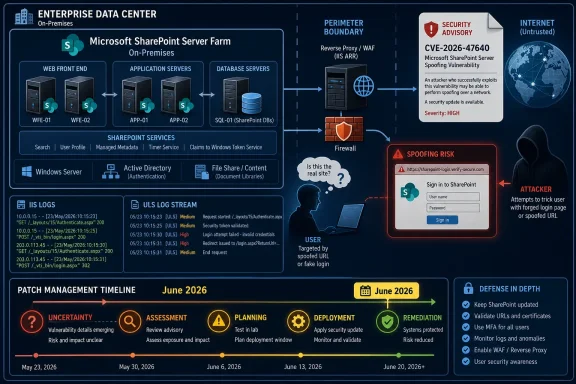
Microsoft’s June 2026 security guidance identifies CVE-2026-47640 as a Microsoft SharePoint Server spoofing vulnerability, placing another on-premises collaboration flaw in the patch queue for administrators who still run SharePoint outside Microsoft 365. The important detail is not merely that SharePoint has another CVE, but that Microsoft’s own risk language points to a vulnerability whose existence is considered credible enough to drive remediation. For Windows and server teams, that makes this less a curiosity than a test of how quickly they can separate exploitable uncertainty from operational noise.
The uncomfortable part is familiar. SharePoint Server is not just another web application in many environments; it is a document store, workflow engine, intranet platform, identity-integrated collaboration surface, and sometimes a graveyard of business processes nobody wants to admit still matter. A spoofing bug in that setting may not carry the visceral punch of remote code execution, but it can still become a foothold in the trust fabric that keeps enterprise users clicking, approving, uploading, and authenticating.
Microsoft’s Security Update Guide entry for CVE-2026-47640 gives administrators the headline they need and withholds much of what they want. The vulnerability is in Microsoft SharePoint Server, the impact category is spoofing, and the entry’s scoring framework includes the familiar measure of confidence in the existence of the vulnerability and the public reliability of technical details. That metric matters because it tells defenders whether they are dealing with rumor, partial research, or vendor-confirmed exposure.
In practice, this is how modern vulnerability disclosure often works. A CVE appears with enough detail to justify patching but not enough detail to hand attackers a convenient blueprint. Microsoft, like other major vendors, tries to thread a narrow needle: disclose the affected product and security impact, provide updates, and avoid publishing an exploit recipe while customers are still inside their change-control windows.
That compromise is never fully satisfying. Security teams want root cause, attack prerequisites, affected configurations, and detection logic. Attackers want the same things. When the public record is thin, defenders must act on the fact of vendor acknowledgment rather than the comfort of a complete postmortem.
The result is a familiar enterprise tension. The less Microsoft says, the more some teams hesitate; but in SharePoint’s case, hesitation has become a historically expensive habit.
In a SharePoint context, spoofing can matter because the platform sits at the intersection of content, permissions, and workflow. A user may trust a SharePoint page because it appears to come from an internal site. A business process may trust a document library because it is part of an approved collaboration space. A browser session may trust an authenticated experience because it lives under a familiar corporate domain.
That does not mean CVE-2026-47640 is necessarily a catastrophic vulnerability. The public description does not justify that leap. But it does mean administrators should resist the lazy ranking that treats spoofing as a second-tier class by default. In web-facing enterprise software, a spoofing flaw can become part of a larger chain: credential theft, session manipulation, phishing from trusted infrastructure, lateral movement, or abuse of delegated trust.
The last decade of enterprise security has repeatedly shown that attackers do not need every vulnerability to be dramatic. They need one gap that fits into a chain. SharePoint’s value as a target comes from the fact that it already sits inside the enterprise’s circle of trust.
That burden is heavier than it looks from the outside. SharePoint farms are rarely simple. They may include front-end servers, application servers, SQL Server back ends, custom solutions, third-party web parts, service accounts, search components, reverse proxies, and identity integrations that have been tuned over years. Updating them is not like patching a single desktop application; it is a maintenance event.
This is why SharePoint security advisories create anxiety out of proportion to their short descriptions. Administrators know that patching can break customizations, expose unsupported dependencies, or require staged testing across environments that no longer perfectly mirror production. They also know that delaying patches for internet-facing collaboration systems is increasingly indefensible.
CVE-2026-47640 lands inside that unresolved contradiction. Microsoft can issue the fix, but customers still have to absorb the operational cost of applying it. The vulnerability is a security event, but the response is an infrastructure governance test.
That distinction matters because vulnerability management is overloaded. Enterprise scanners generate mountains of findings. Patch Tuesday can deliver dozens or hundreds of remediation items across Windows, Office, Azure components, developer frameworks, browsers, and server products. Security teams need a way to distinguish speculative risk from confirmed exposure.
A high-confidence vendor-confirmed vulnerability changes the conversation. It does not automatically mean exploitation is occurring. It does not automatically mean every deployment is exposed in the same way. But it does remove one of the classic excuses for delay: uncertainty over whether the issue is real.
The same metric also hints at attacker knowledge. If enough technical detail is public, or if the vulnerability’s existence has been corroborated by credible research, the risk is not just theoretical. Even without a published exploit, capable actors can reverse-engineer patches, compare binaries, inspect changed assemblies, and infer the underlying flaw. In Microsoft ecosystems, that race begins quickly after updates ship.
SharePoint is especially attractive to that style of analysis because it is complex, high-value, and often exposed beyond the LAN. A vulnerability that begins as a sparse MSRC entry may become more legible once updates are released and compared. If the fix touches request validation, authentication flows, URL handling, token processing, or rendering behavior, skilled analysts may be able to infer the bug class even if Microsoft never publishes a detailed root cause.
That is not an argument against disclosure. It is an argument against complacency. “No public exploit” is a useful data point, but it is not a strategy. The practical question for administrators is whether their patch timeline is faster than the adversary’s reverse-engineering timeline.
For many SharePoint farms, the honest answer is uncomfortable. Change windows are slow, test cycles are fragile, and ownership is sometimes split between collaboration teams, Windows Server teams, database administrators, and security operations. Attackers do not have that committee problem.
Externally published SharePoint often exists for remote access, partner collaboration, extranet portals, or legacy workflows that predate more modern SaaS alternatives. These deployments tend to accumulate exceptions: custom authentication paths, old branding, special reverse proxy rules, and third-party add-ons that nobody wants to touch. Each exception complicates both patching and incident response.
For CVE-2026-47640, administrators should treat public exposure as an accelerator even in the absence of dramatic exploit claims. Spoofing vulnerabilities often depend on user interaction or crafted requests, but public availability widens the pool of possible attempts. It also makes reconnaissance trivial: attackers can fingerprint SharePoint versions, enumerate exposed paths, and test behavior at scale.
The safest assumption is not that every exposed server is already compromised. It is that every exposed server will be tested once enough technical detail emerges. That is the baseline reality of running major enterprise software on the public internet in 2026.
But cloud migration is not a universal remedy. Some organizations cannot move all workloads. Others have hybrid deployments, where SharePoint Online coexists with on-premises farms for legacy applications, regulated data, or deeply customized intranet features. In those environments, the cloud can create a false sense of completion: the visible collaboration experience has moved, but the old server remains alive for one “temporary” dependency.
That leftover server is often the one that causes trouble. It may not receive the same operational attention as the primary platform. Its owners may have moved on. Its patch cadence may be less disciplined because the business no longer thinks of it as strategic.
CVE-2026-47640 is therefore a useful inventory prompt. If an organization believes it has migrated away from on-premises SharePoint, this is the moment to prove it. If the server still exists, still authenticates users, and still stores content, it is not retired; it is risk with a familiar logo.
Teams should also review compensating controls while patches move through change management. Reverse proxy rules, web application firewall policies, conditional access patterns, and external publishing paths may reduce exposure, though they should not be treated as substitutes for vendor fixes. If a farm does not need to be reachable from the internet, this is an excellent time to stop publishing it.
Logging deserves attention as well. Spoofing vulnerabilities can leave traces that look less obvious than exploit attempts against memory corruption or command execution flaws. Administrators should preserve IIS logs, SharePoint ULS logs, authentication events, proxy logs, and identity provider records long enough to support retrospective analysis if public exploit details later emerge.
The point is not to panic. It is to avoid the recurring pattern in which organizations start collecting evidence only after the industry learns that a vulnerability was more actively exploited than first believed. With SharePoint, by the time the headlines become dramatic, the useful logs may already have rolled off.
Security teams need to translate CVE-2026-47640 into terms that collaboration owners and executives understand. The question is not simply whether a server has a missing update. The question is what trust decisions that server supports. Does it host HR documents? Does it publish finance workflows? Does it integrate with identity systems? Does it serve external partners? Does it contain links and pages users are trained to trust?
That mapping changes priority. A lightly used internal farm containing stale project archives is not the same as an externally accessible portal used for supplier document exchange. A spoofing flaw that can influence user trust inside a high-value workflow may deserve faster treatment than a superficially scarier bug in a low-value isolated system.
This is where mature vulnerability management differs from patch counting. The goal is not to make dashboards green. The goal is to reduce the chance that an attacker can turn a known weakness into a business incident.
Recent SharePoint incidents have reinforced that lesson. When serious vulnerabilities affect on-premises SharePoint, the response window can collapse quickly, especially for public-facing servers. Even when a newly disclosed issue is not known to be exploited, defenders remember how fast “patch soon” can turn into “assume compromise” when exploit details or active campaigns appear.
CVE-2026-47640 should be read against that backdrop, not in isolation. The vulnerability category is spoofing, and the public details appear limited, but the affected product is a high-value enterprise server. That combination argues for disciplined urgency: not breathless alarm, but no casual deferral either.
There is also a broader Microsoft platform lesson here. The company’s cloud-first strategy has reduced some customer patching burdens, but it has not eliminated the long tail of on-premises Microsoft infrastructure. Windows Server, Exchange Server, SharePoint Server, SQL Server, and identity components still sit at the center of many environments. Their security posture depends as much on operational hygiene as on vendor engineering.
CVE-2026-47640 is a useful stress test for that governance model. If a security team cannot quickly determine which SharePoint versions are deployed, which farms are internet-facing, who owns them, and when they will be patched, the vulnerability has already revealed a problem. The CVE may be the headline, but asset uncertainty is the deeper weakness.
This is especially true in hybrid estates. A farm may be “legacy” in strategy documents while still being “production” for a business unit. It may be excluded from modernization funding while included in authentication flows. It may be invisible to executives until it becomes visible to attackers.
The organizations that handle this well will not be the ones with the most elaborate severity matrix. They will be the ones with current inventories, clear ownership, tested patch procedures, and the authority to remove unnecessary exposure.
The uncomfortable part is familiar. SharePoint Server is not just another web application in many environments; it is a document store, workflow engine, intranet platform, identity-integrated collaboration surface, and sometimes a graveyard of business processes nobody wants to admit still matter. A spoofing bug in that setting may not carry the visceral punch of remote code execution, but it can still become a foothold in the trust fabric that keeps enterprise users clicking, approving, uploading, and authenticating.
 Microsoft’s Sparse Disclosure Is Itself Part of the Story
Microsoft’s Security Update Guide entry for CVE-2026-47640 gives administrators the headline they need and withholds much of what they want. The vulnerability is in Microsoft SharePoint Server, the impact category is spoofing, and the entry’s scoring framework includes the familiar measure of confidence in the existence of the vulnerability and the public reliability of technical details. That metric matters because it tells defenders whether they are dealing with rumor, partial research, or vendor-confirmed exposure.In practice, this is how modern vulnerability disclosure often works. A CVE appears with enough detail to justify patching but not enough detail to hand attackers a convenient blueprint. Microsoft, like other major vendors, tries to thread a narrow needle: disclose the affected product and security impact, provide updates, and avoid publishing an exploit recipe while customers are still inside their change-control windows.
That compromise is never fully satisfying. Security teams want root cause, attack prerequisites, affected configurations, and detection logic. Attackers want the same things. When the public record is thin, defenders must act on the fact of vendor acknowledgment rather than the comfort of a complete postmortem.
The result is a familiar enterprise tension. The less Microsoft says, the more some teams hesitate; but in SharePoint’s case, hesitation has become a historically expensive habit.
Spoofing Is the Category Administrators Too Often Underrate
“Spoofing” sounds soft compared with “remote code execution.” It evokes fake identities, misleading links, forged requests, or interface deception rather than shell access and ransomware deployment. That softer label can be dangerous, because enterprise systems are built on trust transitions, and spoofing vulnerabilities often attack the seams between what users see, what servers believe, and what identity systems are willing to accept.In a SharePoint context, spoofing can matter because the platform sits at the intersection of content, permissions, and workflow. A user may trust a SharePoint page because it appears to come from an internal site. A business process may trust a document library because it is part of an approved collaboration space. A browser session may trust an authenticated experience because it lives under a familiar corporate domain.
That does not mean CVE-2026-47640 is necessarily a catastrophic vulnerability. The public description does not justify that leap. But it does mean administrators should resist the lazy ranking that treats spoofing as a second-tier class by default. In web-facing enterprise software, a spoofing flaw can become part of a larger chain: credential theft, session manipulation, phishing from trusted infrastructure, lateral movement, or abuse of delegated trust.
The last decade of enterprise security has repeatedly shown that attackers do not need every vulnerability to be dramatic. They need one gap that fits into a chain. SharePoint’s value as a target comes from the fact that it already sits inside the enterprise’s circle of trust.
SharePoint Server Remains the Legacy Asset That Refuses to Leave
Microsoft would plainly prefer many customers to consume collaboration through Microsoft 365, where SharePoint Online is operated as part of a cloud service rather than as a customer-maintained server estate. But on-premises SharePoint persists for predictable reasons: data residency, custom workflows, legacy integrations, regulatory boundaries, disconnected environments, and organizational inertia. The result is a durable installed base with a patching burden that cannot be outsourced.That burden is heavier than it looks from the outside. SharePoint farms are rarely simple. They may include front-end servers, application servers, SQL Server back ends, custom solutions, third-party web parts, service accounts, search components, reverse proxies, and identity integrations that have been tuned over years. Updating them is not like patching a single desktop application; it is a maintenance event.
This is why SharePoint security advisories create anxiety out of proportion to their short descriptions. Administrators know that patching can break customizations, expose unsupported dependencies, or require staged testing across environments that no longer perfectly mirror production. They also know that delaying patches for internet-facing collaboration systems is increasingly indefensible.
CVE-2026-47640 lands inside that unresolved contradiction. Microsoft can issue the fix, but customers still have to absorb the operational cost of applying it. The vulnerability is a security event, but the response is an infrastructure governance test.
The Confidence Metric Is a Signal, Not a Footnote
The user-facing language around the confidence metric is easy to skim past, but it deserves attention. It measures how confident the reporting ecosystem is that the vulnerability exists and how credible the available technical details are. In plain English, it is Microsoft’s way of saying that not all CVEs arrive with the same evidentiary weight.That distinction matters because vulnerability management is overloaded. Enterprise scanners generate mountains of findings. Patch Tuesday can deliver dozens or hundreds of remediation items across Windows, Office, Azure components, developer frameworks, browsers, and server products. Security teams need a way to distinguish speculative risk from confirmed exposure.
A high-confidence vendor-confirmed vulnerability changes the conversation. It does not automatically mean exploitation is occurring. It does not automatically mean every deployment is exposed in the same way. But it does remove one of the classic excuses for delay: uncertainty over whether the issue is real.
The same metric also hints at attacker knowledge. If enough technical detail is public, or if the vulnerability’s existence has been corroborated by credible research, the risk is not just theoretical. Even without a published exploit, capable actors can reverse-engineer patches, compare binaries, inspect changed assemblies, and infer the underlying flaw. In Microsoft ecosystems, that race begins quickly after updates ship.
Patch Diffing Has Made “No Public Exploit” a Temporary Comfort
There was a time when vague advisories bought defenders meaningful time. That era is mostly gone. Attackers and researchers routinely examine vendor patches to identify what changed, then work backward toward exploitability. For widely deployed enterprise software, the patch itself can become the most useful technical disclosure.SharePoint is especially attractive to that style of analysis because it is complex, high-value, and often exposed beyond the LAN. A vulnerability that begins as a sparse MSRC entry may become more legible once updates are released and compared. If the fix touches request validation, authentication flows, URL handling, token processing, or rendering behavior, skilled analysts may be able to infer the bug class even if Microsoft never publishes a detailed root cause.
That is not an argument against disclosure. It is an argument against complacency. “No public exploit” is a useful data point, but it is not a strategy. The practical question for administrators is whether their patch timeline is faster than the adversary’s reverse-engineering timeline.
For many SharePoint farms, the honest answer is uncomfortable. Change windows are slow, test cycles are fragile, and ownership is sometimes split between collaboration teams, Windows Server teams, database administrators, and security operations. Attackers do not have that committee problem.
The Internet-Facing Farm Is the Highest-Risk Farm
The first triage question is exposure. An internal-only SharePoint farm still matters, especially in a post-compromise scenario, but an internet-facing farm belongs in a different risk category. If users can reach it from the public internet, attackers can usually reach it too. That simple fact should dominate prioritization.Externally published SharePoint often exists for remote access, partner collaboration, extranet portals, or legacy workflows that predate more modern SaaS alternatives. These deployments tend to accumulate exceptions: custom authentication paths, old branding, special reverse proxy rules, and third-party add-ons that nobody wants to touch. Each exception complicates both patching and incident response.
For CVE-2026-47640, administrators should treat public exposure as an accelerator even in the absence of dramatic exploit claims. Spoofing vulnerabilities often depend on user interaction or crafted requests, but public availability widens the pool of possible attempts. It also makes reconnaissance trivial: attackers can fingerprint SharePoint versions, enumerate exposed paths, and test behavior at scale.
The safest assumption is not that every exposed server is already compromised. It is that every exposed server will be tested once enough technical detail emerges. That is the baseline reality of running major enterprise software on the public internet in 2026.
The Microsoft 365 Escape Hatch Is Real but Incomplete
For organizations already on SharePoint Online, CVE-2026-47640 is likely to feel distant. Microsoft’s cloud service model changes the patching relationship: the vendor operates the platform, deploys fixes, and shields customers from the mechanics of farm maintenance. That is one reason Microsoft has pushed so hard to move collaboration workloads into Microsoft 365.But cloud migration is not a universal remedy. Some organizations cannot move all workloads. Others have hybrid deployments, where SharePoint Online coexists with on-premises farms for legacy applications, regulated data, or deeply customized intranet features. In those environments, the cloud can create a false sense of completion: the visible collaboration experience has moved, but the old server remains alive for one “temporary” dependency.
That leftover server is often the one that causes trouble. It may not receive the same operational attention as the primary platform. Its owners may have moved on. Its patch cadence may be less disciplined because the business no longer thinks of it as strategic.
CVE-2026-47640 is therefore a useful inventory prompt. If an organization believes it has migrated away from on-premises SharePoint, this is the moment to prove it. If the server still exists, still authenticates users, and still stores content, it is not retired; it is risk with a familiar logo.
Administrators Need a Response Plan That Does Not Wait for Drama
The right operational response is boring, which is usually a compliment in security. Identify affected SharePoint Server instances, determine whether the relevant Microsoft update applies, test it against representative workloads, and deploy according to exposure and business criticality. For internet-facing farms, the timeline should be aggressive.Teams should also review compensating controls while patches move through change management. Reverse proxy rules, web application firewall policies, conditional access patterns, and external publishing paths may reduce exposure, though they should not be treated as substitutes for vendor fixes. If a farm does not need to be reachable from the internet, this is an excellent time to stop publishing it.
Logging deserves attention as well. Spoofing vulnerabilities can leave traces that look less obvious than exploit attempts against memory corruption or command execution flaws. Administrators should preserve IIS logs, SharePoint ULS logs, authentication events, proxy logs, and identity provider records long enough to support retrospective analysis if public exploit details later emerge.
The point is not to panic. It is to avoid the recurring pattern in which organizations start collecting evidence only after the industry learns that a vulnerability was more actively exploited than first believed. With SharePoint, by the time the headlines become dramatic, the useful logs may already have rolled off.
Security Teams Should Translate CVSS Into Business Language
One reason spoofing vulnerabilities are mishandled is that vulnerability management tooling tends to flatten them into abstract scores and categories. A CVE enters a scanner. A severity appears. A due date is assigned. The business hears “patch SharePoint” and sees only disruption.Security teams need to translate CVE-2026-47640 into terms that collaboration owners and executives understand. The question is not simply whether a server has a missing update. The question is what trust decisions that server supports. Does it host HR documents? Does it publish finance workflows? Does it integrate with identity systems? Does it serve external partners? Does it contain links and pages users are trained to trust?
That mapping changes priority. A lightly used internal farm containing stale project archives is not the same as an externally accessible portal used for supplier document exchange. A spoofing flaw that can influence user trust inside a high-value workflow may deserve faster treatment than a superficially scarier bug in a low-value isolated system.
This is where mature vulnerability management differs from patch counting. The goal is not to make dashboards green. The goal is to reduce the chance that an attacker can turn a known weakness into a business incident.
SharePoint’s Security History Keeps Raising the Stakes
SharePoint has spent years as one of those enterprise platforms that defenders cannot ignore and attackers do not overlook. Its role as a document and workflow hub makes it valuable. Its on-premises complexity makes it unevenly maintained. Its integration with Windows authentication and Microsoft’s broader server ecosystem makes it an attractive point of leverage.Recent SharePoint incidents have reinforced that lesson. When serious vulnerabilities affect on-premises SharePoint, the response window can collapse quickly, especially for public-facing servers. Even when a newly disclosed issue is not known to be exploited, defenders remember how fast “patch soon” can turn into “assume compromise” when exploit details or active campaigns appear.
CVE-2026-47640 should be read against that backdrop, not in isolation. The vulnerability category is spoofing, and the public details appear limited, but the affected product is a high-value enterprise server. That combination argues for disciplined urgency: not breathless alarm, but no casual deferral either.
There is also a broader Microsoft platform lesson here. The company’s cloud-first strategy has reduced some customer patching burdens, but it has not eliminated the long tail of on-premises Microsoft infrastructure. Windows Server, Exchange Server, SharePoint Server, SQL Server, and identity components still sit at the center of many environments. Their security posture depends as much on operational hygiene as on vendor engineering.
The Real Risk Is the Gap Between Ownership and Exposure
Many organizations can name their SharePoint administrators. Fewer can name the person accountable for decommissioning the old farm, validating custom solutions after updates, reviewing external publishing rules, and confirming that backups are usable. That gap between technical ownership and risk ownership is where vulnerabilities linger.CVE-2026-47640 is a useful stress test for that governance model. If a security team cannot quickly determine which SharePoint versions are deployed, which farms are internet-facing, who owns them, and when they will be patched, the vulnerability has already revealed a problem. The CVE may be the headline, but asset uncertainty is the deeper weakness.
This is especially true in hybrid estates. A farm may be “legacy” in strategy documents while still being “production” for a business unit. It may be excluded from modernization funding while included in authentication flows. It may be invisible to executives until it becomes visible to attackers.
The organizations that handle this well will not be the ones with the most elaborate severity matrix. They will be the ones with current inventories, clear ownership, tested patch procedures, and the authority to remove unnecessary exposure.
The SharePoint Fix Is Also an Inventory Reckoning
CVE-2026-47640 does not need to be the most dramatic vulnerability of the year to be operationally important. It asks a simple set of questions that many enterprises still struggle to answer quickly. That is why the practical lessons are less about one bug than about the recurring discipline of running on-premises collaboration software in an internet-shaped threat environment.- Organizations should identify every on-premises SharePoint Server instance, including legacy and hybrid systems that may no longer be considered strategic.
- Internet-facing SharePoint farms should be prioritized ahead of internal-only systems because public exposure shortens the defender’s response window.
- Administrators should apply Microsoft’s security update after appropriate testing rather than waiting for exploit code or more detailed public analysis.
- Security teams should preserve SharePoint, IIS, proxy, and authentication logs so they can investigate later if exploitation details emerge.
- Business owners should be told what workflows and data each SharePoint farm supports, because spoofing risk depends heavily on what users and systems trust that server to do.
- Any SharePoint deployment that no longer has a clear owner should be treated as a security finding, not merely an administrative inconvenience.
References
- Primary source: MSRC
Published: 2026-06-09T07:00:00-07:00
Security Update Guide - Microsoft Security Response Center
 msrc.microsoft.com
- Official source: microsoft.com
Disrupting active exploitation of on-premises SharePoint vulnerabilities | Microsoft Security Blog
Microsoft has observed two named Chinese nation-state actors, Linen Typhoon and Violet Typhoon, exploiting vulnerabilities targeting internet-facing SharePoint servers. In addition, we have observed another China-based threat actor, tracked as Storm-2603, exploiting these vulnerabilities...www.microsoft.com - Related coverage: techradar.com
Microsoft releases urgent SharePoint security flaw patches - here's what you need to know, and how to update | TechRadar
Patches for a critical severity SharePoint bug are now availablewww.techradar.com - Related coverage: tomshardware.com
Windows Server vulnerability can grant system privileges with just a malformed packet — domain controllers are being exploited in the wild | Tom's Hardware
System administrators, run the May 12 patch immediately if you haven't already.www.tomshardware.com - Related coverage: windowscentral.com
Microsoft issues emergency SharePoint patches for ToolShell | Windows Central
Microsoft has issued emergency patches for two zero-day vulnerabilities.www.windowscentral.com - Related coverage: pcgamer.com
Microsoft warns of 'active attacks' on its government and business server tech, with one cybersecurity expert claiming that they should 'assume that you have been compromised' | PC Gamer
There are a bunch of security agencies on the case, though.www.pcgamer.com
- Related coverage: itpro.com
SharePoint flaw: Microsoft says hackers deploying ransomware | IT Pro
Fallout from the serious zero-day SharePoint vulnerability continues with Microsoft warning about ransomware attackswww.itpro.com - Related coverage: caloes.ca.gov
</rdf:Alt> </dc:title> <dc:description> <rdf:Alt> <rdf:li xml:lang="x-default"/> </rdf:Alt> </dc:description> <dc:creator> <rdf:Seq> <rdf:li>(Contra
</rdf:Alt> </dc:description> <dc:creator> <rdf:Seq> <rdf:li>(Contractor) Melanie, Barlow@CalOESwww.caloes.ca.gov
- Related coverage: cyxcel.com
CyXcel: Get Expert Cyber Legal Advice and Incident Response | Weightmans
We combine specialist legal expertise with curated technical, cybersecurity and digital transformation partnerships, ensuring you always have the right experts. www.cyxcel.com
- Related coverage: ncsc.gov.uk
- Official source: msrc-ppe.microsoft.com
- Official source: learn.microsoft.com
Security Advisories and Bulletins | Microsoft Learn
learn.microsoft.com - Related coverage: api.urlscan.io

api.msrc.microsoft.com - urlscan.io
urlscan.io - Website scanner for suspicious and malicious URLs
api.urlscan.io
- Related coverage: deepwiki.com
MSRC API Reference | microsoft/MSRC-Microsoft-Security-Updates-API | DeepWiki
This document provides technical reference information for the Microsoft Security Response Center (MSRC) CVRF API that underlies the MsrcSecurityUpdates PowerShell module. This covers the REST API enddeepwiki.com - Related coverage: howtofix.guide
Microsoft Defender CVE-2026-41091 and CVE-2026-45498 Exploited
Microsoft Defender CVE-2026-41091 and CVE-2026-45498 are exploited. Verify Engine 1.1.26040.8, Platform 4.18.26040.7, and update endpoints.howtofix.guide - Related coverage: sra.io
