

Microsoft published CVE-2026-48561, titled “Microsoft Copilot Remote Code Execution Vulnerability,” on July 14, 2026, at 7:00 a.m. Pacific time. The advisory is available at Security Update Guide - Microsoft Security Response Center. From the advisory data verified for this article, no affected product, version, platform, patch, severity rating, exploitability assessment, attack prerequisite, or mitigation is confirmed. Administrators therefore cannot yet determine whether their environments are exposed or deploy a CVE-specific fix. The immediate task is to assign ownership, monitor Microsoft’s advisory and administrative channels, and prepare an inventory that can be matched to the affected product if Microsoft identifies it.
The verified facts are narrow. Keeping them separate from assumptions prevents both unnecessary disruption and delayed response.
For example, an RCE vulnerability might be reachable over a network, through a document or message, through authenticated access, through a local application receiving remote content, or through an integration that processes externally controlled data. It might require user interaction or a nondefault feature. Code might execute in a restricted process, under a signed-in user, under a service identity, or in another environment entirely.
Those examples are general RCE context, not claims about CVE-2026-48561. No particular route, prerequisite, execution context, or privilege level should be attached to this CVE without verified Microsoft information.
This distinction should shape executive reporting. The title warrants attention because RCE can be consequential, but it does not support labels such as “zero-click,” “unauthenticated,” “wormable,” “Internet-exposed,” “critical,” or “actively exploited.” It also does not support the opposite conclusion that the issue is difficult to exploit, narrowly contained, or harmless in default configurations.
Security teams should use the precise language available: Microsoft published a CVE titled “Microsoft Copilot Remote Code Execution Vulnerability,” while the operational scope and remediation are not verified.
Organizations may encounter the Copilot name in endpoint software, Microsoft-hosted services, business applications, development projects, or custom integrations. That is general deployment context and does not establish which, if any, of those categories is affected by CVE-2026-48561.
Until Microsoft names the affected product and servicing path, response ownership should be organized by operational domain rather than by brand.
This matrix prevents a common failure mode: assigning the issue only to the Windows patching team because the advisory comes from Microsoft, or only to the cloud team because “Copilot” is associated with online services. The correct owner depends on the affected component, which is not yet verified.
It also avoids turning a broad inventory exercise into an emergency shutdown. Recording a Copilot-related deployment does not mean that deployment is vulnerable. It means the organization will be able to make a faster, evidence-based decision if Microsoft’s product scope matches it.
Those elements are not verified here. As a result, a compliance team cannot yet define a meaningful deployment denominator, and endpoint administrators cannot produce an accurate installed-versus-remediated report. A dashboard that marks every device with a Copilot reference as vulnerable would be speculative. A dashboard that marks the CVE as resolved because routine Microsoft updates are current would be equally unsupported.
The appropriate interim status is “tracking—scope not verified,” or the equivalent used by the organization’s vulnerability-management system. The record should include the CVE identifier, exact title, publication time, advisory URL, assigned owner, last-review time, and next escalation condition.
Once Microsoft names a product, teams can use a normal decision sequence:
This process is slower than reacting to the title, but it is more defensible. It avoids misapplying fixes and gives leadership a clear explanation for why the organization is monitoring rather than patching immediately.
Least privilege limits what any compromised application, process, or service identity can do. Application and service accounts should have only the permissions required for their intended functions. Administrative rights, write access to sensitive locations, broad API permissions, and cross-system credentials should be reviewed through normal governance processes.
Segmentation and isolation can reduce the effect of code execution. Workloads that process untrusted or externally sourced input generally benefit from restricted access to management interfaces, sensitive data stores, and unrelated production systems. Any changes should follow existing architecture and change-control procedures rather than being presented as a CVE-specific mitigation.
Logging and retention should also follow established incident-readiness standards. Endpoint, identity, cloud, and application logs are useful only if they are enabled, retained for an appropriate period, and connected to asset and service ownership. No particular event identifier, process name, network destination, or hunting query is verified for this CVE, so the SOC should not promote speculative indicators as high-confidence detections.
Backups, recovery procedures, application allowlisting, endpoint protection, identity controls, and secure configuration remain relevant to general RCE resilience. They should be maintained because they reduce broad classes of risk, not because the available CVE title proves that a particular control blocks this vulnerability.
That observation does not establish Copilot’s architecture, the presence of plugins or agents in the affected product, or the root cause of CVE-2026-48561. It would be speculative to claim that this vulnerability involves prompt injection, tool invocation, an extension boundary, command construction, path handling, memory safety, or an authorization error.
Likewise, the title does not show whether an AI model participates in exploitation or is merely associated by product naming with vulnerable conventional code. Engineering teams should wait for verified component and weakness information before choosing an AI-specific response.
This restraint matters because “AI vulnerability” can become an imprecise label. A manipulated model response is different from code execution, but the available facts do not explain how the title’s stated RCE impact is reached. Administrators should avoid filling that gap with familiar AI-security scenarios.
The useful architectural exercise is therefore limited and clearly labeled: document where Copilot-related deployments exist, who operates them, and which team controls changes. Do not assume that files, connectors, extensions, plugins, agents, or tools are involved in this CVE unless Microsoft identifies them.
The owner should record each review even when no new verified information is found. That creates an audit trail and prevents the CVE from being lost between teams while its scope remains unresolved.
CVE-2026-48561 is titled “Microsoft Copilot Remote Code Execution Vulnerability.” Microsoft published it on July 14, 2026, at 7:00 a.m. Pacific time, and its advisory is at Security Update Guide - Microsoft Security Response Center.
No affected product, version, platform, patch, severity, exploitability assessment, attack requirement, execution privilege, or mitigation is verified from the available advisory data. Administrators therefore cannot yet determine which assets are exposed, calculate a credible remediation rate, or deploy a CVE-specific fix.
The next actionable development will be verified product scope or remediation information. When that arrives, organizations with a named CVE owner, mapped service responsibilities, monitored Microsoft channels, documented Copilot deployments, and prepared update workflows will be able to move quickly without relying on guesswork. Until then, disciplined tracking—not dramatic interpretation of the title—is the correct security response.
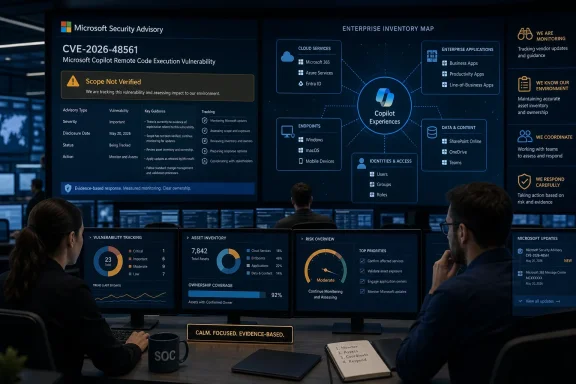 Known, Unknown, and Actions
The verified facts are narrow. Keeping them separate from assumptions prevents both unnecessary disruption and delayed response.Known
- The identifier is CVE-2026-48561.
- The exact title is “Microsoft Copilot Remote Code Execution Vulnerability.”
- Microsoft published it on July 14, 2026, at 7:00 a.m. Pacific time.
- The advisory URL is Security Update Guide - Microsoft Security Response Center.
Unknown
The available advisory data verified for this article does not establish:- The affected Microsoft product or Copilot implementation
- Affected versions, builds, editions, platforms, or deployment models
- Whether the vulnerable component is on an endpoint, in a hosted service, in an application, or in customer-operated integration code
- Whether authentication, user interaction, special configuration, or access to particular content is required
- The execution location or privilege level obtained after successful exploitation
- A severity rating, CVSS score, exploitability assessment, or active-exploitation status
- A patch, fixed version, service-side correction, workaround, or mitigation
- A knowledge base article, update package, restart requirement, or deployment deadline
- A weakness category, root cause, proof of concept, or detection method
Actions
Administrators should track the CVE without guessing which systems are vulnerable. Assign an owner, preserve the Microsoft Security Response Center advisory as the authoritative tracking location, review relevant Microsoft administrative notices, and document Copilot deployments and their service owners. Do not deploy unrelated updates, invent detection rules, or disable services solely because their names include “Copilot.”The CVE Title Identifies an Outcome, Not an Attack Route
Remote code execution, or RCE, is an impact category rather than a complete attack narrative. In general security usage, RCE means that a vulnerability can result in code running in an execution environment through input or interaction originating outside that environment. The practical risk depends on conditions that a title alone cannot answer.For example, an RCE vulnerability might be reachable over a network, through a document or message, through authenticated access, through a local application receiving remote content, or through an integration that processes externally controlled data. It might require user interaction or a nondefault feature. Code might execute in a restricted process, under a signed-in user, under a service identity, or in another environment entirely.
Those examples are general RCE context, not claims about CVE-2026-48561. No particular route, prerequisite, execution context, or privilege level should be attached to this CVE without verified Microsoft information.
This distinction should shape executive reporting. The title warrants attention because RCE can be consequential, but it does not support labels such as “zero-click,” “unauthenticated,” “wormable,” “Internet-exposed,” “critical,” or “actively exploited.” It also does not support the opposite conclusion that the issue is difficult to exploit, narrowly contained, or harmless in default configurations.
Security teams should use the precise language available: Microsoft published a CVE titled “Microsoft Copilot Remote Code Execution Vulnerability,” while the operational scope and remediation are not verified.
“Copilot” Is Not an Inventory Boundary
The strongest practical lesson for administrators is that “Copilot” is a product name or brand reference, not a sufficiently precise asset category. An enterprise inventory cannot reliably answer “Do we run Copilot?” with one device count or one software version.Organizations may encounter the Copilot name in endpoint software, Microsoft-hosted services, business applications, development projects, or custom integrations. That is general deployment context and does not establish which, if any, of those categories is affected by CVE-2026-48561.
Until Microsoft names the affected product and servicing path, response ownership should be organized by operational domain rather than by brand.
| Domain | Primary owner | Record now | Act when Microsoft identifies scope |
|---|---|---|---|
| Windows and endpoint software | Endpoint engineering or desktop management | Copilot-named applications and components visible in managed software inventories, device groups, update rings, and responsible administrators | Compare Microsoft’s affected-product and fixed-version data with managed devices; deploy only the applicable update or configuration change |
| Microsoft-hosted and Microsoft 365 services | Microsoft 365, cloud, or SaaS administration | Enabled services, tenant owners, administrative contacts, and relevant message-center monitoring responsibilities | Review Microsoft’s service notice and determine whether remediation is automatic or requires tenant action |
| Custom applications and integrations | Application security, platform engineering, or development teams | Projects that use Microsoft Copilot-related services or components, deployment locations, maintainers, and dependency owners | Match named components or dependencies to Microsoft’s scope; test and deploy vendor-directed updates or changes |
| Security monitoring and incident coordination | SOC, vulnerability management, and incident response | CVE tracking record, escalation contacts, log-retention status, and links to relevant asset owners | Add validated detections or hunting logic only after the affected component and useful indicators are known |
| Governance and business ownership | Security leadership and service owners | Business-critical deployments, operational dependencies, change-control contacts, and risk-acceptance authority | Prioritize remediation according to confirmed exposure, exploitability, and business impact |
It also avoids turning a broad inventory exercise into an emergency shutdown. Recording a Copilot-related deployment does not mean that deployment is vulnerable. It means the organization will be able to make a faster, evidence-based decision if Microsoft’s product scope matches it.
Do Now: A Bounded Procedure
The following steps are concrete and do not depend on an assumed attack path.- Assign a CVE owner.
Create or update the vulnerability-management record for CVE-2026-48561. Give one person or team responsibility for monitoring Microsoft’s information, coordinating internal owners, and documenting decisions. Record endpoint, cloud, application, and SOC contacts rather than leaving the issue with an unstaffed queue. - Bookmark and subscribe to the MSRC advisory.
Use Security Update Guide - Microsoft Security Response Center as the primary advisory location. Where organizational tooling permits, subscribe to Microsoft Security Response Center notifications or configure the vulnerability-management process to detect changes to the advisory data. Record when the page was last reviewed. - Check Microsoft administrative channels.
Review the Microsoft 365 admin center and relevant security message centers for notices associated with the CVE title, identifier, or a subsequently named product. Ensure the teams that normally receive Microsoft service-health and security communications know who will triage a matching notice. - Prepare endpoint-management review.
Identify the endpoint-management owners and update rings that would handle a Microsoft client or application update if Microsoft later names one. Do not change ring settings or deploy an unrelated package now. The goal is to know where an applicable update would be tested, approved, and released. - Record Copilot deployments and owners.
Build or update a concise list of Copilot-named services, applications, development projects, and integrations known to the organization. For each entry, record the business owner, technical owner, deployment type, management platform, and change-control contact. Do not treat inclusion on this list as evidence of exposure. - Set an escalation trigger.
Reassess when Microsoft identifies an affected product, affected version, fixed version, service action, mitigation, severity, or exploitation status. That trigger should move the item from monitoring to exposure analysis and, where applicable, remediation.
Patch Management Cannot Run on a CVE Title Alone
Enterprise patch programs depend on structured operational data. At minimum, administrators need an affected-product name and a way to distinguish vulnerable installations or service configurations from unaffected ones. They then need a remediation target: a fixed build, update package, configuration change, service action, or vendor statement that no customer action is required.Those elements are not verified here. As a result, a compliance team cannot yet define a meaningful deployment denominator, and endpoint administrators cannot produce an accurate installed-versus-remediated report. A dashboard that marks every device with a Copilot reference as vulnerable would be speculative. A dashboard that marks the CVE as resolved because routine Microsoft updates are current would be equally unsupported.
The appropriate interim status is “tracking—scope not verified,” or the equivalent used by the organization’s vulnerability-management system. The record should include the CVE identifier, exact title, publication time, advisory URL, assigned owner, last-review time, and next escalation condition.
Once Microsoft names a product, teams can use a normal decision sequence:
| Decision point | Required evidence | Administrative response |
|---|---|---|
| Is the named product present? | Asset inventory, tenant configuration, application dependency data, or vendor service notice | Identify potentially affected assets or services |
| Is the installed or hosted version affected? | Microsoft’s affected-version or service-scope statement | Remove unaffected assets from the response population |
| Is customer action required? | Microsoft remediation or service guidance | Select patching, configuration, investigation, or monitoring workflow |
| Is a fix available? | Fixed version, update package, or confirmed service correction | Test and deploy through the product’s normal servicing channel |
| Is exploitation known or likely? | Microsoft’s verified exploitability information or other validated reporting | Adjust priority, hunting, and incident-response posture |
| Has remediation succeeded? | Version, configuration, service status, or other vendor-defined verification | Close or continue tracking with documented evidence |
General RCE Preparedness Without CVE-Specific Assumptions
Although CVE-specific controls cannot be selected from the verified data, organizations can review standard RCE preparedness. These measures are baseline security practices, not evidence about CVE-2026-48561 and not substitutes for Microsoft’s eventual product-specific guidance.Least privilege limits what any compromised application, process, or service identity can do. Application and service accounts should have only the permissions required for their intended functions. Administrative rights, write access to sensitive locations, broad API permissions, and cross-system credentials should be reviewed through normal governance processes.
Segmentation and isolation can reduce the effect of code execution. Workloads that process untrusted or externally sourced input generally benefit from restricted access to management interfaces, sensitive data stores, and unrelated production systems. Any changes should follow existing architecture and change-control procedures rather than being presented as a CVE-specific mitigation.
Logging and retention should also follow established incident-readiness standards. Endpoint, identity, cloud, and application logs are useful only if they are enabled, retained for an appropriate period, and connected to asset and service ownership. No particular event identifier, process name, network destination, or hunting query is verified for this CVE, so the SOC should not promote speculative indicators as high-confidence detections.
Backups, recovery procedures, application allowlisting, endpoint protection, identity controls, and secure configuration remain relevant to general RCE resilience. They should be maintained because they reduce broad classes of risk, not because the available CVE title proves that a particular control blocks this vulnerability.
AI Context Must Not Be Mistaken for CVE Detail
AI-enabled applications can be surrounded by conventional software components: user interfaces, APIs, data-processing layers, identity systems, application services, and customer-developed integrations. As general security context, any system that turns external or generated input into a privileged operation needs strong validation, authorization, and isolation.That observation does not establish Copilot’s architecture, the presence of plugins or agents in the affected product, or the root cause of CVE-2026-48561. It would be speculative to claim that this vulnerability involves prompt injection, tool invocation, an extension boundary, command construction, path handling, memory safety, or an authorization error.
Likewise, the title does not show whether an AI model participates in exploitation or is merely associated by product naming with vulnerable conventional code. Engineering teams should wait for verified component and weakness information before choosing an AI-specific response.
This restraint matters because “AI vulnerability” can become an imprecise label. A manipulated model response is different from code execution, but the available facts do not explain how the title’s stated RCE impact is reached. Administrators should avoid filling that gap with familiar AI-security scenarios.
The useful architectural exercise is therefore limited and clearly labeled: document where Copilot-related deployments exist, who operates them, and which team controls changes. Do not assume that files, connectors, extensions, plugins, agents, or tools are involved in this CVE unless Microsoft identifies them.
Monitoring Timeline and Escalation
A small timeline keeps the response active without creating false urgency.| Stage | Status or trigger | Required action |
|---|---|---|
| Publication | July 14, 2026, at 7:00 a.m. Pacific time | Open the tracking record, assign an owner, and save the advisory URL |
| Current review | Product scope and remediation are not verified for this article | Inventory relevant deployments and monitor Microsoft channels |
| Product identified | Microsoft names an affected product or service | Route the issue to the matching endpoint, cloud, or application owner |
| Versions or conditions identified | Microsoft provides affected versions, configurations, or prerequisites | Determine actual exposure and prioritize affected assets |
| Remediation identified | Microsoft provides an update, fixed version, service action, or mitigation | Test, approve, deploy, and verify through the applicable servicing process |
| Exploitation information identified | Microsoft or another reliable source provides a validated assessment | Adjust urgency and begin evidence-based hunting or incident response as warranted |
| Closure | Remediation and verification criteria are satisfied | Document evidence, exceptions, residual risk, and lessons learned |
Admin Checklist
- [ ] Create or update the record for CVE-2026-48561.
- [ ] Preserve the exact title: “Microsoft Copilot Remote Code Execution Vulnerability.”
- [ ] Record the July 14, 2026, 7:00 a.m. Pacific publication time.
- [ ] Bookmark Security Update Guide - Microsoft Security Response Center.
- [ ] Assign one coordinating owner and named endpoint, cloud, application, and SOC contacts.
- [ ] Check Microsoft 365 administrative and security message centers.
- [ ] Confirm who manages relevant endpoint update rings.
- [ ] Record known Copilot deployments, deployment types, and service owners.
- [ ] Mark affected product, version, severity, exploitability, patch, and mitigation as unverified.
- [ ] Do not publish speculative exposure counts.
- [ ] Do not deploy unrelated updates or undocumented configuration changes.
- [ ] Reassess when Microsoft names an affected product or supplies remediation data.
- [ ] Use only vendor-confirmed detection and verification criteria for CVE-specific reporting.
- [ ] Keep general RCE hardening separate from claims about this vulnerability.
What CVE-2026-48561 Establishes Right Now
The operational position is simple: track the CVE, establish ownership, and prepare to scope it, but do not claim exposure or remediation without product-specific evidence.CVE-2026-48561 is titled “Microsoft Copilot Remote Code Execution Vulnerability.” Microsoft published it on July 14, 2026, at 7:00 a.m. Pacific time, and its advisory is at Security Update Guide - Microsoft Security Response Center.
No affected product, version, platform, patch, severity, exploitability assessment, attack requirement, execution privilege, or mitigation is verified from the available advisory data. Administrators therefore cannot yet determine which assets are exposed, calculate a credible remediation rate, or deploy a CVE-specific fix.
The next actionable development will be verified product scope or remediation information. When that arrives, organizations with a named CVE owner, mapped service responsibilities, monitored Microsoft channels, documented Copilot deployments, and prepared update workflows will be able to move quickly without relying on guesswork. Until then, disciplined tracking—not dramatic interpretation of the title—is the correct security response.
References
- Primary source: MSRC
Published: 2026-07-14T07:00:00-07:00
Security Update Guide - Microsoft Security Response Center
 msrc.microsoft.com
- Official source: microsoft.com
Updating our Vulnerability Severity Classification for AI Systems
www.microsoft.com
- Related coverage: techradar.com
Microsoft 365 Copilot can be turned into a one-click data theft tool — inbox, OneDrive, and SharePoint data all at risk, so patch now | TechRadar
Varonis found a way to chain three bugs into one exploitwww.techradar.com - Related coverage: windowscentral.com
Patched Microsoft Copilot Reprompt exploit stole user data | Windows Central
Varonis Threat Labs has published a report detailing a now-patched security exploit in Microsoft Copilot, allowing attackers to silently steal user data with a single link.www.windowscentral.com
