

Microsoft’s Cloud Mail Platform Gets a Vulnerability With Too Little Public Shape
CVE-2026-48579 arrives with a title that is both clear and frustrating: Microsoft Exchange Online Information Disclosure Vulnerability. It tells us the affected service family and the broad security impact, but not the data class, exploit path, tenant boundary conditions, or whether exploitation requires authentication, user interaction, or a specific Exchange Online feature configuration.
That lack of detail is not unusual for a fresh cloud-service CVE. Vendors often publish the minimum needed to alert customers while withholding mechanics that could accelerate attacker reproduction. In a service like Exchange Online, that restraint is especially understandable because the same platform hosts mailboxes, calendars, identities, transport rules, compliance workflows, and discovery functions for organizations that range from five-person firms to national institutions.
But the thinness of the public record creates a problem for IT teams. “Information disclosure” can mean anything from a narrow metadata leak to exposure of sensitive message content or administrative data. Without a CVSS vector, exploitability assessment, or mitigation note in front of them, defenders are left doing what cloud security often requires: translating vendor shorthand into operational caution.
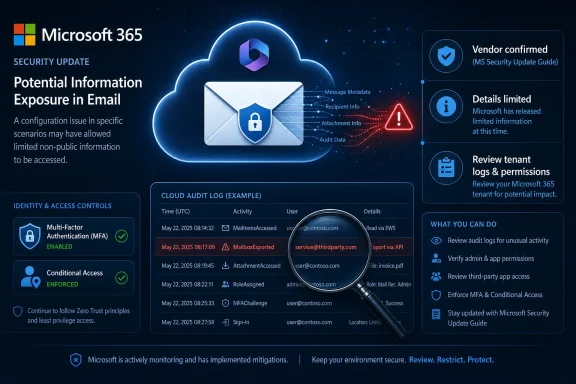
The supplied MSRC language around confidence matters here. Microsoft’s advisory framework distinguishes between a vulnerability that is merely rumored, one that has partial technical corroboration, and one that is confirmed by the vendor or author of the affected technology. In this case, the presence of a named CVE in Microsoft’s own Security Update Guide places the issue on the confirmed side of that spectrum, even if the public details are sparse.
The Confidence Metric Is a Risk Signal, Not a Footnote
The description provided with the advisory explains a metric that many administrators skim past: confidence in the existence of the vulnerability and credibility of known technical details. That sounds academic until a team is deciding whether to wake people up, alter monitoring, brief executives, or wait for richer data.
In vulnerability management, uncertainty is not the same thing as low risk. A bug can be under-described because it is speculative, but it can also be under-described because the vendor knows exactly what went wrong and does not want to hand attackers a recipe. The confidence metric is meant to help separate those cases.
For CVE-2026-48579, the useful reading is that Microsoft has acknowledged the issue in its own advisory system. That gives it more weight than a social-media rumor, a scanner artifact, or a third-party database entry with no vendor confirmation. It does not, however, automatically tell us the blast radius.
That distinction is where seasoned Exchange administrators should slow down. The existence of the vulnerability is credible; the operational details remain incomplete. Treating the CVE as imaginary would be reckless, but treating it as a fully understood incident would be just as sloppy.
Exchange Online Changes the Patch Tuesday Muscle Memory
Exchange Server vulnerabilities usually send administrators into a familiar sequence: identify versions, read the Exchange Team blog, test cumulative updates, schedule maintenance, validate Emergency Mitigation Service status, and check for indicators of compromise. Exchange Online breaks that model.
In Microsoft 365, customers generally do not apply a security update to Exchange Online. Microsoft operates the service, ships the fix, and controls the underlying deployment. For administrators, the job shifts from patch execution to exposure management, audit review, and tenant hygiene.
That can feel like a relief, and sometimes it is. There is no forgotten CAS server sitting in a branch office, no ancient cumulative update blocking the security update, and no load balancer maintenance window standing between the organization and remediation. But there is also less local telemetry and less control over the fix path.
This is the paradox of cloud security advisories. Microsoft may be able to remediate faster than almost any customer could patch on-premises infrastructure, yet customers may receive fewer technical artifacts to validate what happened. The admin’s role becomes less about applying the fix and more about asking whether tenant data, logs, and permissions tell a story worth investigating.
Information Disclosure Is the Quiet Class of Exchange Risk
Remote code execution gets the headlines because it is cinematic. Information disclosure is quieter, and that quiet is dangerous. Mail systems are not just communications tools; they are organizational memory banks.
Exchange Online mailboxes can contain invoices, contracts, privileged reset links, HR conversations, legal discussions, authentication prompts, Teams meeting artifacts, calendar intelligence, and third-party SaaS notifications. Even a constrained disclosure flaw can become valuable if it exposes the right metadata or content to the wrong party.
The phrase “information disclosure” also covers a wide spectrum of failure modes. It may involve cross-tenant isolation, improper authorization, excessive error output, token leakage, unintended message visibility, directory data exposure, or service-side logging artifacts. The advisory title alone does not identify which class applies here.
That ambiguity should shape, not paralyze, the response. Defenders should avoid inventing a worst-case scenario without evidence, but they should also reject the lazy assumption that confidentiality bugs are low priority. In enterprise email, confidentiality is often the crown jewel.
The Real Exposure May Be in Tenant Configuration
Cloud vulnerabilities do not land on a blank slate. They land inside tenants with different licensing, retention policies, external sharing patterns, mail flow rules, app registrations, OAuth grants, administrative roles, and conditional access coverage. Those differences can determine whether a platform bug is merely concerning or operationally serious.
For Exchange Online, the most important surrounding controls are often identity controls. Multifactor authentication, conditional access, session controls, least-privilege administration, and alerting on unusual mailbox access all reduce the chance that a disclosure flaw becomes part of a broader intrusion. They also improve the organization’s ability to determine whether something suspicious happened.
Mailbox audit logging is another practical dividing line. If an advisory later reveals that a vulnerability could expose mailbox content or metadata under specific conditions, organizations with robust audit retention will be in a better position than those relying on default assumptions. Cloud remediation does not replace evidence.
This is where the Microsoft 365 admin center and Purview audit tooling become part of the security response, even before Microsoft publishes deeper technical notes. A cloud-service CVE is not always something you patch, but it is almost always something you contextualize against your tenant.
The Shadow of On-Prem Exchange Still Shapes the Reaction
Exchange has a long memory in security circles. ProxyLogon, ProxyShell, and later Exchange Server incidents trained administrators to treat any Exchange CVE as potentially urgent. That reflex is understandable, but CVE-2026-48579 should not be collapsed into the on-premises history without evidence.
This advisory concerns Exchange Online, not necessarily Exchange Server. That distinction matters because the service model, patch path, and customer responsibilities differ sharply. An on-premises Exchange vulnerability can leave thousands of individually managed servers exposed across the internet; a cloud Exchange vulnerability is typically remediated centrally by Microsoft, even though tenants may still need to review logs and settings.
At the same time, cloud Exchange is not magically immune to serious bugs. Microsoft 365’s scale means a flaw in a shared service can have broad implications, and the sensitivity of hosted email makes confidentiality defects especially important. The risk is different, not nonexistent.
The better comparison is not “cloud safe, server dangerous.” It is “server customers own more of the patching risk, cloud customers own more of the visibility gap.” CVE-2026-48579 sits squarely in that second category.
Microsoft’s Sparse Disclosure Is Defensible, but It Raises the Cost of Trust
Microsoft has reasonable incentives to avoid publishing exploit mechanics too early. If the vulnerability is already fixed or being remediated across the service, technical restraint can reduce copycat activity and protect customers who cannot take independent action anyway. That is the charitable reading, and often the correct one.
But sparse disclosure also asks customers to trust that the vendor has scoped the issue properly, remediated it fully, and will say more if customer action is required. For a platform as central as Exchange Online, that trust is not abstract. It affects incident response decisions, board reporting, cyber-insurance narratives, and customer communications.
The minimum useful disclosure for a cloud vulnerability is not necessarily proof-of-concept detail. It is clarity about whether customers need to act. Administrators need to know whether to rotate credentials, review audit logs, disable a feature, check for suspicious mailbox access, or simply record the advisory and move on.
Until that clarity appears, the responsible posture is measured vigilance. Do not treat CVE-2026-48579 as a confirmed breach. Do not treat it as noise either.
Administrators Should Work the Edges They Control
For most organizations, there will be no Exchange Online patch package to deploy. That does not mean there is nothing to do. It means the work moves to controls, logs, and readiness.
Start with Microsoft 365 service health and message center posts, because cloud advisories often gain practical instructions there before they become richly documented public CVE entries. Then review audit coverage for Exchange activity, especially mailbox access, administrative actions, transport rule changes, inbox rule creation, and unusual application access.
Organizations should also inventory privileged Exchange roles and app permissions. Excessive application consent remains one of the most common ways a mailbox incident becomes durable. If a disclosure flaw intersects with overbroad OAuth grants or stale administrative access, the platform bug becomes only part of the problem.
The goal is not to perform security theater around a vague advisory. The goal is to make sure that if Microsoft later publishes more specific impact criteria, the tenant is already in a defensible state.
The Practical Read for WindowsForum Readers
CVE-2026-48579 is the kind of advisory that rewards calm operators and punishes both extremes. Panic produces speculation; complacency produces blind spots. The useful path is to recognize Microsoft’s acknowledgement as meaningful while waiting for the technical picture to sharpen.
For Windows enthusiasts and lab builders, the interesting wrinkle is that this is not a local Exchange Server maintenance problem. For sysadmins, the important wrinkle is that cloud does not eliminate vulnerability management; it changes where the work happens. For security teams, the advisory is a reminder that confidentiality bugs in email systems deserve more respect than their often-muted severity labels suggest.
- Microsoft has identified CVE-2026-48579 as an Exchange Online information disclosure vulnerability, so the issue should be treated as vendor-confirmed rather than speculative.
- Public technical details remain limited, which means administrators should avoid making assumptions about exploit path, affected data, or tenant-specific exposure.
- Exchange Online customers generally depend on Microsoft for service-side remediation, but they still control audit readiness, identity policy, app permissions, and incident review.
- The “information disclosure” label should not be dismissed, because enterprise mailboxes routinely contain credentials, legal material, business negotiations, and sensitive operational data.
- Hybrid and Microsoft 365 administrators should monitor official service communications for customer actions, especially any guidance involving logs, permissions, or configuration changes.
CVE-2026-48579 is a small entry in Microsoft’s enormous security machinery, but it captures the larger bargain of modern enterprise IT: customers get faster centralized fixes, while surrendering some of the mechanical certainty that came with owning the server. The next useful update from Microsoft will not be the one that satisfies curiosity about root cause; it will be the one that tells administrators exactly what, if anything, they must verify inside their own tenants.
References
- CVE-2026-48579 Microsoft Exchange Online Information Disclosure Vulnerability MSRC · 2026-06-04T07:00:00-07:00