On June 16, 2026, CISA added CVE-2026-48907, an actively exploited improper access control flaw in the Widget Factory Joomla Content Editor, to its Known Exploited Vulnerabilities Catalog, warning federal agencies and private defenders to prioritize remediation where exposed systems are at risk. The notice is short, but the implication is not: another content-management component has crossed from theoretical vulnerability to active attacker utility. For WindowsForum readers, the product name may sound far from the Microsoft stack, yet the operational lesson lands squarely in every mixed environment. The edge is still where patching discipline goes to be tested.
CISA’s KEV updates can look formulaic by design. A new CVE appears, the agency states there is evidence of exploitation, federal agencies receive their binding remediation requirements, and everyone else is “encouraged” to treat the catalog as a practical priority list. That repetition is easy to skim past, especially when the affected product is not Windows, Exchange, SharePoint, or a familiar endpoint agent.
That would be a mistake here. CVE-2026-48907 sits in the uncomfortable category of web-facing software defects that do not need a grand campaign, a nation-state attribution, or a carefully staged phishing operation to become dangerous. If a vulnerable Joomla site is reachable, and the flaw enables an unauthenticated path toward PHP upload and execution as public reporting indicates, the defensive clock starts before most organizations have even identified ownership of the site.
The KEV catalog is not supposed to be a comprehensive list of scary bugs. It is supposed to be a list of bugs that attackers are already using. That distinction matters because it shifts the conversation from “How bad could this be?” to “Where is this present, exposed, and valuable enough to clean up now?”
In that sense, this alert is less about one Joomla extension than about the maturation of vulnerability management. The old patch-everything sermon has been replaced by a colder triage model: patch what is being exploited, patch what is exposed, and patch what gives an attacker control.
That is where vulnerabilities like CVE-2026-48907 become strategically interesting. A Joomla extension is rarely the crown jewel. It is more often the side door: a public-facing application with a plugin ecosystem, a writable web root, legacy content, and enough server-side capability to turn a simple bug into a foothold.
For attackers, the appeal is obvious. CMS plugins are widely deployed, unevenly maintained, and often operated outside the central IT rhythm. They may not be covered by the same patch windows as Windows Server, the same configuration baselines as Microsoft 365, or the same emergency procedures as a domain controller. Yet they sit on the same internet and can lead to the same internal trust relationships.
The “forgotten endpoint” is not necessarily a PC. It is anything with code execution, credentials, network adjacency, and poor ownership. A vulnerable CMS extension checks too many of those boxes.
In a content editor, administrative features are powerful by necessity. They may define profiles, govern file handling, adjust upload permissions, and shape what a user can embed into a page. If an unauthenticated attacker can reach a workflow meant for trusted users, the product’s normal capabilities can become the exploit chain.
That is the ugly elegance of many CMS attacks. The attacker does not always need memory corruption or a novel sandbox escape. They need the application to let them do, without permission, what the administrator can already do by design.
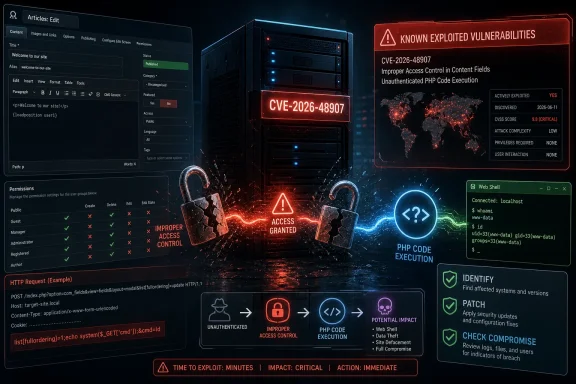
In the case of CVE-2026-48907, public vulnerability descriptions indicate that the JCE editor extension for Joomla can allow creation of new editor profiles by unauthenticated users, ultimately leading to PHP upload and execution. If that description holds in real-world deployments, defenders should treat the vulnerability as more than a permissions bug. They should treat it as a plausible path to web shell deployment.
And once a web shell exists, patching is only half the answer. The vulnerable code path may be closed, but the intruder’s persistence may remain.
That last piece is the part many organizations historically underfund. The patch team closes the ticket. The scanner stops complaining. Compliance goes green. But if exploitation happened before remediation, the security incident is still alive.
BOD 26-04’s direction that agencies check whether threat actors compromised a system before the patch was applied is a recognition of reality. A known exploited vulnerability is not just a maintenance defect. It is a possible crime scene.
This is especially true for web application flaws that can lead to file upload or command execution. A patch may prevent the next upload, but it does not remove a web shell already placed in a writable directory. It does not rotate stolen credentials. It does not invalidate API keys, clean malicious scheduled tasks, or explain outbound traffic that began before the change window.
For private-sector defenders, the directive is not binding. But as with earlier CISA guidance, federal policy often becomes a useful benchmark for everyone else. If an internet-facing asset has a KEV-listed flaw that could give attackers control, “we patched it” is no longer a complete sentence.
That does not mean every KEV entry deserves the same response in every network. A vulnerability in a product you do not run is irrelevant. A flaw buried behind compensating controls may be less urgent than one exposed directly to the internet. But KEV membership should accelerate the discussion and shorten the tolerance for ambiguity.
This is where many organizations still struggle. Asset inventory is supposed to answer the first question: do we have this? Exposure management is supposed to answer the second: can attackers reach it? Detection engineering is supposed to answer the third: would we know if they tried? Incident response is supposed to answer the fourth: what did they do before we fixed it?
The Joomla alert pressures all four disciplines at once. If the organization cannot identify Joomla installations and installed extensions, it cannot scope the vulnerability. If it cannot determine exposure, it cannot prioritize remediation. If it cannot review logs and file changes, it cannot distinguish patched from clean.
The weakness is rarely the absence of a patch. It is the absence of a system that can turn an external warning into an internal answer quickly.
That makes a Joomla extension vulnerability relevant even to admins who never log into Joomla. The Windows domain may still hold service accounts used by the website. The site may send mail through Microsoft 365. The server may authenticate to internal APIs. The marketing database may export to a Windows file share. The compromise path does not care about the org chart.
The same pattern applies to WordPress plugins, Magento extensions, Drupal modules, cPanel add-ons, and countless vendor portals. Plugin ecosystems make platforms useful, but they also multiply trust relationships. Every extension adds code, privilege, update cadence, and a maintainer whose security practices may be invisible to the customer.
That is why “we do not run Joomla” should not be the end of the conversation. The better question is whether the organization has a current list of internet-facing CMS instances and their extensions. If the answer is no, the next KEV entry will simply change the product name.
That split is where remediation slows down. Nobody wants to break the site. Nobody knows whether the extension update is compatible. Nobody knows whether the original developer still supports the template. The ticket sits while exploitation continues.
CISA’s KEV model cuts through some of that hesitation. It says, effectively, that active exploitation changes the calculus. Compatibility testing still matters, but it cannot become an indefinite veto. If a vulnerable component is exposed and can yield control of the asset, the business risk of patching must be weighed against the security risk of delay.
There is also a cultural problem. Organizations often treat CMS sites as publishing tools rather than application servers. But a CMS with upload capability, server-side scripting, authentication, and database access is an application server. It deserves the same vulnerability management, backup strategy, logging, and incident-response planning as any other production system.
The attackers have understood this for years. Defenders are still catching up.
The first step is scoping. Teams need to know where Joomla is deployed, whether the JCE editor extension is installed, what version is running, and whether the affected functionality is reachable from the public internet. That inventory may require scanning, hosting-provider queries, configuration management checks, and conversations with web teams that do not normally sit inside security operations.
The second step is containment by priority. Public-facing systems come first. Systems with upload capability, writable directories, or elevated privileges come before internal test boxes. Sites connected to customer data, payment flows, identity providers, or internal APIs deserve the tightest scrutiny.
The third step is compromise assessment. For a vulnerability that may allow PHP upload and execution, defenders should review web roots for unfamiliar PHP files, recently modified content, unexpected editor profiles, suspicious uploads, anomalous administrator accounts, and outbound connections from the web server. Web server logs, application logs, file integrity monitoring, endpoint telemetry, and hosting control-panel records all matter.
This is where Windows-centric shops should pay attention. A compromised Linux-hosted CMS can still produce Windows-relevant fallout: stolen SMTP credentials, poisoned downloads served to Windows users, malicious redirects, credential harvesting pages, or pivot attempts against internal services. The blast radius is defined by connectivity and trust, not by operating system branding.
That matters because internet-scale exploitation has become fast and industrialized. Once a reliable route to web shell upload is documented, botnets and criminal crews do not need deep knowledge of the target. They need a scanner, a request sequence, and a monetization path.
The monetization path may be spam, SEO poisoning, credential theft, malware staging, cryptomining, resale of access, or use of the host as infrastructure for later attacks. Small sites are not spared because they are unimportant. They are targeted because they are cheap to compromise and useful in bulk.
A KEV listing does not create that attacker interest; it confirms that exploitation has crossed the threshold CISA cares about. By the time the catalog entry appears, the race has usually already started.
BOD 26-04 pushes that idea further by emphasizing high-risk vulnerabilities on publicly exposed assets that grant total control after exploitation. That phrasing is important because it connects three dimensions that are often handled separately: exploit activity, exposure, and impact.
CVE-2026-48907 appears to fit the spirit of that model neatly. It is reportedly exploited in the wild. It affects a web-facing CMS extension. Public descriptions indicate a path to PHP code upload and execution. That combination should move it near the top of the queue for any organization running the affected software.
The point is not that every vulnerability in a CMS extension is catastrophic. The point is that once active exploitation and code execution enter the picture, waiting for a monthly maintenance window becomes a business decision, not just an IT scheduling preference.
Risk-based patching is sometimes misused as a polite phrase for patching less. In its better form, it means patching the dangerous things faster and investigating them more deeply. CISA’s latest update is an argument for the better form.
Web logs may have rotated. Shared hosting may limit visibility. File timestamps may be unreliable after backups or deployments. The CMS itself may not log the administrative action that matters. A vendor may insist everything is fine without providing artifacts.
That does not make compromise assessment optional. It means defenders need to define what evidence is available and what confidence it supports. If logs are missing, say so. If file integrity monitoring was not enabled, say so. If the site was exposed and vulnerable during a known exploitation window, treat that as a risk condition rather than a paperwork nuisance.
The best response will be layered. Patch the extension. Search for suspicious files. Review accounts and profiles. Rotate secrets used by the site. Check outbound traffic. Rebuild from clean media if the evidence suggests server-side compromise. Preserve logs where possible.
The worst response is the familiar one: update the plugin, close the ticket, and hope the attacker did not arrive first.
Many organizations already have sophisticated tooling for Microsoft assets. They can report missing Windows updates, enforce Defender policies, audit Entra ID sign-ins, and manage server configuration at scale. Yet the public CMS estate may live in spreadsheets, vendor invoices, DNS records, or memory.
That mismatch is increasingly indefensible. The public web edge is not a decorative layer around the “real” enterprise. It is part of the attack surface, part of the brand, and often part of the data path. Attackers do not care whether the compromised server is fashionable in the IT department.
There is a practical way forward. Security teams should fold CMS platforms and extensions into the same exposure-management programs used for appliances, VPNs, and remote-access systems. Asset discovery should include HTTP fingerprints and plugin detection where legal and appropriate. Procurement should require update commitments from web vendors. Incident response should include CMS-specific checks.
The goal is not perfection. It is reducing the time between “CISA says this is being exploited” and “we know whether we run it, where it is exposed, whether it is patched, and whether there are signs of compromise.”
Over time, the catalog has become more than a feed for vulnerability scanners. It is a governance instrument. It gives security leaders a defensible way to escalate patching. It gives auditors a concrete set of questions. It gives administrators a reason to interrupt routine maintenance cycles when the risk justifies it.
BOD 26-04 strengthens that role by tying remediation to exposure and potential control of the asset. That is a more mature model than treating every listed CVE identically. It also reflects the reality that federal agencies, like private enterprises, cannot patch every flaw instantly across every system.
The danger is that organizations turn KEV into another checkbox. A vulnerability appears, a patch ticket is created, and success is measured by closure date alone. That misses the catalog’s real value, which is prioritizing the vulnerabilities most likely to already be part of an attack.
CVE-2026-48907 is therefore a useful test case. The remediation is not just “upgrade the Joomla extension.” It is “prove that the exposed web estate is known, updated, and not already carrying attacker residue.”
The concrete work is narrow enough to start today and important enough not to defer:
The next KEV entry may be a Windows flaw, a VPN bug, a browser exploit, a backup appliance weakness, or another CMS plugin most administrators have never heard of. The pattern will be the same: attackers will find the exposed, under-owned systems first, and defenders will be judged by how fast they can turn a public warning into verified local action. CVE-2026-48907 is a reminder that modern vulnerability management is no longer about patching the most famous software; it is about finding the quiet component that gives an attacker control before the attacker finds it again.
 CISA’s Smallest Alerts Are Often the Ones That Matter Most
CISA’s KEV updates can look formulaic by design. A new CVE appears, the agency states there is evidence of exploitation, federal agencies receive their binding remediation requirements, and everyone else is “encouraged” to treat the catalog as a practical priority list. That repetition is easy to skim past, especially when the affected product is not Windows, Exchange, SharePoint, or a familiar endpoint agent.That would be a mistake here. CVE-2026-48907 sits in the uncomfortable category of web-facing software defects that do not need a grand campaign, a nation-state attribution, or a carefully staged phishing operation to become dangerous. If a vulnerable Joomla site is reachable, and the flaw enables an unauthenticated path toward PHP upload and execution as public reporting indicates, the defensive clock starts before most organizations have even identified ownership of the site.
The KEV catalog is not supposed to be a comprehensive list of scary bugs. It is supposed to be a list of bugs that attackers are already using. That distinction matters because it shifts the conversation from “How bad could this be?” to “Where is this present, exposed, and valuable enough to clean up now?”
In that sense, this alert is less about one Joomla extension than about the maturation of vulnerability management. The old patch-everything sermon has been replaced by a colder triage model: patch what is being exploited, patch what is exposed, and patch what gives an attacker control.
The Web Server Has Become the Forgotten Endpoint
Windows administrators have spent years improving endpoint visibility, identity logging, and update compliance. They know which laptops are missing cumulative updates, which servers have Defender alerts, and which privileged accounts tripped conditional access policy. But many organizations still have a blind spot around small web properties: campaign microsites, department-run portals, vendor-managed CMS installs, and half-retired public pages that nobody quite owns.That is where vulnerabilities like CVE-2026-48907 become strategically interesting. A Joomla extension is rarely the crown jewel. It is more often the side door: a public-facing application with a plugin ecosystem, a writable web root, legacy content, and enough server-side capability to turn a simple bug into a foothold.
For attackers, the appeal is obvious. CMS plugins are widely deployed, unevenly maintained, and often operated outside the central IT rhythm. They may not be covered by the same patch windows as Windows Server, the same configuration baselines as Microsoft 365, or the same emergency procedures as a domain controller. Yet they sit on the same internet and can lead to the same internal trust relationships.
The “forgotten endpoint” is not necessarily a PC. It is anything with code execution, credentials, network adjacency, and poor ownership. A vulnerable CMS extension checks too many of those boxes.
Improper Access Control Is Boring Until It Becomes Remote Code Execution
The vulnerability class named by CISA — improper access control — sounds almost bureaucratic. It does not have the visceral clarity of “remote code execution,” “wormable,” or “zero-click.” But access control is where many serious web compromises begin, because the real question is not whether a feature exists; it is who can invoke it.In a content editor, administrative features are powerful by necessity. They may define profiles, govern file handling, adjust upload permissions, and shape what a user can embed into a page. If an unauthenticated attacker can reach a workflow meant for trusted users, the product’s normal capabilities can become the exploit chain.
That is the ugly elegance of many CMS attacks. The attacker does not always need memory corruption or a novel sandbox escape. They need the application to let them do, without permission, what the administrator can already do by design.
In the case of CVE-2026-48907, public vulnerability descriptions indicate that the JCE editor extension for Joomla can allow creation of new editor profiles by unauthenticated users, ultimately leading to PHP upload and execution. If that description holds in real-world deployments, defenders should treat the vulnerability as more than a permissions bug. They should treat it as a plausible path to web shell deployment.
And once a web shell exists, patching is only half the answer. The vulnerable code path may be closed, but the intruder’s persistence may remain.
BOD 26-04 Turns KEV From a List Into a Workflow
CISA’s notice explicitly ties the update to Binding Operational Directive 26-04, the successor framework that updates the earlier BOD 22-01 model. That shift is important. The original KEV regime helped force federal agencies to remediate known exploited vulnerabilities on a schedule. BOD 26-04 sharpens the concept by emphasizing risk-based prioritization, exposed assets, and post-exploitation checks.That last piece is the part many organizations historically underfund. The patch team closes the ticket. The scanner stops complaining. Compliance goes green. But if exploitation happened before remediation, the security incident is still alive.
BOD 26-04’s direction that agencies check whether threat actors compromised a system before the patch was applied is a recognition of reality. A known exploited vulnerability is not just a maintenance defect. It is a possible crime scene.
This is especially true for web application flaws that can lead to file upload or command execution. A patch may prevent the next upload, but it does not remove a web shell already placed in a writable directory. It does not rotate stolen credentials. It does not invalidate API keys, clean malicious scheduled tasks, or explain outbound traffic that began before the change window.
For private-sector defenders, the directive is not binding. But as with earlier CISA guidance, federal policy often becomes a useful benchmark for everyone else. If an internet-facing asset has a KEV-listed flaw that could give attackers control, “we patched it” is no longer a complete sentence.
The Federal Enterprise Is the Floor, Not the Ceiling
CISA’s language always draws a legal boundary: Binding Operational Directives apply to Federal Civilian Executive Branch agencies. That caveat is necessary, but it can obscure the broader effect of the KEV catalog. The catalog has become one of the industry’s most useful filters because it combines a simple criterion with high operational value: there is evidence attackers are using this vulnerability.That does not mean every KEV entry deserves the same response in every network. A vulnerability in a product you do not run is irrelevant. A flaw buried behind compensating controls may be less urgent than one exposed directly to the internet. But KEV membership should accelerate the discussion and shorten the tolerance for ambiguity.
This is where many organizations still struggle. Asset inventory is supposed to answer the first question: do we have this? Exposure management is supposed to answer the second: can attackers reach it? Detection engineering is supposed to answer the third: would we know if they tried? Incident response is supposed to answer the fourth: what did they do before we fixed it?
The Joomla alert pressures all four disciplines at once. If the organization cannot identify Joomla installations and installed extensions, it cannot scope the vulnerability. If it cannot determine exposure, it cannot prioritize remediation. If it cannot review logs and file changes, it cannot distinguish patched from clean.
The weakness is rarely the absence of a patch. It is the absence of a system that can turn an external warning into an internal answer quickly.
Joomla May Not Be Your Platform, but Plugin Risk Is Everyone’s Platform
WindowsForum readers live in a world where Microsoft products dominate the identity layer, endpoint estate, productivity suite, and much of the server room. But almost no real environment is Microsoft-only. Public web infrastructure is often a patchwork of Linux hosts, PHP applications, reverse proxies, CDN rules, managed hosting panels, and third-party extensions chosen years ago by teams that have since reorganized.That makes a Joomla extension vulnerability relevant even to admins who never log into Joomla. The Windows domain may still hold service accounts used by the website. The site may send mail through Microsoft 365. The server may authenticate to internal APIs. The marketing database may export to a Windows file share. The compromise path does not care about the org chart.
The same pattern applies to WordPress plugins, Magento extensions, Drupal modules, cPanel add-ons, and countless vendor portals. Plugin ecosystems make platforms useful, but they also multiply trust relationships. Every extension adds code, privilege, update cadence, and a maintainer whose security practices may be invisible to the customer.
That is why “we do not run Joomla” should not be the end of the conversation. The better question is whether the organization has a current list of internet-facing CMS instances and their extensions. If the answer is no, the next KEV entry will simply change the product name.
Attackers Love the Space Between Ownership and Operations
A CMS site often has at least three owners and none of them fully own security. The business team owns the content. A web agency or vendor owns the design. Infrastructure owns the server, if it is not on shared hosting. Security owns the risk but may not have administrative access.That split is where remediation slows down. Nobody wants to break the site. Nobody knows whether the extension update is compatible. Nobody knows whether the original developer still supports the template. The ticket sits while exploitation continues.
CISA’s KEV model cuts through some of that hesitation. It says, effectively, that active exploitation changes the calculus. Compatibility testing still matters, but it cannot become an indefinite veto. If a vulnerable component is exposed and can yield control of the asset, the business risk of patching must be weighed against the security risk of delay.
There is also a cultural problem. Organizations often treat CMS sites as publishing tools rather than application servers. But a CMS with upload capability, server-side scripting, authentication, and database access is an application server. It deserves the same vulnerability management, backup strategy, logging, and incident-response planning as any other production system.
The attackers have understood this for years. Defenders are still catching up.
The Patch Window Is No Longer the Finish Line
For CVE-2026-48907, the immediate remediation path is straightforward in principle: identify affected Joomla Content Editor installations, update to a fixed version, and remove exposure where the component is not needed. But the operational response should not stop there.The first step is scoping. Teams need to know where Joomla is deployed, whether the JCE editor extension is installed, what version is running, and whether the affected functionality is reachable from the public internet. That inventory may require scanning, hosting-provider queries, configuration management checks, and conversations with web teams that do not normally sit inside security operations.
The second step is containment by priority. Public-facing systems come first. Systems with upload capability, writable directories, or elevated privileges come before internal test boxes. Sites connected to customer data, payment flows, identity providers, or internal APIs deserve the tightest scrutiny.
The third step is compromise assessment. For a vulnerability that may allow PHP upload and execution, defenders should review web roots for unfamiliar PHP files, recently modified content, unexpected editor profiles, suspicious uploads, anomalous administrator accounts, and outbound connections from the web server. Web server logs, application logs, file integrity monitoring, endpoint telemetry, and hosting control-panel records all matter.
This is where Windows-centric shops should pay attention. A compromised Linux-hosted CMS can still produce Windows-relevant fallout: stolen SMTP credentials, poisoned downloads served to Windows users, malicious redirects, credential harvesting pages, or pivot attempts against internal services. The blast radius is defined by connectivity and trust, not by operating system branding.
Public Exploit Chatter Compresses the Defender’s Timeline
The vulnerability was already being discussed in public security channels before CISA’s KEV addition. Public reporting has described proof-of-concept availability and active exploitation against vulnerable Joomla sites. Even when individual reports vary in precision, the broad signal is clear enough: defenders should assume opportunistic scanning is underway.That matters because internet-scale exploitation has become fast and industrialized. Once a reliable route to web shell upload is documented, botnets and criminal crews do not need deep knowledge of the target. They need a scanner, a request sequence, and a monetization path.
The monetization path may be spam, SEO poisoning, credential theft, malware staging, cryptomining, resale of access, or use of the host as infrastructure for later attacks. Small sites are not spared because they are unimportant. They are targeted because they are cheap to compromise and useful in bulk.
A KEV listing does not create that attacker interest; it confirms that exploitation has crossed the threshold CISA cares about. By the time the catalog entry appears, the race has usually already started.
Risk-Based Patching Finally Has Teeth
Security teams have spent years arguing that CVSS alone is not enough. A high severity score can overstate risk for an unreachable component. A medium score can understate danger for a bug that is actively weaponized against exposed systems. The KEV catalog is one of the clearest institutional acknowledgments that exploit reality must shape patch priority.BOD 26-04 pushes that idea further by emphasizing high-risk vulnerabilities on publicly exposed assets that grant total control after exploitation. That phrasing is important because it connects three dimensions that are often handled separately: exploit activity, exposure, and impact.
CVE-2026-48907 appears to fit the spirit of that model neatly. It is reportedly exploited in the wild. It affects a web-facing CMS extension. Public descriptions indicate a path to PHP code upload and execution. That combination should move it near the top of the queue for any organization running the affected software.
The point is not that every vulnerability in a CMS extension is catastrophic. The point is that once active exploitation and code execution enter the picture, waiting for a monthly maintenance window becomes a business decision, not just an IT scheduling preference.
Risk-based patching is sometimes misused as a polite phrase for patching less. In its better form, it means patching the dangerous things faster and investigating them more deeply. CISA’s latest update is an argument for the better form.
Defenders Need Evidence, Not Assurances
The uncomfortable question after any KEV addition is whether the organization can prove non-exploitation. For a workstation vulnerability, the answer may come from endpoint telemetry. For a network appliance, it may come from vendor logs and packet captures. For a CMS extension, the evidence can be messier.Web logs may have rotated. Shared hosting may limit visibility. File timestamps may be unreliable after backups or deployments. The CMS itself may not log the administrative action that matters. A vendor may insist everything is fine without providing artifacts.
That does not make compromise assessment optional. It means defenders need to define what evidence is available and what confidence it supports. If logs are missing, say so. If file integrity monitoring was not enabled, say so. If the site was exposed and vulnerable during a known exploitation window, treat that as a risk condition rather than a paperwork nuisance.
The best response will be layered. Patch the extension. Search for suspicious files. Review accounts and profiles. Rotate secrets used by the site. Check outbound traffic. Rebuild from clean media if the evidence suggests server-side compromise. Preserve logs where possible.
The worst response is the familiar one: update the plugin, close the ticket, and hope the attacker did not arrive first.
The CMS Edge Deserves the Same Discipline as the Windows Core
For Windows-heavy environments, the lesson is not to become Joomla specialists overnight. It is to bring the discipline of enterprise endpoint and server management to the messy web edge. That means ownership, inventory, update channels, logging, backups, and incident playbooks.Many organizations already have sophisticated tooling for Microsoft assets. They can report missing Windows updates, enforce Defender policies, audit Entra ID sign-ins, and manage server configuration at scale. Yet the public CMS estate may live in spreadsheets, vendor invoices, DNS records, or memory.
That mismatch is increasingly indefensible. The public web edge is not a decorative layer around the “real” enterprise. It is part of the attack surface, part of the brand, and often part of the data path. Attackers do not care whether the compromised server is fashionable in the IT department.
There is a practical way forward. Security teams should fold CMS platforms and extensions into the same exposure-management programs used for appliances, VPNs, and remote-access systems. Asset discovery should include HTTP fingerprints and plugin detection where legal and appropriate. Procurement should require update commitments from web vendors. Incident response should include CMS-specific checks.
The goal is not perfection. It is reducing the time between “CISA says this is being exploited” and “we know whether we run it, where it is exposed, whether it is patched, and whether there are signs of compromise.”
CISA’s Catalog Is Becoming a Management Tool, Not Just a Security Feed
The original appeal of the KEV catalog was simplicity. Security teams drowning in vulnerability data needed a smaller, sharper list. CISA provided one by focusing on vulnerabilities with evidence of exploitation.Over time, the catalog has become more than a feed for vulnerability scanners. It is a governance instrument. It gives security leaders a defensible way to escalate patching. It gives auditors a concrete set of questions. It gives administrators a reason to interrupt routine maintenance cycles when the risk justifies it.
BOD 26-04 strengthens that role by tying remediation to exposure and potential control of the asset. That is a more mature model than treating every listed CVE identically. It also reflects the reality that federal agencies, like private enterprises, cannot patch every flaw instantly across every system.
The danger is that organizations turn KEV into another checkbox. A vulnerability appears, a patch ticket is created, and success is measured by closure date alone. That misses the catalog’s real value, which is prioritizing the vulnerabilities most likely to already be part of an attack.
CVE-2026-48907 is therefore a useful test case. The remediation is not just “upgrade the Joomla extension.” It is “prove that the exposed web estate is known, updated, and not already carrying attacker residue.”
The Joomla Alert Leaves Administrators With a Narrow, Practical Mandate
This KEV entry does not require panic, but it does require movement. The organizations most at risk are not necessarily those with the largest Joomla deployments. They are the ones that cannot quickly answer whether they have any Joomla deployments at all.The concrete work is narrow enough to start today and important enough not to defer:
- Organizations should identify every internet-facing Joomla instance they operate or that a vendor operates on their behalf.
- Administrators should determine whether the Widget Factory Joomla Content Editor or JCE editor extension is installed and whether the deployed version is affected.
- Exposed affected systems should be updated or otherwise mitigated before routine maintenance windows if exploitation risk is plausible.
- Security teams should look for evidence of pre-patch compromise, including unexpected PHP files, new or modified editor profiles, unfamiliar administrator accounts, and suspicious outbound traffic.
- Secrets used by vulnerable or compromised sites should be rotated if there is any credible chance attackers obtained server-side access.
- Web properties that no longer have a clear business owner should be retired, isolated, or brought under formal patch management rather than left as unmanaged internet infrastructure.
The next KEV entry may be a Windows flaw, a VPN bug, a browser exploit, a backup appliance weakness, or another CMS plugin most administrators have never heard of. The pattern will be the same: attackers will find the exposed, under-owned systems first, and defenders will be judged by how fast they can turn a public warning into verified local action. CVE-2026-48907 is a reminder that modern vulnerability management is no longer about patching the most famous software; it is about finding the quiet component that gives an attacker control before the attacker finds it again.
References
- Primary source: CISA
Published: 2026-06-16T12:00:00+00:00
- Related coverage: securityaffairs.com
U.S. CISA adds Cisco Catalyst and LiteSpeed cPanel plugin flaws to its Known Exploited Vulnerabilities catalog
U.S. CISA adds Cisco Catalyst and LiteSpeed cPanel plugin flaws to its Known Exploited Vulnerabilities catalog.securityaffairs.com