

CVE-2026-48914 is a QEMU/KVM vulnerability disclosed in June 2026 in which malformed virtio-blk SCSI requests from a highly privileged guest can trigger a heap buffer overflow in the host QEMU process, potentially causing denial of service for the affected virtual machine workload. The bug is not a classic “remote Internet worm” problem, and that matters. But in virtualization, local does not always mean low stakes. When the boundary being tested is the one between guest and host process, even a medium-rated availability flaw deserves more than medium attention.
Security teams are trained to triage by numbers because the work never stops. A CVSS 9.8 screams from the dashboard; a 6.7 often waits its turn. CVE-2026-48914 is exactly the kind of vulnerability that can be misread if the score is treated as the story rather than the beginning of one.
The mechanics are narrow: QEMU’s virtio-blk device handling fails to validate descriptor sizes properly before writing response data for a crafted SCSI command request. A malicious guest with high privileges can arrange a malformed request that causes QEMU to write beyond the bounds of a heap-allocated buffer. The most clearly described outcome is denial of service against the QEMU process.
That last phrase sounds tidy until you translate it into an operations room. A QEMU process is not an abstract component; it is often the userspace body of a running virtual machine. Crash or corrupt that process badly enough, and the guest goes with it. In a lab, that is an annoying restart. In a production virtualization cluster, it is a tenant outage, a failed job, a broken maintenance window, or a degraded service that was supposed to be insulated from exactly this sort of failure.
The vulnerability’s constraints are real. The attacker needs high privileges in the guest, the attack vector is local, and there is no indication from public enrichment data that exploitation is being observed in the wild. But those constraints should not lull administrators into ignoring it. Cloud and virtualization security is full of bugs whose importance lies not in easy entry, but in what they reveal about the seams between isolation layers.
That efficiency depends on shared conventions. The guest builds descriptor chains describing buffers and requests; the host-side device model consumes them. The contract is supposed to be explicit enough that performance does not come at the price of trust. CVE-2026-48914 is a reminder that every descriptor parser is also a security boundary.
The bug centers on SCSI command request handling inside virtio-blk. Public Red Hat Bugzilla details describe a crafted
That is the sort of mistake C programmers recognize instantly and dread equally. The individual write is small, but the violation is fundamental: host code accepted guest-controlled layout information and then wrote past the boundary it was given. The resulting heap out-of-bounds write lives inside the QEMU process, where the host-side device model for the VM is running.
Heap buffer overflows are not all equal. Some become reliable code execution primitives; others are difficult to shape and mostly crash processes. The public assessment for CVE-2026-48914 emphasizes denial of service rather than a proven escape. That distinction matters. But the bug class still deserves respect, because memory corruption in a hypervisor-adjacent process is not the same as a crash in a throwaway desktop utility.
The privilege requirement is also easy to misread. Public scoring lists privileges required as high, which means the attacker is not merely an unprivileged user process casually poking at a disk. They need enough authority inside the guest to program virtio-blk request descriptors in the dangerous way. That sharply limits broad exploitability.
But in many environments, that is not an exotic condition. Developers run privileged workloads inside test VMs. CI systems execute untrusted or semi-trusted build steps in virtual machines. Security researchers, malware sandboxes, student labs, hosting providers, and appliance vendors all routinely run guests whose internal privilege state may not deserve full trust.
The old model said the guest could be hostile and the host would hold. That is still the model administrators want. It is also the model every virtual device bug tests. A vulnerability like CVE-2026-48914 does not need to be a full escape to matter; it only needs to let a guest degrade the host-side machinery responsible for keeping that guest safely contained and available.
There is also a tenant angle, even where no public cloud provider is named as affected. If one customer-controlled guest can crash its own QEMU process, the blast radius may be limited to that VM. If the surrounding orchestration responds poorly, or if storage and scheduling assumptions cascade, the operational consequence can extend beyond the neat boundary drawn in a CVE entry.
In a virtualized stack, the “impacted component” may be the QEMU process backing a particular VM. If that process exits, wedges, or corrupts itself badly enough to require intervention, the guest workload is unavailable. Even if confidentiality is not compromised and even if integrity impact is limited, the operational effect can still be a hard outage.
The CVSS vector publicly associated with the flaw reflects that balance: local attack vector, low attack complexity, high privileges required, no user interaction, changed scope, no confidentiality impact, low integrity impact, and high availability impact. That combination is why the score lands in medium territory rather than critical territory. It is also why the bug is more interesting than its severity label.
“Changed scope” is particularly important. It means the vulnerable component’s security authority differs from the impacted component’s security authority. In plain English, the guest is influencing behavior in a host-side process. That does not automatically mean a hypervisor escape, but it does put the vulnerability in the category administrators watch closely: guest-originated input crossing into host-managed virtualization code.
The availability impact is the cleanest and most defensible concern. A malicious guest could trigger an out-of-bounds heap write in QEMU and potentially knock over the QEMU process. For WindowsForum readers running Windows guests on Linux hosts, Linux guests on KVM, nested labs, or mixed virtualization stacks, that is enough to justify patch planning.
Microsoft publishes CVE information not only for bugs in the Windows kernel or Office, but also for components that intersect with Microsoft products, services, images, developer tooling, or cloud infrastructure. A QEMU/KVM entry in MSRC does not mean your Windows 11 laptop suddenly ships a vulnerable qemu-kvm service. It means Microsoft is tracking the vulnerability as part of the broader ecosystem it has to secure.
That ecosystem includes Azure infrastructure, Linux workloads, developer environments, container hosts, confidential computing stacks, and countless places where Windows administrators touch Linux virtualization whether they wanted to or not. The line between “Microsoft issue” and “open-source infrastructure issue” has been dissolving for years. CVE-2026-48914 is a small but useful example of that larger shift.
For enterprise IT, the practical takeaway is not to ask whether the bug feels Microsoft-branded. The better question is whether any environment under your control runs affected QEMU packages, whether those hosts accept untrusted or semi-trusted guests, and whether your patch management tooling sees hypervisor packages with the same urgency it gives endpoint agents and domain controllers.
That matters especially in organizations where Windows teams own the service, Linux teams own the host, and security teams own the dashboard. A vulnerability can fall between those boundaries because everyone believes it belongs to someone else. Virtualization bugs punish that kind of organizational ambiguity.
The attacker manipulates request descriptors so that a writable input descriptor points to a memory-mapped I/O guest physical address with a length that is too small. QEMU maps that descriptor through a heap bounce buffer sized to the descriptor. Later,
This is a compact vulnerability. There is no sprawling protocol state machine, no browser renderer, no speculative execution puzzle. There is a descriptor, a buffer, a write, and a missing size check. That simplicity is not reassuring; it is precisely why the patch surface is likely narrow and why administrators should expect distributions to ship fixes through ordinary QEMU or qemu-kvm package updates.
Public data also credits researcher Feifan Qian for reporting the issue and indicates an upstream patch was posted to the QEMU development list in late May 2026. The CVE record became visible in mid-June 2026, with Red Hat-associated tracking following shortly afterward. That timeline suggests a conventional coordinated disclosure pattern rather than a frantic zero-day fire drill.
The affected version range listed in public CVE data is broad for upstream QEMU, with qemu versions from 1.1.0 through 11.0.1 marked affected unless otherwise scoped by vendor packaging. Distribution status is more nuanced. Red Hat data marks qemu-kvm packages for current enterprise releases as affected, while older release lines may be unknown or handled through lifecycle-specific support policies.
What this CVE does not currently appear to be is a vulnerability in the Windows virtio guest driver itself. The flaw is in QEMU’s host-side virtio-blk device handling. That distinction is important because patching the guest driver is not the main remediation. The host-side QEMU package is where administrators should look.
For Windows-heavy organizations, the risk often hides in “not our platform” corners. A team may run a few Linux KVM hosts for appliance testing. A build farm may spin up Windows guests on Linux because licensing, automation, or performance made it convenient. A backup validation pipeline may boot images under QEMU to verify recoverability. These are the quiet places where a medium CVE can sit unpatched for months.
The Windows ecosystem also has a long memory of storage and virtualization quirks. Virtio drivers, SCSI controllers, block devices, and synthetic hardware choices are usually discussed as performance tuning topics. CVE-2026-48914 reframes one of those choices as part of the security surface. The fastest virtual disk path is still code, and code that parses guest-supplied descriptors needs the same scrutiny as a network daemon.
This is not a reason to abandon virtio. It is a reason to keep virtio implementations patched and to treat host virtualization packages as production-critical dependencies. The cure for bugs in paravirtualized I/O is not retreat to slow emulation; it is disciplined maintenance of the high-performance path everyone already depends on.
Unlike many userland libraries, QEMU updates do not always fully protect already-running VM processes until those processes are restarted or migrated onto a host running the fixed binary. Package managers can install the patched files, but a long-lived VM may still be backed by the old executable in memory. This is where virtualization patching differs from ordinary server patching.
Clustered environments have options. Live migration can move workloads away from a host, patch it, restart services, and move workloads back. Smaller environments may need planned downtime. Home labs and single-host setups may simply shut down guests, update packages, and restart. The operational method varies, but the security principle does not: the fixed code has to be the code actually running.
Administrators should also avoid overfitting remediation to the exact exploit description. Yes, the flaw involves virtio-blk SCSI request handling. But the safer practical unit of patching is the vendor-provided QEMU or qemu-kvm package, not a hand-edited device configuration workaround. Unless a vendor specifically recommends disabling a feature, changing virtual disk buses as an emergency mitigation can create more risk than it removes.
Where exposure is limited to trusted guests under tight administrative control, organizations may reasonably rank the update behind remotely exploitable perimeter issues. Where guests are tenant-controlled, run untrusted code, or form part of a sandbox service, the priority should climb. The same CVSS score can mean different patch urgency depending on who controls the guest and how quickly a failed VM turns into a business incident.
Virtio makes the guest-host relationship more cooperative, but not more trusting. The guest and host agree on a protocol so I/O can be fast. That protocol is a performance contract, not a security waiver. If the guest says a writable buffer is one byte long, host code must not write four bytes to it just because the normal path expects four bytes to be there.
This is why virtual device vulnerabilities keep appearing across hypervisors. Network adapters, USB controllers, graphics devices, storage controllers, sound devices, and clipboard integrations all extend the attack surface from guest into host-managed code. The more convenient the VM becomes, the more channels exist for malformed input.
The industry has responded by isolating device models, rewriting risky components in safer languages, fuzzing virtual hardware interfaces, and tightening default configurations. QEMU has benefited from years of security hardening, but it remains a large C codebase implementing a vast zoo of devices and compatibility paths. Bugs like CVE-2026-48914 are not shocking; they are the tax paid for decades of hardware abstraction.
The lesson for administrators is not cynicism. It is architecture. Treat untrusted guests as adversarial, keep host packages current, segment management networks, limit who can create privileged guest workloads, and design clusters so the loss of a single VM process is survivable. Patching closes this bug. Architecture determines how much the next one hurts.
A scanner may detect the vulnerable qemu-kvm package on a Linux host, but the application owner may argue that no one has complained about the Windows VM running on it. The virtualization admin may wait for a maintenance window because the cluster is stable. The security team may downgrade the issue because the CVSS score is medium and exploitation requires high guest privileges. Each position is understandable; together they produce drift.
The better model is to classify host virtualization packages as shared-risk infrastructure. If a guest-originated input can crash host-side VM machinery, the owning team should have a predefined patch path. That path should not be invented under pressure for each CVE. It should already exist, just as organizations already have routines for hypervisor microcode, kernel, and storage firmware updates.
This is also where asset inventory becomes painfully practical. Teams need to know which hosts run QEMU, which versions are installed, which guests use virtio-blk, and which environments permit untrusted or privileged guest users. Without that map, severity debates become theater. With it, the update can be scheduled according to real exposure.
For managed platforms, the question changes. Customers of hosted virtualization, cloud services, or appliance vendors should watch vendor advisories rather than trying to infer exposure from upstream QEMU alone. Vendors may backport patches, disable vulnerable code paths, isolate device models differently, or determine that a product configuration is not affected. Upstream version numbers are useful, but vendor packaging is authoritative for production remediation.
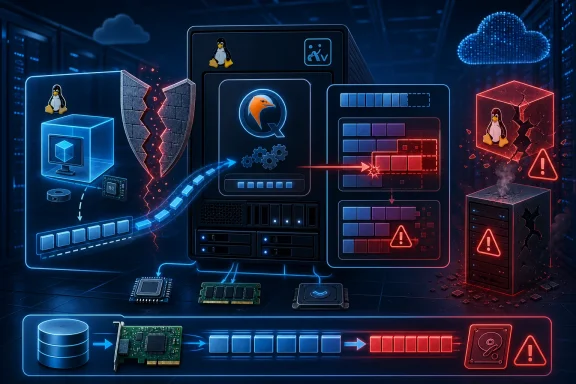 The Hypervisor Boundary Is the Story, Not the Score
Security teams are trained to triage by numbers because the work never stops. A CVSS 9.8 screams from the dashboard; a 6.7 often waits its turn. CVE-2026-48914 is exactly the kind of vulnerability that can be misread if the score is treated as the story rather than the beginning of one.The mechanics are narrow: QEMU’s virtio-blk device handling fails to validate descriptor sizes properly before writing response data for a crafted SCSI command request. A malicious guest with high privileges can arrange a malformed request that causes QEMU to write beyond the bounds of a heap-allocated buffer. The most clearly described outcome is denial of service against the QEMU process.
That last phrase sounds tidy until you translate it into an operations room. A QEMU process is not an abstract component; it is often the userspace body of a running virtual machine. Crash or corrupt that process badly enough, and the guest goes with it. In a lab, that is an annoying restart. In a production virtualization cluster, it is a tenant outage, a failed job, a broken maintenance window, or a degraded service that was supposed to be insulated from exactly this sort of failure.
The vulnerability’s constraints are real. The attacker needs high privileges in the guest, the attack vector is local, and there is no indication from public enrichment data that exploitation is being observed in the wild. But those constraints should not lull administrators into ignoring it. Cloud and virtualization security is full of bugs whose importance lies not in easy entry, but in what they reveal about the seams between isolation layers.
A Storage Fast Path Becomes an Attack Surface
Virtio exists because emulating old hardware forever would be absurd. Modern virtual machines need fast, cooperative I/O devices that avoid pretending every disk is a 1990s controller. Virtio-blk is part of that bargain: a paravirtualized block device designed to move storage requests efficiently between guest and host.That efficiency depends on shared conventions. The guest builds descriptor chains describing buffers and requests; the host-side device model consumes them. The contract is supposed to be explicit enough that performance does not come at the price of trust. CVE-2026-48914 is a reminder that every descriptor parser is also a security boundary.
The bug centers on SCSI command request handling inside virtio-blk. Public Red Hat Bugzilla details describe a crafted
VIRTIO_BLK_T_SCSI_CMD request in which a writable input descriptor can be made too small for the data QEMU later writes. In particular, the vulnerable path writes a four-byte error field without first ensuring that the mapped buffer is large enough.That is the sort of mistake C programmers recognize instantly and dread equally. The individual write is small, but the violation is fundamental: host code accepted guest-controlled layout information and then wrote past the boundary it was given. The resulting heap out-of-bounds write lives inside the QEMU process, where the host-side device model for the VM is running.
Heap buffer overflows are not all equal. Some become reliable code execution primitives; others are difficult to shape and mostly crash processes. The public assessment for CVE-2026-48914 emphasizes denial of service rather than a proven escape. That distinction matters. But the bug class still deserves respect, because memory corruption in a hypervisor-adjacent process is not the same as a crash in a throwaway desktop utility.
“Local” Means Inside the Guest, Not Inside Your Comfort Zone
One reason this vulnerability may be underestimated is the word local. In ordinary endpoint security, local often means the attacker already has a foothold and needs another bug to climb higher. In virtualization, local can mean something different: the attacker controls code inside a guest and is now interacting with host-side emulation logic across a boundary administrators rely on.The privilege requirement is also easy to misread. Public scoring lists privileges required as high, which means the attacker is not merely an unprivileged user process casually poking at a disk. They need enough authority inside the guest to program virtio-blk request descriptors in the dangerous way. That sharply limits broad exploitability.
But in many environments, that is not an exotic condition. Developers run privileged workloads inside test VMs. CI systems execute untrusted or semi-trusted build steps in virtual machines. Security researchers, malware sandboxes, student labs, hosting providers, and appliance vendors all routinely run guests whose internal privilege state may not deserve full trust.
The old model said the guest could be hostile and the host would hold. That is still the model administrators want. It is also the model every virtual device bug tests. A vulnerability like CVE-2026-48914 does not need to be a full escape to matter; it only needs to let a guest degrade the host-side machinery responsible for keeping that guest safely contained and available.
There is also a tenant angle, even where no public cloud provider is named as affected. If one customer-controlled guest can crash its own QEMU process, the blast radius may be limited to that VM. If the surrounding orchestration responds poorly, or if storage and scheduling assumptions cascade, the operational consequence can extend beyond the neat boundary drawn in a CVE entry.
The Denial-of-Service Language Is Doing Real Work
The user-supplied MSRC language emphasizes total loss of availability: the attacker can fully deny access to resources in the impacted component, either while the attack continues or persistently after it ends. That phrasing is not mere boilerplate. It captures why availability flaws in infrastructure components are often more serious than they first appear.In a virtualized stack, the “impacted component” may be the QEMU process backing a particular VM. If that process exits, wedges, or corrupts itself badly enough to require intervention, the guest workload is unavailable. Even if confidentiality is not compromised and even if integrity impact is limited, the operational effect can still be a hard outage.
The CVSS vector publicly associated with the flaw reflects that balance: local attack vector, low attack complexity, high privileges required, no user interaction, changed scope, no confidentiality impact, low integrity impact, and high availability impact. That combination is why the score lands in medium territory rather than critical territory. It is also why the bug is more interesting than its severity label.
“Changed scope” is particularly important. It means the vulnerable component’s security authority differs from the impacted component’s security authority. In plain English, the guest is influencing behavior in a host-side process. That does not automatically mean a hypervisor escape, but it does put the vulnerability in the category administrators watch closely: guest-originated input crossing into host-managed virtualization code.
The availability impact is the cleanest and most defensible concern. A malicious guest could trigger an out-of-bounds heap write in QEMU and potentially knock over the QEMU process. For WindowsForum readers running Windows guests on Linux hosts, Linux guests on KVM, nested labs, or mixed virtualization stacks, that is enough to justify patch planning.
Microsoft’s Appearance Is a Supply-Chain Signal
The source provided by the user is Microsoft’s Security Update Guide, which may surprise some readers because QEMU/KVM is more commonly associated with Linux distributions, Red Hat, upstream QEMU, Proxmox, and cloud infrastructure than with the Windows desktop. But Microsoft’s vulnerability catalog increasingly reflects the messy reality of modern software supply chains. Windows shops are not Windows-only shops anymore.Microsoft publishes CVE information not only for bugs in the Windows kernel or Office, but also for components that intersect with Microsoft products, services, images, developer tooling, or cloud infrastructure. A QEMU/KVM entry in MSRC does not mean your Windows 11 laptop suddenly ships a vulnerable qemu-kvm service. It means Microsoft is tracking the vulnerability as part of the broader ecosystem it has to secure.
That ecosystem includes Azure infrastructure, Linux workloads, developer environments, container hosts, confidential computing stacks, and countless places where Windows administrators touch Linux virtualization whether they wanted to or not. The line between “Microsoft issue” and “open-source infrastructure issue” has been dissolving for years. CVE-2026-48914 is a small but useful example of that larger shift.
For enterprise IT, the practical takeaway is not to ask whether the bug feels Microsoft-branded. The better question is whether any environment under your control runs affected QEMU packages, whether those hosts accept untrusted or semi-trusted guests, and whether your patch management tooling sees hypervisor packages with the same urgency it gives endpoint agents and domain controllers.
That matters especially in organizations where Windows teams own the service, Linux teams own the host, and security teams own the dashboard. A vulnerability can fall between those boundaries because everyone believes it belongs to someone else. Virtualization bugs punish that kind of organizational ambiguity.
Red Hat’s Bug Trail Gives the Clearest Technical Picture
The most useful public technical description comes from Red Hat’s Bugzilla and CVE data. It describes a host heap write past the end of an MMIO bounce buffer while handling a crafted virtio-blk SCSI request. The scenario is precise enough to separate this from generic “input validation” fog.The attacker manipulates request descriptors so that a writable input descriptor points to a memory-mapped I/O guest physical address with a length that is too small. QEMU maps that descriptor through a heap bounce buffer sized to the descriptor. Later,
virtio_blk_handle_scsi() writes the virtio_scsi_inhdr.errors field, which is four bytes, without validating that the mapped buffer can hold it.This is a compact vulnerability. There is no sprawling protocol state machine, no browser renderer, no speculative execution puzzle. There is a descriptor, a buffer, a write, and a missing size check. That simplicity is not reassuring; it is precisely why the patch surface is likely narrow and why administrators should expect distributions to ship fixes through ordinary QEMU or qemu-kvm package updates.
Public data also credits researcher Feifan Qian for reporting the issue and indicates an upstream patch was posted to the QEMU development list in late May 2026. The CVE record became visible in mid-June 2026, with Red Hat-associated tracking following shortly afterward. That timeline suggests a conventional coordinated disclosure pattern rather than a frantic zero-day fire drill.
The affected version range listed in public CVE data is broad for upstream QEMU, with qemu versions from 1.1.0 through 11.0.1 marked affected unless otherwise scoped by vendor packaging. Distribution status is more nuanced. Red Hat data marks qemu-kvm packages for current enterprise releases as affected, while older release lines may be unknown or handled through lifecycle-specific support policies.
The Windows Angle Is Mostly About Guests, Hosts, and Admin Habits
Windows users can encounter this vulnerability from either side of the virtualization glass. A Windows guest running under QEMU/KVM may use virtio storage drivers for performance. A Windows administrator may manage Linux virtualization hosts that run qemu-kvm. A developer may run local QEMU labs for cross-platform testing. A security team may operate malware detonations or sandboxed workloads on KVM-based infrastructure.What this CVE does not currently appear to be is a vulnerability in the Windows virtio guest driver itself. The flaw is in QEMU’s host-side virtio-blk device handling. That distinction is important because patching the guest driver is not the main remediation. The host-side QEMU package is where administrators should look.
For Windows-heavy organizations, the risk often hides in “not our platform” corners. A team may run a few Linux KVM hosts for appliance testing. A build farm may spin up Windows guests on Linux because licensing, automation, or performance made it convenient. A backup validation pipeline may boot images under QEMU to verify recoverability. These are the quiet places where a medium CVE can sit unpatched for months.
The Windows ecosystem also has a long memory of storage and virtualization quirks. Virtio drivers, SCSI controllers, block devices, and synthetic hardware choices are usually discussed as performance tuning topics. CVE-2026-48914 reframes one of those choices as part of the security surface. The fastest virtual disk path is still code, and code that parses guest-supplied descriptors needs the same scrutiny as a network daemon.
This is not a reason to abandon virtio. It is a reason to keep virtio implementations patched and to treat host virtualization packages as production-critical dependencies. The cure for bugs in paravirtualized I/O is not retreat to slow emulation; it is disciplined maintenance of the high-performance path everyone already depends on.
Medium Severity Still Demands a Maintenance Window
The right response to CVE-2026-48914 is boring in the best possible way: inventory, patch, restart affected virtual machine processes where necessary, and verify that hosts are running fixed qemu-kvm builds from their vendor. The challenge is not conceptual. The challenge is operational, because updating QEMU often means touching running workloads.Unlike many userland libraries, QEMU updates do not always fully protect already-running VM processes until those processes are restarted or migrated onto a host running the fixed binary. Package managers can install the patched files, but a long-lived VM may still be backed by the old executable in memory. This is where virtualization patching differs from ordinary server patching.
Clustered environments have options. Live migration can move workloads away from a host, patch it, restart services, and move workloads back. Smaller environments may need planned downtime. Home labs and single-host setups may simply shut down guests, update packages, and restart. The operational method varies, but the security principle does not: the fixed code has to be the code actually running.
Administrators should also avoid overfitting remediation to the exact exploit description. Yes, the flaw involves virtio-blk SCSI request handling. But the safer practical unit of patching is the vendor-provided QEMU or qemu-kvm package, not a hand-edited device configuration workaround. Unless a vendor specifically recommends disabling a feature, changing virtual disk buses as an emergency mitigation can create more risk than it removes.
Where exposure is limited to trusted guests under tight administrative control, organizations may reasonably rank the update behind remotely exploitable perimeter issues. Where guests are tenant-controlled, run untrusted code, or form part of a sandbox service, the priority should climb. The same CVSS score can mean different patch urgency depending on who controls the guest and how quickly a failed VM turns into a business incident.
The Cloud Lesson Is That Guests Are Not Always Gentle
The most persistent myth in virtualization security is that the guest is somehow a polite participant. In reality, every secure hypervisor design assumes the opposite. The guest may be buggy, compromised, malicious, experimental, or simply weird. The host-side device model must survive all of it.Virtio makes the guest-host relationship more cooperative, but not more trusting. The guest and host agree on a protocol so I/O can be fast. That protocol is a performance contract, not a security waiver. If the guest says a writable buffer is one byte long, host code must not write four bytes to it just because the normal path expects four bytes to be there.
This is why virtual device vulnerabilities keep appearing across hypervisors. Network adapters, USB controllers, graphics devices, storage controllers, sound devices, and clipboard integrations all extend the attack surface from guest into host-managed code. The more convenient the VM becomes, the more channels exist for malformed input.
The industry has responded by isolating device models, rewriting risky components in safer languages, fuzzing virtual hardware interfaces, and tightening default configurations. QEMU has benefited from years of security hardening, but it remains a large C codebase implementing a vast zoo of devices and compatibility paths. Bugs like CVE-2026-48914 are not shocking; they are the tax paid for decades of hardware abstraction.
The lesson for administrators is not cynicism. It is architecture. Treat untrusted guests as adversarial, keep host packages current, segment management networks, limit who can create privileged guest workloads, and design clusters so the loss of a single VM process is survivable. Patching closes this bug. Architecture determines how much the next one hurts.
The Patch Is Small, but the Ownership Problem Is Not
In many organizations, virtualization ownership is split three ways. Infrastructure teams run the hosts. Application teams own the guests. Security teams own vulnerability management. CVE-2026-48914 sits at the intersection, which is exactly where accountability often gets blurry.A scanner may detect the vulnerable qemu-kvm package on a Linux host, but the application owner may argue that no one has complained about the Windows VM running on it. The virtualization admin may wait for a maintenance window because the cluster is stable. The security team may downgrade the issue because the CVSS score is medium and exploitation requires high guest privileges. Each position is understandable; together they produce drift.
The better model is to classify host virtualization packages as shared-risk infrastructure. If a guest-originated input can crash host-side VM machinery, the owning team should have a predefined patch path. That path should not be invented under pressure for each CVE. It should already exist, just as organizations already have routines for hypervisor microcode, kernel, and storage firmware updates.
This is also where asset inventory becomes painfully practical. Teams need to know which hosts run QEMU, which versions are installed, which guests use virtio-blk, and which environments permit untrusted or privileged guest users. Without that map, severity debates become theater. With it, the update can be scheduled according to real exposure.
For managed platforms, the question changes. Customers of hosted virtualization, cloud services, or appliance vendors should watch vendor advisories rather than trying to infer exposure from upstream QEMU alone. Vendors may backport patches, disable vulnerable code paths, isolate device models differently, or determine that a product configuration is not affected. Upstream version numbers are useful, but vendor packaging is authoritative for production remediation.
The Practical Read for WindowsForum Readers
CVE-2026-48914 is not a reason to panic, but it is a reason to look under the hood of virtualization stacks that often fade into the background once they work. The most exposed environments are not ordinary desktop users; they are administrators and developers running QEMU/KVM hosts where guest users have meaningful control. The highest-value action is to patch the host-side QEMU packages and ensure running VM processes actually pick up the fixed code.- Organizations should treat the vulnerability as a host-side QEMU/KVM issue, not as a Windows guest driver bug.
- Environments that run untrusted, tenant-controlled, sandboxed, or researcher-controlled guests should prioritize the update above what a generic medium score might imply.
- Installing a patched qemu-kvm package may not be enough for already-running guests; affected VM processes may need restart, migration, or host maintenance to use the fixed binary.
- The clearest publicly described impact is denial of service against the QEMU process, with no public indication that the flaw is being exploited in the wild as of the current advisory cycle.
- Administrators should rely on their Linux distribution, cloud provider, or appliance vendor for fixed package status because downstream backports can make upstream version comparisons misleading.
- The broader lesson is that paravirtualized storage is part of the security boundary, not merely a performance feature.
References
- Primary source: MSRC
Published: 2026-06-19T01:43:42-07:00
Security Update Guide - Microsoft Security Response Center
 msrc.microsoft.com
- Related coverage: vulnerability.circl.lu
Vulnerability-Lookup
Vulnerability-Lookup - Fast vulnerability lookup correlation from different sources.vulnerability.circl.lu - Related coverage: security.snyk.io
- Related coverage: kvm-forum.qemu.org
- Related coverage: qemu.readthedocs.io
