

Microsoft published CVE-2026-45641 on June 9, 2026, as a critical Windows Hyper-V remote code execution vulnerability affecting supported Windows client and server releases, with official fixes available through the month’s cumulative security updates and Microsoft marking the report confidence as confirmed. The uncomfortable detail is not the label “remote code execution” by itself, but the boundary it threatens: the line between a guest VM and the Hyper-V host. Microsoft says exploitation is less likely and not publicly disclosed or exploited, but the advisory still deserves more than routine Patch Tuesday muscle memory. In virtualization, a “local” bug can become an infrastructure problem when the local machine is someone else’s guest.
The first trap in reading CVE-2026-45641 is the apparent contradiction in Microsoft’s own scoring. The title calls it a Windows Hyper-V remote code execution vulnerability, yet the CVSS vector lists the attack vector as local. That is not a clerical error; it is the security model doing exactly what security models do, compressing messy real-world exposure into a few letters.
Microsoft’s explanation is straightforward: the attacker is located in a guest VM, and the exploit path involves specially crafted file operation requests from that guest to hardware resources exposed inside the VM. If successful, those requests could result in code execution on the host server. The attack is “local” in the CVSS sense because code must run in the local context of the guest, but “remote” in the operational sense because the target of consequence is the host.
That distinction matters for admins who have learned, often correctly, to triage local vulnerabilities behind network-facing ones. A local elevation bug on a single workstation and a local guest-to-host path in a virtualization stack do not carry the same blast radius. Hyper-V is not just another Windows component; it is the isolation layer many organizations use to make untrusted or semi-trusted workloads tolerable.
The best way to read this advisory is as a warning about misplaced comfort. If you operate Hyper-V hosts that run workloads controlled by different teams, tenants, developers, contractors, students, or customers, “local” does not mean “low concern.” It means the attacker may need a foothold in a VM before they can start pulling at the host boundary.
That is an important nuance because modern vulnerability advisories often mix several kinds of uncertainty. Sometimes a vendor knows something breaks but not why. Sometimes a researcher has a plausible theory but no reliable reproduction. Sometimes exploitability is disputed because the vulnerable path depends on timing, configuration, or weird environmental conditions.
Here, Microsoft’s position is sharper. The vulnerability exists, the vendor has confirmed it, and an official fix is available. The exploitability assessment says exploitation is less likely, but the confidence assessment says the bug is real.
Those two statements can coexist. A confirmed vulnerability can still be hard to exploit. A difficult exploit can still become easier once patches ship and attackers start diffing binaries. The publication of a fix often starts a second clock, one that defenders and reverse engineers both hear.
The “no privileges required” metric can look startling next to the FAQ language describing an authenticated attacker on a guest VM. This is one of those places where CVSS and operational language do not align perfectly. From the vulnerable component’s perspective, the attacker does not need administrative rights or special privileges to trigger the condition; from the environment’s perspective, they still need the ability to run code inside a guest VM.
That is why this is not the same emergency as an unauthenticated wormable network service listening on every server. It is also why dismissing it would be lazy. The affected surface is smaller than the open internet, but the assets behind it are often larger: Hyper-V hosts tend to sit beneath clusters, dev labs, test infrastructure, jump environments, VDI pools, and small-business servers doing more jobs than their owners care to admit.
Microsoft identifies the weakness as type confusion, a class of memory-safety issue where code treats a resource as though it were a different kind of object than it really is. The executive summary also mentions an out-of-bounds read. Those details are not a full root-cause disclosure, but they are enough to tell defenders that this is not a policy misconfiguration or an authentication bypass. It is a bug in how the virtualization stack handles data crossing a sensitive boundary.
That surface is not theoretical. Hypervisors are built to share hardware safely among mutually suspicious operating systems, and that sharing requires translation. The guest asks for something that looks like a disk, a network adapter, a GPU, a file path, or a device. The host or hypervisor layer turns that request into real work. Bugs live in the translation.
CVE-2026-45641 appears to sit in that uncomfortable neighborhood: file operation requests from the VM to hardware resources on the VM. Microsoft does not disclose enough to map the vulnerable call path, and that restraint is normal for an active security update. But the advisory’s framing tells admins where to think: not network perimeter, not browser content, not email attachment, but the mechanisms by which a guest touches emulated or synthetic hardware.
For a home user running a single trusted VM for testing, that risk is narrower. For an enterprise that lets developers spin up VMs, hosts security sandboxes, runs legacy apps, or offers shared lab infrastructure, it is different. Trust boundaries inside the data center are still trust boundaries.
The listed fixed builds are concrete enough for compliance teams to chase. Windows 10 21H2 moves to build 19044.7417, Windows 10 22H2 to 19045.7417, Windows 11 23H2 to 22631.7219, Windows 11 24H2 to 26100.8655, Windows 11 25H2 to 26200.8655, and Windows 11 26H1 to 28000.2269. Windows Server 2022 is fixed at 20348.5256, while Windows Server 2025 is fixed at 26100.32995.
The KB numbers are similarly direct: KB5094127 for the Windows 10 releases, KB5093998 for Windows 11 23H2, KB5094126 for Windows 11 24H2 and 25H2, KB5095051 for Windows 11 26H1, KB5094128 for Windows Server 2022, and KB5094125 for Windows Server 2025. For most managed environments, this is less about finding a standalone hotfix than making sure the monthly cumulative update actually lands on the systems that host VMs.
That last clause is the one that matters. A workstation missing the update is a vulnerable endpoint. A Hyper-V host missing the update is a vulnerable substrate. The host may not have users browsing the web or opening documents, but it has guests sending it requests all day long.
Exploitability ratings are snapshots, not guarantees. They reflect what Microsoft knows when the advisory goes live, including whether exploit code is public, whether the bug is being used in the wild, and how hard exploitation appears to be. They do not freeze attacker capability in amber.
There is also a familiar post-patch dynamic. Once a fix is available, attackers can compare patched and unpatched binaries, look for the changed code path, and attempt to reconstruct the vulnerability. This does not always yield a weaponized exploit, and it may not here. But the existence of a confirmed bug with high impact means defenders should assume interest will increase after publication, not decrease.
The practical conclusion is boring in the best possible way: patch Hyper-V hosts deliberately and soon. Do not confuse “less likely” with “irrelevant,” especially in environments where guests are less trusted than hosts.
Developers use local VMs. Security teams use sandboxes. Power users run test builds. Some organizations rely on virtualization-based security features that sit adjacent to the same broader platform investment, even when the exact exposure depends on configuration. A laptop that runs a disposable VM downloaded from a lab, a customer image, or a malware-analysis workflow is not operating in the same risk posture as a laptop with no local virtualization use.
The advisory does not say every Windows client is equally exposed in practice. It does say the affected products include supported Windows client releases. That should be enough for endpoint management teams to avoid carving out “just workstations” from the deployment plan.
For enthusiasts, the lesson is even simpler. If you use Hyper-V for labs, old software, Linux guests, Windows Insider testing, or nested virtualization experiments, do not sit on this patch because the word “server” appears in the exploit scenario. The host is the prize, whether it is a rack-mounted system or the machine under your desk.
In mixed-trust environments, the guest is not a friendly workload. It is a containment zone. The point of the VM is that code inside it may be buggy, compromised, experimental, or intentionally hostile. Any vulnerability that gives that code a plausible path toward the host deserves heightened attention.
This is also where asset classification often fails. The security team may have an inventory of domain controllers, internet-facing servers, and endpoints, while virtualization hosts sit in a platform bucket maintained by a different group. If the Hyper-V cluster is treated as plumbing, its patch status may not get the urgency assigned to the workloads it carries.
That inversion is dangerous. The host has more authority than the guest. A compromised guest can be rebuilt; a compromised host can undermine multiple guests, expose memory or storage, tamper with workloads, and break the assumptions incident responders rely on when they draw containment boundaries.
This is a recurring theme in Windows security: hardening choices reduce exposure, but they do not replace patching the code that remains. A headless host can still process guest requests. A minimal installation can still run Hyper-V. A server with no browser and no email client can still be vulnerable through the interfaces it intentionally exposes to workloads.
Server Core administrators are often disciplined patchers because their environments are already more automated. Still, virtualization clusters have their own operational friction. Live migration, failover capacity, backup windows, storage dependencies, and guest uptime commitments can turn a straightforward cumulative update into a choreography problem.
That choreography is exactly why this advisory should be scheduled rather than deferred. If a host needs evacuation, draining, reboot sequencing, and validation, the calendar should start moving now. The complexity of patching a virtualization host is not an argument against urgency; it is the reason urgency needs planning.
The right tone, then, is restrained seriousness. This is not a reason to shut down Hyper-V hosts or distrust every VM. It is not a reason to abandon virtualization, which remains one of the most important isolation tools in the Windows ecosystem. It is a reason to respect the isolation layer enough to patch it quickly.
Security teams should also resist the temptation to over-read the lack of public exploitation. Absence of evidence is valuable but limited. The advisory’s temporal score includes “unproven” exploit code maturity, but the report confidence is confirmed and remediation is official. That combination says the defensive path is clear even if the offensive path is not public.
The operational goal should be to close the gap before the advisory becomes more interesting to attackers. Most organizations cannot control whether exploit research accelerates after Patch Tuesday. They can control whether their Hyper-V hosts are still waiting for updates when it does.
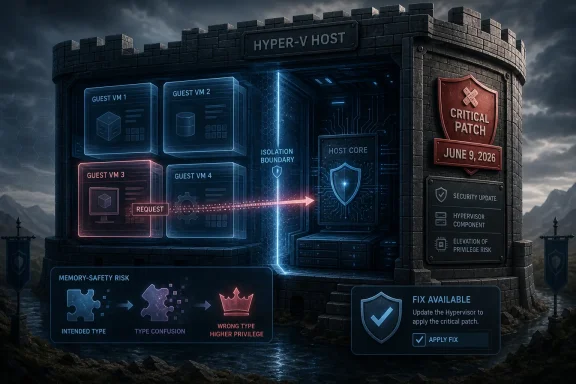 Hyper-V Turns a Local Vector Into a Host Problem
The first trap in reading CVE-2026-45641 is the apparent contradiction in Microsoft’s own scoring. The title calls it a Windows Hyper-V remote code execution vulnerability, yet the CVSS vector lists the attack vector as local. That is not a clerical error; it is the security model doing exactly what security models do, compressing messy real-world exposure into a few letters.Microsoft’s explanation is straightforward: the attacker is located in a guest VM, and the exploit path involves specially crafted file operation requests from that guest to hardware resources exposed inside the VM. If successful, those requests could result in code execution on the host server. The attack is “local” in the CVSS sense because code must run in the local context of the guest, but “remote” in the operational sense because the target of consequence is the host.
That distinction matters for admins who have learned, often correctly, to triage local vulnerabilities behind network-facing ones. A local elevation bug on a single workstation and a local guest-to-host path in a virtualization stack do not carry the same blast radius. Hyper-V is not just another Windows component; it is the isolation layer many organizations use to make untrusted or semi-trusted workloads tolerable.
The best way to read this advisory is as a warning about misplaced comfort. If you operate Hyper-V hosts that run workloads controlled by different teams, tenants, developers, contractors, students, or customers, “local” does not mean “low concern.” It means the attacker may need a foothold in a VM before they can start pulling at the host boundary.
Microsoft’s Confidence Signal Is the Quietest Loud Part
The user-facing snippet that prompted this discussion is Microsoft’s definition of Report Confidence, a CVSS temporal metric that measures how certain the vulnerability is and how credible the known technical details are. For CVE-2026-45641, Microsoft marks that metric as confirmed. That does not mean public exploit code exists, and it does not mean attacks are underway. It means Microsoft is no longer treating the issue as speculative.That is an important nuance because modern vulnerability advisories often mix several kinds of uncertainty. Sometimes a vendor knows something breaks but not why. Sometimes a researcher has a plausible theory but no reliable reproduction. Sometimes exploitability is disputed because the vulnerable path depends on timing, configuration, or weird environmental conditions.
Here, Microsoft’s position is sharper. The vulnerability exists, the vendor has confirmed it, and an official fix is available. The exploitability assessment says exploitation is less likely, but the confidence assessment says the bug is real.
Those two statements can coexist. A confirmed vulnerability can still be hard to exploit. A difficult exploit can still become easier once patches ship and attackers start diffing binaries. The publication of a fix often starts a second clock, one that defenders and reverse engineers both hear.
The Score Says Critical, But the Shape Says Specialized
CVE-2026-45641 carries a CVSS 3.1 base score of 8.4, which Microsoft maps to critical severity. The base vector is unusually revealing: low attack complexity, no privileges required, no user interaction, unchanged scope, and high impact to confidentiality, integrity, and availability. In plain English, Microsoft is saying the bug’s potential consequences are severe if the attacker can reach the vulnerable path.The “no privileges required” metric can look startling next to the FAQ language describing an authenticated attacker on a guest VM. This is one of those places where CVSS and operational language do not align perfectly. From the vulnerable component’s perspective, the attacker does not need administrative rights or special privileges to trigger the condition; from the environment’s perspective, they still need the ability to run code inside a guest VM.
That is why this is not the same emergency as an unauthenticated wormable network service listening on every server. It is also why dismissing it would be lazy. The affected surface is smaller than the open internet, but the assets behind it are often larger: Hyper-V hosts tend to sit beneath clusters, dev labs, test infrastructure, jump environments, VDI pools, and small-business servers doing more jobs than their owners care to admit.
Microsoft identifies the weakness as type confusion, a class of memory-safety issue where code treats a resource as though it were a different kind of object than it really is. The executive summary also mentions an out-of-bounds read. Those details are not a full root-cause disclosure, but they are enough to tell defenders that this is not a policy misconfiguration or an authentication bypass. It is a bug in how the virtualization stack handles data crossing a sensitive boundary.
The Guest-to-Host Boundary Is Where Virtualization Earns Its Keep
Hyper-V’s promise is not merely that a VM runs Windows or Linux in a neat window. Its promise is that code in the guest cannot casually become code in the host. Every host device, synthetic driver, virtual bus, storage path, graphics channel, clipboard feature, and integration service is part of that promise’s attack surface.That surface is not theoretical. Hypervisors are built to share hardware safely among mutually suspicious operating systems, and that sharing requires translation. The guest asks for something that looks like a disk, a network adapter, a GPU, a file path, or a device. The host or hypervisor layer turns that request into real work. Bugs live in the translation.
CVE-2026-45641 appears to sit in that uncomfortable neighborhood: file operation requests from the VM to hardware resources on the VM. Microsoft does not disclose enough to map the vulnerable call path, and that restraint is normal for an active security update. But the advisory’s framing tells admins where to think: not network perimeter, not browser content, not email attachment, but the mechanisms by which a guest touches emulated or synthetic hardware.
For a home user running a single trusted VM for testing, that risk is narrower. For an enterprise that lets developers spin up VMs, hosts security sandboxes, runs legacy apps, or offers shared lab infrastructure, it is different. Trust boundaries inside the data center are still trust boundaries.
Patch Tuesday Becomes a Virtualization Maintenance Window
The fix for CVE-2026-45641 is delivered through Microsoft’s June 9, 2026 security updates. The affected list spans Windows 10 Version 21H2 and 22H2 on x64 systems, Windows 11 Version 23H2, 24H2, 25H2, and 26H1 on x64 systems, plus Windows Server 2022 and Windows Server 2025, including Server Core installations. That range makes the advisory relevant to both client Hyper-V users and server administrators.The listed fixed builds are concrete enough for compliance teams to chase. Windows 10 21H2 moves to build 19044.7417, Windows 10 22H2 to 19045.7417, Windows 11 23H2 to 22631.7219, Windows 11 24H2 to 26100.8655, Windows 11 25H2 to 26200.8655, and Windows 11 26H1 to 28000.2269. Windows Server 2022 is fixed at 20348.5256, while Windows Server 2025 is fixed at 26100.32995.
The KB numbers are similarly direct: KB5094127 for the Windows 10 releases, KB5093998 for Windows 11 23H2, KB5094126 for Windows 11 24H2 and 25H2, KB5095051 for Windows 11 26H1, KB5094128 for Windows Server 2022, and KB5094125 for Windows Server 2025. For most managed environments, this is less about finding a standalone hotfix than making sure the monthly cumulative update actually lands on the systems that host VMs.
That last clause is the one that matters. A workstation missing the update is a vulnerable endpoint. A Hyper-V host missing the update is a vulnerable substrate. The host may not have users browsing the web or opening documents, but it has guests sending it requests all day long.
“Exploitation Less Likely” Is Not a Permission Slip
Microsoft says CVE-2026-45641 was not publicly disclosed and not exploited at the time of publication. It also rates exploitation as less likely. Those are useful signals, and they should keep this bug out of panic territory. They should not keep it out of the maintenance queue.Exploitability ratings are snapshots, not guarantees. They reflect what Microsoft knows when the advisory goes live, including whether exploit code is public, whether the bug is being used in the wild, and how hard exploitation appears to be. They do not freeze attacker capability in amber.
There is also a familiar post-patch dynamic. Once a fix is available, attackers can compare patched and unpatched binaries, look for the changed code path, and attempt to reconstruct the vulnerability. This does not always yield a weaponized exploit, and it may not here. But the existence of a confirmed bug with high impact means defenders should assume interest will increase after publication, not decrease.
The practical conclusion is boring in the best possible way: patch Hyper-V hosts deliberately and soon. Do not confuse “less likely” with “irrelevant,” especially in environments where guests are less trusted than hosts.
Client Hyper-V Is Not Off the Hook
The server story is obvious: Hyper-V hosts run workloads, and hosts should be patched. The client story is easier to overlook. Windows 10 and Windows 11 systems with Hyper-V enabled can be affected too, and client virtualization has become more common than many asset inventories admit.Developers use local VMs. Security teams use sandboxes. Power users run test builds. Some organizations rely on virtualization-based security features that sit adjacent to the same broader platform investment, even when the exact exposure depends on configuration. A laptop that runs a disposable VM downloaded from a lab, a customer image, or a malware-analysis workflow is not operating in the same risk posture as a laptop with no local virtualization use.
The advisory does not say every Windows client is equally exposed in practice. It does say the affected products include supported Windows client releases. That should be enough for endpoint management teams to avoid carving out “just workstations” from the deployment plan.
For enthusiasts, the lesson is even simpler. If you use Hyper-V for labs, old software, Linux guests, Windows Insider testing, or nested virtualization experiments, do not sit on this patch because the word “server” appears in the exploit scenario. The host is the prize, whether it is a rack-mounted system or the machine under your desk.
The Real Risk Lives in Mixed-Trust VM Farms
CVE-2026-45641 is most interesting where Hyper-V is used to separate work rather than merely organize it. A single admin running a handful of trusted internal servers on a Hyper-V host faces a different threat model from a university lab, a contractor build farm, a training environment, a shared QA cluster, or a hosting scenario where VM users are not all equally trusted.In mixed-trust environments, the guest is not a friendly workload. It is a containment zone. The point of the VM is that code inside it may be buggy, compromised, experimental, or intentionally hostile. Any vulnerability that gives that code a plausible path toward the host deserves heightened attention.
This is also where asset classification often fails. The security team may have an inventory of domain controllers, internet-facing servers, and endpoints, while virtualization hosts sit in a platform bucket maintained by a different group. If the Hyper-V cluster is treated as plumbing, its patch status may not get the urgency assigned to the workloads it carries.
That inversion is dangerous. The host has more authority than the guest. A compromised guest can be rebuilt; a compromised host can undermine multiple guests, expose memory or storage, tamper with workloads, and break the assumptions incident responders rely on when they draw containment boundaries.
Server Core Does Not Make the Bug Disappear
It is notable that Microsoft lists Server Core installations for Windows Server 2022 and Windows Server 2025. Server Core reduces the local graphical footprint and removes many components, which is good hygiene. It does not magically remove every virtualization attack surface.This is a recurring theme in Windows security: hardening choices reduce exposure, but they do not replace patching the code that remains. A headless host can still process guest requests. A minimal installation can still run Hyper-V. A server with no browser and no email client can still be vulnerable through the interfaces it intentionally exposes to workloads.
Server Core administrators are often disciplined patchers because their environments are already more automated. Still, virtualization clusters have their own operational friction. Live migration, failover capacity, backup windows, storage dependencies, and guest uptime commitments can turn a straightforward cumulative update into a choreography problem.
That choreography is exactly why this advisory should be scheduled rather than deferred. If a host needs evacuation, draining, reboot sequencing, and validation, the calendar should start moving now. The complexity of patching a virtualization host is not an argument against urgency; it is the reason urgency needs planning.
The Advisory Leaves Room for Restraint
Microsoft has not published a proof of concept, and the advisory does not describe active exploitation. It credits MORSE with Microsoft, which suggests the issue emerged through internal or coordinated research rather than a public scramble. That matters because it gives defenders a cleaner window than they get during a zero-day fire drill.The right tone, then, is restrained seriousness. This is not a reason to shut down Hyper-V hosts or distrust every VM. It is not a reason to abandon virtualization, which remains one of the most important isolation tools in the Windows ecosystem. It is a reason to respect the isolation layer enough to patch it quickly.
Security teams should also resist the temptation to over-read the lack of public exploitation. Absence of evidence is valuable but limited. The advisory’s temporal score includes “unproven” exploit code maturity, but the report confidence is confirmed and remediation is official. That combination says the defensive path is clear even if the offensive path is not public.
The operational goal should be to close the gap before the advisory becomes more interesting to attackers. Most organizations cannot control whether exploit research accelerates after Patch Tuesday. They can control whether their Hyper-V hosts are still waiting for updates when it does.
The Patch Is Smaller Than the Boundary It Protects
CVE-2026-45641 is a compact advisory with a broad implication: virtualization security depends on every small translation layer doing its job. Microsoft’s published details point to a confirmed Hyper-V flaw, critical impact, available fixes, no known exploitation, and a guest-originated path that could reach the host.- Organizations should prioritize June 2026 cumulative updates on systems that run Hyper-V hosts, especially where guest workloads are not fully trusted.
- Administrators should verify fixed build numbers rather than assuming update deployment succeeded because a patch ring was targeted.
- Security teams should treat the local CVSS attack vector as a guest-context requirement, not as reassurance that the host is safe.
- Client systems with Hyper-V enabled should remain in scope for remediation, particularly developer workstations, lab machines, and analysis systems.
- Environments using Server Core still need the relevant cumulative updates because reduced surface area does not remove the vulnerable Hyper-V path.
- The lack of public exploitation lowers immediate panic, but the confirmed report confidence and critical impact argue against deferral.
References
- Primary source: MSRC
Published: 2026-06-09T07:00:00-07:00
Security Update Guide - Microsoft Security Response Center
 msrc.microsoft.com
