

CVE-2026-4948 is a medium-severity firewalld vulnerability disclosed on March 27, 2026, in which a local unprivileged Linux user can alter runtime firewall state through mis-authorized D-Bus setters, with Microsoft listing the issue through its Security Update Guide for affected environments. The bug is not a Windows firewall flaw, and it is not a remote-code-execution fire drill. But it is exactly the kind of cross-platform security issue that now lands on Windows administrators’ desks because Microsoft’s estate increasingly includes Linux, containers, Azure images, WSL-adjacent workflows, and Defender-managed heterogeneous fleets.
The uncomfortable lesson is that “medium” does not always mean “minor.” A firewall control-plane bug that requires local access is still a firewall control-plane bug, and local access is no longer a comforting boundary in an era of compromised developer boxes, cloud workloads, service accounts, jump hosts, and container escape chains. CVE-2026-4948 matters because it turns a supposedly privileged security decision into something a local low-privilege user may be able to influence.
The Microsoft Security Response Center listing for CVE-2026-4948 is a reminder that Microsoft’s security perimeter has stretched far beyond Windows DLLs, Office macros, and Active Directory protocols. The company now ships, hosts, scans, and secures Linux components across Azure, Defender, container services, and first-party infrastructure. That makes a firewalld advisory relevant to WindowsForum readers even if their daily muscle memory still starts with Event Viewer and ends with PowerShell.
Firewalld is a dynamic firewall manager used by many Linux distributions to coordinate firewall rules without requiring administrators to hand-edit backend packet-filtering rules directly. It exposes management interfaces over D-Bus, the interprocess communication system heavily used on Linux desktops and servers. In the normal model, sensitive operations should be protected by authorization policy, usually mediated through PolicyKit-style controls.
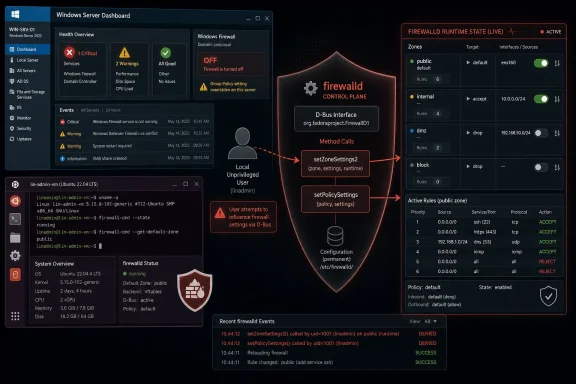
CVE-2026-4948 breaks confidence in that model. The issue centers on two runtime setters,
That matters because runtime firewall state is not paperwork. It is the live enforcement layer deciding which traffic is allowed, denied, redirected, or exposed. A local attacker who can loosen that state may not instantly become root, but they may be able to open a path for later movement, weaken segmentation, or make an otherwise contained foothold more useful.
D-Bus is often invisible to administrators until something goes wrong. It is the message bus through which desktop components, system services, and privileged daemons communicate. That abstraction is powerful because it lets software expose structured methods instead of forcing every management task through shell commands or bespoke sockets.
But abstraction is also where authorization bugs grow. If one method is checked as “show me information” when it actually changes live state, the system’s security boundary becomes a naming problem. The bug report language around CVE-2026-4948 suggests precisely that kind of mismatch: runtime setters appear to have been protected with an action associated with configuration information rather than a stricter authorization path.
That is not exotic exploitation. It is more mundane, and therefore more worrying. A local user does not need a kernel memory corruption primitive or a browser sandbox escape to benefit from it. They need the right local conditions, the vulnerable firewalld version, and a policy profile permissive enough to let the call through.
The score is reasonable. The danger is treating the score as the story.
Local access is a condition attackers often already have by the time defenders notice anything unusual. A phished developer workstation, a compromised SSH key, a malicious dependency in a build pipeline, an abused CI runner, or a low-privilege shell on a cloud VM all satisfy the basic “local user” premise. Once that foothold exists, the attacker’s next question is not whether the vulnerability is remote; it is whether the vulnerability improves the position.
A firewall-state modification can do that in several ways. It can expose a service that was meant to remain local. It can weaken host-level barriers between workloads. It can help prepare a machine for inbound command-and-control traffic. It can also create confusion for responders who assume the firewall reflects an administrator’s intent.
That last point is underappreciated. Firewalls are not just preventive controls; they are also part of the mental model defenders use when reconstructing an incident. If a low-privilege user can alter runtime firewall state, then “the firewall would have blocked that” becomes less reliable as an investigative assumption.
Attackers may see the same property as an advantage. Runtime-only changes can be stealthier, more opportunistic, and easier to blend into the noise of legitimate service management. If the attacker only needs a short window to stage data, pivot laterally, or reach a normally filtered port, persistence is optional.
This is where Linux host firewalls differ from the tidy diagrams in compliance binders. In production, firewall state is often manipulated by orchestration tools, VPN clients, container runtimes, libvirt, Kubernetes components, cloud agents, and administrators in a hurry. A malicious runtime modification may not look dramatic unless defenders are baselining both intended configuration and live state.
That is especially true on workstations and developer systems. The Red Hat bug details indicate the issue was tied to systems using a desktop profile of firewalld. That focus should make enterprise desktop teams pay attention rather than relax. Developer laptops, engineering workstations, and Linux desktops often sit at the intersection of source code, credentials, VPN access, and relaxed local experimentation.
This distinction matters for triage. A hardened server profile with stricter local authorization policy may not present the same practical risk as a developer workstation using a more permissive desktop-oriented policy. Likewise, distribution backports and vendor-specific packaging can make version numbers less straightforward than they appear from upstream advisories.
But the narrowing details do not make the issue irrelevant. They tell administrators where to look first. Linux desktops, lab systems, jump boxes with GUI packages, admin workstations, and general-purpose cloud VMs built from broad images deserve more scrutiny than minimalist server installs.
The desktop profile angle also illustrates a recurring security trade-off. Desktop Linux has historically needed to let local users do practical things without drowning them in password prompts. Network changes, printer setup, removable devices, time settings, and firewall profiles all live in that uneasy zone between usability and privilege. CVE-2026-4948 is a case study in how one overly generous authorization path can make that compromise visible.
Firewalld is a policy translator and state manager for network exposure. When it works, administrators rarely think about it. When it misbehaves, the system may still appear healthy while silently enforcing the wrong network boundary. That asymmetry is why firewall management bugs deserve a different kind of attention from ordinary application flaws.
On Linux, host firewalls often coexist with cloud security groups, Kubernetes network policies, service meshes, endpoint protection, and upstream network firewalls. This layered approach is good engineering, but it can also produce complacency. Teams assume that if one layer is weakened, another will catch the mistake.
Sometimes that is true. Sometimes the host firewall is the only thing preventing a local test service, administrative console, database listener, or debugging port from becoming reachable in a sensitive network segment. A local attacker who can change runtime firewall rules may not need to defeat every layer. They only need to find the layer that was quietly carrying more responsibility than anyone admitted.
For many organizations, the answer is yes. Azure fleets frequently include Linux VMs. Defender for Cloud and Defender for Endpoint surface Linux vulnerability findings. Developers use Linux build hosts, containers, WSL distributions, and self-hosted runners. Identity and access models often cross the Windows-Linux boundary through SSH, Entra-integrated login paths, secrets stores, and automation accounts.
That mixed estate changes patch governance. A vulnerability can enter the Microsoft admin view because Microsoft tracks it, scans for it, hosts affected workloads, or ships related components, even when the vulnerable code originated in the Linux ecosystem. The old mental partition — Microsoft patches over here, Linux advisories over there — is increasingly fictional.
The right lesson for WindowsForum readers is not that Microsoft somehow owns firewalld in the traditional Windows Update sense. The lesson is that Microsoft’s security ecosystem has become one of the places where Linux risk becomes visible. Visibility, however, is not remediation. Someone still has to determine which images, machines, containers, and endpoints actually carry the vulnerable package and policy profile.
That variation is not noise; it is the reality of open-source vulnerability handling. Upstream version numbers, downstream backports, distribution policy, support windows, and packaging choices all matter. A scanner that simply sees “firewalld version X” may be directionally useful but insufficient for final risk decisions.
Administrators should therefore avoid two common mistakes. The first is assuming that upstream version 2.4.0 or earlier automatically maps cleanly to exposure in every distribution. The second is assuming that a distribution’s “minor issue” language means the bug can be ignored on high-value systems.
Context decides urgency. A single-user Linux laptop used for browsing has a different risk profile from a privileged admin workstation with VPN access into production. A cloud VM with no local interactive users differs from a shared research box with dozens of shell accounts. The same CVE can be routine on one asset and strategically important on another.
Imagine a compromised developer account on a Linux workstation. The attacker cannot become root immediately, and outbound filtering limits some traffic. If the vulnerable firewalld policy lets the attacker change runtime state, the host’s network posture may become more pliable. That does not make the CVE a universal breach button, but it may remove friction at a crucial stage.
Or consider a shared engineering host. Local unprivileged users may be assumed to be mutually untrusted, but the firewall policy may be treated as an administrator-controlled boundary. If one user can alter that boundary, the trust model of the host changes. The attacker’s gain is not necessarily privilege escalation in the classic root-shell sense; it is unauthorized control over a security control.
This is why integrity-only vulnerabilities can be underrated. Confidentiality gets headlines because data theft is obvious. Availability gets attention because outages are visible. Integrity failures can be quieter, especially when they alter configuration, routing, access control, or policy state. By the time defenders see the consequence, the control plane has already lied.
That question is broader than this CVE. Administrators should examine local authorization policy for firewalld and related D-Bus methods, especially on desktop-profile systems and shared hosts. They should also compare runtime firewall state against expected configuration in environments where host firewalls form part of the security boundary.
For Microsoft-centered shops, the work should flow through existing management planes where possible. Defender vulnerability inventory, Azure VM update management, configuration management tools, and endpoint telemetry can help identify Linux assets that need attention. But teams should not assume every Linux instance is covered just because it appears in a cloud subscription or asset spreadsheet.
The hard part is unmanaged Linux. Lab machines, abandoned build hosts, one-off cloud images, developer-installed distributions, and long-lived appliances are where medium CVEs go to become incident footnotes. Firewalld is common enough that those forgotten corners deserve a search.
The uncomfortable lesson is that “medium” does not always mean “minor.” A firewall control-plane bug that requires local access is still a firewall control-plane bug, and local access is no longer a comforting boundary in an era of compromised developer boxes, cloud workloads, service accounts, jump hosts, and container escape chains. CVE-2026-4948 matters because it turns a supposedly privileged security decision into something a local low-privilege user may be able to influence.
 Microsoft’s Linux Problem Is Now Everyone’s Patch Problem
The Microsoft Security Response Center listing for CVE-2026-4948 is a reminder that Microsoft’s security perimeter has stretched far beyond Windows DLLs, Office macros, and Active Directory protocols. The company now ships, hosts, scans, and secures Linux components across Azure, Defender, container services, and first-party infrastructure. That makes a firewalld advisory relevant to WindowsForum readers even if their daily muscle memory still starts with Event Viewer and ends with PowerShell.Firewalld is a dynamic firewall manager used by many Linux distributions to coordinate firewall rules without requiring administrators to hand-edit backend packet-filtering rules directly. It exposes management interfaces over D-Bus, the interprocess communication system heavily used on Linux desktops and servers. In the normal model, sensitive operations should be protected by authorization policy, usually mediated through PolicyKit-style controls.
CVE-2026-4948 breaks confidence in that model. The issue centers on two runtime setters,
setZoneSettings2 and setPolicySettings, which were reportedly guarded in a way that allowed certain local unprivileged users to modify runtime firewall state without proper authentication. In plain English, the firewall’s management surface was too trusting about who was allowed to change live policy.That matters because runtime firewall state is not paperwork. It is the live enforcement layer deciding which traffic is allowed, denied, redirected, or exposed. A local attacker who can loosen that state may not instantly become root, but they may be able to open a path for later movement, weaken segmentation, or make an otherwise contained foothold more useful.
The Bug Lives in the Gap Between Policy and Enforcement
The most interesting part of CVE-2026-4948 is not that a local user can touch something they should not. Linux, Windows, macOS, and network appliances all have long histories of local authorization mistakes. The interesting part is where the mistake sits: between the policy engine that decides whether a caller is allowed to do something and the firewall daemon that actually does it.D-Bus is often invisible to administrators until something goes wrong. It is the message bus through which desktop components, system services, and privileged daemons communicate. That abstraction is powerful because it lets software expose structured methods instead of forcing every management task through shell commands or bespoke sockets.
But abstraction is also where authorization bugs grow. If one method is checked as “show me information” when it actually changes live state, the system’s security boundary becomes a naming problem. The bug report language around CVE-2026-4948 suggests precisely that kind of mismatch: runtime setters appear to have been protected with an action associated with configuration information rather than a stricter authorization path.
That is not exotic exploitation. It is more mundane, and therefore more worrying. A local user does not need a kernel memory corruption primitive or a browser sandbox escape to benefit from it. They need the right local conditions, the vulnerable firewalld version, and a policy profile permissive enough to let the call through.
“Local Only” Is a Reassurance That Ages Badly
Security teams have learned to triage local-only vulnerabilities aggressively, and usually for good reason. A remote unauthenticated exploit against an internet-facing service deserves a different response from a local bug requiring an existing account. CVE-2026-4948’s CVSS 3.1 score of 5.5 reflects that reality: local attack vector, low complexity, low privileges required, no user interaction, high integrity impact, and no direct confidentiality or availability impact.The score is reasonable. The danger is treating the score as the story.
Local access is a condition attackers often already have by the time defenders notice anything unusual. A phished developer workstation, a compromised SSH key, a malicious dependency in a build pipeline, an abused CI runner, or a low-privilege shell on a cloud VM all satisfy the basic “local user” premise. Once that foothold exists, the attacker’s next question is not whether the vulnerability is remote; it is whether the vulnerability improves the position.
A firewall-state modification can do that in several ways. It can expose a service that was meant to remain local. It can weaken host-level barriers between workloads. It can help prepare a machine for inbound command-and-control traffic. It can also create confusion for responders who assume the firewall reflects an administrator’s intent.
That last point is underappreciated. Firewalls are not just preventive controls; they are also part of the mental model defenders use when reconstructing an incident. If a low-privilege user can alter runtime firewall state, then “the firewall would have blocked that” becomes less reliable as an investigative assumption.
Runtime Changes Are the Attacker’s Favorite Kind
CVE-2026-4948 concerns runtime firewall state, and that word deserves attention. Runtime changes are live, immediate, and often less durable than permanent configuration changes. Administrators may see that as a mitigating factor because a reboot, reload, or configuration reapplication can erase the attacker’s work.Attackers may see the same property as an advantage. Runtime-only changes can be stealthier, more opportunistic, and easier to blend into the noise of legitimate service management. If the attacker only needs a short window to stage data, pivot laterally, or reach a normally filtered port, persistence is optional.
This is where Linux host firewalls differ from the tidy diagrams in compliance binders. In production, firewall state is often manipulated by orchestration tools, VPN clients, container runtimes, libvirt, Kubernetes components, cloud agents, and administrators in a hurry. A malicious runtime modification may not look dramatic unless defenders are baselining both intended configuration and live state.
That is especially true on workstations and developer systems. The Red Hat bug details indicate the issue was tied to systems using a desktop profile of firewalld. That focus should make enterprise desktop teams pay attention rather than relax. Developer laptops, engineering workstations, and Linux desktops often sit at the intersection of source code, credentials, VPN access, and relaxed local experimentation.
The Desktop Profile Detail Narrows the Blast Radius but Sharpens the Lesson
The public bug details are important because they narrow the most alarming reading of the CVE. The vulnerable condition reportedly involves firewalld versions up to and including 2.4.0, and exploitation requires local unprivileged access on a system where firewalld is using the desktop profile. That is not the same as saying every firewalld deployment on every Linux server is equally exposed.This distinction matters for triage. A hardened server profile with stricter local authorization policy may not present the same practical risk as a developer workstation using a more permissive desktop-oriented policy. Likewise, distribution backports and vendor-specific packaging can make version numbers less straightforward than they appear from upstream advisories.
But the narrowing details do not make the issue irrelevant. They tell administrators where to look first. Linux desktops, lab systems, jump boxes with GUI packages, admin workstations, and general-purpose cloud VMs built from broad images deserve more scrutiny than minimalist server installs.
The desktop profile angle also illustrates a recurring security trade-off. Desktop Linux has historically needed to let local users do practical things without drowning them in password prompts. Network changes, printer setup, removable devices, time settings, and firewall profiles all live in that uneasy zone between usability and privilege. CVE-2026-4948 is a case study in how one overly generous authorization path can make that compromise visible.
Firewalld Is Infrastructure, Not Just a Package
It is tempting to treat firewalld as “just another package” in the vulnerability queue. Update it, close the ticket, move on. That may be operationally efficient, but it misses why the package is sensitive.Firewalld is a policy translator and state manager for network exposure. When it works, administrators rarely think about it. When it misbehaves, the system may still appear healthy while silently enforcing the wrong network boundary. That asymmetry is why firewall management bugs deserve a different kind of attention from ordinary application flaws.
On Linux, host firewalls often coexist with cloud security groups, Kubernetes network policies, service meshes, endpoint protection, and upstream network firewalls. This layered approach is good engineering, but it can also produce complacency. Teams assume that if one layer is weakened, another will catch the mistake.
Sometimes that is true. Sometimes the host firewall is the only thing preventing a local test service, administrative console, database listener, or debugging port from becoming reachable in a sensitive network segment. A local attacker who can change runtime firewall rules may not need to defeat every layer. They only need to find the layer that was quietly carrying more responsibility than anyone admitted.
The Windows Angle Is Heterogeneous Management, Not Windows Firewall
Windows administrators should resist the instinct to dismiss this advisory because the vulnerable component is not part of Windows Firewall. The practical question is not “does this affect my Windows 11 laptop?” It is “does my Microsoft-managed estate contain Linux systems where this bug is reachable, visible, and patchable?”For many organizations, the answer is yes. Azure fleets frequently include Linux VMs. Defender for Cloud and Defender for Endpoint surface Linux vulnerability findings. Developers use Linux build hosts, containers, WSL distributions, and self-hosted runners. Identity and access models often cross the Windows-Linux boundary through SSH, Entra-integrated login paths, secrets stores, and automation accounts.
That mixed estate changes patch governance. A vulnerability can enter the Microsoft admin view because Microsoft tracks it, scans for it, hosts affected workloads, or ships related components, even when the vulnerable code originated in the Linux ecosystem. The old mental partition — Microsoft patches over here, Linux advisories over there — is increasingly fictional.
The right lesson for WindowsForum readers is not that Microsoft somehow owns firewalld in the traditional Windows Update sense. The lesson is that Microsoft’s security ecosystem has become one of the places where Linux risk becomes visible. Visibility, however, is not remediation. Someone still has to determine which images, machines, containers, and endpoints actually carry the vulnerable package and policy profile.
Distribution Status Is Where the Real Work Begins
The public ecosystem around CVE-2026-4948 shows the usual staggered response pattern. NVD lists the issue with Red Hat as the source and a medium CVSS score. Debian’s tracker shows fixed and vulnerable states varying across releases, with some branches receiving fixed packages and others treated with lower urgency. Amazon Linux listed Amazon Linux 2023 as affected with remediation status evolving through its advisory process, while Amazon Linux 2 was marked not affected.That variation is not noise; it is the reality of open-source vulnerability handling. Upstream version numbers, downstream backports, distribution policy, support windows, and packaging choices all matter. A scanner that simply sees “firewalld version X” may be directionally useful but insufficient for final risk decisions.
Administrators should therefore avoid two common mistakes. The first is assuming that upstream version 2.4.0 or earlier automatically maps cleanly to exposure in every distribution. The second is assuming that a distribution’s “minor issue” language means the bug can be ignored on high-value systems.
Context decides urgency. A single-user Linux laptop used for browsing has a different risk profile from a privileged admin workstation with VPN access into production. A cloud VM with no local interactive users differs from a shared research box with dozens of shell accounts. The same CVE can be routine on one asset and strategically important on another.
Attack Chains Make Medium Bugs Bigger
Modern intrusions are rarely built from one spectacular exploit. More often, they are assembled from small permissions mistakes, stolen credentials, overly broad local access, weak segmentation, and one or two bugs that turn inconvenience into leverage. CVE-2026-4948 fits that second model.Imagine a compromised developer account on a Linux workstation. The attacker cannot become root immediately, and outbound filtering limits some traffic. If the vulnerable firewalld policy lets the attacker change runtime state, the host’s network posture may become more pliable. That does not make the CVE a universal breach button, but it may remove friction at a crucial stage.
Or consider a shared engineering host. Local unprivileged users may be assumed to be mutually untrusted, but the firewall policy may be treated as an administrator-controlled boundary. If one user can alter that boundary, the trust model of the host changes. The attacker’s gain is not necessarily privilege escalation in the classic root-shell sense; it is unauthorized control over a security control.
This is why integrity-only vulnerabilities can be underrated. Confidentiality gets headlines because data theft is obvious. Availability gets attention because outages are visible. Integrity failures can be quieter, especially when they alter configuration, routing, access control, or policy state. By the time defenders see the consequence, the control plane has already lied.
The Patch Is Necessary, but Verification Is the Control
Applying vendor updates is the obvious first step. Firewalld fixes are already visible in distribution trackers, and affected Linux systems should receive the relevant package updates through their normal vendor channels. But patching alone does not answer the operational question that CVE-2026-4948 raises: do you know who can change firewall state on your machines?That question is broader than this CVE. Administrators should examine local authorization policy for firewalld and related D-Bus methods, especially on desktop-profile systems and shared hosts. They should also compare runtime firewall state against expected configuration in environments where host firewalls form part of the security boundary.
For Microsoft-centered shops, the work should flow through existing management planes where possible. Defender vulnerability inventory, Azure VM update management, configuration management tools, and endpoint telemetry can help identify Linux assets that need attention. But teams should not assume every Linux instance is covered just because it appears in a cloud subscription or asset spreadsheet.
The hard part is unmanaged Linux. Lab machines, abandoned build hosts, one-off cloud images, developer-installed distributions, and long-lived appliances are where medium CVEs go to become incident footnotes. Firewalld is common enough that those forgotten corners deserve a search.
The Practical Read for Admins Who Own Mixed Fleets
CVE-2026-4948 is not a panic event, but it is a useful audit trigger. The right response is targeted, evidence-driven, and slightly skeptical of easy scanner output. One short pass through the estate should establish where firewalld is installed, which versions are present, which distribution fixes exist, and whether local users have a realistic path to abuse the affected D-Bus methods.- Systems running firewalld versions up to and including 2.4.0 deserve review, but distribution backports and vendor advisories should decide final exposure.
- Linux desktops, developer workstations, shared hosts, and GUI-enabled admin machines should be prioritized because the vulnerable condition has been associated with the desktop firewalld policy profile.
- Affected systems should receive vendor-provided firewalld updates rather than improvised local patches, unless a vendor-supported mitigation is explicitly documented.
- Administrators should compare live firewall state with intended policy on sensitive systems because runtime changes may not leave the same footprint as permanent configuration edits.
- Microsoft security teams should treat the MSRC listing as a cross-platform signal and verify Linux coverage in Defender, Azure, configuration management, and inventory tooling.
References
- Primary source: MSRC
Published: 2026-06-03T01:43:43-07:00
Security Update Guide - Microsoft Security Response Center
 msrc.microsoft.com
- Related coverage: datacomm.com
CVE-2026-4948 Firewalld: firewalld: local unprivileged user can modify firewall state due to d-bus setter mis-authorization - DataComm Networks Incorporated
Information published.www.datacomm.com - Related coverage: sentinelone.com
CVE-2026-4948: firewalld Auth Bypass Vulnerability
CVE-2026-4948 is an authentication bypass vulnerability in firewalld. Learn about its impact, affected versions, and mitigation methods.www.sentinelone.com
- Related coverage: firewalld.org
Documentation - Manual Pages - firewalld.dbus | firewalld
Welcome to the firewalld project homepage! Firewalld provides a dynamically managed firewall with support for network/firewall zones that defines t...firewalld.org
- Related coverage: service.securitm.ru
CVE-2026-4948 - CVE уязвимости - SECURITM
Firewalld: firewalld: local unprivileged user can modify firewall state due to d-bus setter mis-authorizationservice.securitm.ru
- Related coverage: thehackerwire.com
CVE-2026-4948 - Medium Vulnerability - TheHackerWire
TheHackerWire - Your daily source for cybersecurity news, CVE alerts, hacking tutorials, and security tool reviews. Stay ahead of cyber threats.www.thehackerwire.com
